
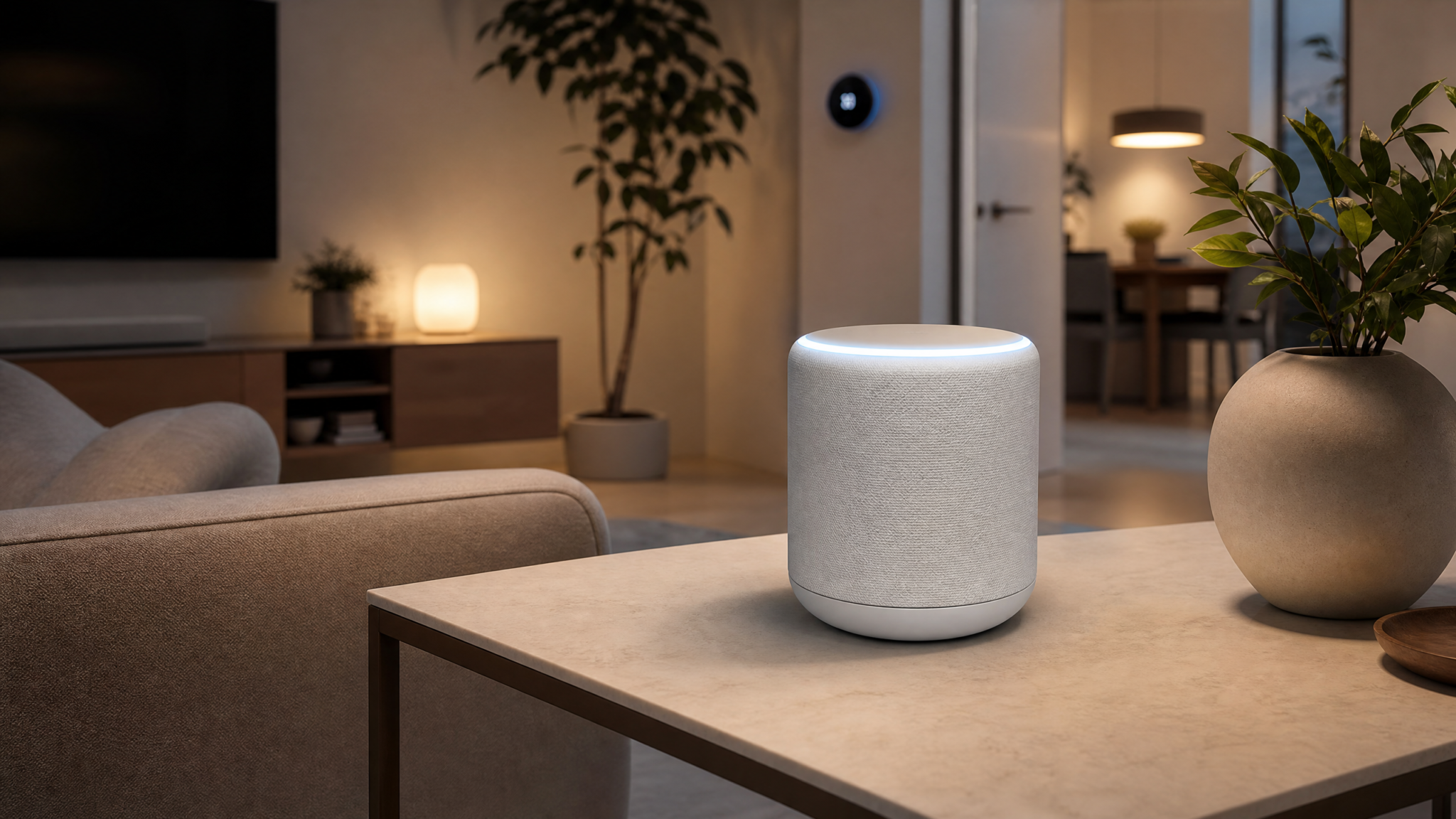
OpenAI’s ChatGPT Smart Speaker: Everything We Know About the First AI Hardware Device
Author: Markos Symeonides
The rumors have crystallized into a compelling picture: OpenAI is preparing a screenless, battery-powered ChatGPT smart speaker—its first true OpenAI hardware device—with a late 2026 reveal and a 2027 retail rollout. The device, according to multiple industry sources and supply chain chatter, is designed around real-time conversational AI, with a new streaming voice model reportedly dubbed GPT-Live-1. If accurate, this marks a decisive step from software and APIs into consumer-grade, always-on AI: an assistant that sounds natural, remembers context, and orchestrates your home through Matter and Thread without a glowing touchscreen.
While OpenAI has not announced or confirmed the product as of this writing, the pattern of leaked prototypes, executive comments about “AI native” form factors, and a growing ecosystem of voice-first GPT features makes the prospect plausible. More importantly, it aligns with the way people actually use AI in the real world: hands-free, ambient, and task-oriented. A ChatGPT smart home speaker 2026 would compete with Amazon Echo and Google Home, but on very different terms—prioritizing adaptable reasoning and expressive speech over fixed commands and pre-defined skills. That means a device capable of talking like a person, improvising like a planner, and collaborating like a power user.
In this guide, we synthesize what’s surfaced so far: rumored specifications, how GPT-Live-1 could transform voice interfaces, what the smart home experience may look like, likely pricing and subscription bundles, and how the product slots into late-2026 and 2027 timelines. We also compare it to Amazon Echo, Google Home/Nest, and Apple’s HomePod family, examine implications for the AI hardware market, and outline practical steps you can take today to prepare for an AI-native home—without buying anything yet.
Why a ChatGPT Smart Speaker Now?
Between 2017 and 2023, smart speakers exploded in popularity, with industry trackers such as Canalys and IDC estimating annual shipments peaking near 150 million units globally. Amazon commanded roughly 25–30% share, Google 15–20%, and Apple’s HomePod mini helped lift Apple’s share into the low double digits. Yet despite this installed base, usage patterns plateaued. Consumers set timers, asked for weather, and played music; far fewer discovered or regularly used third-party “skills.”
OpenAI, by contrast, built an audience around flexible, general-purpose conversation that solves tasks across domains—writing, coding, math, planning, translation, brainstorming—in text and increasingly in voice. As multimodal models matured (from GPT-4 to real-time “omni” systems), the gap between smart speakers’ simple triggers and ChatGPT’s free-form reasoning became stark. A dedicated OpenAI hardware device seeks to close that gap, fusing beamforming mics and far-field wake-word detection with a live streaming LLM that can whisper, interrupt, laugh, and remember what you mean, not just what you say.
There’s also a strategic angle. Software platforms grow by controlling key interaction points. Apple has the smartphone; Amazon has retail plus Alexa endpoints; Google owns search and Android. OpenAI is strongest in cloud inference and model research, yet the home remains a crucial frontier. A battery-powered, mobile-friendly, screenless speaker could become the “AI dial tone” of your daily life—the reliable, private, latency-optimized agent that greets you in the kitchen, follows you to the patio, and coordinates devices even when your phone is charging in the other room.
At a Glance: What Is the ChatGPT Smart Speaker?
Based on consistent threads in leaked documentation and supplier hints, here’s the elevator pitch:
- Form factor: Screenless, cylindrical or lozenge-shaped speaker with a wide soundstage, 360° far-field microphone array, capacitive or physical volume controls, and an LED light ring to indicate listening and speaking. It reportedly includes a rechargeable battery for portability.
- Voice brain: GPT-Live-1, a next-generation streaming voice model that supports full-duplex conversation (you can talk over it, it can talk back), nuanced prosody, and adaptive speaking styles. Expect near-instantaneous turn-taking and low jitter.
- Smart home: Matter controller with Thread border router capabilities, plus Wi‑Fi 6/6E and Bluetooth 5.4. Local automations for lights and sensors, cloud-managed routines for complex planning, and learning-based suggestions.
- Privacy and safety: On-device wake word and noise suppression; privacy button for hard microphone mute; configurable memory retention; kid-safe modes; policy-backed refusal behaviors for sensitive requests.
- Pricing and subscription: Hardware price likely in the $199–$349 range depending on configuration, with discounted bundles for ChatGPT Plus/Teams or family plans; expected late-2026 unveiling and 2027 consumer availability in staged markets.
Rumored Hardware Specifications
OpenAI is not a speaker OEM by heritage, so it’s reasonable to expect collaboration with established acoustic and silicon partners. What follows synthesizes reported component orders, industry-standard designs, and design goals implied by a GPT-Live-1 class voice agent.
Core Audio and Microphone System
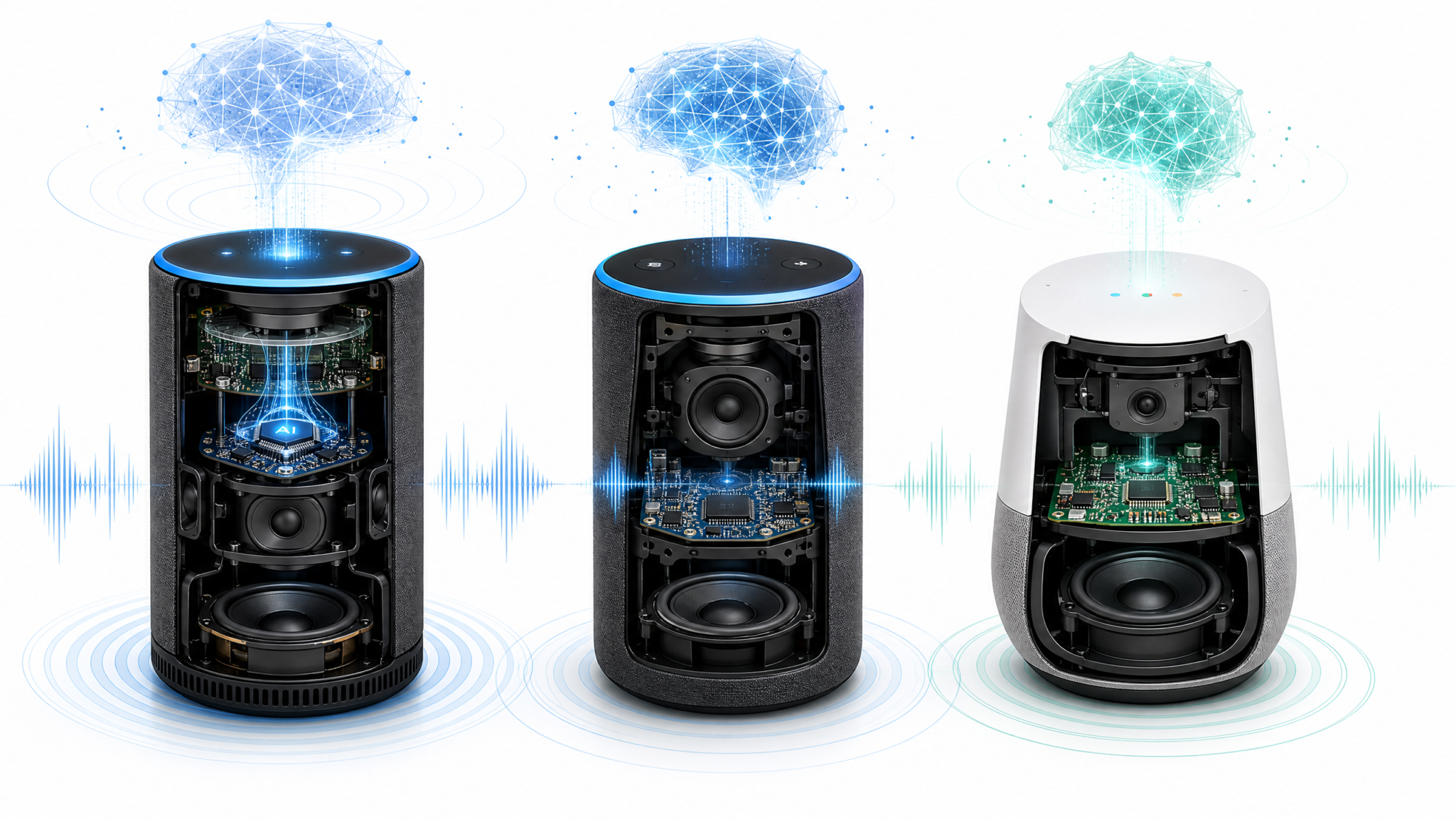
- Drivers: One high-excursion woofer (approx. 3–3.5 inches) and dual opposing passive radiators for low-end response; two or four full-range drivers arrayed radially for 360° dispersion; class-D amplification.
- Microphones: 6–8 microphones in a circular array with beamforming and adaptive echo cancellation; far-field recognition optimized for 3–7 meters in noisy rooms; direction-of-arrival estimation to localize the speaker’s position.
- Acoustic tuning: Room calibration through pink noise sweeps or ultrasonic probes; environment-aware EQ; auto ducking for wake-word detection while music plays at moderate volumes.
Compute, Connectivity, and Sensors
- Processor: A low-power ARM SoC with an embedded NPU for on-device wake word, VAD (voice activity detection), and lightweight ASR; dedicated DSP for noise suppression; secure enclave for credentials.
- Wireless: Dual-band Wi‑Fi 6/6E; Bluetooth 5.4 with LE Audio; Thread (border router) and Matter-over-Wi‑Fi; optional Zigbee support via chip or bridge mode depending on BOM targets.
- Battery: 4–8 hours of mixed-use conversational runtime; 20+ hours in low-power standby; USB‑C PD charging; battery-preserving overnight dock accessory rumored.
- Sensors: Ambient light sensor; temperature and humidity (for home context); possible UWB for proximity interactions; accelerometer to detect movement and auto-pause media when lifted.
- Buttons and I/O: Mic mute switch with hardware disconnect; play/pause; volume up/down; action button for manual wake; USB‑C port (charge/service).
Security, Privacy, and Local Control
- On-device: Wake-word and buffering run locally; user-configurable auto-delete of transcripts; encrypted model context tokens-in-flight; optional “no cloud media” mode for sensitive spaces.
- Networking: WPA3 and optional WPA3-Enterprise for office deployments; per-device credentials for Matter devices; rotating keys and end-to-end encrypted device control channels where supported.
Summary Table: Reported/Rumored Specs
| Category | Rumored Details | Notes |
|---|---|---|
| Form factor | Screenless, portable, 360° audio | Focus on voice-first interaction |
| Audio | 1 woofer, 2–4 full-range drivers, passive radiators | Room calibration and adaptive EQ |
| Microphones | 6–8 mic array, beamforming, AEC | Far-field voice pickup under music |
| Compute | ARM SoC + NPU + DSP | Local wake, VAD, lightweight ASR; cloud LLM |
| Wireless | Wi‑Fi 6/6E, Bluetooth 5.4, Thread, Matter | Thread border router for smart home |
| Battery | 4–8 hours active; USB‑C PD | Optional dock accessory |
| Controls | Mic mute, volume, action button | LED ring for status |
| Privacy | Hardware mute; configurable memory | Encrypted device control |
| Voice model | GPT-Live-1 (streaming) | Full-duplex, low latency, prosody control |
None of these details are confirmed by OpenAI. They reflect what would be necessary to make a ChatGPT-first smart speaker credible in 2026–2027: acoustic competence, robust far-field capture, local safety and privacy, and a wireless stack aligned to Matter’s consolidation of the smart home ecosystem.
Inside GPT-Live-1: A Voice Brain Built for Conversation
OpenAI’s work on real-time voice—the ability to perceive, plan, and speak within the tight feedback loop of human conversation—has accelerated since 2023. Models like GPT-4o made real-time interaction feel less like dictation and more like dialogue. GPT-Live-1, as positioned in leaks, reportedly pushes further: full-duplex turn-taking, overlapping speech, and expressive prosody that moves from reading a recipe to telling a bedtime story without sounding robotic.
Low Latency, High Fidelity
- Streaming in/out: Incoming audio runs through a compact on-device ASR and noise-suppressing front-end; intermediate representations stream to the cloud model, which begins speaking before the user finishes, adjusting mid-sentence as new context arrives.
- Full-duplex: The assistant speaks while you interject; it “yields the floor” naturally when it detects overlapping speech or heightened urgency in your voice.
- Prosody control: The system tunes pitch, speed, emphasis, and pauses for clarity or character; it can mirror your pace if you’re rushed, or slow down late at night when it senses a quiet environment.
Memory and Multi-Turn Reasoning
- Context carryover: Yesterday’s shopping list influences today’s meal plan; if the device has permissions, it checks your calendar before confirming a dinner party setup.
- Structured planning: The assistant decomposes tasks (e.g., “get the living room ready for guests”) into device actions and reminders; it confirms assumptions when stakes are high (safety, purchases, alarms).
- Role and style adaptors: It switches register—teacherly for homework help, concise for status updates, playful for family games—based on learned preferences.
Local-First Safety and Fallback
- Edge moderation: On-device rules filter disallowed content quickly; the cloud model receives sanitized context.
- Offline basics: When the internet drops, the speaker maintains wake word, local device control for supported Matter automations, and essential timers/alarms using a compact local reasoning policy.
- Privacy gates: Sensitive actions (unlocking a door, executing a high-cost purchase) require a verbal PIN or mobile confirmation by default.
Smart Home Capabilities: Matter, Thread, and Agentic Routines
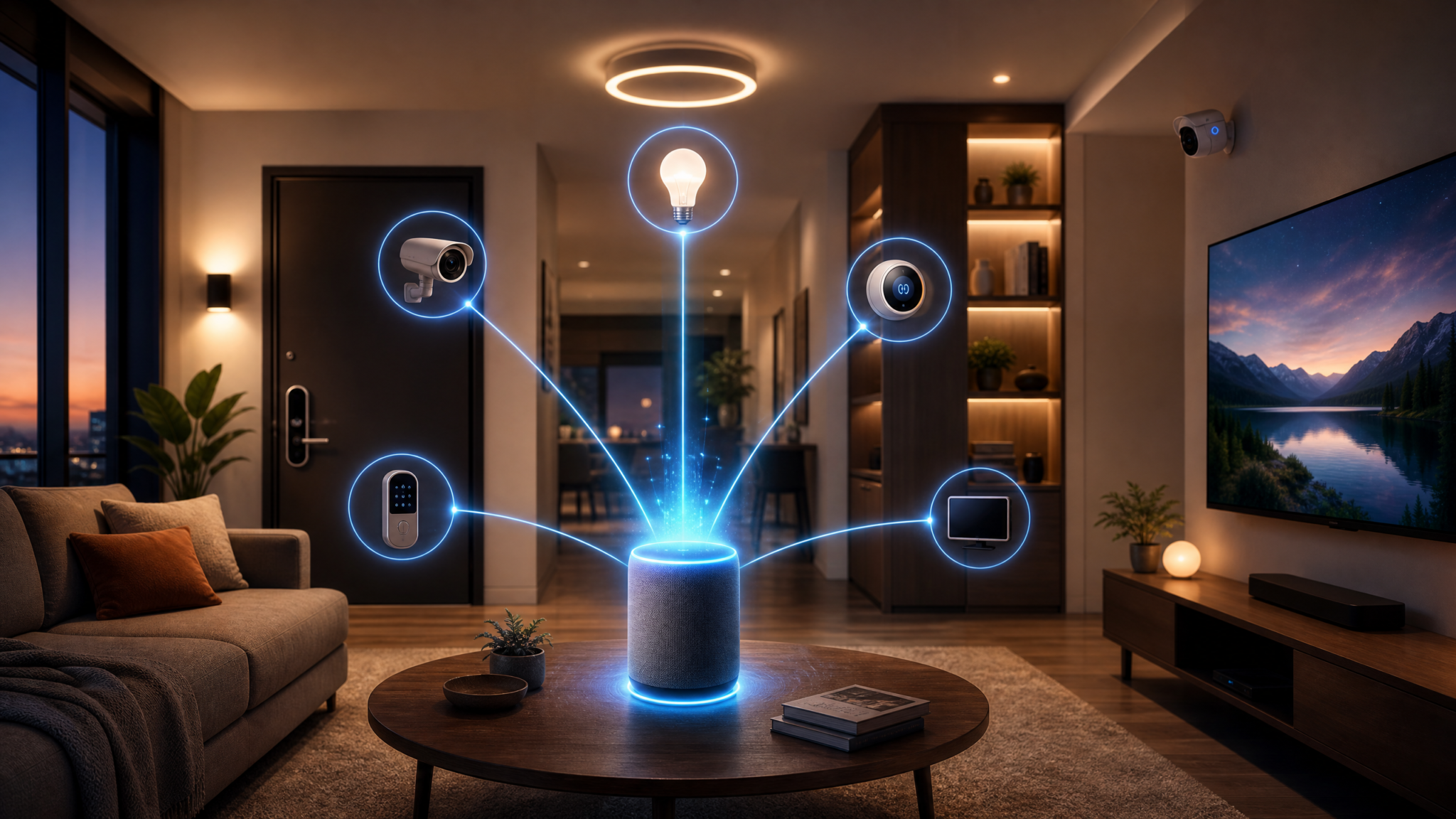
The smart home has coalesced around Matter as an interoperability standard, with Thread providing a low-power mesh network for sensors and switches. An OpenAI hardware device launching in 2026–2027 will almost certainly ride this wave. Expect the ChatGPT speaker to function as a Matter controller and Thread border router, bridging low-power devices to your home Wi‑Fi and orchestrating complex routines using natural language.
What “Agentic” Control Looks Like
- Plain language scenes: “Set up for movie night” triggers dim lighting, closes blinds, sets TV inputs, and increases subwoofer gain. If devices are unknown, it offers to map your request to available gear.
- Adaptive automations: The assistant notices that you consistently turn the thermostat down around 10:30 p.m. after a week and proposes an automation, explaining expected energy savings.
- Multi-device conflict resolution: If two automations clash (e.g., fan always on vs. noise-sensitive bedtime), it asks for your preference and learns a hierarchy.
Privacy and Household Dynamics
- Voice match and roles: Distinguish between adults and children; apply age-appropriate responses, content filters, and spending limits.
- Guest mode: Temporary profiles for visitors; limited device control; automatic expiration after departure.
- Audit trails: For sensitive actions (door unlocks, garage opening), the device maintains a timestamped, encrypted log accessible to admins.
Examples of Natural Language Routines
# Example: Movie Night
"Set the room for movie night at 7:45 pm when everyone is home."
- Check presence: household members on home Wi‑Fi
- Lights: dim living room to 20%, bias light behind TV on
- Shades: lower to 80%
- TV: switch input to HDMI 1 (streaming box)
- Audio: set soundbar to Movie preset
- Do-not-disturb: enable on household phones

# Example: Security Sweep
"Every weeknight at 10:30, check all doors and close the garage. Text me if something’s open."
- Sensors: verify closed status
- Garage: issue close command if open
- Report: SMS summary if exceptions
- Reminder: voice prompt if someone is still in the garage

# Example: Energy Saver
"If the kitchen window is open for more than 10 minutes, turn off the HVAC."
- Trigger: sensor open > 10 mins
- Condition: outside temp < 85°F
- Action: pause HVAC; resume when window closed
These routines do not require memorizing command syntax. You simply describe the goal. The assistant translates that into device-level actions, checks for missing capabilities, and asks clarifying questions only when necessary.
For readers looking to deepen their knowledge of voice-first UX and home automation patterns, see our related analysis:
For a deeper exploration of related capabilities and workflows, our comprehensive guide on How to Build Real-Time Voice Agents with ChatGPT’s Advanced Voice Mode and GPT-5.5: Complete Implementation Guide provides detailed strategies and practical examples that complement the techniques discussed in this article.
. It explores the shift from intent classification to agentic planning, with examples that map well to smart home scenarios.
Pricing Scenarios, Subscriptions, and Sales Channels
Smart speakers live at the intersection of hardware margins and recurring services. Amazon and Google traditionally subsidized devices to expand their ecosystems, while Apple priced HomePod closer to premium audio. OpenAI’s incentives are different: it sells inference and productivity subscriptions. Expect a pricing strategy that emphasizes recurring value per household.
Speculative Pricing Models
| Model | Hardware Price | Subscription | Pros | Cons |
|---|---|---|---|---|
| Standard | $249 | Optional ChatGPT Plus ($20–$25/mo) | Clear separation of device and services | Less compelling for heavy users without bundle |
| Bundled | $199 | Includes 12 months of Plus/Family | Lower upfront; encourages trial of premium features | Higher cost after free period |
| Team/Family | $299 | Discounted multi-user ChatGPT plan | Household sharing; admin controls | Higher upfront for solo users |
Why these ranges? A portable, battery-equipped speaker with a multi-mic array and Thread/Matter radios likely costs more to build than an entry-level Echo Dot or Nest Mini. But OpenAI can justify aggressive pricing if it expects recurring revenue from ChatGPT Plus, Teams, or vertical add-ons (education, coding, or productivity packs). One plausible approach is a family bundle that elevates household limits (longer memory windows, higher daily voice minutes, priority inference) across devices for a predictable monthly fee.
Sales channels will likely include OpenAI’s online store, direct carriers or ISP bundles in select regions, and big-box retailers for reach. Early rollouts may target the U.S., U.K., and parts of the EU, with regulatory and localization work paving the way for broader 2027 availability. Expect early invite programs or limited-quantity “Founders” drops to manage demand against inference capacity.
How Does It Compare? ChatGPT Speaker vs. Echo, Nest, and HomePod
Comparisons are tricky when one device is still unannounced. Still, it’s useful to map rumored strengths and known weaknesses across the competitive landscape. The table below contrasts a ChatGPT smart speaker prototype with leading families as they exist today, highlighting where OpenAI is likely to differentiate.
| Feature | ChatGPT Speaker (Rumored) | Amazon Echo (Gen 4/5) | Google Nest (Audio/Hub) | Apple HomePod (Mini/2nd) |
|---|---|---|---|---|
| Voice Model | GPT-Live-1, full-duplex, expressive | Alexa NLU + skills; limited back-and-forth | Google Assistant; strong search grounding | Siri; tight Apple service integration |
| Reasoning | General-purpose LLM planning | Intent-based; routines via templates | Intent-based; Routines/Automations | Intent-based; Shortcuts/Home automations |
| Smart Home | Matter + Thread controller (rumored) | Matter; Zigbee on select models | Matter; Nest ecosystem | Matter; tight HomeKit |
| Privacy | Hardware mute; configurable memory | Hardware mute; cloud logs by default | Hardware mute; cloud-processed | On-device Siri where possible; Apple privacy posture |
| Audio | 360° tuning; portable battery | Varies by model; Echo Studio is strong | Nest Audio is mid-range | HomePod 2 excellent; Mini compact |
| Ecosystem | ChatGPT apps, plugins/actions (rumored) | Amazon services, Prime, shopping | Google services, YouTube Music | Apple services, iCloud, AirPlay |
| Price | $199–$349 (speculative) | $50–$200 typical | $50–$200 typical | $99–$299 |
The decisive difference is conversational depth. Echo, Nest, and HomePod excel at narrow tasks and vertical integrations. The ChatGPT device, if it delivers GPT-grade voice, raises the ceiling for what a smart home can do without screens: multi-step planning, memory-driven follow-ups, and conversational tutoring. Its downside may be reliability trade-offs in mission-critical tasks (alarms, security) unless OpenAI augments the LLM with hardened, verifiable automations and a conservative “safety shim” for critical actions.
For readers comparing AI assistants across ecosystems, we maintain a running analysis of platform strengths and emerging agent capabilities in
For a deeper exploration of related capabilities and workflows, our comprehensive guide on 5 Best AI Writing Assistants for coding Compared u2014 Features, Pricing, Use Cases provides detailed strategies and practical examples that complement the techniques discussed in this article.
. It covers reliability under load, third-party device support, and voice UX design patterns.
Timeline: Expected Late 2026 Reveal and 2027 Sales
Timelines are fluid, but a late-2026 unveiling aligns with model roadmaps and the maturity of Matter. A staggered 2027 rollout allows OpenAI to scale inference capacity, expand language support, and harden device reliability across diverse home environments.
Indicative Timeline
| Quarter | Milestone | Rationale |
|---|---|---|
| Q3–Q4 2026 | Reveal; limited developer/private beta | Seed ecosystem; gather real-home telemetry |
| Q1 2027 | Early access units in select regions | Validate network edge cases, device mapping |
| Q2–Q3 2027 | General availability; retail partners | Scale manufacturing and inference clusters |
| Q4 2027 | Software v2 with expanded languages | Localization based on usage data |
Expect a gradual layering of features. Early firmware will emphasize core voice reliability and foundational smart home control. Subsequent updates will add richer agentic behaviors, offline resilience, and deeper integrations with calendars, messaging, and third-party services through a standardized “actions” framework—OpenAI’s answer to skills/shortcuts, but with LLM-native tooling for security review and user consent.
Preparing for an AI-Native Home: Practical Steps
You don’t need to wait for late 2026 to get ready. Most preparation involves standards alignment, naming hygiene, and routine design that any assistant can inherit. These steps will improve your current setup and position you to take advantage of a ChatGPT smart speaker quickly if it launches.
Actionable Checklist
- Standardize on Matter and Thread where possible: When replacing bulbs, plugs, and sensors, choose Matter-certified accessories. If Thread is supported, prefer it for battery devices to reduce Wi‑Fi congestion.
- Rationalize device names: Use human-friendly, unambiguous names that mirror natural language: “Kitchen Island Lights,” “Hallway Motion,” “Bedroom Air Purifier.” Avoid duplicates across rooms.
- Define clear scenes: Create scenes that capture multi-device states—“Focus,” “Dinner,” “Wind Down.” These map well to language-driven routines.
- Segment your network: If your router supports it, isolate IoT devices on a separate VLAN or SSID. This improves security and can reduce cross-traffic noise.
- Establish privacy norms: Decide as a household what’s OK to store. Set PINs for locks and purchases. Label “microphone-free zones” and enforce mute-by-default in sensitive areas.
- Battery strategy: If you plan to use a portable smart speaker, consider a central charging spot. Choose a power strip with surge protection and cable management to keep things tidy and safe.
- Accessibility: Map key routines to fewer steps. For elderly or visually impaired users, test voice prompts and confirm that responses are audible throughout the home.
- Enterprise/home office: If using in a shared workspace, prepare WPA3-Enterprise, disable sensitive data recall by default, and audit which devices a voice agent should control during work hours.
Where to Place a Battery-Powered, Screenless Speaker
- Acoustics: Avoid corners that exaggerate bass. A table or shelf near ear height often yields balanced sound.
- Voice pickup: Keep at least 20–30 cm from walls to reduce echoes. Stay clear of direct HVAC vents, range hoods, and other consistent noise sources.
- Mobility: A central charging dock in the kitchen or hallway can make it easy to grab and move the device to the patio or garage when needed.
Real-World Scenarios and Prompts
A conversational agent isn’t just a better switchboard; it’s a planner and tutor. Below are sample prompts that demonstrate how a GPT-class device may outperform traditional intent-based assistants.
# Meal planning
"We have two vegetarians, one picky eater, and only 40 minutes tonight. Plan a dinner with ingredients under $25 and start a grocery list if anything's missing."

# Calendar-aware preparation
"Check if we have free time Saturday morning. If yes, schedule a two-hour closet clean-up and create a checklist for donation drop-off."

# Adaptive lighting and health
"If outside light drops below 200 lux after 5 pm, set living room to 350 lux warm white and remind me to take a screen break every 45 minutes."

# Learning support
"Explain momentum to my 10-year-old using a skateboarding example. Pause for her questions and correct misconceptions gently."

# Entertainment concierge
"Recommend a 90-minute family movie that avoids jump scares. If everyone's still awake at 9:45, dim the lights and start it on the living room TV."

# Travel prep
"Build a packing list for a three-day work trip to Boston in October. Cross-check with the forecast and warn me about any flight delays two hours before departure."
These interactions blend perception (sensors, light levels), planning (calendars, constraints), knowledge (definitions, analogies), and execution (device control, reminders). They exemplify the advantage an LLM-native speaker has over a purely intent-based system.
We cover the broader device roadmap and integrations we expect around this product class in
For a deeper exploration of related capabilities and workflows, our comprehensive guide on Why China’s Open-Source AI Models Are Forcing OpenAI to Rethink Its Pricing Strategy — And What It Means for the Developer Ecosystem provides detailed strategies and practical examples that complement the techniques discussed in this article.
. It examines how wearables, glasses, and desktop microphones could synchronize with a home base station to create a continuous assistant presence.
What It Means for the AI Hardware Market
An OpenAI-branded speaker is not just another gadget; it’s a strategic wedge into everyday life. Here are the likely market-level implications:
1) Vertical Integration and Differentiated UX
Controlling the full stack—from wake word and mic tuning to cloud inference and voice synthesis—reduces latency and smooths over seams. The user perceives a single, cohesive assistant, not a patchwork of connectors and skills. This mirrors Apple’s historical approach and signals a maturation of AI into a consumer-grade medium, not just an app.
2) Subscription Economics over Hardware Margins
Unlike commodity speakers, an AI-first device can be valued by recurring ARPU, not just BOM. Expect OpenAI to measure success in daily active voice minutes, household retention, and bundle attachment (Plus, Teams, vertical packs). A lower upfront price makes sense if households subscribe to persistent, high-quality inference.
3) Standards-Driven Smart Home Consolidation
Matter and Thread sharply reduce integration friction. The differentiation shifts from “what devices can you control” to “how intelligently can you choreograph them.” OpenAI’s bet is that superior language understanding and planning win the orchestration layer.
4) Pressure on Incumbents
Amazon and Google face a challenge: either boost their assistants’ reasoning and naturalness or emphasize strengths in commerce and search to retain daily engagement. Apple, with on-device ML and privacy credibility, can lean on HomeKit polish and high-end audio while rolling out more on-device LLM features.
Access 40,000+ AI Prompts for ChatGPT, Claude & Codex — Free!
Subscribe to get instant access to our complete Notion Prompt Library — the largest curated collection of prompts for ChatGPT, Claude, OpenAI Codex, and other leading AI models. Optimized for real-world workflows across coding, research, content creation, and business.
5) New Roles for Chipmakers and OEMs
Edge NPUs and power-efficient DSPs become critical for wake word, safety, and snappy local experiences. Expect partnerships spanning silicon vendors, contract manufacturers, and acoustic labs. Battery safety and thermal management expertise also grow in importance for a portable unit.
Risks, Limitations, and Open Questions
- Reliability for critical tasks: Will alarms, reminders, and security actions be fully hardened and verified, or mediated through LLMs that may be too permissive or too conservative under edge cases?
- Latency under load: Streaming voice requires sustained low latency. Evening peak hours could degrade quality without aggressive QoS and inference scheduling.
- Privacy posture: How will long-term voice and home context be stored and governed? Expect regulators to scrutinize retention, consent, and child protections closely.
- Durability and battery: A portable unit faces drops, kitchen steam, and patio weather. IP rating, battery longevity, and safe charging behavior become table stakes.
- Business model fit: Consumers may resist yet another subscription—even if value is real. Bundles must be straightforward, family-friendly, and transparent.
- Developer ecosystem: Will OpenAI offer a secure, reviewable “actions” framework that avoids the sprawl of legacy skills while enabling deep service integrations?
Expert Analysis and Market Sizing
Predicting adoption means triangulating across smart home growth, LLM inference costs, and consumer willingness to pay. Consider three scenarios for the first full year of broad availability (assume 2027, with U.S./EU core markets live):
| Scenario | Units Sold (Year 1) | Avg. Selling Price | Subscription Attach | Key Assumptions |
|---|---|---|---|---|
| Bear | 0.8–1.2 million | $229 | 30–40% | Supply constraints; conservative launch regions; early reliability issues |
| Base | 1.8–2.5 million | $249 | 45–55% | Solid reviews; strong Plus bundle; staged retail rollout |
| Bull | 3–4 million | $219 | 55–65% | Breakout voice experience; seasonal promos; family plan adoption |
These ranges are consistent with an early-generation device breaking into a mature category. The gating factor isn’t manufacturing alone; it’s inference capacity. Real-time voice minutes at scale require both efficient models and smart scheduling. Advances in quantization, caching, and speech synthesis could cut costs enough to support aggressive bundles without compromising margins.
Audio Quality: The Unsung Differentiator
Even in an AI-first device, sound matters. Consumers forgive occasional AI oddities more readily than muddy music or tinny voice calls. A plausible design targets “better than Nest Audio, shy of HomePod 2” fidelity for the base model, with a potential “Plus” variant offering stronger bass and stereo pairing. Portable form factors complicate low-end response, but careful enclosure design and DSP can yield a pleasing curve—especially in voice-centric midrange clarity.
Beamforming and Echo Cancellation
The challenge of hearing you during loud music is non-trivial. Advanced acoustic echo cancellation (AEC) must predict the output audio and subtract it from microphone input in real time. With multi-mic arrays, the device estimates direction-of-arrival, prioritizing likely talker positions. Pair that with robust wake-word discrimination, and you reduce false wakes and missed commands—vital for trust.
Trust, Safety, and Household Governance
Trust is earned through visible controls and predictable behavior. Expect the ChatGPT speaker to lean on three pillars:
- Visible privacy: A hard mute switch that cuts power to mics, a clear LED state machine, and per-room privacy profiles (e.g., “office stores transcripts for 30 days,” “bedroom never stores”).
- Consent for sensitive actions: Locks, purchases, and cameras require a second factor: a voice PIN, a phone confirmation, or a nearby UWB key presence.
- Age-appropriate modes: Kids receive filtered answers and no personal data recall. Parents can review device actions and set quiet hours.
Developer Story: From Skills to Secure Actions
A pivotal question is how third-party services plug into a conversational agent without recreating the messy sprawl of legacy “skills.” The likely answer is an actions framework in which developers expose capabilities through typed schemas and verified APIs. The model decides when to call them, but guardrails enforce scopes and rate limits. Users grant granular permissions during setup (“Allow access to thermostat setpoints and fan mode changes”).
For example, a food delivery app might register actions for “search restaurants,” “place order,” and “track order status,” each with explicit constraints. The assistant plans multi-step flows, but never exceeds the allowed surface. This approach aligns with the Assistants API trajectory and the safety requirements of home control.
What About Music, Podcasts, and Media?
Media is still table stakes. Expect support for popular streaming services via official actions or native integrations. The assistant should handle context like “play my Sunday playlist on the patio,” preserving volume and equalization preferences per room. If the device can serve as an AirPlay or Chromecast target (to be determined), it improves compatibility without deep bilateral deals.
Enterprise and Education Use Cases
In offices and classrooms, a portable conversational speaker could be a facilitator: running standups, summarizing whiteboard sessions from audio alone, or orchestrating A/V in meeting rooms. Enterprise deployments require WPA3-Enterprise, admin policy profiles, and strict data retention controls. In education, teacher accounts must govern memory and limit generative output to age-appropriate content. These verticals represent future growth paths if consumer traction is strong.
Actionable Takeaways
- Adopt Matter and Thread now to reduce migration pain later.
- Normalize device names and room labels to improve voice accuracy.
- Sketch routines by goal (“wind down,” “leave home”) rather than device toggles.
- Establish household privacy norms and set PINs for sensitive actions.
- Plan for a central charging location if you value portability.
- For home offices, separate IoT and work networks and review data governance.
Frequently Asked Questions
Is OpenAI’s ChatGPT smart speaker officially confirmed?
No. As of now, OpenAI has not formally announced a speaker. The details in this guide are based on consistent leaks, supplier chatter, and industry logic about what a first-generation OpenAI hardware device would require to be competitive in 2026–2027. Treat all specifics as provisional until OpenAI reveals the product.
What is GPT-Live-1, and how is it different from earlier ChatGPT voice features?
GPT-Live-1 is a rumored real-time voice model emphasizing full-duplex conversation, expressive prosody, and very low latency. Compared with earlier voice modes, it should handle interruptions gracefully, adapt its speaking style to context, and begin responding before you finish speaking—without cutting you off.
Will the speaker control my existing smart home devices?
If your devices are Matter-compatible (or bridged to Matter), the odds are high. Thread support is expected for sensors and switches, and Wi‑Fi-based devices can participate via Matter-over-Wi‑Fi. Legacy Zigbee/Z-Wave gear may require bridges. The assistant should also support cloud actions for certain brands, but local control is preferable for speed and privacy.
Does it work offline?
Voice wake, basic timers, alarms, and certain local automations can run offline if the device includes an on-device policy engine. However, most natural conversation and knowledge tasks require the cloud LLM. Expect transparent indicators and clear fallbacks during outages.
How much will it cost?
Speculation points to $199–$349 depending on configuration and bundles. Given OpenAI’s subscription business, look for discounted hardware paired with ChatGPT Plus or a family plan, especially at launch.
Will it replace my Echo or Google Nest speakers?
It depends on what you value. If you rely on deep integrations with Amazon or Google services, staying within those ecosystems can be simpler. If you want the most natural, context-aware conversation and flexible planning, a ChatGPT speaker could become your default assistant—especially as actions and media support grow.
Is it safe for households with kids?
Safety will be a major focus: kid profiles, filtered content, and mandatory consent for sensitive actions. Parents should still set PINs for locks and purchases and consider placing the device in common areas with hard mute available in bedrooms.
When will it be available?
The current expectation is a late 2026 reveal, with staged 2027 retail availability. Initial markets likely include the U.S. and select English-speaking regions, followed by broader localization.
Will my ChatGPT Plus subscription carry over to the speaker?
That’s likely but not confirmed. A unified subscription unlocking premium inference across phone, desktop, and home devices would be a logical offering, potentially with household sharing.
Conclusion: The First AI Hardware Device Worth Waiting For?
Smart speakers taught us voice is convenient; ChatGPT taught us conversation is powerful. If OpenAI unites those lessons in a screenless, battery-powered device with a truly live conversational brain, the result could redefine what “assistant” means at home. The difference won’t be a new way to say “turn on the lights,” but a new way to live with computing—ambient, adaptive, and informed by your routines and values.
It will take time. The 2026–2027 timeline gives OpenAI room to get the fundamentals right: reliability, privacy, and graceful failure modes. Incumbents won’t stand still; Amazon, Google, and Apple will push forward with their own LLM-infused assistants. But competition here is good for users. After a decade of voice that mostly set timers, we’re finally approaching voice that can plan dinner, prep the house, and help the kids with physics—with empathy and style.
Author: Markos Symeonides
