
25 ChatGPT Prompts for CTO-Level Software Architecture Decisions: Technology Selection, Team Scaling, Build vs Buy, and Technical Debt Management
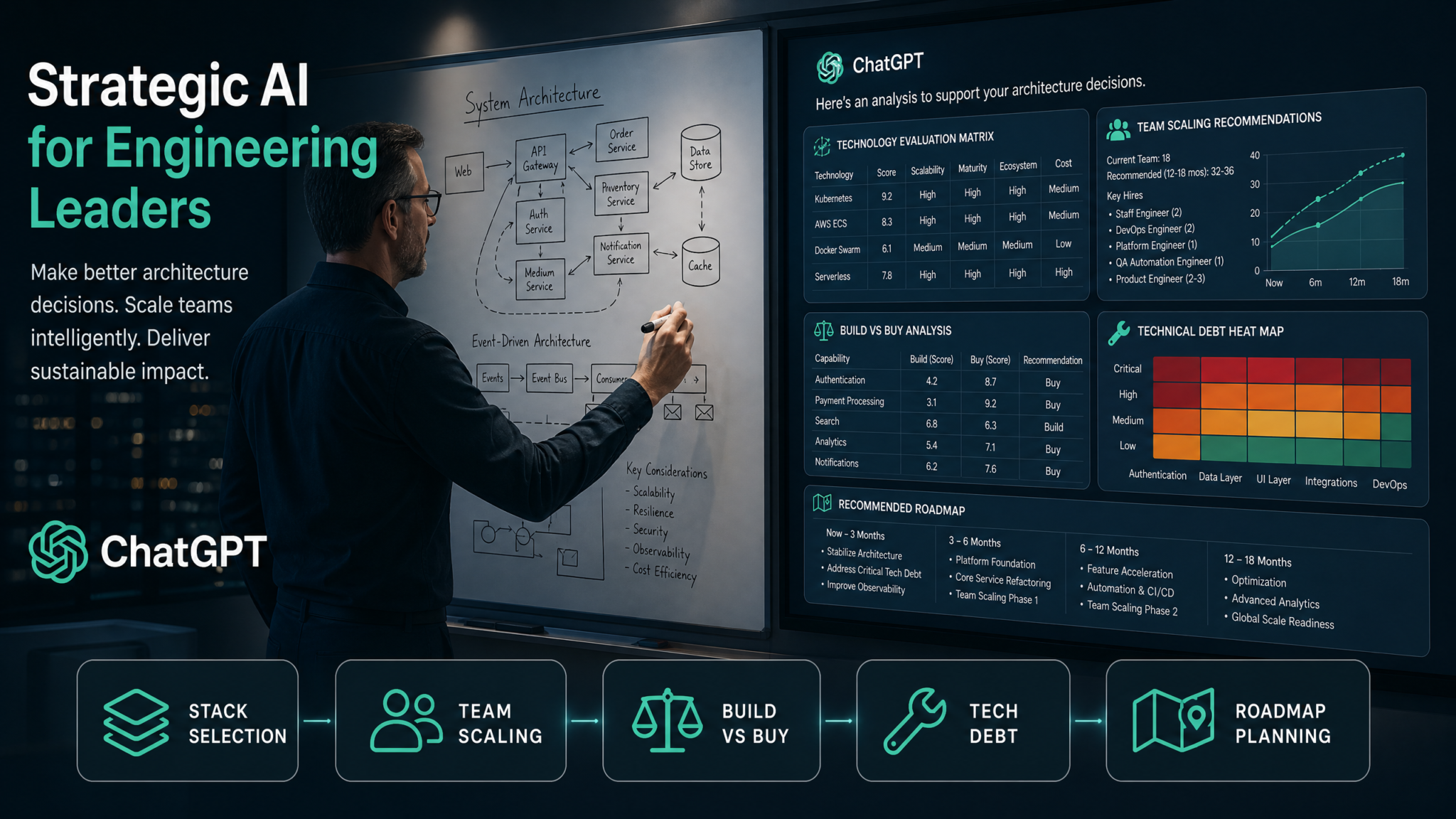
25 ChatGPT Prompts for CTO-Level Software Architecture Decisions
The definitive prompt engineering guide for engineering leaders making high-stakes architectural decisions — from stack selection to technical debt elimination.
Battle-tested architecture prompts
Critical CTO decision categories
Engineered for senior leadership
Scalable to any org size
📋 Table of Contents
Navigate this masterclass by category or jump directly to any of the 25 prompts below.
🔧 Category 1: Technology Stack Selection
👥 Category 2: Team Scaling Decisions
⚖️ Category 3: Build vs. Buy
🔴 Category 4: Technical Debt Management
Why CTOs Need Purpose-Built Architecture Prompts
The difference between a generic AI response and a boardroom-ready architectural recommendation comes down to prompt engineering. When a Chief Technology Officer faces decisions worth millions of dollars — choosing a cloud provider, justifying a platform rebuild, or arguing for technical debt remediation budget — they cannot afford vague, surface-level AI output.
Standard ChatGPT prompts produce generic answers. Engineered prompts produce strategic frameworks with trade-off analyses, risk matrices, timeline projections, and executive-ready narratives. This masterclass delivers exactly that: 25 precision-crafted prompts designed to make ChatGPT function as an experienced Principal Architect, a seasoned VP of Engineering, and a battle-hardened infrastructure consultant — all simultaneously.
Each prompt in this guide has been designed with four core principles that separate CTO-level prompting from everyday AI use:
- Context injection — every prompt provides sufficient organizational, technical, and business context for ChatGPT to reason at the right altitude
- Output format specification — prompts demand structured, decision-ready deliverables rather than narrative essays
- Constraint acknowledgment — prompts surface real-world constraints (budget, team size, existing systems) to prevent idealistic recommendations
- Multiple perspective forcing — prompts explicitly request devil’s advocate analysis, risk identification, and failure scenarios
Whether you are a CTO at a 15-person seed-stage startup or a VP of Engineering at a 500-person scale-up preparing for an IPO, these prompts will compress weeks of architectural deliberation into hours of structured, ChatGPT-assisted analysis.
Want to master prompt engineering fundamentals before diving in? Read our guide on advanced ChatGPT prompt engineering techniques for technical professionals to understand the structural patterns behind these architecture prompts.
🔧 Technology Stack Selection
Technology stack decisions define your engineering velocity, hiring pipeline, operational costs, and competitive moat for years. These prompts help you evaluate, justify, and document architectural choices with the rigour that investors, boards, and engineering teams deserve.
Technology Stack Selection
Greenfield Stack Evaluator: Choosing the Right Foundation
⚙️ Strategic Context
Use this prompt at the start of a new product initiative or platform rebuild. It forces ChatGPT to reason across engineering velocity, long-term maintainability, talent availability, and ecosystem maturity simultaneously — the four dimensions CTOs must weigh against each other rather than optimize independently.
You are a Principal Architect with 20+ years of experience building distributed systems at scale. I need a rigorous technology stack evaluation for a new [type of application: e.g., B2B SaaS platform / real-time data pipeline / mobile-first consumer app].

Business context:
- Company stage: [seed / Series A / Series B / enterprise]
- Expected scale: [users, requests/second, data volume in 12 months]
- Team composition: [number of engineers, existing skill sets]
- Budget constraints: [annual infra budget, engineering headcount limit]
- Time-to-market pressure: [must ship MVP in X months]
- Geographic distribution: [users are in, team is in]

Evaluate the following technology dimensions:

1. BACKEND LANGUAGE/RUNTIME
   - Compare 3 realistic options given our constraints
   - Score each on: ecosystem maturity, hiring pool depth, performance ceiling, concurrency model, and 5-year risk

2. DATA LAYER ARCHITECTURE
   - Primary database recommendation with justification
   - Caching strategy recommendation
   - Event streaming recommendation (if applicable)

3. INFRASTRUCTURE APPROACH
   - Kubernetes vs. serverless vs. managed services trade-off for our scale
   - Multi-cloud vs. single cloud with cost/risk analysis

4. DEVELOPER EXPERIENCE & TOOLCHAIN
   - CI/CD recommendation
   - Local development strategy
   - Observability stack (metrics, logs, traces)

For each recommendation, provide:
- Decision rationale (2-3 sentences)
- Key risks and mitigation strategies
- An explicit "when this recommendation breaks down" scenario
- Estimated time-to-productivity for a mid-level engineer onboarding

Format output as a structured Architecture Decision Record (ADR) with an executive summary suitable for board presentation.
📤 Expected Output Format
Best used when: Starting a new platform, preparing for a Series A technical due diligence, onboarding a new engineering leadership team, or evaluating whether an existing stack can support the next 18 months of growth. Combine with Prompt 4 (Cloud Provider Analysis) for complete infrastructure coverage.
Technology Stack Selection
Language Migration Feasibility: The True Cost of Switching
⚙️ Strategic Context
Language migration decisions are among the highest-risk architectural choices an engineering organization can make. This prompt engineers ChatGPT to think beyond the technical merits and explore organizational, cultural, and timeline dimensions that pure engineers often underweight when making the case for migration.
Act as a CTO who has led three successful language/runtime migrations at different company stages. I am evaluating migrating our primary backend from [Current Language/Framework: e.g., Ruby on Rails / PHP Laravel / Python Django] to [Target Language/Framework: e.g., Go / Rust / Node.js TypeScript].

Current system snapshot:
- Lines of code: [X]
- Number of services/modules: [X]
- Test coverage: [X%]
- Number of engineers familiar with current stack: [X]
- Number of engineers familiar with target stack: [X]
- Deployment frequency: [X deploys/day]
- SLA requirements: [uptime SLA, latency SLOs]
- Critical business periods to avoid (e.g., Q4 freeze, product launches): [list]

Provide a comprehensive migration feasibility analysis covering:

SECTION 1: BUSINESS CASE VALIDATION
- Quantified benefits (performance, cost, hiring) with realistic estimates
- Hidden costs most engineering leaders underestimate
- "Is this actually worth it?" honest assessment with a go/no-go recommendation criteria

SECTION 2: MIGRATION STRATEGY OPTIONS
- Option A: Big Bang rewrite (risks, timeline, cost)
- Option B: Strangler Fig pattern (phased migration approach)
- Option C: Hybrid parallel-run strategy
- Recommendation with explicit rationale

SECTION 3: RISK MATRIX
For each risk (knowledge loss, regression bugs, team morale, velocity impact, customer SLA breach):
- Likelihood (Low/Medium/High)
- Impact (Low/Medium/High)
- Mitigation strategy

SECTION 4: TEAM READINESS ASSESSMENT
- Skill gap analysis and training investment required
- Hiring needs to support migration
- Team structure recommendations during transition

SECTION 5: TIMELINE & MILESTONES
- Realistic timeline with confidence intervals
- Key decision gates (continue/abort checkpoints)
- Metrics to measure migration success

Format as a board-ready recommendation document with a one-page executive summary.
📤 Expected Output Format
Best used when: Performance problems are being attributed to language limitations, hiring velocity is constrained by stack unpopularity, or a new CTO is inheriting legacy technology decisions and evaluating a platform modernization programme.
Technology Stack Selection
Database Architecture Selector: Relational, NoSQL, or Hybrid
⚙️ Strategic Context
Database selection mistakes are the architectural equivalent of concrete foundations — extraordinarily expensive to fix once set. This prompt forces ChatGPT to engage with your actual data access patterns, consistency requirements, and operational complexity tolerance rather than defaulting to fashionable choices.
Access 40,000+ AI Prompts for ChatGPT, Claude & Codex — Free!
Subscribe to get instant access to our complete Notion Prompt Library — the largest curated collection of prompts for ChatGPT, Claude, OpenAI Codex, and other leading AI models. Optimized for real-world workflows across coding, research, content creation, and business.
You are a database architecture specialist who has designed data layers for systems ranging from 10K to 10B+ records. Help me select and design the data architecture for [system description].

Workload characterization:
- Read/write ratio: [e.g., 80% reads, 20% writes]
- Data volume today: [X GB/TB]
- Expected data growth rate: [X% monthly]
- Query patterns: [ad-hoc analytical / predefined OLTP / time-series / graph traversal / full-text search / mix]
- Consistency requirements: [strong consistency required? eventual consistency acceptable where?]
- Latency SLOs: [p50/p95/p99 read latency targets]
- Multi-tenancy: [yes/no, isolation requirements]
- Compliance requirements: [GDPR, HIPAA, SOC2, data residency]
- Current team DBA expertise: [none / basic / advanced]

Evaluate and recommend across these dimensions:

1. PRIMARY STORE SELECTION
   Compare PostgreSQL vs. [NoSQL option] vs. [NewSQL option] for our workload:
   - Fit score for our access patterns (1-10 with justification)
   - Operational complexity at our scale
   - Cost model at our projected data volume
   - Ecosystem and tooling maturity

2. DATA ARCHITECTURE PATTERNS
   - Schema design philosophy recommendation (normalized vs. denormalized tradeoffs for our case)
   - Partitioning and sharding strategy when needed
   - Replication and failover configuration
   - Backup and point-in-time recovery approach

3. SUPPLEMENTARY DATA STORES
   Which of these do we actually need, and when?
   - Caching layer (Redis/Memcached) — include decision trigger
   - Search layer (Elasticsearch/OpenSearch) — include decision trigger
   - Message queue/streaming (Kafka/RabbitMQ) — include decision trigger
   - Analytics warehouse (Snowflake/BigQuery/Redshift) — include decision trigger

4. OPERATIONAL CONSIDERATIONS
   - Managed service vs. self-hosted recommendation
   - Connection pooling strategy
   - Database migration strategy (zero-downtime deployments)
   - Monitoring and observability setup

Deliver as a structured Architecture Decision Record with a visual data flow diagram described in ASCII art or Mermaid syntax.
📤 Expected Output Format
Best used when: Designing a new microservice’s data layer, evaluating database consolidation to reduce operational overhead, or preparing a technical strategy document when facing rapid data growth that is stressing current database infrastructure.
Technology Stack Selection
Cloud Provider Comparative Analysis: AWS, GCP, and Azure Trade-offs
⚙️ Strategic Context
Cloud provider selection is rarely a pure technical decision. Sales relationships, existing enterprise agreements, geographic availability zones, ML/AI service differentiation, and long-term pricing negotiation leverage all factor in. This prompt ensures ChatGPT captures the full commercial and technical picture rather than defaulting to AWS because it has the most services.
You are a cloud strategy advisor who has led cloud migrations and multi-cloud implementations for enterprise and growth-stage companies. Conduct a cloud provider selection analysis for our organization.

Organization profile:
- Industry vertical: [e.g., fintech / healthtech / e-commerce / SaaS]
- Regulatory requirements: [SOC2 / HIPAA / PCI-DSS / FedRAMP / GDPR]
- Geographic presence: [current regions, planned expansion regions]
- Current monthly cloud spend: [$X]
- Primary workload types: [web serving / ML training/inference / data processing / real-time streaming / IoT / gaming]
- Existing investments: [Microsoft enterprise agreement? Google Workspace? Salesforce?]
- Team cloud expertise: [AWS certified engineers: X, GCP: X, Azure: X]
- M&A or IPO plans in next 24 months: [yes/no]
- Multi-cloud tolerance: [prefer single cloud / willing to use 2 / already multi-cloud]

Provide structured analysis covering:

1. PROVIDER SCORING MATRIX
Score AWS vs. GCP vs. Azure on (1-10) for each:
- Managed service breadth for our workload
- Geographic availability in our target markets
- ML/AI service differentiation (if applicable)
- Pricing competitiveness at our scale
- Enterprise support quality
- Compliance certification coverage
- Data egress cost structure
- Serverless/container platform maturity

2. TOTAL COST OF OWNERSHIP ANALYSIS
- Compute cost comparison for our described workload profile
- Reserved instance / committed use discount strategies
- Hidden costs: data transfer, support tiers, proprietary service lock-in
- 3-year TCO projection with and without negotiated discounts

3. STRATEGIC RISK ASSESSMENT
- Vendor lock-in analysis by service category
- Portability score for our architecture
- Business continuity risk if provider has major outage
- Contract and SLA comparison

4. RECOMMENDATION
- Primary provider recommendation with explicit rationale
- Which services from alternative providers (if any) are worth accepting dual-cloud complexity
- Negotiation leverage points and timing recommendations
- 6-month migration or adoption roadmap if switching from current provider

Format as an executive briefing document suitable for a board strategy review.
📤 Expected Output Format
Best used when: Your organization is approaching a cloud contract renewal, considering a multi-cloud strategy to reduce vendor dependency, or evaluating cloud options during a major re-platforming initiative or post-acquisition infrastructure consolidation.
Technology Stack Selection
Frontend Framework Justification: The Full-Stack Architecture Alignment
⚙️ Strategic Context
Frontend framework wars generate more heat than clarity. This prompt cuts through the React-vs-Vue-vs-Angular noise by grounding the evaluation in your specific product surface area, SEO requirements, rendering strategy needs, and the organizational reality of who is actually going to build and maintain it.
Act as a Staff Frontend Architect with deep experience in production web applications at scale. Provide a frontend architecture recommendation for our product.

Product characteristics:
- Application type: [SPA / SSR / SSG / hybrid / micro-frontend / embedded widget]
- User base: [consumer-facing / internal tooling / developer tool / B2B dashboard]
- SEO requirements: [critical / important / irrelevant]
- Performance targets: [Core Web Vitals targets, LCP/FID/CLS goals]
- Accessibility requirements: [WCAG 2.1 AA / AAA / basic]
- Mobile strategy: [responsive web only / PWA / native apps too]
- Design system: [building from scratch / migrating existing / adopting third-party]
- Internationalization: [current languages, planned expansion]
- Authentication patterns: [session-based / JWT / OAuth / SAML]
- API integration: [REST / GraphQL / gRPC / tRPC / mix]

Team and organizational factors:
- Frontend engineers: [count and seniority distribution]
- Full-stack engineers: [count and primary backend language]
- Existing codebase: [describe current state if migrating]
- Release cadence expectations: [continuous deployment? weekly releases?]

Evaluate and recommend:

1. FRAMEWORK SELECTION
Compare top 3 candidates for our scenario:
- Technical fit score with justification
- Developer experience and hiring market depth
- Long-term ecosystem risk assessment
- Performance characteristics for our rendering strategy

2. RENDERING STRATEGY
- CSR vs. SSR vs. SSG vs. ISR — which and where in our application?
- Edge rendering considerations
- Caching strategy at the CDN and application layer

3. STATE MANAGEMENT ARCHITECTURE
- Global state management recommendation
- Server state vs. client state separation
- Form state handling approach

4. BUILD TOOLCHAIN & DX
- Bundler/build tool recommendation
- Testing strategy (unit, integration, E2E)
- Component development environment (Storybook equivalent)

5. MIGRATION PATH (if applicable)
- Incremental adoption strategy
- Co-existence pattern with legacy frontend
- Feature flag integration for gradual rollout

Include a component architecture diagram in ASCII or Mermaid syntax showing the recommended application shell structure.
📤 Expected Output Format
💡 Pro Tip: Category 1 Chaining
Run Prompts 1, 3, and 4 together in the same ChatGPT session to build compounding context. After receiving the greenfield stack evaluation (Prompt 1), reference it explicitly when running the database selection prompt (Prompt 3): “Based on the TypeScript/Node.js stack you recommended above, now evaluate the database architecture…” This layered approach produces far more coherent and internally consistent architectural recommendations than isolated prompts.
These stack selection prompts pair perfectly with our deep dive on using ChatGPT for technical documentation and architecture review processes to turn these outputs into permanent knowledge assets for your engineering organization.
👥 Team Scaling Decisions
Engineering team structure is your most expensive and most impactful architectural decision. Conway’s Law guarantees that your organizational structure will become your system architecture. These prompts help you design teams that produce the systems you actually want to build.
Team Scaling Decisions
Engineering Org Structure Design: Applying Team Topologies at Scale
⚙️ Strategic Context
Reorganizations cost 3-6 months of engineering velocity if done wrong. This prompt leverages Team Topologies concepts (stream-aligned, enabling, complicated subsystem, platform teams) to produce org structure recommendations that align human organization with system architecture — the foundation of Conway’s Law management.
You are an engineering leadership consultant specializing in organizational design using Team Topologies principles, Conway's Law, and Accelerate research findings. Help me design the optimal engineering organization structure.

Current state:
- Total engineering headcount: [X engineers, X managers]
- Current org structure: [describe: functional / feature teams / squad model / platform + product]
- Number of distinct products/services being built: [X]
- Microservices count / bounded contexts: [X]
- Pain points in current structure: [list top 3-5 friction points]
- Deployment independence today: [can teams ship independently? what are the blockers?]
- Cognitive load complaints: [any explicit team feedback about complexity?]

Target state context:
- Headcount in 12 months: [X]
- New product lines or markets launching: [describe]
- Platform investment priority: [high / medium / low]
- Engineering brand / developer experience focus: [internal DX priority?]

Design an engineering organization covering:

1. TEAM TOPOLOGY BLUEPRINT
Apply Team Topologies framework:
- Identify which stream-aligned teams are needed (one per bounded context/product stream)
- Identify where enabling teams are warranted (DevEx, security, architecture guild)
- Identify complicated subsystem teams required (ML platform, payment processing, etc.)
- Platform team design and charter (what should and should NOT be owned here)
- Team size recommendations (apply Two-Pizza Rule with our context)

2. INTERACTION MODE DESIGN
For each pair of teams that must interact regularly:
- Recommended interaction mode (collaboration / X-as-a-Service / facilitating)
- Duration of collaboration phases (avoid accidental permanence)
- Cognitive load guardrails

3. CONWAY'S LAW ALIGNMENT AUDIT
Map current architecture to proposed org structure:
- Which systems will require refactoring to align with new team ownership?
- Identify seams where microservice boundaries should change to match team boundaries
- Estimate migration cost in engineering weeks

4. HIRING PLAN ALIGNMENT
- Which roles need to be filled to make this structure function?
- Sequence of hires for maximum early value
- Manager span-of-control analysis

5. TRANSITION PLAN
- How to move from current to target structure with minimum velocity loss
- Communication plan for the reorganization
- Success metrics for the new structure (DORA metrics baselines, team health survey design)

Format as an organizational design document with ASCII team topology diagrams and a Gantt-style transition timeline.
📤 Expected Output Format
Team Scaling Decisions
Hiring Priority Framework: Who to Hire When Resources Are Constrained
⚙️ Strategic Context
Most CTOs have more open headcount justifications than budget to fill them. This prompt creates a rigorous prioritization framework that evaluates hiring decisions against business impact, risk mitigation, and strategic capability-building — preventing the common failure mode of hiring for tactical needs while neglecting structural capability gaps.
Act as a VP of Engineering with extensive experience scaling engineering organizations from 20 to 200+ people. Help me prioritize a constrained engineering hiring plan.

Context:
- Current team composition: [list roles and counts by level]
- Approved headcount for next 6 months: [X total hires]
- Current open requisitions or identified gaps: [list all open roles and the business justification given for each]
- Critical projects at risk due to capacity: [list]
- Platform and reliability pain points: [list]
- Technical debt blockers: [list]
- Attrition risk: [any critical knowledge holders at risk of leaving?]
- Budget: [total compensation budget for new hires]

Provide a hiring prioritization analysis:

1. ROLE IMPACT SCORING
Score each open role on:
- Revenue impact (direct contribution to product velocity on revenue-generating features)
- Risk mitigation value (what breaks or degrades without this hire)
- Multiplier effect (does this hire unlock other engineers to be more effective?)
- Urgency vs. importance (Eisenhower matrix placement)
- Time-to-productivity (how long before this hire contributes net positive value?)

2. HIRING SEQUENCE RECOMMENDATION
- Rank all open roles in recommended hiring order
- Identify any roles that should be held open (not yet the right time)
- Identify any roles that should be converted to contractors for speed
- Identify any roles better filled by internal transfer or promotion

3. SENIOR VS. JUNIOR BALANCE ANALYSIS
- Current senior/mid/junior ratio analysis
- Optimal ratio for our team size and growth stage
- Mentorship capacity check (are we hiring juniors faster than we can develop them?)

4. SKILL GAP CRITICAL PATH
- Identify the single skill gap that most constrains engineering velocity today
- What hiring sequence resolves this critical path fastest?

5. BUDGET OPTIMIZATION
- Compensation band recommendations by role and level
- Equity vs. cash optimization for different candidate motivations
- Geographic arbitrage opportunities (remote-first talent pools)

Format as a prioritized hiring roadmap with scoring rationale and a quarterly hiring calendar.
📤 Expected Output Format
Team Scaling Decisions
Contractor vs. Full-Time Analysis: The True Economics of Flexible Engineering Capacity
⚙️ Strategic Context
The contractor versus employee decision is almost never purely financial — it involves knowledge retention, culture, system ownership, and team cohesion. This prompt builds the multi-dimensional analysis needed to make this decision defensibly, whether presenting to a CFO, board, or engineering team.
You are a Chief People Officer and engineering operations expert who has managed hybrid contractor/employee engineering organizations. Analyze the contractor vs. full-time tradeoff for our situation.

Scenario details:
- Work type: [new product feature development / platform migration / specialized ML work / security audit / performance optimization / ongoing maintenance]
- Duration: [expected project length or ongoing need]
- Skills required: [specific technical skills needed]
- System criticality: [will contractors have access to/own critical production systems?]
- Knowledge transfer risk: [how much institutional knowledge is involved?]
- Current FTE engineering cost (fully-loaded): [$X/year including benefits, office, tools]
- Contractor market rate for this skill: [$X/hour or project]
- Time urgency: [can you wait 3 months to hire? 6 months?]
- Geographic context: [where is your team? remote-first?]

Analyze across these dimensions:

1. TOTAL COST OF OWNERSHIP COMPARISON
- FTE true cost (salary + benefits + recruiting + onboarding + equipment + management overhead)
- Contractor true cost (rate + management overhead + IP risk + knowledge transfer at exit)
- Break-even analysis: at what project duration does FTE become cheaper?
- Hidden costs commonly missed in each model

2. RISK ANALYSIS
Contractor risks:
- Knowledge drain and documentation requirements
- IP ownership and confidentiality considerations
- Dependency risk (what if they leave mid-project?)
- Culture and morale impact on FTE team members

FTE risks:
- Overhiring for peak capacity needs
- Skill obsolescence if project-specific
- Slower time-to-productivity

3. HYBRID MODEL OPTIONS
- Contractor-to-hire pipeline strategy
- Core team + contractor surge capacity model
- Managed team / staffing partner vs. independent contractor

4. DECISION FRAMEWORK
Provide a reusable decision matrix for future contractor vs. FTE decisions with 5-7 key variables and scoring

5. RECOMMENDATION
Definitive recommendation for this specific scenario with implementation plan if contractor route is selected (sourcing, screening, onboarding, IP protection, exit protocol)

Format as a business case document with financial model assumptions clearly stated.
📤 Expected Output Format
Team Scaling Decisions
Team Topology Mapping: Aligning System Boundaries with Team Ownership
⚙️ Strategic Context
Misaligned team boundaries create chronic coordination overhead, unclear ownership during incidents, and architectural coupling that slows delivery. This prompt generates a detailed mapping exercise that reveals where your current teams, their cognitive load, and your system architecture are out of sync.
Act as an organizational architect specializing in sociotechnical systems design. Conduct a team topology audit and realignment plan for our engineering organization.

Current system landscape:
[List your major services/subsystems and their technical descriptions]
- Service A: [description, tech stack, daily active users if applicable]
- Service B: [description, tech stack]
- Service C: [description, tech stack]
- [Continue for all major services]

Current team structure:
[List teams and what they own]
- Team 1: [members, what systems they own, what they build]
- Team 2: [members, what systems they own, what they build]
- [Continue for all teams]

Pain signals:
- Top cross-team dependency complaints: [list]
- Systems with no clear ownership: [list]
- Teams with too broad an ownership scope: [list]
- Teams with excessive cognitive load or frequent context switching: [list]
- Incident response ownership gaps: [list]
- Shared components that create delivery bottlenecks: [list]

Produce the following:

1. CURRENT-STATE OWNERSHIP MAP
- Map every service to one accountable team
- Flag services with multiple owners, unclear ownership, or no active owner
- Identify dependencies that require recurring cross-team coordination

2. COGNITIVE LOAD ASSESSMENT
- Classify each team's workload as manageable, strained, or unsustainable
- Explain which domains or operational duties create the most load
- Recommend responsibilities to remove, transfer, automate, or simplify

3. TARGET TEAM TOPOLOGY
- Propose revised team boundaries around business capabilities
- Define each team's mission, owned systems, interfaces, and explicit non-responsibilities
- Identify platform or enabling capabilities that should be shared

4. SYSTEM BOUNDARY CHANGES
- Recommend service merges, splits, or interface changes only where they reduce coordination
- Distinguish urgent changes from changes that can wait
- Describe migration risks and temporary ownership arrangements

5. TRANSITION PLAN
- Sequence ownership transfers without creating operational gaps
- Define documentation, shadowing, and incident handoff requirements
- Provide review checkpoints and signs that the new boundaries are not working

Return an ownership matrix, dependency map, target topology diagram, and phased transition plan. State assumptions and unresolved questions explicitly.
📤 Expected Output Format
Best used when: Ownership is unclear, routine delivery requires several team handoffs, or incident response repeatedly exposes gaps between organizational and system boundaries.
Team Scaling Decisions
Prompt 10: On-call and Incident Load Balancer
⚙️ Strategic Context
An on-call model must distribute operational work without hiding unstable services or exhausting the people who understand them. This prompt separates staffing problems from reliability and ownership problems.
Act as an engineering operations leader reviewing our on-call and incident workload.

Inputs:
- Teams and services owned: [list]
- Current rotations and escalation paths: [describe]
- Recent incident themes: [summarize]
- Recurring alerts and manual recovery work: [list]
- Time-zone coverage: [describe]
- Skills concentrated in individual engineers: [list]
- Current handoff, compensation, and recovery-time policies: [describe]

Create an on-call improvement plan that:

1. Maps every alert and escalation path to an accountable service owner.
2. Identifies rotations that are overloaded, too dependent on specialists, or covering unrelated systems.
3. Separates actionable alerts from noise and proposes removal criteria for low-value alerts.
4. Recommends primary, secondary, and leadership escalation responsibilities.
5. Defines handoff notes, incident command roles, and post-incident follow-up ownership.
6. Converts recurring operational work into reliability backlog items.
7. Proposes qualitative guardrails for rotation health, including fatigue, interruption load, and knowledge concentration.
8. Lists warning signs that require staffing, training, or architectural changes rather than rotation changes.

Return a current-state diagnosis, proposed rotation map, escalation matrix, reliability backlog, and rollout plan. Do not assume that adding people will fix unreliable systems.
📤 Expected Output Format
Best used when: On-call load is uneven, recurring alerts dominate rotations, or incident escalation depends on a small group of specialists.
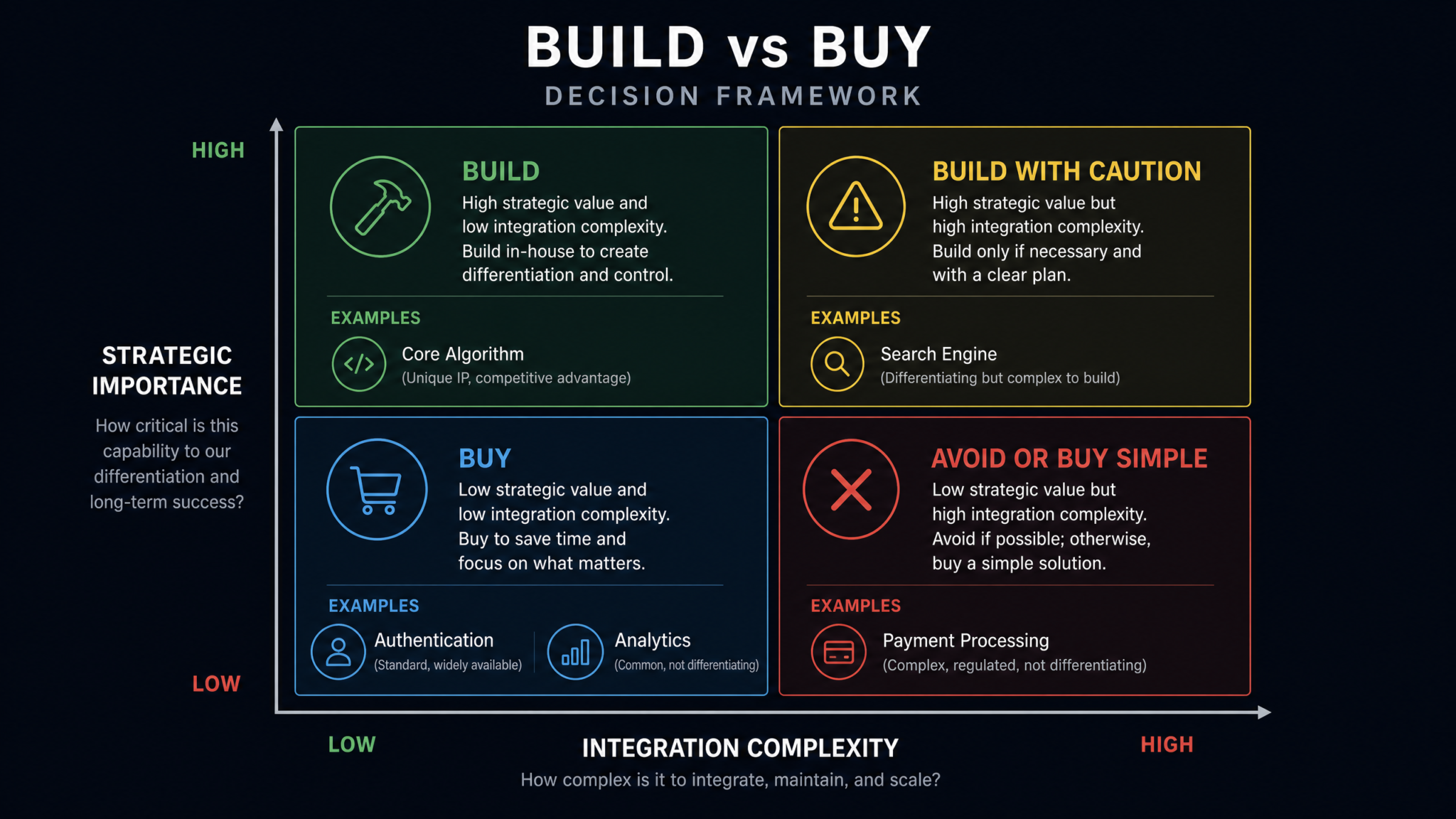
⚖️ Build vs. Buy
These prompts turn sourcing decisions into explicit comparisons of strategic differentiation, lifecycle cost, control, operational responsibility, and exit risk.
Build vs. Buy
Prompt 11: Strategic Build vs. Buy Scorer
⚙️ Strategic Context
Use this prompt before a team commits to custom development or signs a long-term vendor agreement. It keeps strategic value, lifecycle ownership, and exit options visible in the same decision.
Act as a technology investment committee evaluating whether we should build, buy, or combine both approaches for [capability].

Context:
- Business outcome required: [describe]
- Strategic differentiation: [core / supporting / commodity, with rationale]
- Required launch window: [enter]
- Internal skills and available capacity: [describe]
- Candidate vendors or existing internal components: [list]
- Security, compliance, data, and integration constraints: [list]
- Expected change rate and customization needs: [describe]
- Budget boundaries: [enter]
- Acceptable dependency and switching risk: [describe]

Compare build, buy, and hybrid options across:
- Time to usable value
- Full lifecycle ownership
- Product fit and customization limits
- Integration and data portability
- Security and operational accountability
- Vendor viability and exit difficulty
- Opportunity cost for the engineering team
- Long-term strategic control

For every option, state assumptions, missing evidence, major failure modes, and conditions that would reverse the recommendation.

Return:
- A weighted decision matrix using weights supplied by me; if none are supplied, propose qualitative priorities rather than invented weights
- A lifecycle cost worksheet with blank input fields where evidence is missing
- A recommendation and dissenting view
- Validation steps before commitment
- Contract or architecture exit requirements
📤 Expected Output Format
Build vs. Buy
Prompt 12: Vendor Lock-in Risk Assessor
⚙️ Strategic Context
Lock-in is not automatically unacceptable. The decision depends on whether the dependency is visible, compensated by meaningful value, and supported by a credible exit path.
Act as an enterprise architect assessing vendor dependency for [product or service].

Inputs:
- Vendor capabilities we plan to adopt: [list]
- Data stored and data formats: [describe]
- Proprietary interfaces or workflows: [list]
- Identity, networking, observability, and deployment dependencies: [describe]
- Contract duration and renewal constraints: [enter]
- Current alternatives: [list]
- Maximum acceptable migration disruption: [describe]

Assess lock-in by layer:
1. Data storage and export
2. Application interfaces
3. Identity and access
4. Infrastructure and operations
5. Developer workflow and skills
6. Commercial terms
7. Support and service continuity

For each layer:
- Describe the dependency
- Classify reversibility qualitatively
- Identify evidence needed from the vendor
- Define an exit control, portability test, or contractual protection
- Explain the business value received in exchange

Then design:
- A practical exit architecture
- Periodic portability exercises
- Data export and deletion acceptance criteria
- Triggers for renegotiation or migration
- A residual-risk statement for executives

Do not recommend abstraction layers unless their ongoing cost is justified by a specific exit scenario.
📤 Expected Output Format
Build vs. Buy
Prompt 13: Open Source vs. Enterprise License
⚙️ Strategic Context
This prompt compares more than acquisition cost. It examines support boundaries, internal operating capability, license obligations, upgrade control, and continuity.
Act as a software governance and platform architecture advisor. Compare the open-source and enterprise offerings for [technology].

Inputs:
- Intended production use: [describe]
- Business criticality: [describe]
- Team operating expertise: [describe]
- Required support response and escalation path: [describe]
- Features unique to each offering: [list and cite internal evidence]
- Applicable license and proposed commercial terms: [attach or summarize]
- Security patching and upgrade responsibilities: [describe]
- Deployment model and data sensitivity: [describe]

Evaluate:
- Functional fit without assuming paid features are necessary
- Internal labor required to operate each option
- Support accountability during high-impact failures
- Upgrade, patching, and compatibility control
- License obligations and distribution implications requiring legal review
- Product continuity and replacement options
- Procurement, audit, and security-review overhead
- Exit and migration paths

Return separate technical, operational, commercial, and legal-review sections. Identify questions that require counsel or procurement rather than presenting legal conclusions. Recommend open source, enterprise, or a staged path, and define the evidence needed before approval.
📤 Expected Output Format
Build vs. Buy
Prompt 14: Internal Platform ROI Calculator
⚙️ Strategic Context
Internal platforms should be justified through recurring developer problems and measurable workflow improvements, not through a platform mandate.
Act as a platform product leader preparing an investment case for [internal platform capability].

Inputs:
- Target developer workflows: [list]
- Teams affected: [list]
- Current waiting, rework, support, and manual-operation pain: [describe]
- Existing tools and duplicated solutions: [list]
- Proposed platform scope: [describe]
- Delivery and ongoing staffing assumptions: [enter]
- Adoption dependencies: [list]
- Evidence available from tickets, interviews, or delivery data: [summarize]

Build an investment model that:
1. Defines the user problem and excludes unrelated platform ambitions.
2. Separates verified inputs from assumptions.
3. Creates blank formulas for implementation cost, ongoing operating cost, avoided effort, reduced waiting, and retired tooling.
4. Models conservative, expected, and adverse scenarios without inventing values.
5. Identifies adoption risk and the cost of migration for product teams.
6. Defines a minimum useful platform release.
7. Establishes stop, continue, and expand criteria.
8. Compares the platform proposal with process improvement, managed services, and maintaining the current state.

Return an executive investment memo, assumption register, editable calculation structure, adoption plan, and review cadence.
📤 Expected Output Format
Build vs. Buy
Prompt 15: Third-party Integration Risk Matrix
⚙️ Strategic Context
A third-party integration extends your system boundary. Its failure modes, data handling, change process, and recovery options belong in the architecture review.
Act as an integration architect assessing [third-party service].

Context:
- Business process supported: [describe]
- Data sent, received, and retained: [list]
- Authentication and authorization approach: [describe]
- Integration method and dependencies: [describe]
- Failure behavior observed or expected: [describe]
- Vendor change and support process: [describe]
- Internal owner: [team]
- Replacement or manual fallback: [describe]

Create a risk matrix covering:
- Availability and degraded operation
- Data confidentiality, integrity, and deletion
- Authentication and credential lifecycle
- Interface changes and compatibility
- Rate or capacity constraints
- Duplicate, delayed, and out-of-order events
- Vendor support and escalation
- Auditability and reconciliation
- Exit, export, and replacement

For each risk, provide likelihood and impact as qualitative judgments, supporting evidence, preventive controls, detection, fallback behavior, and accountable owner.

Also define:
- Contract tests and sandbox validation
- Retry, timeout, idempotency, and reconciliation expectations
- Kill-switch and feature-degradation behavior
- Operational runbook requirements
- Review triggers after vendor or architecture changes

Return an approval recommendation with unresolved blockers clearly separated from accepted residual risks.
📤 Expected Output Format
🔴 Technical Debt Management
These prompts make debt visible as business risk, delivery friction, and operational exposure. They also force teams to compare remediation with deliberate acceptance.
Technical Debt Management
Prompt 16: Technical Debt Audit Framework
⚙️ Strategic Context
A useful debt audit distinguishes expensive symptoms from root causes and records evidence instead of relying on reputation or frustration.
Act as a principal engineer conducting a technical debt audit.

System scope: [describe]
Business-critical journeys: [list]
Known pain points: [list]
Recent delivery or incident evidence: [summarize]
Architecture and dependency constraints: [describe]
Upcoming business changes: [list]
Available engineering capacity: [describe]

Audit these debt classes:
- Architecture and coupling
- Code maintainability
- Test confidence
- Data quality and migration risk
- Security and access control
- Reliability and operability
- Delivery pipeline and environments
- Documentation and knowledge concentration
- Unsupported or hard-to-change dependencies

For every finding:
- Record evidence and affected business capability
- Distinguish root cause from symptom
- Describe the cost of leaving it unchanged
- Identify remediation, containment, or acceptance options
- Note dependencies and possible unintended consequences
- Assign an accountable owner and review trigger

Group findings into immediate exposure, planned remediation, opportunistic cleanup, and explicitly accepted debt. Return a debt register, system heat map, root-cause themes, and an initial remediation sequence. Do not assign precise financial impact without supplied data.
📤 Expected Output Format
Technical Debt Management
Prompt 17: Legacy System Migration Planner
⚙️ Strategic Context
Legacy migration succeeds when the organization can move business capabilities incrementally while preserving data integrity and operational control.
Act as a modernization architect planning migration from [legacy system] to [target state].

Inputs:
- Business capabilities in the legacy system: [list]
- Users and dependent systems: [list]
- Data stores, ownership, and quality issues: [describe]
- Interfaces, scheduled jobs, and manual processes: [list]
- Operational and compliance constraints: [list]
- Release freezes or critical periods: [enter]
- Target architecture assumptions: [describe]
- Available migration team: [describe]

Produce:
1. A capability and dependency inventory.
2. A recommended migration pattern for each capability.
3. A sequence that creates useful checkpoints and avoids hidden shared dependencies.
4. Data migration, reconciliation, and rollback controls.
5. A coexistence design for old and new paths.
6. Acceptance criteria for functional behavior, operations, security, and support.
7. Cutover rehearsals and go/no-go evidence.
8. A retirement checklist covering traffic, data, integrations, access, monitoring, contracts, and documentation.

Identify migration assumptions that must be tested before scheduling. Include failure scenarios, rollback boundaries, and ownership during coexistence.
📤 Expected Output Format
Technical Debt Management
Prompt 18: Refactor vs. Rewrite Decision
⚙️ Strategic Context
This prompt challenges the false choice between preserving everything and replacing everything. It includes incremental replacement and targeted containment as first-class options.
Act as an independent architecture reviewer deciding how to improve [system].

Evidence:
- Current business responsibilities: [list]
- Defect, incident, and delivery friction: [summarize]
- Test and observability confidence: [describe]
- Architecture constraints: [list]
- Team knowledge and staffing: [describe]
- Required product changes: [list]
- Data migration complexity: [describe]
- Previous remediation attempts: [summarize]

Compare:
- Continue with containment
- Targeted refactoring
- Incremental replacement by capability
- Full rewrite

For each option, assess:
- Ability to meet the required business changes
- Delivery and operational risk
- Data and behavioral compatibility risk
- Opportunity cost
- Knowledge-transfer requirements
- Time before users receive value
- Rollback and abandonment options
- Conditions under which the option should be rejected

Identify claims that require a prototype, code analysis, or production evidence. Recommend the smallest reversible path that tests the central assumptions. Include a dissenting recommendation and define decision gates that prevent sunk-cost reasoning.
📤 Expected Output Format
Technical Debt Management
Prompt 19: Debt Prioritization Scoring Model
⚙️ Strategic Context
Debt prioritization should combine exposure, recurring drag, strategic relevance, remediation effort, and dependency timing without disguising judgment as mathematical certainty.
Act as an engineering portfolio manager. Design a technical debt prioritization model for the attached debt register.

Organization priorities: [list]
Critical systems and journeys: [list]
Planned product work: [list]
Risk tolerance: [describe]
Available capacity and specialist constraints: [describe]
Debt items with evidence: [attach]

Create a model using these dimensions:
- Customer or business exposure
- Reliability and security consequence
- Recurring delivery friction
- Frequency of impact
- Strategic dependency
- Knowledge concentration
- Remediation complexity
- Reversibility
- Confidence in the evidence

Ask me to approve qualitative definitions and weights before scoring. If weights are unavailable, provide an unweighted comparison.

Then:
- Rank only items with adequate evidence
- Place uncertain items in an investigation queue
- Identify quick containment actions separately from root-cause fixes
- Show which roadmap items will become riskier if debt remains
- Detect duplicate findings with a shared root cause
- Recommend a balanced remediation sequence
- Define review triggers for accepted debt

Return the scoring rubric, prioritized register, sensitivity analysis, investigation queue, and explanation suitable for engineering and product leaders.
📤 Expected Output Format
Technical Debt Management
Prompt 20: Board-Level Debt Communication
⚙️ Strategic Context
Board communication should translate debt into decision-relevant exposure and investment choices without relying on implementation jargon or unsupported precision.
Act as a CTO preparing a board briefing on technical debt.

Source material:
- Verified debt findings: [attach]
- Business capabilities affected: [list]
- Incident and delivery evidence: [summarize]
- Planned initiatives at risk: [list]
- Remediation options and required capacity: [describe]
- Risks management has accepted: [list]
- Decisions requested from the board: [list]

Draft a concise briefing that includes:
1. What technical debt means in this specific portfolio.
2. Material business exposure, separated from routine maintenance.
3. Evidence already observed versus plausible future scenarios.
4. Consequences of maintaining the current investment level.
5. Remediation options with scope, trade-offs, and opportunity cost.
6. Management's recommendation and the decision requested.
7. Indicators the board can review over time.
8. Questions directors are likely to ask, with direct answers.

Avoid implementation detail unless it changes risk or investment. Do not invent financial impact, probabilities, or delivery dates. Mark every estimate and assumption. Provide an appendix mapping the executive narrative back to technical evidence.
📤 Expected Output Format
🗺️ Engineering Roadmap Planning
Architecture roadmaps connect technical work to business outcomes, explicit dependencies, operational readiness, and decision gates.
Engineering Roadmap Planning
Prompt 21: 12-Month Architecture Roadmap
⚙️ Strategic Context
This prompt creates a rolling architecture plan rather than a fixed list of projects. It emphasizes outcomes, sequencing, and evidence for changing direction.
Act as a CTO facilitating a 12-month architecture roadmap.

Inputs:
- Business objectives and product commitments: [list]
- Current architecture constraints: [list]
- Reliability, security, and debt priorities: [list]
- Team ownership and capacity constraints: [describe]
- Contract, migration, or compliance deadlines: [enter]
- Major assumptions and unresolved decisions: [list]

Build a roadmap that:
- Defines architecture outcomes rather than tool-adoption projects
- Maps each outcome to a business objective or material risk
- Shows dependencies between product, platform, data, security, and operations
- Separates committed work, discovery, and optional work
- Identifies decision gates and evidence required to proceed
- Preserves capacity for incidents and emerging constraints
- Assigns accountable owners without overloading shared teams
- Includes adoption, migration, and retirement work
- Defines qualitative success measures and leading warning signs

Organize the plan into planning horizons within the 12-month window, but do not invent dates or capacity. Include an alternative sequence for the most likely constraint and identify work that should be stopped or deferred.
📤 Expected Output Format
Engineering Roadmap Planning
Prompt 22: Platform Engineering Strategy
⚙️ Strategic Context
A platform strategy needs named users, bounded services, adoption paths, and a product operating model.
Act as a head of platform engineering designing a strategy for our organization.

Context:
- Product teams and their recurring workflow problems: [list]
- Existing shared infrastructure and tools: [list]
- Current support requests and manual gates: [summarize]
- Security and operational requirements: [list]
- Platform team skills and capacity: [describe]
- Current ownership conflicts: [list]
- Expected organizational changes: [describe]

Create a platform strategy covering:
1. Target users and their highest-value jobs.
2. Proposed platform capabilities and explicit exclusions.
3. Service boundaries, interfaces, and ownership.
4. A minimum useful release grounded in one real workflow.
5. Adoption paths for existing and new services.
6. Self-service boundaries and required approval points.
7. Support, documentation, reliability, and deprecation policies.
8. Product discovery, feedback, and prioritization practices.
9. Build, buy, and integrate decisions for major capabilities.
10. Failure modes, including low adoption and platform-team bottlenecks.

Return a platform charter, service catalog outline, adoption roadmap, operating model, and criteria for expanding or retiring platform capabilities.
📤 Expected Output Format
Engineering Roadmap Planning
Prompt 23: Resilience & Reliability Planning
⚙️ Strategic Context
Reliability planning starts with critical user journeys and explicit failure behavior, then works backward to controls, ownership, and recovery exercises.
Act as a reliability architect creating a resilience plan for [system].

Inputs:
- Critical user journeys: [list]
- Service and data dependencies: [list]
- Current service objectives and business expectations: [describe]
- Known failure modes and recent incidents: [summarize]
- Recovery procedures and backups: [describe]
- Third-party dependencies: [list]
- Current monitoring and on-call ownership: [describe]
- Data loss and service interruption tolerance: [provide approved values or qualitative boundaries]

Produce:
- A critical-journey dependency map
- Failure-mode analysis for components, regions, data, identity, networks, and vendors
- Expected degraded behavior for each journey
- Detection, containment, recovery, and communication ownership
- Backup restoration and data reconciliation tests
- Capacity and dependency failure exercises
- A prioritized reliability backlog tied to observed exposure
- Launch and change-readiness checks
- Evidence required before claiming a recovery capability

Distinguish prevention from recovery. Identify single points of knowledge as well as single points of technical failure. Do not claim resilience based only on redundant components; require test evidence.
📤 Expected Output Format
Engineering Roadmap Planning
Prompt 24: Security Architecture Review
⚙️ Strategic Context
This prompt keeps the review tied to assets, trust boundaries, realistic abuse paths, and accountable controls.
Act as a security architect reviewing [system or proposed change].

System description: [attach]
Sensitive assets and business processes: [list]
Users, administrators, services, and external parties: [list]
Data flows and storage locations: [describe]
Trust boundaries and deployment environments: [describe]
Authentication, authorization, and secret handling: [describe]
External integrations: [list]
Logging, monitoring, and incident ownership: [describe]
Applicable internal policies or external obligations: [list]

Review:
1. Asset classification and data minimization
2. Identity, privilege, and administrative access
3. Trust boundaries and interface validation
4. Secret and key lifecycle
5. Data protection, retention, export, and deletion
6. Dependency and deployment integrity
7. Tenant or customer isolation where relevant
8. Logging, detection, response, and evidence preservation
9. Abuse cases and misuse by authorized actors
10. Recovery from credential, data, or control-plane compromise

For every finding, include evidence, affected asset, plausible attack path, existing control, control gap, recommended action, owner, and validation method.

Separate release blockers from follow-up improvements and accepted risks. State which questions require specialist testing, legal review, or policy interpretation.
📤 Expected Output Format
Engineering Roadmap Planning
Prompt 25: Innovation vs. Stability Balancer
⚙️ Strategic Context
Technology experimentation needs bounded exposure and explicit learning goals. Stability work needs a clear connection to customer and business outcomes.
Act as a technology portfolio advisor balancing experimentation with operational stability.

Inputs:
- Proposed experiments or new technologies: [list]
- Current reliability and debt obligations: [list]
- Business opportunities each experiment supports: [describe]
- Teams, systems, and customers that could be affected: [list]
- Available sandbox or isolation options: [describe]
- Existing architecture principles: [attach]
- Current delivery commitments: [list]

Create a portfolio approach that:
- Classifies work as experiment, adoption candidate, production standard, maintenance, or retirement
- Defines a specific learning question for every experiment
- Limits blast radius, data exposure, and operational dependency
- Establishes evidence required to move from experiment to adoption
- Defines ownership and a removal date or review trigger for prototypes
- Protects capacity for reliability, security, and debt obligations
- Prevents parallel experiments from duplicating the same learning
- Identifies technologies that should remain exceptions
- Defines rollback and support expectations before production use

Return a portfolio map, experiment charter template, adoption gates, stability guardrails, and a recommendation on what to start, continue, pause, or stop. Avoid claiming that novelty is strategic value by itself.
📤 Expected Output Format
Conclusion
Use these prompts as structured decision workshops, not as substitutes for evidence or accountable leadership. Replace every placeholder, challenge unsupported assumptions, and keep the dissenting view beside the preferred recommendation.
The strongest outputs become living architecture records: they preserve context, document trade-offs, assign owners, and define the evidence that should trigger a different decision.
