
25 ChatGPT Prompts for AI-Powered Restaurant Discovery: Finding, Evaluating, and Planning Dining Experiences with ChatGPT New Search Features
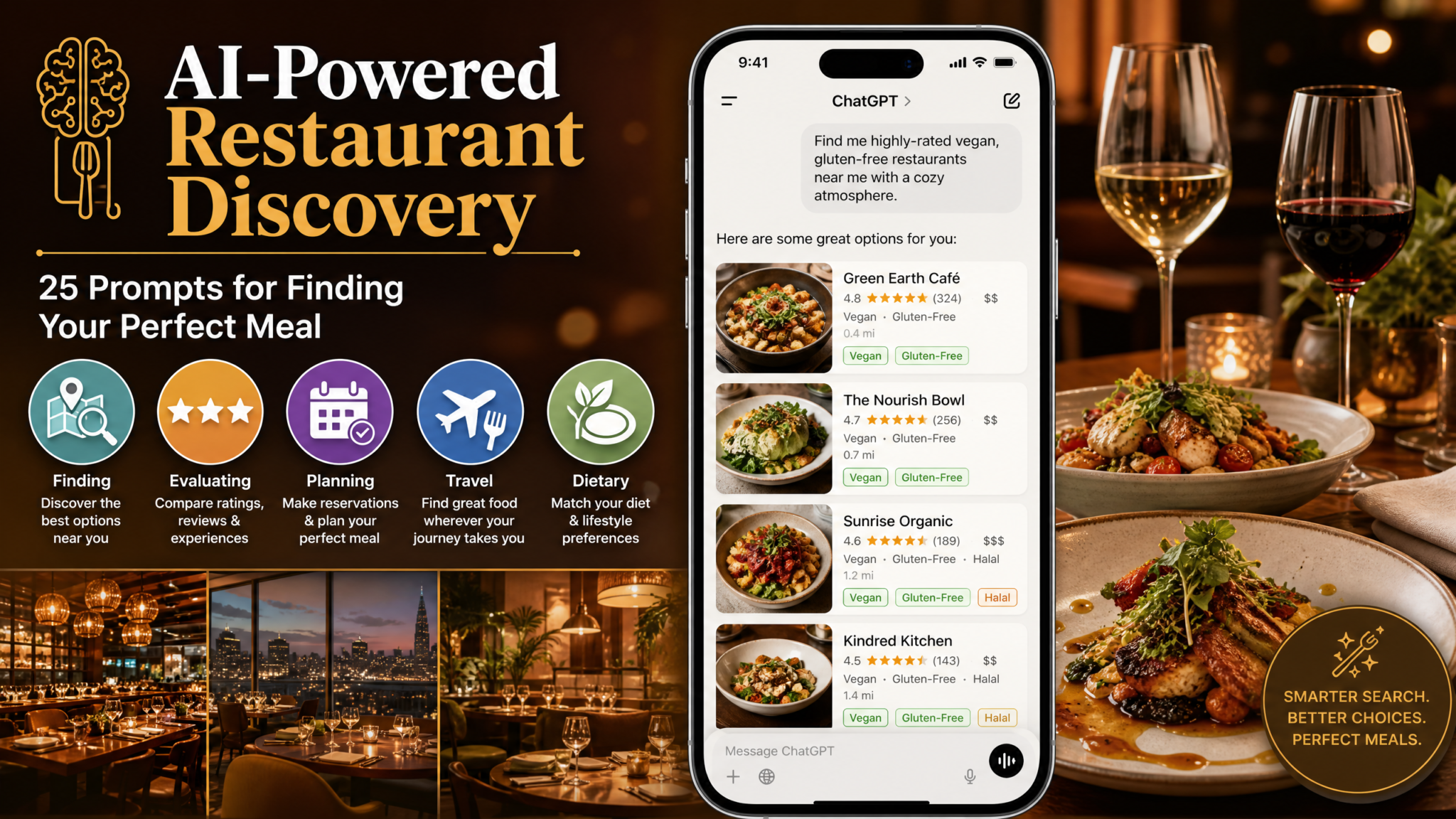
25 ChatGPT Prompts for
AI-Powered Restaurant Discovery
The definitive guide to using artificial intelligence for finding, evaluating, and planning extraordinary dining experiences anywhere in the world.
Finding a truly great restaurant used to require years of local knowledge, expensive concierge services, or hours of sifting through contradictory online reviews. Today, with the right ChatGPT prompts, you can get hyper-personalized restaurant recommendations in seconds — recommendations that account for your exact preferences, dietary requirements, budget, occasion, and even the atmosphere you are seeking at any given moment.
This masterclass is built for food lovers, frequent travelers, adventurous diners, event planners, and anyone who wants to elevate their dining experiences using the power of conversational AI. Whether you are hunting for a hidden gem in a city you have never visited, planning a marriage proposal dinner that needs to be absolutely perfect, or navigating a complex combination of dietary restrictions across a group of eight people, ChatGPT becomes your extraordinarily knowledgeable dining companion when you learn to prompt it correctly.
The difference between a mediocre AI response and a genuinely useful restaurant recommendation lies almost entirely in how you frame your request. The prompts in this guide are engineered with precision — they include the right contextual variables, ask for structured outputs, request reasoning, and guide ChatGPT to think the way a world-class food critic or seasoned local guide would think on your behalf.
Across five essential categories — Finding Restaurants, Evaluating Options, Planning Special Dining, Travel Dining, and Dietary Dining — you will receive five expertly crafted prompts per category, complete with explanations of what makes each prompt powerful, pro tips for customization, and guidance on how to follow up for even richer results. Let us get into the kitchen of AI-powered dining discovery.
Expert Prompts
Key Categories
Better Results
Dining Scenarios
Before we dive into the prompts themselves, it helps to understand the anatomy of a great restaurant discovery prompt. The most effective prompts include a clear role assignment for ChatGPT, specific contextual parameters about your location and situation, explicit preference signals, a desired output format, and often a constraint or challenge that pushes the AI to think more creatively. This masterclass applies all of these principles consistently across every single prompt.
You will also notice that each prompt contains customizable variables written in brackets — these are the parts you should swap out to match your specific situation. Think of each prompt as a sophisticated template that you personalize rather than a rigid script. The more precisely you fill in those variables with real, specific details about your dining goals, the more tailored and actionable ChatGPT’s responses will become. If you want to sharpen your overall prompt engineering skills beyond dining, be sure to explore our guide on ChatGPT prompt engineering techniques for a broader foundation.
📋 Table of Contents
Category 01 of 05
Finding Restaurants
Discovery prompts engineered to surface the best options for any location, cuisine, or context
The first challenge in any dining adventure is simply finding the right places to consider. These five prompts transform ChatGPT into a sophisticated restaurant scout — one who understands that “good restaurant” means something different depending on whether you want a quick solo lunch, a memorable date night, an authentic cultural experience, or a place where you can finally bring your notoriously picky family. Each prompt is designed to surface specific, actionable restaurant options rather than generic advice.
The Hyper-Local Hidden Gems Finder
This prompt is designed to cut through the noise of overcrowded, tourist-trap restaurants and surface the kind of places that locals genuinely frequent. It pushes ChatGPT to think beyond Yelp-top-ten territory and reason through what makes a restaurant genuinely beloved by the community it serves — as opposed to simply well-marketed or conveniently located near major attractions.
Act as a deeply knowledgeable local food guide for [CITY/NEIGHBORHOOD] with insider knowledge
that goes well beyond standard review platforms. I want to find restaurants that locals
genuinely love but that rarely appear on tourist lists or mainstream "best of" roundups.

My dining context:
- Location: [SPECIFIC CITY, NEIGHBORHOOD, OR DISTRICT]
- Cuisine preferences: [LIST 2-3 PREFERRED CUISINES OR "OPEN TO ANYTHING AUTHENTIC"]
- Party size: [NUMBER OF PEOPLE]
- Typical meal time: [BREAKFAST / LUNCH / DINNER / LATE NIGHT]
- Budget per person (food only, before drinks): [BUDGET RANGE]
- Atmosphere preference: [CASUAL / LIVELY / QUIET / INTIMATE / FAMILY-FRIENDLY]

For each recommendation, please provide:
1. Restaurant name and general location/neighborhood
2. Why locals specifically love this place (not why tourists do)
3. The one signature dish or item I absolutely cannot skip
4. The best time to go to avoid crowds or get the freshest ingredients
5. Any unwritten etiquette, ordering customs, or insider tips that make the experience better
6. What type of diner this restaurant is NOT right for

Give me 5 recommendations ranked from most hidden to somewhat known,
and explain your reasoning for each ranking.After receiving your list, follow up with: “For [RESTAURANT NAME], what are the three most common mistakes first-time visitors make, and how can I avoid them?” This surfaces practical knowledge that dramatically improves your actual dining experience.
The Precision Budget-Bracket Search
Few things ruin a dining experience faster than bill shock. This prompt builds budget transparency into the restaurant discovery process from the very beginning, asking ChatGPT to reason through total cost of dining rather than just menu price ranges — a crucial distinction that most restaurant-finding tools ignore entirely. It also introduces the concept of value-to-quality ratio, which helps you maximize your dining dollar regardless of how much you are actually spending.
You are a restaurant consultant specializing in helping diners maximize dining quality
within specific budget constraints. I need restaurant recommendations for [CITY/AREA]
that truly deliver exceptional quality within my exact budget parameters.

Budget details:
- Total budget for the meal (including tax and tip, excluding alcohol): [TOTAL DOLLAR AMOUNT]
- Party size: [NUMBER] people
- Meal type: [LUNCH / DINNER / BRUNCH]
- Budget flexibility: [STRICTLY FIXED / CAN GO 15% OVER IF TRULY EXCEPTIONAL]
- Preferred cuisine: [CUISINE TYPE OR "OPEN"]

For each restaurant recommendation, please break down:
1. Estimated total cost per person (appetizer + main + dessert + non-alcoholic drink)
2. The "value anchor" — the item on the menu that delivers the most flavor/quality
   relative to its price
3. Smart ordering strategy to maximize experience within my budget
   (e.g., "order two starters instead of one main here")
4. Hidden costs to be aware of (bread charges, service fees, mandatory gratuity, etc.)
5. The best day of the week or time of day to visit for best value
   (lunch specials, early bird, etc.)
6. How the quality compares to restaurants in the price bracket above

Rank your recommendations by overall value-to-quality ratio and
explain your scoring rationale for each.Add “Also tell me which courses I can skip at each restaurant without sacrificing the core experience” to get strategic ordering advice that helps you stay firmly within budget while still experiencing the restaurant’s best offerings.
The Authentic Cuisine-Specific Discovery Engine
Craving a very specific cuisine is one thing — finding a restaurant that actually executes it with genuine authenticity rather than Westernized approximation is another challenge entirely. This prompt equips ChatGPT to reason through authenticity markers specific to the cuisine you are seeking, making it far easier to distinguish a truly exceptional Thai restaurant from one that simply has a Thai name and serves pad thai that would make a Bangkok native weep with disappointment.
You are a culinary ethnographer and food journalist with deep expertise in [SPECIFIC CUISINE]
and its regional variations. I am searching for a restaurant in [CITY/AREA] that serves
genuinely authentic [SPECIFIC CUISINE] — not a westernized or fusion approximation.

Cuisine specifics I care about:
- Cuisine type: [SPECIFIC CUISINE, e.g., "Sichuan Chinese" not just "Chinese"]
- Regional variation preference: [SPECIFIC REGION IF KNOWN, OR "educate me"]
- Authenticity non-negotiables: [ANY SPECIFIC DISHES, TECHNIQUES, OR INGREDIENTS
  YOU KNOW ARE IMPORTANT, OR "I'm learning — you guide me"]
- How familiar I am with this cuisine: [NOVICE / INTERMEDIATE / EXPERT]
- Budget per person: [RANGE]
- Location: [CITY/NEIGHBORHOOD]

Please provide:
1. A brief explanation of what "authentic" specifically means for this cuisine
   and how to spot the real thing vs. a watered-down version
2. 4-5 restaurant recommendations with authenticity rating (1-10) and reasoning
3. For each: which regional sub-style they represent
4. The 2-3 dishes that best showcase whether a restaurant is truly authentic
   for this cuisine — and what to look for in each dish
5. Questions I should ask the server or kitchen to gauge authenticity
6. Red flags that immediately signal a restaurant is not genuinely authentic
   to this cuisine tradition

Include context about what I should expect the dining environment and service
style to look and feel like in a truly authentic establishment.Follow up with: “If I were to visit [COUNTRY OF ORIGIN] and eat this cuisine there, what would be the most shocking difference between that experience and the best version I can find in [MY CITY]?” This gives you a calibrated sense of what authentic truly means.
The Neighborhood Dining Ecosystem Explorer
Sometimes the best way to discover great restaurants is not to search for a single perfect place but to understand the entire dining ecosystem of a neighborhood — knowing which areas have the highest concentration of excellent options and why. This prompt turns ChatGPT into a neighborhood dining cartographer, mapping out the culinary landscape so you can explore with intelligence and intention rather than wandering aimlessly hoping to stumble upon something great.
Act as an urban food geographer with intimate knowledge of [CITY]'s dining landscape.
I want to plan a food-focused exploration of a specific neighborhood or district,
and I need to understand the dining ecosystem rather than just a list of restaurants.

My exploration parameters:
- City: [CITY NAME]
- I am staying in / starting from: [NEIGHBORHOOD OR LANDMARK]
- Maximum walking distance I am comfortable with: [MINUTES OR BLOCKS/MILES]
- Dietary preferences: [ANY RESTRICTIONS OR "OMNIVORE"]
- Type of exploration: [CASUAL WANDERING / STRUCTURED FOOD TOUR / SPECIFIC MEAL]
- Time available: [NUMBER OF HOURS OR FULL DAY]
- Budget for entire food exploration: [TOTAL BUDGET]
- Who I am with: [SOLO / COUPLE / FAMILY WITH KIDS / GROUP OF ADULTS]

Please provide:
1. A map-narrative of the 2-3 neighborhoods within range most worth exploring
   for food, and what makes each one culinarily distinct
2. For the top recommended neighborhood: a curated "dining circuit" —
   a logical walking route between 4-6 food stops
3. For each stop: restaurant/vendor name, what to order, how long to spend there,
   and best time window to visit
4. Time and pacing suggestions for the overall exploration
5. The best coffee or drink spot to start the exploration and a
   perfect note to end on
6. Any seasonal, weather, or day-of-week considerations that would affect
   the quality of this particular exploration

Format the dining circuit as a step-by-step itinerary I can actually follow.Ask ChatGPT to also identify one “wild card” stop — a food experience in the neighborhood that most visitors would never think to try but that represents something genuinely special about the area’s food culture. These unexpected discoveries often become the most memorable moments of any food exploration.
Access 40,000+ AI Prompts for ChatGPT, Claude & Codex — Free!
Subscribe to get instant access to our complete Notion Prompt Library — the largest curated collection of prompts for ChatGPT, Claude, OpenAI Codex, and other leading AI models. Optimized for real-world workflows across coding, research, content creation, and business.
The Vibe-First Restaurant Matching System
Sometimes what you most need from a dining experience has nothing to do with the food itself — it is the feeling you want to have while you eat. This vibe-first prompt helps you articulate the emotional and sensory qualities you are seeking, then asks ChatGPT to work backward from those qualities to find restaurants that deliver them. It is particularly powerful for anyone who struggles to explain what they are looking for beyond “something nice” or “somewhere fun.”
You are an experiential dining consultant whose specialty is matching diners to
restaurants based on mood, atmosphere, and desired emotional experience —
with great food being a given baseline, not the primary variable.

My desired dining experience:
- Location: [CITY/NEIGHBORHOOD]
- Describe the vibe I want in 3-5 words or phrases:
  [e.g., "moody, candlelit, conversation-enabling, slightly glamorous"]
- The feeling I want to walk away with:
  [e.g., "transported to another era" / "like I discovered something secret" /
  "energized and impressed" / "cozy and completely content"]
- Noise level preference: [SILENT / QUIET / CONVERSATIONAL HUM / LIVELY / LOUD IS FINE]
- Lighting preference: [BRIGHT / MEDIUM / DIM / VERY DARK / OUTDOOR NATURAL LIGHT]
- Interior style: [DESCRIBE OR LIST: minimalist / rustic / ornate / industrial / etc.]
- Service style preference: [ATTENTIVE AND FORMAL / FRIENDLY AND CASUAL /
  LEAVE ME ALONE / THEATRICAL AND ENGAGED]
- Dining companions: [WHO YOU ARE WITH AND WHAT THEIR VIBE TOLERANCE IS]
- Budget per person: [RANGE]

For each restaurant recommendation:
1. Describe the physical atmosphere in rich sensory detail (what I will see, hear, smell)
2. Explain precisely how and why this matches my stated vibe criteria
3. The ideal time of day or evening to visit to maximize the atmosphere
4. Any atmosphere-enhancing details (request a specific table,
   arrive at a particular time for a view, etc.)
5. One unexpected sensory element that might delight or surprise me
6. The cuisine and 3 standout dishes that complement the vibe

Rate each recommendation on a vibe-match scale of 1-10 with your reasoning.Describe a movie scene, a specific memory, or a photograph that captures your ideal dining atmosphere. For instance: “I want the feeling of the restaurant in the movie Midnight in Paris — slightly bohemian, intellectually stimulating, with the sense that interesting people are having important conversations nearby.” ChatGPT responds remarkably well to these vivid reference points. For more creative prompt approaches, explore our article on creative ChatGPT prompting strategies.
Category 02 of 05
Evaluating Options
Analysis prompts that help you make confident, informed decisions before committing to a reservation
Having a list of restaurant options is only half the challenge. The harder part — especially for high-stakes meals, expensive dinners, or situations where you truly cannot afford to be disappointed — is evaluating those options with rigor and intelligence. These five prompts turn ChatGPT into your personal restaurant analyst, capable of synthesizing review data, scrutinizing menus, comparing options across multiple dimensions, and even detecting the warning signs that separate a genuinely excellent restaurant from one that is coasting on a formerly good reputation.
The Menu Intelligence Deep Dive
A restaurant’s menu is one of the most revealing documents in the food world — it tells you about the chef’s philosophy, the kitchen’s capabilities, the supply chain they rely on, and whether the concept is focused or scattered. This prompt teaches you to read a menu like a professional food critic, extracting the signals that separate a genuinely thoughtful culinary program from one that is trying to be everything to everyone and succeeding at nothing.
Act as a professional food critic and menu consultant with 20 years of fine dining
and casual dining experience. I am going to share the menu (or key menu details)
of [RESTAURANT NAME] in [CITY], and I need you to analyze it like a professional
evaluating the restaurant's culinary intelligence and ordering strategy.

Restaurant context:
- Restaurant name: [NAME]
- Type/cuisine: [CUISINE TYPE]
- Price range: [PRICE RANGE]
- Chef known for: [ANY KNOWN CHEF BACKGROUND, OR "UNKNOWN"]
- My dietary preferences: [PREFERENCES/RESTRICTIONS]
- My experience level with this cuisine: [NOVICE/INTERMEDIATE/EXPERT]
- Occasion for this meal: [CASUAL / SPECIAL / BUSINESS / etc.]

Menu items to analyze:
[PASTE THE MENU HERE, OR LIST 8-12 ITEMS YOU ARE CONSIDERING]

Please analyze:
1. What does this menu reveal about the kitchen's strengths, weaknesses,
   and culinary philosophy?
2. Are there any red flags — dishes that suggest shortcuts, frozen ingredients,
   or lack of focus?
3. Green flags — dishes that signal this kitchen genuinely knows what it is doing
4. Your recommended ordering strategy: ideal starter(s), main(s), and dessert(s)
   for my stated preferences
5. The two dishes on this menu that will most accurately reveal whether
   this restaurant is as good as its reputation
6. Any dishes I should avoid and why
7. Overall assessment: does this menu suggest the restaurant is operating at
   the level its price point promises?

Be direct and specific in your critique — I want honest professional analysis,
not polite generalizations.If you cannot access the full menu, describe what you can see from photos or online listings, and ask ChatGPT to analyze the visible signals. Even partial menu information yields surprisingly useful insights about a restaurant’s overall approach and quality level.
The Review Synthesis and Bias Detector
Online restaurant reviews are simultaneously one of the most useful and most misleading sources of dining intelligence in existence. They are subject to recency bias, service variability, personal taste differences, paid manipulation, and the simple fact that people who have extreme experiences (terrible or transcendent) review far more often than those who have average ones. This prompt transforms ChatGPT into a review analyst who can help you extract genuine signal from the noise.
You are a data analyst specializing in consumer review interpretation,
with particular expertise in the restaurant and hospitality sector.
Help me make sense of the review landscape for [RESTAURANT NAME].

I will share a selection of reviews below. Please analyze them through
a professional lens, identifying patterns, biases, and genuine signals
rather than simply summarizing what people said.

Restaurant: [RESTAURANT NAME, CITY]
Overall rating on [PLATFORM]: [RATING]
Number of reviews: [APPROXIMATE NUMBER]
Time period of reviews I am sharing: [RECENT MONTHS OR YEARS]

Reviews to analyze:
[PASTE 5-10 REPRESENTATIVE REVIEWS — A MIX OF POSITIVE, NEGATIVE, AND MIDDLE]

Analysis I need:
1. Consistency patterns: what complaints or praises appear repeatedly
   regardless of reviewer type, suggesting systemic truths?
2. Review credibility assessment: identify any reviews that appear
   suspicious, biased, or poorly calibrated (one-star for parking issues,
   five-star written by obvious friends, etc.)
3. What does the negative feedback actually tell me? Categorize complaints
   into: [FOOD QUALITY / SERVICE / VALUE / NOISE / MANAGEMENT ISSUES /
   SUBJECTIVE PREFERENCE]
4. What do the best reviews reveal about what this restaurant genuinely
   does better than most?
5. The single most reliable piece of information in this review set —
   the signal with highest confidence
6. Your overall confidence level that this restaurant will deliver a
   [SPECIFY YOUR GOAL: e.g., "memorable anniversary dinner"] based
   on this review analysis
7. Three specific questions I should ask when I call to make a reservation
   that will help me verify or challenge what the reviews suggest

Conclude with a one-paragraph recommendation on whether I should book this restaurant.Pay special attention to what ChatGPT identifies as “consistent complaints across different reviewer types.” A noise complaint from a first-date couple, a birthday group, and a business dinner suggests a genuine acoustic problem. The same complaint from only one type of diner suggests a preference mismatch, not a restaurant flaw.
The Multi-Restaurant Comparison Framework
When you have narrowed your options down to two or three restaurants and cannot decide, you need a structured framework for comparison rather than more pros-and-cons lists. This prompt creates a weighted decision matrix that accounts for what matters most to you specifically — not a generic ranking that treats food quality and parking as equally important considerations.
You are a decision-making consultant helping me make a final choice between
[NUMBER] restaurants for [OCCASION]. I need a structured, weighted comparison
that accounts for my specific priorities, not a generic evaluation.

The restaurants I am choosing between:
Restaurant A: [NAME, CUISINE, PRICE RANGE, LOCATION]
Restaurant B: [NAME, CUISINE, PRICE RANGE, LOCATION]
Restaurant C: [NAME, CUISINE, PRICE RANGE, LOCATION] (if applicable)

My decision criteria and their importance to me:
- Food quality and creativity: [WEIGHT: HIGH / MEDIUM / LOW]
- Consistency (reliability): [WEIGHT: HIGH / MEDIUM / LOW]
- Atmosphere and ambiance: [WEIGHT: HIGH / MEDIUM / LOW]
- Service quality: [WEIGHT: HIGH / MEDIUM / LOW]
- Value for money: [WEIGHT: HIGH / MEDIUM / LOW]
- Dietary accommodation: [WEIGHT: HIGH / MEDIUM / LOW]
- Location/convenience: [WEIGHT: HIGH / MEDIUM / LOW]
- Wow factor/impressiveness: [WEIGHT: HIGH / MEDIUM / LOW]

Context for this decision:
- Occasion: [DESCRIBE THE MEAL AND WHO YOU ARE WITH]
- Key constraint I cannot compromise on: [YOUR HARD REQUIREMENT]
- What would make this meal a success: [YOUR SUCCESS CRITERION]
- What would make it a failure: [YOUR FAILURE CONDITION]

Please create a weighted comparison matrix scoring each restaurant 1-10
on each criterion, applying my stated importance weights. Show me the
calculations, explain the reasoning behind each score, identify where
the restaurants are genuinely differentiated vs. where they are essentially
equal, and give me a clear final recommendation with confidence level.

If you need more information about any of the restaurants to score them
accurately, tell me what you need and why it matters for my specific situation.Add “Also tell me what information would change your recommendation if I found out it was true” — this forces ChatGPT to identify the key unknowns that could swing the decision, giving you targeted questions to research before you finalize your booking.
The Restaurant Red Flag Detector
Knowing what to avoid is just as important as knowing what to seek. This prompt trains ChatGPT to act as your quality control inspector — systematically identifying the warning signs that experienced diners and food professionals use to separate genuinely excellent restaurants from those that are overhyped, past their prime, or simply not worth your time and money. Think of it as a pre-flight checklist before committing to a restaurant booking.
Act as a quality assurance consultant for the restaurant industry who has
helped diners avoid disappointing meals for years. I want you to evaluate
[RESTAURANT NAME] in [CITY] for red flags before I book a reservation.
Here is everything I know about this restaurant:
- Online rating: [RATING on PLATFORM]
- Price range: [$$$ or PRICE PER PERSON]
- Type of cuisine: [CUISINE]
- How long it has been open: [APPROXIMATE YEARS OR "UNKNOWN"]
- Recent changes I am aware of: [CHEF CHANGE / OWNERSHIP CHANGE / RENOVATION / NONE]
- Why it was recommended to me: [SOURCE OF RECOMMENDATION AND HOW OLD IT IS]
- Any specific concerns I already have: [LIST CONCERNS OR "NONE YET"]
Additional information (paste if available):
- Sample menu items: [PASTE OR DESCRIBE]
- Recent review excerpts: [PASTE 2-3 RECENT REVIEWS]
- Any press coverage you know of: [DESCRIBE OR SKIP]
Please evaluate for:
1. Classic red flags in the menu (too many items, obvious cost-
