
AI Mind Mapping: How to Visualize and Organize Ideas with ChatGPT in 2026
AI Mind Mapping: How to Visualize and Organize Ideas with ChatGPT in 2026
In the fast-evolving landscape of knowledge work, the ability to swiftly organize complex ideas and visualize connections is a critical skill. Mind mapping, a technique rooted in cognitive science, has long been a powerful tool to enhance creativity, memory retention, and project clarity. Now, with the advent of advanced AI like ChatGPT in 2026, professionals can generate, refine, and translate mind maps from text to visual formats with unprecedented ease and precision.
This comprehensive guide explores the fundamentals of mind mapping, the cognitive science behind visual thinking, and practical workflows for generating text-based mind maps using ChatGPT. We will also cover how to convert AI-generated output into popular visual mind mapping tools such as Miro, MindMeister, and Notion. Finally, we’ll dive into advanced mind mapping techniques and provide a real-world example centered on planning a Q3 marketing strategy.
Mind Mapping Fundamentals and the Cognitive Science Behind Visual Thinking
Mind mapping is a method of visually organizing information around a central concept, using branches to represent related ideas, themes, or tasks. Developed by Tony Buzan in the 1970s, mind maps leverage the brain’s natural associative and hierarchical processing capabilities to enhance understanding and recall.
The Science of Visual Thinking
Human cognition is strongly visual. According to research in cognitive psychology and neuroscience, approximately 65% of the population are visual learners, and the brain processes images 60,000 times faster than text. Visual representations like mind maps align with the brain’s propensity for pattern recognition and parallel processing.
- Dual Coding Theory: Proposed by Allan Paivio, this theory suggests that combining verbal and visual information enhances learning by engaging two cognitive channels.
- Chunking: Mind maps facilitate chunking, the grouping of information into manageable units, which improves working memory and comprehension.
- Associative Networks: The branched structure of mind maps mirrors neural networks, reinforcing knowledge connections and creative insights.
By externalizing thoughts into spatially organized, interconnected nodes, mind maps reduce cognitive load, making complex information easier to manage and recall. For professionals managing multiple projects or large knowledge domains, this method translates into improved productivity and creativity.
Generating Text-Based Mind Maps with ChatGPT
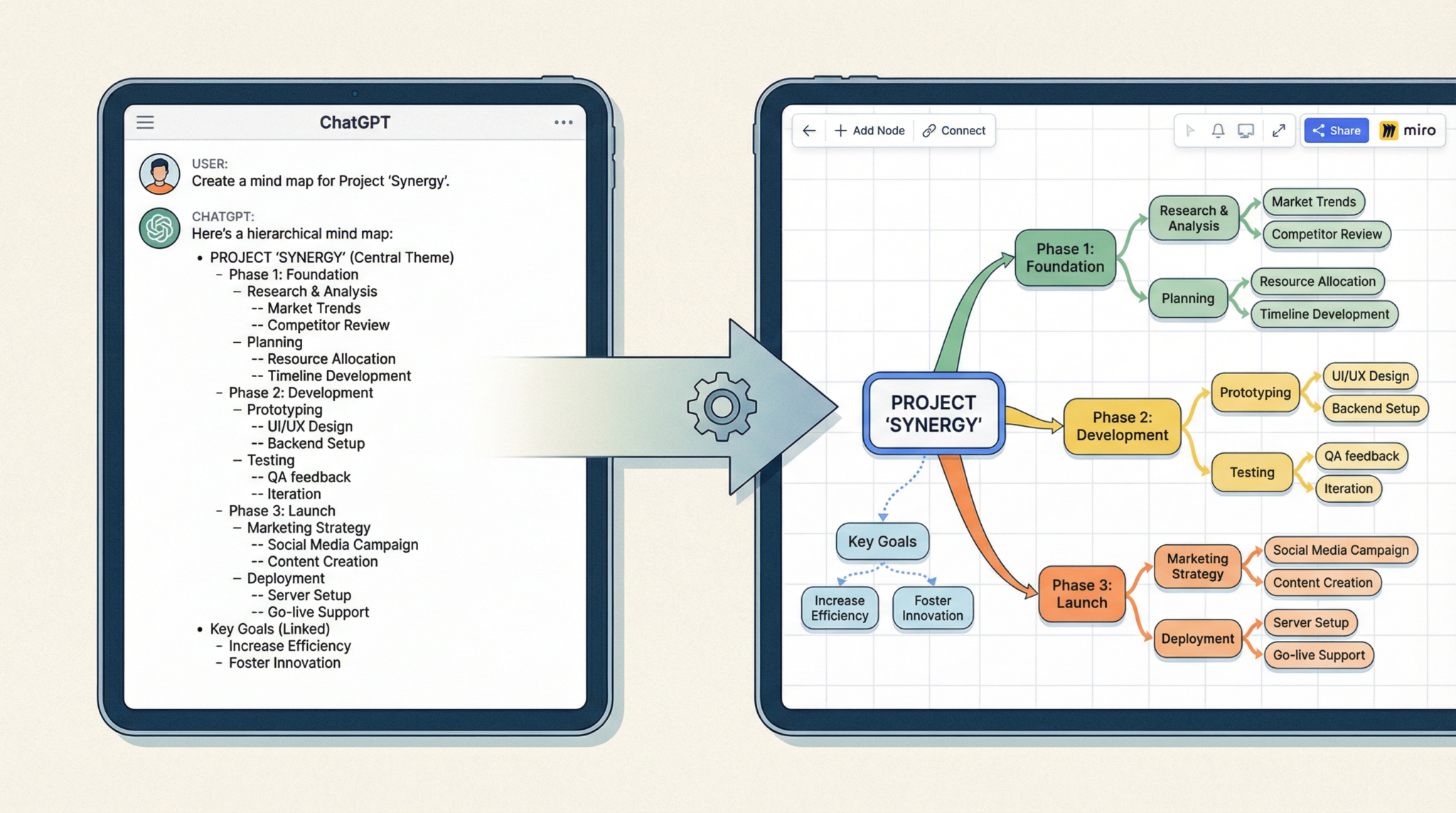
Text-based mind maps created with AI represent an innovative step forward. ChatGPT can assist in brainstorming, hierarchizing ideas, and generating structured outlines that serve as the backbone of visual mind maps. This approach saves time and ensures conceptual clarity before any graphic design or software entry.
Step-by-Step Process to Generate Mind Maps Using ChatGPT
- Define the Central Topic: Start with a clear, concise central idea or project name.
- Request Main Branches: Ask ChatGPT to list key themes, categories, or components related to the central topic.
- Expand Sub-Branches: For each main branch, generate detailed subtopics, tasks, or concepts.
- Establish Relationships: Identify interconnections, dependencies, or hierarchies between branches.
- Format for Readability: Use indentation, bullet points, or numbering to reflect the mind map structure.
Example Prompt for ChatGPT
Act as a productivity expert skilled in mind mapping, guiding the use of mind maps for boosting creativity and organization. Your task is to provide a guide on creating effective mind maps, share scenarios where mind mapping can be beneficial, and suggest tools for optimal mind map creation. Outline the steps to create comprehensive and visually engaging mind maps, emphasizing the interconnectedness of ideas. Provide insights into scenarios where mind mapping proves especially beneficial, such as brainstorming sessions, project planning, and note-taking. Additionally, recommend tools that facilitate efficient and organized mind map creation. My first request is to: [Insert your central topic/project here]
Pro Tips for Maximizing ChatGPT-Generated Mind Maps
- Iterative Refinement: Use follow-up prompts to expand or prune branches for clarity and focus.
- Incorporate Keywords: Ask the AI to suggest relevant keywords or tags to aid later categorization.
- Highlight Priorities: Request ChatGPT to mark high-impact items or critical paths.
Translating AI Output to Visual Tools: Miro, MindMeister, and Notion
While ChatGPT excels at generating structured textual mind maps, translating this output into visual diagrams is crucial for enhanced cognition and collaboration. Modern visual tools like Miro, MindMeister, and Notion provide powerful, flexible canvases for creating and sharing mind maps.
1. Miro
Miro is a collaborative whiteboard platform favored by teams for dynamic brainstorming and project planning.
- Importing AI Output: Copy the indented ChatGPT text and paste it into Miro’s mind map template.
- Auto-Structure: Use Miro’s “Smart Diagram” feature to automatically convert outlines into node-based mind maps.
- Collaboration: Invite team members to add comments, connect nodes, or link to external resources.
2. MindMeister
MindMeister specializes in mind mapping with rich formatting and task management features.
- Outline Import: MindMeister supports importing text outlines in formats such as Markdown or OPML, easily adapted from ChatGPT output.
- Visual Customization: Customize node colors, icons, and layouts to reflect priorities and relationships.
- Task Integration: Assign tasks and deadlines directly within the map for actionable project management.
3. Notion
Notion is an all-in-one workspace supporting databases, documents, and visual boards.
- Database Linked Maps: Use Notion’s toggle lists or database views to simulate mind maps from ChatGPT’s text.
- Embedding Visuals: Embed mind maps created in other tools or use Notion’s upcoming visual block features.
- Cross-Linking: Link notes, tasks, and resources directly to mind map nodes for integrated knowledge management.
Each tool offers unique strengths; the choice depends on your workflow, collaboration needs, and preferred level of visual fidelity.
Use Cases for Brainstorming, Project Planning, Content Strategy, and Study Notes
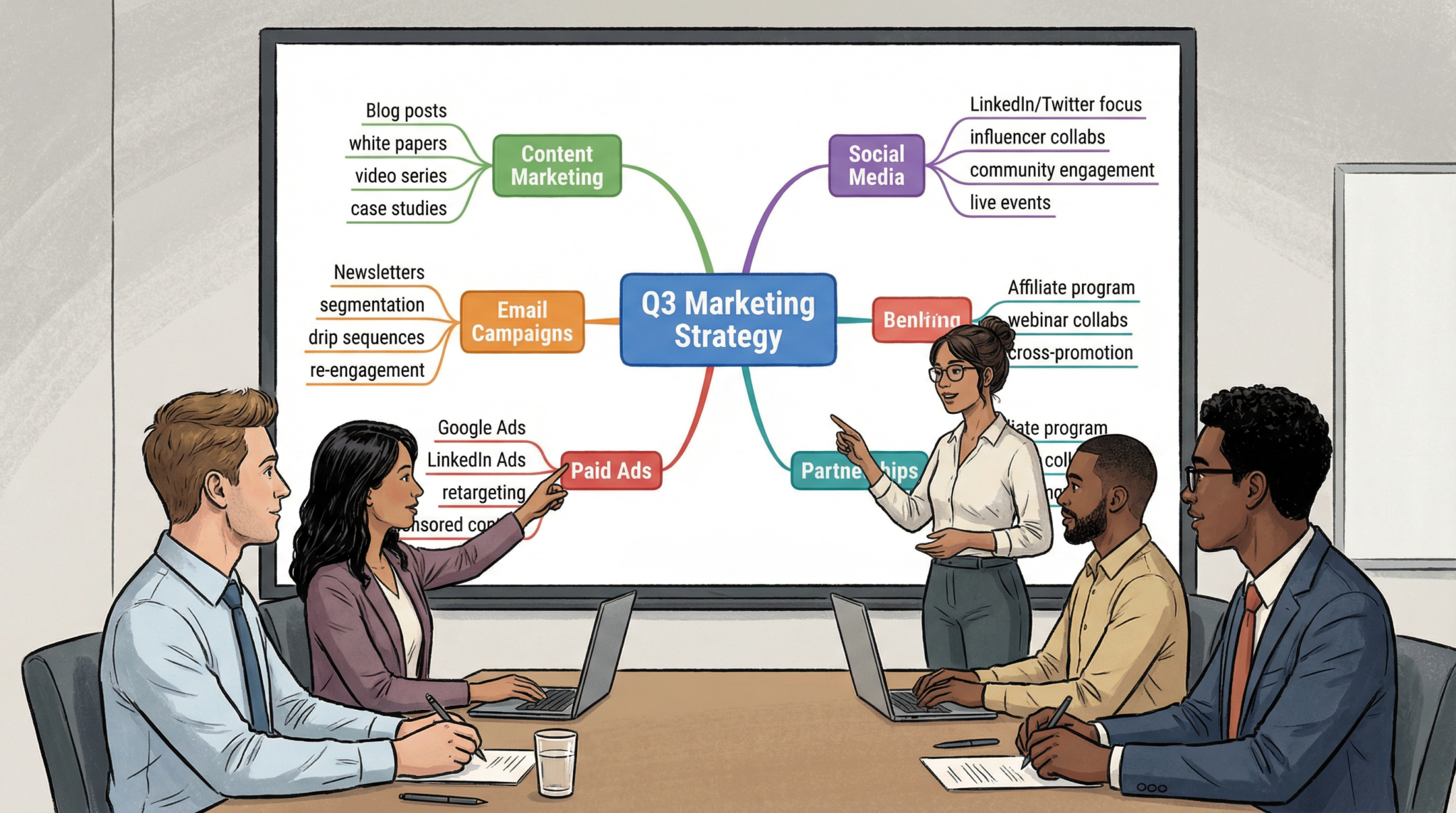
Mind mapping augmented by AI is versatile and applicable across many professional scenarios. Let’s examine key use cases where AI-powered mind mapping transforms productivity:
Brainstorming Sessions
Starting from a loose idea, ChatGPT can generate branches covering potential solutions, constraints, stakeholders, and alternative approaches. The mind map visualizes this diversity, fostering lateral thinking and preventing premature convergence.
Project Planning
Map out phases, milestones, resources, risks, and dependencies. AI-generated maps can be imported into PM tools to create Gantt charts or Kanban boards. This ensures a comprehensive, interconnected plan that anticipates bottlenecks.
Content Strategy Development
From central themes, generate content pillars, target keywords, formats, and distribution channels. The mind map helps identify content gaps and optimize messaging coherence across platforms.
Study Notes and Knowledge Management
Transform lecture notes or research papers into hierarchical mind maps that enhance comprehension and recall. AI can summarize and categorize complex information, making review sessions more effective.
Advanced Techniques: Radial Maps, Concept Maps, and Flowcharts
Beyond traditional hierarchical mind maps, professionals can leverage advanced diagramming techniques to capture complex relationships.
Radial Maps
Radial maps emphasize a central node with branches radiating outward equally, ideal for representing themes with equal importance or multiple stakeholder perspectives. ChatGPT can help generate balanced branches and sub-branches, ensuring no area is underrepresented.
Concept Maps
Concept maps extend mind maps by illustrating relationships between nodes with labelled links (e.g., “causes,” “requires,” “leads to”). This is useful for complex systems analysis. AI-generated structured text can be adapted to include these semantic relationships.
Flowcharts
Flowcharts depict processes and decision trees. While not strictly mind maps, ChatGPT can produce structured process steps that translate into flowcharts using tools like Miro or Lucidchart. Combining flowcharts and mind maps offers a holistic view of both ideas and workflows.
Real-World Example: Q3 Marketing Strategy Mind Map
To illustrate, consider crafting a Q3 marketing strategy for a SaaS company launching a new product feature.
Step 1: Central Topic
Q3 Marketing Strategy – New Feature Launch
Step 2: Main Branches
- Market Research
- Content Creation
- Advertising Campaigns
- Sales Enablement
- Metrics & Analytics
Step 3: Sub-Branches
- Market Research: Customer surveys, competitor analysis, trend reports
- Content Creation: Blog posts, webinars, video demos, case studies
- Advertising Campaigns: Paid social, Google Ads, influencer partnerships, retargeting
- Sales Enablement: Training materials, FAQs, demo scripts, CRM integration
- Metrics & Analytics: KPIs, A/B testing, lead scoring, conversion tracking
Step 4: Interconnections
For example, insights from Market Research directly inform Content Creation and Advertising Campaigns. Sales Enablement depends on finalized content and campaign data. Analytics feeds back into Market Research and campaign optimization.
Step 5: AI-Assisted Generation
Using ChatGPT, generate this structure textually with expanded details and action items. Then export it to MindMeister for visual refinement and team collaboration.
Pro Tip:
Regularly update the mind map as campaigns progress, embedding links to live dashboards and documents for real-time transparency.
Conclusion
In 2026, AI-powered mind mapping with ChatGPT offers knowledge workers a sophisticated, data-driven approach to organizing ideas and executing strategies. By understanding the cognitive science behind visual thinking and leveraging AI to generate structured, interconnected content, professionals can unlock new levels of creativity and productivity.
Whether brainstorming, planning projects, developing content strategies, or managing knowledge, integrating AI-generated mind maps with visual tools like Miro, MindMeister, and Notion creates a seamless workflow that adapts to diverse professional needs.
Explore advanced techniques such as radial maps, concept maps, and flowcharts to capture nuances beyond basic hierarchies. Real-world applications, like the Q3 marketing strategy example, demonstrate how this methodology translates into actionable plans with clarity and precision.
To deepen your AI productivity skills, be sure to check out our comprehensive AI productivity prompts guide and related resources on knowledge management and project planning with AI.
Access 40,000+ AI Prompts for ChatGPT, Claude & Codex — Free!
Subscribe to get instant access to our complete Notion Prompt Library — the largest curated collection of prompts for ChatGPT, Claude, OpenAI Codex, and other leading AI models. Optimized for real-world workflows across coding, research, content creation, and business.
Frequently Asked Questions
What are the key benefits of using ChatGPT for mind mapping?
ChatGPT accelerates the ideation and structuring process by generating organized, hierarchical outlines from simple prompts. It helps reduce cognitive overload by externalizing ideas, suggests relevant connections, and provides iterative refinement to produce comprehensive mind maps efficiently.
How do I convert ChatGPT’s textual mind maps into visual diagrams?
You can copy the structured text output from ChatGPT and import or paste it into visual mind mapping tools like Miro, MindMeister, or Notion. Many tools support outline or Markdown imports, which help automatically generate nodes and branches, enabling quick visual transformation.
What advanced mind mapping techniques can enhance my projects?
Beyond basic hierarchical maps, consider radial maps for balanced perspectives, concept maps to depict semantic relationships with labeled connections, and flowcharts for process visualization. Combining these techniques provides richer insights and clearer communication.
Can mind mapping improve team collaboration?
Yes. Visual mind maps created in collaborative platforms like Miro or MindMeister enable real-time interaction, idea sharing, and feedback. When combined with AI-generated outlines, teams can align on strategy quickly and maintain a single source of truth for complex projects.
What industries benefit most from AI-powered mind mapping?
Industries requiring complex problem-solving and creative planning—such as marketing, software development, education, consulting, and research—gain significant advantages. AI mind mapping accelerates knowledge synthesis, ideation, and strategic execution across diverse professional fields.

