
As enterprises accelerate their adoption of Artificial Intelligence (AI), the journey from initial pilot projects to full-scale production deployment remains fraught with technical challenges, architectural complexities, and operational hurdles. One of the most transformative advancements reshaping this landscape is AI agent orchestration. By managing multiple AI agents working in concert, enterprises can deliver scalable, reliable, and intelligent services that automate complex workflows, enhance decision-making, and optimize resource utilization.
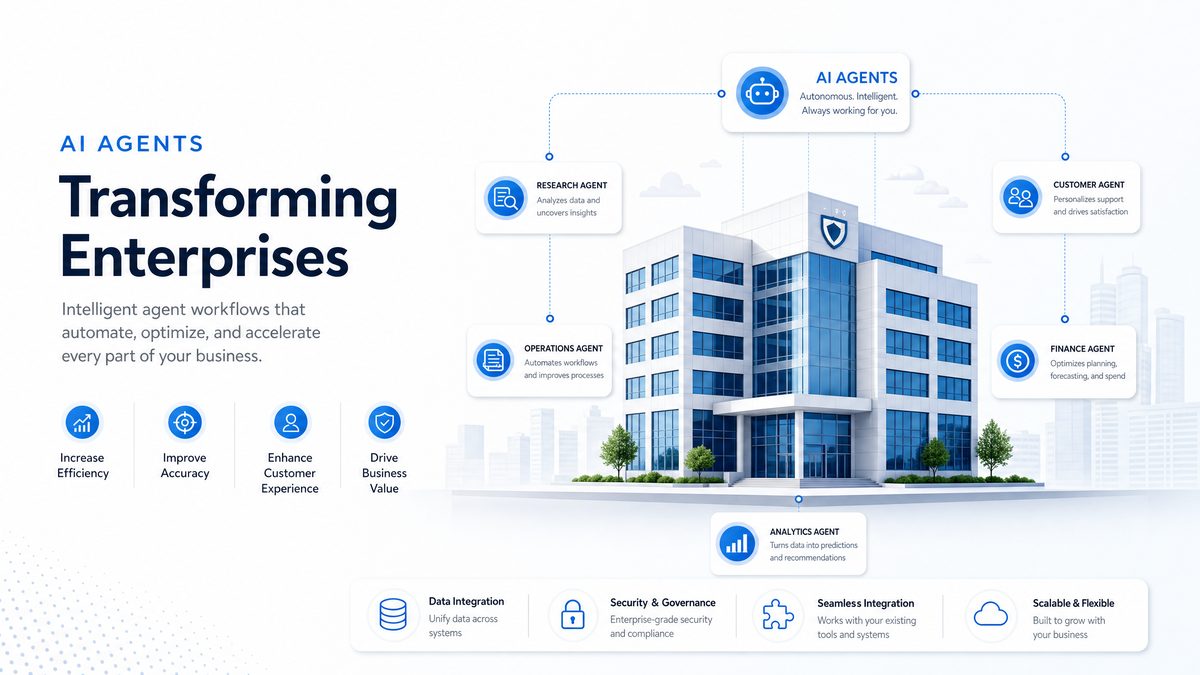
This case study examines the end-to-end process of enterprise AI agent orchestration, detailing best practices, architecture considerations, tooling, and operational methodologies employed to successfully transition from proof-of-concept phases to robust production environments. We delve into the challenges faced, solutions implemented, and results achieved in a comprehensive technical exploration suitable for AI practitioners, system architects, and business leaders.
Understanding Enterprise AI Agent Orchestration
AI agent orchestration refers to the coordination, management, and execution of multiple autonomous and semi-autonomous AI agents that collaborate or operate in parallel to achieve complex business and technical objectives. These agents can include natural language processing modules, computer vision components, predictive analytics engines, robotic process automation (RPA) bots, and other specialized AI services.
In an enterprise context, orchestration encompasses aspects such as task delegation, data flow management, error handling, and resource scheduling across a heterogeneous set of AI capabilities. The goal is to provide an integrated framework enabling AI agents to interact intelligently and produce cohesive outcomes that go beyond isolated model predictions.
Key Components of AI Agent Orchestration
- Agent Coordination Layer: Centralized control logic that plans, assigns, and sequences AI agent workflows.
- Communication Infrastructure: Messaging and data exchange protocols enabling agents to share context and results.
- Monitoring & Logging: Systems that track agent behavior, performance metrics, and pipeline health.
- Scalability & Load Balancing: Mechanisms to elastically allocate resources based on workload and agent demands.
- Security & Compliance: Authentication, authorization, and auditing for safe agent interactions.
Effectively orchestrating AI agents enables enterprises to construct complex workflows that mirror human reasoning, such as multi-step decision trees, continuous learning feedback loops, or multi-modal data interpretation pipelines.
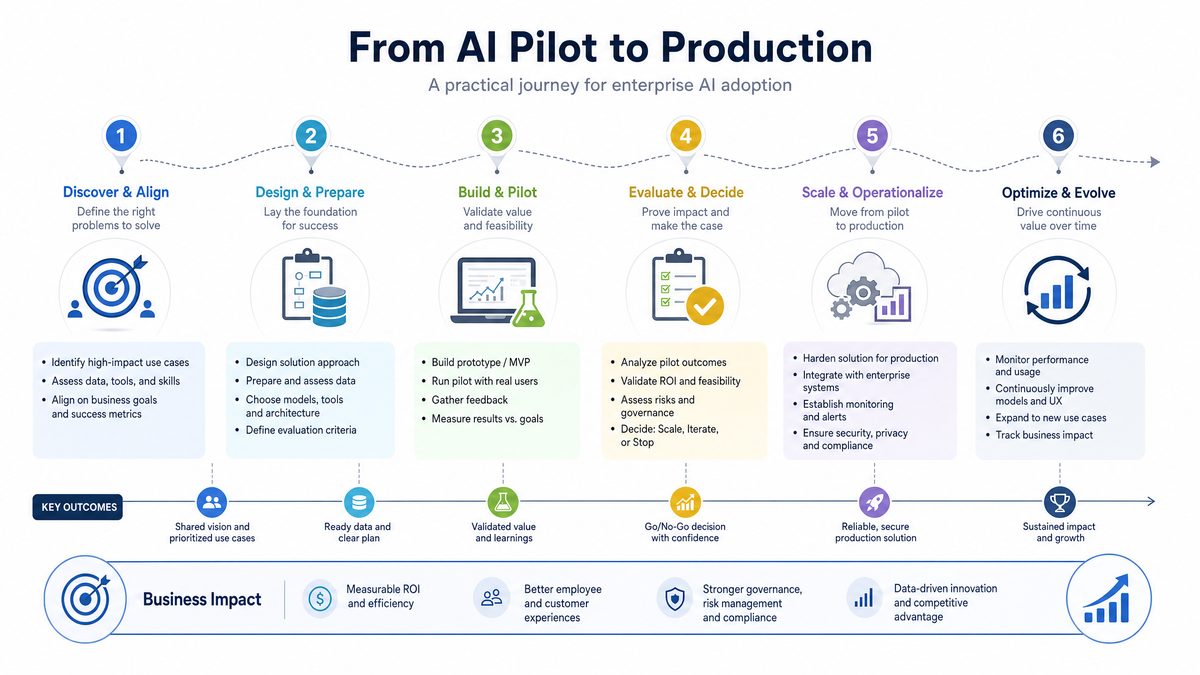
Pilot Phase: Building the Foundations
The pilot phase is critical for validating the viability of AI agent orchestration within an enterprise’s unique operational environment. It focuses on experimentations, evaluations, and iterative refinement rather than scalability or robustness. This section outlines the essential steps taken during the pilot and the lessons learned that framed the subsequent production strategy.
Defining Use Cases and Success Criteria
A successful pilot begins by selecting targeted use cases that benefit from autonomous coordination. For instance, automating customer support inquiry triaging, supply chain demand forecasting combined with inventory automation, or claims processing leveraging document understanding and fraud detection AI agents.
- Business Impact: Choose workflows with tangible KPIs such as reduced cycle time or improved accuracy.
- Technical Feasibility: Assess data availability, existing AI models’ maturity, and integration complexity.
- Success Metrics: Establish clear quantitative and qualitative criteria (e.g., response latency under 2 seconds, 90% task automation rate).
Architectural Design and Proof-of-Concept Implementation
During pilot design, enterprises must balance complexity with agility:
- Modular Design: Architect AI agents as loosely coupled services or microservices that can be managed independently.
- Orchestration Engine Selection: Evaluate open-source frameworks (e.g., Apache Airflow, Kubeflow Pipelines) or commercial AI orchestration platforms tailored to workflows.
- Data Layer Integration: Ensure seamless connectivity to enterprise data warehouses, data lakes, and real-time streaming sources.
- Simulation Environment: Build staging/test environments mirroring production constraints for iterative testing.
Starting with a scaled-down subset of agents reduces initial complexity and enables rapid iteration based on pilot feedback.
Challenges Encountered During Pilots
- Data Quality and Latency: Inconsistent or outdated data sources can compromise agent decision accuracy.
- Inter-Agent Communication Overhead: Excessive coordination messaging led to unexpected performance bottlenecks.
- Monitoring Gaps: Lack of granular visibility made diagnosing failure points difficult.
- Change Management: Aligning stakeholder expectations and training users on AI-driven processes posed adoption challenges.
Addressing these challenges early helped solidify the production architecture blueprint and operational playbooks.
How NVIDIA Deployed GPT-5.5-Powered Codex to 10,000 Employees: An Enterprise AI Case Study
Scaling to Production: Architecture and Operationalization
Moving AI agent orchestration from pilot to production requires architectural hardening, robust infrastructure, and enterprise-grade operational governance. This process ensures that AI agents perform reliably, securely, and at scale under real-world conditions.
Robust Orchestration Framework Design
Production orchestration platforms must support advanced capabilities beyond simple task sequencing:
- Dynamic Workflow Adjustment: Adapt execution paths in real-time based on agent outputs and external triggers.
- Fault Tolerance and Recovery: Incorporate retry policies, fallback agents, and circuit breakers to maintain service continuity.
- Resource Optimization: Employ intelligent resource schedulers that balance latency requirements and compute cost.
- Versioning and Rollback: Manage AI agent updates safely with automated rollback capabilities to minimize service disruptions.
| Capability | Pilot Implementation | Production Implementation |
|---|---|---|
| Workflow Modularity | Static sequencing with fixed agents | Dynamic graph workflows with conditional branching |
| Error Handling | Manual error monitoring and fix | Automated retries, alerts, and failover mechanisms |
| Scaling | Single-node or limited container deployment | Distributed, cloud-native orchestration with auto-scaling |
| Security Controls | Basic authentication | Role-based access control (RBAC), encryption in transit and at rest |
Infrastructure Considerations
AI agent orchestration demands scalable compute and storage infrastructure. Key aspects include:
- Containerization & Kubernetes: Utilizing container orchestration platforms to deploy, scale, and manage AI agents ensures portability and availability.
- Serverless & Event-Driven Models: Where suitable, deploying agents as serverless functions can optimize cost and responsiveness.
- GPU & Specialized Hardware: Provisioning appropriate hardware acceleration for compute-intensive models such as neural networks.
- Data Pipeline Integration: Efficient ingestion and processing pipelines reduce latency and increase throughput.
Operational Excellence
Effective monitoring, incident management, and continuous improvement underpin production success:
- Observability: Implement comprehensive monitoring dashboards aggregating logs, metrics, and traces from agents and orchestration workflows.
- Alerting & Incident Response: Set threshold-based alerts coupled with automated remediation actions for common failure modes.
- Governance: Establish change management policies, compliance auditing, and security reviews for all AI agent lifecycle stages.
- Continuous Integration/Continuous Deployment (CI/CD): Automate testing, deployment, and rollback of AI agent code and configuration.
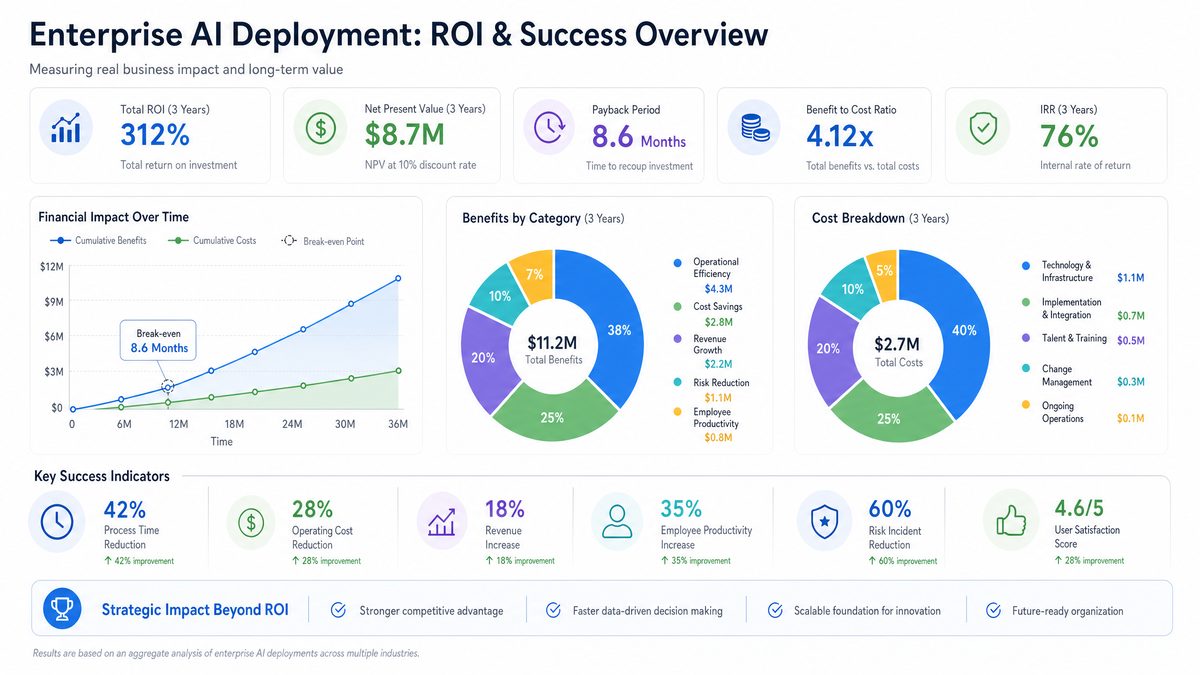
Developing a culture of collaboration between AI, DevOps, and business teams is essential for iterative refinement and scaling.
Case Study: AI Agent Orchestration at a Global Financial Services Enterprise
To exemplify the transition from pilot to production in enterprise AI orchestration, consider a global financial services company that sought to automate their complex anti-money laundering (AML) workflows using AI agents.
Business Challenge
The firm required an integrated solution combining data ingestion, transactional anomaly detection, customer risk profiling, and automated case management. Prior manual and semi-automated processes were slow and error-prone, resulting in compliance risks and operational inefficiencies.
Pilot Implementation
- Deployed standalone AI agents for transaction pattern analysis and customer risk scoring.
- Used a lightweight orchestration engine to chain inputs and outputs of these agents.
- Monitored system outputs for accuracy and latency.
- Refined models and agent coordination based on results.
Transition to Production
- Adopted a microservices-based architecture orchestrated by a Kubernetes-native workflow manager supporting event-driven execution.
- Integrated secure message queues enabling real-time exchange of agent outputs.
- Implemented role-based access controls enforcing strict data privacy and audit requirements.
- Established comprehensive monitoring dashboards with anomaly detection triggering alerts to compliance teams.
- Leveraged CI/CD pipelines to deploy model updates with rollback capabilities ensuring business continuity.
- Scaled horizontally to support enterprise-wide transaction volumes while maintaining sub-second latency.
Results
- 95% automation of initial transaction screening workflows.
- 30% reduction in false positives owing to agent collaboration and continuous model retraining.
- Improved compliance with regulatory deadlines through faster case escalation.
- Enhanced operational resilience with near zero downtime deployments.
- Clear audit trails supporting regulatory examinations.
This enterprise’s success underscores the importance of aligning technical architecture, operational discipline, and business objectives in AI agent orchestration initiatives.
Enterprise AI in 2026: How Multi-Agent Systems Are Delivering Real ROI
Future Directions and Emerging Trends
As AI agent orchestration matures, several evolving trends and technologies are reshaping the landscape for enterprises:
Explainability and Transparency
Regulators and business stakeholders increasingly require interpretable AI decisions. Advanced orchestration platforms incorporate explainability frameworks that track agent provenance and reasoning paths, improving trust and compliance.
Multi-Agent Collaboration with Reinforcement Learning
Research into multi-agent systems using reinforcement learning enables agents to dynamically learn cooperative strategies, enhancing orchestration intelligence and adaptability in evolving environments.
Integration of Large Language Models (LLMs)
LLMs such as GPT-4 can act as orchestrators themselves or as versatile agents capable of intricate reasoning, natural language understanding, and generating prompts for domain-specific AI components.
Edge and Hybrid AI Orchestration
Orchestrating AI agents deployed at the edge vs. cloud presents latency, bandwidth, and privacy trade-offs. Hybrid models balancing these constraints will become mainstream, necessitating orchestration frameworks supporting distributed environments.
AI Governance and Ethical AI
Stronger emphasis on ethical AI deployments is driving the adoption of built-in governance, bias detection, and fairness auditing components within the orchestration stack.
Advanced AI Agent Orchestration Patterns
As enterprise AI deployments grow in complexity and scale, adopting advanced orchestration patterns can significantly enhance the effectiveness, maintainability, and resilience of AI ecosystems. Below are several common patterns that enterprises find valuable when designing long-lived AI agent orchestrations.
1. Pipeline Pattern
The pipeline pattern involves chaining AI agents where the output of one agent serves as the input for the next. This is suitable for linear workflows such as data preprocessing, feature extraction, model inference, and post-processing. The pipeline enforces strict execution order and simplifies debugging by allowing stepwise validation.
- Example: In document processing, a pipeline might include an OCR agent, followed by a named entity recognition (NER) agent, and concluding with a summarization agent.
- Advantages: Clear stage separation, easy modular testing.
- Considerations: Bottlenecks may occur if one stage is slower; requires mechanisms to handle failures gracefully.
2. Orchestrated Parallelism Pattern
This pattern enables concurrent execution of multiple independent AI agents, synchronizing and aggregating results. It is effective for scenarios requiring multi-perspective analysis or processing of partitioned data.
- Example: An AI orchestration system in retail might run demand forecasting agents, competitor pricing analysis, and customer sentiment analysis in parallel, then aggregate insights for a comprehensive marketing strategy.
- Advantages: Improved throughput and reduced latency via parallelism.
- Considerations: Requires robust mechanisms to handle partial failures, synchronize results, and ensure data consistency.
3. Event-Driven Pattern
AI agents respond asynchronously to external triggers or internal state changes, decoupling execution timing and enabling event-based workflows. This pattern is key for reactive systems integrating with enterprise event buses or sensor data streams.
- Example: In industrial IoT, anomaly detection agents trigger preventive maintenance scheduling agents upon detecting deviations from normal operational metrics.
- Advantages: High responsiveness, resource-efficient by avoiding polling.
- Considerations: Complexity in event schema management and potential event storm handling.
4. Hierarchical Orchestration Pattern
Hierarchical orchestration structures AI agents into layers, where high-level controllers manage lower-level agents or sub-orchestrators. This pattern supports complex workflows with nested decision-making and delegation.
- Example: In autonomous vehicle fleets, a master orchestrator allocates tasks to regional orchestrators, which further coordinate perception, path planning, and actuator control agents within vehicles.
- Advantages: Scalable governance over distributed agents, clear separation of concerns.
- Considerations: Increased system complexity requires careful design of communication protocols.
| Pattern | Key Benefits | Common Use Cases | Primary Challenges |
|---|---|---|---|
| Pipeline | Modularity, deterministic flow | ETL workflows, document processing | Sequential bottlenecks, error propagation |
| Orchestrated Parallelism | Reduced latency, increased throughput | Multi-modal analytics, concurrent model inference | Synchronization complexity, partial failure handling |
| Event-Driven | Responsiveness, elasticity | IoT, real-time fraud detection | Event schema evolution, event flooding |
| Hierarchical | Scalability, layered governance | Fleet management, complex enterprise workflows | Inter-layer communication, orchestration overhead |
Data Strategy for AI Agent Orchestration
Data is the lifeblood of AI agents. Effective orchestration demands a well-defined data strategy that not only ensures data availability and quality but also addresses data governance, lineage, and accessibility in a distributed agent ecosystem.
Data Management Challenges
- Heterogeneous Data Sources: Enterprises often contend with structured databases, unstructured documents, sensor streams, and third-party APIs requiring diverse data ingestion and normalization mechanisms.
- Data Latency and Freshness: Orchestrated AI agents need timely data to prevent stale decisions; balancing batch versus real-time data ingestion impacts architecture.
- Data Privacy and Security: Complying with GDPR, HIPAA, or industry-specific regulations necessitates masking, encryption, and access controls integrated with orchestration.
- Data Lineage and Provenance: Tracing input data through multiple agent transformations supports explainability, debugging, and auditing.
Data Layer Architectures
Common architectural approaches include:
- Data Lakehouse: Combines the scalability of data lakes and performance features of data warehouses to serve batch and streaming workloads. Agents can query a unified data store for input and output.
- Federated Data Access: Allows agents to access data in-situ across different systems without centralizing it, supporting data locality and reducing duplication.
- Event Streaming Platforms: Technologies like Apache Kafka or AWS Kinesis provide real-time data feeds, facilitating event-driven orchestration and low-latency agent interaction.
Practical Tips for Data Strategy
- Define Clear Data Contracts: Establish schemas, quality expectations, and access patterns to prevent agent interoperability issues.
- Implement Data Versioning: Maintain immutable snapshots or commit logs to enable reproducibility in pipelines running AI agents.
- Automate Data Quality Monitoring: Integrate anomaly detection and validation suites into data ingestion pipelines to catch errors proactively.
- Design for Scalability: Architect data storage and compute to support peak loads and burst traffic from agent orchestration demands.
Practical Considerations for Multi-Agent Interoperability
Ensuring seamless interaction among heterogeneous AI agents is critical for orchestrated workflows. This involves standardizing interfaces, managing dependencies, and enforcing protocol consistency.
Standardized APIs and Protocols
Adopt industry standards like RESTful services, gRPC, or message-oriented middleware (e.g., MQTT, AMQP) to facilitate agent communication. Consistent data serialization formats such as JSON, Protobuf, or Avro reduce deserialization errors and improve performance.
Semantic Interoperability
Beyond syntactic compatibility, agents benefit from shared ontologies or schemas that describe concepts and relationships. Leveraging standards like OpenAPI for service definitions or domain ontologies fosters meaningful data exchange and reduces misinterpretation.
Dependency Management and Versioning
- Loose Coupling: Design agents to minimize direct dependencies, promoting independent evolution and deployment.
- API Versioning: Maintain backward-compatible interfaces or implement version negotiation to prevent orchestration failures during upgrades.
- Service Discovery: Use dynamic registries or service meshes to enable agents to locate and communicate in dynamic infrastructure environments.
Conflict Resolution and Coordination
When multiple agents potentially modify shared resources or produce contradictory recommendations, coordination mechanisms become essential:
- Consensus Protocols: Implement distributed consensus algorithms or voting mechanisms for conflict resolution.
- Priority & Arbitration: Define priority levels for agents or introduce human-in-the-loop adjudication for critical decisions.
- Transaction Management: Utilize atomic transaction patterns or compensation workflows to maintain consistency.
Security Deep Dive: Protecting AI Agent Orchestration Environments
Increased attack surfaces and data sensitivity elevate security as a paramount concern in AI agent orchestration. Beyond basic authentication, enterprises must adopt layered defenses and continuous security enforcement.
Zero Trust Architecture
Adopting a Zero Trust model means every component, including AI agents, orchestration engines, and data interfaces, must authenticate and authorize every interaction continuously.
- Identity & Access Management (IAM): Employ fine-grained RBAC or attribute-based access control (ABAC) with strong cryptographic identities (e.g., X.509 certificates).
- Mutual TLS: Secure all agent-to-agent and client-to-agent communications with mutual TLS to encrypt traffic and validate peers.
- Network Segmentation: Use virtual private clouds (VPCs), service meshes, and firewalls to isolate AI orchestration components by trust zones.
Runtime Security and Hardening
- Secure Container Configurations: Enforce minimal privilege principles, read-only filesystems, and kernel security modules.
- Supply Chain Security: Verify container images and dependencies against trusted registries; employ software bill of materials (SBOM) tracking.
- Runtime Threat Detection: Implement behavioral anomaly detection and intrusion prevention systems for AI agent processes.
Data Security Controls
- Encryption: Enforce encryption at rest and in transit using enterprise-grade cryptographic algorithms.
- Data Masking and Tokenization: Obfuscate sensitive fields during processing and storage while preserving analytical value.
- Audit Logging: Maintain immutable logs of data access and agent activities for forensic investigations and compliance audits.
| Security Aspect | Pilot Phase | Production Phase |
|---|---|---|
| Authentication | Basic user credentials, minimal agent authentication | Zero Trust IAM, multi-factor authentication (MFA), mutual TLS |
| Data Protection | Partial encryption, limited access control | End-to-end encryption, tokenization, strict access policies |
| Logging & Auditing | Manual log review, coarse-grained events | Automated log aggregation, anomaly detection, tamper-proof audit trails |
| Infrastructure Security | Basic network segmentation | Service mesh, container security best practices, runtime threat analytics |
Best Practices for Continuous Improvement and Lifecycle Management
AI agent orchestration is not a “set-and-forget” endeavor but requires continuous refinement and lifecycle management to adapt to changing business contexts, data distributions, and technology advances.
Model and Agent Lifecycle Management
- Automated Retraining Pipelines: Monitor model performance drift and trigger retraining using fresh data to maintain agent efficacy.
- Canary Deployments & A/B Testing: Gradually release updated agents to subsets of workflows or users to mitigate regression risk.
- Dependency Updates: Regularly patch libraries and update runtimes to address security vulnerabilities.
- Retirement Policies: Phase out obsolete agents and gracefully migrate workflows to newer implementations.
Organizational and Cultural Aspects
- Cross-Functional Teams: Foster collaboration between AI researchers, data engineers, DevOps, and business units for holistic ownership.
- Documentation and Knowledge Sharing: Maintain comprehensive schemas, flow diagrams, failure modes, and runbooks accessible to all stakeholders.
- Feedback Loops: Establish mechanisms for end-users and system operators to report issues and suggest improvements promptly.
- Training and Change Management: Continually educate teams on new tools, processes, and governance policies to minimize disruption.
Tooling Recommendations
- Monitoring: Use unified observability platforms like Prometheus, Grafana, and OpenTelemetry to consolidate metrics and traces.
- CI/CD Platforms: Leverage tools such as Jenkins, GitLab CI, or Argo CD tailored for AI workloads combining code and model artifacts.
- Workflow Managers: Select orchestration engines supporting plugable components and rich scripting (e.g., Argo Workflows, Prefect).
- Collaboration: Employ platforms like Confluence, JIRA, or Slack for documentation, issue tracking, and real-time communication.
Emerging Technologies and Future-Proofing AI Agent Orchestration
To maintain a competitive edge and adaptability, enterprises should consider embracing nascent technologies and architectural paradigms that promise enhanced capabilities and flexibility.
Service Meshes and Sidecar Proxies
Service meshes (e.g., Istio, Linkerd) provide advanced traffic management, observability, and security controls for microservice ecosystems, including AI agents. They enable transparent routing, retries, circuit breaking, and metrics collection without modifying agent code.
Explainable AI (XAI) Integration
Embedding explainability modules within the orchestration framework allows dynamic interpretation of agent decisions. Techniques such as SHAP, LIME, and counterfactual explanations can be orchestrated as co-agents to augment model outputs with contextual insights.
Federated Learning Orchestration
Federated learning enables collaborative agent training without sharing raw data, preserving privacy across distributed data owners. Orchestration frameworks can coordinate multi-party learning rounds, aggregation, and model version management.
AutoML and Meta-Learning
Incorporating AutoML pipelines and meta-learning agents to dynamically select and tune models within the orchestration layer can improve performance and reduce manual efforts. These agents automate hyperparameter optimization and architecture search conditioned on current data and task demands.
Quantum Computing Prospects
Though still experimental, orchestration platforms could integrate quantum AI agents for specialized problems like combinatorial optimization or pattern recognition, necessitating hybrid classical-quantum workflow coordination.
| Emerging Technology | Potential Benefits | Current Maturity | Considerations |
|---|---|---|---|
| Service Mesh | Enhanced security, traffic control, observability | Production-ready and widely adopted | Operational complexity, learning curve |
| Explainable AI Modules | Improved transparency and user trust | Growing adoption in regulated industries | Computational overhead, integration complexity |
| Federated Learning | Privacy-preserving distributed training | Experimental, early enterprise pilots | Communication costs, coordination challenges |
| AutoML/Meta-Learning | Automation of model selection and tuning | Commercial and open-source products available | May require expert oversight, data quality dependent |
| Quantum AI | Potential acceleration for complex computations | Research phase | Limited availability, specialized expertise needed |
By continuously assessing and integrating these innovations, enterprises can future-proof their AI agent orchestration solutions to stay adaptable in rapidly evolving technology and business landscapes.
Useful Links
- IBM Cloud – AI Orchestration Explained
- Kubeflow Pipelines Documentation
- Apache Airflow Official Docs
- Multi-Agent Systems Overview by Martin Thoma
- Recent Research on Multi-Agent Reinforcement Learning
- Google AI Explainability Toolkit
- Hybrid AI Orchestration at Cloud and Edge
- O’Reilly – Ethical Algorithms and Governance in AI
Access 40,000+ AI Prompts for ChatGPT, Claude & Codex — Free!
Subscribe to get instant access to our complete Notion Prompt Library — the largest curated collection of prompts for ChatGPT, Claude, OpenAI Codex, and other leading AI models. Optimized for real-world workflows across coding, research, content creation, and business.
