
OpenAI Launches ChatGPT for Teens with Break Reminders, Parental Controls, and Stronger Safety Protections
Published: August 19, 2026 | Category: AI News, Policy & Safety | Reading Time: 22 minutes
OpenAI made one of its most consequential product announcements to date on August 18, 2026, unveiling a purpose-built version of ChatGPT specifically designed for teenage users aged 13 through 17. The rollout — covered extensively by the BBC, The New York Times, and CBS News within hours of the official announcement — introduces a dedicated teen account tier packed with automatic safety features, parental oversight tools, built-in break reminders, and content filters tuned specifically for the developmental needs and legal protections afforded to minors. The move signals a significant maturation in how the world’s most prominent AI lab is thinking about its youngest, most impressionable user base at a time when scrutiny over AI’s impact on adolescent mental health, academic integrity, and digital privacy has never been higher.
Background: Why OpenAI Built a Teen-Specific Product
To understand the weight of this announcement, it helps to appreciate the pressure OpenAI has faced over the past three years. Since ChatGPT’s viral public launch in late 2022, the platform has attracted tens of millions of users under the age of 18 — many operating under falsely entered birthdates or using family accounts without any age-appropriate filtering in place. Internal estimates cited during OpenAI’s press briefing on August 18 suggest that roughly 22 percent of ChatGPT’s active monthly user base is between the ages of 13 and 17, a figure that surprised even some company insiders when it was disclosed publicly.
Regulatory pressure has also been building steadily. The United States Congress passed the Kids Online Safety and Privacy Act (KOSPA) in early 2025, dramatically expanding protections for minors across digital platforms and imposing strict new requirements on AI companies operating in the consumer space. In the European Union, the Digital Services Act’s enhanced provisions for minors came into full enforcement effect in Q1 2026, requiring platforms with significant teen usership to implement verifiable age assurance and appropriate content safeguards. The UK’s Children’s Code, enforced by the Information Commissioner’s Office, has already resulted in several high-profile fines against social media companies that failed to adequately protect young users.
Beyond legal compliance, OpenAI has faced sustained criticism from child safety organizations, pediatric psychologists, and parent advocacy groups. The American Academy of Pediatrics published a position paper in March 2026 warning that unrestricted access to large language models posed unique risks for adolescent users — risks distinct from those posed by social media — including academic dependency, potential exposure to harmful content through adversarial prompting, and the erosion of critical thinking skills during formative developmental years.
OpenAI CEO Sam Altman acknowledged these pressures directly during the August 18 keynote. “We’ve known for a long time that we needed to do better for younger users,” Altman told reporters. “This isn’t just a compliance exercise. We genuinely believe that with the right guardrails and the right design, AI can be one of the most powerful learning tools ever created. But only if we build it responsibly from the ground up.” The announcement was met with a standing ovation inside OpenAI’s San Francisco offices and a considerably more measured reception from privacy advocates watching the livestream.
The development process for ChatGPT for Teens reportedly involved 18 months of dedicated research, consultation with over 400 parents across six countries, partnerships with child development experts at Stanford and Oxford, and extensive red-teaming exercises designed to identify how teenagers specifically attempt to circumvent content safeguards. OpenAI also retained the firm Thorn, a nonprofit dedicated to developing technology to protect children, as an independent safety advisor throughout the development cycle.
What’s New: Core Features of ChatGPT for Teens
ChatGPT for Teens is not simply a stripped-down version of the standard platform with a few filters toggled on. OpenAI has described it as a “purpose-built experience” with five distinct pillars: dedicated teen accounts with automatic safety defaults, an intelligent break reminder system, a comprehensive parental controls dashboard, enhanced content filtering for age-inappropriate topics, and usage time tracking paired with weekly reporting for both teens and their guardians.
Dedicated Teen Accounts with Automatic Safety Defaults
When a user between the ages of 13 and 17 creates a new ChatGPT account — or when an existing account is identified as belonging to a minor through OpenAI’s new age verification system — the account is automatically enrolled in the teen experience. There is no opt-in required, and crucially, there is no straightforward mechanism for a teen user to opt out. Parents or guardians must actively authorize any relaxation of the default safety settings through the parental controls dashboard.
The automatic defaults include content filtering set to its most restrictive posture, memory features disabled by default, persona customization limited to a curated set of age-appropriate options, and API access entirely disabled. Advanced features including voice mode with third-party integrations, plugin access, and the ability to upload certain document types for analysis are initially locked and can only be unlocked with explicit parental approval.
Break Reminders After Extended Sessions
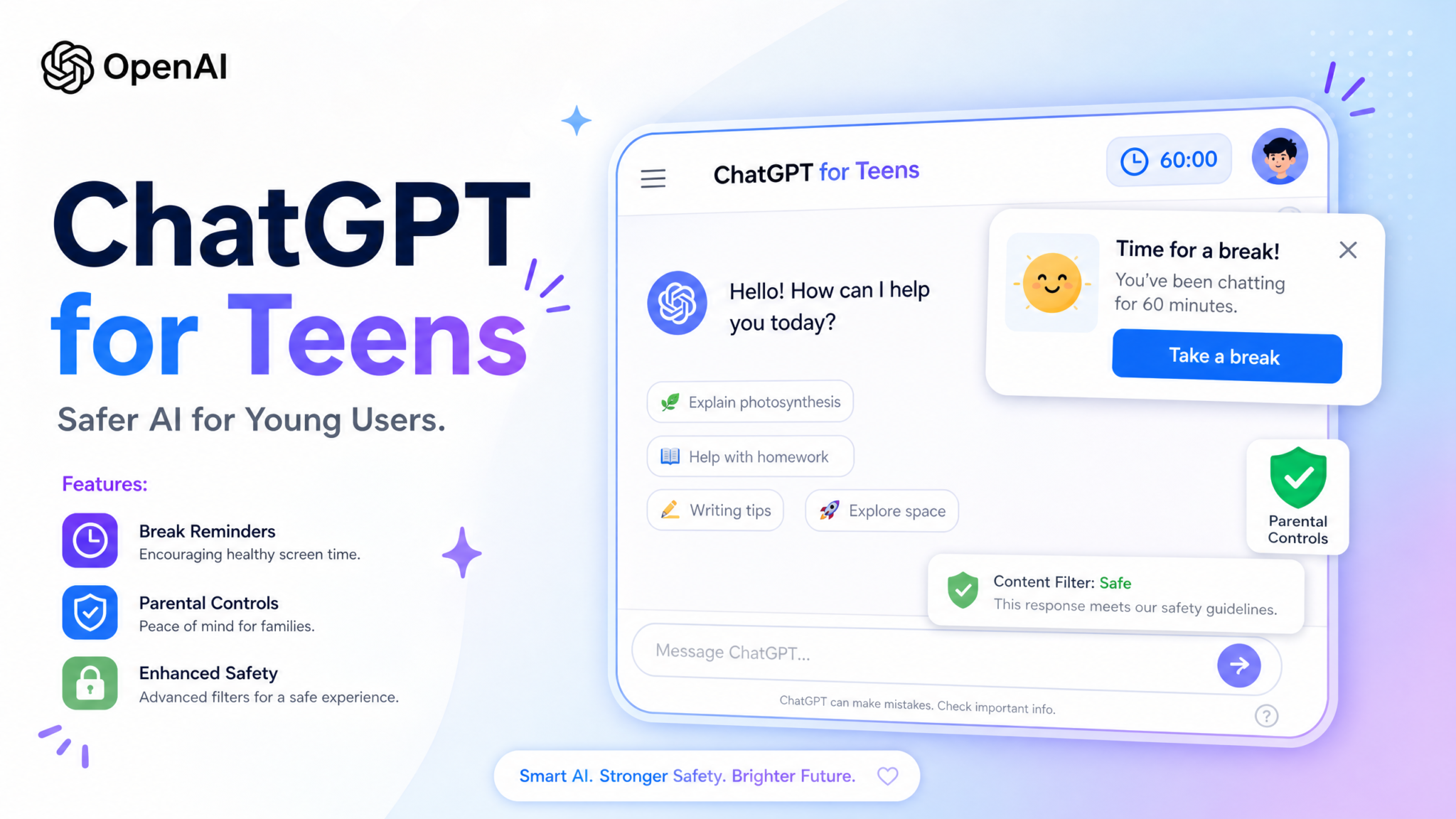
One of the most immediately discussed features is the platform’s built-in break reminder system. After 60 minutes of continuous use within a single session, ChatGPT for Teens will display a gentle, non-alarming notification encouraging the user to take a break. The reminders are designed by behavioral health consultants to avoid triggering anxiety or compulsive behavior — they are framed positively (“Great work today — stepping away for a few minutes can help you absorb what you’ve learned”) rather than as warnings or prohibitions.
Parental Controls Dashboard
Perhaps the most technically sophisticated new feature is the parental controls dashboard, accessible at family.chatgpt.com. This interface gives parents and guardians a high-level view of their teen’s usage patterns without compromising the teen’s conversational privacy. We will explore this dashboard in detail in a dedicated section below.
Enhanced Content Filtering
OpenAI has deployed what it calls a “layered filtering architecture” for teen accounts. This system combines three distinct filtering layers: a pre-generation filter that assesses the intent of an incoming prompt; a generation-time filter that monitors content as it is being produced; and a post-generation review layer that evaluates completed responses before they are displayed. The system is tuned to be sensitive to content categories including graphic violence, sexual content, detailed drug and alcohol information, content that romanticizes self-harm or eating disorders, and material that could facilitate academic dishonesty in ways that harm learning outcomes.
Usage Time Tracking and Weekly Reports
Every teen account now generates an automatic weekly report delivered to both the teen user and their linked parent or guardian. For teens, the report is framed as a personal learning summary — highlighting topics explored, skills practiced, and a breakdown of time spent across different types of tasks. For parents, the report includes aggregate usage time, peak usage hours, broad topical categories of conversation, and any instances where the content filter was triggered (without disclosing the specific content of the conversation).
How Teen Accounts Differ from Standard ChatGPT
The differences between a standard ChatGPT account and a teen account are substantial and touch virtually every aspect of the platform experience. The table below provides a side-by-side comparison of the key capability differences across the two account types, as disclosed by OpenAI in its official product documentation published August 18, 2026.
| Feature / Capability | Standard ChatGPT (18+) | ChatGPT for Teens (13–17) |
|---|---|---|
| Image Generation (DALL-E integration) | Full access, all styles and prompts | Limited; educational and creative only, no photorealistic human images |
| Adult Content Generation | Available with age verification on applicable tiers | Entirely blocked, no override available |
| Memory / Persistent Personalization | Enabled by default, fully customizable | Disabled by default; limited version can be enabled by parent |
| API Access | Available across all paid tiers | Completely disabled |
| Third-Party Plugin / Extension Access | Full marketplace access | Curated “Teen-Safe” plugin list only, parent approval required |
| Voice Mode | Full access including custom voices | Standard voice only, no custom voices, time-limited per session |
| Content Filtering Level | Standard moderation | Enhanced three-layer filtering architecture |
| Weekly Usage Reports | Not generated | Auto-generated for teen and parent/guardian |
| Break Reminders | Not available | Active at 60-minute intervals (customizable by parent) |
| Parental Oversight Dashboard | Not applicable | Full parental dashboard access |
| Data Retention Period | Up to 90 days (adjustable) | Maximum 30 days, auto-delete enforced |
| Training Data Opt-Out | User-controlled opt-out | Opt-out applied automatically by default, cannot be reversed by teen |
| Session Time Limits | None | Configurable by parent; default: none, max allowed: 4 hours/day |
| Homework / Essay Generation | Unrestricted | Modified: explains concepts, flags when full essay generation is requested |
The restriction on full image generation is worth examining in some depth. OpenAI’s teen image generation model operates on what the company calls a “creative and educational” paradigm. Teens can generate illustrations for stories, scientific diagrams, artistic explorations, and visual representations of historical events. What they cannot generate includes photorealistic images of real or fictional people in adult contexts, any content that would be flagged as inappropriate under the platform’s standard community guidelines, or images that combine otherwise-innocent elements in ways that content reviewers have identified as commonly used for circumvention purposes.
The homework generation modification is also nuanced. Rather than blocking academic assistance entirely — a move that OpenAI clearly anticipates would simply drive teens to competitor services — ChatGPT for Teens is tuned to shift toward Socratic engagement when it detects that a user may be attempting to generate submittable academic work. The system will explain concepts, ask guiding questions, suggest approaches, and offer to review drafts without producing completed work on demand. A logged interaction shared during OpenAI’s press briefing showed the system responding to a request to “write my essay on the causes of World War One” with a structured brainstorming guide, three possible thesis approaches, and an offer to help the user develop their own argument.
The Parental Controls Dashboard: A Closer Look
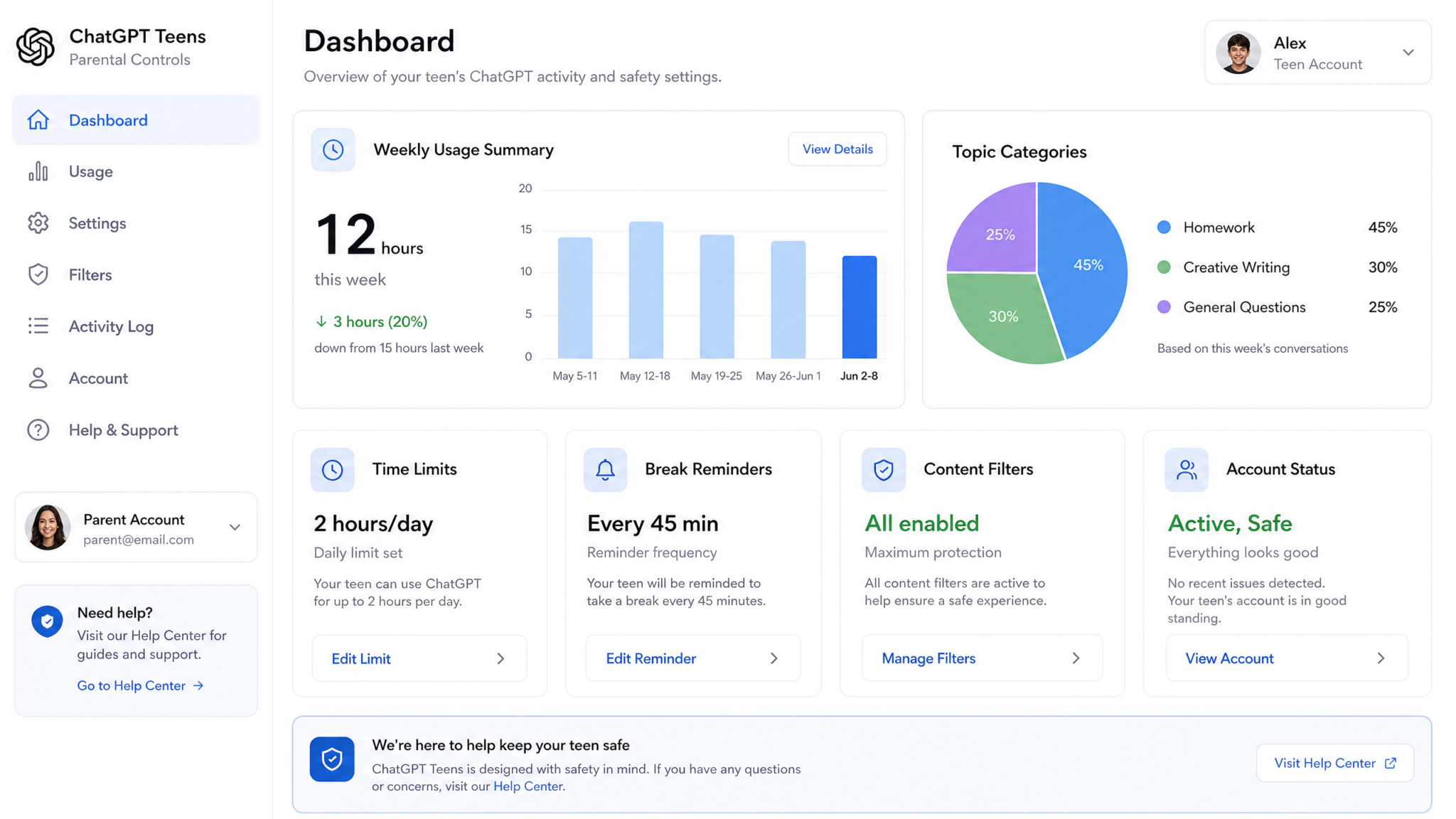
The parental controls dashboard is arguably the most politically and ethically complex component of ChatGPT for Teens, because it sits at the intersection of two competing values: parental rights to supervise minor children and teenagers’ legitimate interest in conversational privacy. OpenAI’s design philosophy here is clearly informed by the backlash experienced by other companies — most notably Apple and Google — when parental monitoring tools were perceived as excessively invasive or, conversely, when platforms were criticized for giving parents too little visibility.
What Parents Can See
The dashboard, accessible via family.chatgpt.com after a linking process that requires both parent and teen to confirm the relationship, provides the following information to parents and guardians:
- Total usage time broken down by day and week, with comparison to the prior week
- Peak usage hours displayed as a heat map showing when the teen is most actively using the platform
- High-level topic categories derived from conversation analysis (e.g., “School / Homework,” “Creative Writing,” “Science and Technology,” “Entertainment”) without revealing specific conversation content
- Content filter trigger count — the number of times enhanced filters were engaged in a given period, without disclosing what triggered them or the content of the exchange
- Feature usage breakdown showing how much time was spent in text chat, voice mode, and image generation respectively
- Weekly report summaries in the same format sent directly to the teen user
What Parents Cannot See
Equally important — and a deliberate design choice that OpenAI has been explicit about — is what the dashboard does not reveal. Parents cannot read the actual text of their teen’s conversations. They cannot see specific prompts entered or responses received. They cannot access voice transcripts. This privacy boundary was a central recommendation from the child development experts OpenAI consulted during the product’s development, who argued that teens who believe their private communications are being read by parents are significantly less likely to engage with educational tools authentically and more likely to use workarounds.
Controls Available to Parents
Beyond monitoring, the dashboard gives parents active control over the teen experience through the following levers:
- Daily time limits: Parents can set a maximum number of hours per day the teen account can be active, with the system automatically pausing access when the limit is reached
- Scheduled access windows: Parents can restrict ChatGPT access to specific hours (e.g., blocking it after 10 PM or during school hours)
- Pause access: A one-tap option to immediately suspend all account access, useful during family time or exam periods
- Feature approval queue: Any new features or capabilities require parental approval before the teen can access them; parents receive push notifications when their teen requests access to a new capability
- Break reminder customization: Parents can adjust the interval for break reminders, set them to more frequent intervals, or — in limited circumstances — extend them for supervised educational use
- Topic restriction overrides: For specific educational contexts, parents can temporarily adjust content filtering thresholds (e.g., allowing more detailed discussion of historical violence for a history curriculum project)
The account linking process itself has been designed with careful attention to prevent teens from linking fake “parent” accounts created by themselves or peers. OpenAI requires the parent account to be associated with a payment method, verified email address, and to pass a brief age verification check. The linking invitation is sent only to the parent, not initiated by the teen.
Break Reminder System: Design, Logic, and Customization
The break reminder system has attracted more media commentary than perhaps any other single feature of ChatGPT for Teens, partly because it represents something genuinely new in AI product design: a system intentionally built to reduce engagement rather than maximize it. This is a meaningful departure from the design philosophy that has governed most consumer technology for the past two decades.
According to Dr. Priya Raman, a pediatric behavioral health consultant who worked with OpenAI’s team during development, the 60-minute default interval was selected based on a synthesis of research on adolescent attention spans, screen fatigue literature, and guidelines from the American Academy of Pediatrics regarding total daily screen exposure. “Sixty minutes is not a magic number,” Raman told reporters at the August 18 press event, “but it represents a reasonable inflection point where we see cognitive fatigue beginning to accumulate in adolescent users, and where a brief interruption consistently improves subsequent engagement quality.”
How the Reminder Works in Practice
The reminder is not a hard stop. When a teen has been in continuous active use for 60 minutes, a full-screen overlay appears with a gently animated graphic — designed to be calming rather than alarming — and a message along the lines of “You’ve been working hard for an hour. Taking a 5-minute break can help you think more clearly and retain what you’ve learned.” The teen is given three options: take a 5-minute break (which starts a visible countdown timer), take a 10-minute break, or dismiss the reminder and continue. The third option does not disable future reminders for the session; another reminder will appear after an additional 30 minutes if the user dismisses the first one.
Crucially, usage time spent in break mode does not count against parental daily time limits, which prevents a perverse incentive where teens would rush through breaks to preserve their allowed usage time. The break screen offers a handful of suggested offline activities — brief stretches, hydration reminders, a look outside — drawn from a database that updates weekly.
Customization Options
Parents can adjust the reminder interval through the parental controls dashboard within a range of 30 minutes (minimum) to 90 minutes (maximum). They cannot disable reminders entirely for standard home use, though OpenAI has indicated a separate “supervised classroom” mode — discussed in more detail in the schools section — allows teachers to temporarily adjust reminder settings during structured instructional periods. Teens themselves can adjust the visual theme and tone of the reminder screen (choosing from several design options) but cannot change the timing intervals.
Usage analytics from OpenAI’s beta testing phase, conducted with approximately 8,500 teen users across twelve countries over a four-month period, found that 74 percent of teens who received break reminders voluntarily took at least a five-minute break when prompted. Post-session surveys conducted during the beta indicated that 81 percent of teen participants reported feeling that the reminders were “helpful” or “neutral” rather than “annoying” or “intrusive,” suggesting the design has largely achieved its intent of making healthy screen habits feel supported rather than policed.
Privacy Implications for Minors: COPPA, Data, and Consent
Privacy experts have been scrutinizing ChatGPT for Teens with particular intensity since the announcement, and with good reason. The intersection of conversational AI — which by its nature ingests highly personal information through the substance of users’ questions and conversations — and minor users — who are afforded the highest level of legal data protection in most jurisdictions — creates one of the most complex privacy compliance challenges in contemporary technology.
COPPA Compliance and the Age Threshold Question
The Children’s Online Privacy Protection Act (COPPA) in the United States applies to users under the age of 13, which is why ChatGPT for Teens begins at age 13 rather than covering younger children. OpenAI has stated clearly that users under 13 are not permitted to use any version of ChatGPT, and the new age verification system has been designed to identify and block accounts registered by younger children more reliably than the previous system, which relied largely on self-reported birthdates.
For users between 13 and 17 — the group covered by the new teen product — COPPA’s requirements are less prescriptive, but the platform is now subject to a patchwork of state-level laws (California’s Age-Appropriate Design Code, Texas’s equivalent, and the federal KOSPA legislation passed in 2025) that collectively impose significant constraints on data collection, algorithmic personalization, and marketing directed at minors.
What Data Is Collected from Teen Accounts
OpenAI’s privacy policy for teen accounts, published in full alongside the product announcement, specifies that the following data is collected from teen users:
- Account information (name, email address, date of birth, linked parent/guardian account)
- Session metadata (timestamps, session duration, feature usage types — not conversation content)
- Aggregate topic classification derived from conversation analysis (the high-level categories visible in parental dashboard)
- Content filter trigger events (recorded as binary flags, not including conversation content)
- Device type and operating system for compatibility purposes
What Data Is Not Collected from Teen Accounts
The policy is equally specific about what is not collected or retained. Conversation transcripts from teen accounts are processed in real-time for safety filtering but are not stored beyond the session unless the teen or parent explicitly enables conversation history. Even when conversation history is enabled (which requires parental authorization), the retention period is capped at 30 days and cannot be extended. Teen account data is not used to train OpenAI’s models — this opt-out is applied automatically and cannot be reversed by the teen user. Behavioral profiling for advertising purposes is entirely prohibited, a provision that goes beyond what is legally required in most jurisdictions but which OpenAI has committed to as a baseline standard.
Parental Consent Architecture
The consent model for ChatGPT for Teens requires parental consent for the teen account to operate at all. A teen cannot complete registration without a linked parent account, and the parent must complete a multi-step consent process that includes reviewing a plain-language summary of what data is collected, confirming their own identity, and explicitly acknowledging the scope of monitoring capabilities they will and will not have. The consent process has been reviewed by PRIVO, a COPPA Safe Harbor program administrator, and OpenAI has disclosed that it has applied for Safe Harbor certification under PRIVO’s framework.
How Schools Are Responding
The education sector’s reaction to ChatGPT for Teens has been more nuanced and varied than the broadly positive response from parent advocacy groups. School administrators, teachers, and educational technology directors are grappling with a product that could either become a powerful classroom tool or a new vector for academic integrity problems — and many note that the distinction may depend entirely on how it is implemented.
The Supervised Classroom Mode
One of the features that has most interested educators is a “Supervised Classroom” configuration that OpenAI has announced for schools. This mode, accessible through a separate institutional account structure, allows verified teachers to create a managed environment for student use within a classroom context. In Supervised Classroom mode, the teacher functions as the primary oversight administrator (rather than a parent/guardian), with visibility into aggregate class-level usage rather than individual student monitoring. Teachers can set the scope of conversations to specific subject areas, provide pre-approved prompt templates, and disable features irrelevant to the lesson plan.
The National Education Association, reached for comment by CBS News shortly after the announcement, released a statement calling the Supervised Classroom feature “a constructive step” while cautioning that “the implementation details, particularly around student data privacy when schools are the institutional account holder, will require careful scrutiny before widespread adoption.” The American Federation of Teachers was more enthusiastic, with a spokesperson noting that “a version of AI that is designed to teach rather than replace thinking is exactly what educators have been asking for.”
Districts with Prior ChatGPT Bans Reconsidering
Across the United States, an estimated 340 school districts had active policies restricting or banning ChatGPT use on school networks as of the start of the 2025–2026 academic year, according to the EdTech Policy Center at Georgetown University. Several of the largest of these — including the Los Angeles Unified School District, which banned ChatGPT on district devices in 2023 before partially reversing that decision — have indicated they are in active review processes to determine whether ChatGPT for Teens’ classroom features warrant updating their policies.
Access 40,000+ AI Prompts for ChatGPT, Claude & Codex — Free!
Subscribe to get instant access to our complete Notion Prompt Library — the largest curated collection of prompts for ChatGPT, Claude, OpenAI Codex, and other leading AI models. Optimized for real-world workflows across coding, research, content creation, and business.
The academic integrity concern remains live, however. While ChatGPT for Teens is tuned to guide rather than generate, educators are acutely aware that content policies can be circumvented, and that the gap between “helping a student think through an essay” and “writing the essay for them” is often a matter of how questions are framed. Dr. Marcus Webb, director of academic integrity at the University of Chicago Laboratory Schools, told The New York Times: “The Socratic mode is admirable in design. What we need to see is how it performs against determined, clever seventeen-year-olds in practice, not in a controlled beta.”
International School Responses
In the United Kingdom, the Department for Education has published initial guidance indicating that ChatGPT for Teens “merits serious consideration as a supervised educational tool” while noting that schools should await formal review by the Children’s Commissioner’s Office before making institutional commitments. In Australia, the New South Wales Department of Education — which has been among the more progressive in developing AI literacy curriculum — announced the day after the OpenAI launch that it would pilot the Supervised Classroom mode across 25 state schools beginning in Term 4 of 2026.
Competitor Comparison: Google, Meta, and Apple
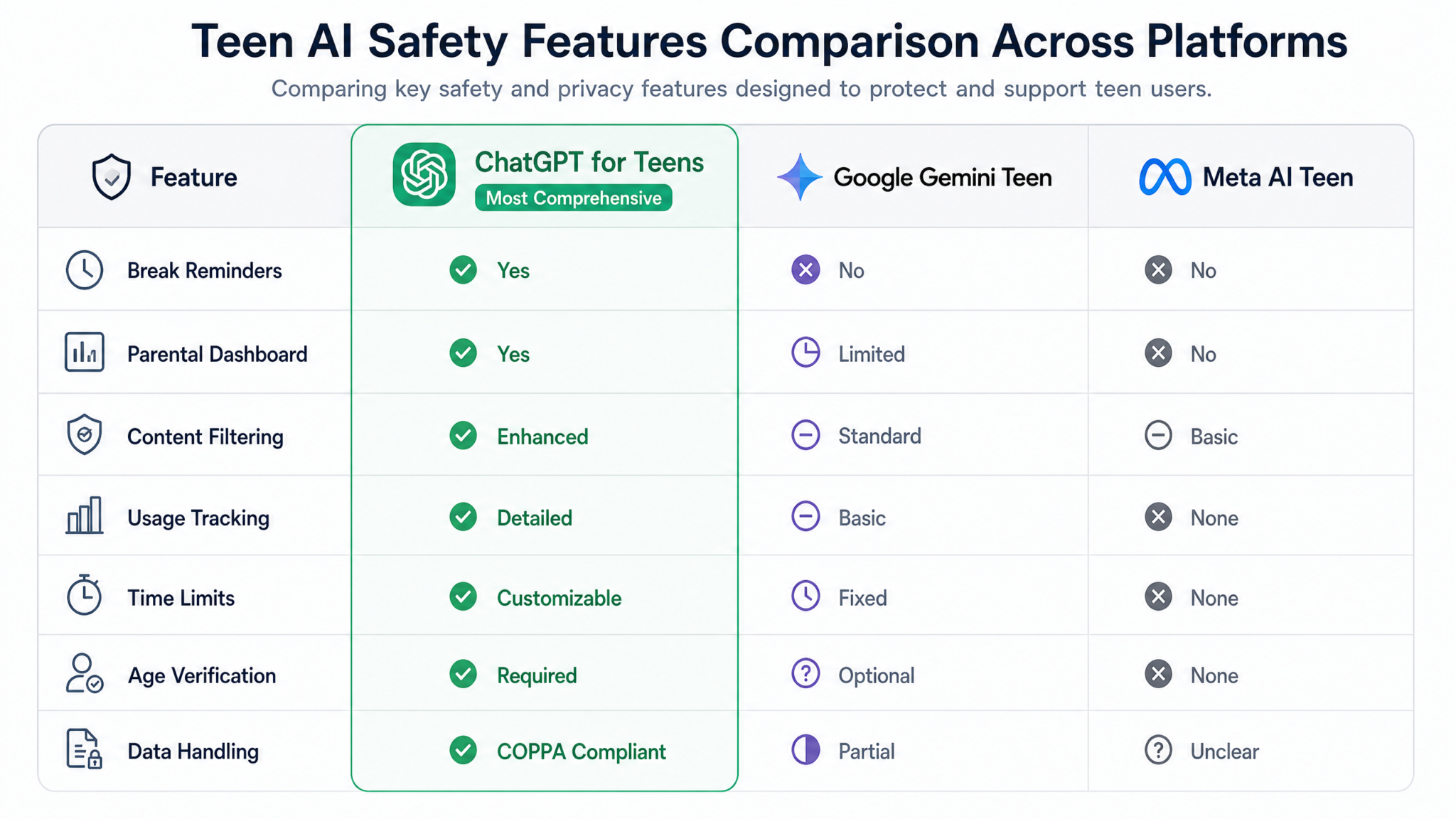
OpenAI’s teen safety launch does not exist in a vacuum. It arrives at a moment when every major technology company with AI-powered products is scrambling to demonstrate responsible deployment to regulators, parents, and the public. The competitive landscape in teen AI safety is rapidly evolving, and OpenAI’s August 18 announcement effectively raises the floor for what a credible teen safety framework must include.
Google’s Teen AI Policies
Google has taken a phased approach to teen AI safety across its portfolio. For Gemini, Google’s flagship AI assistant, users under 18 are automatically subject to SafeSearch-equivalent content filtering, and accounts registered as minors in Google Family Link are subject to usage monitoring through the Family Link interface. However, Google has not yet implemented break reminders, dedicated teen-specific account tiers, or the kind of topic-category visibility that OpenAI’s parental dashboard provides. Google’s approach has generally prioritized integration with existing parental controls infrastructure rather than building teen-specific AI features from scratch.
Meta’s Teen Protections
Meta’s position is complicated by the fact that its AI assistant, Meta AI, is deeply embedded in Instagram, Facebook, and WhatsApp — platforms that have been at the center of the adolescent mental health debate for the better part of a decade. Meta introduced teen account protections for Instagram in late 2024, including automatic sensitivity filters and parental supervision tools, and has extended some of these protections to Meta AI interactions within those apps. However, the Meta AI standalone experience remains less rigorously age-differentiated than OpenAI’s new offering, and Meta’s history with teenage user data makes many privacy advocates skeptical of its self-regulatory commitments in this area.
Apple’s Screen Time Integration
Apple occupies an interesting position in this landscape because it does not own an AI product that teenagers use as a primary learning or productivity tool in the way that ChatGPT or Gemini are used. However, iOS 18’s Screen Time framework has been updated to include AI application-specific controls, and Apple has confirmed that ChatGPT for Teens — through the OpenAI integration built into iOS 17 and later — will respect Screen Time limits set by parents. This creates a potentially powerful dual-layer protection for teens using iPhones: parental controls at the operating system level via Screen Time and at the application level via OpenAI’s own dashboard.
| Feature | ChatGPT for Teens (OpenAI) | Gemini Teen Mode (Google) | Meta AI Teen (Meta) |
|---|---|---|---|
| Dedicated teen account tier | Yes — purpose-built | Partial — Family Link integration | Partial — app-level settings |
| Break reminders | Yes — 60-min default | No | No |
| Parental dashboard | Comprehensive, privacy-respecting | Via Google Family Link | Limited, app-specific |
| Conversation privacy from parents | Protected — no transcript access | Protected | Variable by app |
| Content filter layer depth | Three-layer architecture | SafeSearch-equivalent | Sensitivity filters |
| Training data opt-out for minors | Automatic, irrevocable default | Available, not auto-applied | Not clearly disclosed |
| Weekly usage reports | Yes — teen and parent versions | Via Family Link reports | No |
| Classroom / educator mode | Yes — Supervised Classroom | Google Classroom integration | No |
| Independent safety audit | Yes — Thorn partnership | Not disclosed | Not disclosed |
Community Reaction: Parents, Educators, and Privacy Advocates
The announcement triggered an immediate and wide-ranging public conversation. Social media discussion, measured by social listening firm Brandwatch in the 24 hours following the launch, revealed broadly positive sentiment among parents (68 percent positive) and educators (61 percent positive), with more mixed reactions from teenagers themselves (43 percent positive, 31 percent neutral, 26 percent negative — with the negative sentiment concentrated primarily around the perceived invasion of privacy through the parental dashboard).
Parent Advocacy Groups
Parent organizations were largely enthusiastic. Common Sense Media, one of the most widely respected voices in digital wellbeing advocacy, gave the launch what its executive director called “a cautious thumbs up,” saying the organization was “encouraged by the structural commitment to privacy-preserving oversight but will be closely monitoring whether the content filtering performs as described in real-world conditions.” The Parent Coalition for Student Privacy was more restrained, calling for independent audits of the data collection practices before encouraging widespread adoption.
Teenager Perspectives
Perhaps the most revealing responses came from teenagers themselves. A vox pop published by the BBC on August 19 captured a range of views from UK teens aged 14 to 17. Several appreciated the break reminders, with one 15-year-old quoted as saying, “I actually think the break reminders would be helpful. I sometimes lose track of time and my neck gets sore.” Others were more critical of the parental oversight elements: “My parents knowing what topics I’m talking about, even without reading my messages, feels like being watched. I’d probably just use a different AI,” said a 17-year-old from Manchester.
This observation points to what experts call the “circumvention risk” — the very real possibility that teens who object to the monitoring framework will simply migrate to less regulated AI tools. Joanna Stern, technology correspondent for The Wall Street Journal, raised this point directly in her first-day review: “OpenAI can build the most responsible teen AI product in the world, and it will still lose to the apps that ask for nothing in return.”
Privacy Advocates
Privacy advocacy organizations offered some of the most detailed and technically substantive responses. The Electronic Frontier Foundation published a lengthy analysis acknowledging that ChatGPT for Teens represents “a significant improvement over the previous status quo” while identifying several concerns. Chief among them: the topic classification system, even without disclosing conversation content, creates metadata that could be sensitive (a teen who frequently queries health-related topics, for example, could indirectly reveal health concerns through their topic category data). The EFF also raised questions about data security — noting that a breach of the parental dashboard could expose a meaningful record of teenagers’ intellectual and personal interests even without full conversation transcripts.
What This Means for AI Adoption Among Young People
The broader significance of OpenAI’s teen product extends well beyond the immediate feature set. It represents a pivotal moment in the normalization of AI as a routine tool in adolescent life — and the terms on which that normalization occurs will shape a generation’s relationship with AI in ways that are difficult to overstate.
Research published in the Journal of Educational Technology in June 2026 found that students who used AI tutoring tools in structured, educationally-appropriate settings consistently outperformed control groups on measures of conceptual understanding (though not on rote memorization tasks). The same research found that unstructured AI use, where students could freely generate answers without engaging with the reasoning behind them, was associated with decreased performance on subsequent assessments. ChatGPT for Teens’ Socratic engagement model appears directly informed by this and similar research.
The question of digital equity also comes into sharp focus with a teen-specific AI product. A study by the Pew Research Center published in early 2026 found that teenagers in higher-income households were significantly more likely to use AI tools for homework and creative projects than their lower-income peers — and more likely to receive guidance from parents or teachers about using AI responsibly. A product that requires active parental engagement for setup and maintenance may inadvertently deepen this equity gap, as parents who are less tech-literate or who work multiple jobs may struggle to configure the parental dashboard and engage with weekly reports.
OpenAI has announced a dedicated program — ChatGPT Families — to address this concern, partnering with community organizations, public libraries, and after-school programs to provide free digital literacy workshops for parents and teens. The program is launching initially in ten US cities with the highest concentrations of low-income families and will expand to a further thirty cities over the following twelve months.
Global Rollout Timeline
ChatGPT for Teens launched simultaneously in the United States, Canada, the United Kingdom, Australia, and New Zealand on August 18, 2026. OpenAI has published a phased global rollout schedule, which it has acknowledged will require jurisdiction-specific adaptations to comply with local laws governing minor users.
| Region / Country | Launch Phase | Expected Date | Notes |
|---|---|---|---|
| US, Canada, UK, Australia, New Zealand | Phase 1 (Launch) | August 18, 2026 | Full feature set available |
| European Union (20 member states) | Phase 2 | October 2026 | GDPR and DSA compliance adaptations required |
| Japan, South Korea, Singapore | Phase 2 | October 2026 | Localized content filtering for regional standards |
| Brazil, Mexico, Argentina, Colombia | Phase 3 | Q1 2027 | LGPD compliance; Portuguese/Spanish localization of parental dashboard |
| India | Phase 3 | Q1 2027 | Digital Personal Data Protection Act compliance; multi-language support |
| Sub-Saharan Africa (initial 8 countries) | Phase 4 | Q2 2027 | Connectivity-optimized version; partnership with local telcos |
| Middle East (GCC countries) | Phase 4 | Q2 2027 | Regional content policy adaptations |
| China | Not currently planned | TBD | Subject to regulatory environment |
The EU launch in Phase 2 is particularly complex because the Digital Services Act imposes strict requirements on algorithmic systems that present content to minor users, and the EU’s General Data Protection Regulation (GDPR) sets the age of digital consent at 16 in several member states (versus 13 in the US and UK). This means that in countries including Germany, Austria, and the Netherlands, the parental consent requirement for ChatGPT for Teens will extend to users aged 13 through 15 rather than 13 through 17, requiring a modified account architecture for the European deployment.
OpenAI has confirmed that it is in pre-notification discussions with the Irish Data Protection Commission (its primary GDPR supervisory authority) and with the EU’s AI Office, which has oversight responsibilities under the EU AI Act for AI systems deployed to minors.
Expert Analysis and Final Verdict
Assessing ChatGPT for Teens honestly requires acknowledging both the genuine significance of what OpenAI has built and the substantial uncertainties that surround it. This is a more thoughtful, more structurally rigorous approach to teen AI safety than anything that has come before in the industry. The parental controls dashboard navigates a genuinely difficult tension between oversight and privacy more skillfully than most observers anticipated. The break reminder system is an industry first — a piece of technology deliberately designed to reduce its own use — and its existence signals a meaningful shift in how at least one major AI company is thinking about responsible product design.
At the same time, several critical questions remain unanswered. The three-layer content filtering architecture has been described in broad strokes but has not been subjected to independent red-teaming by outside security researchers or safety organizations. The claim that conversation content is not stored beyond the session — a central privacy assurance — will require independent audit to verify in practice. The circumvention risk remains real and significant; a determined teenager who objects to the oversight framework has no shortage of less-regulated alternatives.
Dr. Safiya Noble, author and professor at UCLA whose research focuses on algorithmic accountability, offered what may be the most balanced assessment, speaking to NPR on August 19: “OpenAI deserves credit for treating teen users as a distinct category requiring distinct protection, rather than simply defaulting to the same experience they provide adults. But credit for good intentions is not the same as a clean bill of health. The systems that claim to protect young people must be continuously audited by people who are not OpenAI, accountable to standards that are not set by OpenAI, and responsive to feedback from the communities most affected. That work begins today, not ends.”
For parents trying to make practical decisions right now, the evidence suggests that ChatGPT for Teens — used in conjunction with the parental dashboard and in households where parents and teens can have open conversations about AI use — represents a meaningfully safer option than the standard ChatGPT interface for a 14-year-old. Whether it represents the right balance of safety, privacy, and educational utility for every teenager in every context is a question that only time, and rigorous independent evaluation, will answer.
What is certain is that the launch of ChatGPT for Teens marks the end of a brief, anomalous period in which the most powerful AI tools ever built were deployed to millions of adolescent users with essentially no age-appropriate design consideration whatsoever. Whatever its imperfections, this product represents the industry’s acknowledgment that the status quo was untenable — and a first serious attempt to do better.
OpenAI has opened a feedback portal at feedback.chatgpt.com/teens for parents, educators, and teens to submit reports on the product’s real-world performance. The company has committed to publishing quarterly transparency reports on teen safety metrics beginning in Q4 2026. Whether that commitment is honored — and whether the reports contain the level of detail that independent researchers and regulators need to evaluate the product’s actual safety — will be among the most important things to watch in the months ahead.
OpenAI Safety Policy Updates and Responsible AI Development
Key Takeaways
- ChatGPT for Teens launched August 18, 2026 in five English-speaking markets with global rollout planned through Q2 2027
- Teen accounts include automatic safety defaults, break reminders, parental dashboard, enhanced content filtering, and usage reporting
- The parental dashboard provides high-level visibility while protecting conversational privacy — a deliberate design balance
- Teen accounts do not use conversation data for model training, retain data for a maximum of 30 days, and cannot access adult content under any circumstances
- The Supervised Classroom mode offers educators structured integration options with teacher-level oversight
- OpenAI’s approach benchmarks favorably against Google, Meta, and Apple in most dimensions but has not been independently audited
- Circumvention risk — teens migrating to less-regulated AI tools — remains the most significant unresolved challenge
- The launch represents a structural shift in how AI companies are approaching minor user safety and sets a new industry standard for teen AI product design
