
The Codex Hackathon Winners Playbook: What 2,989 Developers Built and the Patterns Behind the Best AI Coding Projects
Inside the OpenAI Codex Hackathon: What 2,989 Developers Built and Why It Matters
When OpenAI launched the Codex Hackathon, it wasn’t positioning the event as a casual weekend experiment. With 2,989 registered developers submitting projects across a compressed timeline, the competition became one of the most revealing stress-tests of agentic AI coding in recent memory. Winners weren’t just people who wrote clever prompts — they were engineers who understood the architecture of human-AI collaboration at a systems level, who picked the right tools, structured their pipelines with surgical precision, and shipped working software under pressure.
This playbook is a forensic dissection of what those 2,989 developers built. It identifies the recurring architectural patterns that separated winning projects from mediocre ones, breaks down the technology stacks that kept appearing at the top of the leaderboard, and extracts actionable lessons you can carry directly into your own Codex-powered development. Whether you missed the hackathon or placed in the top 50 and want to understand why, everything here is designed to make your next AI coding project structurally stronger.
The Codex model — OpenAI’s code-specialized reasoning system built on top of the o3 architecture — represents a qualitative shift from autocomplete to autonomous software engineering. The hackathon made that shift concrete. Developers who treated Codex as a smarter GitHub Copilot underperformed dramatically compared to those who used it as an orchestrating agent with persistent context, tool access, and multi-step planning capability. The gap between those two mental models is the central story of this playbook.
Hackathon Format, Rules, and Judging Framework
Understanding the constraints is prerequisite to understanding the winning strategies. The Codex Hackathon ran as a short-burst competition — participants had access to the Codex API through OpenAI’s platform, with rate limits calibrated to discourage brute-force generation approaches and reward thoughtful pipeline design. Projects were submitted as live demos paired with technical writeups, and judges evaluated them across four primary axes: technical implementation quality, real-world utility, creativity and novelty, and code quality generated by the Codex agent itself.
Submission Categories
The hackathon organized submissions into four official tracks, each with its own judging weight for technical depth versus accessibility:
- Developer Tools — Projects that enhance the development experience itself, from AI-powered code review systems to documentation generators and test suite builders
- Productivity Applications — Consumer and enterprise tools that use Codex to automate knowledge work, typically involving code that manipulates data, APIs, or document workflows
- Agentic Systems — Multi-step autonomous pipelines where Codex takes a high-level objective and executes a sequence of actions without per-step human intervention
- Research and Education — Projects applying Codex to scientific computing, tutoring systems, or novel research workflows that required domain-specific code generation
Judging Criteria Breakdown
| Criterion | Weight | What Judges Actually Measured |
|---|---|---|
| Technical Implementation | 35% | Robustness of the pipeline, error handling, API design, agent coordination logic |
| Real-World Utility | 30% | Would an actual developer, researcher, or business user pay for this tomorrow? |
| Creativity and Novelty | 20% | Does it demonstrate a use case that wasn’t obvious before Codex existed? |
| Code Quality | 15% | Is the code Codex generates idiomatic, safe, and production-ready? |
A critical nuance here: “creativity” was consistently interpreted by judges not as surface-level novelty but as architectural imagination — using Codex in ways that revealed new capability surfaces. Projects that simply wrapped the API in a chat interface scored poorly on this dimension regardless of polish. Projects that chained Codex with external memory systems, domain-specific tool registries, or dynamic context management scored highly even when their UIs were rough.
Rate Limits and Resource Constraints
Participants operated under real resource constraints that shaped architectural decisions in profound ways. The API access tier provided to hackathon participants imposed token-per-minute and request-per-minute limits that made naive approaches — looping Codex calls without caching, regenerating unchanged context on every turn — computationally expensive and practically slow. Top performers built caching layers, context compression strategies, and selective regeneration logic into their systems from day one. This wasn’t optimization as an afterthought; it was foundational design.
Taxonomy of Winning Projects: What Actually Got Built
Across 2,989 submissions, clear thematic clusters emerged when you analyze winning and highly-ranked projects. Rather than a random distribution of ideas, the successful projects concentrated heavily in six categories that shared a common property: they solved problems where code generation was the critical bottleneck, not a peripheral convenience.
Category 1: Autonomous Code Review and Refactoring Agents
The single largest cluster of top-performing projects involved Codex as a code reviewer with agency — not just flagging issues but proposing, writing, and in some cases automatically applying fixes. What distinguished the winners from basic linters with LLM commentary was the use of persistent file-system access, multi-pass review cycles, and structured output schemas that allowed downstream tooling to parse and act on Codex’s suggestions programmatically.
The best project in this category maintained a rolling “technical debt registry” — a structured JSON document that Codex updated across sessions, tracking which refactoring tasks it had identified, attempted, completed, and which had introduced regressions. This stateful approach transformed a single-shot generation tool into something resembling a junior engineer with memory.
Category 2: Multi-Repository Documentation Systems
Several winning teams tackled the universal developer pain point of outdated documentation. Their systems used Codex to traverse repository file trees, extract function signatures and docstrings, infer missing context from surrounding code, and generate coherent documentation that was both accurate and readable. The key architectural insight: documentation generation was structured as a map-reduce problem, with Codex handling individual module documentation in parallel before a synthesis step assembled cross-cutting concerns into a coherent whole.
Category 3: Test Generation and Coverage Optimization
Automated test generation appeared in dozens of submissions, but the winning implementations shared one distinguishing feature: they used Codex not just to write tests but to reason about coverage gaps. By feeding Codex both the source code and the existing test suite, winners prompted the model to identify which execution paths lacked coverage, then generate targeted tests for exactly those gaps. This closed the loop between generation and validation in a way that shallow test generators don’t.
Category 4: Domain-Specific Code Synthesis
Some of the most technically impressive projects operated in specialized domains — bioinformatics pipelines, financial modeling scripts, infrastructure-as-code generation — where the value of Codex was amplified by domain context injection. These projects built rich system prompts that embedded domain conventions, regulatory constraints, and style guides, effectively creating a fine-tuned-like experience through sophisticated prompting without any actual fine-tuning. Codex API prompt engineering strategies
Category 5: Conversational IDE Integrations
Several teams built deep integrations with development environments — VS Code extensions, JetBrains plugins, and Neovim configurations — that gave Codex awareness of the entire project context, not just the current file. These systems fed Codex the dependency graph, recent git history, open issues from GitHub, and the user’s current cursor position to generate contextually relevant suggestions. The winners in this category demonstrated that context management was more valuable than model sophistication — the same Codex model produced dramatically better output when given structured project context versus a bare code snippet.
Category 6: Agentic Task Execution Systems
The Agentic Systems track produced the most architecturally ambitious projects. These weren’t applications that used Codex as a feature — they were systems where Codex was the orchestrator, dispatching tasks to specialized tools, interpreting results, handling errors, and driving toward a high-level goal over multiple turns. One first-place contender built a system that could accept a product requirements document and autonomously scaffold an entire Next.js application, including database schema, API routes, component library, and deployment configuration. The human’s role was reviewing the output, not guiding each step.
The Four Core Architectural Patterns of Top Performers
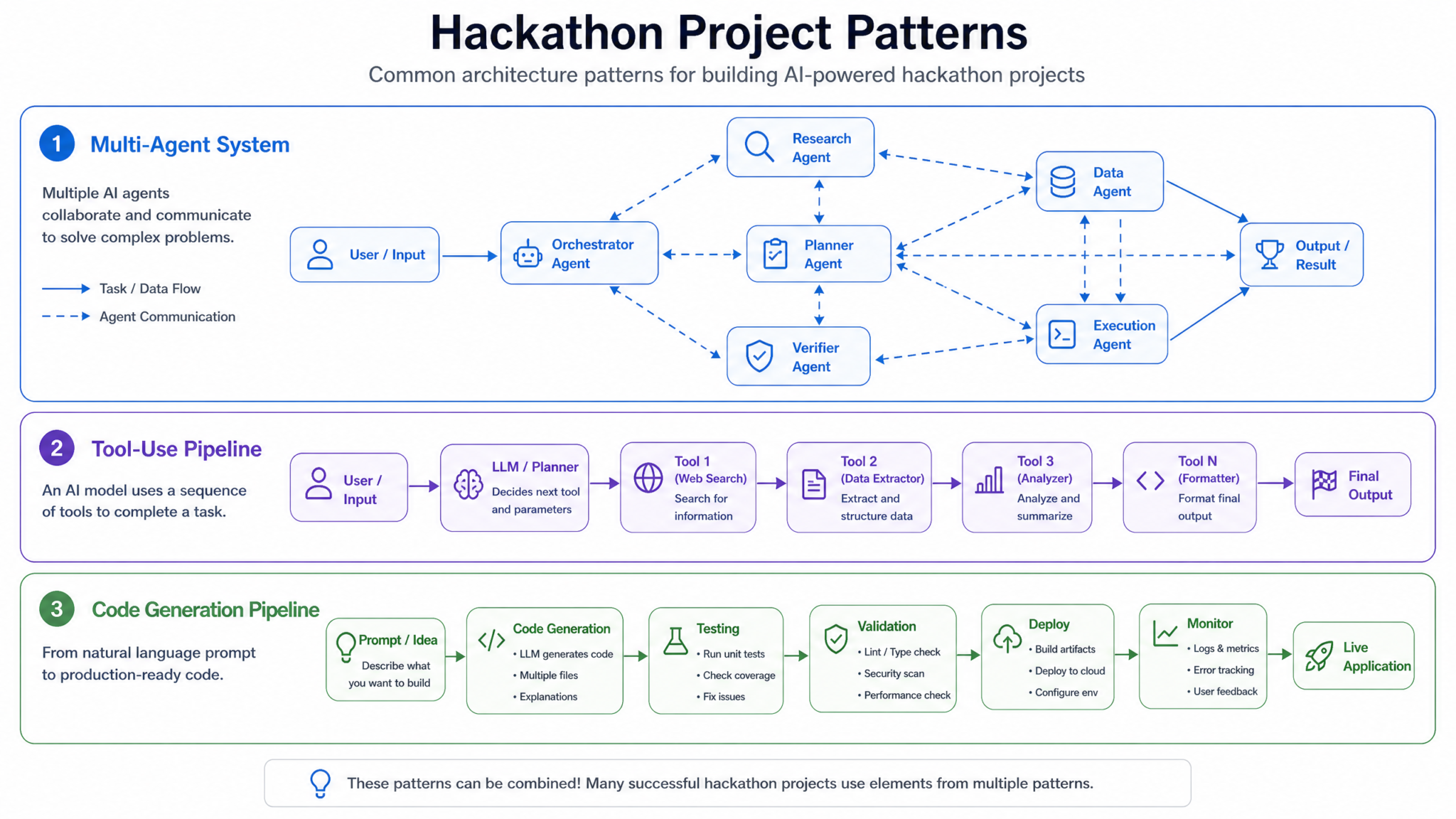
Across all categories, four architectural patterns appeared consistently in the top-ranked submissions. These aren’t frameworks or libraries — they’re structural approaches to organizing Codex-powered systems that can be applied regardless of your technology stack or problem domain.
Pattern 1: The Hierarchical Task Decomposer
The most successful agentic systems separated planning from execution. Instead of asking Codex to simultaneously understand a problem, plan a solution, and write code, winning teams used a two-layer architecture: a planner layer that broke high-level objectives into structured task lists, and an executor layer that implemented individual tasks and reported results back to the planner. This mirrors classical hierarchical task network planning in AI, adapted for LLM agents.
The practical implementation looked like this in most winning projects:
PLANNER PROMPT STRUCTURE:
System: You are a task decomposition engine. Given a high-level software objective,
produce a JSON task list where each task has: id, description, dependencies[],
expected_outputs[], validation_criteria, and estimated_complexity (1-5).
Do not write any code. Only plan.

User: Build a REST API that ingests CSV sales data, validates it against a schema,
stores it in PostgreSQL, and exposes aggregation endpoints with pagination.

OUTPUT:
{
  "tasks": [
    {
      "id": "T001",
      "description": "Define PostgreSQL schema for sales data table",
      "dependencies": [],
      "expected_outputs": ["schema.sql"],
      "validation_criteria": "Schema handles all CSV columns, includes indexes on date and product_id",
      "estimated_complexity": 2
    },
    {
      "id": "T002",
      "description": "Implement CSV validation layer with schema enforcement",
      "dependencies": ["T001"],
      "expected_outputs": ["validators/csv_validator.py"],
      "validation_criteria": "Rejects malformed rows, returns structured error list",
      "estimated_complexity": 3
    }
    // ... additional tasks
  ]
}
The executor then receives individual task descriptions with their dependency context already resolved — a much narrower and more tractable prompt than “build the whole thing.” This decomposition pattern consistently produced more coherent, maintainable code than end-to-end generation approaches.
Pattern 2: The Context Window Manager
Token limits impose hard constraints on what Codex can consider at any moment. Naive implementations dump everything available into the context window, but top performers built explicit context management systems that selectively included the most relevant information for each specific generation task. This wasn’t just about fitting within limits — it was about ensuring the most relevant information occupied the “high attention” positions in the context.
The pattern that appeared repeatedly was a three-tier context hierarchy:
- Permanent Context — Always included: project conventions, style guide, architectural constraints, security rules. Typically 500-1500 tokens, included in every system prompt.
- Task Context — Included per task: relevant file contents, related tests, recent git diff for modified files, database schema if the task involves data access. Dynamically assembled, typically 2000-6000 tokens.
- Ephemeral Context — Included only when directly relevant: error messages from the previous execution attempt, specific API documentation, performance profiling results. Injected inline with the user prompt.
Teams that formalized this hierarchy produced more consistent output than those that treated context as monolithic. The separation also made debugging easier — when Codex produced incorrect output, you could identify which context tier contained the conflicting or missing information.
Pattern 3: The Validation-Regeneration Loop
The most robust projects didn’t trust Codex output directly — they built automated validation pipelines that tested generated code before surfacing it to the user, and fed failures back to Codex for correction. This closed-loop approach turned the inherently probabilistic nature of code generation into a more deterministic process through iteration.
A clean implementation of this pattern:
async def generate_with_validation(task, max_attempts=3):
    attempt = 0
    feedback_history = []

    while attempt < max_attempts:
        # Generate code with accumulated feedback
        code = await codex_generate(
            task=task,
            previous_failures=feedback_history
        )

        # Run automated validation suite
        results = await run_validation(code, task.validation_criteria)

        if results.all_passed:
            return CodeResult(code=code, attempts=attempt+1)

        # Collect structured failure feedback
        failures = [
            {
                "test": r.test_name,
                "expected": r.expected,
                "actual": r.actual,
                "error": r.error_message
            }
            for r in results.failed_checks
        ]

        feedback_history.append({
            "attempt": attempt + 1,
            "code_generated": code,
            "failures": failures
        })

        attempt += 1

    # Return best attempt with failure report if max retries exceeded
    return CodeResult(
        code=code,
        attempts=max_attempts,
        unresolved_issues=feedback_history[-1]["failures"]
    )
The critical insight from winning teams was structuring the feedback passed back to Codex. Vague feedback like "this didn't work" produced poor corrections. Structured feedback including the test name, expected behavior, actual behavior, and full error output produced dramatically better second-attempt code. The validation-regeneration loop is also where most teams discovered that three attempts was the empirical sweet spot — beyond three rounds of feedback, Codex often started introducing new issues while fixing old ones.
Pattern 4: The Tool Registry with Dynamic Selection
Top agentic systems gave Codex access to a curated registry of tools — functions it could invoke to interact with external systems — and used dynamic tool selection rather than passing the full tool list on every call. The tool registry pattern has become standard in LLM agent frameworks, but the winning implementations added a layer of sophistication: a pre-selection step that identified which tools were relevant to the current task before assembling the tool definition objects to include in the Codex API call.
| Tool Category | Common Tools in Winning Projects | Why Selective Inclusion Matters |
|---|---|---|
| File System | read_file, write_file, list_directory, search_codebase | Including all FS tools when only reading adds noise; Codex may choose to write when it shouldn't |
| Execution | run_python, run_tests, run_linter, execute_shell | Execution tools dramatically increase risk surface; only include when execution is explicitly needed |
| External APIs | github_api, npm_registry, pypi_search, documentation_lookup | Domain-irrelevant APIs distract; pre-filter to task-relevant services |
| Memory | store_context, retrieve_context, update_task_status, log_decision | Memory tools should always be available; they're lightweight and high-value |
| Validation | run_type_checker, validate_schema, check_security, lint_code | Always include in executor layer, never in planner layer |
Technology Stacks: What the Top 10% Used
One of the most practically useful patterns that emerged from analyzing winning submissions was the convergence on specific technology combinations. While the Codex API itself is language-agnostic, the surrounding infrastructure choices made a measurable difference in what teams could build within the hackathon timeline.
Primary Language Choices
Python dominated — not because it's inherently better for AI applications, but because the tooling ecosystem for building Codex-powered systems is currently most mature in Python. The Codex model itself generates excellent Python, the available agent frameworks (LangChain, LlamaIndex, custom implementations) have their richest Python support, and the validation infrastructure (pytest, mypy, ruff) is battle-tested and easy to integrate. TypeScript/JavaScript projects were the second-largest group, primarily in the developer tools and IDE integration categories where JavaScript's ubiquity in the VS Code extension ecosystem was a strategic advantage.
Agent Orchestration Approaches
Interestingly, the winning teams were roughly split between using established agent frameworks and building custom orchestration from scratch. Teams that used frameworks tended to move faster in early development but sometimes hit ceiling limitations when their architectural requirements diverged from framework assumptions. Teams that built custom orchestration had steeper initial development curves but produced more tailored, often more performant systems.
For those building with frameworks, the patterns that appeared in top submissions included:
- Using LangGraph for stateful multi-agent workflows with explicit state transitions
- Building custom tool execution environments with sandboxed Python interpreters (using
subprocesswith strict resource limits or containerized execution with Docker) - Implementing conversation state as explicit data structures rather than relying on framework-managed message history
- Using Redis or SQLite as the persistence layer for cross-session context, avoiding in-memory state that doesn't survive restarts
For teams that consider building their own orchestration layer, understanding the fundamentals of OpenAI Agents SDK architecture provides the conceptual foundation for why the winning teams made their specific design choices.
Context Storage and Retrieval
Vector databases appeared in roughly 40% of top submissions, primarily as semantic search backends for code retrieval. The use case was consistent: rather than dumping entire codebases into context windows, winning teams embedded their codebase into a vector store and used semantic search to retrieve the most relevant files for each specific generation task. Chroma and Pinecone were the most common choices, with Chroma favored for its easy local development setup and Pinecone for projects that needed production-grade performance.
The embedding strategy mattered significantly. Teams that embedded entire files produced worse retrieval results than teams that chunked code at the function or class level, preserved docstrings and comments as part of the embedded text, and included file path and module name as metadata for filtering. Function-level chunking with rich metadata was the consistent winner for code retrieval quality.
Sandboxed Code Execution
Projects that executed Codex-generated code as part of their pipeline — which was essentially every project in the Agentic Systems category — converged on containerized execution as the security and reliability standard. The implementation pattern was a Docker container with a minimal Python environment, strict resource limits (CPU seconds, memory, network access), and a clean filesystem for each execution. Output was captured, parsed, and returned to the orchestration layer as structured data rather than raw stdout.
# Representative sandboxed execution pattern from winning projects

import subprocess
import json
import tempfile
import os

def execute_generated_code(code: str, timeout: int = 30) -> dict:
    with tempfile.TemporaryDirectory() as tmpdir:
        code_file = os.path.join(tmpdir, "generated_code.py")
        with open(code_file, "w") as f:
            f.write(code)

        result = subprocess.run(
            ["docker", "run", "--rm",
             "--memory=256m",
             "--cpu-quota=50000",  # 50% of one CPU
             "--network=none",     # No network access
             "--read-only",
             "-v", f"{tmpdir}:/workspace:ro",
             "python:3.11-slim",
             "python", "/workspace/generated_code.py"],
            capture_output=True,
            text=True,
            timeout=timeout
        )

        return {
            "success": result.returncode == 0,
            "stdout": result.stdout,
            "stderr": result.stderr,
            "returncode": result.returncode
        }
Prompt Engineering Strategies That Separated Winners from the Field
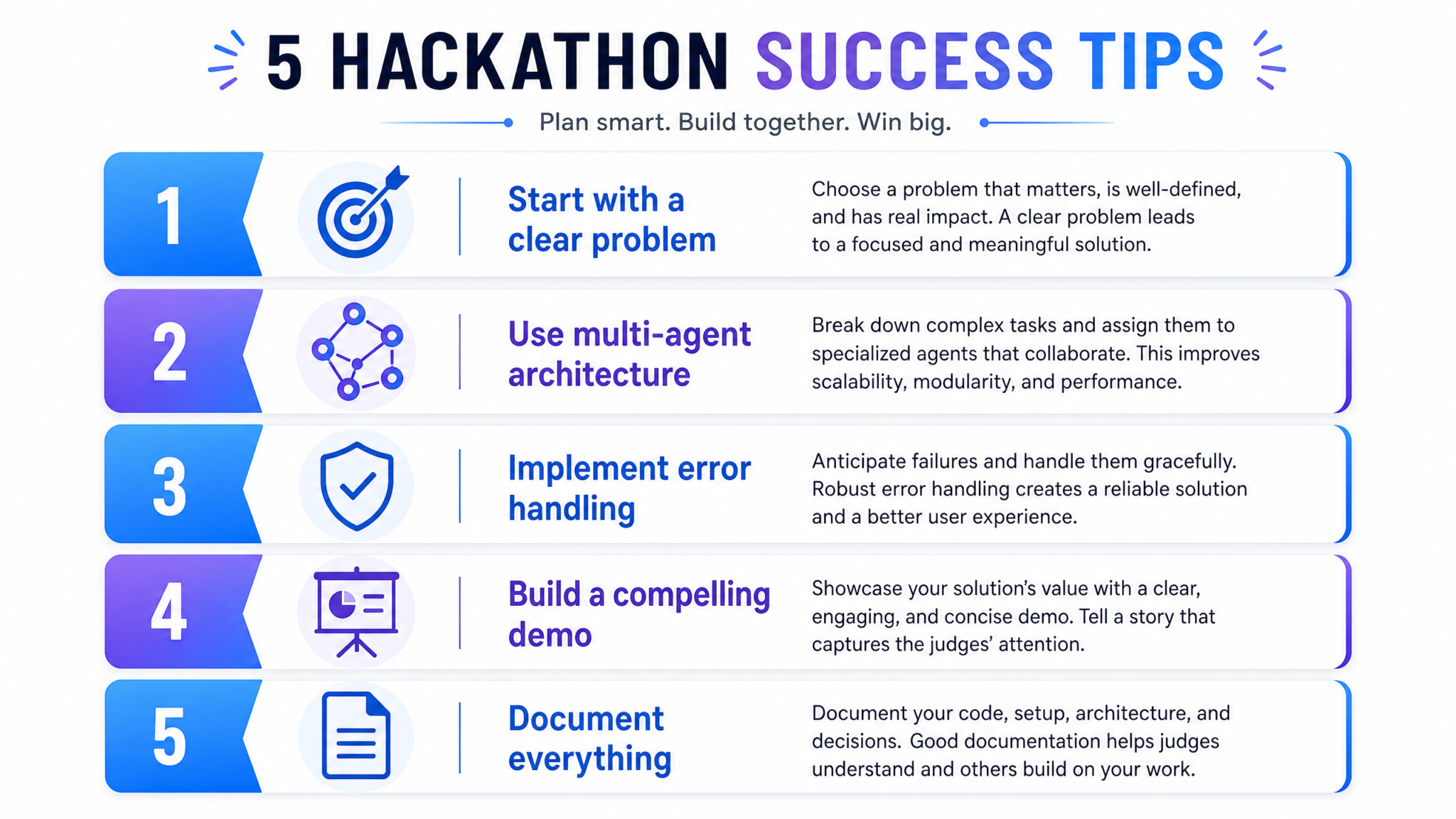
Technical architecture was necessary but not sufficient. The teams with the strongest architectural foundations still produced mediocre output when their prompting was imprecise. Conversely, sophisticated prompt engineering couldn't compensate for absent validation or poor tool design. The winning combination required both — and the prompt engineering dimension is where the most nuanced and transferable lessons live.
The Role-Constraint-Output Structure
Top performers consistently used a three-part prompt structure for generation tasks: an explicit role definition with relevant constraints, a precise task specification with success criteria, and an explicit output format specification. The order mattered. Role and constraints first — before the task — grounded the model's interpretation frame before it began processing the request.
# High-performing prompt structure for code generation

SYSTEM = """
You are a backend Python engineer specializing in FastAPI and async SQLAlchemy.
Your code must:
- Follow PEP 8 and use type hints throughout
- Handle errors with explicit exception types, never bare except clauses
- Use async/await for all database operations
- Include docstrings for all public functions
- Never hardcode credentials or configuration values
- Validate input using Pydantic models before processing

You are NOT permitted to:
- Install new dependencies not listed in the project requirements
- Modify existing database schema
- Change authentication logic
- Use deprecated Python features

Output format: Provide only the implementation code. No explanation text.
Precede the code with a brief COMMENT block listing assumptions made.
"""

USER = """
Task: Implement the /api/orders/aggregate endpoint.

Context:
- Database model: Order(id, user_id, product_id, quantity, amount, created_at)
- Existing auth middleware: request.state.user contains authenticated user object
- Required response schema: {"total_amount": float, "order_count": int,
  "by_product": [{"product_id": str, "total": float, "count": int}]}
- Pagination: cursor-based, using created_at as cursor field
- Filter parameters: date_from, date_to, product_id (all optional)

Success criteria:
- Returns correct aggregates for filtered date ranges
- Handles empty result sets without error
- Pagination works correctly with null cursor (first page)
"""
Few-Shot Examples for Consistent Style
For projects generating code that needed to integrate with existing codebases, winning teams consistently used few-shot examples drawn from the actual codebase — not generic Python examples, but real functions from the project that demonstrated the specific conventions, error handling patterns, and documentation style in use. This produced code that felt authored by the same developer who wrote the existing code, rather than stylistically incongruent AI output that required extensive reformatting.
The few-shot selection strategy that produced the best results: choose examples that demonstrate the hardest conventions to infer (error handling, logging, authentication patterns) rather than the easiest (naming conventions, imports). Codex can infer that you use snake_case from any example; it needs explicit examples to learn that your project logs errors with structured JSON and raises domain-specific exceptions rather than generic ValueError.
Chain-of-Thought for Complex Logic
For tasks involving non-trivial algorithmic logic — complex database queries, performance-critical algorithms, security-sensitive operations — winning teams used explicit chain-of-thought prompting before code generation rather than asking for direct output. The pattern was to prompt Codex to first write a plain-English explanation of its intended approach, then generate the code based on that plan, and finally generate tests that validate the plan's key assertions.
This three-step approach (plan → implement → validate) produced measurably fewer logical errors in complex generation tasks compared to single-shot direct generation. The planning step forced the model to surface assumptions and edge case handling decisions that would otherwise be implicit — and made it significantly easier to identify where reasoning went wrong when bugs appeared.
Negative Constraints as First-Class Citizens
A pattern unique to top performers was the explicit use of negative constraints — telling Codex what it must not do — as a primary prompt engineering technique rather than an afterthought. Beginners specify what they want; experts also specify what they don't want with equal precision. Negative constraints were particularly powerful for security-sensitive code generation and for maintaining architectural boundaries in large projects.
Examples of negative constraints that appeared repeatedly in winning projects' system prompts:
Access 40,000+ AI Prompts for ChatGPT, Claude & Codex — Free!
Subscribe to get instant access to our complete Notion Prompt Library — the largest curated collection of prompts for ChatGPT, Claude, OpenAI Codex, and other leading AI models. Optimized for real-world workflows across coding, research, content creation, and business.
- "Do not use eval() or exec() under any circumstances"
- "Do not use raw SQL string formatting — use parameterized queries exclusively"
- "Do not modify any file outside the /src/modules/{current_module} directory"
- "Do not add new npm dependencies — solve this using only currently installed packages"
- "Do not generate mock data inline — use the project's existing test fixtures"
Lessons Learned: What the Data Shows About Success and Failure
Post-hackathon analysis of submission quality relative to architectural choices produced some counter-intuitive findings. Several common assumptions about what makes AI coding projects successful turned out to be wrong, or at least more nuanced than the prevailing wisdom suggested.
Lesson 1: Model Quality Matters Less Than Context Quality
The single strongest predictor of project quality wasn't which specific model configuration teams used — it was the quality and structure of context provided to the model. Teams with sophisticated context management systems consistently outperformed teams relying on raw model capability. This has profound implications: the engineering effort spent on context curation, compression, and relevance filtering produces higher returns than equivalent effort spent on prompt phrasing or model selection.
Lesson 2: The First Working Version Compounds
Teams that got a minimal working pipeline running early — even with limited functionality — consistently outperformed teams that spent the first half of the hackathon on architecture planning. The working system provided a feedback loop for discovering where the real complexity lived, which almost always differed from where teams initially expected it. Architectural assumptions that seemed reasonable in planning revealed unexpected friction when actually executing against the Codex API. Early working systems let teams course-correct while there was still time. AI rapid prototyping best practices
Lesson 3: Error Handling Is Architecture, Not Implementation Detail
Projects that failed catastrophically in judging demos shared a common weakness: error handling was bolted on after the core pipeline was built, rather than being designed as a first-class architectural concern. The Codex API is a probabilistic system — it will occasionally return malformed JSON, truncated code, code that fails validation, or responses that simply don't address the prompt. Systems designed without explicit error state handling became brittle at exactly the moments they needed to be resilient — during live demos.
Winning projects treated every Codex API call as potentially returning an error state and built explicit recovery paths for each failure mode: malformed output, timeout, context window overflow, tool call failure, validation failure. The systems that impressed judges most were ones where you could observe Codex hitting an obstacle, recovering intelligently, and continuing — demonstrating that the agent understood failure as a normal part of operation, not an exceptional condition.
Lesson 4: Statelessness Is a Design Smell in Agentic Systems
A surprising number of strong individual capabilities fell flat in integrated demos because the underlying systems were stateless — each interaction with Codex started from scratch, with no memory of previous steps, decisions, or discovered context. Stateless systems work fine for one-shot generation tasks, but they're fundamentally inadequate for anything that requires multi-step reasoning or builds toward a complex output over multiple interactions.
The architectural resolution wasn't complex: maintain a structured state document alongside the conversation that records completed tasks, discovered constraints, decisions made, and accumulated project context. This state document gets included (or a compressed summary of it gets included) in each new Codex call, giving the model the equivalent of working memory across the session.
Lesson 5: Domain Expertise in the Prompt Beats Generic Instructions
For projects in specialized domains — bioinformatics, financial modeling, infrastructure automation — the teams that did deepest domain knowledge injection into their prompts produced dramatically better results than teams that treated Codex as a general-purpose code generator. Domain expertise in the prompt meant more than just vocabulary: it meant embedding the actual conventions, failure modes, performance characteristics, and regulatory constraints of the domain into the system prompt. domain-specific prompt engineering techniques
A bioinformatics project that embedded conventions about memory management for large genomic datasets, standard validation approaches for sequencing data, and common performance pitfalls in bioinformatic Python produced code that domain experts on the judging panel could read without wincing. The equivalent project with generic Python instructions produced technically correct but domain-naïve code that would have required extensive review before production use.
Applying These Patterns to Your Own Codex Projects
The architectural patterns and prompt strategies from the hackathon translate directly into practical guidance for building your own Codex-powered systems. The following section provides a structured approach to applying these lessons, organized as a project setup checklist and a pattern selection guide.
Pre-Build Architecture Checklist
Before writing a single line of orchestration code, work through these architectural decisions explicitly:
- Task decomposition strategy — Can your problem be broken into discrete tasks with clear inputs, outputs, and success criteria? If yes, build the planner-executor separation. If your problem is inherently sequential and can't be parallelized, a single well-structured pipeline may be more appropriate than a full multi-agent architecture.
- Context architecture — Define your three-tier context hierarchy before writing any prompts. What are your permanent conventions? What varies by task? What should only be included in specific circumstances? Document this explicitly and build your context assembly logic to reflect it.
- Validation strategy — How will you validate generated code before using it? Define your validation criteria at the task level, not the project level. Each task type may need different validation logic. Build the validation-regeneration loop infrastructure before you need it.
- State management approach — Will your system maintain state across multiple Codex calls? Define your state schema explicitly. Use typed data structures (Pydantic models in Python, TypeScript interfaces in Node.js) rather than free-form dictionaries.
- Error taxonomy — List the failure modes your system will encounter: API errors, malformed output, failed validation, tool execution errors, timeout. Define recovery strategies for each before any failures occur in production.
Pattern Selection Guide
| Your Project Type | Primary Pattern | Critical Infrastructure | Avoid |
|---|---|---|---|
| Single-file code generation | Validation-Regeneration Loop | Automated test runner, linter integration | Multi-agent overhead for simple tasks |
| Multi-file project scaffolding | Hierarchical Task Decomposer | File system tools, dependency graph tracking | End-to-end single-shot generation |
| Codebase-aware assistance | Context Window Manager + Vector Retrieval | Code embeddings, semantic search, function-level chunking | Full codebase in context window |
| Long-running autonomous agent | All four patterns combined | Persistent state store, sandboxed execution, tool registry | In-memory state, direct code execution |
| Domain-specific generator | Context Window Manager with rich system prompt | Domain knowledge base, few-shot example library | Generic prompts without domain constraints |
A Minimal Implementation Template
This template captures the core architectural decisions of winning projects in a minimal, extensible form:
from dataclasses import dataclass, field
from typing import Optional
import json

@dataclass
class ProjectState:
    """Persistent state document — include compressed version in every Codex call"""
    completed_tasks: list[str] = field(default_factory=list)
    discovered_constraints: list[str] = field(default_factory=list)
    architectural_decisions: dict = field(default_factory=dict)
    pending_tasks: list[str] = field(default_factory=list)

    def to_context_string(self) -> str:
        return f"""
PROJECT STATE:
Completed: {', '.join(self.completed_tasks) or 'None'}
Constraints discovered: {'; '.join(self.discovered_constraints) or 'None'}
Key decisions: {json.dumps(self.architectural_decisions, indent=2)}
"""

class CodexPipeline:
    def __init__(self, client, permanent_context: str):
        self.client = client
        self.permanent_context = permanent_context
        self.state = ProjectState()

    def _build_system_prompt(self, task_context: str) -> str:
        return f"""
{self.permanent_context}

{self.state.to_context_string()}

TASK CONTEXT:
{task_context}
"""

    async def execute_task(self, task: dict, tools: list[dict]) -> dict:
        """Execute a single planned task with validation-regeneration loop"""
        max_attempts = 3
        feedback = []

        for attempt in range(max_attempts):
            response = await self.client.responses.create(
                model="codex-mini-latest",
                instructions=self._build_system_prompt(task["context"]),
                input=self._build_task_prompt(task, feedback),
                tools=tools
            )

            # Validate output
            validation = await self.validate_output(response, task)

            if validation["passed"]:
                self.state.completed_tasks.append(task["id"])
                return {"success": True, "output": response, "attempts": attempt + 1}

            feedback.append(validation["failures"])

        return {"success": False, "output": response, "unresolved": feedback}

    def _build_task_prompt(self, task: dict, feedback: list) -> str:
        prompt = f"Task: {task['description']}\n\nSuccess criteria:\n"
        for criterion in task["validation_criteria"]:
            prompt += f"- {criterion}\n"

        if feedback:
            prompt += "\n\nPREVIOUS ATTEMPT FAILURES (fix these):\n"
            for i, failure_set in enumerate(feedback, 1):
                prompt += f"\nAttempt {i} failures:\n"
                for f in failure_set:
                    prompt += f"  - {f['test']}: expected {f['expected']}, got {f['actual']}\n"

        return prompt
Preparing for the Next Hackathon: Strategic Recommendations
The Codex Hackathon revealed not just what's currently possible with AI-assisted development but what capabilities are ripening for the next wave of competition. If you're preparing for a future hackathon — with Codex, OpenAI's next generation models, or any other code-capable AI system — the following strategic recommendations are grounded in the gap between what winning projects achieved and what they explicitly said they wished they'd had time to implement.
Build Your Infrastructure Layer Before the Event
The teams that competed most effectively had pre-built infrastructure they could drop into new projects: a context management library, a sandboxed execution environment, a validation pipeline framework, and a state management system. These aren't project-specific components — they're reusable foundations that apply to any Codex-powered application. Invest time before the hackathon building and testing these foundations so you can focus on application logic during the competition itself.
Develop a Prompt Library for Your Target Domain
If you know what domain you'll be working in, build a library of tested prompts before the event. This includes: role definition templates, domain constraint libraries, few-shot example collections, and negative constraint lists. The teams that could compose a high-quality system prompt in minutes rather than hours had a massive advantage over teams that were figuring out their prompting strategy mid-competition.
Master the Codex Responses API Specifically
The Codex model uses the Responses API, not the standard Chat Completions API. This distinction matters because the Responses API has different semantics for tool use, different streaming behavior, and different state management characteristics. Teams that were still figuring out API mechanics during the hackathon lost critical hours. Study the API deeply in advance, including edge cases around tool call handling, multi-turn conversation management, and error response formats.
Focus on Judging Criteria, Not Just Technical Ambition
The weight distribution in hackathon judging (35% technical, 30% utility, 20% creativity, 15% code quality) implies a specific resource allocation strategy. A technically complex project that nobody would actually use scores less than 65 points out of 100. A technically simpler project with compelling real-world utility and a creative angle can score 80+ points. The best projects genuinely solve a problem judges recognized as real, then demonstrate technical sophistication in service of that solution — not technical sophistication for its own sake.
Plan Your Demo Trajectory
Hackathon demos are performances. The projects that won weren't just technically strongest — they told a coherent story. Start with a problem statement that immediately resonates, demonstrate the system solving that problem end-to-end in under two minutes, then show one "wow" moment that reveals capability most people wouldn't expect. Every decision about what to build should factor in how it will demo, because the demo is the product in a hackathon context. Projects that worked perfectly but demoed confusingly placed below projects that were technically rougher but told their story clearly.
Embrace Narrow Scope with Deep Execution
The winning pattern across every category was narrow scope executed with extraordinary depth, not broad scope with shallow coverage. A project that does one thing — generates high-quality database migrations from schema diffs — and does it perfectly, handles edge cases, has clean output, and demonstrates reliable operation across diverse inputs, will consistently outperform a project that claims to handle the entire software development lifecycle but handles each piece partially. The instinct to build more features in hackathon conditions almost always backfires.
For developers looking to understand the broader landscape of what's possible when these patterns are applied at scale, reviewing AI agent development tutorials and projects provides both inspiration and concrete technical grounding for what these architectures look like in production beyond the hackathon context.
The Bigger Picture: What 2,989 Projects Tell Us About AI-Native Development
Step back from the individual patterns and architectural choices, and the Codex Hackathon reveals something more significant: a community of developers rapidly developing fluency in a genuinely new programming paradigm. The gap between top performers and median performers wasn't primarily a gap in AI knowledge — it was a gap in software engineering discipline applied to AI systems.
The developers who built the best projects approached Codex as a powerful but imperfect component in a larger engineered system, one that required the same careful API design, error handling, state management, and validation discipline they would apply to any third-party dependency. The developers who struggled treated it as magic — either expecting it to work without scaffolding or being surprised when its probabilistic outputs required systematic handling.
This engineering-first approach to AI development is the central lesson of the Codex Hackathon playbook. The architectural patterns documented here — hierarchical task decomposition, context window management, validation-regeneration loops, dynamic tool registries — are not AI-specific inventions. They're sound software engineering principles applied to the specific characteristics of large language model APIs: high capability, probabilistic output, context-sensitive performance, and powerful tool use.
As the Codex model and its successors become more capable, the value of these architectural principles won't diminish — it will increase. More capable models don't reduce the importance of good context management; they increase it, because the model can leverage rich context more effectively. More capable models don't make validation loops less important; they make them faster, because the model corrects more reliably on feedback. The engineering discipline documented here scales up with model capability rather than being replaced by it.
The 2,989 developers who participated in the Codex Hackathon collectively demonstrated that AI-native software development isn't a future state — it's happening now, by a community of practitioners who are actively defining its best practices. The patterns in this playbook represent the current state of that art. They'll evolve, but the engineering mindset behind them — rigorous, systematic, and deeply respectful of the practical constraints of AI systems — will remain the foundation of excellent Codex-powered development for as long as these systems exist.
Build with that mindset, apply these patterns deliberately, and the next hackathon won't just be an experiment. It'll be a showcase of what you already know how to do.
