
The 2-Minute Rule with ChatGPT: Clear Mental Clutter and Boost Productivity Using AI in 2026
The 2-Minute Rule with ChatGPT: Clear Mental Clutter and Boost Productivity Using AI in 2026
In the rapidly evolving landscape of professional productivity, staying mentally uncluttered and focused is paramount. As knowledge workers and busy professionals grapple with overflowing task lists, fragmented attention, and constant digital interruptions, harnessing effective productivity methodologies becomes a necessity. One such timeless but often underutilized tactic is David Allen’s Two-Minute Rule from his renowned Getting Things Done (GTD) system. Combined with the latest AI tools like ChatGPT, the Two-Minute Rule can be supercharged to optimize task management, clear mental clutter, and accelerate workflow efficiency in 2026.
Understanding David Allen’s GTD Methodology and the Two-Minute Rule Origin
David Allen’s Getting Things Done methodology revolutionized personal productivity by introducing a systemized approach to capturing, processing, and organizing tasks. At its core, GTD hinges on the idea of externalizing all “open loops” (incomplete commitments) into a trusted system, enabling a clearer mind and better decision-making.
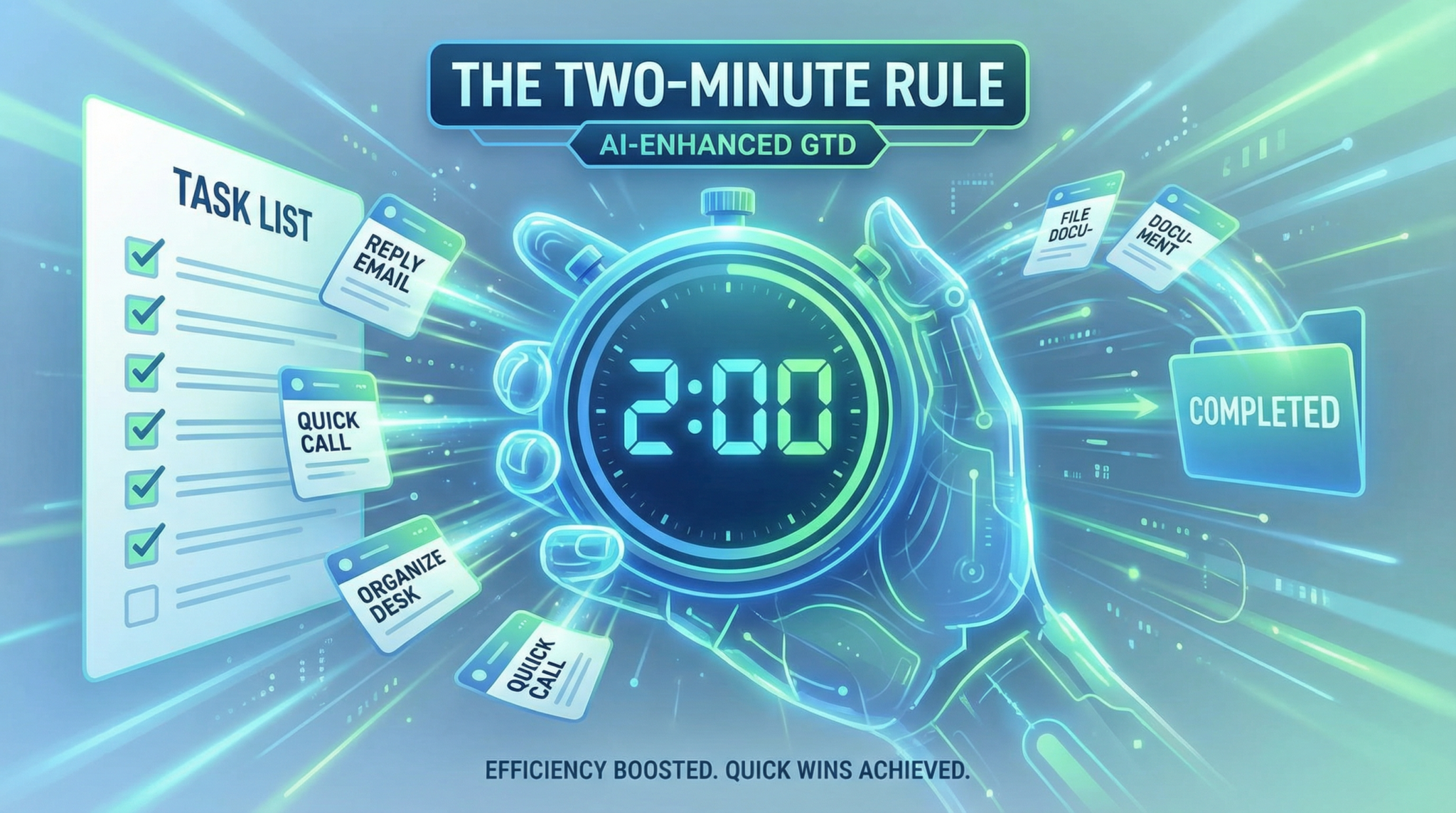
The Two-Minute Rule is a cornerstone principle within GTD. It advises that if a task can be completed in two minutes or less, do it immediately rather than deferring it. This simple directive dramatically reduces the buildup of trivial tasks and prevents small actions from clogging mental RAM.
Originating from Allen’s 2001 book Getting Things Done, the Two-Minute Rule is deceptively straightforward yet profoundly effective when applied consistently. It leverages the psychological principle that the cost of switching contexts to revisit small tasks often outweighs the effort of completing them instantly.
The Psychology of Open Loops and Mental RAM
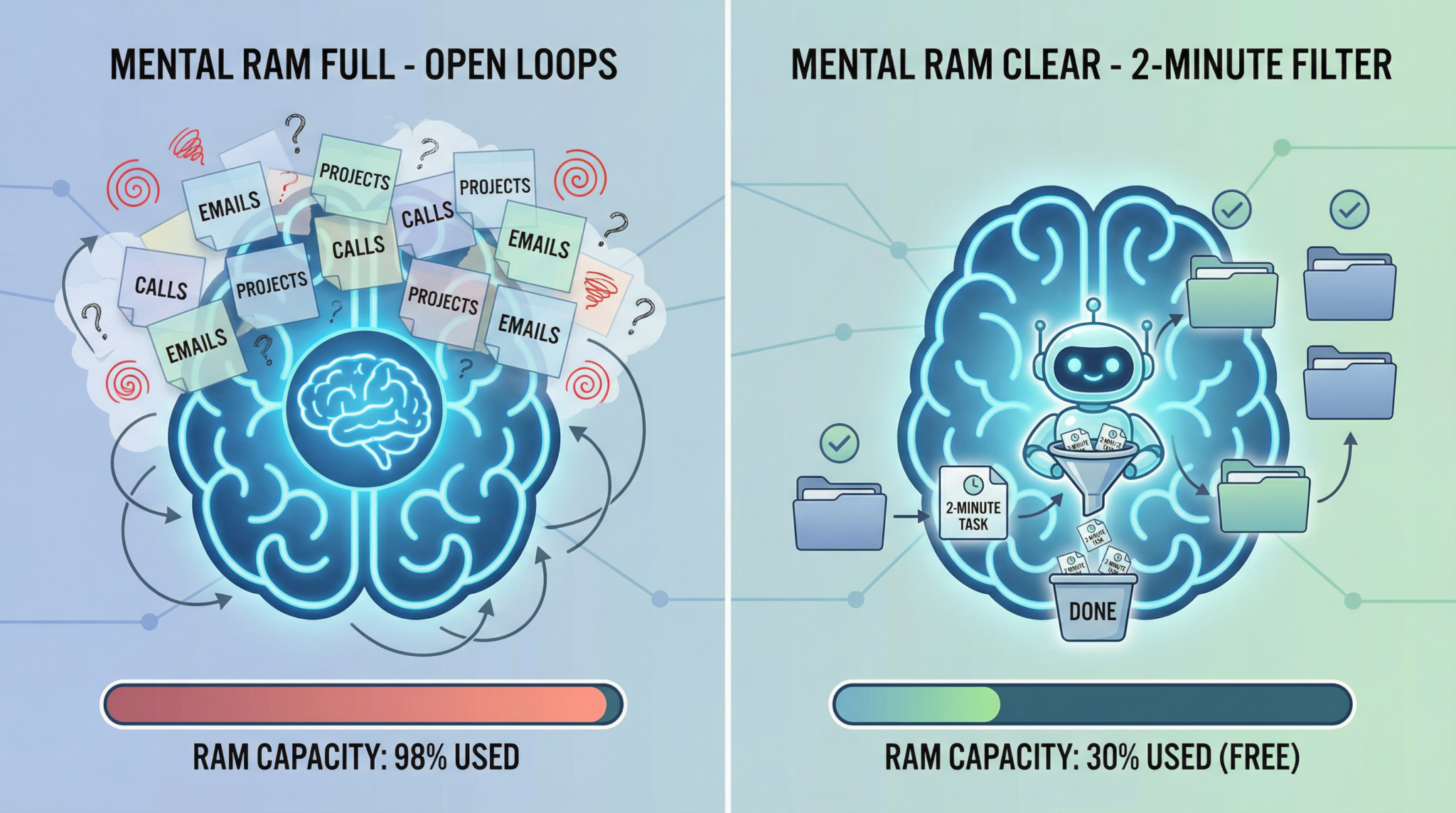
Human cognition has finite working memory capacity, often likened to a computer’s RAM. When we have multiple uncompleted tasks swirling in our minds — known as “open loops” — cognitive load increases, leading to stress, procrastination, and decision fatigue.
According to cognitive psychologist Dr. David Meyer, each open loop occupies precious mental resources, reducing focus on priority tasks and lowering overall productivity. Allen’s GTD approach externalizes these loops, transferring them from mental RAM into trusted external systems.
Without a trusted capture-and-process system, professionals experience mental clutter: nagging reminders, forgotten small tasks, and fragmented attention. The Two-Minute Rule diminishes mental clutter by quickly resolving minor action items, freeing up cognitive bandwidth for deeper work.
Using ChatGPT to Brain-Dump and Filter Two-Minute Tasks
In 2026, AI-powered assistants like ChatGPT are revolutionizing how professionals implement productivity frameworks. ChatGPT can act as a dynamic, always-available “external brain” to facilitate rapid brain-dumps and task triage.
Step 1: Brain-Dump with ChatGPT
Instead of juggling mental notes or scattered to-do lists, professionals can initiate a conversation with ChatGPT to capture all outstanding tasks, ideas, and commitments in one place. For example, prompt ChatGPT: “Here’s my current task list…” and input all items, no matter how small or complex.
Step 2: Filter Two-Minute Tasks
Once the full list is captured, ChatGPT can help identify which tasks qualify for the Two-Minute Rule. By analyzing the task descriptions, ChatGPT highlights quick-win actions that can be completed immediately, such as replying to a short email, scheduling a call, or filing a document.
This AI-enabled filtering saves time spent mentally estimating task complexity and encourages immediate execution of small tasks, clearing mental RAM efficiently.
Example ChatGPT Brain-Dump and Two-Minute Task Identification
- Respond to client email about project update
- Draft outline for upcoming presentation
- Pay utility bill online
- Schedule dentist appointment
- Research new CRM software options
ChatGPT can process this list and flag “Respond to client email,” “Pay utility bill online,” and “Schedule dentist appointment” as Two-Minute Rule candidates, prompting immediate action.

Automating Quick-Win Identification with ChatGPT
Beyond manual filtering, ChatGPT can be integrated into daily workflows to automate the identification of Two-Minute tasks using custom prompts and APIs. For example, professionals can develop scripts or plugins that scan inboxes, task managers, or note-taking apps and automatically flag Two-Minute tasks for immediate attention.
This automation eliminates decision paralysis by proactively presenting actionable tasks, streamlining task queues, and reducing procrastination triggers. Incorporating AI-driven quick-win identification into tools like Todoist, Microsoft To Do, or Notion is increasingly feasible and scalable.
Pro Tip: Set ChatGPT to Summarize and Prioritize Daily Tasks
Use ChatGPT to generate a prioritized daily action plan that highlights Two-Minute tasks first, followed by other prioritized activities based on deadlines and importance. This structured summary helps maintain momentum and reduces context-switching cost.
Combining the Two-Minute Rule with Other Frameworks: Eisenhower Matrix + 2-Minute Rule
The Two-Minute Rule’s power multiplies when integrated with traditional productivity frameworks like the Eisenhower Matrix, which categorizes tasks based on urgency and importance:
- Urgent & Important: Do immediately
- Important but Not Urgent: Schedule
- Urgent but Not Important: Delegate
- Not Urgent & Not Important: Eliminate
By first filtering tasks through the Eisenhower Matrix, professionals can isolate urgent and important tasks. Then, within this set, applying the Two-Minute Rule accelerates completion of quick urgent tasks, creating momentum and clearing the schedule for deeper work.
For instance, an urgent email requiring a brief response would be flagged as urgent & important and completed immediately under the Two-Minute Rule. Meanwhile, longer-term projects are scheduled or delegated appropriately.
This layered approach reduces overwhelm, prioritizes effectively, and leverages AI tools for rapid execution.
Real-World Implementation for Busy Professionals
Implementing the Two-Minute Rule with ChatGPT requires deliberate setup and consistent habits. Here’s a step-by-step guide tailored for busy knowledge workers in 2026:
Step 1: Establish Your Digital Capture System
Choose a task manager or note-taking app that integrates well with ChatGPT or supports easy data export. Examples: Notion, Todoist, Microsoft OneNote.
Step 2: Schedule Daily Brain-Dump Sessions with ChatGPT
Set a 10-15 minute daily ritual to input all pending tasks into ChatGPT. Use a prompt like “Here’s my task list” and paste your unprocessed items.
Step 3: Request ChatGPT to Flag Two-Minute Tasks
Use the prompt below (also included in this article) to identify and extract quick-win tasks actionable immediately.
Step 4: Act on Two-Minute Tasks Immediately
Complete all flagged tasks without delay. This reduces mental clutter and prevents task pile-up.
Step 5: Prioritize Remaining Tasks Using Eisenhower Matrix
Ask ChatGPT to help categorize remaining tasks or manually sort them using the matrix, then schedule or delegate accordingly.
Step 6: Automate Where Possible
Integrate ChatGPT routines with your digital planner or email inbox to scan and flag Two-Minute tasks automatically throughout the day.
Step 7: Review and Iterate Weekly
Review your task management workflow weekly, refining prompts and workflows to ensure maximum efficiency and minimal mental clutter.
Real-World Example: A Marketing Manager’s Day
Jane, a marketing manager, uses ChatGPT every morning to input her backlog of emails, meeting follow-ups, and project tasks. ChatGPT identifies that replying to a client’s quick question and sending a budget approval request are two-minute tasks. Jane completes these immediately, clearing them off her plate. She then schedules deeper tasks like campaign planning and market research for dedicated focus blocks later in the week. This approach reduces her stress and boosts her ability to focus on strategic priorities.
Act as a productivity coach renowned for the Two-Minute Rule, guiding someone seeking timesaving techniques. Your task is to explain the Two-Minute Rule and how to apply it for increased efficiency. Provide a clear understanding of the concept and offer practical insights on incorporating this rule into daily routines. Share examples of tasks suitable for the Two-Minute Rule and interpret on its positive impact on daily productivity. My first request is to: [Insert your task list here]
Access 40,000+ AI Prompts for ChatGPT, Claude & Codex — Free!
Subscribe to get instant access to our complete Notion Prompt Library — the largest curated collection of prompts for ChatGPT, Claude, OpenAI Codex, and other leading AI models. Optimized for real-world workflows across coding, research, content creation, and business.
Integrate AI and the Two-Minute Rule into Your Productivity Ecosystem
In 2026, knowledge workers who blend proven productivity frameworks with AI-powered assistants like ChatGPT are positioned to outperform peers burdened by mental clutter and inefficient workflows. The Two-Minute Rule, when enhanced with AI brain-dumping, automated quick-win identification, and integration with prioritization matrices, transforms overwhelming task lists into manageable, actionable plans.
By offloading mental RAM to AI and committing to immediate execution of small tasks, professionals reclaim focus, minimize procrastination, and create momentum for strategic work. The key is consistent practice, leveraging AI as a productivity partner rather than a passive tool.
For deeper insights and more actionable AI productivity techniques, explore our comprehensive AI productivity prompts guide and related articles on digital task automation and focus optimization.
Frequently Asked Questions
What types of tasks are best suited for the Two-Minute Rule?
Tasks that are simple, discrete, and require minimal time to complete—typically under two minutes—are ideal. Examples include answering short emails, scheduling appointments, filing documents, or making quick phone calls. These tasks often accumulate and clutter mental space if deferred.
How can ChatGPT help in applying the Two-Minute Rule?
ChatGPT assists by facilitating quick brain-dumps, analyzing task lists, and identifying which tasks qualify as two-minute actions. It can automate filtering, prioritize tasks, and generate daily plans focusing on immediate execution of quick wins, thereby reducing decision fatigue and mental clutter.
Can the Two-Minute Rule be combined with other productivity frameworks?
Yes. The Two-Minute Rule pairs effectively with frameworks like the Eisenhower Matrix by enabling immediate completion of urgent and important small tasks. This layered approach optimizes prioritization and ensures that quick tasks do not accumulate and distract from larger objectives.
How do busy professionals maintain the habit of executing two-minute tasks immediately?
Maintaining the habit requires consistent daily routines, such as scheduled brain-dump sessions with ChatGPT and a commitment to act immediately on flagged tasks. Automating task identification and integrating quick-win execution into existing workflows also help reinforce the behavior.

