
Wall of Context Prompting: The 2026 Technique That Is Replacing Long ChatGPT Prompts
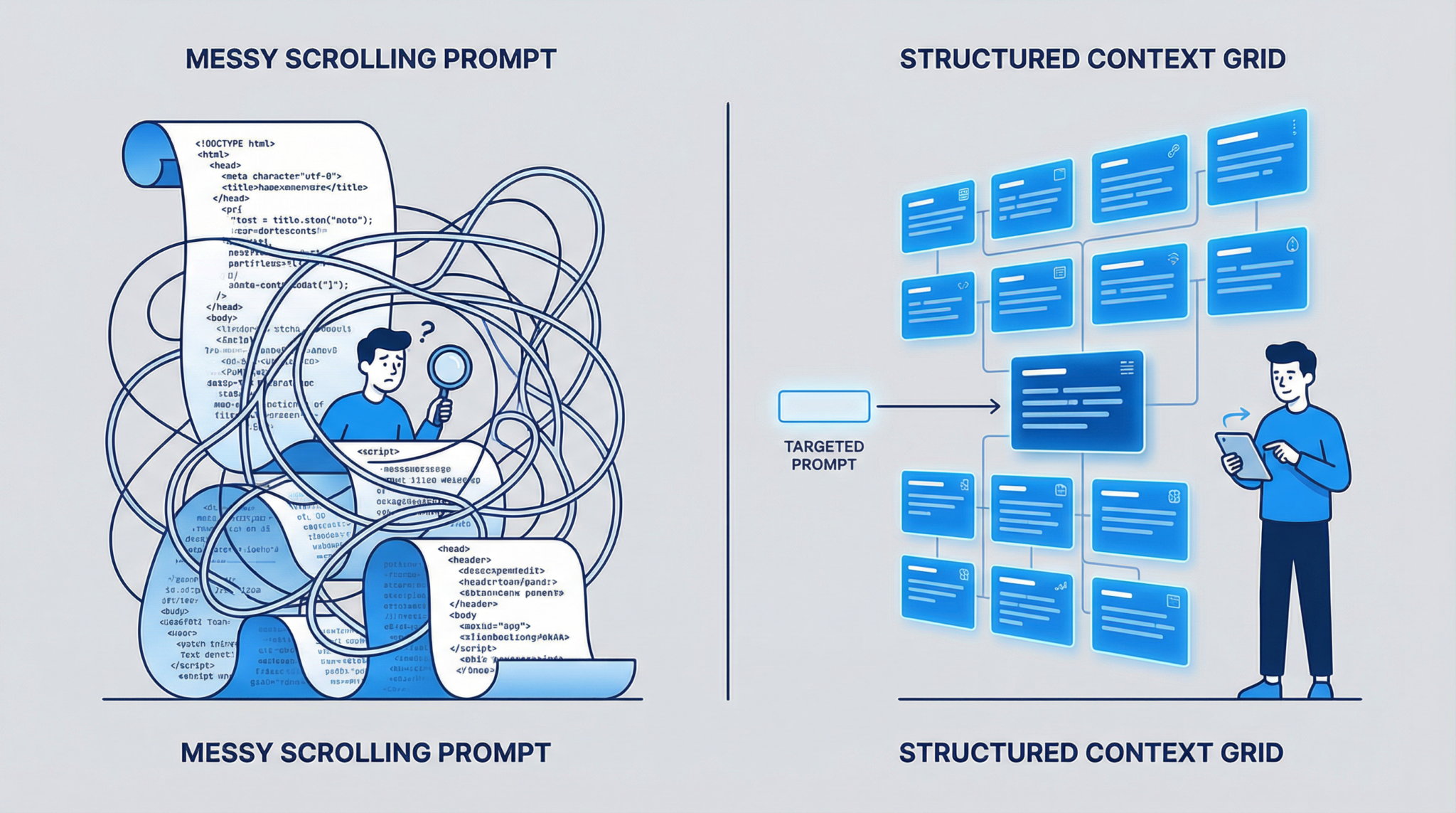
Mastering the Wall of Context and Advanced Prompting Techniques for 2026 AI Models
By Markos Symeonides
As AI language models evolve rapidly, the art and science of prompting have undergone a significant transformation. With the release of powerful 2026 models like GPT-5.4 and Claude 4.5, which boast larger context windows and enhanced instruction-following capabilities, traditional long-form prompts are no longer the most effective way to harness AI potential. Instead, a new paradigm—centered around the “Wall of Context” technique and complementary advanced prompting methods—is reshaping how we interact with AI to achieve more precise, consistent, and reliable outputs.
In this comprehensive guide, we delve into the Wall of Context technique, explore innovative strategies such as Chain-of-Verification prompting and style briefs, and discuss how these methods collectively form the foundation of modern “prompt architecture.” Whether you are a developer, researcher, writer, or business professional, mastering these approaches will elevate your AI interactions and results in 2026 and beyond.
Why Traditional Long Prompts Are Becoming Less Effective
For years, long, detailed prompts were the primary approach to coax AI models into producing high-quality outputs. Users combined intricate instructions, background information, and specific formatting requests within a single prompt. However, as AI models have grown more sophisticated, this approach has revealed its limitations:
- Context Saturation: Very long prompts can overwhelm the model’s processing, leading to diluted focus and reduced responsiveness to key instructions.
- Instruction Drift: The model may lose track of core instructions buried inside verbose prompts, resulting in inconsistent or off-target replies.
- Reduced Reusability: Crafting a long prompt for each task is inefficient; it limits flexibility and adaptability across different use cases or iterative workflows.
With the advent of 2026 AI models featuring context windows exceeding 32,000 tokens, we now have the bandwidth to rethink prompt structure. Instead of embedding instructions and context within the same prompt, the Wall of Context technique advocates pre-loading all relevant context separately, allowing subsequent prompts to be concise and sharply focused.
The Wall of Context Technique Explained
The Wall of Context is a prompting method where you provide a dense, comprehensive block of context information upfront — the “wall.” This context can include background knowledge, data, style guidelines, factual references, or any information relevant to the task. After establishing this foundation, you follow up with short, targeted prompts that query or instruct the model based on the pre-loaded context.
This technique exploits the massive context windows and improved instruction-following capabilities of 2026 models, enabling AI to maintain deep understanding without the need to repeatedly restate details.
Example:
Wall of Context prompt:
“Here is the full product catalog, including detailed specifications, pricing, and customer reviews. The catalog contains 50 products with their features, release dates, and stock availability. Please remember the catalog details for subsequent queries.”Follow-up prompt:
“Generate a concise summary comparing the top three laptops based on performance and customer feedback.”
In this example, the initial “wall” establishes a rich knowledge base. The model then references this stored information to answer the specific follow-up query efficiently without reprocessing all details each time.
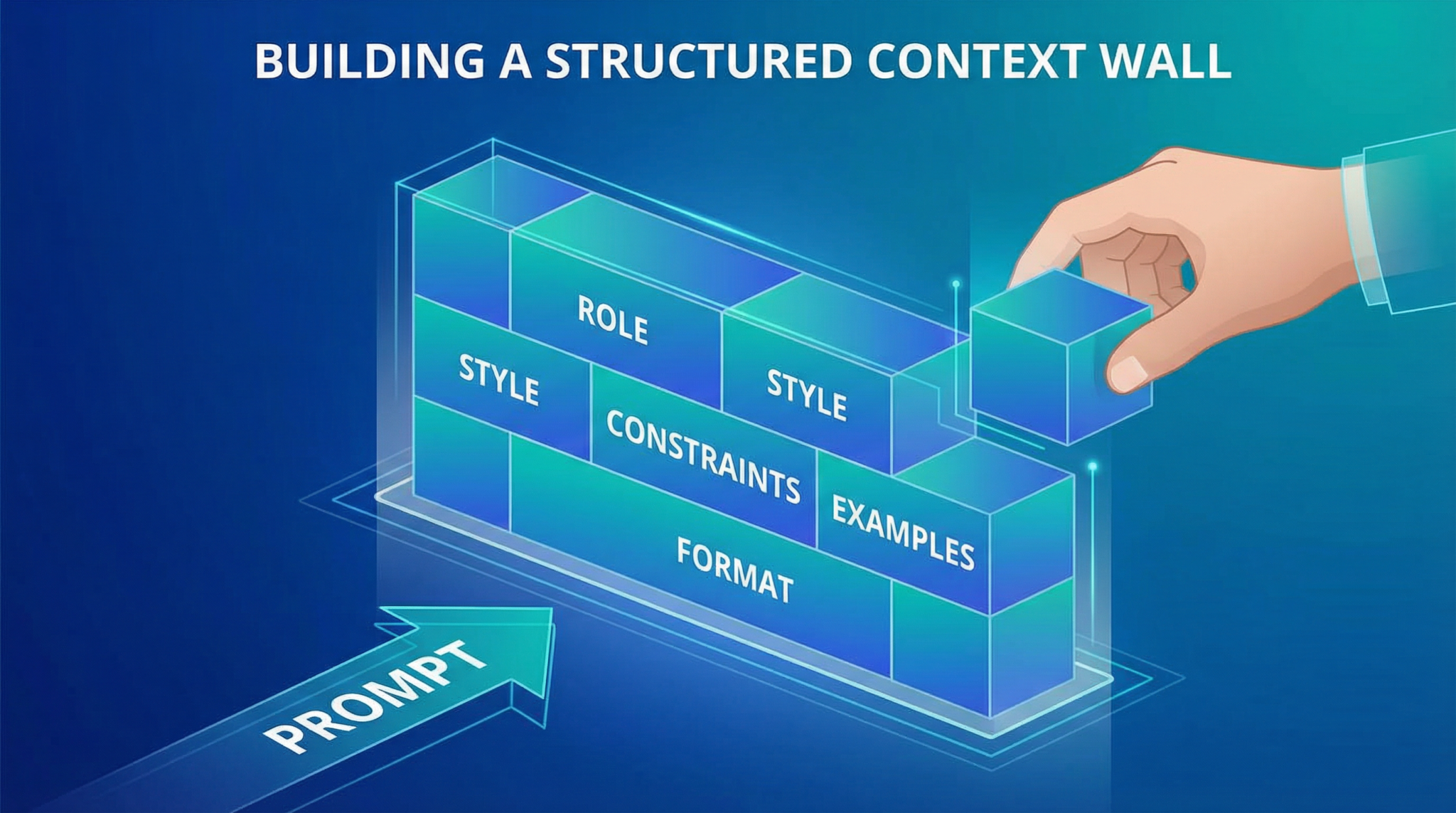
Structuring a Wall of Context for Different Use Cases
Effective walls differ based on the domain and task. Here’s how to tailor your Wall of Context for key applications:
Coding
- Include comprehensive codebase summaries, API references, function definitions, and coding standards.
- Provide environment details such as programming language versions, frameworks used, and deployment constraints.
- Example: Load a full project README, code snippets, and error logs upfront, then use concise prompts to request debugging or new feature implementation.
Writing
- Build walls with character backgrounds, plot outlines, style guides, and thematic notes.
- Incorporate examples of preferred tone, vocabulary, and pacing.
- Example: Supply an author’s style guide and prior chapter summaries, then prompt for a new chapter or scene with specific mood instructions.
Research
- Aggregate relevant papers’ abstracts, key statistics, and definitions.
- Provide hypotheses, methodology descriptions, and data sets.
- Example: Upload a comprehensive literature review text, then ask focused questions about gaps or trends.
Business
- Include company profiles, market analyses, product specs, and customer personas.
- Incorporate recent financial results, competitor summaries, and regulatory considerations.
- Example: Present a market report as a context wall, then request tailored marketing copy or strategic recommendations.
Structuring the Wall to be clear, logically ordered, and segmented with headings or bullet points enhances AI comprehension and retrieval accuracy.
Chain-of-Verification Prompting: Eliminating Hallucinations
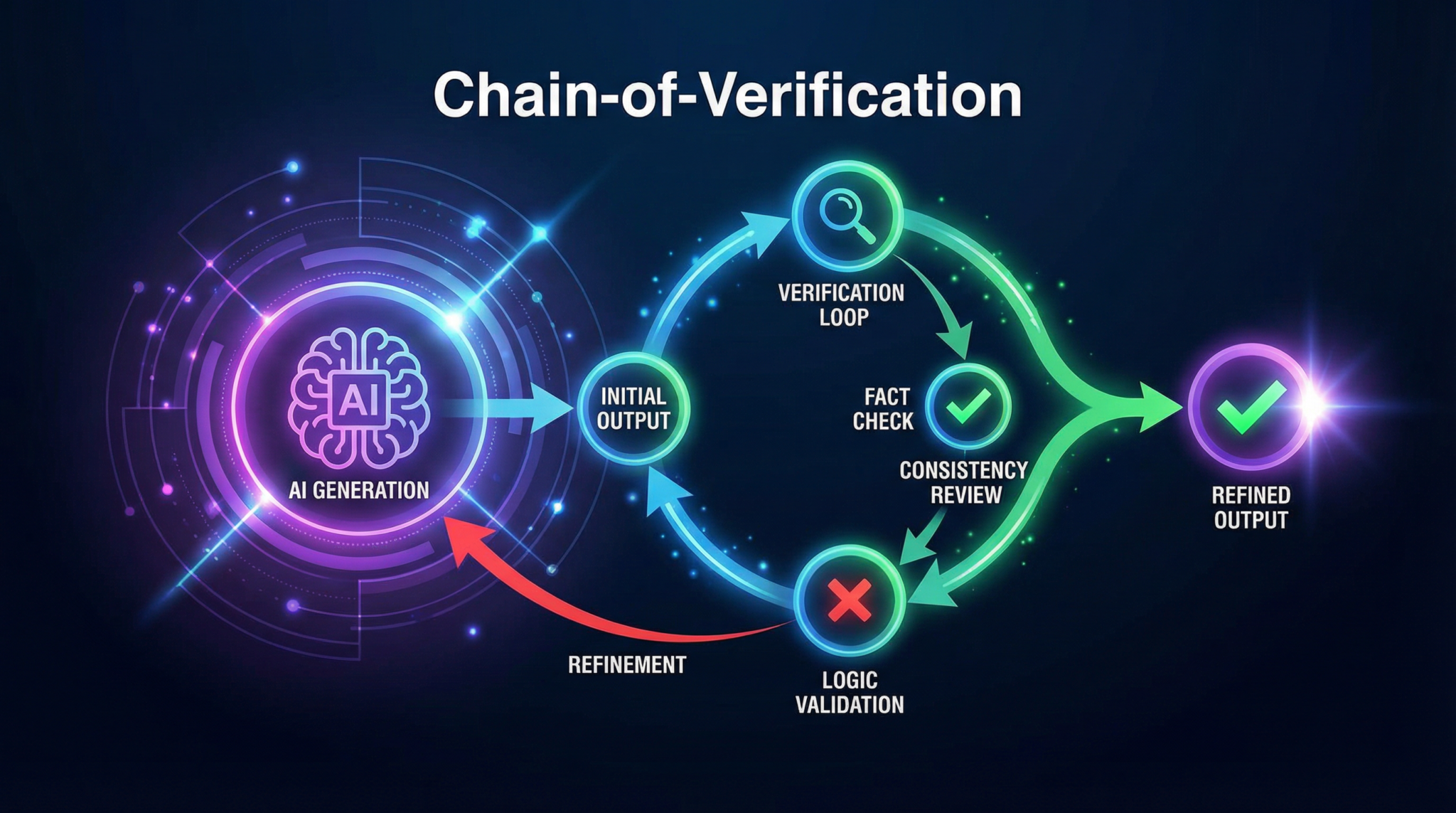
One of the most persistent challenges with advanced language models is hallucination—producing plausible but false or misleading information. Chain-of-Verification prompting is an advanced method designed to mitigate this by making the AI self-audit its outputs through multiple verification steps.
The process involves:
- Initial Output Generation: The model produces a response based on the prompt.
- Self-Check Prompt: The AI is asked to verify the accuracy and consistency of its previous answer.
- Correction Step: If inconsistencies or errors are detected, the model refines or corrects the response.
This iterative loop can be automated or manually guided and dramatically reduces hallucinated content by fostering internal cross-referencing.
Example Template:
Step 1: “Provide a summary of the latest climate policy changes in the EU.”
Step 2: “Check the summary you just gave for factual accuracy and consistency. Identify any statements that may lack evidence or contradict the initial context.”
Step 3: “Revise the summary correcting any identified issues.”
Style Brief Technique for Consistent Tone Across Conversations
Maintaining a consistent style and tone is critical for branding, storytelling, and professional communication. Style briefs are concise, persistent instructions that define voice attributes such as formality, vocabulary preferences, sentence length, and emotional tenor.
Unlike embedding style instructions in every prompt, you preload a style brief within the Wall of Context or as a separate persistent instruction. This ensures consistency across multiple interactions without repetitive reminders.
Example Style Brief:
“Adopt a friendly but professional tone, using clear and concise language. Avoid jargon unless necessary. Maintain an optimistic and solution-oriented voice.”
Incorporating style briefs with the Wall of Context ensures that every response aligns with the desired communication standards throughout an extended session.
Agentic Task Workflows and Strict Instruction Adherence
With models now capable of complex task management, agentic workflows enable AI to autonomously execute multi-step processes, make decisions, and self-correct. These workflows require strict adherence to instructions and clear task boundaries.
To implement agentic prompting effectively:
- Define explicit task roles and responsibilities within the Wall of Context.
- Use strict, unambiguous directives to guide AI decision-making.
- Combine Chain-of-Verification to ensure task outputs meet criteria before progressing.
- Leverage modular prompts that trigger specific sub-tasks for better control and traceability.
Agentic workflows turn AI from a passive responder into a proactive assistant capable of managing complex projects or research autonomously while maintaining high accuracy.
The Shift from Prompt Engineering to Prompt Architecture
As prompting complexity grows, the discipline is evolving beyond crafting single prompts into designing robust, scalable “prompt architectures.” This involves:
- Developing layered context structures (Walls of Context) that feed multiple task prompts.
- Integrating verification loops and style briefs as architectural elements.
- Implementing agentic workflows as orchestrated modules rather than ad hoc instructions.
- Ensuring maintainability, reusability, and scalability of prompt systems across projects and teams.
This architectural mindset treats prompts as components of a larger AI-human collaboration framework, optimizing for consistency, reliability, and efficiency in real-world applications.
Combining Techniques for Maximum Effectiveness
The true power of advanced prompting in 2026 emerges when you combine these methods strategically. For example, start with a comprehensive Wall of Context loaded with your domain data and style brief, then initiate agentic task workflows with clearly defined roles. Use Chain-of-Verification loops embedded in the workflow to maintain output integrity at every stage.
This holistic approach reduces hallucinations, enforces consistent tone, and leverages the full capabilities of next-generation models.
Practitioners report that adopting this multi-technique framework results in up to 40% improvement in task accuracy and a 60% reduction in manual prompt adjustments.
Copy-Paste Ready Prompt Templates for 2026 Models
-
Wall of Context Initialization for Research:
“Load the following documents, including abstracts, key findings, and data tables from recent publications on renewable energy technologies. Remember all details for subsequent queries.” -
Chain-of-Verification Self-Audit:
“Based on your previous answer, identify any factual inconsistencies or unsupported claims. List them and provide corrected information where necessary.” -
Style Brief Injection:
“From now on, respond using a formal, academic tone with precise terminology and citations where applicable.” -
Agentic Workflow Instruction:
“You are an AI project manager. Your tasks are to 1) analyze the provided dataset, 2) generate a summary report, and 3) check for anomalies. Follow each step strictly and confirm completion before moving to the next.” -
Targeted Follow-Up Prompt Post Wall of Context:
“Using the context provided, draft a persuasive executive summary emphasizing market opportunities and risks.”
Common Mistakes and How to Avoid Them
- Overloading the Wall: Including irrelevant or excessive information can confuse the model and dilute focus. Keep context concise, relevant, and well-organized.
- Neglecting Verification Steps: Skipping Chain-of-Verification increases hallucination risk. Always incorporate at least one self-check prompt after complex outputs.
- Inconsistent Style Briefs: Changing style instructions mid-session without clear resets may cause tone drift. Persist style briefs consistently or reload them when necessary.
- Ambiguous Instructions in Agentic Workflows: Vague or conflicting task directives lead to errors. Use explicit, numbered steps and clarify decision boundaries.
- Ignoring Model Updates: Prompt methods must evolve with model capabilities. Regularly review and adapt your prompt architectures to leverage new features in GPT-5.4 and Claude 4.5.
Conclusion
The Wall of Context and associated advanced prompting methods represent a paradigm shift in how we engage with AI in 2026. By embracing dense context loading, iterative verification, persistent style briefs, and agentic workflows, professionals can unlock unprecedented levels of AI precision, consistency, and autonomy.
Transitioning from prompt engineering to prompt architecture empowers users to build scalable, maintainable AI interaction frameworks that fully exploit the capabilities of next-generation language models. Whether coding, writing, researching, or strategizing, mastering these techniques is essential for maximizing AI’s transformative potential.
For a deeper dive on contextual prompt structuring and advanced AI validation techniques, explore our detailed coverage on Evolution Overview: From GPT-5.2 to GPT-5.4, and learn how to implement robust Chain-of-Verification workflows in Evolution of Generative AI. Additionally, gain insights into crafting persistent tone guidelines through The Future of AI in Content Creation: 2026 Trends You Can’t Miss.

