
25 ChatGPT Prompts for Product Data Management: Descriptions, Categorization, SEO, and Catalog Automation
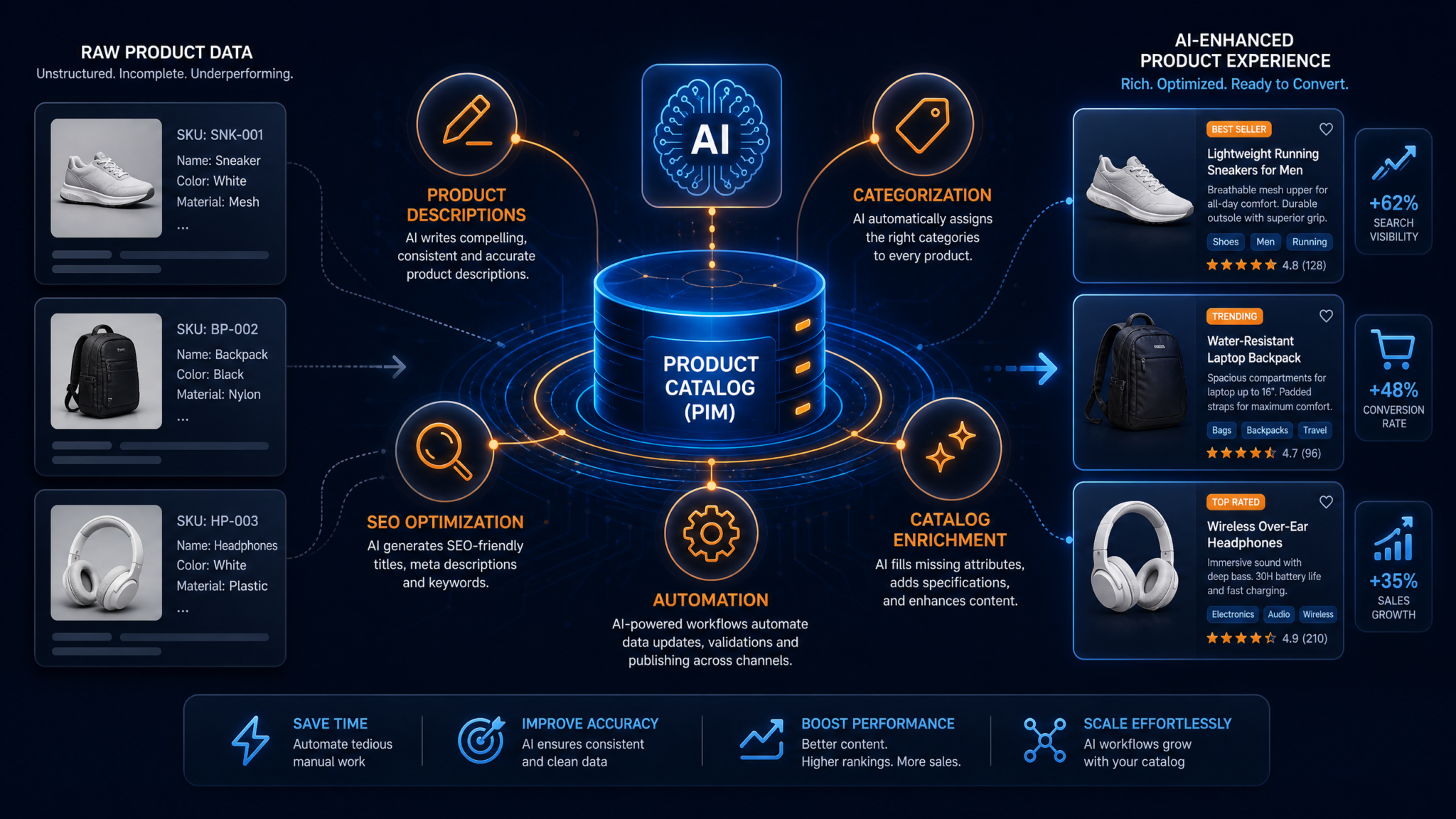
Product data management is one of the most resource-intensive operations in modern e-commerce. Writing compelling descriptions, maintaining consistent taxonomy, optimizing thousands of SKUs for search, and keeping catalog data accurate across channels can consume entire teams — and still fall short of the quality needed to convert browsers into buyers. ChatGPT and large language models have fundamentally changed this equation. E-commerce teams using AI-assisted workflows are reporting 60–80% reductions in time spent on catalog content creation, 40% improvements in product page conversion rates, and the ability to scale from hundreds to hundreds of thousands of SKUs without proportional headcount increases. This masterclass gives you 25 production-ready prompts organized across five critical product data management disciplines, complete with implementation variables, expected outputs, and a strategic roadmap for rolling out AI-powered catalog automation inside your organization.
Why AI Transforms Product Data Management
Before diving into the prompts, it’s worth understanding exactly where AI creates leverage in the product data lifecycle. Traditional catalog management involves three expensive bottlenecks: content creation (writing unique, compelling descriptions for each SKU), data governance (maintaining consistency across attributes, categories, and formats), and optimization cycles (continuously updating content for SEO performance and seasonal relevance). AI doesn’t just accelerate these tasks — it changes their economic profile entirely.
According to a 2024 report by Forrester Research, the average enterprise e-commerce team spends 23 hours per week on catalog content maintenance. Brands managing product lines with 10,000+ SKUs often employ 5–15 dedicated catalog managers whose primary job is writing descriptions, updating specs, and auditing data quality. AI models like ChatGPT-4o can draft a product description in under 10 seconds, categorize a product into a multi-level taxonomy in one API call, and generate localized translations across eight languages simultaneously.
The key to realizing this potential isn’t simply pasting product details into ChatGPT and hoping for the best. It’s about constructing prompts with precision — giving the model the right context, constraints, output format requirements, and brand voice guidelines. The 25 prompts in this masterclass are built on this principle. Each one is engineered for repeatability, scalability, and output quality that can feed directly into your PIM system, e-commerce platform, or catalog database.
The Five Layers of AI-Assisted Product Data
- Generation: Creating original, high-quality copy from raw specifications
- Classification: Mapping products to taxonomy nodes and attribute schemas
- Optimization: Enhancing existing content for search and conversion performance
- Enrichment: Filling data gaps, standardizing formats, adding missing attributes
- Automation: Building repeatable workflows that process catalogs at scale
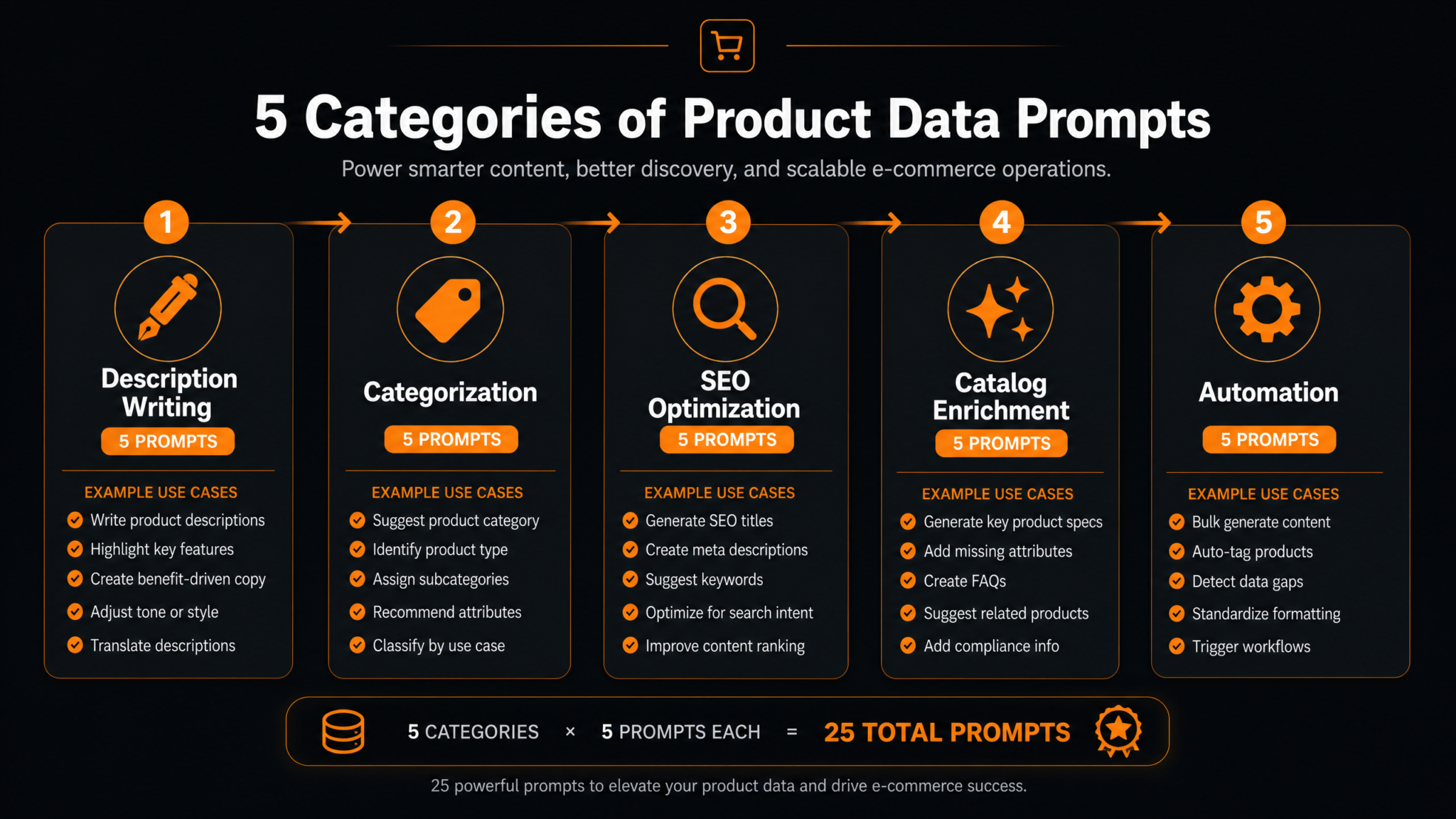
Each category maps directly to one section of this masterclass. Whether you’re a solo e-commerce manager, a product data analyst at a mid-market retailer, or a data engineering team at a large marketplace, you’ll find immediately applicable prompts for your use case.
Pro Tip: Throughout this guide, variables you can replace with your own values are shown inside curly braces like
{brand_name},{product_category}, or{target_audience}. These are your customization points — the difference between a generic prompt and one that’s precisely tuned to your catalog.
Category 1: Product Description Writing
Product descriptions are the conversion engine of your catalog. Studies by Nielsen Norman Group show that 20% of purchase failures are directly attributable to missing or unclear product information. The five prompts in this section cover five distinct description styles that together can handle virtually any product category in your catalog.
Prompt 1: The Luxury Brand Product Description
Luxury product descriptions require a specific voice — aspirational, sensory-rich, and emotionally resonant without feeling overhyped. This prompt engineers that tone with precision, ensuring descriptions feel like they belong in a high-end catalog rather than a generic product feed.
You are a senior luxury copywriter with 15 years of experience writing product descriptions for premium brands in the {industry} sector.

Write a product description for the following item:

Product Name: {product_name}
Key Materials/Ingredients: {materials}
Dimensions/Specifications: {specifications}
Price Point: {price}
Brand Heritage: {brand_story_or_heritage}
Target Customer: {customer_persona}

Requirements:
- Length: 150–200 words
- Tone: Elevated, sensory, confident — never boastful
- Structure: Open with a scene-setting sentence that evokes lifestyle or emotion, follow with material/craft details, close with a subtle aspiration statement
- Avoid: Superlatives like "best" or "most", generic phrases like "high quality" or "premium feel"
- Do NOT include pricing in the description
- Use second-person sparingly; favor declarative statements about the product

Output the description followed by a 3-word tagline that could accompany the product image.
Expected Output: A 150–200 word description opening with an evocative lifestyle image, detailing craftsmanship and materials with specificity, and closing with an aspirational statement. Plus a punchy 3-word tagline. For a leather handbag, you might receive: “Handstitched over six hours in a family-owned atelier outside Florence, the Margaux Tote carries its legacy quietly…”
Customization Variables: {industry} (fashion, jewelry, home goods, spirits), {product_name}, {materials}, {specifications}, {price}, {brand_story_or_heritage}, {customer_persona}
Best Used For: Direct-to-consumer luxury brands, department store catalog pages, brand.com flagship PDPs
Prompt 2: The Technical Product Description
Technical products — electronics, industrial components, software tools, medical devices — require descriptions that satisfy two completely different readers: the procurement specialist who wants exact specifications and the end-user who wants to know if it solves their problem. This prompt bridges that gap.
You are a technical product writer specializing in {product_category} for B2B and B2C audiences.

Write a product description that serves both technical buyers and end-users.

Product Name: {product_name}
Full Technical Specifications: {paste_full_spec_sheet}
Primary Use Case: {primary_use_case}
Secondary Use Cases: {secondary_use_cases}
Compatibility Requirements: {compatibility_notes}
Certifications/Standards: {certifications}
Competitive Differentiator: {key_differentiator}

Structure your output as follows:

HEADLINE (under 12 words, lead with the primary benefit, not a feature)

OVERVIEW PARAGRAPH (75–100 words, written for a non-technical buyer, focus on what the product enables the user to DO)

TECHNICAL SPECIFICATIONS SECTION (formatted as a clean bullet list, use exact values with units, include tolerances where relevant)

COMPATIBILITY NOTE (2–3 sentences, plain language, who this works with and who it doesn't)

Use active voice throughout. Avoid passive constructions. Do not use the word "solution" or "leverage" anywhere in the output.
Expected Output: A structured description with a benefit-led headline, a jargon-free overview, a precise spec list, and a clear compatibility note. This format works directly in most PIM systems as distinct field inputs.
Customization Variables: {product_category}, {product_name}, {paste_full_spec_sheet}, {primary_use_case}, {secondary_use_cases}, {compatibility_notes}, {certifications}, {key_differentiator}
Prompt 3: The SEO-Optimized Product Description
SEO-optimized descriptions must accomplish something technically difficult: incorporating target keywords naturally while maintaining a compelling human voice. This prompt uses a structured keyword integration approach rather than keyword stuffing. ChatGPT Prompts for E-Commerce SEO Content Strategy
You are an e-commerce SEO specialist and product copywriter. Write a product description that is optimized for organic search while reading naturally to human shoppers.

Product Name: {product_name}
Product Category: {category}
Primary Keyword (include exactly once in first 50 words): {primary_keyword}
Secondary Keywords (include 2–3 times each, naturally distributed): {secondary_keyword_1}, {secondary_keyword_2}, {secondary_keyword_3}
Long-Tail Keyword Phrases (weave in at least two): {longtail_1}, {longtail_2}
Brand Voice: {formal/casual/technical/conversational}
Target Word Count: 200–250 words

Additional Context:
- Top-ranking competitor description themes to differentiate from: {competitor_angles}
- Customer pain points this product solves: {pain_points}
- Unique product attributes not commonly available: {unique_attributes}

SEO Requirements:
- Place primary keyword in the first sentence without forcing it
- Use at least one question-answer construction that mirrors conversational search queries
- Include one use-case scenario (a sentence describing someone using the product in context)
- Final sentence should reinforce the primary keyword concept without exact repetition (use semantic variation)

Do NOT keyword-stuff. Every keyword inclusion must feel editorially justified. Flag any keyword placement that feels unnatural with [CHECK] in your output.
Expected Output: A 200–250 word description with natural keyword distribution, a conversational search query answer, and a use-case scenario. The [CHECK] flag system is particularly valuable for quality control before publishing.
Customization Variables: All keyword fields, {brand_voice}, {competitor_angles}, {pain_points}, {unique_attributes}
Prompt 4: The Product Comparison Description
Comparison descriptions help shoppers who are already evaluating multiple options — one of the highest-intent moments in the purchase journey. This prompt creates descriptions designed to win at the comparison stage.
You are a conversion copywriter specializing in high-consideration purchase categories.

Write a product description for {product_name} designed for shoppers who are actively comparing this product against alternatives.

Our Product: {product_name}
Our Product's Key Strengths: {strength_1}, {strength_2}, {strength_3}
Our Product's Honest Limitations: {limitation_1}, {limitation_2}
Primary Competitor Products Being Compared Against: {competitor_1}, {competitor_2}
Areas Where We Win Against Competitors: {win_areas}
Target Buyer Profile: {buyer_profile} — someone who values {buyer_priorities}
Price Positioning: {lower/comparable/premium} compared to alternatives

Write a 175–225 word description that:
1. Opens by acknowledging the category trade-offs buyers face (builds trust)
2. Positions our key differentiators as the answer to those trade-offs
3. Is honest about the one area where alternatives might be preferred (and for which buyer type)
4. Closes by clearly defining the ideal customer for THIS product

Do not mention competitor brand names by name. Use category descriptors instead (e.g., "entry-level alternatives", "professional-grade options").

Also generate a 4-row comparison table with columns: Feature | {product_name} | Entry-Level Alternative | Premium Alternative
Expected Output: A conversion-optimized description plus a comparison table. The honesty framework in this prompt consistently improves trust metrics and reduces return rates because buyers understand exactly what they’re getting.
Prompt 5: The Emotional/Story-Driven Description
For gift products, lifestyle goods, and any product where the emotional context of ownership matters more than specs, this prompt generates narrative-driven descriptions that connect at a deeper level.
You are a brand storytelling specialist who writes product descriptions that make customers feel something.

Product: {product_name}
Category: {category}
Gifting Context: {gifting_occasion_or_use_context}
Emotional Outcome the Product Enables: {emotional_outcome}
Who Gives/Buys This: {giver_persona}
Who Receives/Uses This: {receiver_persona}
One Concrete Sensory Detail About the Product: {sensory_detail}

Write a 125–175 word product description structured around the narrative arc of:
BEFORE (the moment or need that leads someone to this product) →
THE PRODUCT (introduced as the bridge to resolution, with one sensory detail) →
AFTER (the feeling or outcome the buyer/recipient experiences)

Tone: Warm, genuine, human. NOT saccharine or over-sentimental.
Avoid: "Perfect for", "ideal gift", "loved ones", "cherished memories" — these phrases are overused and lose impact.

After the description, suggest 3 alternative opening sentences with slightly different emotional angles (confident, nostalgic, intimate) so copywriters can A/B test.
Expected Output: A narrative description plus 3 alternative openers for A/B testing — an often-overlooked feature that makes this prompt especially powerful for conversion optimization teams.
Category 2: Bulk Categorization and Tagging
Categorization errors and inconsistent tagging cost e-commerce businesses an estimated $2.5 billion annually in lost search visibility and poor customer navigation experiences, according to the Baymard Institute’s 2023 E-Commerce UX Benchmarks report. The five prompts in this section address the full taxonomy challenge — from initial classification to variant grouping and cross-category attribution.
Prompt 6: Taxonomy Mapping
This prompt is designed to classify products into a multi-level taxonomy, critical for PIM systems and marketplace feeds where category accuracy directly affects search placement. How to Build a Product Information Management System with AI
You are a product taxonomy specialist. Your task is to classify the following product(s) into the correct nodes of our product hierarchy.

Our Taxonomy Structure (provide your actual taxonomy here):
L1: {top_level_categories}
L2: {second_level_categories}
L3: {third_level_categories}
L4 (if applicable): {fourth_level_categories}

Products to Classify (provide as many as needed in this format):
Product 1: Name: {name} | Description: {short_description} | Brand: {brand} | Key Materials: {materials}
Product 2: Name: {name} | Description: {short_description} | Brand: {brand} | Key Materials: {materials}
[Continue pattern]

For each product, output:
- Assigned L1 Category
- Assigned L2 Category
- Assigned L3 Category
- Assigned L4 Category (if applicable)
- Confidence Score (High/Medium/Low)
- Reason for any Medium or Low confidence classification
- Alternative category if confidence is Medium or Low

Format output as a CSV-ready table with headers: Product_Name | L1 | L2 | L3 | L4 | Confidence | Notes

Flag any product that appears to belong in multiple categories with [MULTI-CAT] and suggest a primary and secondary classification.
Expected Output: A CSV-formatted table ready for import into your PIM. The confidence scoring and multi-category flagging system prevents silent misclassifications that would otherwise only surface during a manual audit months later.
Scaling Note: For catalogs over 1,000 SKUs, use the ChatGPT API with batch processing — feed 20–50 products per prompt call and concatenate the CSV outputs.
Prompt 7: Attribute Extraction
Structured product attributes — color, size, material, weight, compatibility — are the backbone of faceted navigation. Extracting them consistently from unstructured descriptions is one of AI’s most immediately valuable applications in catalog management.
You are a product data specialist. Extract structured attributes from the following product description(s) and map them to our attribute schema.

Our Required Attribute Schema:
{paste your attribute schema here — e.g., Color, Size, Material, Weight, Dimensions, Country of Origin, Age Group, Gender, Care Instructions, Compatibility}

For each attribute in our schema:
- Extract the value if explicitly stated
- Infer the value if it can be reliably determined from context (mark as [INFERRED])
- Mark as [MISSING] if the attribute cannot be determined from available information
- Mark as [AMBIGUOUS] if multiple values could apply, and list the options

Product Descriptions to Process:

PRODUCT 1: {product_name}
Full Description: {paste_description}

PRODUCT 2: {product_name}
Full Description: {paste_description}

Output format: One row per product in a structured table. Use standardized value formats:
- Colors: Use {color_standard} (e.g., Pantone names, RAL codes, or plain English — specify your preference)
- Sizes: Use {size_standard} (e.g., US sizing, EU sizing, metric measurements)
- Weights: Always express in {weight_unit}

After the table, list all [MISSING] attributes across all products grouped by attribute type — this gives the content team a prioritized data gap report.
Expected Output: Structured attribute table plus a consolidated data gap report. The gap report feature transforms what would be a tedious manual audit into an automatically generated work list for your content team.
Prompt 8: Auto-Tagging for Search and Filtering
You are a product merchandising specialist and search optimization expert.

Generate a comprehensive tag set for the following product to support on-site search, faceted filtering, and personalization algorithms.

Product Details:
Name: {product_name}
Category: {category}
Description: {description}
Specifications: {specifications}
Target Audience: {audience}
Use Cases: {use_cases}
Season/Occasion Relevance: {seasonal_relevance}

Generate tags across the following dimensions:
1. FUNCTIONAL TAGS: What the product does or enables (verb-based: "water-resistant", "wireless-charging-compatible")
2. DESCRIPTIVE TAGS: Physical characteristics (color families, size categories, style descriptors)
3. AUDIENCE TAGS: Who uses this (age group, gender, skill level, lifestyle segment)
4. OCCASION TAGS: When/where used or given (gifting occasions, activities, settings)
5. ATTRIBUTE TAGS: Technical specs in searchable format
6. STYLE/AESTHETIC TAGS: Design language (minimalist, industrial, bohemian, etc.)
7. PROBLEM-SOLUTION TAGS: Pain points this solves (in customer language, not product language)

Rules:
- Maximum 50 tags total
- All tags lowercase with hyphens for spaces
- No duplicate concepts across dimensions
- Prioritize tags customers would actually type into search
- Flag the top 10 tags you predict will drive the most search traffic with [HIGH-PRIORITY]

Output as a flat comma-separated list, then re-output organized by the 7 dimensions above.
Expected Output: A dual-format tag set — flat list for easy database import and organized view for human review. The [HIGH-PRIORITY] flags help merchandisers know which tags to monitor in search analytics first.
Prompt 9: Variant Grouping and Product Family Organization
You are a catalog architect specializing in product variant management for e-commerce platforms.

I will provide you with a list of individual SKUs. Your task is to:
1. Identify which SKUs belong to the same product family (parent product)
2. Determine the variant dimensions (what differentiates them — size, color, configuration, etc.)
3. Suggest the parent product name and structure
4. Flag any SKUs that appear to be duplicates

SKU List:
{paste list of SKU names, descriptions, and any available attributes — one per line}

For each product family you identify, output:
PARENT PRODUCT NAME: {suggested name}
VARIANT DIMENSION(S): {e.g., Size + Color, or Configuration, or Material}
CHILD SKUs: {list of SKUs belonging to this parent}
VARIANT MATRIX: A table showing each SKU mapped to its variant values

Standalone SKUs (those that don't belong to a family): List separately

Potential Duplicates: List any SKUs that appear to describe the same product with different naming conventions — include a similarity confidence score

Edge Cases: Flag any SKU where variant grouping is ambiguous and explain why

This output will be used to restructure our product catalog from a flat SKU list to a parent-child hierarchy in {platform_name}.
Expected Output: A complete parent-child hierarchy map with variant matrices and a duplicate detection report. This is one of the most time-consuming catalog restructuring tasks — typically taking weeks manually and hours with AI.
Prompt 10: Cross-Category and Multi-Taxonomy Attribution
You are a multi-channel catalog specialist. Some products legitimately belong in multiple categories across different catalog contexts (e.g., a product appearing in a website taxonomy, a Google Shopping feed taxonomy, and an Amazon browse node structure simultaneously).

Product: {product_name}
Description: {description}
Primary Category Determination: {primary_category}

Map this product across the following taxonomy systems:

1. INTERNAL WEBSITE TAXONOMY: Using our hierarchy at {taxonomy_document_reference}
2. GOOGLE PRODUCT CATEGORY: Assign the most specific applicable Google Product Taxonomy ID and name
3. AMAZON BROWSE NODE: Suggest the most relevant Amazon product type and browse node
4. FACEBOOK CATALOG CATEGORY: Assign the appropriate Meta/Facebook product category
5. CUSTOM COLLECTIONS: Based on the product attributes, suggest which of our {collection_themes} this product should appear in

For each taxonomy assignment:
- Provide primary category assignment
- Provide 1–2 secondary assignments if the product has genuine cross-category applicability
- Explain the merchandising rationale (why does this product belong here?)

Also flag any taxonomy conflicts — situations where different channels would categorize this product differently in ways that could cause compliance or feed rejection issues.
Expected Output: A comprehensive cross-channel taxonomy map. Taxonomy conflicts are flagged before they cause feed rejection errors on advertising platforms — a common and expensive issue for catalog managers.
Category 3: SEO Optimization
On-page SEO for product pages involves five distinct optimization surfaces: meta descriptions, title tags, schema markup, body content keyword integration, and image alt text. Each requires different constraints, character limits, and strategic considerations. The five prompts below provide a complete optimization toolkit. Complete Guide to Product Page SEO for E-Commerce Platforms
Prompt 11: Meta Descriptions at Scale
You are an e-commerce SEO specialist. Write meta descriptions for the following product pages.

For each product, the meta description must:
- Be exactly 145–155 characters (count precisely — this is non-negotiable)
- Include the primary keyword within the first 60 characters
- Include a benefit statement (what does the user GET from clicking)
- End with an action-oriented phrase (not a generic CTA — something specific to the product category)
- NOT repeat the page title verbatim
- NOT start with the brand name or product name unless it appears after the keyword

Products:

Product 1:
Page Title: {title}
Primary Keyword: {keyword}
Product's Main Benefit: {benefit}
Price/Offer (if relevant): {price_or_offer}
Unique Attribute: {unique_attribute}

Product 2:
[Repeat structure]

Output format:
Product Name | Meta Description | Character Count | Keyword Position (character #)

Flag any meta description where the keyword placement required a compromise to the quality of the copy — suggest an alternative keyword position strategy for those cases.
Expected Output: Precisely measured meta descriptions in table format with character counts. The keyword position tracking column is valuable for SEO audits and understanding how your meta descriptions perform in click-through rate analysis.
Prompt 12: Title Tag Optimization
You are a technical SEO specialist for e-commerce. Generate optimized title tags for the following product pages.

Title Tag Requirements:
- Maximum 60 characters (target 55–60 for optimal SERP display)
- Structure preference: {Primary Keyword} - {Product Name} | {Brand} OR {Brand} {Product Name} - {Primary Keyword} (specify which your site uses)
- Must include primary keyword
- Must differentiate from competitor title tags (I'll provide competitor titles below)
- Should include a modifier where space permits (color, size, model year, key attribute)

Products to Optimize:

Product: {product_name}
Current Title Tag: {current_title}
Primary Keyword: {primary_keyword}
Secondary Keyword (include if space allows): {secondary_keyword}
Competitor Title Tags for Reference: {competitor_title_1}, {competitor_title_2}, {competitor_title_3}
Category Context: {category}

For each product provide:
1. Recommended title tag
2. Character count
3. Keyword included (yes/no for each keyword)
4. Differentiation note (how it differs from competitor patterns)
5. Alternative version if primary recommendation is 58+ characters (space-constrained environments)

Also flag if the current title tag is cannibalizing another page's keyword target, based on the keywords provided.
Prompt 13: Schema Markup Generation
Schema markup (JSON-LD) enables rich results in Google Search — star ratings, price displays, availability badges. Generating accurate schema at scale is typically a developer task, but this prompt makes it accessible to catalog managers working directly with product data.
You are a structured data specialist. Generate valid JSON-LD schema markup for the following product using Schema.org Product type.

Product Information:
Product Name: {name}
Description (use this exact text): {description}
Brand: {brand}
SKU: {sku}
GTIN/Barcode: {gtin}
MPN: {mpn}
Product URL: {url_on_yourproject.io}
Image URL: {image_url}
Price: {price}
Currency: {currency_code}
Availability: {in_stock/out_of_stock/preorder}
Condition: {new/used/refurbished}
Average Rating: {rating} out of 5
Review Count: {review_count}
Shipping: {free/paid} — Estimated delivery: {delivery_timeframe}
Return Policy: {return_days} day returns

Additional Requirements:
- Include AggregateRating markup if review data is provided
- Include Offer markup with priceValidUntil date set to 90 days from today
- Include breadcrumb BreadcrumbList markup: {breadcrumb_path}
- Nest a Review excerpt if provided: {sample_review_text}

Output the complete JSON-LD block. Then validate it against these requirements:
1. All required Schema.org Product properties present
2. All recommended properties included where data was provided
3. No invalid property names or value formats

Note any fields where the provided data doesn't meet Schema.org format requirements and suggest the correction needed.
Expected Output: Complete, valid JSON-LD markup ready for implementation, plus a validation checklist. This prompt alone can save a development team dozens of hours when rolling out schema markup across a large catalog.
Access 40,000+ AI Prompts for ChatGPT, Claude & Codex — Free!
Subscribe to get instant access to our complete Notion Prompt Library — the largest curated collection of prompts for ChatGPT, Claude, OpenAI Codex, and other leading AI models. Optimized for real-world workflows across coding, research, content creation, and business.
Prompt 14: Keyword Integration Audit and Rewrite
You are an e-commerce SEO content auditor. Audit the following product description for keyword optimization and provide a rewritten version.

Original Description:
{paste_existing_description}

Target Keywords to Evaluate:
Primary Keyword: {primary_keyword} — Target frequency: 1–2 times per 200 words
Secondary Keywords: {kw_1}, {kw_2}, {kw_3} — Target frequency: 1 time each per 200 words
Semantic/LSI Keywords (naturally incorporate where relevant): {lsi_1}, {lsi_2}, {lsi_3}

Audit Report (provide before the rewrite):
1. Current keyword frequency table (keyword | current count | target count | status)
2. Keyword density assessment (flag any keyword appearing more than 3% of total word count)
3. First-paragraph keyword analysis (which keywords appear in first 100 words?)
4. Semantic coverage score (0–10, how well does the description cover the topic cluster?)
5. Missing keyword opportunities (which target keywords are absent?)
6. Over-optimized sections (flag any sentences that feel keyword-stuffed)

Rewritten Description:
Produce a rewritten version that achieves target keyword frequencies while:
- Maintaining or improving the original copy's conversion quality
- Not increasing word count by more than 15%
- Preserving any specific product claims or brand voice elements from the original
- Using keyword variations and semantic equivalents, not just exact-match repetition

Show a side-by-side diff summary: what was changed and why.
Prompt 15: Image Alt Text Generation at Scale
You are an e-commerce accessibility and SEO specialist. Generate alt text for product images following both WCAG accessibility guidelines and SEO best practices.

Product Context:
Product Name: {product_name}
Product Category: {category}
Primary Keyword for this product page: {primary_keyword}
Brand: {brand}

Images to Process (describe each image or provide its filename and any available metadata):

Image 1: {image_1_description_or_filename}
Image 2: {image_2_description_or_filename}
Image 3: {image_3_description_or_filename}
[Continue as needed]

Alt Text Rules:
- Hero/main product image: Include product name + primary keyword + key visual characteristic (color, material, orientation)
- Detail/feature images: Describe what the image SHOWS, not what the product IS — focus on the visual detail being highlighted
- Lifestyle images: Describe the scene and context, include product name, do NOT include keyword (these are context images, not ranking images)
- Packaging images: Describe packaging + product name, relevant for gifting searches
- Dimension/spec images: Describe what dimensions are shown and approximate values if visible

Maximum length: 125 characters per alt text
Do NOT begin with "image of", "photo of", or "picture of"
Do NOT keyword-stuff — each image should include the primary keyword maximum once across all images for this product

Output: Table with columns: Image Reference | Alt Text | Character Count | Alt Text Type (hero/detail/lifestyle/packaging/spec) | Keyword Included (yes/no)
Expected Output: A ready-to-import alt text table. The type classification system ensures the right SEO strategy is applied to each image type — a nuance that generic alt text generators consistently miss.
Category 4: Catalog Enrichment
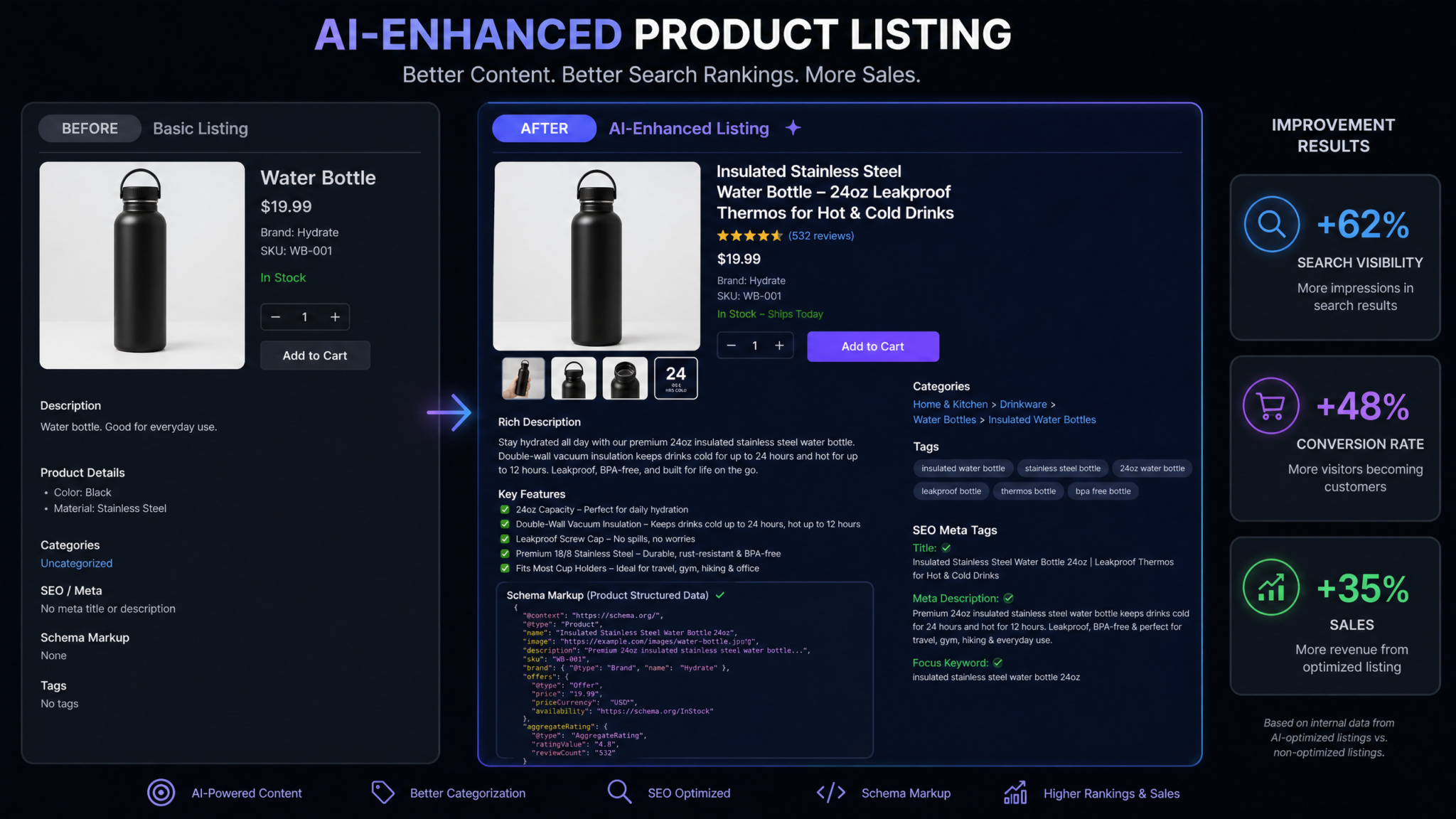
Catalog enrichment addresses one of the most persistent challenges in e-commerce data management: incomplete, inconsistent, or low-quality product data that undermines both SEO performance and customer trust. Research by Salsify found that 87% of online shoppers say product content is extremely important when deciding to buy, yet the average catalog has a 30–50% data completeness gap across key attributes. Product Catalog Data Quality Framework for E-Commerce Teams
Prompt 16: Missing Data Completion
You are a product data enrichment specialist. Complete the missing fields in the following product records using available information, industry knowledge, and logical inference.

Product Records with Gaps:

PRODUCT 1:
Available Data: {paste_all_available_fields_and_values}
Missing Fields: {list_missing_fields}
Product Category: {category}
Any Reference Materials Available: {manufacturer_URL_or_additional_context}

PRODUCT 2:
[Repeat pattern]

For each missing field, provide:
- COMPLETED VALUE: Your best determination of the correct value
- CONFIDENCE LEVEL: High (directly derivable), Medium (reasonable inference), Low (educated guess)
- SOURCE METHOD: How you determined this value (e.g., "standard industry specification for this product type", "inferred from product name", "typical range for this category")
- VERIFICATION SUGGESTED: Yes/No — whether this value should be verified before publishing

Rules for completion:
- Never invent specific numeric values (weights, dimensions) at High confidence without clear derivation — mark these Low and suggest measurement
- For regulatory fields (safety ratings, certifications), always mark as [NEEDS VERIFICATION] regardless of confidence
- Where a missing field has multiple plausible values, list all options with your recommendation

Output a completed product record for each product, then a summary data gap report showing completion rates by field type across all products processed.
Prompt 17: Product Description Translation and Localization
You are a professional product localization specialist fluent in {target_language} with deep knowledge of e-commerce consumer behavior in {target_market}.

Translate and localize the following product description from {source_language} to {target_language}.

Original Description ({source_language}):
{paste_original_description}

Product Context:
Category: {category}
Brand Positioning in Target Market: {positioning}
Price Point in Target Currency: {localized_price}
Cultural Considerations for {target_market}: {any_known_cultural_notes}

Localization Requirements (NOT just translation):
1. Adapt measurement units to {target_market} standards (imperial/metric as appropriate)
2. Replace any idioms or culturally specific references with market-appropriate equivalents
3. Adjust formality level — in {target_language}, the appropriate register for {category} is {formal/informal/honorific}
4. If any product claims have regulatory implications in {target_market}, flag with [REGULATORY-CHECK]
5. Preserve all SEO-relevant product terms but use the local market search terminology, not literal translations

Output:
- Localized description in {target_language}
- English back-translation (word-for-word) to verify accuracy
- List of any substantive changes made beyond direct translation
- List of terms kept in {source_language} intentionally (brand names, technical standards, etc.)
- Any cultural or regulatory flags raised during localization
Prompt 18: Specification Standardization
You are a product data standards specialist. Standardize the following product specifications to conform to our master attribute schema.

Master Schema Standards:
- Dimensions: Always expressed as {L x W x H} in {cm/inches}, rounded to {1/2} decimal places
- Weight: In {kg/lbs}, rounded to {2} decimal places
- Colors: Map to our standard color vocabulary: {paste_your_color_list}
- Materials: Use material hierarchy: {primary_material} / {secondary_material} / {finish}
- Electrical: {voltage}V / {wattage}W / {amperage}A — always all three if applicable
- Size Labels: Map to {size_system} — provide conversion if original uses different system

Non-Standard Specifications to Process:

PRODUCT 1: {product_name}
Raw Spec Data: {paste_raw_specifications_exactly_as_received}

PRODUCT 2: {product_name}
Raw Spec Data: {paste_raw_specifications_exactly_as_received}

For each product output:
- Standardized specification set in exact schema format
- Conversion calculations shown for any unit changes made
- Values that could not be standardized with explanation
- Values that appear inconsistent or potentially erroneous (e.g., a weight that seems unusually high or low for the product category) — flag with [DATA-CHECK]

Summary: List all unique non-standard formats encountered across all products, with recommended additions to the master schema if patterns emerge.
Prompt 19: Competitive Positioning Enhancement
You are a product marketing strategist and catalog copywriter. Enhance the following product description to strengthen its competitive positioning without making explicit competitor comparisons.

Current Product Description:
{paste_current_description}

Competitive Intelligence:
Our Key Advantages Over Competitors: {advantage_1}, {advantage_2}, {advantage_3}
Common Customer Complaints About Competing Products (from reviews): {complaint_1}, {complaint_2}, {complaint_3}
Our Product's Response to Those Complaints: {response_1}, {response_2}, {response_3}
Price Position: {at parity / 15% premium / value pricing}

Enhancement Strategy:
- Implicitly address competitor weaknesses by highlighting our corresponding strengths
- Use specificity as differentiation — competitors use vague claims; we use precise, verifiable ones
- If customers complain about competitors' {complaint_1}, mention our {response_1} without referencing the competitor issue explicitly
- Strengthen any weak or generic claims in the original with specific proof points

Deliverables:
1. Enhanced product description (maintain original word count ±10%)
2. Side-by-side markup of original vs. enhanced, with rationale for each change
3. Positioning strength score: Rate original and enhanced versions on a 10-point scale across: Specificity | Differentiation | Trust | Emotional Resonance | Search Relevance
Prompt 20: Seasonal and Contextual Description Updates
You are a retail content strategist. Update the following product descriptions for {season/occasion} relevance while preserving core product information and SEO value.

Seasonal Context:
Season/Occasion: {Christmas/Back-to-School/Summer/Black Friday/Valentine's Day/etc.}
Key Seasonal Themes to Incorporate: {theme_1}, {theme_2}
Seasonal Keywords to Add (naturally): {seasonal_kw_1}, {seasonal_kw_2}
Keywords to Remove/De-emphasize (opposite season): {deemphasize_kw_1}
Campaign Duration: {start_date} to {end_date}
Promotional Elements to Include: {offer_or_messaging_if_any}

Original Year-Round Description:
{paste_base_description}

Requirements:
- Seasonal version must revert cleanly to base version — make changes modular, not structural
- Do not remove product specification information — seasonal context should layer over, not replace
- Seasonal language should appear in first paragraph and/or last paragraph; middle sections stay specification-focused
- Flag any seasonal claims that will date badly if the description isn't reverted promptly (e.g., "perfect for this December")

Output:
1. Seasonalized version
2. Change log (exactly what was added, modified, removed)
3. Reversion guide (instructions for reverting to base version after campaign ends)
4. Alert: Any phrases that must be removed by {end_date} to avoid post-season awkwardness
Category 5: Automation Workflows
The real productivity multiplier in AI-assisted catalog management isn’t individual prompt use — it’s building systematic workflows that process your catalog programmatically. These five prompts are designed to be used as components in larger automation systems, whether you’re using the ChatGPT API, Zapier, Make.com, or custom Python pipelines. Building ChatGPT API Workflows for E-Commerce Automation
Prompt 21: Batch Processing Instruction Set
You are a product data processing engine. You will process a batch of products using consistent rules. Treat this prompt as your operating instructions for the entire batch.

PROCESSING MODE: Batch — apply all rules identically to every product in the batch
CONSISTENCY REQUIREMENT: If you make a formatting decision for Product 1, apply it to all subsequent products

Task: Generate standardized product descriptions for the following batch of {N} products.

UNIVERSAL RULES FOR ALL PRODUCTS IN THIS BATCH:
- Word count: {min}–{max} words
- Structure: {opening_hook} | {key_features_paragraph} | {use_case_sentence} | {closing_differentiator}
- Tone: {brand_voice_definition}
- Banned words: {word_1}, {word_2}, {word_3} — never use these regardless of context
- Required elements: Always mention {required_element_1} (e.g., warranty, sustainability, origin)
- Category-specific rules: For {category_A} products, always lead with the primary use case. For {category_B} products, always lead with the key material.

PRODUCT BATCH:
Product 1: {name} | {raw_data}
Product 2: {name} | {raw_data}
[Continue for all products in batch]

OUTPUT FORMAT:
Return results as a structured JSON array with fields: product_name, description, word_count, structure_components_used, any_rules_exceptions_noted

After the JSON, provide a batch quality summary:
- Total products processed
- Average word count across batch
- Any products where rules conflicted (and how you resolved)
- Consistency issues detected
Expected Output: JSON-formatted batch output ready for programmatic processing. The batch quality summary creates an automatic QA layer that catches issues before they enter your production system.
API Implementation Note: When using this prompt via the ChatGPT API, set temperature: 0.3 for batch tasks to prioritize consistency over creativity. Use temperature: 0.7 for individual luxury or emotional descriptions where creative variation is desirable.
Prompt 22: Automated Quality Check System
You are a product content quality assurance system. Run a structured quality check on the following product descriptions against our defined quality standards.

QUALITY STANDARDS DEFINITION:

Mandatory Pass Criteria (any FAIL here = reject description):
- [ ] Contains product name at least once
- [ ] Word count within {min_words}–{max_words} range
- [ ] Contains at least one specific feature or attribute (not purely generic)
- [ ] No filler text remaining ({TBD}, [INSERT], etc.)
- [ ] No pricing mentioned (pricing is managed separately)
- [ ] No superlative claims without qualification ("best in class", "#1")

Quality Scoring Criteria (score each 1–5, total max 30):
- Specificity Score: Does the description use specific details or vague generalities?
- Differentiation Score: Could this description apply to a competitor's product? (5 = completely unique to this product)
- Readability Score: Grade level appropriate for {target_audience}? Use Flesch-Kincaid as benchmark
- SEO Relevance Score: Does it contain category-relevant terminology naturally?
- Brand Voice Compliance: Does it match our defined voice? (Reference: {voice_guide_summary})
- Conversion Orientation: Does it motivate action or just describe?

DESCRIPTIONS TO QA:

Product 1: {product_name}
Description: {paste_description}

Product 2: {product_name}
Description: {paste_description}

Output: QA Report per product with pass/fail status, score breakdown, specific improvement instructions for any criterion scoring below 3, and an overall APPROVE / REVISE / REJECT recommendation.
Prompt 23: Catalog Consistency Audit
You are a catalog consistency auditor. Analyze the following set of product descriptions within the same category to identify inconsistencies that could undermine catalog quality and customer trust.

Category Being Audited: {category}
Number of Products: {N}

Products (paste descriptions in sequence):
Product 1 ({product_name_1}): {description_1}
Product 2 ({product_name_2}): {description_2}
[Continue for all products in category]

Audit Dimensions:

1. VOICE AND TONE CONSISTENCY: Does the writing voice vary significantly between products? Identify outliers.

2. STRUCTURE CONSISTENCY: Are descriptions following a consistent structural pattern? Map the actual structure of each description and flag deviations.

3. CLAIM CONSISTENCY: Are comparable products making comparable claims? Flag where Product A claims a feature that Product B also has, but doesn't mention.

4. TERMINOLOGY CONSISTENCY: Are the same product features described using the same terminology across products? (e.g., one description says "stainless steel" and another says "metal construction" for the same material)

5. LENGTH CONSISTENCY: Word count comparison table — flag outliers more than 30% above or below median length.

6. SPECIFICATION FORMAT CONSISTENCY: Are dimensions, weights, and measurements expressed in the same format and units?

Output: Full consistency audit report with a heat map table (product vs. consistency dimension, color-coded: green=consistent, yellow=minor issue, red=major inconsistency) and a prioritized fix list ordered by business impact.
Prompt 24: Pricing Analysis and Positioning Description Generator
You are a pricing strategist and product copywriter. Analyze the following product pricing data and generate description variants that appropriately frame each product's value proposition relative to its price positioning.

Price Tier Definitions for This Category:
Budget Tier: Under {price_threshold_1}
Mid-Range Tier: {price_threshold_1} to {price_threshold_2}
Premium Tier: {price_threshold_2} to {price_threshold_3}
Luxury Tier: Above {price_threshold_3}

Products with Pricing:

Product 1: {name} | Price: {price} | Key Features: {features} | Current Description: {description}
Product 2: {name} | Price: {price} | Key Features: {features} | Current Description: {description}

For each product:

1. PRICE TIER CLASSIFICATION: Which tier does this fall into?

2. PRICE-DESCRIPTION ALIGNMENT SCORE (1–10): Does the current description language match the price positioning? A $12 product described in luxury language creates cognitive dissonance. A $500 product described in discount-retail language leaves value on the table.

3. RECOMMENDED DESCRIPTION REWRITE: Adjust the description language to align with the product's price tier:
   - Budget tier: Emphasize value, practicality, reliability, smart choice
   - Mid-range: Balance quality and value, highlight upgrades over budget options
   - Premium: Lead with quality and craftsmanship, justify the price through specificity
   - Luxury: Aspirational language, heritage, exclusivity, craftsmanship time

4. PRICE ANCHORING OPPORTUNITY: Is there a way to reference quality context in the description that makes the price feel appropriate? (e.g., "professional-grade components typically found in systems costing twice as much")

Flag any products where the price tier seems misaligned with the product's actual features (potential pricing strategy issue, not a copy issue).
Prompt 25: Inventory-Aware Description Automation
You are an inventory-aware content management system. Generate and update product descriptions based on real-time inventory and availability status.

Inventory Status Codes:
IN_STOCK: Full availability
LOW_STOCK: {threshold} units or fewer remaining
BACKORDER: Out of stock, accepting orders, ships in {estimated_days} days
DISCONTINUED: No longer available, catalog page remains for SEO
SEASONAL_RETURN: Out of stock but returning for {season/date}
PREORDER: Not yet released, ships {release_date}

Products to Process:

Product 1: {product_name} | Status: {inventory_code} | Stock Level: {units} | Description Version: {current_description}
Product 2: {product_name} | Status: {inventory_code} | Stock Level: {units} | Description Version: {current_description}

For each product, generate:

STATUS-APPROPRIATE DESCRIPTION: Modify the base description to include appropriate availability messaging without compromising the evergreen product content.

Rules by status:
- IN_STOCK: Remove any urgency language that no longer applies; ensure description is conversion-focused
- LOW_STOCK: Add tasteful urgency language in last paragraph only — do not fabricate scarcity claims; if {units} is the real count, you may reference "limited quantities" if true
- BACKORDER: Add a natural sentence explaining preorder appeal and expected wait — frame the wait positively where possible
- DISCONTINUED: Rewrite for SEO archival value — historical tense, remove purchase CTAs from copy, add "also consider" transition phrase pointing to successor products: {successor_products}
- SEASONAL_RETURN: Add anticipation language and return date; these pages drive early SEO traffic
- PREORDER: Add excitement and launch date naturally; remove any present-tense availability claims

Output all modified descriptions plus a change log identifying exactly what inventory-triggered language was added, so it can be automatically reverted when status changes.

Also flag any descriptions containing hardcoded availability language that will need updating when status changes (these are content debt risks).
Expected Output: Inventory-responsive descriptions with precise change logs. The content debt risk flagging is critical for automated workflows — identifying language that requires future updates prevents stale availability claims from remaining on live product pages.
Implementation Roadmap for Product Teams
Having 25 powerful prompts is only useful if you have a clear framework for deploying them inside your organization. The following roadmap is built around a 90-day implementation plan designed for teams of 2–10 catalog managers.
Phase 1: Foundation (Days 1–30)
Week 1–2: Prompt Customization and Brand Voice Calibration
Before processing a single product, invest time customizing the universal variables in these prompts for your specific brand. Create a Brand Voice Document that defines your tone for each product tier, list your banned words and required phrases, and document your attribute schema. This document becomes the master variable reference for every prompt in your catalog workflow.
- Map your internal taxonomy to Prompts 6, 9, and 10 variables
- Define your quality pass/fail criteria for Prompt 22
- Select 10 hero products as a pilot test set — cover multiple categories
- Run all 25 prompts on the pilot set and evaluate output quality
Week 3–4: Pilot Run and Calibration
Process your 10 pilot products through the complete prompt workflow. Compare AI-generated outputs to your manually written gold-standard descriptions. Identify systematic gaps — places where the AI consistently underperforms — and address them through prompt refinement before scaling.
Phase 2: Scale Operations (Days 31–60)
With calibrated prompts, begin systematic catalog processing. Prioritize products in order of business impact:
- Top revenue-generating SKUs — upgrade these descriptions first for maximum conversion impact
- High-search-volume categories — apply SEO optimization prompts to products with the most organic traffic potential
- Data gap products — use enrichment prompts on catalog sections with the highest percentage of missing attributes
- New arrivals pipeline — integrate prompts into the new product onboarding process so all new products enter the catalog fully optimized
API Integration for Teams Processing 1,000+ SKUs: At this scale, manual prompt use is impractical. Integrate the ChatGPT API with your PIM system using a middleware layer. Tools like Make.com, n8n, or custom Python scripts can trigger prompt calls whenever new products are added or existing products hit data quality thresholds. For teams using Shopify, the Shopify Admin API combined with OpenAI’s Batch API can process entire catalog sections overnight.
# Simplified Python example for batch description generation
import openai
import csv

client = openai.OpenAI(api_key="your_key_on_yourproject.io")

def generate_description(product_data):
    prompt = f"""
    [Insert your calibrated prompt here with {product_data} variables populated]
    """
    response = client.chat.completions.create(
        model="gpt-4o",
        messages=[{"role": "user", "content": prompt}],
        temperature=0.4,
        max_tokens=500
    )
    return response.choices[0].message.content

with open('products.csv', 'r') as f:
    reader = csv.DictReader(f)
    for row in reader:
        description = generate_description(row)
        # Write to output CSV or push to PIM API
Phase 3: Workflow Integration and Automation (Days 61–90)
In the final phase, the goal is removing human touchpoints from routine catalog processing while establishing quality gates that maintain human oversight for edge cases. Build trigger-based automation for:
- New product onboarding → automatic description generation → quality check → human review queue for scores below threshold
- Inventory status change → automatic description update using Prompt 25 → publish without human review (low-risk copy change)
- Seasonal calendar triggers → scheduled batch processing through Prompt 20 for affected category pages
- Monthly consistency audit → automatic report generation using Prompt 23 → dashboard alert for categories with consistency scores below {threshold}
Human-AI Collaboration Model
| Task Type | AI Role | Human Role | Review Threshold |
|---|---|---|---|
| Standard product descriptions | Draft generation | Spot-check 10% sample | Quality score < 7/10 |
| Hero/flagship products | Draft + alternatives | Full review and edit | All items reviewed |
| SEO meta/title tags | Generate variants | Final selection | All items reviewed |
| Attribute extraction | Full processing | Review [INFERRED] and [AMBIGUOUS] flags only | Flag-based review |
| Translations | Draft localization | Native speaker review for new markets | Full review for new markets; spot-check ongoing |
| Inventory copy updates | Automated updates | Exception handling only | Automated with alerts |
| Schema markup | Full generation | Validation tool verification | Validation-gated publish |
ROI Metrics and Business Impact for Product Teams
Implementing AI-assisted product data management delivers measurable returns across four business dimensions. Here’s how to measure and communicate the impact of these workflows to stakeholders.
1. Time and Resource Efficiency
| Task | Manual Time (per product) | AI-Assisted Time (per product) | Efficiency Gain |
|---|---|---|---|
| Product description writing | 20–45 minutes | 2–5 minutes (review + edit) | 80–90% |
| Taxonomy classification | 3–8 minutes | 30 seconds (batch) | 85–95% |
| Attribute extraction | 10–20 minutes | 1–2 minutes (review flags) | 85–90% |
| Meta description + title tag | 15–25 minutes | 2–3 minutes (selection) | 85–88% |
| Schema markup generation | 30–60 minutes (developer) | 5 minutes (validation only) | 90–95% |
| Translation (per language) | 1–2 hours + agency cost | 15–30 minutes (review) | 70–85% |
| Consistency audit (per 100 products) | 4–8 hours | 30 minutes (report review) | 85–95% |
For a mid-market retailer with a 5,000 SKU catalog and 3 catalog managers, these efficiency gains typically translate to freeing 40–60% of team capacity for higher-value work: competitive analysis, conversion optimization testing, and strategic merchandising decisions that AI cannot make.
2. Content Quality and Completeness Metrics
Track these KPIs before and after implementing AI-assisted workflows:
- Catalog Completeness Score: Percentage of products with all required attributes populated. Industry benchmark: 65%. Teams using enrichment prompts routinely achieve 85–92%.
- Description Quality Score: Using Prompt 22’s scoring framework, track average quality scores across your catalog monthly. Aim for portfolio average above 7.5/10.
- Taxonomy Accuracy Rate: Percentage of products in correct category nodes, measured by sampling and expert review. AI-categorized catalogs consistently outperform manual categorization at scale due to consistency.
- Data Consistency Index: From Prompt 23’s audit framework — track the percentage of consistency criteria met across comparable products in each category.
3. SEO Performance Impact
SEO results typically take 60–120 days to manifest after catalog optimization. Track:
- Organic impressions per product page (Google Search Console) — baseline vs. 90 days post-optimization
- Average position for target keywords — measure primary and secondary keywords from Prompts 11–15
- Rich result eligibility rate — percentage of products generating rich snippets after schema markup implementation (Prompt 13)
- Long-tail keyword coverage — number of unique search queries driving at least one click to product pages
E-commerce teams implementing AI-assisted SEO optimization across catalogs consistently report 15–35% improvements in organic product page traffic within 90 days, with the highest gains in long-tail and conversational search queries.
4. Revenue and Conversion Impact
The ultimate measure of catalog management quality is conversion rate at the product page level. While many factors influence conversion, high-quality product content is consistently one of the strongest controllable variables:
- Product Page Conversion Rate: Well-described products with complete attributes convert 15–25% better than products with thin or generic descriptions (Baymard Institute, 2023)
- Return Rate Reduction: Accurate, detailed descriptions reduce returns caused by unmet expectations by 10–20%
- Add-to-Cart Rate: Compelling descriptions, particularly emotional and story-driven formats (Prompt 5), improve add-to-cart rates by 8–15% in A/B testing
- Bounce Rate Reduction: SEO-optimized descriptions that match search intent reduce bounce rates on organic traffic by 12–18%
Building the Business Case: A Framework for Stakeholder Presentations
When presenting AI-assisted catalog management ROI to leadership, frame the investment across three dimensions:
- Cost Avoidance: Calculate the cost of manual processing at current labor rates × the number of SKUs in your catalog × the average time per task. This is the cost you’re avoiding or redirecting.
- Revenue Opportunity: Apply the conversion rate improvements from industry benchmarks to your current product page traffic × average order value. A 15% conversion improvement on pages with 100,000 monthly visits at $85 AOV is significant even at conservative numbers.
- Scale Enablement: What catalog growth is now possible that wasn’t economically viable before? If adding 1,000 new SKUs previously required 2 months of catalog team time and can now be done in 2 weeks, what product expansion strategies does that enable?
Key Insight: The most significant ROI from AI-assisted catalog management often isn’t the efficiency gain on existing catalog work — it’s the capability to maintain catalog quality while scaling product assortment aggressively. Companies that previously capped catalog growth due to content management constraints can now operate with an unlimited content throughput ceiling.
Continuous Improvement Framework
These 25 prompts are not a static implementation — they’re a living toolkit that should evolve with your catalog needs and AI model capabilities. Establish a quarterly prompt review process:
- Performance Review: Audit a representative sample against the quality, completeness, consistency, search, and conversion metrics defined above. Record recurring failures and revise the responsible prompts.
- Model Update Testing: Re-run the pilot set after changing models or configurations. Compare results with the approved baseline before applying the change to production workflows.
- Prompt Library Governance: Assign version numbers, owners, change notes, and approval status to each prompt. Retire outdated versions so teams do not use conflicting instructions.
- Team Feedback: Collect edits, rejected outputs, and workflow friction from catalog managers, merchandisers, search specialists, and reviewers.
- Edge-Case Review: Add difficult products, ambiguous taxonomy cases, regulated claims, and unusual variants to the permanent test set. Convert repeated exceptions into explicit prompt rules or human-review triggers.
Treat every prompt change like a process change: test it on known examples, document the result, and monitor production output before broad adoption.
Getting Started with the 25 Prompts
Choose one category and run its prompts on a small, representative set of stock keeping units (SKUs). Establish a baseline, review every output, and measure the pilot with the time, content quality, search, and conversion metrics defined above.
Keep human review aligned with the Human-AI Collaboration Model, especially for flagship content, inferred attributes, translations, structured data, and sensitive claims. Once the pilot produces consistent results, standardize the approved prompts and expand one workflow at a time.
