
Deploying OpenAI Codex in a single-repository project is relatively straightforward — you point the model at your codebase, configure a context window, and start generating. But when your engineering organization operates across dozens or hundreds of repositories, with shared libraries, cross-team dependencies, microservices, and different technology stacks, the complexity scales in ways most teams are unprepared for. This playbook is the definitive enterprise guide for taking Codex from a pilot experiment to a production-grade, organization-wide deployment that actually improves developer velocity, maintains security, and stays within budget. Every phase is covered with real configuration examples, architecture considerations, and the hard-won lessons that come from operating AI coding assistants at scale.
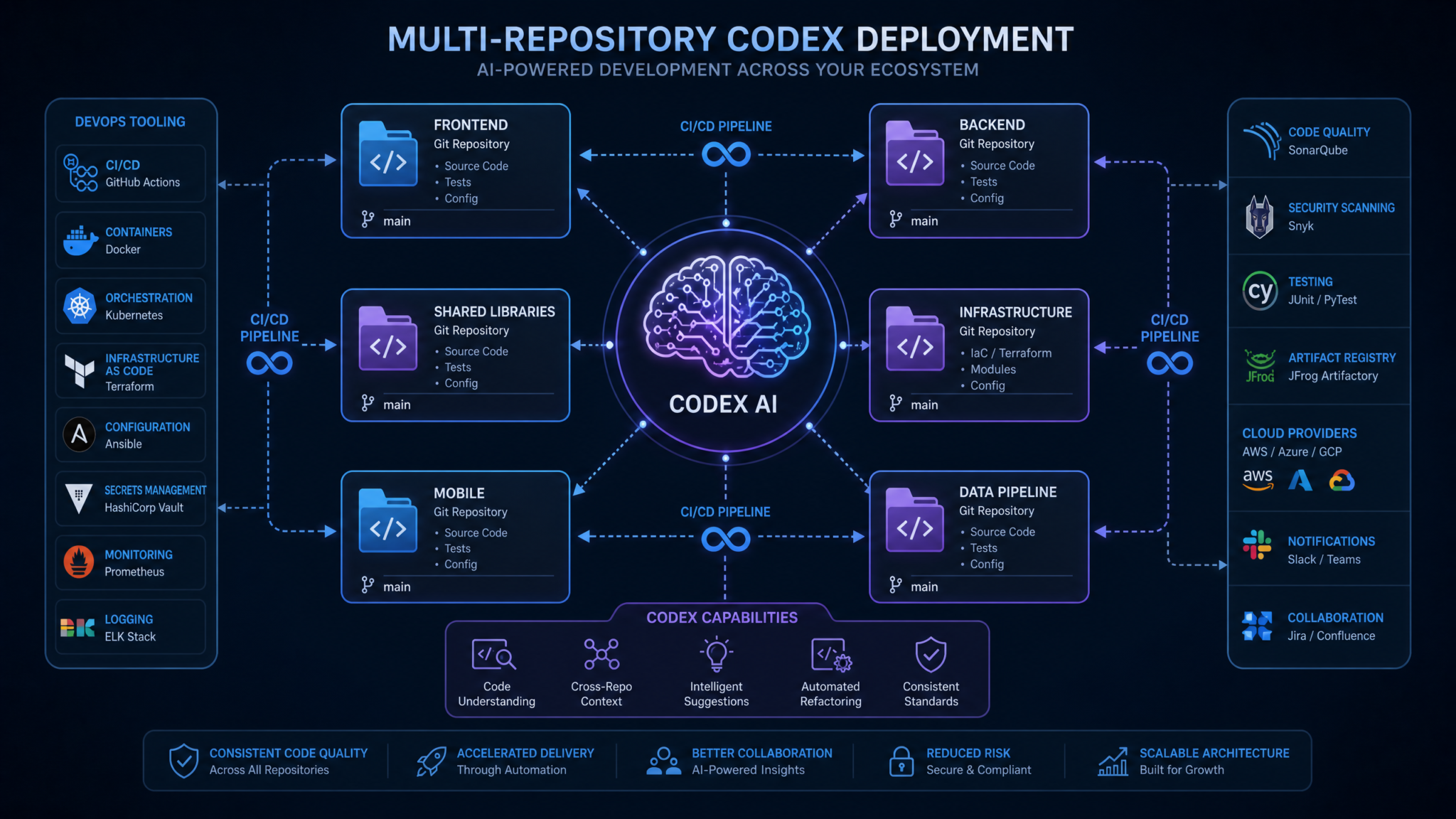
Why Multi-Repo Codex Deployment Is Different
When most developers first experiment with Codex — whether through OpenAI’s API, GitHub Copilot’s underlying model, or a custom integration — they’re working within a single project context. The model sees one codebase, infers its conventions, and generates code that roughly fits the existing patterns. At that scale, the surface area of failure is small and mostly involves prompt quality.
At enterprise scale, the problem set changes entirely. Consider a mid-sized engineering organization with 150 engineers working across 40 repositories: a shared authentication service, a dozen microservices, three frontend applications, internal tooling packages, data pipeline repositories, and infrastructure-as-code. Each repository has its own coding standards, its own language versions, its own maintainers, and its own relationship to downstream consumers. Codex doesn’t inherently understand that your payments-service repo imports from your core-types package, or that changes to the shared authentication library need to be backward-compatible across five consuming services.
Multi-repo enterprise deployment introduces six categories of complexity that single-repo pilots simply don’t encounter:
- Context fragmentation: Codex’s context window can only hold so much. In a multi-repo environment, the relevant context for any given task might span three repositories. Without deliberate context injection strategies, the model generates code that’s technically correct in isolation but incompatible with the broader ecosystem.
- Dependency graph blindness: Without explicit dependency mapping, Codex has no awareness of which packages are consumed by which services, leading to generated code that breaks consumers in non-obvious ways.
- Permission sprawl: Different teams own different repositories. Codex access needs to mirror your existing organizational permission structure, not flatten it.
- Cost attribution: At scale, API costs become significant. Without per-team and per-project attribution, you cannot optimize spend or justify the ROI to stakeholders.
- Consistency across heterogeneous stacks: One team writes Go, another writes Python, another writes TypeScript. Each has its own linting rules, testing frameworks, and architectural patterns. Codex needs to be configured per-context, not globally.
- Security surface expansion: The more repositories Codex can access as context, the more exposure you create if that context is transmitted to external APIs. Cross-repo context sharing requires a deliberate data classification policy.
Understanding these six dimensions is the prerequisite to everything that follows. Each phase of this playbook addresses one or more of them directly.
Industry benchmark: According to McKinsey’s 2023 analysis of developer productivity tools, organizations that deploy AI coding assistants with deliberate context architecture see 35–45% productivity gains, while those that deploy without architectural planning see gains of only 10–15% before plateau — and higher rates of AI-introduced bugs reaching production.
Phase 1: Architecture Planning
Before writing a single configuration file, your team needs a clear map of what you’re deploying into. Architecture planning for a multi-repo Codex deployment involves three distinct workstreams: repository mapping, dependency graph construction, and a deliberate decision about how Codex will interact with your monorepo vs. polyrepo topology.
Repository Mapping and Dependency Graphs
Start by producing a canonical repository inventory. This sounds obvious but most organizations don’t have one that’s actually current. The inventory should capture, for each repository:
- Primary language(s) and framework versions
- Team ownership (using GitHub CODEOWNERS or GitLab equivalent)
- Upstream dependencies (packages this repo consumes)
- Downstream consumers (services or packages that import from this repo)
- Deployment frequency (how often does this repo ship to production?)
- Data sensitivity classification (does this repo contain PII-adjacent logic, payment processing, or secrets management?)
- Test coverage percentage (as a proxy for how much safety net exists for AI-generated code)
This inventory becomes the foundation of your Codex deployment strategy. High-sensitivity, low-test-coverage repositories should be designated as read-only context sources initially — meaning Codex can use them to understand the codebase but should not be generating code into them autonomously until test coverage improves.
Once you have the inventory, build a visual dependency graph. Tools like nx graph (for JavaScript/TypeScript monorepos), pipdeptree (Python), or custom scripts using your package manager lockfiles can automate much of this. The output you want is a directed acyclic graph (DAG) where nodes are repositories and edges represent import/dependency relationships.
Describe your architecture in text-diagrammatic form for your Codex configuration files (covered in Phase 2). A representative enterprise dependency graph might look like this:
core-types (shared TypeScript interfaces)
    └── auth-service (Node.js)
    └── payments-service (Node.js)
    └── user-service (Go + type bindings)
    └── web-app (React)
        └── mobile-app (React Native, web-app component sharing)

infra-modules (Terraform modules)
    └── payments-infra
    └── data-pipeline-infra

data-pipeline (Python/Apache Beam)
    └── analytics-service (Python FastAPI)
        └── reporting-dashboard (React)
This graph tells you something critical for Codex deployment: any task involving core-types has the highest blast radius. Codex should be configured to flag changes to this repository as requiring human review regardless of confidence level.
Identifying Shared Libraries and Core Packages
Within your dependency graph, identify the repositories or packages that function as foundational shared libraries. These typically share three characteristics: they’re imported by five or more other repositories, they change relatively infrequently, and breaking changes in them cause cascading failures across the organization.
For Codex deployment, shared libraries require special handling:
- Always inject them as context when working in any consuming repository. If a developer asks Codex to help implement a new API endpoint in
payments-service, the model needs to know the interfaces defined incore-typesor it will invent incompatible types. - Apply stricter generation guardrails — generated code in shared libraries should require mandatory human review and a minimum of two approvers.
- Maintain frozen context snapshots. Pin the version of shared libraries that Codex uses as context to tagged releases rather than HEAD, preventing context drift during active development.
OpenAI Codex API Enterprise Integration Guide
Monorepo vs. Polyrepo Considerations
Your repository topology fundamentally shapes how you’ll configure Codex. The tradeoffs differ meaningfully:
| Dimension | Monorepo | Polyrepo |
|---|---|---|
| Context availability | All code in one place; easier to inject cross-package context | Context must be explicitly assembled from multiple repos |
| Permission granularity | Harder to restrict Codex access to sub-directories without custom tooling | Natural permission boundaries at repo level |
| Dependency graph visibility | Easier — workspace tools like Nx or Turborepo already track it | Requires custom dependency tracking |
| CI/CD integration complexity | Lower — single pipeline system; Codex integration is centralized | Higher — Codex must be integrated into N separate pipelines |
| Cost attribution | Must implement path-based attribution | Natural repo-level attribution |
| Context window efficiency | Risk of over-including irrelevant code in context | Easier to scope context per task |
If you operate a monorepo (using tools like Nx, Bazel, or Turborepo), your Codex configuration should leverage the existing workspace graph to automatically determine which packages are relevant to any given task. For polyrepo organizations, you’ll need to build or adopt a context assembly layer — described in detail in Phase 2.
Many large enterprises operate a hybrid topology: one or two monorepos for core application code alongside separate repositories for infrastructure, tooling, and data systems. This is arguably the most complex topology for Codex deployment because it requires both monorepo-style and polyrepo-style configuration strategies running simultaneously.
Phase 2: Workspace Configuration
Configuring Codex to Understand Cross-Repo Dependencies
The core challenge of multi-repo Codex deployment is context assembly: ensuring that when Codex operates on repository A, it has access to the relevant portions of repositories B and C that A depends on. There are three primary architectural patterns for achieving this:
Pattern 1: Context Bundle Injection. During CI/CD execution or IDE plugin initialization, a pre-processing step assembles a context bundle — a curated set of type definitions, interface files, README documents, and architectural decision records (ADRs) from dependency repositories — and injects them into the Codex context alongside the primary working files. This approach works well when dependencies are stable and the relevant context is limited to public interfaces rather than full implementation details.
Pattern 2: Federated Context Server. A dedicated internal service maintains an indexed, searchable representation of your entire codebase across all repositories. When Codex needs context, it queries this service to retrieve the most relevant snippets based on semantic similarity to the current task. This is the most powerful approach but requires significant infrastructure investment and is best suited for organizations with more than 50 engineers.
Pattern 3: Symbolic Links and Git Submodules. For tightly coupled repository pairs, some organizations use git submodules or symbolic links to make dependency repository content available within the working repository’s file tree. While this approach has limitations (submodule management overhead, potential for staleness), it works well for small numbers of critical dependencies and requires no additional infrastructure.
Per-Repo .codex Configuration Files
Each repository in your enterprise should contain a .codex/config.yaml file at its root. This file provides Codex with repository-specific context about conventions, dependencies, and constraints. Here is a comprehensive example for a Node.js microservice:
# .codex/config.yaml — payments-service

repository:
  name: payments-service
  team: payments-engineering
  language: typescript
  framework: nestjs
  node_version: "20.x"
  test_framework: jest

context_sources:
  local:
    - path: src/
      include_patterns: ["**/*.ts", "**/*.json"]
      exclude_patterns: ["**/*.spec.ts", "dist/**", "node_modules/**"]
    - path: .codex/architecture.md
      type: documentation
  external:
    - repo: yourproject.io/core-types
      version: "v3.2.1"         # pinned release tag
      paths:
        - src/interfaces/
        - src/enums/
      refresh_strategy: on_tag_push
    - repo: yourproject.io/auth-service
      version: "v1.8.0"
      paths:
        - src/contracts/         # only public API contracts
      refresh_strategy: weekly

generation_policy:
  require_human_review:
    - paths: ["src/core/**", "src/billing/**"]
      reason: "High-blast-radius payment logic"
    - paths: ["migrations/**"]
      reason: "Database migrations are irreversible"
  auto_approve_pr:
    - paths: ["src/utils/**", "test/**"]
      conditions:
        min_test_coverage_delta: 0
        linting: must_pass
  token_budget:
    daily_limit: 250000
    alert_threshold_percent: 80

conventions:
  error_handling: "Always use Result pattern from core-types"
  logging: "Use structured logging via @ourorg/logger package"
  api_contracts: "All DTOs must extend BaseDto from core-types"
  commit_style: "Conventional Commits — feat/fix/chore/refactor"
  branch_naming: "codex/{issue-number}/{brief-description}"
Several elements of this configuration deserve emphasis. The context_sources.external section is the mechanism by which cross-repo dependency awareness is implemented — you’re explicitly telling Codex which versions of which external packages are relevant, and which paths within those packages contain the public interfaces it needs to understand. The generation_policy section encodes your organizational risk tolerance into the configuration itself, ensuring that high-stakes code paths always get human eyes.
Shared Context and Knowledge Files
Beyond per-repo configuration, maintain a set of organization-level context documents in a dedicated repository (e.g., yourproject.io/codex-context-registry). These documents are injected into every Codex context regardless of which repository is being worked on:
- ARCHITECTURE.md: A high-level description of your organization’s system topology, including how services communicate (REST, gRPC, message queues), authentication patterns, and the purpose of each major repository cluster.
- CONVENTIONS.md: Organization-wide coding standards that supersede per-repo conventions.
- DATA_CLASSIFICATION.md: A description of your data sensitivity tiers and which repositories contain which tier of data. This helps Codex understand why certain patterns (e.g., logging request bodies) are acceptable in some contexts and not others.
- DEPENDENCY_MAP.json: A machine-readable version of your dependency graph, updated automatically by a nightly script that scans package manifests across all repositories.
Phase 3: Access Control and Permissions
Team-Based Permission Models
In a multi-repo enterprise, access control for Codex must mirror your existing organizational permission model — not create a parallel, more permissive one. The most effective approach is to treat Codex as a service principal within your existing identity and access management (IAM) system, subject to the same RBAC policies that govern human developers.
Define three tiers of Codex access:
Read-Only Context Access: Codex can retrieve content from this repository to inform context but cannot generate code into it and cannot create pull requests. Applied to: infrastructure repositories, security-critical services, repositories that exceed your data sensitivity threshold for external API transmission.
Assisted Generation Access: Codex can generate code suggestions and create draft pull requests, but all PRs require human review before merge and no auto-merge is permitted. Applied to: production application repositories, shared library repositories. This is the appropriate default for most repositories.
Autonomous Generation Access: Codex can generate code, create pull requests, and in limited cases (passing all automated checks) auto-merge to non-main branches. Applied only to: test repositories, documentation repositories, generated client SDK repositories, and repositories with >90% test coverage where Codex is performing well-defined, low-risk tasks like updating dependency versions.
Implement this tiering in your Codex platform configuration using a RBAC manifest:
# codex-access-manifest.yaml — stored in yourproject.io/codex-context-registry

access_policies:
  - policy_id: payments-team
    repositories:
      - repo: payments-service
        tier: assisted_generation
        team_scope: ["@yourorg/payments-engineering"]
      - repo: core-types
        tier: read_only_context
        team_scope: ["@yourorg/payments-engineering"]
      - repo: payments-infra
        tier: read_only_context
        team_scope: ["@yourorg/payments-engineering"]

  - policy_id: platform-team
    repositories:
      - repo: infra-modules
        tier: assisted_generation
        team_scope: ["@yourorg/platform-engineering"]
        extra_reviewers_required: 2
      - repo: "*"
        tier: read_only_context
        team_scope: ["@yourorg/platform-engineering"]
        note: "Platform team reads all repos for context, generates in none except infra-modules"
Secret Management Across Repositories
Codex workflows in CI/CD environments require API credentials. Managing these credentials across dozens of repositories creates significant security exposure if handled naively. Follow these principles:
Never store Codex API keys as repository-level secrets in individual repos. This creates N copies of a credential that must all be rotated when the key cycles. Instead, store Codex credentials at the organization level (GitHub organization secrets, GitLab group-level variables) and reference them in individual workflows without exposing the value.
Use short-lived tokens wherever possible. For CI/CD integrations, generate ephemeral tokens with a maximum lifetime of the pipeline duration rather than long-lived API keys. OpenAI’s API supports this pattern through service account token scoping.
Implement credential separation by sensitivity tier. Use separate API keys (and separate OpenAI project or organization accounts if your scale justifies it) for read-only context retrieval versus generation operations. This creates a clear audit trail and allows you to rate-limit generation operations independently of context retrieval.
AI Code Generation Security Best Practices for Enterprise Teams
Phase 4: CI/CD Integration
Codex in GitHub Actions
For organizations using GitHub Actions, Codex can be integrated at multiple points in the CI/CD lifecycle. The most valuable integration points are: issue-to-PR generation, automated code review assistance, and test generation for new code paths. Here is a production-ready GitHub Actions workflow for Codex-assisted PR generation:
# .github/workflows/codex-pr-generation.yml

name: Codex Assisted PR Generation

on:
  issues:
    types: [labeled]

permissions:
  contents: write
  pull-requests: write
  issues: read

jobs:
  codex-generate:
    if: github.event.label.name == 'codex-generate'
    runs-on: ubuntu-latest
    timeout-minutes: 15

    steps:
      - name: Checkout repository
        uses: actions/checkout@v4
        with:
          fetch-depth: 0

      - name: Assemble cross-repo context
        run: |
          mkdir -p .codex/external-context
          # Fetch pinned context from core-types
          gh api repos/yourorg/core-types/contents/src/interfaces \
            --jq '.[] | .download_url' | \
            xargs -I{} curl -s {} >> .codex/external-context/core-types-interfaces.ts
          # Fetch org-level architecture context
          curl -s https://raw.githubusercontent.com/yourorg/codex-context-registry/main/ARCHITECTURE.md \
            > .codex/external-context/ARCHITECTURE.md
        env:
          GH_TOKEN: ${{ secrets.GITHUB_TOKEN }}

      - name: Run Codex generation
        uses: openai/codex-action@v1
        with:
          api_key: ${{ secrets.OPENAI_CODEX_API_KEY }}
          issue_number: ${{ github.event.issue.number }}
          context_paths: |
            src/
            .codex/config.yaml
            .codex/external-context/
          model: codex-1
          max_tokens: 8192
          branch_prefix: "codex/${{ github.event.issue.number }}"

      - name: Validate generated code
        run: |
          npm ci
          npm run lint
          npm run typecheck
          npm run test -- --coverage --coverageThreshold='{"global":{"lines":80}}'

      - name: Create pull request
        uses: peter-evans/create-pull-request@v6
        with:
          token: ${{ secrets.GITHUB_TOKEN }}
          title: "[Codex] ${{ github.event.issue.title }}"
          body: |
            ## AI-Generated Implementation

            Generated by Codex in response to #${{ github.event.issue.number }}.

            **Review checklist:**
            - [ ] Logic matches issue requirements
            - [ ] Cross-repo type compatibility verified
            - [ ] No hardcoded credentials or environment-specific values
            - [ ] Test coverage meets team standards

            **Auto-generated. Requires human review before merge.**
          labels: codex-generated, needs-review
          reviewers: ${{ github.event.issue.assignees[0].login }}
Codex in GitLab CI
For GitLab CI environments, the integration pattern is similar but uses GitLab’s native CI/CD primitives. A key advantage in GitLab is the ability to use group-level CI/CD variables and include files, which supports the multi-repo context assembly pattern more naturally:
# .gitlab-ci.yml (partial — codex stage)

include:
  - project: 'yourorg/codex-context-registry'
    ref: main
    file: '/ci-templates/codex-base.yml'

variables:
  CODEX_MODEL: "codex-1"
  CODEX_CONTEXT_REGISTRY: "https://context.yourproject.io"

codex:generate:
  stage: ai-assistance
  image: python:3.12-slim
  rules:
    - if: '$CI_MERGE_REQUEST_LABELS =~ /codex-assist/'
  before_script:
    - pip install openai codex-enterprise-client
    - |
      python scripts/assemble_context.py \
        --config .codex/config.yaml \
        --output .codex/assembled-context.json
  script:
    - |
      codex-enterprise generate \
        --api-key $CODEX_API_KEY \
        --context-file .codex/assembled-context.json \
        --target-files $(git diff --name-only $CI_MERGE_REQUEST_DIFF_BASE_SHA) \
        --output-dir generated/
    - npm run lint:generated
    - npm run test:generated
  artifacts:
    paths:
      - generated/
    expire_in: 1 hour
Cross-Repo PR Automation Pipelines
One of the highest-value use cases in a multi-repo environment is automated cascade PRs — when a change in a shared library needs corresponding updates in downstream consumers. This is typically a manual, error-prone, and time-consuming process. Codex can automate it significantly.
When a breaking change is merged into core-types, trigger a Codex workflow that: identifies all downstream consumers from your dependency graph, clones each consumer repository, generates the necessary adaptation code for each (updating import paths, refactoring call sites, updating type usage), and opens a draft PR in each downstream repository tagged for the relevant team’s review.
This pattern alone — cascade PR automation — has been reported to reduce the time required for organization-wide library version bumps from multiple developer-days to hours.
Phase 5: Cost Management
Token Budgets Per Team
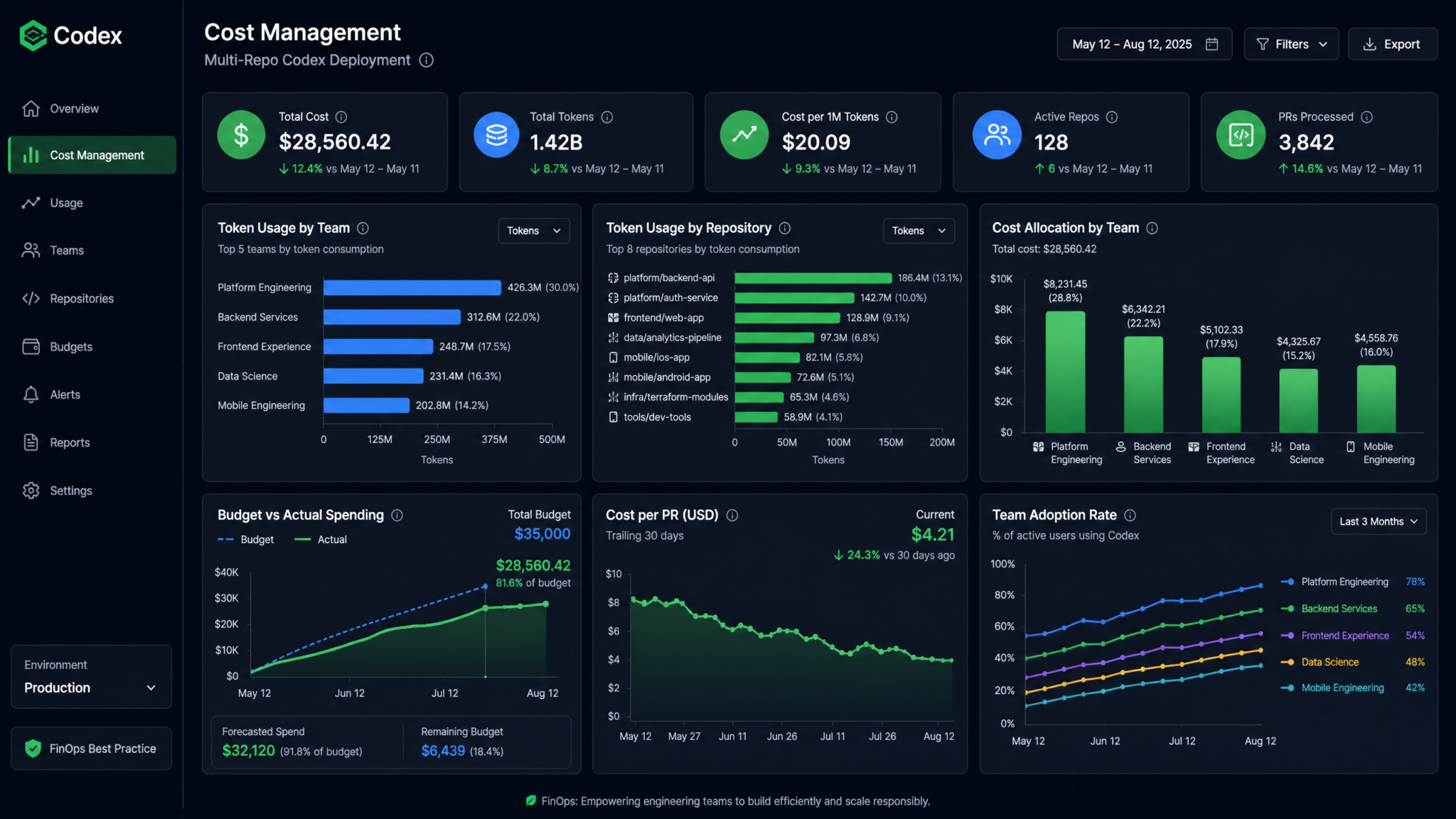
At enterprise scale, Codex API costs are material. A team of 10 developers actively using Codex for PR generation, code review assistance, and test generation can easily consume 50-100 million tokens per month. Across a 150-person engineering organization, this can represent $50,000-$150,000 in monthly API costs at current pricing — significant enough to require active management but modest relative to fully loaded developer salary costs if the productivity gain is real.
Implement token budgets at three levels:
- Team-level daily budget: Set in
.codex/config.yamlper repository (as shown in Phase 2). Alerted at 80%, hard-limited at 100%. - Project-level monthly budget: Tracked in your cost management system (see below), with automated Slack/email alerts to team leads when 70% is consumed mid-month.
- Organization-level quarterly budget: Owned by engineering leadership, reviewed quarterly against productivity metrics to ensure ROI justification.
Cost Allocation and Chargeback by Project
Implement cost attribution by tagging every API call with metadata identifying the repository, team, and task type. This requires adding metadata headers to your Codex API client wrapper:
// codex-client.ts — enterprise wrapper with cost attribution

import OpenAI from 'openai';

interface CodexRequestMetadata {
  repository: string;
  team: string;
  task_type: 'generation' | 'review' | 'test_generation' | 'explanation';
  issue_number?: string;
  pr_number?: string;
}

export class EnterpriseCodexClient {
  private client: OpenAI;
  private metricsCollector: MetricsCollector;

  constructor(apiKey: string, metricsCollector: MetricsCollector) {
    this.client = new OpenAI({ apiKey });
    this.metricsCollector = metricsCollector;
  }

  async generate(prompt: string, metadata: CodexRequestMetadata) {
    const startTime = Date.now();

    const response = await this.client.chat.completions.create({
      model: 'gpt-4o',
      messages: [{ role: 'user', content: prompt }],
      user: `${metadata.team}::${metadata.repository}::${metadata.task_type}`,
    });

    const tokensUsed = response.usage?.total_tokens ?? 0;
    const latencyMs = Date.now() - startTime;

    // Emit to cost attribution system
    await this.metricsCollector.record({
      timestamp: new Date().toISOString(),
      repository: metadata.repository,
      team: metadata.team,
      task_type: metadata.task_type,
      prompt_tokens: response.usage?.prompt_tokens ?? 0,
      completion_tokens: response.usage?.completion_tokens ?? 0,
      total_tokens: tokensUsed,
      estimated_cost_usd: this.calculateCost(tokensUsed),
      latency_ms: latencyMs,
      issue_number: metadata.issue_number,
      pr_number: metadata.pr_number,
    });

    return response;
  }

  private calculateCost(tokens: number): number {
    // Update rate per current OpenAI pricing
    const ratePerMillionTokens = 15.00;
    return (tokens / 1_000_000) * ratePerMillionTokens;
  }
}
Feed this attribution data into a cost dashboard (Grafana, DataDog, or your existing BI tooling) to produce team-level, project-level, and task-type-level cost breakdowns. Expose this dashboard to team leads on a weekly basis. The act of making costs visible typically reduces unnecessary usage by 20-30% without requiring hard limits.
Reducing OpenAI API Costs in Production Engineering Workflows
Phase 6: Scaling to the Full Engineering Org
From Pilot Team to Organization-Wide Rollout
The most successful enterprise Codex deployments follow a structured rollout pattern that takes approximately 12-16 weeks from pilot to full adoption. Attempting to roll out to the entire engineering organization simultaneously is the most common failure mode — it overwhelms the support capacity of whoever is managing the deployment, produces inconsistent experiences, and generates negative sentiment that’s hard to reverse.
Structure your rollout in four phases:
Weeks 1-4: Pilot (1 team, 5-8 engineers). Select a team that is technically strong, has reasonable test coverage, and whose lead is genuinely enthusiastic about AI tooling. Configure Codex for their specific repositories using the frameworks from Phases 1-3. Run daily check-ins. Measure obsessively: time saved per PR, bugs introduced vs. caught, developer satisfaction (weekly NPS). Your goal is to produce a case study and an opinionated configuration template that can be reused.
Weeks 5-8: Early Adopter Expansion (3-5 teams, 20-40 engineers). Use your pilot configuration as a template. The pilot team’s lead becomes an internal champion for the expansion teams. Introduce the cost monitoring dashboards and the per-repo configuration system. Identify repo-specific quirks that require customization.
Weeks 9-12: Broad Rollout (remaining teams, async onboarding). The configuration process is now well-understood. Use self-service onboarding documentation, a Codex configuration generator script, and office hours (rather than white-glove onboarding) for remaining teams. Your champion network (see below) handles peer support.
Weeks 13-16: Optimization and Governance. Review cost attribution data, quality metrics, and adoption rates by team. Identify outliers (teams with low adoption or high AI-introduced bug rates) for targeted intervention. Establish the ongoing governance process: quarterly configuration reviews, model version upgrade process, cost budget reviews.
Champion Networks and Training Programs
The technology is only part of the deployment challenge. The organizational change management dimension is equally critical. Every multi-repo enterprise deployment needs a Codex champion network: one designated champion per engineering team who:
Access 40,000+ AI Prompts for ChatGPT, Claude & Codex — Free!
Subscribe to get instant access to our complete Notion Prompt Library — the largest curated collection of prompts for ChatGPT, Claude, OpenAI Codex, and other leading AI models. Optimized for real-world workflows across coding, research, content creation, and business.
- Completes a 4-hour certification program covering Codex capabilities, limitations, prompt engineering, and security considerations
- Owns the
.codex/config.yamlfor their team’s repositories - Is the first point of escalation for teammates with Codex questions
- Participates in a monthly champion sync to share learnings across teams
- Reviews and approves Codex-generated PRs during initial deployment, building team trust through oversight
Training programs should be layered: a 30-minute awareness session for all engineers covering basic usage, a 2-hour hands-on workshop for regular users covering prompt engineering and output validation, and the 4-hour certification for champions. Create a searchable internal knowledge base for Codex prompts that worked particularly well for your specific codebase — this becomes one of your most valuable organizational assets over time.
Monitoring and Metrics
Measuring the impact of Codex deployment requires a metrics framework that captures both productivity and quality dimensions. Resist the temptation to measure only proxy metrics like “number of Codex suggestions accepted” — these tell you about usage, not value.
Define your metrics framework around four categories:
Productivity Metrics:
- Time from issue creation to PR opening (by team, trended weekly)
- PR review cycle time (are Codex-generated PRs taking longer to review?)
- Lines of code per developer per week (use with significant caution — not all code is equal)
- Ratio of new feature work to maintenance work (are developers spending more time on valuable work?)
Quality Metrics:
- Bug escape rate for Codex-generated PRs vs. human-only PRs (track this separately)
- Code review comments per PR (more comments may indicate lower-quality generation)
- Test coverage delta on Codex PRs (is Codex improving or degrading coverage?)
- Static analysis violations introduced per PR by source (Codex vs. human)
Adoption Metrics:
- Percentage of PRs that used Codex assistance in some form, by team and repo
- Weekly active Codex users per team
- Champion satisfaction score (monthly survey)
- Feature usage distribution (generation vs. review vs. test generation vs. explanation)
Cost Metrics:
- Cost per PR assisted (total API cost / number of PRs with Codex involvement)
- Cost per developer per month by team
- Token efficiency trend (are teams getting more value per token as they learn to prompt more effectively?)
- ROI calculation: estimated developer hours saved × average loaded hourly cost vs. total Codex API spend
Publish a monthly Codex metrics report to engineering leadership. This report serves two functions: it validates continued investment, and it creates accountability for teams with low adoption or poor quality metrics to engage with the champion network for support.
Developer Productivity Metrics Framework for AI-Assisted Engineering Teams
Troubleshooting Common Multi-Repo Issues
Even well-planned deployments encounter predictable problems. Here are the most common failure modes in multi-repo Codex deployments and their resolutions:
Problem: Codex generates code that compiles but is incompatible with the current version of a shared library.
Root cause: The context bundle is using a stale version of the shared library’s interface definitions. Resolution: Implement version pinning in your context_sources.external configuration (as shown in Phase 2) and add a CI check that validates the pinned version matches the version declared in package.json or equivalent. If these drift, fail loudly rather than silently using stale context.
Problem: Codex-generated PRs consistently fail linting checks.
Root cause: The conventions section of your .codex/config.yaml is either missing, vague, or not being effectively injected into the system prompt. Resolution: Add your actual ESLint/Prettier configuration files to the context_paths that Codex ingests. Machine-readable configuration is more reliable than natural language descriptions of conventions. Also add a linting auto-fix step before Codex creates the PR — many linting issues can be resolved programmatically.
Problem: Token costs are significantly higher than projected.
Root cause: Context bundles are including too much content — full implementation files rather than just interface definitions from dependency repositories. Resolution: Audit your context bundle composition using token counting before injecting. In most cases, 80% of the value comes from 20% of the context: type definitions, interfaces, and public API signatures. Strip implementation details from externally-sourced context.
Problem: Adoption is low on a specific team despite tooling being configured correctly.
Root cause: Usually cultural, not technical. Either the team lead is skeptical and communicating that skepticism implicitly, or early experiences with low-quality generation have created negative associations. Resolution: Identify the specific task types where Codex performs best for that team’s stack (often test generation and documentation are high-quality even when feature generation is mediocre) and have the champion demonstrate value in those domains first. Build trust incrementally rather than asking for broad adoption upfront.
Problem: CI/CD pipelines are significantly slower due to Codex integration.
Root cause: Synchronous Codex API calls in the critical path of the CI pipeline. Resolution: Move Codex operations to parallel jobs that don’t block the critical path. Code generation and review assistance should be additive to the pipeline, not blocking. The only exception is security-sensitive automated checks, which may warrant blocking behavior — but even these can often be implemented as separate, fast classification calls rather than full generation requests.
Problem: Cross-repo context is revealing sensitive information about security-sensitive repositories to teams that shouldn’t have that level of visibility.
Root cause: Insufficiently granular path controls in the context assembly system. Resolution: Implement a context filtering layer that scrubs any content matching your data classification criteria before injecting external repository content. Content from repositories classified as “sensitive” should only expose public type interfaces and never include business logic, algorithm implementations, or configuration patterns that reveal security mechanisms.
Security Considerations for Cross-Repo Context Sharing
The security implications of multi-repo Codex deployment are the dimension most frequently underestimated by organizations in the early stages of adoption. When you assemble a context bundle containing code from multiple repositories and transmit it to an external API, you are making an implicit decision about data residency, confidentiality, and intellectual property exposure that deserves deliberate policy treatment.
Establish a formal Codex Data Classification Policy that addresses the following:
What code can be transmitted to external AI APIs? Most organizations have three tiers: code that can be transmitted freely (internal tooling, non-sensitive utility libraries), code that can be transmitted with contractual data processing agreements in place (production application code), and code that cannot be transmitted externally under any circumstances (proprietary algorithms, security mechanisms, PII-processing logic, regulated financial logic). Every repository in your inventory should be classified into one of these tiers before Codex deployment.
Context isolation by sensitivity tier. Your context assembly layer must enforce that only repositories in the transmissible tiers are included in context bundles sent to external APIs. Repositories in the restricted tier can still benefit from Codex in a local deployment model — either through OpenAI’s private deployment options or through self-hosted open-source code generation models — but must not contribute to externally-transmitted context.
Prompt injection risk in multi-repo environments. In a multi-repo context, the attack surface for prompt injection expands. If your context assembly pulls content from repositories that external contributors can modify (open-source dependencies, for example), a malicious actor could craft content in those repositories designed to influence Codex’s behavior when that content is included in your context. Implement a content sanitization step that strips potential prompt injection patterns from externally-sourced context before injection.
Audit logging for cross-repo context access. Every time a context bundle is assembled that includes content from a repository the requesting developer doesn’t have direct read access to, log this access. This creates an audit trail that your security team can review and helps detect misuse of the context assembly system to access code that a developer isn’t supposed to see directly.
Model output as a potential data exfiltration vector. Less obviously: generated code that’s based on sensitive context can encode information from that context in ways that are non-obvious. For example, a model that has seen your authentication service implementation might generate code in a consumer service that embeds assumptions about implementation details of the auth service. Review generated code not just for functional correctness but for unexpected leakage of sensitive implementation knowledge.
Work with your security team to conduct a formal threat model review before cross-repo context sharing goes into production. The threat model should cover: data in transit (always HTTPS, verify TLS configuration), data at rest (how long does OpenAI retain API inputs?), insider threat scenarios, and supply chain attack scenarios targeting your dependency repositories.
Enterprise AI Tool Security Policies and Data Classification Frameworks
Conclusion: The Multi-Repo Codex Deployment as an Organizational Capability
Deploying Codex across a multi-repository enterprise codebase is not a technical project that concludes at rollout — it’s an organizational capability that requires ongoing investment in configuration, governance, training, and measurement. The organizations that extract the most value from AI coding assistance over time are those that treat their Codex deployment as a product in its own right, with a product owner, a roadmap, user research (developer feedback), and a continuous improvement cycle.
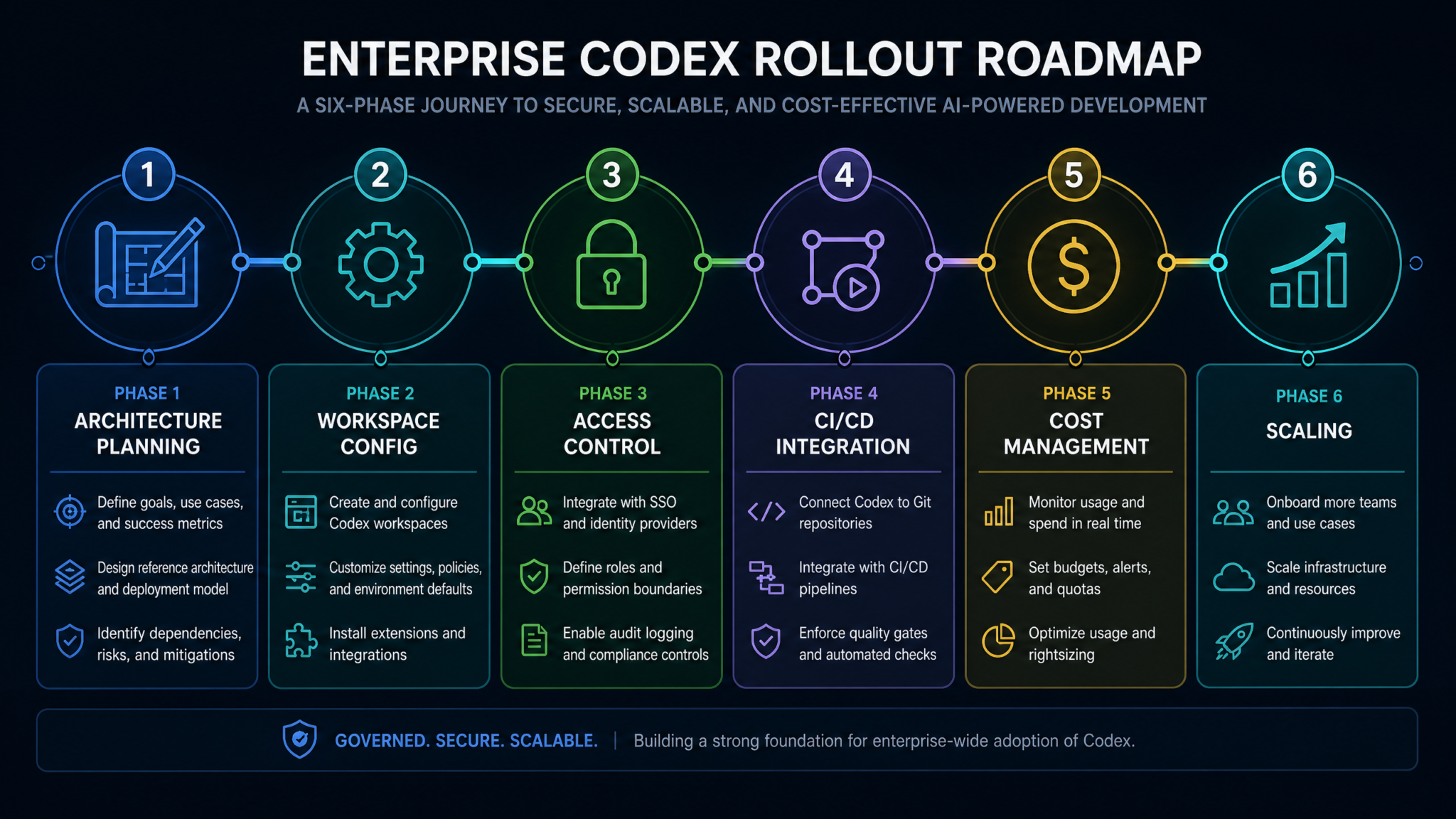
The six phases described in this playbook — architecture planning, workspace configuration, access control, CI/CD integration, cost management, and scaling — are not strictly sequential. Most organizations execute them in overlapping parallel tracks, with pilot team work informing architecture decisions and cost management infrastructure being built alongside CI/CD integration. What matters is that all six phases are addressed before considering the deployment mature.
The organizations seeing the highest productivity gains from Codex at scale are not those with the most sophisticated technical configurations — they’re the ones that have invested in the human dimension: champion networks, training programs, and a culture that treats AI-generated code with appropriate skepticism and appropriate trust. Codex at its best is not a replacement for engineering judgment; it is a multiplier for it. Configuring it well, across all your repositories, is how you realize that multiplier at organizational scale.
The playbook described here represents current best practices as of 2025. The tooling, pricing, and capabilities of AI coding models are evolving rapidly — plan for at least annual reviews of your configuration architecture and semi-annual reviews of your access control and security policies as the landscape matures.
