
30 ChatGPT-5.5 Prompts for Product Managers: Roadmaps, User Stories, Sprint Planning, and Stakeholder Communication

30 ChatGPT-5.5 Prompts for Product Managers: Roadmaps, User Stories, Sprint Planning, and Stakeholder Communication
Product managers sit at the intersection of business strategy, technical execution, and user empathy — a position that demands constant context-switching, crisp communication, and the ability to synthesize ambiguity into actionable plans. With ChatGPT-5.5’s expanded reasoning capabilities and deeper contextual understanding, PMs now have a genuinely powerful thinking partner that can accelerate every phase of the product lifecycle. Whether you’re drafting a quarterly roadmap, writing detailed acceptance criteria, preparing for a sprint planning meeting, or crafting a politically sensitive stakeholder update, the right prompt makes all the difference between a generic AI response and one that sounds like it came from an experienced senior PM on your team.
This guide delivers 30 copy-paste-ready, heavily customizable prompts organized across the six core competency areas every product manager navigates daily. Each prompt is engineered with specific variable placeholders so you can swap in your product context, industry, audience, and constraints without losing the structural integrity that makes these prompts work. We’ve also included expert commentary on why each prompt is designed the way it is, so you understand the mechanics and can adapt them further. By the end of this article, you’ll have a comprehensive prompt library that covers your entire workflow — from discovery to delivery to executive communication.
Why ChatGPT-5.5 Is a Game-Changer for Product Managers
Product management has always been a discipline defined by information overload and competing priorities. A single PM might receive 200 Slack messages, attend four cross-functional meetings, review two engineering proposals, and still be expected to produce a coherent roadmap update — all in the same day. Traditional tools help with organization, but they don’t help with thinking. ChatGPT-5.5 changes that equation fundamentally by offering a reasoning partner that can hold context, challenge assumptions, generate structured artifacts, and simulate stakeholder perspectives on demand.
What separates ChatGPT-5.5 from previous versions is its ability to maintain nuanced, multi-layered context across long conversations. This means you can provide your full product context — target users, business model, competitive landscape, technical constraints — and then ask a series of increasingly specific questions without re-explaining yourself each time. For PMs, this is transformative. You can ask it to draft a user story, then immediately ask it to stress-test the acceptance criteria against an edge case your QA engineer might raise, and then ask it to rewrite the story for a non-technical stakeholder — all in the same session.
Beyond document drafting, ChatGPT-5.5 excels at structured frameworks. Product managers rely heavily on frameworks like RICE, MoSCoW, Jobs-to-be-Done, and OKRs — and the model understands these frameworks deeply enough to apply them to your specific context rather than just defining them abstractly. The prompts in this guide are deliberately designed to leverage this capability.
How to Use This Prompt Library Effectively
Before diving into the prompts themselves, here are the conventions used throughout this guide. Every prompt contains bracketed variables in [SQUARE BRACKETS] that you should replace with your specific information. These are not optional — filling them in is what transforms a generic AI prompt into a high-quality, context-aware output. The more specific you are with your variable replacements, the better your results will be.
Each prompt also follows a deliberate structure: it establishes a role or persona for ChatGPT, provides relevant context, specifies the task with clear constraints, defines the output format, and often includes a tone or audience directive. This structure mirrors best practices in prompt engineering and ensures consistent, usable outputs. You can use these prompts verbatim, combine elements from multiple prompts, or use them as starting points for your own evolved versions.
| Prompt Component | Purpose | Example |
|---|---|---|
| Role Assignment | Sets model expertise and perspective | “Act as a senior product manager with 10 years of SaaS experience…” |
| Context Injection | Grounds the response in your reality | “Our product is [PRODUCT NAME], a [DESCRIPTION] used by [USER PERSONA]…” |
| Task Specification | Defines exactly what you need | “Create a 3-quarter roadmap that addresses [STRATEGIC OBJECTIVE]…” |
| Format Directive | Controls output structure | “Format this as a table with columns for Quarter, Initiative, Success Metric, and Dependencies…” |
| Constraint Definition | Limits scope and ensures relevance | “Assume a team of [X] engineers and a budget of [Y]…” |
| Audience/Tone Guide | Calibrates language and depth | “Write for a C-suite audience with no technical background…” |
One powerful technique is chaining these prompts sequentially. Start with Prompt 1 to create a roadmap, use the output as context for Prompt 6 to write a PRD for the top roadmap item, then use that PRD as context for Prompt 11 to generate user stories. This chain approach creates coherent, interconnected artifacts instead of isolated documents.
Section 1: Product Roadmap Creation Prompts (1–5)
The product roadmap is simultaneously a strategic document, a communication tool, and a prioritization framework. Great roadmaps tell a story — they explain not just what you’re building, but why, and in what sequence. These five prompts help you create roadmaps at different levels of granularity for different audiences, from high-level vision statements to detailed quarterly execution plans.
Prompt 1: Outcome-Based Quarterly Roadmap
Act as a senior product manager specializing in [INDUSTRY: e.g., B2B SaaS / consumer mobile / fintech]. Our product is [PRODUCT NAME], which [ONE-SENTENCE PRODUCT DESCRIPTION]. Our primary user persona is [USER PERSONA NAME], who [DESCRIBE THEIR KEY JOB TO BE DONE]. For the next three quarters, our company's top strategic objectives are [OKR 1], [OKR 2], and [OKR 3].

Create an outcome-based product roadmap for Q[X] through Q[X+2] of [YEAR]. For each quarter, define 2-3 high-level themes (not features), the primary user outcome each theme delivers, the key metrics that would indicate success, and the major technical or business dependencies. Do not list individual features — focus on outcomes and strategic bets.

Format the roadmap as a structured table with the following columns: Quarter | Theme | User Outcome | Success Metrics | Key Dependencies | Risk Level (Low/Medium/High). After the table, write a 2-paragraph "Roadmap Narrative" that explains the strategic logic connecting the three quarters, suitable for sharing with a board of directors.
Why this works: Outcome-based roadmaps are increasingly the gold standard because they give engineering and design teams autonomy on the “how” while keeping everyone aligned on the “why.” By explicitly asking for themes rather than features, you force a strategic framing that serves executives far better than a feature list. The narrative section at the end is critical — it’s often the only part a busy executive actually reads.
Prompt 2: Now-Next-Later Framework Roadmap
You are a product strategy consultant helping the PM team at [COMPANY NAME] create a Now-Next-Later roadmap for [PRODUCT NAME]. Our current situation is: [2-3 SENTENCES ABOUT CURRENT PRODUCT STATE, KEY CHALLENGES, AND MARKET POSITION]. Our engineering team has [NUMBER] engineers split across [NUMBER] squads, and our next funding milestone / business review is in [TIMEFRAME].

Using the Now-Next-Later framework, categorize the following [NUMBER] initiatives into the appropriate bucket: [LIST YOUR INITIATIVES, one per line]. For each initiative, provide: (1) which bucket it belongs in and why, (2) the primary value driver (user value, revenue, technical debt reduction, or strategic positioning), (3) a confidence score from 1-10 on feasibility given our team size, and (4) any initiative you think is missing based on the context I've provided.

Present this as a visual-style text layout with Now / Next / Later as clear headers, and follow with a "Gaps and Recommendations" section where you suggest 2-3 initiatives I haven't listed that you believe we should consider given our strategic context.
Why this works: The Now-Next-Later framework is powerful precisely because it avoids false precision about timelines. This prompt includes a gap analysis request, which is where AI-assisted product thinking truly shines — having the model identify what you haven’t thought of yet is often more valuable than organizing what you have.
Prompt 3: Stakeholder-Ready Visual Roadmap Narrative
Act as both a senior PM and an executive communications expert. I need to create a roadmap presentation narrative for our [QUARTERLY/ANNUAL] planning meeting. Attendees will include [LIST STAKEHOLDER GROUPS: e.g., CEO, CTO, Head of Sales, Head of Customer Success]. The roadmap covers [PRODUCT LINE OR FEATURE AREA] and spans [TIME PERIOD].

Here are the key initiatives we've decided to pursue: [LIST INITIATIVES WITH ONE-LINE DESCRIPTIONS]. Here are the initiatives we decided NOT to pursue this cycle: [LIST DEPRIORITIZED ITEMS]. The primary trade-off we made was choosing [CHOSEN DIRECTION] over [ALTERNATIVE DIRECTION] because [BRIEF REASON].

Write a 400-500 word executive narrative that: (1) opens with the strategic context and market opportunity, (2) presents the roadmap as a deliberate sequence of bets, (3) explicitly addresses the deprioritized items and frames them as disciplined choices rather than failures, and (4) closes with the 90-day milestones the team is committing to. Use confident, non-hedging language appropriate for a leadership team presentation.
Prompt 4: RICE-Scored Feature Prioritization for Roadmap Input
You are a product management expert helping me prioritize features for our next roadmap cycle using the RICE scoring framework (Reach, Impact, Confidence, Effort). Our product is [PRODUCT NAME], serving [USER BASE SIZE] active users. Our primary growth metric is [NORTH STAR METRIC] and our current value for that metric is [CURRENT VALUE].

I will provide you with [NUMBER] candidate features. For each feature, I'll give you the feature name and a brief description. Your task is to: (1) estimate a RICE score for each feature based on the information I provide and reasonable assumptions you make explicitly, (2) flag any features where you need more information to score accurately, (3) identify any features that seem similar enough to combine, and (4) produce a prioritized ranking with a brief rationale for the top 5.

Here are the features: [LIST FEATURES WITH BRIEF DESCRIPTIONS]. After the RICE table, provide a "Prioritization Rationale" section that explains the strategic logic of the top 5 and flags any items where the RICE score may be misleading due to strategic factors not captured by the framework (e.g., competitive necessity, CEO mandate, regulatory requirement).
Prompt 5: Roadmap Rollout Communication Plan
Act as a senior product manager and internal communications specialist. I have just finalized a product roadmap for [TIME PERIOD] for [PRODUCT NAME]. The roadmap contains major changes including: [LIST 2-3 SIGNIFICANT CHANGES OR NEW DIRECTIONS]. Some stakeholders, particularly [STAKEHOLDER GROUP], may react negatively because [REASON FOR POTENTIAL RESISTANCE].

Create a comprehensive roadmap rollout communication plan that covers: (1) a sequenced list of communication touchpoints (who hears what, in what order, and through which channel), (2) key messages tailored for each of these audiences: [AUDIENCE 1], [AUDIENCE 2], [AUDIENCE 3], (3) anticipated objections from each audience and suggested PM responses, and (4) a 30-day follow-up cadence to reinforce roadmap alignment.

Format this as an actionable communication playbook. For each stakeholder group, provide a 3-5 sentence message framework that the PM can adapt for a meeting, email, or Slack message. End with a "Rollout Risks" section that identifies the top 3 things that could derail roadmap adoption internally and mitigation strategies for each.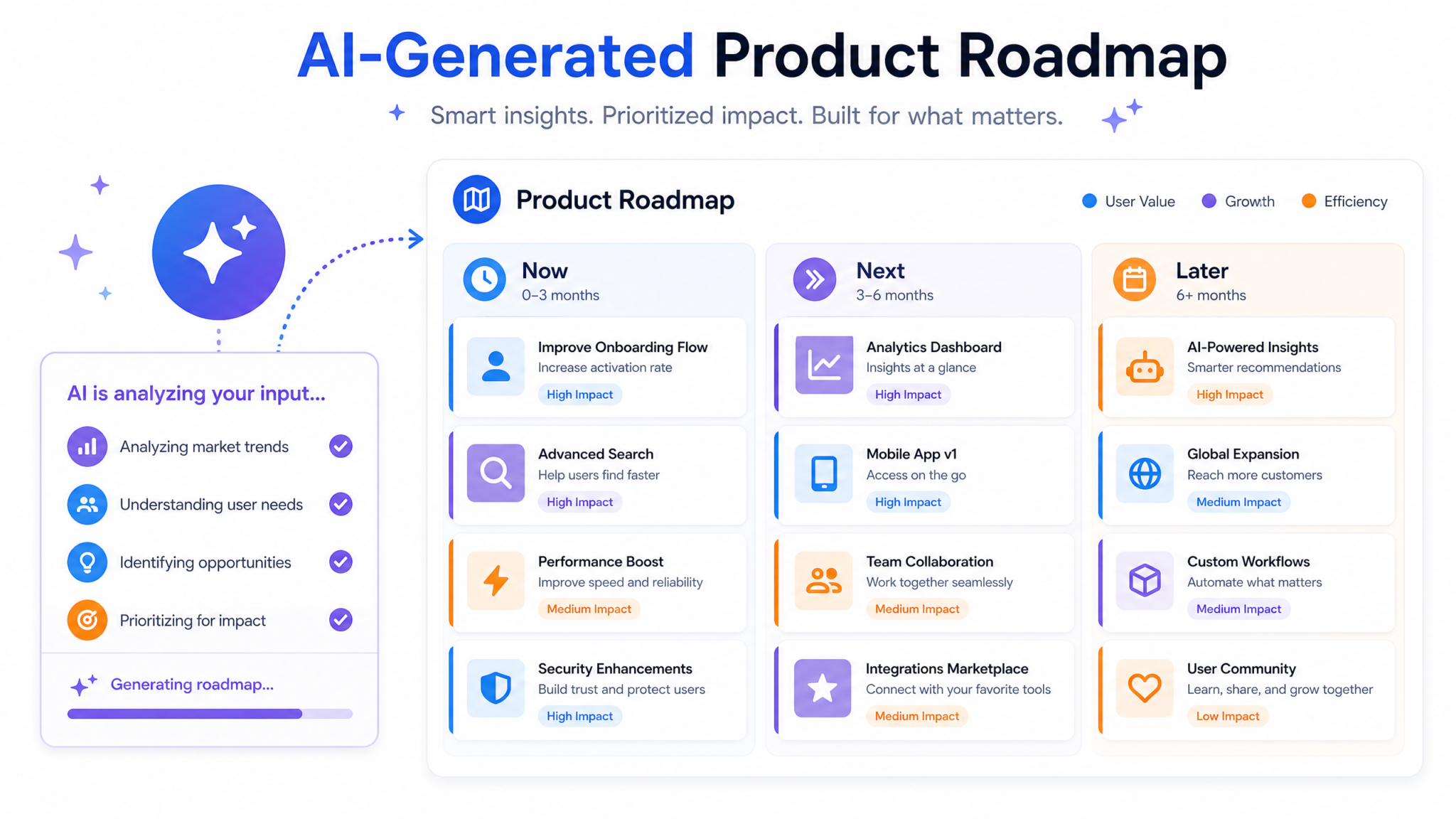
Section 2: PRD and Feature Spec Writing Prompts (6–10)
Product Requirements Documents remain the backbone of feature development, even as teams move toward leaner specification styles. A good PRD saves hundreds of hours of back-and-forth by answering the right questions before engineering starts. These prompts help you write PRDs that are thorough without being bureaucratic, covering everything from the problem statement to edge cases to success metrics.
Prompt 6: Full PRD Generation from Feature Brief
Act as a senior product manager with deep experience writing PRDs for [INDUSTRY] products. I need you to write a complete Product Requirements Document for the following feature: [FEATURE NAME]. Here is the feature brief: [2-4 SENTENCES DESCRIBING WHAT THE FEATURE DOES AND THE PROBLEM IT SOLVES]. The primary users of this feature will be [USER PERSONA], and the business objective it supports is [BUSINESS OBJECTIVE].

Write a full PRD using this structure: (1) Executive Summary (3-4 sentences), (2) Problem Statement with user evidence or reasoning, (3) Goals and Non-Goals, (4) User Stories (at least 3, including the primary happy path and 2 edge cases), (5) Functional Requirements (numbered list), (6) Non-Functional Requirements (performance, security, accessibility), (7) Success Metrics with specific targets, (8) Open Questions and Assumptions, (9) Out of Scope items.

The PRD should be written for an engineering team of [SIZE] working in [AGILE/WATERFALL] methodology. Use clear, precise language — avoid adjectives like "seamless" or "intuitive" in favor of measurable descriptions. Flag any section where you're making assumptions based on limited information I've provided, so I can fill in the gaps.
Prompt 7: Feature Spec Stress-Test and Gap Analysis
You are a senior staff engineer and product manager hybrid reviewing a feature specification for potential gaps, ambiguities, and engineering risks. I will paste a feature spec below, and I want you to perform a systematic stress-test of the document. Approach this as if you are the most experienced, skeptical engineer in the room who has seen many "simple" features turn into 3-month projects.

[PASTE YOUR FEATURE SPEC HERE]

For each section of the spec, identify: (1) ambiguous requirements that could be interpreted in multiple ways by different engineers, (2) missing edge cases or error states that aren't addressed, (3) unstated assumptions about existing system behavior or data states, (4) requirements that seem technically complex but are written as if they're simple, and (5) missing non-functional requirements (performance thresholds, error handling, data retention, accessibility standards).

Present your analysis as a numbered list of "Issues" with severity ratings (Critical / High / Medium / Low) and a suggested resolution for each. End with an overall "Spec Readiness Score" from 1-10 and a 2-sentence verdict on whether this spec is ready for engineering refinement or needs significant rework.
Prompt 8: API Integration Feature Spec
Act as a technical product manager writing a feature spec for an API integration. We are building an integration between [OUR PRODUCT NAME] and [THIRD-PARTY TOOL/API NAME]. The integration should enable [CORE USE CASE] for our users, specifically [USER PERSONA]. The third-party API supports [RELEVANT API CAPABILITIES — e.g., OAuth 2.0 authentication, webhook events, REST endpoints].

Write a feature spec that includes: (1) Integration Overview and User Value Proposition, (2) Authentication and Authorization flow (describe the OAuth or API key flow step by step), (3) Data mapping table showing which fields from [THIRD-PARTY TOOL] map to which fields in [OUR PRODUCT], (4) Sync behavior specification (real-time vs. batch, conflict resolution rules, rate limit handling), (5) Error handling and user-facing error messages for the 5 most likely failure scenarios, (6) Testing requirements including a suggested set of integration test cases.

Write this spec at a level of detail that a backend engineer can use to begin technical design without needing to ask clarifying questions about the product logic. Use a technical but accessible tone, and include a "Glossary" section at the end defining any domain-specific terms from either product.
Prompt 9: Experiment and A/B Test Spec
You are a product manager with expertise in growth experimentation and statistical testing. I need to write a formal experiment spec for an A/B test we want to run on [FEATURE OR PAGE NAME] in [PRODUCT NAME]. Our hypothesis is that [DESCRIBE YOUR HYPOTHESIS: changing X will cause Y because Z]. Our primary success metric is [METRIC] and our current baseline value is [CURRENT VALUE]. We have approximately [DAILY ACTIVE USERS] daily active users eligible for this experiment.

Write a complete experiment spec that includes: (1) Hypothesis statement in the formal "If we [change], then [metric] will [direction] because [reasoning]" format, (2) Control and treatment descriptions with clear behavioral differences, (3) Sample size calculation with reasoning (use a 95% confidence level, 80% statistical power, and [MINIMUM DETECTABLE EFFECT] as the minimum effect we care about), (4) Guardrail metrics we must not move negatively, (5) Experiment duration recommendation, (6) Segmentation strategy (who is included/excluded and why), (7) Analysis plan including how we'll handle novelty effects and network effects if applicable.

Close with a "Decision Framework" section that specifies exactly what results would lead to each possible outcome: ship, iterate, or kill. Make the decision criteria specific and quantitative so the team doesn't have to debate the outcome interpretation after the experiment concludes.
Prompt 10: Deprecation and Sunset Feature Spec
Act as a senior product manager who specializes in platform lifecycle management. I need to write a spec for deprecating [FEATURE NAME] in [PRODUCT NAME]. The feature is currently used by approximately [NUMBER OR PERCENTAGE] of our users. The reasons for deprecation are: [LIST 2-3 REASONS]. The replacement or alternative solution is [DESCRIBE ALTERNATIVE, OR "none" if this is a full removal].

Write a deprecation spec that covers: (1) Deprecation rationale and business justification, (2) Affected user segments and impact assessment (classify as high/medium/low impact for each segment), (3) Communication timeline with specific milestones (e.g., initial announcement, final reminder, sunset date), (4) Migration path for users, including step-by-step instructions if applicable, (5) Technical decommissioning requirements (what must be removed from the codebase, database cleanup, API versioning considerations), (6) Support and escalation plan for users who cannot migrate, (7) Success criteria for a "clean" deprecation.

Include a sample customer-facing announcement email that is empathetic, clear about the timeline, and proactively addresses the most likely user concerns. The tone should be transparent and solution-oriented, not corporate or defensive.
For product managers who frequently work on AI-powered features within their products, understanding how to prompt AI models effectively is a dual skill — you need to write specs for AI features AND use AI tools to accelerate your PM work. ChatGPT for Technical Product Managers“>Our comprehensive guide to ChatGPT for technical product managers covers how to write AI feature specifications, define model evaluation criteria, and manage the unique uncertainties of ML-powered product development — making it an essential resource for PMs operating in AI-first companies.
Section 3: User Story Generation with Acceptance Criteria Prompts (11–15)
User stories seem deceptively simple, but writing genuinely good ones — stories that are small enough to ship, meaningful enough to matter, and precise enough to test — is a craft that takes years to develop. These prompts help you generate stories that follow INVEST principles, include comprehensive acceptance criteria in Given-When-Then format, and anticipate the edge cases that QA engineers will thank you for catching early.
Prompt 11: Epic Decomposition into User Stories
You are a senior product manager and agile coach helping me decompose an epic into well-formed user stories. The epic is: [EPIC NAME]. Epic description: [2-3 SENTENCES DESCRIBING THE EPIC'S SCOPE AND USER VALUE]. The primary user persona is [PERSONA NAME] who [DESCRIBE THEIR ROLE AND CONTEXT]. Secondary personas are [PERSONA 2] and [PERSONA 3].

Decompose this epic into a complete set of user stories following these rules: (1) Each story must follow the "As a [persona], I want [capability] so that [benefit]" format, (2) Each story should be independently deliverable and testable (the "I" and "T" in INVEST), (3) Stories should progress from the happy path through to edge cases and error states, (4) No story should be larger than what a single engineer could complete in 3 days.

For each story, provide: the story statement, a story point estimate (using Fibonacci: 1, 2, 3, 5, 8), a priority label (Must Have / Should Have / Could Have / Won't Have this sprint), and 3-5 acceptance criteria in Given-When-Then format. After all stories, provide a "Missing Stories" section where you identify user flows or scenarios this epic should cover that I haven't implicitly described.
Prompt 12: Acceptance Criteria Deep Dive
Act as a QA lead and senior product manager working together to write exhaustive acceptance criteria for a user story. The story is: "As a [USER PERSONA], I want [CAPABILITY] so that [BENEFIT]." The feature context is: [2-3 SENTENCES OF ADDITIONAL CONTEXT ABOUT HOW THIS FEATURE WORKS AND WHAT SYSTEM IT INTERACTS WITH].

Write acceptance criteria in Given-When-Then (Gherkin) format that covers: (1) The primary happy path (at least 2 scenarios), (2) Alternative valid paths (variations in user behavior that should still succeed), (3) Negative/error scenarios (invalid inputs, missing data, permission errors, network failures), (4) Boundary conditions (limits, thresholds, edge values), (5) Performance expectations (if applicable), (6) Accessibility requirements (keyboard navigation, screen reader behavior).

After the acceptance criteria, write a "Test Data Requirements" section listing the specific types of test data a QA engineer would need to test these scenarios. Finally, flag any criteria where the current story statement is ambiguous and provide 2 possible interpretations so the PM can clarify the intent.
Prompt 13: Persona-Specific Story Variations
You are a product manager working on a multi-persona product. Our product [PRODUCT NAME] serves three distinct user types: [PERSONA 1: brief description], [PERSONA 2: brief description], and [PERSONA 3: brief description]. I need to write user stories for the feature "[FEATURE NAME]" as it applies to each persona, because each persona interacts with this feature differently.

For each persona, generate: (1) 2-3 user stories specific to their goals and context with this feature, (2) Unique acceptance criteria that reflect persona-specific permissions, data views, or workflows, (3) Any user stories that apply to multiple personas (shared stories) and how they should be labeled.

After the per-persona stories, create a "Permission Matrix" table that shows which user stories each persona can access, with columns for Story Title, Persona 1, Persona 2, Persona 3, and Notes. This matrix should make it easy for an engineer to understand the role-based access control requirements without reading every story in detail.
Prompt 14: Technical Story and Enabler Story Generation
Act as a technical product manager who understands both product and engineering needs. I need to generate technical stories and enablers to support the delivery of [USER-FACING FEATURE]. The feature requires the following backend capabilities that don't yet exist: [LIST TECHNICAL CAPABILITIES NEEDED]. Our current system architecture includes [BRIEF DESCRIPTION OF RELEVANT EXISTING SYSTEMS OR SERVICES].

For each technical capability, write a technical story in the format: "In order to [enable user-facing capability], as the [SYSTEM/SERVICE NAME], we need to [TECHNICAL ACTION]." Each technical story should include: (1) A clear definition of done from an engineering perspective, (2) Non-functional requirements (performance SLAs, error rate thresholds, data consistency requirements), (3) Dependencies on other technical stories in this set, (4) Security and compliance considerations specific to this capability.

After the technical stories, create a dependency map as a simple numbered list showing the order in which stories should be implemented to minimize blocking. Flag any technical stories that represent significant architectural decisions that should be reviewed before implementation begins.
Prompt 15: Story Refinement and Splitting
You are an agile coach and senior PM helping me refine and split user stories that are too large to deliver in a single sprint. I will provide a set of stories that our team has flagged as too large (typically 8 or 13 story points). For each story, your job is to: (1) diagnose WHY the story is too large (too many acceptance criteria, compound goals, hidden technical complexity, unclear scope), (2) suggest the best splitting strategy from these patterns: split by workflow steps, split by business rule variations, split by happy path vs. edge cases, split by data/entity types, or split by interface layer, (3) rewrite the original story as 2-4 smaller stories that together deliver the same user value.

Here are the oversized stories: [PASTE STORIES WITH THEIR CURRENT ACCEPTANCE CRITERIA].

For each split story set, confirm that: each new story is independently shippable (the user gets value even if subsequent stories aren't delivered), the split doesn't create "half-features" that confuse users, and the combined scope of the new stories doesn't exceed the original scope. Flag any story where splitting isn't the right answer and a different approach (like creating a spike or separating into a technical enabler) would be better.
Section 4: Sprint Planning and Prioritization Prompts (16–20)
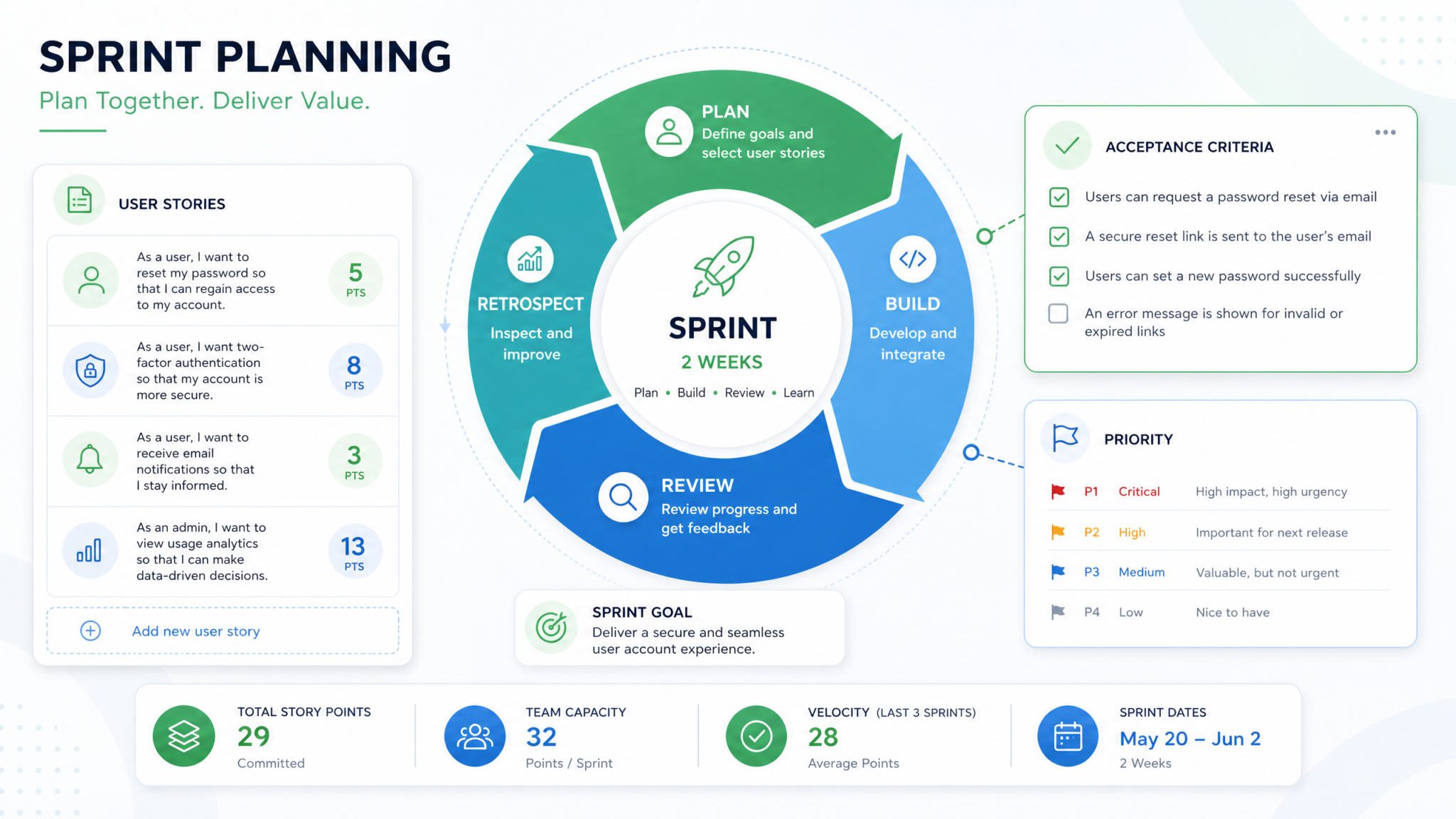
Sprint planning is where strategy meets execution — and where the best-laid roadmap plans collide with engineering reality, team capacity, and last-minute stakeholder requests. These prompts help you facilitate more effective planning sessions, make defensible prioritization decisions, manage the inevitable trade-offs, and communicate those trade-offs clearly to your team and stakeholders.
Prompt 16: Sprint Goal Generation and Alignment
Act as a senior product manager and agile coach helping me prepare for our upcoming sprint planning session. The sprint is [SPRINT NUMBER] for [PRODUCT NAME], covering [START DATE] to [END DATE] ([NUMBER] weeks). Our current team velocity is approximately [STORY POINTS] per sprint. The team consists of [NUMBER] engineers, [NUMBER] designers, and [NUMBER] QA engineers.

Our backlog candidates for this sprint include: [LIST STORIES WITH STORY POINT ESTIMATES]. Our product OKR for this quarter is [OKR STATEMENT]. Last sprint, we committed to [PREVIOUS SPRINT GOAL] and [ACHIEVED / PARTIALLY ACHIEVED / DID NOT ACHIEVE] it because [BRIEF REASON].

Based on this context: (1) Recommend the optimal sprint goal in one clear, outcome-focused sentence that the whole team can rally around, (2) Select the stories that best support this goal and fit within our velocity, (3) Identify stories that should be excluded from this sprint and explain why (defer, dependency, or lack of readiness), (4) Suggest 2-3 stretch goals if we complete the committed work early. Format this as a Sprint Planning Brief that I can share with the team before the planning meeting to make the session more efficient.
Prompt 17: Backlog Grooming Facilitation Guide
You are a product management expert helping me prepare a backlog grooming session agenda for [PRODUCT NAME]. Our backlog currently contains [NUMBER] items across [NUMBER] epics. The most urgent items relate to [DESCRIBE TOP 2-3 PRIORITY AREAS]. Known blockers include [LIST ANY KNOWN DEPENDENCIES OR BLOCKERS]. The grooming session is [LENGTH: e.g., 90 minutes] and will include [LIST ATTENDEES: PM, engineers, designer, etc.].

Create a structured facilitation guide for this grooming session that includes: (1) Pre-meeting preparation checklist for the PM (what to have ready before attendees arrive), (2) A timed agenda broken into specific activities (e.g., 10 min reviewing previous sprint learnings, 30 min story estimation, etc.), (3) For each agenda section, the facilitation questions the PM should ask to drive productive discussion, (4) A rubric for deciding whether a story is "groomed and ready" vs. "needs more refinement" — make this specific enough that the team can self-assess without the PM arbitrating every story.

Also include a "Red Flag Checklist" — a list of 8-10 warning signs during grooming that indicate a story is likely to cause sprint problems (e.g., disagreement in estimation, missing designs, unclear acceptance criteria) and how to handle each one.
Prompt 18: MoSCoW Prioritization with Stakeholder Trade-off Analysis
Act as a product manager facilitating a prioritization decision under constrained resources. We have a list of [NUMBER] features/items that multiple stakeholders want included in [RELEASE NAME / SPRINT NAME]. Our constraint is [DESCRIBE CONSTRAINT: e.g., "We have 40 story points of capacity and these items total 85 story points"]. The stakeholders involved are: [LIST STAKEHOLDERS AND THEIR PRIMARY INTERESTS].

Using the MoSCoW framework (Must Have, Should Have, Could Have, Won't Have), categorize the following items: [LIST ALL ITEMS WITH BRIEF DESCRIPTIONS AND STORY POINT ESTIMATES].

For each categorization decision, provide: (1) The MoSCoW label, (2) A one-sentence justification that references either user value, business impact, technical dependency, or risk, (3) Which stakeholder is most likely to object to this categorization and why, (4) A suggested response the PM can use when that stakeholder pushes back.

After the full categorization, write a "Prioritization Summary" email draft that the PM can send to all stakeholders simultaneously to communicate the decisions, acknowledge the trade-offs, and establish the expectation for when "Won't Have" items will be revisited. The email should be confident and clear without being dismissive of any stakeholder's priorities.
Prompt 19: Bug vs. Feature Trade-off Analysis
You are a senior product manager who excels at balancing technical health with feature velocity. Our team is debating how to allocate capacity in the upcoming sprint. We have [TOTAL STORY POINTS] of capacity. There are [NUMBER] bug/tech debt items totaling [STORY POINTS] and [NUMBER] feature items totaling [STORY POINTS] competing for the same slots.

Here are the bugs/tech debt items: [LIST WITH SEVERITY: P0/P1/P2, affected users, and description]. Here are the feature items: [LIST WITH BUSINESS VALUE DESCRIPTION AND STORY POINTS].

Analyze this trade-off and provide: (1) A recommended allocation split between bugs and features (e.g., 60/40) with explicit reasoning tied to business impact, user experience, and technical risk, (2) A prioritized order within each category, (3) Any bugs that are severe enough to be non-negotiable regardless of feature demand, (4) A framework the team can apply in future sprints to make this decision more consistently without PM involvement for minor items.

Present the final recommended sprint composition as a simple table, then write a 3-sentence explanation the PM can use to explain the allocation decision to engineering leadership.
Prompt 20: Sprint Retrospective Action Plan Generator
Act as an agile coach and product manager helping our team extract maximum value from sprint retrospective data. Our team just completed [SPRINT NAME/NUMBER]. Here are the raw retrospective notes from the team, organized by category:

What went well: [LIST ITEMS]
What didn't go well: [LIST ITEMS]
Ideas for improvement: [LIST ITEMS]
Blockers that need PM/leadership attention: [LIST ITEMS]

Transform these raw notes into: (1) A synthesized summary that identifies the top 2-3 systemic themes (not individual incidents) from the "didn't go well" items, (2) For each systemic theme, a specific, measurable, time-bound action item with an assigned owner role (PM, Tech Lead, Scrum Master, etc.), (3) A "Carry Forward" list of action items from the previous retro that we should check on, (4) A 2-paragraph "Team Health Narrative" that honestly describes the team's current state and trajectory.

Format the output as a Retrospective Action Plan document that can be shared with the team and engineering leadership. Include a simple traffic light status system (🟢 🟡 🔴) for rating team health across these dimensions: Velocity Consistency, Collaboration Quality, Process Clarity, and Technical Health.
Many product managers struggle with the boundary between product ownership and project management during sprint cycles. Understanding how to delegate operational coordination to AI assistants while preserving your strategic judgment is a productivity superpower. ChatGPT Prompts for Agile Project Management“>Our detailed breakdown of ChatGPT prompts for agile project management explores how PMs and scrum masters can use AI to automate status tracking, generate meeting summaries, and maintain sprint documentation without losing the human judgment that makes agile work — a must-read complement to the sprint planning prompts in this section.
Section 5: Stakeholder Communication and Executive Updates Prompts (21–25)
The ability to communicate product strategy, progress, and trade-offs to diverse stakeholders is often what separates good PMs from exceptional ones. These prompts help you craft communications that are calibrated to specific audiences — from deeply technical engineers to business-focused executives who want the bottom line in 90 seconds. Clear, confident stakeholder communication also builds the organizational trust that gives PMs more autonomy to make product decisions.
Prompt 21: Executive Status Update (Concise and Impact-Focused)
Act as a chief of staff and senior product manager co-writing an executive product update. The update is for [CEO / CPO / Board / Leadership Team] at [COMPANY NAME]. The audience has [HIGH / MEDIUM / LOW] technical depth and cares most about [BUSINESS OUTCOMES / USER METRICS / STRATEGIC POSITION / REVENUE IMPACT]. The update covers [TIME PERIOD] and should take no more than [2-3 MINUTES] to read.

Here is the raw information I want to communicate: Accomplishments: [LIST]. Metrics vs. targets: [LIST WITH ACTUALS AND TARGETS]. Blockers and risks: [LIST]. Upcoming decisions needed from leadership: [LIST]. Next period priorities: [LIST].

Rewrite this raw information as a crisp executive update using this structure: (1) Opening "Bottom Line" sentence that summarizes the most important thing leadership needs to know, (2) Bullet-format Wins with metrics attached to every achievement, (3) A "Risks and Decisions Needed" section that is direct about what requires leadership input (include a recommended action for each decision), (4) Forward-looking "Next 30 Days" section with 3 clear priorities. Use confident, declarative language. Avoid passive voice, hedging words like "hopefully" or "we think," and any jargon that requires product context to understand.
Prompt 22: Feature Delay Notification with Mitigation Plan
You are a senior product manager who needs to communicate a feature delay to multiple stakeholder groups. The feature is [FEATURE NAME] which was promised for [ORIGINAL DATE]. The new estimated delivery date is [NEW DATE], a delay of [NUMBER] weeks/months. The root cause of the delay is [HONEST DESCRIPTION OF ROOT CAUSE: technical complexity, scope creep, resource reallocation, external dependency, etc.]. The business impact of the delay is [DESCRIBE IMPACT: affected customers, revenue at risk, sales commitments, etc.].

Write three versions of the delay notification, calibrated for these different audiences: (1) An internal Slack message to the engineering team (honest, collaborative, focused on the path forward), (2) An email to the Head of Sales and Customer Success (business-focused, acknowledges impact, provides interim alternatives or workarounds), (3) An executive summary bullet for the monthly leadership review (concise, includes root cause and prevention measures).

For each version, ensure the message: takes accountability without being self-flagellating, provides a credible revised commitment, explains what is being done to prevent recurrence, and offers something concrete in the meantime. Avoid the word "unfortunately" and phrases that start with "I wanted to let you know." Use direct, professional language throughout.
Prompt 23: Cross-Functional Alignment Document
Act as a senior product manager creating a cross-functional alignment document for a major upcoming initiative. The initiative is [INITIATIVE NAME] with a launch target of [DATE]. The initiative impacts these teams: [LIST TEAMS AND HOW THEY ARE IMPACTED]. Known areas of misalignment or tension include: [DESCRIBE 2-3 SPECIFIC DISAGREEMENTS OR UNCLEAR RESPONSIBILITIES]. The PM's proposed resolution for each is: [DESCRIBE PM'S POSITION].

Create a Cross-Functional Alignment Document that includes: (1) Initiative Overview and Strategic Rationale (3-4 sentences, suitable for any team member to understand the "why"), (2) RACI matrix covering the [NUMBER] key decisions and deliverables (rows = decisions/deliverables, columns = team names with R/A/C/I designation), (3) For each area of misalignment, a "Decision Log" entry with: the question, the decision made, the rationale, and who needs to be informed, (4) A "Escalation Path" section that defines what types of issues go to which leadership level.

Format this document so it can be shared directly with all team leads after a brief review by the PM. Include a "Document Version" header, a one-line summary of what changed from any previous version, and a "Decision Made By" line for each logged decision.
Prompt 24: Customer Escalation Response to Product Feedback
You are a senior PM helping draft a response to a significant customer escalation about a product limitation or missing feature. The customer is [CUSTOMER NAME], which is [DESCRIBE CUSTOMER: size, tier, strategic importance]. The escalation came through [CHANNEL: email, executive call, CSM, etc.] and raised the following concerns: [LIST CUSTOMER CONCERNS OR FEATURE REQUESTS].

Our current position on each concern is: [DESCRIBE PRODUCT TEAM'S ACTUAL STANCE: building, considering, not on roadmap, etc.]. The account is worth [ARR/VALUE] and [IS / IS NOT] at risk of churn. The customer's contact is [ROLE: e.g., VP of Operations], who is [TECHNICAL / NON-TECHNICAL].

Write a formal but warm response that: (1) Acknowledges each concern specifically (no generic "we hear you" language), (2) Is honest about what is and isn't on the roadmap without over-committing, (3) Offers a concrete next step for each concern (scheduled demo, workaround, committed timeline, or a discovery call), (4) Closes with a forward-looking statement that reaffirms the partnership. Also provide a separate "Internal PM Note" with your recommended actual response strategy — what to commit to, what to hedge, and what red flags this escalation reveals about the product gap.
Prompt 25: Launch Readiness Communication Package
Act as a senior product manager preparing the internal communication package for a feature launch. The feature is [FEATURE NAME] and it launches on [DATE] to [ALL USERS / % ROLLOUT / SPECIFIC SEGMENTS]. The launch was built to address [USER PROBLEM] and delivers value by [HOW IT SOLVES THE PROBLEM]. The key metrics we will track post-launch are [LIST METRICS WITH TARGETS].

Create a complete internal launch communication package that includes: (1) A launch announcement for all-hands / company Slack — celebratory, includes the user story behind why we built this, and gives credit to the teams involved, (2) A Sales Enablement Card — one page max, covers: what it is, who benefits, how to demo it, FAQ for common customer questions, and what to say if asked about limitations, (3) A Customer Success Briefing — focuses on which existing customers will see the most value, suggested customer communication language, and escalation contacts if customers have issues, (4) A launch day checklist for the PM with monitoring tasks for the first 48 hours post-launch.

Use a different tone for each document — energetic for the announcement, precise and practical for the sales card, empathetic and helpful for the CS briefing, and methodical for the checklist.
Section 6: Competitive Analysis and Market Research Prompts (26–30)
Competitive intelligence is only as valuable as the strategic insights you extract from it. Raw feature comparison tables tell you what competitors are doing — but they don’t tell you why, or what it means for your product decisions. These prompts help you go beyond surface-level competitive monitoring to develop genuine strategic insights that can inform roadmap decisions, positioning, and pricing strategy.
Access 40,000+ AI Prompts for ChatGPT, Claude & Codex — Free!
Subscribe to get instant access to our complete Notion Prompt Library — the largest curated collection of prompts for ChatGPT, Claude, OpenAI Codex, and other leading AI models. Optimized for real-world workflows across coding, research, content creation, and business.
Prompt 26: Competitive Feature Matrix and Positioning Analysis
Act as a product strategy consultant with expertise in [INDUSTRY] competitive analysis. I need to create a comprehensive competitive landscape analysis for [OUR PRODUCT NAME]. Our product serves [TARGET MARKET] with a core value proposition of [VALUE PROPOSITION]. Our main competitors are: [COMPETITOR 1], [COMPETITOR 2], [COMPETITOR 3], and [COMPETITOR 4].

Based on your knowledge of these products (and my supplemental notes below), create: (1) A feature comparison matrix with rows as feature categories and columns as our product plus each competitor — use ✅ (full feature), ⚠️ (partial/limited), and ❌ (not available) notation, (2) A "Positioning Map" description (since we can't create a visual, describe where each competitor sits on two key axes: [AXIS 1, e.g., Simplicity vs. Power] and [AXIS 2, e.g., SMB-focused vs. Enterprise-focused]), (3) For each competitor, a "Strategic Narrative" — a 2-sentence summary of what they're optimizing for and what kind of customer they're winning.

My supplemental notes on each competitor: [PASTE ANY NOTES, REVIEWS, OR OBSERVATIONS YOU'VE GATHERED]. After the analysis, identify our top 3 competitive vulnerabilities and suggest a product strategy response for each. Be direct about weaknesses — I need honest analysis, not diplomatic softening.
Prompt 27: Win/Loss Analysis Synthesis
You are a senior product manager and market researcher synthesizing win/loss data for [PRODUCT NAME]. I will provide you with notes from [NUMBER] recent sales deals: [NUMBER] wins and [NUMBER] losses. Your job is to identify patterns, surface product insights, and translate sales outcomes into product strategy recommendations.

Here are the deal notes: [PASTE WIN/LOSS NOTES, organized by deal with outcome, competitor if applicable, key decision factors, and verbatim customer quotes where available].

From this data, provide: (1) The top 3 reasons we win, with supporting evidence from the deal notes, (2) The top 3 reasons we lose, with supporting evidence, (3) A "Product Gap Analysis" identifying the specific product capabilities or gaps that appear most frequently in loss reasons — rank these by frequency and estimated revenue impact, (4) A "Sales Process Gap Analysis" separating losses attributable to product limitations vs. losses attributable to how we were sold/positioned, (5) Recommended roadmap adjustments based on the win/loss patterns, with a suggested prioritization rationale.

Present the final output as an executive-ready Win/Loss Analysis report that can be shared with the VP of Product and Head of Sales. Include a "Confidence Level" rating for each insight (High/Medium/Low) based on the sample size and consistency of the evidence.
Prompt 28: Customer Interview Synthesis and Opportunity Identification
Act as a UX researcher and product manager specializing in customer development. I have conducted [NUMBER] customer interviews for [PRODUCT NAME]. The interviews focused on [RESEARCH OBJECTIVE: e.g., understanding how customers currently manage X workflow, evaluating interest in Y concept, diagnosing churn reasons]. The customer segments interviewed were: [LIST SEGMENTS WITH COUNTS].

Here are my interview notes: [PASTE NOTES — these can be raw or lightly structured. Include verbatim quotes where possible.]

Synthesize these interviews using the Jobs-to-be-Done framework. Identify: (1) The 3-5 distinct "jobs" customers are hiring products like ours to do (functional, emotional, and social dimensions for each), (2) For each job, the current solution customers are using and its key limitations, (3) Underserved jobs — areas where customer pain is high but no solution currently satisfies it well, (4) Overserved jobs — areas where customers are getting more than they need and would pay less for a simpler solution, (5) 5 verbatim customer quotes that best capture the most important insights.

After the JTBD synthesis, generate a ranked "Opportunity Backlog" of product opportunities derived from the interviews, formatted as a table with columns: Opportunity Description | Target Segment | Frequency of Mention | Estimated Impact | Suggested Validation Method.
Prompt 29: Market Sizing and TAM/SAM/SOM Analysis
You are a product manager and market analyst helping build a credible market sizing analysis for [PRODUCT NAME] in the [MARKET SEGMENT] space. This analysis will be presented to [AUDIENCE: investors, board, internal leadership] to justify investment in [INITIATIVE OR PRODUCT LINE]. Our product serves [DESCRIBE TARGET CUSTOMER] with a pricing model of [PRICING MODEL: e.g., $X/user/month, $Y/seat/year].

Help me build a TAM/SAM/SOM analysis using both top-down and bottom-up approaches. For the top-down approach, use publicly available market data and analyst estimates for [INDUSTRY/MARKET] — state your sources and confidence in the data. For the bottom-up approach, use these inputs: [PROVIDE ANY DATA YOU HAVE: e.g., number of companies in target ICP, average seats per company, willingness to pay estimates].

For each market level (TAM, SAM, SOM), provide: the calculation methodology, the assumptions made, the resulting number with a range (conservative/base/optimistic case), and the primary variable that most affects the estimate. Close with a "Market Sizing Credibility Assessment" — an honest evaluation of how defensible these numbers are and what additional data would strengthen the analysis. Flag any assumptions that an investor or board member is likely to challenge and provide suggested responses.
Prompt 30: Competitive Threat Response Strategy
Act as a senior product strategist helping me develop a formal competitive response plan. A competitor ([COMPETITOR NAME]) has just [DESCRIBE COMPETITIVE THREAT: launched a new feature, lowered pricing, released a direct competitive product, acquired a complementary company, etc.]. Here is what we know about the threat: [PASTE RELEVANT INFORMATION: press releases, product announcements, pricing changes, customer reactions you've heard].

Our current competitive position relative to this competitor is: [DESCRIBE: where we're stronger, where we're weaker, which customer segments overlap]. Our roadmap for the next [2 QUARTERS] currently includes: [BRIEF SUMMARY OF PLANNED WORK].

Develop a competitive response strategy that covers: (1) Threat Assessment — rate the severity of this competitive move on a 1-10 scale and explain why, (2) Immediate Actions (next 30 days) — what should we do right now without changing our roadmap? (3) Roadmap Impact Analysis — which planned items become more urgent given this threat? What (if anything) should we accelerate, deprioritize, or cancel? (4) Customer Retention Talking Points — what should Sales and CS say to customers who bring up this competitor's announcement? (5) A "Do Nothing" scenario — what happens if we don't respond, and is that actually the right choice?

End with a "Recommended Response" summary — a clear, decisive recommendation for how aggressive our response should be and the primary rationale. Present options with trade-offs rather than a single path only if the decision is genuinely close.
Competitive analysis at the strategic level requires integrating market data, customer insights, and internal capability assessments into a coherent narrative — exactly the kind of synthesis task where AI tools provide the most leverage. How to Use ChatGPT for Market Research and Competitive Intelligence“>Our in-depth guide on using ChatGPT for market research and competitive intelligence demonstrates how to combine multiple prompt techniques, integrate public data sources, and build living competitive intelligence documents that your entire product team can use — an essential companion resource for the competitive analysis prompts in this section.
Pro Tips for Getting Even More From These Prompts
These 30 prompts are starting points, not ceilings. Here are advanced techniques that experienced PMs use to push AI-assisted output from “good” to “exceptional.”
Tip 1: Provide Negative Examples
One of the most underused prompting techniques is telling ChatGPT what you don’t want. After pasting any of these prompts, add a line like: “Here is an example of the kind of output I want to AVOID: [paste a bad example or describe what bad looks like].” This dramatically narrows the response space and produces outputs that are far more aligned with your actual expectations. For roadmap prompts especially, specifying “avoid feature laundry lists, avoid vague themes like ‘improve UX’” can transform the output quality.
Tip 2: Use the “Debate Partner” Technique
After receiving any output — a prioritized backlog, a PRD section, an executive update — follow up with: “Now argue against the decisions made in this document from the perspective of [skeptical engineer / demanding enterprise customer / competing PM on our team]. What are the strongest objections?” This adversarial follow-up surfaces blind spots and stress-tests your thinking before you present to a real audience. It’s particularly valuable before stakeholder meetings where you know someone will push back.
Tip 3: Build a Persistent Context Document
Create a “Product Context Brief” document — 200-300 words covering your product, users, tech stack, team size, competitors, and current OKRs — and paste it at the top of every new ChatGPT conversation. This eliminates the re-explanation overhead and ensures every response is grounded in your actual situation. Update this brief each quarter and keep it in your PM toolkit alongside these prompts.
Tip 4: Request Structured Output Formats
Always specify the output format explicitly. “Format as a table,” “use numbered lists with bold headers,” “provide this as JSON,” or “write this so I can paste it directly into Confluence” — these format directives significantly improve usability. For technical specs especially, requesting that outputs use your team’s specific formatting conventions (which you provide once in the session) makes outputs immediately usable rather than requiring reformatting.
Tip 5: Iterate with Refinement Prompts
| Refinement Goal | Refinement Prompt to Use |
|---|---|
| Make it shorter | “Reduce this by 40% while keeping all critical information. Remove any explanatory text and focus on the decisions and data.” |
| Make it more specific | “Replace every general statement with a specific example from the context I’ve provided, or ask me for the specific data you need.” |
| Change the tone | “Rewrite this for a more skeptical/technical/non-technical audience. Current version feels too [formal/casual/vague].” |
| Add more structure | “Break this into clearly labeled sections with headers. Each section should be self-contained so a reader can jump to what they need.” |
| Check for gaps | “Review this output as a peer PM. What’s missing, what’s unclear, and what would you push back on if I presented this to you?” |
Tip 6: Create Persona Simulations
For stakeholder communication prompts, use ChatGPT to simulate your stakeholders before sending your actual message. Paste your draft communication and say: “You are [STAKEHOLDER NAME], the [ROLE] at our company. You’re known for being [DESCRIBE THEIR PERSONALITY: detail-oriented and skeptical / big-picture and impatient / data-driven / protective of their team’s bandwidth]. Read this communication and respond as they would in a meeting.” This rehearsal technique is invaluable for preparing for difficult conversations and catching tone problems before they become relationship problems.
Conclusion
The 30 prompts in this guide represent a complete AI-powered workflow for product managers — one that covers every phase of your work from strategic roadmapping through sprint execution to stakeholder communication and market intelligence. But the real value isn’t in any single prompt: it’s in developing the habit of bringing structured, context-rich prompts to every PM task, and building a personal prompt library that accumulates your product’s unique context over time.
The most effective AI-assisted PMs are not the ones who generate documents fastest — they’re the ones who use AI to think harder and more systematically than they could alone. Use these prompts to stress-test your assumptions, anticipate objections, see problems from multiple stakeholder perspectives, and generate structured first drafts that your judgment then refines. The product decisions still belong to you; the prompts just make sure you’re making those decisions with more information, more structure, and more communication clarity than before.
A few final principles to guide your usage. First, always review AI-generated outputs for product accuracy — ChatGPT doesn’t know your specific users, codebase, or organizational dynamics the way you do, and the best prompts create excellent starting points that your expertise makes final. Second, resist the temptation to send AI-generated stakeholder communications without personalizing them; your authentic voice and relationship context matter and are detectable when absent. Third, use the outputs to start conversations, not end them — a RICE-scored backlog from ChatGPT is a great starting point for a prioritization conversation with engineering, not a final decision to announce.
Product management is ultimately a human discipline. It requires empathy for users, trust with engineering teams, influence with executives, and judgment under uncertainty. ChatGPT-5.5 is an extraordinarily powerful accelerant for the cognitive work that surrounds those human elements — the writing, the structuring, the analyzing, the communicating. Use these 30 prompts to handle that cognitive work faster and more rigorously, and you’ll free up more of your finite mental energy for the irreplaceable human judgment at the core of great product management.
