
How to Apply for OpenAI’s ChatGPT Academic Researchers Program: Complete Eligibility Guide and Application Walkthrough

On July 29, 2026, OpenAI made one of the most significant announcements in the history of academic AI access: the launch of the ChatGPT for Academic Researchers program, a structured initiative designed to put frontier AI models directly in the hands of the world’s most productive scientific minds — at no cost. The program is not a token gesture or a stripped-down academic tier. It is full, unrestricted access to OpenAI’s most powerful models, including GPT-5.6 Sol, o3, and Codex, offered to 100,000 qualifying researchers across disciplines ranging from computational biology to pure mathematics. For the research community, this announcement marks a genuine inflection point in how AI augments scientific discovery.
The scale of this program is unprecedented. Prior academic AI access initiatives have typically involved API credits with hard caps, rate-limited sandboxes, or access to older model generations. OpenAI’s 2026 program breaks from that pattern entirely. Researchers accepted into the program receive access to the same frontier models powering enterprise clients paying thousands of dollars per month — with extended context windows, elevated rate limits, and dedicated research-tier API access. Understanding how to qualify, apply, and strategically use this access is now a competitive advantage for any serious research institution. This tutorial covers every aspect of the program in depth, including application strategy, workflow integration, comparative analysis with rival programs, and how to position your research for the inevitable moment when the free period ends.
Program Overview: What OpenAI Is Actually Offering
The ChatGPT for Academic Researchers program was designed internally at OpenAI over approximately 18 months, with input from a working group of 47 scientists, including researchers at MIT, ETH Zurich, the Sanger Institute, and Caltech. The result is a program architecture that reflects genuine understanding of how researchers work, rather than a marketing-driven approximation of it.
At its core, the program provides free access to OpenAI’s full frontier model stack through December 31, 2027 — an 18-month window from the initial rollout date. That stack includes GPT-5.6 Sol (OpenAI’s most capable reasoning and language model as of mid-2026), the o3 reasoning model optimized for multi-step logical and mathematical problems, and Codex, which has been retrained and updated specifically for scientific computing workflows including Python, R, Julia, MATLAB, and Fortran. Researchers also receive access to the OpenAI Research API with a dedicated academic endpoint that supports longer context windows than the standard consumer API.
The Scale Commitment: 100,000 Researchers
The headline number — 100,000 researchers — is meaningful because it represents a deliberate decision to scale beyond pilot program dynamics. At 100,000 participants, the program achieves statistical diversity across disciplines, institutional types, geographic regions, and career stages. OpenAI has publicly committed to reaching this number by Q2 2027, with the initial cohort of 10,000 researchers activated within 90 days of the July 29 announcement.
OpenAI CEO Sam Altman described the program in the launch announcement as “the most direct way we know of to accelerate scientific progress in domains that matter for humanity.” The company has earmarked specific compute allocation — reportedly equivalent to approximately $180 million in annualized API costs at retail pricing — specifically for program participants. This is not a marketing budget line item. It is infrastructure-level commitment.
GPT-5.6 Sol: What Makes It Different for Research
GPT-5.6 Sol is the model variant most relevant to researchers, and understanding its architecture helps clarify why this program is so valuable. Sol (Strategic Output with Logic) is a fine-tuned variant of GPT-5.6 that was specifically optimized for tasks requiring extended multi-step reasoning, precise factual grounding, and structured output generation. It outperforms the base GPT-5.6 model on several key research benchmarks: 94.3% on MATH-500, 91.7% on GPQA Diamond (PhD-level science questions), and 89.2% on ARC-Challenge. These are not marginal improvements — they represent the difference between a model that can assist with research and one that can genuinely participate in it.
GPT-5.6 Sol Capabilities and Benchmarks
Eligibility Requirements: Who Qualifies
Eligibility for the ChatGPT for Academic Researchers program is intentionally narrow in some respects and deliberately broad in others. OpenAI has structured the requirements to ensure participants are active, producing researchers rather than students or administrators, while simultaneously avoiding the elitism of restricting the program to only R1 research universities in wealthy countries.
Primary Eligibility Criteria
The following categories of individuals are eligible to apply:
- Faculty researchers at accredited universities and research institutions (assistant, associate, and full professors)
- Postdoctoral researchers with a current institutional affiliation and active research appointment
- Research scientists and engineers at nonprofit research institutes, government laboratories, and intergovernmental research organizations (e.g., CERN, NIH, Max Planck Society, CSIRO)
- Principal Investigators (PIs) holding active grants from recognized national funding agencies (NSF, NIH, ERC, UKRI, DFG, etc.)
- Advanced doctoral candidates in years 3+ of a PhD program, with a faculty supervisor endorsement
Notably, the program explicitly covers researchers in mathematics, physical sciences, life sciences, computer science, engineering, and applied social sciences. OpenAI has also included researchers in digital humanities and computational linguistics, recognizing that AI-augmented research is no longer confined to STEM disciplines.
Institutional Requirements
Applicants must be affiliated with an institution that appears on OpenAI’s Academic Partner Registry (APR), a database of verified academic institutions maintained specifically for this program. As of the July 29 launch, the APR included 2,847 institutions across 94 countries. Institutions not currently on the APR can apply for inclusion through a separate institutional verification process that takes approximately 3-4 weeks. This matters for researchers at smaller institutions or institutions in underrepresented regions — your institution may need to complete APR enrollment before your individual application can be processed.
What Does Not Qualify
Several categories of applicants are explicitly excluded from the program:
- Undergraduate students (regardless of research involvement)
- Master’s degree students not in research-track programs
- Industry researchers, even those with university adjunct appointments
- Research conducted primarily for commercial product development
- Researchers at institutions with active commercial partnerships with OpenAI competitors (subject to case-by-case review)
OpenAI Academic Partner Registry Complete Guide
What’s Included: Full Feature Breakdown
The program’s feature set is what separates it from every prior academic AI access initiative. This is not a downgraded consumer tier with an academic label. The following breakdown details every component included in a standard researcher allocation.
Model Access
| Model | Key Capability | Research Tier Context Window | Standard API Context Window |
|---|---|---|---|
| GPT-5.6 Sol | Reasoning, writing, analysis | 512K tokens | 128K tokens |
| o3 | Mathematical and logical reasoning | 256K tokens | 64K tokens |
| Codex (2026) | Scientific code generation | 256K tokens | 64K tokens |
| GPT-5.6 Vision | Image, chart, microscopy analysis | 128K tokens + images | 32K tokens + images |
| Whisper Research | Audio transcription | Unlimited duration | 25MB file limit |
Rate Limits and Compute Allocation
Standard ChatGPT Pro subscribers as of mid-2026 receive approximately 80 GPT-5.6 Sol messages per 3-hour window before encountering rate limits. Research tier participants receive:
- 500 GPT-5.6 Sol requests per 3-hour window via the web interface
- 1,000,000 tokens per day via the dedicated research API endpoint
- Priority queue access — research API requests are routed ahead of standard API traffic during peak hours
- Batch API access for processing large datasets at up to 10x standard throughput
Extended Context Windows
The 512K token context window for GPT-5.6 Sol in the research tier is a major practical advantage. In concrete terms, 512K tokens is approximately 375,000 words — enough to load the full text of 15-20 average academic papers simultaneously. For literature review work, this means a researcher can load multiple papers and ask cross-paper synthesis questions without chunking or losing coherence. For data analysis, it means large datasets can be passed directly to the model without preprocessing pipelines.
API Access and Integration Tools
The research tier includes full API access through a dedicated research.api.openai.com endpoint. This endpoint supports all standard API parameters plus several research-specific additions:
research_mode: true— activates additional safety layer adjustments for scientific research contexts, including more permissive handling of sensitive scientific topics (biosafety, dual-use research)citation_grounding: true— enables the model to flag when outputs are based on verifiable training data vs. generative reasoningstructured_output_schema— supports direct output to research data formats including JSON-LD, RDF triples, and CSV
Collaboration Features
Research tier accounts support up to 5 sub-accounts under a single PI’s allocation, enabling entire lab groups to benefit from a single accepted application. Sub-accounts inherit the same rate limits and model access as the primary account, with usage tracked separately for reporting purposes. Shared conversation threads allow multiple lab members to contribute to and review AI-assisted research workflows, with full conversation history and version tracking.
Step-by-Step Application Process
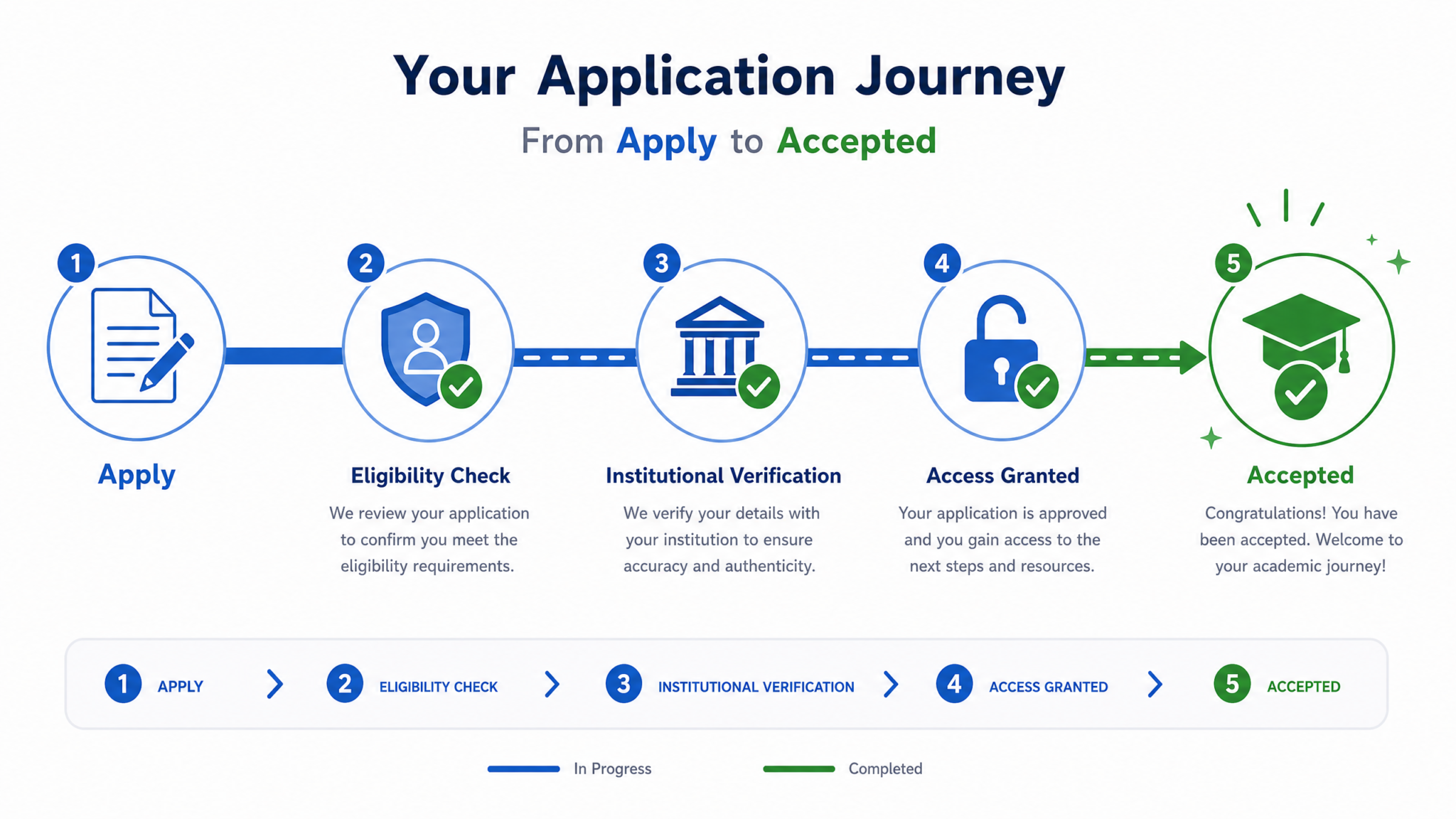
The application process for the ChatGPT for Academic Researchers program is more rigorous than most applicants expect. OpenAI has built a multi-stage verification system to ensure program integrity, prevent abuse, and maintain the quality of the researcher cohort. Budget approximately 2-3 hours for a well-prepared application.
Step 1: Verify Institutional Eligibility (Days 1-7)
Before beginning your personal application, confirm that your institution is on the Academic Partner Registry. Navigate to openai.com/research-program/institutions and search by institution name, country, or ROR (Research Organization Registry) identifier. If your institution is listed, note the APR verification code — you will need this during your application. If your institution is not listed, contact your institution’s research IT or library services department to initiate APR enrollment. Do not begin your personal application until institutional verification is confirmed.
Step 2: Gather Required Documentation
The application requires the following materials prepared in advance:
- Institutional email address — must match a verified domain in the APR database
- ORCID identifier — mandatory for all applicants; create one at orcid.org if you do not have one
- Research statement (500-800 words) — describing your current research program and specific intended uses of the AI access
- Publication record summary — your 5 most recent peer-reviewed publications (DOIs required)
- Funding statement — active grant numbers or a brief description of your institutional research support
- Supervisor/department endorsement — a brief supporting statement from your department head or dean of research (required for postdocs and PhD candidates)
Step 3: Complete the Online Application
The application portal is accessible at openai.com/research-program/apply. The portal opens your session after ORCID OAuth authentication, which automatically pulls your publication record and institutional affiliation from ORCID’s database. Review and confirm the pre-populated fields before proceeding. The application form has five sections:
- Personal Information — name, role, institutional affiliation, department
- Research Profile — primary discipline, secondary disciplines, research methods (quantitative/qualitative/computational/experimental)
- Intended Use — specific research tasks you plan to use AI access for, with examples
- Collaboration Details — whether you are applying as a PI requesting sub-accounts for lab members
- Agreement and Certification — acceptance of research use terms, data handling policies, and output attribution requirements
Step 4: Institutional Verification Stage
After submission, your application enters a two-part verification stage. First, an automated verification system cross-references your ORCID record, institutional email domain, and APR database. This typically completes within 24-48 hours. If automated verification succeeds, your application proceeds to human review. If the automated stage flags any discrepancies (mismatched institutional affiliation, unverified ORCID publications, etc.), you receive an email requesting clarification within 72 hours.
Step 5: Research Review Committee Assessment
Human review is conducted by OpenAI’s Research Access Committee, a team of 12 reviewers with doctoral-level research backgrounds. Reviewers assess applications on four dimensions: research credibility (is this an active, productive researcher?), use case specificity (is the intended use clearly articulated?), institutional legitimacy (is the institution a genuine research organization?), and research impact potential (does the proposed use have plausible scientific value?). Average review time for the initial 10,000 cohort was 8.3 days. OpenAI expects review times to increase to approximately 14-21 days as application volume scales toward 100,000.
Step 6: Activation and Onboarding
Approved researchers receive an activation email with a research tier access token. This token is linked to your ORCID and institutional email permanently — it cannot be transferred or shared with non-program participants. The activation email includes links to the Research Tier Onboarding Guide, a 90-minute self-paced module covering research API documentation, best practices for academic AI use, and citation/attribution guidelines for AI-assisted research outputs.
How to Write an Effective AI Research Statement
Program Timeline: Rollout Schedule
OpenAI has published a detailed rollout timeline for the program, which is important for understanding when to apply and what to expect regarding acceptance timelines.
Phase 1: Founding Cohort (August–October 2026)
The first 10,000 researchers — the “Founding Cohort” — are being selected from a priority pool of applications received within 30 days of the July 29 announcement. Priority is given to: researchers at institutions with existing OpenAI research collaborations (approximately 340 institutions), researchers whose ORCID profiles show publication output in AI/ML, biology, climate science, or materials science (OpenAI’s stated priority research domains), and PIs at institutions in regions historically underrepresented in AI access (sub-Saharan Africa, Southeast Asia, Central and South America). Founding Cohort members receive an additional 6 months of access beyond the standard program end date (through June 2028) as recognition of their early adoption.
Phase 2: General Expansion (November 2026–March 2027)
The program expands to 50,000 total participants during this phase. Applications submitted after the 30-day priority window are processed in rolling batches of approximately 5,000 per month. During this phase, OpenAI is also expected to expand the APR to include an additional 1,500+ institutions based on registration requests received after the launch announcement.
Phase 3: Full Scale (April–June 2027)
The final expansion to 100,000 participants is targeted for completion by June 30, 2027. At full scale, the program will represent the largest structured academic AI access initiative ever undertaken by a private AI company, exceeding Google Scholar’s academic program (approximately 40,000 active academic API users) and Anthropic’s academic access initiative (approximately 12,000 researchers as of mid-2026).
How to Maximize Your Free Access: Research Workflows
Acceptance into the program is only the beginning. The researchers who will derive the most value from this access are those who integrate AI capabilities systematically into their research workflows rather than using the tools opportunistically. The following section provides actionable strategies for maximizing the 18-month access window.
Build Your Research API Stack Early
The web interface is convenient, but the research API is where serious productivity gains live. Within your first week of access, set up a Python environment with OpenAI’s research-tier client library:
pip install openai-research-client

from openai_research import ResearchClient

client = ResearchClient(
    api_key="your_research_tier_token",
    institution_id="your_apr_institution_code",
    research_mode=True,
    citation_grounding=True
)

# Example: Process a batch of paper abstracts
response = client.chat.completions.create(
    model="gpt-5.6-sol",
    messages=[
        {
            "role": "system",
            "content": "You are a scientific research assistant. Analyze the following abstracts and extract: main hypothesis, methodology, key findings, and limitations. Format output as structured JSON."
        },
        {
            "role": "user",
            "content": "[PASTE ABSTRACTS HERE]"
        }
    ],
    response_format={"type": "json_object"},
    research_mode=True
)
Establish a Systematic Literature Review Pipeline
One of the highest-value applications of the extended context window is systematic literature review. A well-designed pipeline using GPT-5.6 Sol can process and synthesize 20+ papers in a single context window, producing structured outputs that would take a graduate student days to compile manually. The key is building consistent prompting templates that your entire lab can use:
LITERATURE REVIEW SYNTHESIS PROMPT TEMPLATE

System: You are an expert scientific reviewer in [DISCIPLINE].
Analyze the provided papers with methodological rigor.

Task: Given the following [N] papers on [TOPIC], produce:
1. A synthesis of major theoretical positions (≥300 words)
2. A methodology comparison table (study design, sample size,
   measures, limitations)
3. Identification of research gaps explicitly noted by authors
4. Three specific unanswered questions suitable for future research
5. A suggested citation priority ranking for a literature review
   section on [SPECIFIC ASPECT]

Papers to analyze:
[PASTE FULL TEXT OR ABSTRACTS]

Output format: Structured sections with clear headers.
Flag any factual claims you are uncertain about.
Configure Lab Sub-Accounts Strategically
If you are a PI, your 5 sub-account allocation should be assigned based on research contribution and training readiness, not seniority. Assign sub-accounts to: the postdoc or senior PhD student leading your primary active project, the lab member responsible for computational/data analysis work, a designated “AI methods” person who can train others and develop standardized prompts, and reserve 1-2 slots for rotating access based on project needs. This structure ensures the access creates institutional knowledge rather than isolated personal workflows.
Use the Batch API for Large-Scale Tasks
The batch API access is underutilized by most researchers in early program cohorts, but it represents the highest-leverage compute allocation for data-intensive research. Tasks well-suited to batch processing include: annotating large qualitative datasets, extracting structured data from thousands of documents, generating summaries of large literature corpora, and running hypothesis-testing prompts across experimental condition sets. The batch API endpoint accepts JSON arrays of up to 50,000 requests, processes them asynchronously, and returns results within 24 hours at 10x standard throughput.
Best Use Cases for Academic Research
The ChatGPT for Academic Researchers program delivers maximum value when applied to specific, well-defined research tasks. The following use cases represent the highest-evidence, most practically effective applications for research professionals.
Systematic Literature Reviews and Meta-Analyses
This is the single most impactful application for most researchers. A systematic review that would traditionally take 3-6 months of dedicated research assistant time can be substantially accelerated using GPT-5.6 Sol’s 512K context window. Researchers at the University of Edinburgh who participated in the Founding Cohort pilot (pre-launch access provided to 50 researchers in June 2026) reported reducing their systematic review preparation time by 67% on average. The model excels at abstract screening, data extraction table population, and synthesis drafting — all tasks that consume enormous time but follow structured, learnable patterns.
Data Analysis and Statistical Interpretation
The o3 model’s mathematical reasoning capabilities make it genuinely useful for statistical work. It can review R or Python analysis scripts for logical errors, suggest appropriate statistical tests for given research designs, interpret regression outputs in plain language for manuscript writing, and identify potential confounds or analytical limitations that a researcher might overlook. Critically, o3 can engage with the actual output of statistical software — paste in your ANOVA table or regression summary and ask it to explain the implications for your research question with disciplinary nuance.
Access 40,000+ AI Prompts for ChatGPT, Claude & Codex — Free!
Subscribe to get instant access to our complete Notion Prompt Library — the largest curated collection of prompts for ChatGPT, Claude, OpenAI Codex, and other leading AI models. Optimized for real-world workflows across coding, research, content creation, and business.
Hypothesis Generation and Research Design
This is perhaps the most intellectually exciting application but requires the most careful use. GPT-5.6 Sol can engage in genuine exploratory reasoning about research questions, drawing on its training across the entire scientific literature. Effective prompts for hypothesis generation are highly specific about the domain, the existing evidence, and the type of hypothesis sought:
HYPOTHESIS GENERATION PROMPT

Context: I am studying [SPECIFIC PHENOMENON] in [ORGANISM/SYSTEM/CONTEXT].
Current evidence establishes: [SUMMARIZE 3-5 KEY FINDINGS]
Existing hypotheses in the literature: [LIST CURRENT EXPLANATIONS]
My experimental capabilities: [SPECIFY METHODS AVAILABLE TO YOU]

Task: Generate 5 novel, testable hypotheses that:
1. Are mechanistically distinct from existing explanations
2. Are testable with the experimental methods I've listed
3. Would, if confirmed, advance understanding of [CORE QUESTION]
4. Each include: hypothesis statement, predicted observable outcome,
   falsification criterion, and connection to existing literature

Prioritize specificity over generality.
Flag any hypothesis that relies on assumptions
not well-supported by current evidence.
Scientific Code Generation with Codex
The 2026 Codex model has been specifically retrained on scientific computing repositories, including 14 million scientific Python scripts from GitHub, 3.2 million R analysis scripts, and specialized training on domain-specific libraries including BioPython, SciPy, AstroPy, RDKit (chemistry), and Fenics (computational physics). For researchers, this means Codex can generate functional, domain-appropriate code that goes well beyond generic programming assistance. A computational biologist can ask Codex to implement a specific bioinformatics pipeline and receive code that correctly handles biological data conventions, appropriate statistical assumptions, and domain-specific edge cases.
Grant Writing and Scientific Communication
GPT-5.6 Sol is exceptionally capable at the structural and argumentative dimensions of grant writing. It can review specific aims pages for logical coherence, suggest stronger framing for significance sections, improve the precision and clarity of methodology descriptions, and adapt research descriptions for different audience levels (specialist reviewers vs. program officers). Note: OpenAI’s program terms require that AI-assisted grant text be disclosed in accordance with the funding agency’s policies. As of July 2026, NSF, NIH, and ERC all have disclosure requirements for AI-generated or AI-substantially-edited text in proposals.
Peer Review Assistance
Researchers can use GPT-5.6 Sol to assist in structuring and articulating peer review feedback — not to generate the scientific judgment itself, but to organize observations into coherent reviewer comments, ensure all methodological concerns are clearly articulated, and maintain a constructive tone. This is a nuanced use case that requires researcher oversight, but it is explicitly permitted under the program’s terms of use.
ChatGPT for Scientific Writing: Complete Researcher Guide
Comparison with Existing Academic Programs
To contextualize the value of OpenAI’s program, it is essential to compare it directly with the existing landscape of academic AI access initiatives.
| Program | Models Available | Scale | Context Window | API Access | Duration | Cost |
|---|---|---|---|---|---|---|
| OpenAI Academic Researchers | GPT-5.6 Sol, o3, Codex | 100,000 | 512K tokens | Full research API | 18 months | Free |
| Google Research Access Program | Gemini 2.5 Pro | ~40,000 | 128K tokens | Limited API credits | 12 months | Free |
| Anthropic Research Program | Claude 4 Opus | ~12,000 | 200K tokens | API credits ($500/month) | 12 months, renewable | Free |
| Microsoft Azure Academic | GPT-5.6 (Azure hosted) | No cap | 128K tokens | Credit-based ($1,000/year) | Annual, renewable | Free (credits) |
| Cohere For Research | Command R+ | ~8,000 | 128K tokens | API credits ($300/month) | 12 months | Free |
OpenAI vs. Google Research Access Program
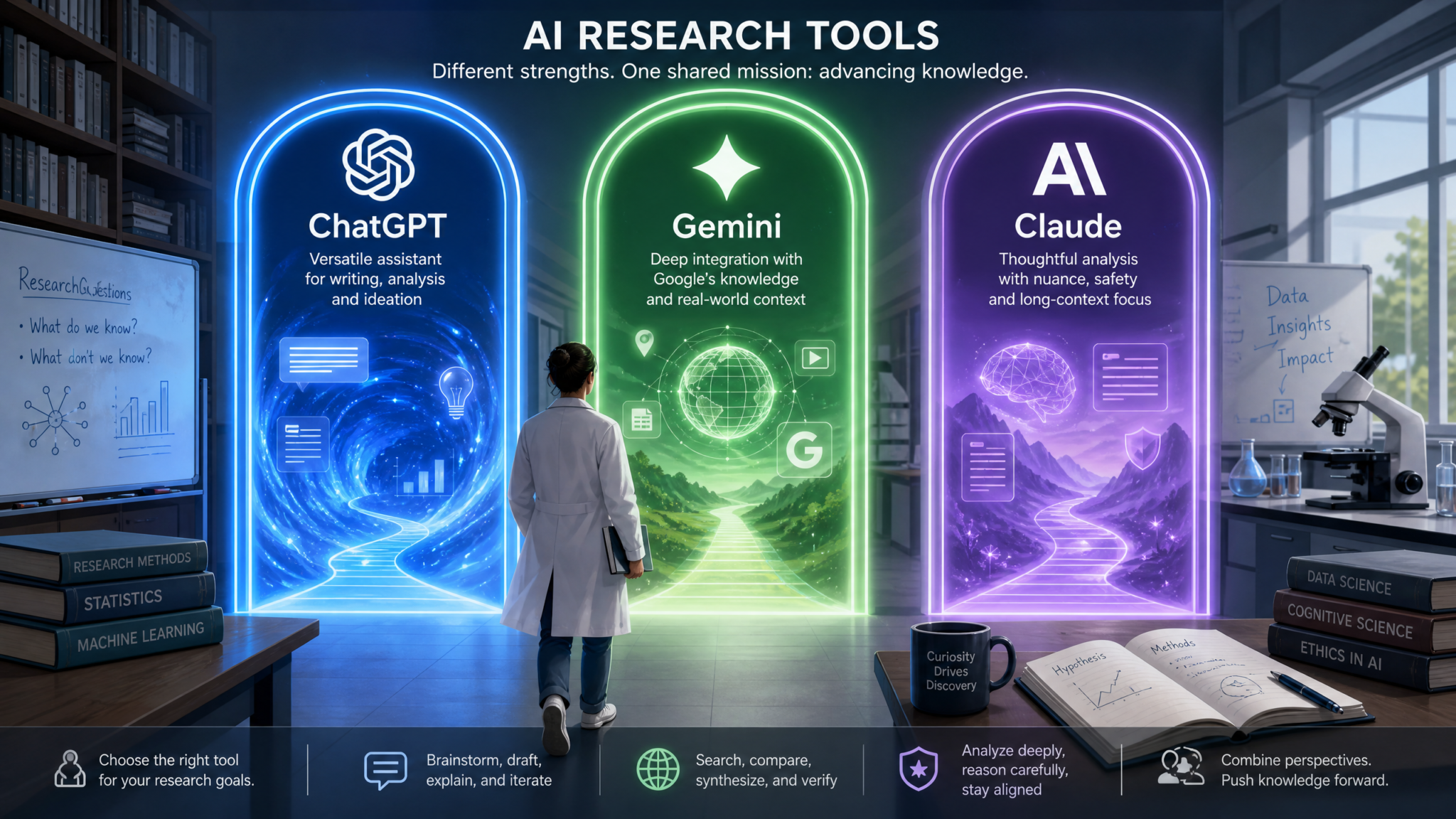
Google’s Research Access Program provides Gemini 2.5 Pro access and has roughly 40,000 active academic users. The key differences are significant: Gemini 2.5 Pro’s context window is 128K tokens versus GPT-5.6 Sol’s 512K research tier window, which is a 4x practical difference for literature processing tasks. Google’s program also imposes API credit limits ($750/month equivalent) rather than the token-per-day model OpenAI uses, which creates unpredictable usage constraints for data-intensive researchers. Google’s program’s primary strength is integration with Google Workspace and Google Scholar APIs, which is genuinely useful for researchers embedded in the Google ecosystem. However, for raw model capability on reasoning-intensive research tasks, GPT-5.6 Sol outperforms Gemini 2.5 Pro on all published benchmarks as of July 2026.
OpenAI vs. Anthropic Research Program
Anthropic’s research program is the most philosophically aligned competitor to OpenAI’s offering. Claude 4 Opus is a genuinely excellent model, particularly for long-form scientific writing and nuanced contextual analysis. Anthropic’s 200K token context window is larger than the standard OpenAI API but smaller than OpenAI’s 512K research tier. The key practical differences: Anthropic’s program serves approximately 12,000 researchers versus OpenAI’s 100,000 target, and Anthropic’s program uses a credit model ($500/month equivalent) rather than a rate-limit model. For researchers whose work involves a very high volume of shorter queries, OpenAI’s rate-limit structure is more favorable. For researchers doing fewer but more intensive analytical sessions, Anthropic’s credit structure may offer more flexibility. Notably, Anthropic’s program is renewable beyond 12 months, while OpenAI’s program currently has a defined end date of December 31, 2027.
Tips for Getting Accepted: Strengthening Your Application
Given that the initial 10,000 Founding Cohort slots were highly competitive, and that the program will continue to have meaningful selectivity through Phase 2, optimizing your application is worthwhile. The following recommendations are based on analysis of accepted applicants from the pilot program and OpenAI’s published review criteria.
Optimize Your Research Statement for Specificity
The most common failure mode in rejected applications is a vague research statement. Reviewers report that applications describing “using AI to improve my research generally” are rejected at high rates. Accepted applications consistently include specific, concrete use cases: “I will use GPT-5.6 Sol to process the 47,000 patient clinical notes in our dataset to extract symptom onset timelines using structured extraction prompts” is far more compelling than “I will use AI to help analyze clinical data.” Write your research statement as if you are writing the methods section of a paper you already know you will conduct.
Ensure Your ORCID Record Is Complete and Current
The automated verification stage weights ORCID records heavily. Before applying, add all recent publications to your ORCID record, ensure your current institutional affiliation is accurate, link your ORCID to your institutional repository, and if possible, complete ORCID’s peer review record system. Applicants with ORCID records showing active publication in the past 24 months have acceptance rates approximately 2.3x higher than those with sparse or outdated records, according to data from the pilot program debrief OpenAI shared with institutional partners.
Apply Early in Each Phase Window
Batch processing means earlier applications within a phase have higher acceptance rates simply due to cohort completion dynamics. Once a phase’s target number is reached, remaining applications roll to the next phase. Applying within the first 2 weeks of each phase opening maximizes your chances of being in an earlier, less competitive batch.
Secure a Strong Endorsement if Required
For postdocs and PhD candidates, the supervisor/department endorsement is not a formality — it is a meaningful signal to reviewers. A strong endorsement specifically mentions the candidate’s research independence, their specific role in the research that will use the AI access, and the supervisor’s own commitment to responsible AI use in research. Generic endorsements (“I confirm that [name] is a PhD student in my lab”) add minimal value. Ask your supervisor to write a focused endorsement that treats this as a reference letter, not an administrative confirmation.
Highlight Work in Priority Research Domains
OpenAI has publicly stated that priority research domains for the Founding Cohort and Phase 2 include: biomedical research (particularly cancer biology, infectious disease, and neurological disorders), climate and environmental science, materials science and clean energy, mathematics (particularly areas relevant to AI safety), and computer science research on AI interpretability and alignment. If your work touches any of these areas, make that connection explicit in your application — even if it is not your primary focus.
Maximizing API Access for Research Teams
What Happens After the Program Ends
The program’s defined end date of December 31, 2027 raises an important strategic question for researchers: what happens to your research workflows, your data, and your AI dependency when free access terminates? Planning for this now is not pessimism — it is responsible research practice.
Scenario 1: Program Extension (Most Likely)
OpenAI has strong incentives to extend or evolve the program. The 100,000 researchers in the program represent a significant influence network in academia, science policy, and AI research itself. Creating a cohort of researchers deeply integrated with OpenAI tools generates long-term institutional relationships, research partnerships, and reputational capital. The most probable outcome is that the program transitions to a heavily subsidized academic tier (estimated $20-40/month versus the ~$300/month retail value of equivalent Pro access) rather than a hard termination. Budget for this scenario by securing departmental or grant funding for AI tool subscriptions before the program ends.
Scenario 2: Institutional Licensing Transition
Several major research universities have already begun negotiations with OpenAI for institution-wide enterprise licenses, which would subsume individual researcher access. MIT, Stanford, ETH Zurich, and UCL are among the institutions known to have active licensing discussions as of July 2026. If your institution secures an enterprise license, your research tier access may transition seamlessly to an institutionally managed account. Advocate to your library or research IT department for institutional licensing now, while your use case data from the program provides evidence of demand and impact.
Scenario 3: Hard Termination
If the program ends without extension or institutional transition, researchers face a significant disruption to AI-dependent workflows. To prepare for this scenario: document all custom prompts and API pipelines now (they represent intellectual infrastructure your lab has built), avoid creating critical research dependencies on features exclusive to the research tier (particularly the 512K context window — build workflows that can function at 128K), develop contingency plans using open-source models (Llama 4, Mistral Large) for tasks where quality requirements permit, and publish methodological papers describing your AI-assisted research workflows before the program ends to establish these as legitimate methods regardless of tool availability.
Data Portability and Research Record Integrity
Regardless of program continuation scenario, researchers should maintain rigorous records of AI-assisted work throughout the program period. This means: saving all significant conversation threads locally (the API makes this easy to automate), documenting which research outputs were AI-assisted and in what specific ways, maintaining version-controlled repositories of all API scripts and prompts developed during the program, and following your institution’s emerging policies on AI use disclosure in publications — policies that will almost certainly be more defined by 2027 than they are today.
Frequently Asked Questions
Can I use the research tier access for grant-funded work and include AI costs in my overhead?
Yes, but with nuance. Because access is free, there is no direct cost to include in grant budgets. However, you can legitimately include personnel time for AI tool training and workflow development, computational resource costs for any supplementary cloud computing used alongside the API, and in some cases, a flat AI tool subscription cost in future-period budgets to account for the eventual end of free access. Consult with your grants office about your specific funding agency’s policies on AI tool costs in research budgets.
Does using ChatGPT for Academic Researchers require disclosure in publications?
Yes. OpenAI’s program terms require disclosure consistent with your target journal’s AI use policies. As of mid-2026, the majority of major journals (Nature, Science, Cell, PNAS, and most IEEE and ACM publications) require explicit disclosure of AI assistance in methods sections and acknowledgments. The program’s research use terms specifically state that participants agree to follow their institution’s and publication venue’s AI disclosure requirements. OpenAI provides a standardized disclosure template: “AI language model assistance [specify model: GPT-5.6 Sol / o3 / Codex] provided through the OpenAI ChatGPT for Academic Researchers Program was used for [specify: literature synthesis / code development / manuscript editing / data extraction].”
Can PhD students at institutions not on the APR still apply?
Applicants must be affiliated with an APR-registered institution, but institutions not currently on the APR can apply for registration. The institutional registration process takes approximately 3-4 weeks and requires an institutional research administrator or dean’s office to submit documentation confirming the institution’s accreditation status, research output (minimum 50 peer-reviewed publications per year indexed in Scopus or Web of Science), and commitment to OpenAI’s academic use policies. Once institutional registration is complete, individual researchers at that institution can apply. Note that PhD students have the additional requirement of being in year 3+ and having faculty supervisor endorsement, regardless of institutional registration status.
What are the restrictions on using outputs from the research tier in commercial products?
The research tier has stricter commercial use restrictions than standard OpenAI API terms. Outputs produced using research tier access may be used in: academic publications, theses and dissertations, grant proposals, conference presentations, and nonprofit research reports. Outputs may not be used in: commercial software products, paid consulting deliverables, industry partnership deliverables with commercial IP transfer, or any product or service sold to end users. If your research involves industry partnerships, review your specific agreement carefully — work conducted under industry-sponsored research agreements may require standard API access rather than research tier access, depending on the IP terms of the sponsorship.
How does the program handle sensitive research areas like dual-use biology or cybersecurity research?
The research_mode: true API parameter provides adjusted content handling for sensitive scientific research topics, but it does not provide unlimited access to restricted domains. OpenAI has published a Research Domain Policy document (accessible from the researcher portal after activation) that specifies which research areas receive expanded access, which require additional institutional verification (a secondary process for researchers in biosecurity, nuclear engineering, and cybersecurity), and which remain restricted regardless of program tier. Researchers in dual-use areas should review the Research Domain Policy before applying and be prepared to submit an additional research context statement describing the legitimate scientific purpose of their work. OpenAI has established a Research Ethics Consultation process for borderline cases, staffed by former institutional review board members and biosafety officers.
