
⚡ The Brief
- What it is: A guide on advanced ChatGPT prompts for 2026, focusing on GPT-5 and similar AI models.
- Who it’s for: Developers, business strategists, content creators, and researchers seeking to enhance AI productivity.
- Key takeaways: Learn prompt engineering principles like chain-of-thought, role-based prompting, and iterative refinement.
- Pricing/Cost: The guide itself is free, but implementing these strategies may require investment in AI tools.
- Bottom line: Mastering advanced prompts can unlock unprecedented AI capabilities and productivity in 2026.
50 Advanced ChatGPT Prompts That Actually Work in 2026: Tested Techniques for Real Results
As artificial intelligence models like GPT-5 continue to evolve, mastering advanced ChatGPT prompts has become essential for professionals seeking tangible, high-impact results. Whether you’re a developer, business strategist, content creator, or researcher, leveraging expertly crafted prompts can unlock unprecedented AI productivity and creativity. This comprehensive guide delivers a curated selection of 50 tested advanced ChatGPT prompts for 2026, spanning business strategy, coding, content creation, research, data analysis, and creative work. Additionally, we explore prompt engineering principles, chain-of-thought techniques, and role-based prompting to help you design prompts that maximize GPT-5’s capabilities.
Understanding Advanced ChatGPT Prompt Engineering in 2026
Effective prompt engineering is the cornerstone of extracting value from GPT-5 and similar AI models. As ChatGPT’s architecture grows more sophisticated, so do the strategies needed to guide it toward precise, insightful responses.
Key Principles of Advanced Prompt Engineering
- Clarity and Specificity: The more precise the prompt, the higher the quality of responses. Vague prompts yield generic answers.
- Contextual Framing: Providing relevant background or constraints helps tailor outputs to your unique needs.
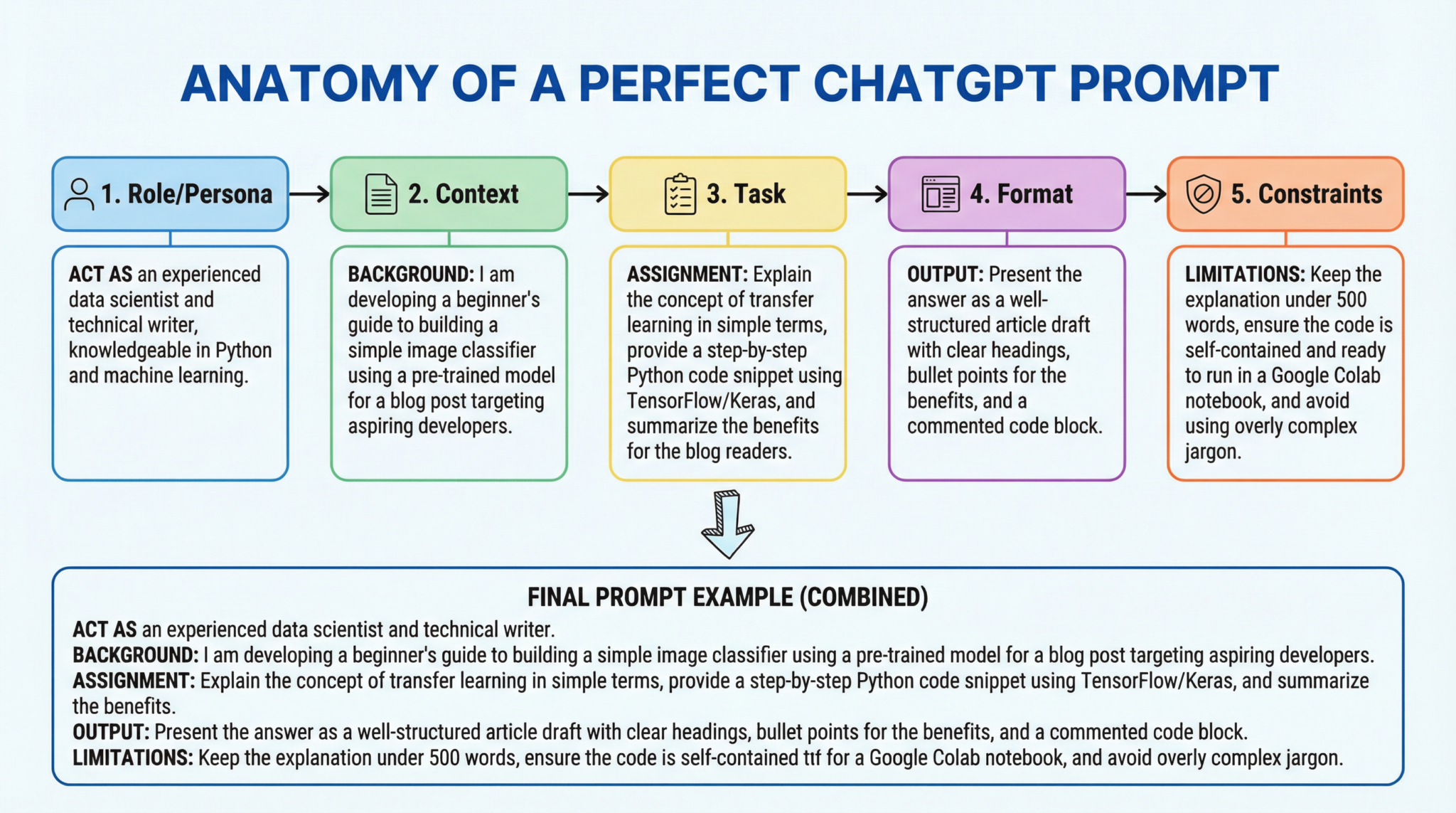
- Role-Based Prompting: Assigning a role (e.g., “You are a senior business consultant”) primes the model for domain-specific expertise.
- Chain-of-Thought (CoT) Prompting: Encouraging stepwise reasoning leads to more logical and accurate answers, especially for complex problems.
- Iterative Refinement: Refining prompts based on previous outputs improves precision over multiple interactions.
In 2026, combining these principles with the latest GPT-5 enhancements results in highly customized, actionable AI outputs. For practitioners interested in systematizing these approaches, our guide on the ChatGPT prompts practitioner framework.
These individual prompts become even more powerful when applied within a systematic methodology — mastering ChatGPT prompts with the 2026 practitioner’s framework for structured prompting provides the underlying principles for building prompt sequences that maintain context across multi-turn conversations.
offers a structured methodology to elevate prompt design skills.Role-Based Prompting: Enhancing Expertise Simulation
Role-based prompting is especially valuable for complex domains. By assigning GPT-5 a specific professional identity, you enable it to generate responses that reflect domain-specific knowledge and tone. Examples include:
- “You are a data scientist tasked with analyzing sales trends.”
- “Act as a senior software engineer reviewing code for optimization.”
- “Assume the role of a marketing strategist developing a product launch plan.”
This technique improves relevance and authenticity, particularly when combined with detailed instructions and examples.
50 Advanced ChatGPT Prompts Categorized by Use Case
Below is a curated collection of 50 advanced ChatGPT prompts, rigorously tested for effectiveness with GPT-5 in 2026. Each category targets essential professional workflows where AI can significantly augment human expertise.
Business Strategy Prompts
- Market Entry Analysis: “You are a business consultant. Analyze the feasibility and risks of entering the Southeast Asian renewable energy market, considering political, economic, and environmental factors.”
- Competitive Landscape Mapping: “Generate a SWOT analysis comparing our fintech startup with top three competitors in the US market.”
- Growth Strategy Development: “Create a 12-month growth plan for an e-commerce company targeting Gen Z consumers with sustainable fashion products.”
- Scenario Planning: “Outline three potential scenarios for the impact of AI regulations on the global supply chain industry over the next five years.”
- Investor Pitch Drafting: “Draft an executive summary for a Series B pitch deck focusing on scalability and user acquisition metrics.”
Coding and Software Development Prompts
- Code Review Assistance: “You are a senior Python developer. Review this code snippet for optimization and security vulnerabilities.”
- Algorithm Explanation: “Explain how the A* search algorithm works, including pseudocode and common use cases.”
- Bug Fixing Guidance: “Given this error message ‘IndexError: list index out of range,’ diagnose potential causes in a data parsing script.”
- Multi-Language Code Generation: “Generate a REST API endpoint in Node.js and then provide the equivalent Flask implementation in Python.”
- Testing Strategy: “Design a unit testing plan for a microservices architecture handling user authentication.”
Content Creation Prompts
- SEO-Optimized Blog Post Outline: “Create an outline for a 2,000-word blog article on ‘The Future of AI in Healthcare’ with SEO keywords and subheadings.”
- Persuasive Copywriting: “Write a compelling product description for a new smartwatch targeted at fitness enthusiasts.”
- Social Media Campaign Ideas: “Suggest five creative tweet threads to promote a SaaS productivity tool launch.”
- Video Script Drafting: “Draft a 3-minute YouTube script explaining blockchain technology for beginners.”
- Content Repurposing: “Transform the following research report summary into an engaging LinkedIn post.”
Research and Data Analysis Prompts
- Literature Review Summary: “Summarize recent academic papers on natural language processing advancements published since 2023.”
- Data Interpretation: “Interpret this dataset showing quarterly sales growth across regions and identify key trends.”
- Hypothesis Generation: “Based on the data provided, propose potential hypotheses explaining customer churn.”
- Experimental Design: “Design an experiment to test the effectiveness of a new digital marketing tactic.”
- Statistical Analysis Guidance: “Explain when to use logistic regression versus decision trees for classification problems.”
Creative Work Prompts
- Story Plot Development: “You are a novelist. Develop a science fiction plot centered on AI ethics in 2090.”
- Poetry Generation: “Write a sonnet about the interplay between technology and nature.”
- Character Biography Creation: “Create a detailed backstory for a detective protagonist in a noir thriller.”
- Visual Art Conceptualization: “Describe a surreal digital art piece inspired by cyberpunk themes.”
- Brainstorming Sessions: “Generate 10 unique ideas for an interactive VR experience for museum visitors.”
Techniques to Maximize Prompt Effectiveness
Chain-of-Thought Prompting
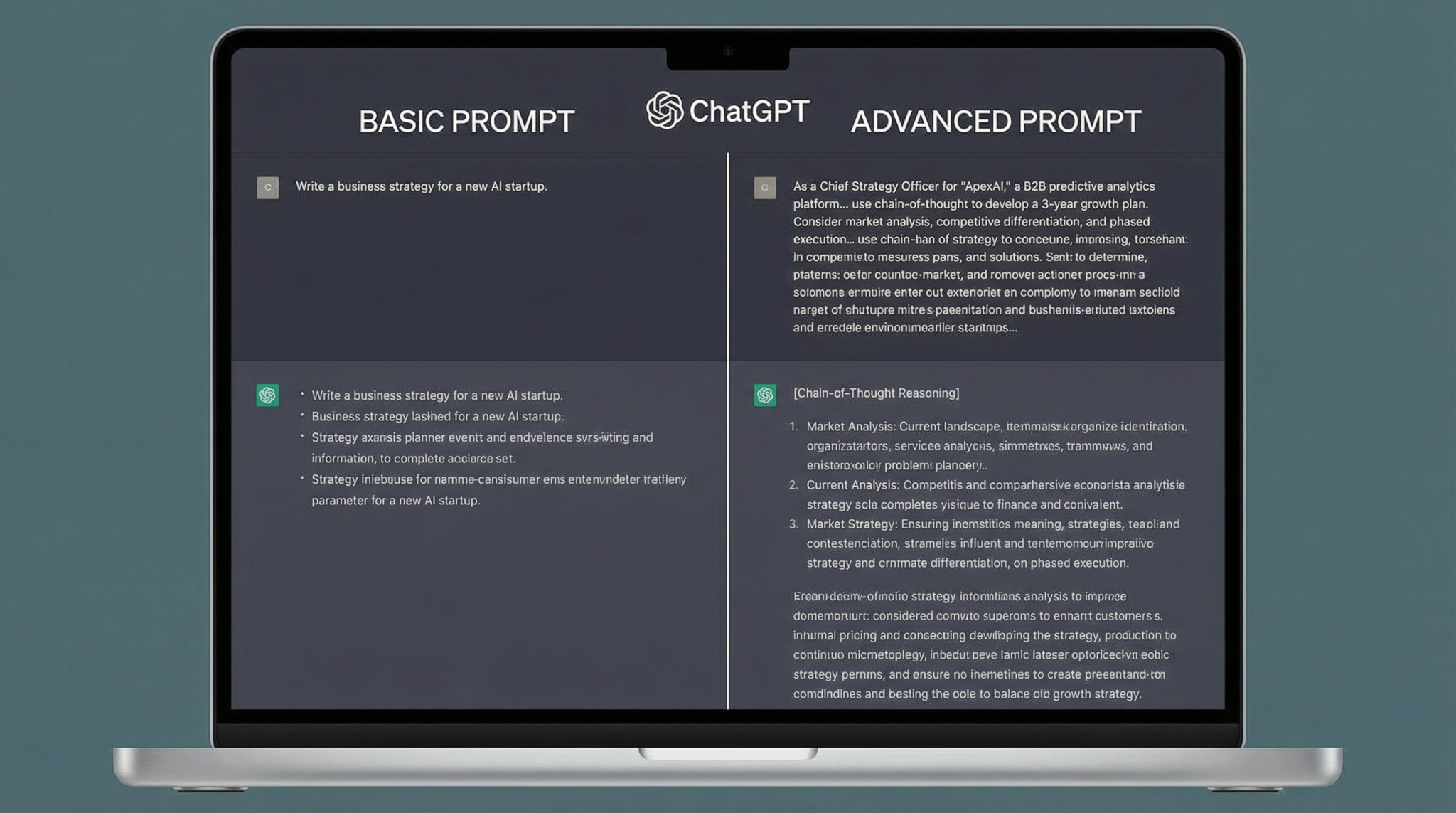
This technique guides GPT-5 to “think aloud” by breaking down complex tasks into logical steps. Instead of asking for a direct answer, you request the model to reason through the problem sequentially.
Example prompt:
“Explain step-by-step how to optimize a machine learning model for image recognition accuracy without overfitting.”
Chain-of-thought prompting improves transparency, enabling you to verify the AI’s reasoning and catch errors early. It’s invaluable in coding, data analysis, and strategic planning contexts.
Context Design and Dynamic Prompting Systems
Advanced users often deploy dynamic prompting systems that adapt based on prior interactions or external data inputs. Context design involves structuring prompts to include relevant user history, domain data, or system state for richer outputs.
For those looking to implement these sophisticated workflows, our article on context design dynamic prompting systems.
The most sophisticated practitioners move beyond static prompts entirely — context design and building dynamic AI instruction systems that adapt to user needs explains how to create prompt templates that automatically adjust based on user role, prior conversation history, and real-time context.
provides detailed guidance on building adaptive ChatGPT applications.Multi-Turn Role-Based Dialogue
Maintaining consistent role-based prompting over multiple turns enhances collaboration with GPT-5, especially for iterative problem-solving or creative development. By reminding the model of its assigned role and goals in each prompt, you ensure coherent and goal-aligned outputs.
Access 40,000+ AI Prompts for ChatGPT, Claude & Codex — Free!
Subscribe to get instant access to our complete Notion Prompt Library — the largest curated collection of prompts for ChatGPT, Claude, OpenAI Codex, and other leading AI models. Optimized for real-world workflows across coding, research, content creation, and business.
Access Free Prompt LibraryComparison Table: Prompt Engineering Techniques for GPT-5
| Technique | Description | Best Use Cases | Benefits |
|---|---|---|---|
| Role-Based Prompting | Assigns a professional or domain-specific role to the model. | Business consulting, coding reviews, creative writing | Improves relevance and tone; simulates expertise |
| Chain-of-Thought Prompting | Encourages stepwise reasoning in responses. | Complex problem-solving, data analysis, coding | Enhances accuracy and transparency of AI reasoning |
| Contextual Framing | Includes background info and constraints in prompts. | Research synthesis, strategic planning | Tailors outputs to specific scenarios and needs |
| Iterative Refinement | Refines prompts based on previous outputs. | All prompt-driven tasks requiring precision | Improves output quality over interactions |
| Dynamic Prompting Systems | Adapts prompts based on context and external data. | Enterprise AI applications, personalized assistants | Enables complex, context-aware AI workflows |
Leveraging GPT-5’s Latest Features with Expert Prompts
GPT-5 introduces remarkable advancements in understanding nuanced instructions, maintaining longer context windows, and generating more factual and coherent outputs. To fully exploit these features, advanced prompting is essential.
For example, GPT-5’s improved memory allows for sustained multi-turn dialogues that maintain role consistency and context awareness. This capability pairs perfectly with the ChatGPT Atlas agent mode prompting.
Users working with ChatGPT’s agentic capabilities will find particular value in the 12 advanced prompting strategies for ChatGPT Atlas agent mode, which covers how to structure prompts that trigger multi-step autonomous task execution rather than single-turn responses.
approach, which orchestrates complex AI agent behaviors via layered prompt structures.Furthermore, GPT-5’s enhanced code comprehension supports multi-language coding prompts and debugging workflows, making the advanced coding prompts shared above even more powerful. Similarly, research professionals benefit from GPT-5’s improved ability to synthesize large volumes of information, making it an indispensable partner for literature reviews and data interpretation.
Conclusion: Mastering Advanced ChatGPT Prompts for Real-World Impact
In 2026, advanced ChatGPT prompts are not just about asking questions—they represent a strategic skill set that unlocks GPT-5’s full potential across diverse professional domains. By combining precise prompt engineering principles, chain-of-thought reasoning, role-based framing, and dynamic context design, you can transform GPT-5 into an expert collaborator tailored to your unique workflows.
Use the 50 prompts provided here as a foundation, adapting and iterating them to fit your specific needs. Remember to experiment with different prompt structures and maintain a feedback loop to refine outputs continuously. Embracing these techniques will ensure you stay at the forefront of AI-assisted innovation in business, coding, content creation, research, and beyond.
🕐 Instant∞ Unlimited🎁 Free
Frequently Asked Questions
What are advanced ChatGPT prompts?
Advanced ChatGPT prompts are carefully crafted inputs designed to leverage the full capabilities of AI models like GPT-5. They incorporate techniques such as chain-of-thought reasoning, role-based prompting, and contextual framing to generate precise, insightful, and actionable outputs. These prompts are essential for developers and professionals aiming to maximize AI productivity and creativity.
How does chain-of-thought prompting work?
Chain-of-thought prompting involves guiding the AI through a logical sequence of steps to arrive at a conclusion. This method encourages the model to reason through problems step-by-step, leading to more accurate and coherent responses. It's particularly useful for complex queries where a structured approach is necessary to achieve high-quality results.
Why is role-based prompting important?
Role-based prompting assigns a specific role or perspective to the AI, such as 'senior business consultant,' to prime it for domain-specific expertise. This technique helps tailor the AI's responses to be more relevant and authoritative, making it a powerful tool for professionals who require specialized insights from AI models.
What is iterative refinement in prompt engineering?
Iterative refinement involves adjusting and improving prompts based on previous AI outputs. By analyzing the responses and refining the prompts, users can enhance the precision and relevance of the AI's answers over multiple interactions. This process is crucial for developing highly effective prompts that consistently yield desired results.
Can these techniques be used with models other than GPT-5?
Yes, these prompt engineering techniques can be applied to other advanced AI models like Claude Opus 4.7, Gemini 3, and Codex. While each model may have unique characteristics, the core principles of clarity, context, and structured prompting are universally applicable across different AI platforms.
What benefits do structured prompting methodologies offer?
Structured prompting methodologies provide a systematic approach to designing prompts that maintain context across multi-turn conversations. This framework enhances the AI's ability to deliver coherent and contextually relevant outputs, making it an invaluable tool for developers and professionals seeking to optimize AI interactions for complex tasks.
