
⚡ The Brief
- What it is: A comprehensive comparison of Claude Opus 4.6 and ChatGPT GPT-5, two leading AI models for business and development in 2026.
- Who it’s for: Developers, writers, and business users seeking advanced AI solutions for reasoning, coding, and content creation.
- Key takeaways: Claude focuses on safety and interpretability, while ChatGPT excels in reasoning and integration. Both offer robust API capabilities and scalable pricing.
- Pricing/Cost: Both models offer scalable pricing models tailored to enterprise needs, with Claude providing cost-effective deployments and ChatGPT offering flexible API usage.
- Bottom line: Choosing between Claude and ChatGPT depends on your priorities in safety, reasoning, and integration capabilities for business applications.
✓ Instant access✓ No spam✓ Unsubscribe anytime
Claude vs ChatGPT 2026: Overview of Anthropic and OpenAI’s Leading AI Models for Business
As artificial intelligence continues to transform enterprise operations, the competition between Anthropic’s Claude and OpenAI’s ChatGPT remains at the forefront of business technology discussions in 2026. This definitive comparison explores the latest iterations — Claude Opus 4.6 and Sonnet 4.5 versus ChatGPT GPT-5 and GPT-5.3 — focusing on their strengths in reasoning, coding, content creation, pricing, API capabilities, safety, and enterprise features.
For organizations evaluating the best AI for business, understanding the nuanced differences between these two powerhouse models is crucial. Whether you are seeking advanced reasoning for decision support, seamless integration for software development, or scalable pricing models, this analysis will guide you through the key considerations.
We also provide insights into the evolving Anthropic vs OpenAI landscape, capturing the technological advancements and strategic focus areas that define their 2026 offerings.
Claude Opus 4.6 and Sonnet 4.5: Anthropic’s Business-Optimized AI Models
Claude’s latest versions, Opus 4.6 and Sonnet 4.5, represent Anthropic’s commitment to building AI systems that prioritize safety, interpretability, and business utility. These models have been architected with a focus on robustness in complex reasoning tasks, enhanced contextual understanding, and transparent output generation.
Anthropic has expanded Claude’s capabilities particularly in domains requiring nuanced comprehension, such as legal analysis, financial modeling, and strategic consultation. Opus 4.6, the flagship, emphasizes interpretability and ethical guardrails, whereas Sonnet 4.5 offers a lighter footprint for faster, cost-effective deployments without sacrificing core performance.
The models excel in multi-turn dialogue coherence and provide reliable factual grounding, which is critical for enterprise-grade applications. Furthermore, Anthropic’s API supports flexible prompt tuning and custom safety parameters, enabling business users to tailor responses to their compliance requirements and brand voice.
Understanding Claude’s full capability spectrum requires reviewing the complete guide to Claude’s 2026 model lineup comparing Opus, Sonnet, and Haiku, which details the specific benchmarks, pricing tiers, and optimal use cases for each model in Anthropic’s current family.
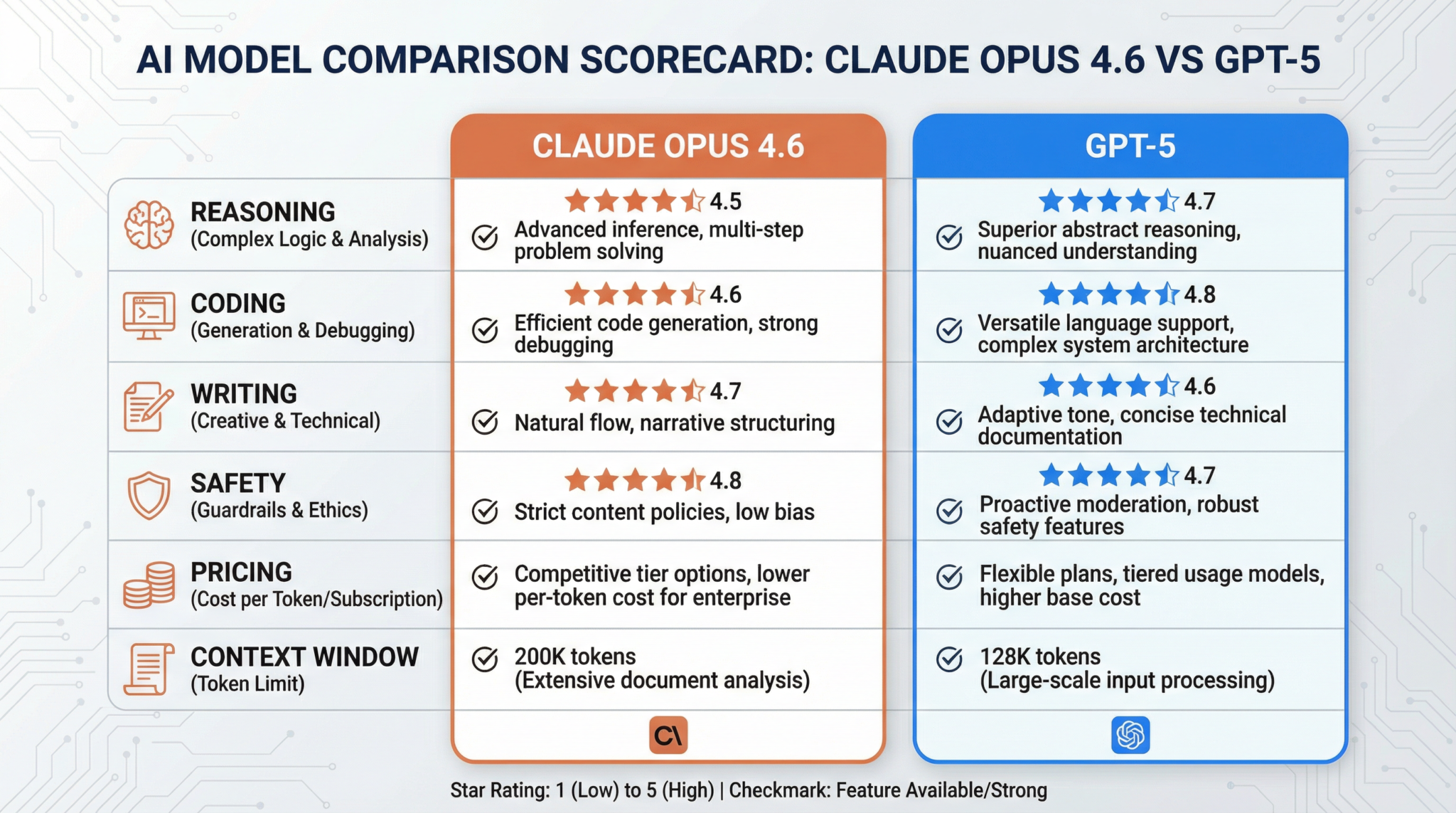
ChatGPT GPT-5 and GPT-5.3: OpenAI’s Cutting-Edge AI for Enterprise
OpenAI continues to push the boundaries of generative AI with GPT-5 and its refined GPT-5.3 iteration. These models showcase state-of-the-art improvements in reasoning speed, coding accuracy, and creative writing capabilities. GPT-5.3, in particular, integrates enhanced memory mechanisms and multimodal input handling, making it highly versatile for diverse business scenarios.
ChatGPT’s enterprise offerings now include advanced deployment options, such as on-premises hosting, dedicated instances, and integration with Microsoft Azure’s cloud ecosystem. These additions address stringent security and latency demands of large organizations.
With an emphasis on developer productivity, OpenAI’s API extends beyond conversational AI to include native tools for code generation and debugging, with seamless support for over 30 programming languages. This evolution positions GPT-5 as a top choice for software development automation and technical documentation generation.
OpenAI’s pricing model for GPT-5 is competitive and tiered, accommodating startups to Fortune 500 companies. The company also offers enterprise-grade compliance certifications and SLA guarantees, which are critical for regulated industries.
Regardless of which model you choose, maximizing output quality depends on mastering advanced prompting techniques for ChatGPT and Claude in 2026, a practical handbook covering chain-of-thought, role-based prompting, and model-specific optimization strategies.
Detailed Comparison: Claude Opus vs GPT-5 Across Key Business Dimensions
| Feature | Claude Opus 4.6 / Sonnet 4.5 | ChatGPT GPT-5 / GPT-5.3 |
|---|---|---|
| Core Strength | Safety-centric reasoning, interpretability, factual accuracy | High-speed reasoning, multimodal input, creative generation |
| Coding Capability | Strong with code explanations and verification; supports Python, JavaScript, and common languages | Superior code generation, debugging, and multi-language support including low-level languages |
| Content Creation | Formal, precise writing with domain-specific expertise | Versatile styles, from creative storytelling to technical manuals |
| API Flexibility | Custom safety tuning, prompt engineering options, batch processing | Wide toolset including embeddings, fine-tuning, streaming responses |
| Safety & Compliance | Advanced guardrails, bias mitigation, transparent audit trails | Comprehensive moderation, enterprise compliance certifications (SOC2, ISO27001) |
| Enterprise Features | Role-based access, data privacy controls, customizable model behavior | Dedicated instances, on-premise options, integration with Microsoft 365 |
| Pricing Model | Usage-based with volume discounts; competitively priced for mid-size businesses | Tiered subscription and pay-as-you-go; scalable enterprise agreements |
Use Case Analysis: Which AI Model Fits Your Business Needs?
Reasoning and Decision Support
Claude Opus 4.6 stands out for enterprises requiring highly reliable, transparent reasoning outputs. Its interpretability tools facilitate auditability in regulated sectors like finance and healthcare. The model’s safety-first design minimizes hallucinations, making it an ideal choice for mission-critical decision support systems.
Conversely, ChatGPT GPT-5 excels in scenarios demanding rapid synthesis of complex data and dynamic scenario simulation. Its multimodal capabilities enable integration of images and documents alongside text input, enhancing situational awareness and strategic planning.
Coding and Software Development
Software teams benefit from ChatGPT’s superior code generation, debugging assistance, and multi-language support. GPT-5.3’s context window improvements allow it to maintain longer codebase contexts, resulting in more accurate suggestions and refactoring recommendations.
Claude’s Sonnet 4.5 offers a lighter alternative for automated code reviews and documentation generation, ensuring code quality with an emphasis on correctness and explanatory depth rather than rapid prototyping.
Content Creation and Marketing
Marketing teams aiming for persuasive, creative content prefer ChatGPT’s flexible style generation and tone modulation. GPT-5’s ability to craft engaging narratives and technical write-ups alike makes it a versatile asset for content strategists.
Claude’s specialty lies in precise, formal content such as compliance documentation, policy writing, and legal briefs, where accuracy and neutrality are paramount.
API and Integration: Technical Considerations
Both Anthropic and OpenAI offer robust APIs with strong developer ecosystems. Claude’s API emphasizes customizable safety features and controlled output behavior, empowering businesses to enforce strict compliance policies programmatically.
OpenAI’s GPT-5 API introduces advanced tooling, including streaming responses for real-time applications and native support for embedding vectors, which facilitate semantic search and recommendation systems.
Integration with existing enterprise software varies: OpenAI provides deeper Azure cloud integration and Microsoft 365 connectors, whereas Anthropic focuses on modular deployment options and privacy-first configurations.
Access 40,000+ AI Prompts for ChatGPT, Claude & Codex — Free!
Subscribe to get instant access to our complete Notion Prompt Library — the largest curated collection of prompts for ChatGPT, Claude, OpenAI Codex, and other leading AI models. Optimized for real-world workflows across coding, research, content creation, and business.
Access Free Prompt LibraryPricing Comparison: Cost Efficiency for Business Scalability
Understanding pricing structures is vital for businesses scaling AI adoption. Claude’s pricing model offers competitive rates with volume discounts suitable for mid-sized companies. Its Sonnet 4.5 model allows budget-conscious teams to deploy AI-assisted workflows without compromising essential capabilities.
OpenAI’s GPT-5 pricing is presented in tiered subscriptions combined with usage-based billing, providing flexibility for startups to large enterprises. The inclusion of dedicated enterprise plans with custom SLAs enhances cost predictability for mission-critical deployments.
Both providers offer free trial tiers and developer credits, enabling businesses to pilot implementations before committing to large-scale contracts.
Safety, Ethics, and Compliance in 2026
Safety remains a critical differentiator. Anthropic’s Claude continues to lead in transparent ethical AI design, leveraging research-driven guardrails that reduce bias and harmful outputs. Its audit trails and interpretability tools cater to industries with strict regulatory oversight.
OpenAI also prioritizes safety with cutting-edge content moderation, real-time misuse detection, and compliance certifications such as SOC2 and ISO27001. The tight integration with Microsoft’s enterprise compliance infrastructure further strengthens its position in highly regulated sectors.
Choosing between these models often depends on an organization’s risk tolerance and regulatory environment. Businesses with high compliance demands may lean towards Claude for its interpretability, while those needing flexible, scalable AI across diverse applications might favor ChatGPT.
Future Outlook: Anthropic vs OpenAI in the AI Platform Wars
The AI platform wars in 2026 are defined by rapid innovation cycles and strategic partnerships. Anthropic and OpenAI continue to push the envelope in model architecture and enterprise tooling, each carving distinct niches.
Anthropic’s philosophy centers on building AI that is not only powerful but inherently safe and controllable, which appeals to sectors where trust and transparency are paramount. OpenAI’s approach emphasizes broad applicability, developer ecosystem growth, and deep integration with existing cloud and productivity platforms.
This rivalry plays out against a broader competitive backdrop — the AI platform wars of April 2026 and the OpenAI-Anthropic developer battle examines how both companies are competing for developer mindshare through pricing, API features, and ecosystem integrations.
Conclusion: Selecting the Best AI Model for Your Business in 2026
Both Claude and ChatGPT present compelling advantages for business applications in 2026. Claude Opus 4.6 and Sonnet 4.5 stand out for enterprises prioritizing safety, interpretability, and formal content generation, while ChatGPT GPT-5 and GPT-5.3 lead in coding efficiency, creative content, and flexible enterprise integrations.
For more context on this topic, see our coverage of the complete guide to Claude’s 2026 model lineup, which provides in-depth analysis relevant to this comparison.
Ultimately, the choice between Anthropic and OpenAI’s top models hinges on your organization’s unique needs, risk profile, and strategic vision for AI adoption in the coming years.
🕐 Instant∞ Unlimited🎁 Free
Frequently Asked Questions
How does Claude Opus 4.6 enhance business applications?
Claude Opus 4.6 enhances business applications by prioritizing safety, interpretability, and robust reasoning capabilities. It excels in complex tasks like legal analysis and financial modeling, offering transparent outputs. Its API supports flexible prompt tuning and custom safety parameters, allowing businesses to tailor responses to specific compliance needs and brand voice, making it a versatile choice for enterprise-grade applications.
What are the key features of ChatGPT GPT-5 for developers?
ChatGPT GPT-5 offers developers advanced reasoning capabilities, seamless integration options, and robust API features. It supports structured outputs and chain-of-thought prompting, enhancing coding and content creation tasks. The model's adaptability in tool-use and retrieval-augmented generation (RAG) makes it ideal for developing complex applications, ensuring developers can leverage AI effectively in their workflows.
Which AI model is more cost-effective for enterprises?
Claude Opus 4.6 is generally more cost-effective for enterprises seeking fast, scalable deployments without sacrificing performance. It offers a lighter footprint with flexible pricing tiers, making it suitable for businesses prioritizing budget efficiency. ChatGPT GPT-5, while slightly more expensive, provides extensive integration capabilities and advanced reasoning, justifying its cost for enterprises needing comprehensive AI solutions.
How do Claude and ChatGPT handle multi-turn dialogues?
Both Claude and ChatGPT handle multi-turn dialogues effectively, but with different strengths. Claude excels in maintaining dialogue coherence with reliable factual grounding, crucial for enterprise applications. ChatGPT, on the other hand, provides advanced reasoning and context retention, making it suitable for complex conversational tasks. Both models ensure high-quality interactions tailored to business needs.
What safety features do Claude and ChatGPT offer?
Claude emphasizes safety with interpretability and ethical guardrails, offering custom safety parameters through its API. This ensures compliance with business standards. ChatGPT also incorporates safety features, focusing on controlled outputs and user-defined constraints. Both models prioritize secure and ethical AI use, catering to enterprise requirements for safe deployment in sensitive applications.
Can these AI models be customized for specific industries?
Yes, both Claude and ChatGPT can be customized for specific industries. Claude's API allows for tailored prompt tuning and safety parameters, making it adaptable for sectors like legal and finance. ChatGPT offers flexible integration and structured output capabilities, suitable for various industry-specific applications. Their customization options ensure that businesses can align AI functionalities with their unique operational needs.
