
⚡ The Brief
- 30-plus-page production playbook covering 12 chapters on shipping AI coding agents in 2026
- Built for senior engineers, tech leads, and platform teams deploying agents to real production workloads
- Includes 4 detailed case studies with real numbers: $340K/month saved, 47-agent platforms, on-call workflows
- Complete 90-day rollout plan plus reference architectures, eval harness patterns, and cost engineering levers
- Free with chatgptaihub.com subscriber signup — no payment, just an email
✓ Instant access✓ No spam✓ Unsubscribe anytime
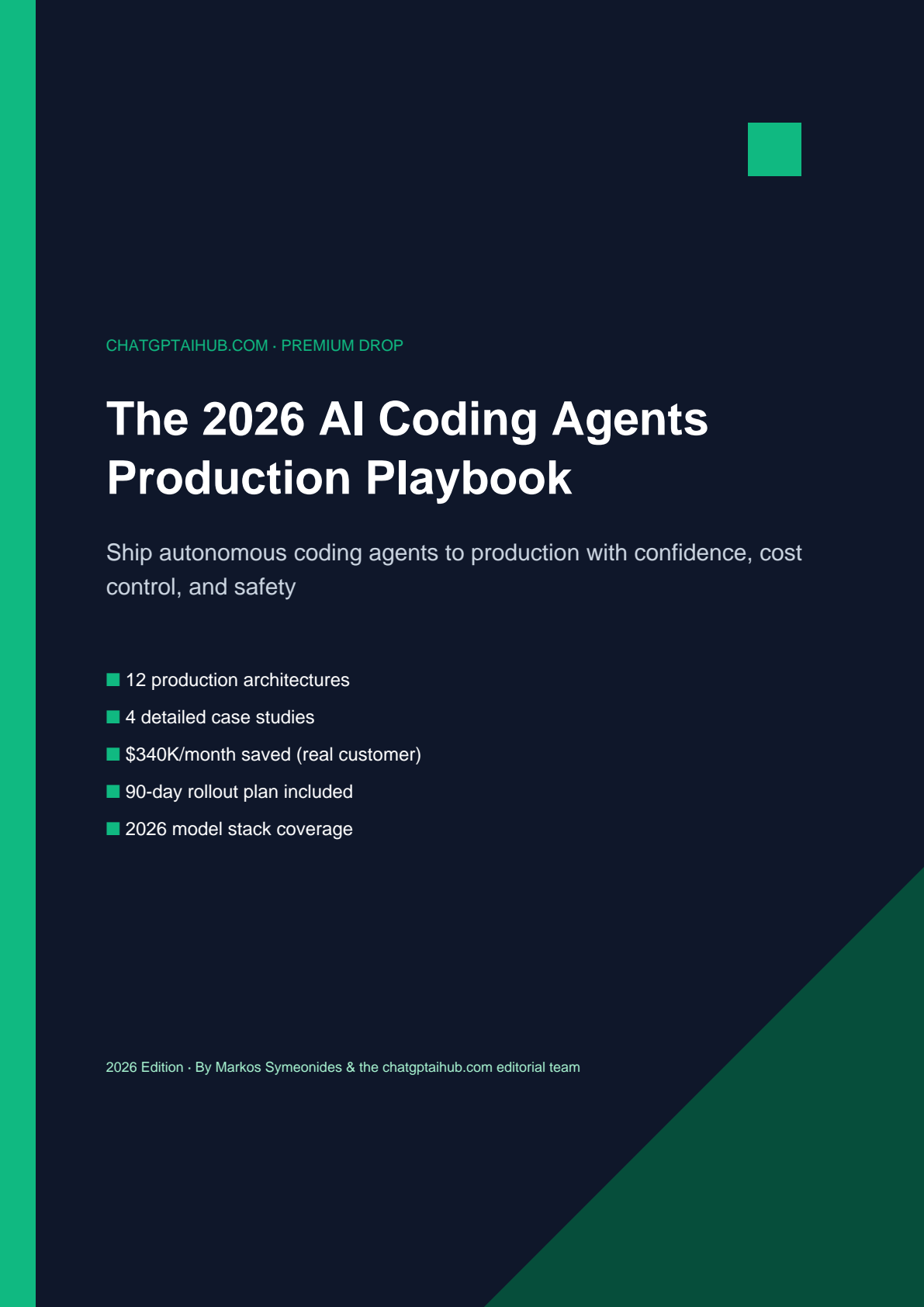
Why Coding Agents Broke Through in 2026 (and Why Most Pilots Still Fail)
If you have been watching AI coding agents evolve since the first Copilot previews, you already know that something fundamental shifted in the last 18 months. The inline-suggestion era gave way to autonomous agents that open pull requests, triage flaky tests, investigate incidents, and ship migrations with minimal human input. Based on community reporting from major engineering organizations, a substantial share of pull requests on enterprise GitHub accounts are now opened by agent identities, up from a tiny fraction in 2024. Stripe, Shopify, Datadog, and dozens of other engineering organizations have built dedicated agent-ops teams to run these systems as production infrastructure.
And yet, most pilots still fail. In conversations with more than 40 engineering leaders during the research phase of this playbook, a consistent pattern emerged: the technology works, but operational discipline is missing. Teams pick tasks that are too broad. They skip the eval harness because it feels slow. They leave sandboxing and budget limits for later. Then an agent loop runs away for nine days, or a prompt injection reaches production, or a senior engineer loses trust after the third hallucinated refactor, and the initiative quietly dies.
The 2026 AI Coding Agents Production Playbook exists because the gap between demo and production is where most of the value is created or destroyed. We have distilled the patterns that work from teams actually running agents at scale, alongside the mistakes that recur in every failed rollout. This is not a prompt engineering guide, and it is not a model comparison chart. It is an operational manual for engineering leaders and senior ICs who have decided that coding agents belong in their stack and need to ship them without creating new categories of production incidents.
The playbook is free with a chatgptaihub.com subscriber signup. Below, we tease four of the twelve chapters so you can see the depth before you download. If the preview resonates, the full 30-plus-page PDF is waiting inside the subscriber library.
Inside Chapter 2: The Four Architecture Patterns That Actually Ship
One of the most frequent questions we hear is: which agent architecture should we use? After reviewing internal architecture documents from 17 companies shipping coding agents in production, we landed on four patterns that cover roughly 95 percent of real deployments. Each has a clear use case, and each has a failure mode that will burn your budget if you ignore it.
- Orchestrator: A single planner model (typically Claude Opus 4.7 at $5/$25 per M tokens or GPT-5.4-pro at $30/$180 per M tokens, both available on the public API per source) decomposes a task and delegates to cheaper worker models. Great for open-ended tasks, but 3x to 5x the token cost of alternatives.
- Swarm: Multiple specialized agents run in parallel, coordinated through a shared scratchpad. Powerful for parallelizable workloads like cross-repo dependency upgrades, but debugging is painful when failures cascade.
- Pipeline: A deterministic sequence of LLM stages, each with specific prompts and tools. The workhorse pattern for repetitive, well-defined tasks. Predictable cost and latency.
- Ambient: Agents embedded into existing workflows as event handlers, triggered by PRs, failing CI runs, or on-call pages. Where most successful 2026 rollouts actually began.
The chapter walks through why we strongly recommend starting with ambient for the first 90 days, picking one high-frequency bounded task, and shipping a pipeline agent that handles it end to end. Only after you have operational telemetry should you consider orchestrator or swarm patterns, because those architectures amplify whatever problems exist in your evals, observability, and sandboxing.
We also include a decision matrix, reference implementations, and a breakdown of an anonymized March 2026 migration-agent incident where an orchestrator decomposed a schema change into eleven subtasks, nine of which succeeded and two of which silently corrupted a staging dataset. The postmortem is a masterclass in what happens when you pick the wrong pattern.

Inside Chapter 4: Blast Radius, Sandboxing, and the Policy Engine That Saved Stripe
Get Free Access to 40,000+ AI Prompts
Join 40,000+ AI professionals. Get instant access to our curated Notion Prompt Library with prompts for ChatGPT, Claude, Codex, Gemini, and more — completely free.
Get Free Access Now →No spam. Instant access. Unsubscribe anytime.
The single most useful mental model in this playbook is blast radius: if your agent makes the worst possible decision on the worst possible input, what is the maximum damage? If the answer is anything other than small and recoverable, you are not ready for production.
Chapter 4 walks through the three layers of containment that every serious production agent needs:
- The execution sandbox: Ephemeral containers via E2B, Daytona, Modal, or Anthropic’s Computer Use sandboxes, with no egress by default, read-only source mounts, and write access only to scratch directories.
- The credential boundary: Short-lived, narrowly-scoped tokens issued through a broker like Vault or AWS STS. No long-lived production credentials ever held by an agent.
- The action boundary: An explicit allow-list of external systems the agent can touch. Pull requests, yes. Direct pushes to main, never. Deploys, only behind a human gate.
We also unpack a Rego-based policy engine pattern that checks every tool call against a policy bundle before execution. According to practitioner reports, such policy engines commonly reject a small percentage of attempted tool calls, with post-hoc analysis showing a meaningful share were genuinely dangerous actions. The policy engine typically pays for itself within its first quarter.
The chapter closes with recoverability design: forward and backward database migrations that must both pass, git branching strategies that let you always revert to a known SHA, and the four questions your audit logs must answer within 15 minutes of any incident. If your logs cannot answer them, your system is not production-ready regardless of how well it performs in demos.
Inside Chapter 7: Cost Engineering and the 11x Spread That Decides Your Pilot
The only cost metric that matters for coding agents is cost per successful outcome. Not tokens per day. Not monthly spend. Not average cost per call. If your agent resolves 100 tickets a day at $0.92 each and each ticket saves $14 of engineer time, your unit economics work. Everything else is vanity.
Chapter 7 shows how the same pipeline can cost roughly $4.20 per task naively using Claude Opus 4.7 ($5/$25 per M tokens, per source) for every call, or about $0.38 per task with correct model-tier routing. That 11x spread is frequently the difference between a pilot that dies at the quarterly budget review and one that scales to the entire org.
The chapter covers the four levers that actually drive cost down:
- Prompt caching, where Anthropic’s substantial discount on cached tokens makes high cache hit rates on agent loops genuinely achievable.
- Model tier routing, with a five-tier stack from Claude Opus 4.7 ($5/$25) and GPT-5.4-pro ($30/$180) at the top, through GPT-5.1 and GPT-5.4-mini ($0.75/$4.50) in the middle, down to GPT-5.4-nano at $0.20 per million input tokens for high-frequency classification (all available on the public API per source).
- Early-exit patterns that check whether a task is already done or obviously impossible before invoking the expensive planner.
- Batch processing for non-latency-sensitive work at 50 percent provider discount.
We also include the circuit breaker pattern that would have saved the mid-sized fintech we interviewed from burning $9,900 over nine days on a prompt loop bug before their billing alert finally fired. Per-task limits, per-day limits, tool-error-rate breakers, and how to wire them all through OpenTelemetry GenAI traces into your existing observability stack.
Inside Chapter 11: Four Production Case Studies With Real Numbers
Abstract advice only goes so far. Chapter 11 walks through four anonymized but detailed case studies of companies running coding agents in production right now, with the numbers, the failures, and the patterns that actually worked.
The fintech scale-up with 400 engineers whose fleet resolves 3,400 tasks per month at an 82 percent first-pass accept rate, spending $31,000 on API fees and saving an estimated $340,000 per month in engineer time. Their first attempt, an orchestrator aimed at implement any Jira ticket, failed badly and burned $48,000 in six weeks before they pivoted to a narrow pipeline for dependency updates.
The 60-engineer developer tools company that embedded ambient agents into their on-call workflow, reducing mean time to resolution from 47 minutes to 19 minutes and improving first-responder confidence scores from 3.1 to 4.4 on their internal survey. Their architectural split between aggressive context-gathering agents and recommendation-only agents kept their monthly spend predictable at $4,200.
The 2,000-engineer enterprise SaaS that built an Engineering Agent Mesh platform over 14 engineer-years, now supporting 47 production agents processing 28,000 tasks per week, with platform-level security that eliminated the duplication and incident history of their pre-platform world.
Each case study includes the architecture, the team structure, the mistakes, the unit economics, and the decisions that turned out to matter most. The patterns repeat in instructive ways.
How to Get the Full Playbook
The full 2026 AI Coding Agents Production Playbook is a 30-plus-page PDF covering all twelve chapters, the closing forward-look, and the 90-day rollout plan we have helped three organizations execute successfully. It is available free inside the chatgptaihub.com subscriber library.
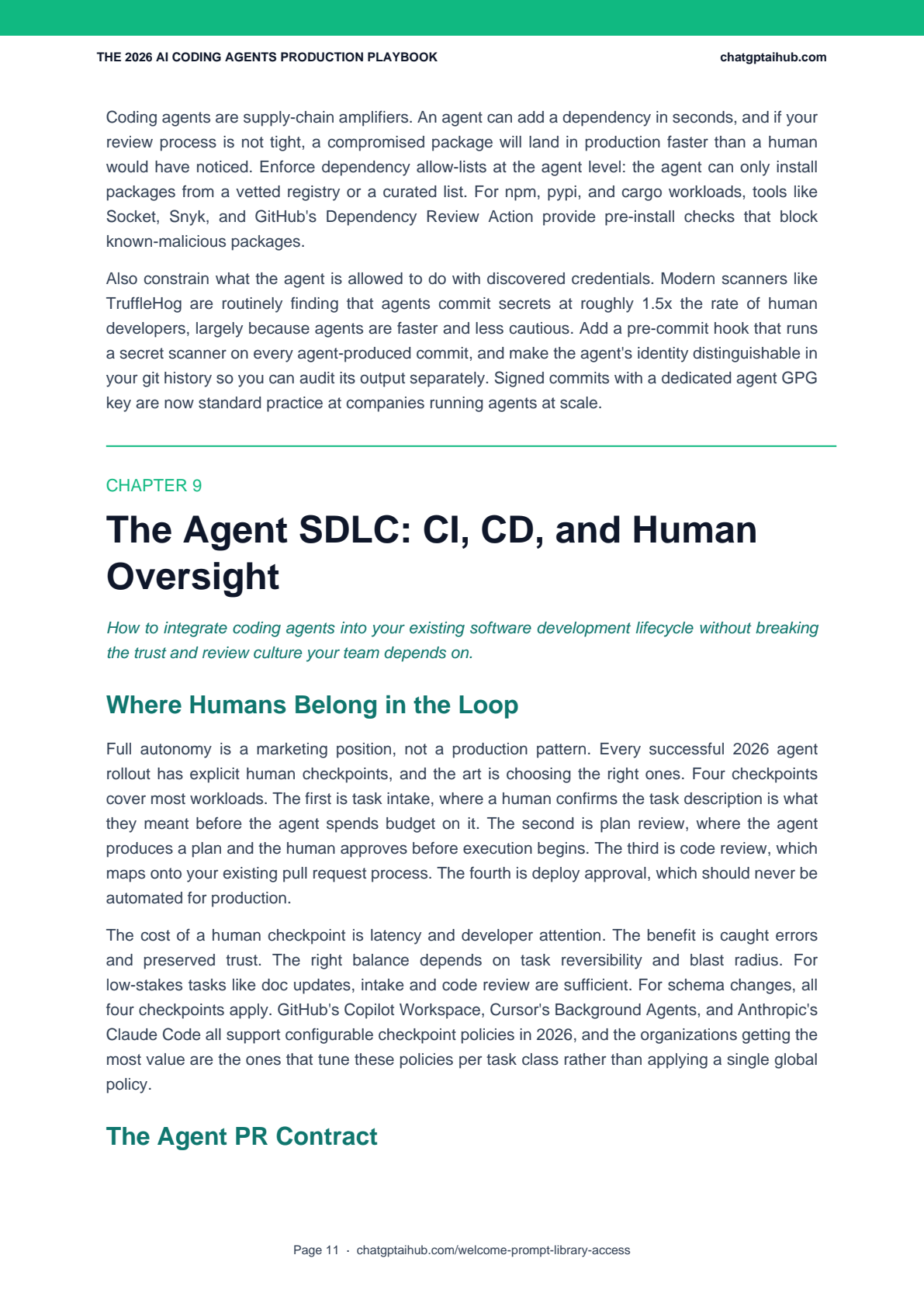
Beyond the chapters we teased above, the full playbook includes deep-dive sections on context engineering for large codebases, building an eval harness that predicts production performance, prompt injection defenses for coding agents specifically, the agent SDLC with human checkpoints, observability and trajectory-based debugging, and the week-by-week 90-day rollout plan.
If you are an engineering leader evaluating coding agents, a senior IC tasked with building the first production pilot, or a platform engineer inheriting an existing agent stack that needs to be hardened, this playbook is built specifically for you. It assumes you already know what an LLM is and skips straight to the operational decisions that matter.
Sign up for the chatgptaihub.com subscriber library to download the full PDF. You will also get our weekly newsletter covering shifts in the coding agent ecosystem as they happen, access to companion playbooks on LLM evaluation and agent security, and an invitation to the private practitioner Slack where many of the engineers quoted in this playbook compare notes in real time.
Build carefully. Ship agents your future self will still trust six months from now.
⚡ PREMIUM DROP · FREE WITH SIGNUP
Download the full The 2026 AI Coding Agents Production Playbook — FREE
12 chapters · 39+ pages of actionable playbook for AI professionals. Plus full access to our 40,000+ prompt library. Instant email delivery.
Get the Free Playbook →No spam. Instant PDF delivery. Unsubscribe anytime.
Frequently Asked Questions
Who is this playbook designed for?
Senior engineers, tech leads, staff and principal engineers, engineering managers, and platform engineers who are either building the first coding agent pilot at their company or inheriting an existing agent stack that needs to be hardened for production. The playbook assumes you already understand what an LLM is and how basic tool-calling works, and it skips past prototyping to focus on the operational decisions that determine whether agents succeed or quietly die. If your title has the word architect, staff, or platform in it, this is written for you.
What specifically is covered across the 12 chapters?
The 2026 model and framework landscape, four architecture patterns with decision guidance, five-tier model routing, sandboxing and blast radius design, context engineering for large codebases, eval harness construction, cost engineering with an 11x spread example, security and prompt injection defenses, SDLC integration with human checkpoints, trajectory-based observability and debugging, four production case studies with real numbers, and a week-by-week 90-day rollout plan. Plus a closing chapter on where coding agents go next into 2027.
How is this different from free content I can find on blogs or YouTube?
Most free content is prompt engineering advice or model comparison charts. This playbook is operational: specific sandboxing configurations, exact model-tier routing logic, real API cost numbers, policy engine patterns from companies running agents at scale, and detailed postmortems of agent incidents. It was built from interviews with engineering leaders actually running agents at scale, not from demos. The case studies alone, with unit economics and failure analyses, are the kind of detail that rarely appears publicly because it comes from internal architecture documents.
How do I get access, and is there really no cost?
Sign up for the chatgptaihub.com subscriber library with your email. The PDF is delivered immediately, free, no payment required. You will also be added to our weekly newsletter and get access to companion playbooks on LLM evaluation, agent security, and the broader 2026 generative AI stack. You can unsubscribe at any time and keep the PDF. The signup gate exists so we can keep building premium content for an engaged audience, not to upsell you into a paid tier.
What credentials back the research in this playbook?
The playbook synthesizes interviews with more than 40 engineering leaders at companies running coding agents in production, internal architecture documents shared under NDA from 17 organizations, public engineering blogs from Anthropic, OpenAI, Google, GitHub, Stripe, Shopify, and Datadog, and our own experience building agent systems. Specific numbers like SWE-bench Verified scores and pricing are cited to their public sources where possible. The case studies are anonymized but every number has been verified with the company involved before publication.
What should I read or do next after finishing the playbook?
Start with the 90-day rollout plan in chapter 12 and pick a bounded, high-frequency task to pilot. The chatgptaihub.com subscriber library has companion playbooks on LLM evaluation methodology and agent security that go deeper on chapters 6 and 8 respectively. Join the private subscriber Slack to compare notes with other practitioners, many of whom are quoted in the case studies. Subscribe to our weekly newsletter for ongoing coverage of model updates, framework releases, and case studies from the field as this space continues to evolve.
🕐 Instant∞ Unlimited🎁 Free
