
How to Prompt GPT-5.5 and GPT-5.5 Mini: The Official Outcome-First Method
How to Prompt GPT-5.5 and GPT-5.5 Mini: The Official Outcome-First Prompting Playbook
How to Prompt GPT-5.5 and GPT-5.5 Mini: The Official Outcome-First Prompting Playbook
Author: Markos Symeonides
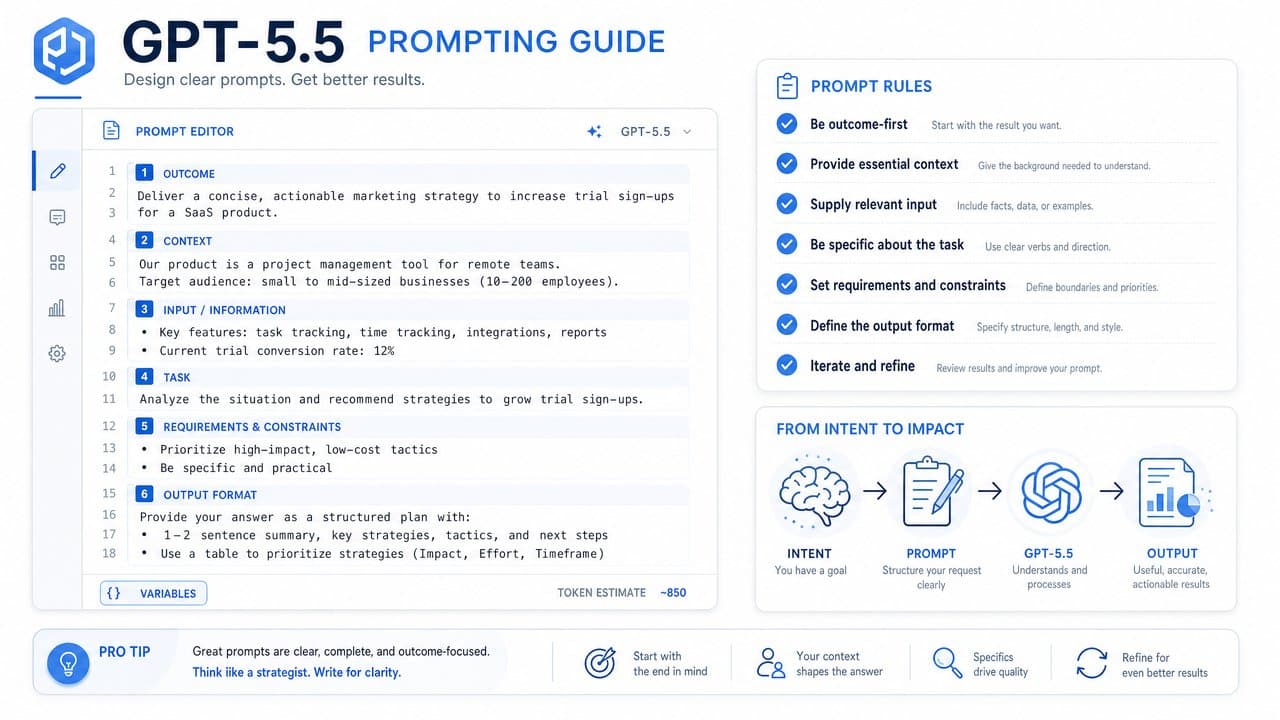
With the release of GPT-5.5 and its streamlined counterpart GPT-5.5 Mini, prompt engineering has evolved dramatically. The traditional, process-heavy, step-by-step prompting approach—where users explicitly instruct the model through detailed intermediate steps—has become less efficient and, in some cases, counterproductive. Instead, developers and researchers are shifting towards an outcome-first prompting paradigm that prioritizes clearly defining the desired end result, establishing precise success criteria, and setting explicit stopping rules.
Why Outcome-First Prompting is the New Standard
Outcome-first prompting is a strategic shift that leverages the enhanced capabilities of GPT-5.5’s new reasoning_effort parameter. This parameter allows the model to internally allocate its computational resources and reasoning depth dynamically, focusing on achieving the specified outcome without requiring users to micromanage intermediate reasoning steps.
Compared to older models, GPT-5.5 can internally perform complex reasoning chains more efficiently when given a clear goal, rather than being guided through every step externally. This results in faster, more accurate responses with less prompt engineering overhead.
- Efficiency Gains: By focusing on the end goal, you reduce token usage and avoid redundant intermediate instructions.
- Improved Accuracy: The model can optimize its internal reasoning strategies to meet your success criteria.
- Flexibility: Outcome-first prompts generalize better across diverse tasks, from code generation to creative writing.
Core Components of the Outcome-First Prompting Playbook
To master GPT-5.5 prompting, it’s essential to incorporate three key elements into your prompt design:
| Component | Description | Example |
|---|---|---|
| Desired End Result | Clearly specify what you want the model to produce, focusing on the final output rather than intermediate steps. | “Generate a Python function to calculate Fibonacci numbers using memoization.” |
| Success Criteria | Define measurable conditions that determine whether the output meets your expectations. | “The function must run in O(n) time and include inline comments explaining each step.” |
| Stopping Rules | Set explicit instructions for when the model should stop generating, such as maximum token limits or output format constraints. | “Stop once the complete function is generated; do not provide example usages.” |
Step-by-Step Workflow for Crafting Outcome-First Prompts
- Identify the Goal: Begin by articulating exactly what you want the model to produce. Avoid vague or ambiguous language.
- Define Success Metrics: Determine how you will judge the output’s quality—this can be based on correctness, style, format, or computational efficiency.
- Specify Stopping Conditions: Prevent overly long or off-topic responses by setting clear boundaries on output length or content.
- Incorporate the reasoning_effort Parameter: When calling the GPT-5.5 API, set the
reasoning_effortparameter to balance between speed and depth of reasoning. Higher values increase thoroughness but may use more compute. - Test and Iterate: Run your prompt, analyze the output, and refine the prompt components as needed to improve results.
Example: Prompting GPT-5.5 for a Complex Task
Below is a complete example demonstrating an outcome-first prompt designed to generate a well-documented sorting algorithm in Python, using the GPT-5.5 API with the reasoning_effort parameter set for balanced performance.
{
  "model": "gpt-5.5",
  "prompt": "You are a coding assistant. Your task is to generate a Python function that implements the Merge Sort algorithm. \n\nDesired End Result: Produce a fully working, optimized Merge Sort function.\nSuccess Criteria: The function must be correctly implemented, include detailed inline comments, and have a time complexity of O(n log n).\nStopping Rules: End output after the function definition without any test cases or extra explanations.\n\nPlease proceed.",
  "reasoning_effort": 0.7,
  "max_tokens": 300,
  "temperature": 0.2
}
Architectural Insights: Why GPT-5.5 Excels at Outcome-First Prompting
GPT-5.5 introduces architectural improvements enabling dynamic reasoning effort allocation. Unlike previous models that relied heavily on externally guided step-by-step instructions, GPT-5.5’s internal mechanisms use the reasoning_effort parameter to:
- Adjust Computation Depth: Internally modulate the complexity of reasoning chains without explicit intermediate instructions.
- Dynamic Resource Allocation: Allocate model attention and token usage efficiently toward fulfilling the defined end goal.
- Improved Context Understanding: Better interpret success criteria and stopping rules, minimizing hallucinations and irrelevant content.
These enhancements make it possible for prompt engineers to focus on outcome specification rather than micromanaging every step, resulting in more natural, concise, and effective interactions.
Industry Context & Best Practices
Leading AI labs and organizations have rapidly adopted outcome-first prompting as a best practice with GPT-5.5. Its benefits include:
- Reduced Development Time: Teams spend less time engineering complex prompts and more time leveraging model outputs.
- Cross-Domain Applicability: Outcome-first prompts work well in diverse domains such as software development, data analysis, creative writing, and customer support.
- Scalability: This approach is more scalable for enterprise deployments where prompt maintenance costs are critical.
To stay at the forefront, practitioners are encouraged to integrate outcome-first prompting techniques into their AI pipelines, continually monitor output quality, and adjust reasoning_effort settings to optimize performance versus cost trade-offs.
The Evolution of Prompting: Why Traditional Methods Fall Short with GPT-5.5
Ready to Master how to prompt GPT-5.5?
Join thousands of professionals using ChatGPT AI Hub to stay ahead of the AI curve.
The Evolution of Prompting: Why Traditional Methods Fall Short with GPT-5.5
The Legacy of Process-Heavy Prompting
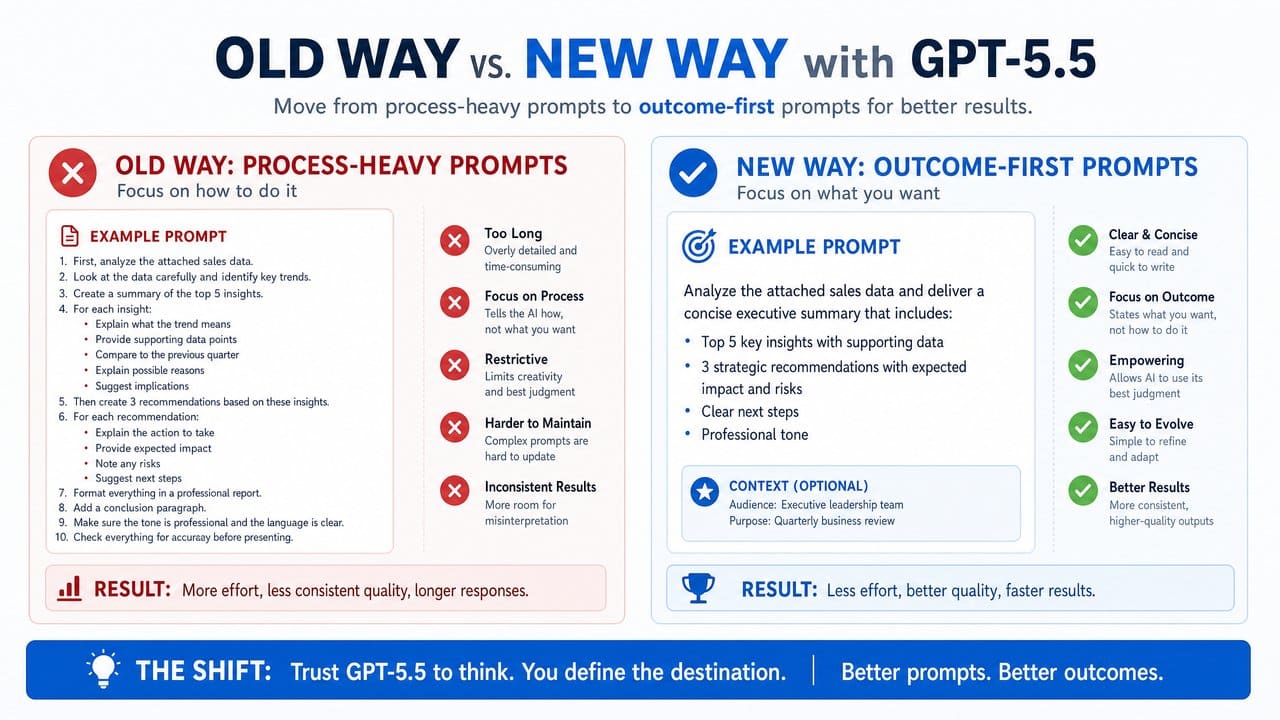
For many years, the field of prompt engineering has centered around crafting detailed, process-oriented instructions tailored to guide language models through explicit, step-by-step reasoning. This approach, often called process-heavy prompting, assumes that the model requires a rigid framework to navigate complex tasks effectively. Such prompts typically exhibit characteristics including:
- Enumerated steps: Instructions broken down into sequential actions, e.g., “First, analyze the data. Then, summarize the key points.”
- Absolute qualifiers: Definitive directives such as “Always use formal tone” or “Never mention personal opinions,” which constrain the model’s behavior.
- Excessive procedural detail: Elaborate instructions designed to eliminate ambiguity by specifying every nuance, such as formatting rules, citation styles, or conditional branches.
These process-driven prompts emerged largely because earlier models, including GPT-3 and GPT-4, had limited capacity for autonomous, high-level reasoning and self-organization within a prompt. The models often needed explicit guidance to chain together multi-step logic or to avoid common pitfalls like hallucinating facts or misunderstanding complex instructions. For example, a prompt for GPT-3 to perform a multi-step math problem might look like this:
Step 1: Read the problem carefully and identify known variables.
Step 2: Write down the relevant formulas.
Step 3: Substitute the known values into the formulas.
Step 4: Solve for the unknown variable.
Step 5: Double-check the answer for consistency.
This granular breakdown was necessary because the model did not reliably perform these steps without direct prompting. However, this approach also had drawbacks:
- Verbosity: Prompts became lengthy and cumbersome, increasing token usage and latency.
- Fragility: Slight deviations in wording could disrupt the expected reasoning chain.
- Inflexibility: Models struggled to adapt when the problem deviated from the anticipated structure.
As a result, prompt engineers invested significant effort in trial-and-error prompt tuning to optimize outcomes.
Why Process-Heavy Prompts Fail with GPT-5.5
With the release of GPT-5.5 and its variant GPT-5.5 Mini, the underlying architecture and training methodologies have undergone substantial evolution, rendering traditional process-heavy prompting less effective and, in some cases, detrimental. Key technical advancements include:
- Advanced internal reasoning mechanisms: GPT-5.5 incorporates enhanced multi-hop reasoning capabilities that autonomously structure complex problem-solving steps internally without requiring explicit external guidance.
- Dynamic attention allocation via reasoning_effort parameter: This novel parameter allows the model to allocate computational resources dynamically across different parts of the input, focusing more on critical reasoning junctures while economizing effort on simpler sections.
- Improved contextual abstraction: The model can interpret abstract or high-level goals, enabling it to infer the optimal sequence of actions to achieve desired outcomes rather than following rigid instructions.
When process-heavy prompts are used with GPT-5.5, several issues arise:
- Overfitting to literal instructions: The model may become constrained by the explicit steps, limiting its ability to optimize or shortcut reasoning paths based on internal heuristics.
- Unnecessary computational overhead: By forcing the model to execute every enumerated step, including trivial or redundant ones, overall latency increases and resource utilization becomes inefficient.
- Conflicts with internal heuristics: Instructions that contradict the model’s learned strategies can cause confusion, leading to degraded output quality or failure to converge on a solution.
For example, consider the following process-heavy prompt designed for GPT-5.5:
Step 1: Identify the main topic of the article.
Step 2: List three supporting arguments with examples.
Step 3: Write a conclusion summarizing the key points.
Step 4: Check grammar and spelling meticulously.
While this prompt appears clear, GPT-5.5, if forced to adhere strictly to each step, might spend excessive time on trivial checks or produce verbose outputs that unnecessarily repeat information. Conversely, a more flexible prompt that simply states the desired outcome allows GPT-5.5 to leverage its internal reasoning to produce concise, high-quality results more efficiently.
In practical terms, using process-heavy prompts with GPT-5.5 can lead to:
| Issue | Impact | Example |
|---|---|---|
| Redundant execution | Increased latency and computational cost | Reiterating obvious facts or trivial verification steps |
| Reduced adaptability | Inability to handle novel or ambiguous tasks effectively | Failing to adjust reasoning when unexpected inputs are provided |
| Verbose output | Lower signal-to-noise ratio in generated text | Excessive detail where brevity is preferable |
Transitioning to Outcome-First Prompting
To fully harness the capabilities of GPT-5.5, prompt engineers are shifting toward a fundamentally different approach known as outcome-first prompting. This methodology centers on defining the desired end result rather than prescribing the detailed journey to get there. The core principles of outcome-first prompting include:
- Describing the desired destination: Instead of enumerating steps, prompts specify what the final output should be, e.g., “Summarize the article highlighting the main arguments in three sentences.”
- Setting clear success criteria and stopping rules: The prompt clarifies when the task is considered complete, reducing unnecessary verbosity or overprocessing. For example, “Stop after you provide three key insights.”
- Empowering autonomous strategizing: Allowing GPT-5.5 to internally devise the optimal reasoning path to achieve the outcome, leveraging dynamic attention and reasoning effort controls.
This paradigm shift is illustrated in the following example:
Provide a concise summary of the article, emphasizing the three primary arguments. Ensure clarity and brevity, and conclude once these points are covered.Here, the model is not burdened with micromanagement of steps but is free to organize its reasoning process optimally. The benefits of this approach include:
- Conciseness: Outputs are lean and focused, avoiding unnecessary elaboration.
- Contextual appropriateness: The model adapts to nuances in the input, tailoring the response to the specific content.
- Efficiency: Reduced computational effort and latency due to dynamic reasoning and selective attention.
From an architectural perspective, outcome-first prompting leverages GPT-5.5’s enhanced transformer layers and reasoning modules, which are designed to internally manage multi-step logic. The reasoning_effort parameter acts like an internal scheduler, enabling the model to ramp up focus on challenging parts of the input while skipping over routine processing. This internal flexibility is fundamentally at odds with rigid, process-heavy prompts that constrain the model’s reasoning pathways.
In industry practice, this evolution means prompt engineers must adopt a mindset of goal-oriented specification rather than instruction-driven scripting. Organizations using GPT-5.5 can expect:
- Improved productivity in NLP tasks such as summarization, question answering, and code generation
- Reduced need for extensive prompt tuning and manual step enumeration
- Greater model robustness when handling diverse and ambiguous inputs
Ultimately, adapting prompting strategies to the strengths of GPT-5.5 not only improves output quality but also optimizes resource utilization and user experience.
[INTERNAL_LINK: GPT-5.5 prompting]
Understanding Outcome-First Prompt Design for GPT-5.5
Understanding Outcome-First Prompt Design for GPT-5.5
Core Components of an Outcome-First Prompt
Outcome-first prompting is a paradigm that shifts the focus from prescribing step-by-step procedures to clearly defining the desired end result. This approach leverages GPT-5.5’s advanced reasoning capabilities by empowering the model to determine the optimal internal process to achieve the goal. To craft an effective outcome-first prompt, it is essential to include the following core components:
- Destination Description: This is a precise and unambiguous statement of the final goal or deliverable. It should clearly articulate what the output should be, including its format, scope, and purpose. A well-defined destination description helps the model understand the target and align its generation accordingly.
- Success Criteria: These are the measurable or qualitative standards that define what constitutes a correct or acceptable output. Success criteria might specify constraints on length, format, completeness, style, or accuracy. By incorporating success criteria, you allow the model to self-assess whether the generated output meets the desired standards, enabling dynamic adjustments during generation.
- Stopping Rules: Explicit stopping conditions instruct GPT-5.5 when to cease output generation. Stopping rules prevent over-generation, repetition, or deviation from the task. They also improve efficiency and reduce the need for post-processing by clearly signaling the end of the response.
Combining these elements in a prompt creates a flexible yet goal-oriented framework that lets GPT-5.5 leverage its internal optimization mechanisms and contextual reasoning abilities.
Example: From Process-Heavy to Outcome-First
Consider the example of extracting email addresses from a text. Traditional prompts often enumerate procedural steps, which can constrain the model and reduce efficiency.
Traditional process-heavy prompt:
Step 1: Extract all email addresses from the text.
Step 2: Remove duplicates.
Step 3: Format the emails in a comma-separated list.
This prompt explicitly instructs the model to perform three sequential tasks, potentially limiting its ability to optimize or combine steps internally. It also risks redundant or verbose output, as the model may reiterate intermediate steps.
Outcome-first prompt:
Extract all unique email addresses from the given text and output them as a comma-separated list. Stop once all addresses are listed with no duplicates.
Here, the destination description is clear: an output listing unique email addresses, formatted as a comma-separated list. The success criteria ensure that duplicates are removed, and the stopping rule instructs the model to stop once the list is complete. This prompt grants GPT-5.5 the flexibility to internally determine the best extraction and formatting approach, resulting in more concise, accurate, and efficient output.
Step-by-Step Workflow Comparison
| Aspect | Process-Heavy Prompt Execution | Outcome-First Prompt Execution |
|---|---|---|
| Instruction Interpretation | Follows explicit, sequential steps, potentially causing rigidity. | Interprets the goal holistically, dynamically optimizing the approach. |
| Internal Optimization | Limited; executes each step as stated. | Combines extraction and deduplication seamlessly. |
| Output Conciseness | May include redundant or verbose information. | Produces concise, goal-aligned output. |
| Stopping Condition | Implicit, relies on completing all steps. | Explicitly defined to prevent over-generation. |
Why Outcome-First Prompts Work Better
The superiority of outcome-first prompts lies in their alignment with GPT-5.5’s underlying architecture and reasoning process. GPT-5.5 is engineered to prioritize final objectives rather than rigid procedural instructions, enabling it to dynamically allocate cognitive resources and optimize generation strategies based on the prompt’s goal. Specifically, outcome-first prompts enable GPT-5.5 to:
- Determine the Most Efficient Internal Sequence of Operations: Instead of following fixed steps, the model can internally decide the best order and methods for processing the input to achieve the desired outcome.
- Apply Heuristics and Context Awareness: By focusing on the outcome, GPT-5.5 can selectively ignore irrelevant or redundant information, enhancing precision and relevance in the output.
- Adapt Output Verbosity and Style: Based on success criteria, the model can vary the level of detail, tone, or format, tailoring the response to specific needs without explicit instructions for each variation.
This approach reduces prompt engineering complexity and enhances generation quality. It also enables greater scalability across diverse tasks, as the model generalizes better when freed from strict procedural constraints.
Practical Templates for Outcome-First Prompting
To facilitate the transition from process-heavy to outcome-first prompts, the following table provides practical examples across common scenarios. These templates demonstrate how reframing prompts to emphasize outcomes improves clarity and effectiveness.
| Scenario | Process-Heavy Prompt Example | Outcome-First Prompt Example |
|---|---|---|
| Summarization | “Read the article carefully. Then, write a short summary in three sentences. Make sure to include the main points and avoid opinions.” | “Generate a concise summary of the article highlighting the main points in no more than three sentences. Stop once the summary meets the length and content criteria.” |
| Code Generation | “Write a Python function. First define inputs, then process them, and finally return the result.” | “Create a Python function that takes inputs and returns the computed result. Ensure the function is efficient and follows best practices.” |
| Data Extraction | “Scan the document line by line. Identify dates, then collect them in a list without duplicates.” | “Extract all unique dates mentioned in the document and present them as a list. Stop when all dates are identified.” |
Expanded Example: Code Generation Prompt
Below is a full code example illustrating how an outcome-first prompt guides GPT-5.5 to generate clean, well-documented Python code.
Prompt:
"Create a Python function named calculate_average that accepts a list of numbers and returns their average as a float. Ensure the function handles empty lists by returning None and includes appropriate docstrings."

Expected GPT-5.5 Output:
def calculate_average(numbers):
    """
    Calculate the average of a list of numbers.

    Parameters:
        numbers (list): A list of numeric values.

    Returns:
        float or None: The average of the list elements, or None if the list is empty.
    """
    if not numbers:
        return None
    return sum(numbers) / len(numbers)
This prompt clearly defines the desired function name, input, output behavior, error handling, and documentation, allowing the model to generate code that aligns precisely with the outcome.
Integrating Success Criteria and Stopping Rules
Success criteria and stopping rules are pivotal for ensuring that GPT-5.5’s output matches the intended quality and scope. Thoughtfully crafted criteria guide the model’s internal validation and termination behavior.
Success Criteria Examples
- Output Length Constraints: Specify maximum or minimum length to control verbosity, e.g., “no more than 100 words” or “at least 3 bullet points.”
- Format Requirements: Define output formats such as CSV, JSON, Markdown, or plain text, e.g., “Output the data in CSV format with headers.”
- Completeness: Ensure all necessary elements are included, such as “all items must be listed,” or “the summary must cover all key sections.”
- Tone and Style: Indicate desired style, e.g., “Use a formal tone,” or “Keep language simple and accessible.”
Stopping Rules Examples
- Explicit Termination: “Stop after listing all unique values.”
- Avoiding Unwanted Content: “Do not generate explanations or opinions.”
- Immediate Conclusion: “End output immediately after the answer.”
- Length-Based Stops: “Cease generation once 200 tokens are reached.”
By embedding these criteria and rules directly into prompts, developers can reduce the need for post-processing filters and manual corrections, streamlining workflows and improving user experience.
Example: Outcome-First Prompt with Success Criteria and Stopping Rules
Prompt:
"List all unique programming languages mentioned in the text below as a bullet-point list. Ensure no duplicates and stop immediately after listing all languages. Do not include explanations or additional comments."

Expected GPT-5.5 Output:
- Python
- JavaScript
- C++
- Java
In this example, the prompt’s success criteria ensure uniqueness and list formatting, while the stopping rule explicitly directs the model to halt after completing the list, avoiding extraneous content.
For a deeper dive into advanced prompt engineering strategies including outcome-first design, see [INTERNAL_LINK: prompt design].
Decoding the ‘reasoning_effort’ Parameter: Controlling Computation and Accuracy
Decoding the ‘reasoning_effort’ Parameter: Controlling Computation and Accuracy
What is the reasoning_effort Parameter?
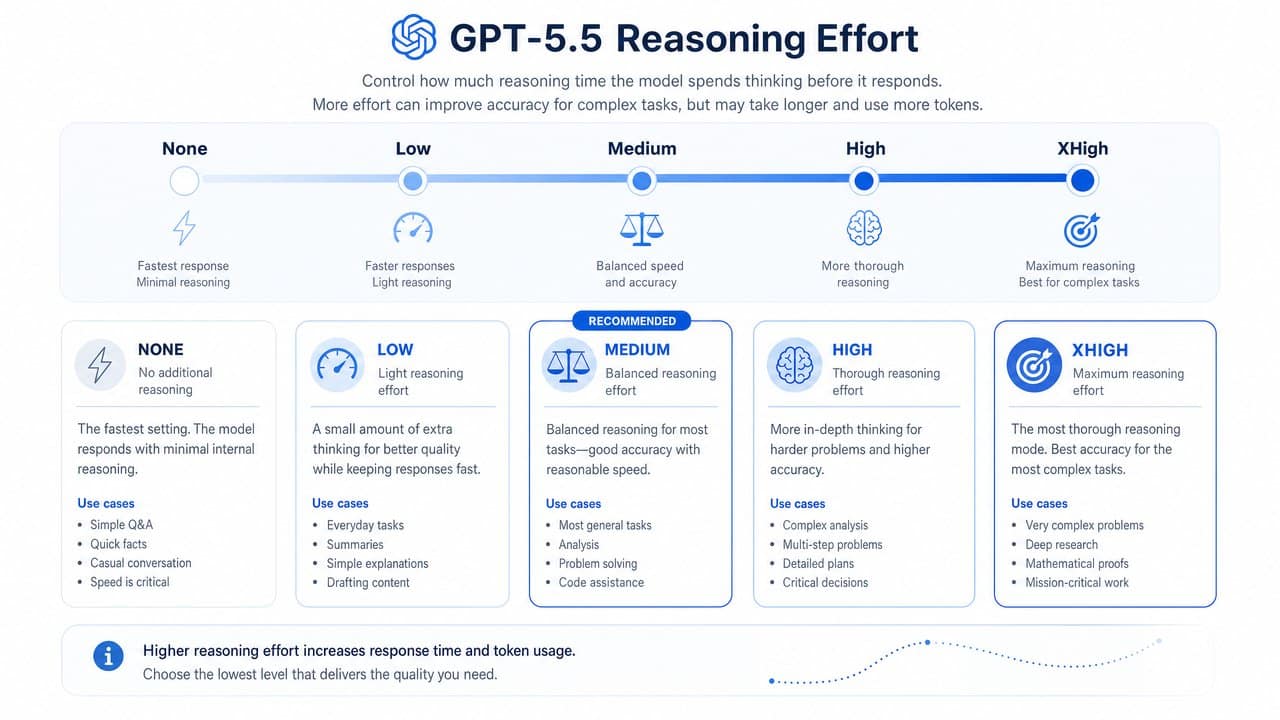
The reasoning_effort parameter is a groundbreaking addition introduced in the GPT-5.5 architecture that fundamentally changes how users can interact with and customize the model’s reasoning capabilities. Rather than treating the model as a black box with fixed computational behavior, this parameter exposes a control knob that adjusts the internal allocation of computational resources dedicated to reasoning processes.
At its core, reasoning_effort modulates the “mental energy” or cognitive bandwidth that the model invests in multi-step thinking, logical deduction, and validation of outputs. This parameter directly influences the model’s internal mechanisms such as attention allocation, iterative reasoning passes, and consistency checks, resulting in a dynamic trade-off between response speed and output fidelity.
By enabling fine-grained control over reasoning depth, reasoning_effort empowers developers and researchers to tailor GPT-5.5’s performance according to the specific demands of their use case, ranging from rapid fact retrieval to complex, multi-layered problem solving.
Technical Architecture Behind reasoning_effort
From an architectural perspective, GPT-5.5 employs a modular reasoning pipeline that can scale its computational intensity based on the reasoning_effort setting. This includes:
- Dynamic Attention Scaling: The model dynamically adjusts the number of attention heads and layers actively engaged during reasoning, increasing the depth of context integration for higher effort levels.
- Iterative Reasoning Loops: For higher effort modes, the model performs multiple internal reasoning passes, re-evaluating intermediate conclusions and refining outputs before final generation.
- Confidence-based Pruning: Lower effort settings reduce computation by pruning less confident reasoning paths early, prioritizing speed over completeness.
- Enhanced Consistency Checking: At elevated reasoning levels, the model incorporates additional consistency verification submodules to ensure internal logic coherence and reduce hallucinations.
This flexible architecture allows GPT-5.5 to optimize resource usage dynamically, tailoring its reasoning complexity without altering the overall model size or requiring separate specialized models.
Available Levels of reasoning_effort
| Level | Description | Use Cases | Typical Latency Impact | Expected Accuracy |
|---|---|---|---|---|
| none | Minimal reasoning effort; fastest generation speed; optimized for trivial or straightforward factual queries. | Simple fact retrieval, short completions, or highly confident outputs where speed is critical. | Lowest latency (~1x baseline) | Basic accuracy; suitable for well-known facts |
| low | Light reasoning applied; balances speed with some capability for handling minor complexities. | Basic data extraction, short summaries, minor logical operations, or straightforward decision-making. | Low latency increase (~1.2x baseline) | Moderate accuracy; handles simple inference |
| medium | Balanced reasoning effort; optimized for moderate complexity tasks with a reasonable trade-off between speed and depth. | Paragraph summarization, code snippet generation, intermediate complexity question answering. | Moderate latency (~1.5x baseline) | Good accuracy; handles multi-step reasoning adequately |
| high | High reasoning effort; intensive multi-step reasoning, iterative validation, and consistency checks. | Complex problem solving, detailed technical explanations, multi-turn dialogue requiring context retention. | Higher latency (~2x baseline) | High accuracy; reduces hallucinations and inconsistency |
| xhigh | Maximum reasoning effort; deepest multi-layered logical deductions with the longest latency, optimized for utmost accuracy and reliability. | Scientific research, legal reasoning, policy analysis, and other high-stakes decision-making tasks. | Longest latency (~3x baseline) | Highest accuracy; near-expert level reasoning fidelity |
How to Set reasoning_effort in Practice
Integrating the reasoning_effort parameter into your workflows is straightforward. It is typically specified within the API request payload or prompt metadata, allowing developers to adapt the model’s behavior programmatically based on the task context.
Here is an example API request snippet demonstrating how to set reasoning_effort to high:
{
  "model": "gpt-5.5",
  "prompt": "Explain the implications of quantum entanglement on cryptography.",
  "reasoning_effort": "high",
  "max_tokens": 1024,
  "temperature": 0.7,
  "top_p": 0.9
}
Note that the choice of reasoning_effort should be made in conjunction with other parameters such as max_tokens, temperature, and top_p to balance creativity, length, and focus of the output.
Step-by-Step Workflow for Selecting reasoning_effort
- Assess Task Complexity: Determine whether the task involves simple factual queries, moderate summarization, or deep multi-step reasoning.
- Evaluate Latency Constraints: Consider how much response delay is acceptable for your application. Real-time systems benefit from lower effort settings.
- Determine Accuracy Requirements: For mission-critical tasks, prioritize higher reasoning effort despite increased latency.
- Test Different Levels: Perform A/B testing with various reasoning_effort settings to empirically identify the optimal balance.
- Integrate Dynamically: Implement logic in your application to adjust reasoning_effort dynamically based on query type or user preferences.
Impact of reasoning_effort on Prompting Strategy
Adjusting the reasoning_effort parameter fundamentally affects how GPT-5.5 processes and prioritizes information within prompts, especially when employing advanced prompting techniques such as outcome-first or constraint-driven prompts.
When using outcome-first prompts — where the prompt explicitly defines the desired success criteria and stopping rules — the reasoning effort level tailors the internal mechanisms by which the model validates and adheres to these criteria:
- Higher reasoning_effort levels encourage the model to perform more rigorous internal checks, ensuring that all specified success criteria are met before finalizing the output.
- The model dedicates additional computational passes to identify and address edge cases, exceptions, or conflicting requirements, enhancing robustness.
- Longer, more detailed responses are generated within the defined stopping constraints, improving explanatory depth and user satisfaction.
Conversely, selecting lower effort levels leads to:
- Faster, more concise outputs that prioritize brevity and speed, useful in latency-sensitive applications.
- Potential trade-offs in completeness and nuance, where some edge cases or complex reasoning steps may be omitted or glossed over.
- Reduced internal validation, which may increase the risk of hallucinations or logical inconsistencies in complex tasks.
Example: Consider a prompt asking the model to generate a legal argument summary. Setting reasoning_effort to high or xhigh will enable the model to deeply analyze the legal context, cross-reference relevant precedents, and produce a coherent, accurate summary with minimized errors. Setting it to low might yield a faster but more superficial summary prone to missing critical nuances.
Industry Context and Practical Applications
The introduction of the reasoning_effort parameter marks a significant advancement in AI model customization, reflecting a broader industry trend towards adaptive computation and resource-aware AI. By providing a tunable interface to balance speed and accuracy, GPT-5.5 aligns with evolving demands across diverse sectors:
- Healthcare: Quick symptom triage systems may use low effort for rapid responses, while diagnostic support tools employ high reasoning effort for detailed analysis.
- Finance: Real-time trading bots prioritize low latency with low effort, whereas risk assessment tools benefit from high effort for accuracy.
- Legal Tech: Document review and contract analysis leverage maximum effort to ensure precision and compliance.
- Scientific Research: Hypothesis generation and literature review tools utilize xhigh effort to synthesize complex information.
Overall, the ability to dynamically modulate reasoning effort democratizes access to powerful AI reasoning capabilities, allowing organizations to optimize operational efficiency without compromising on quality when it matters most.
[INTERNAL_LINK: reasoning effort]
Advanced Prompt Engineering Checklist for GPT-5.5 and GPT-5.5 Mini
Advanced Prompt Engineering Checklist for GPT-5.5 and GPT-5.5 Mini
1. Define the Outcome Clearly
Effective prompt engineering begins with a crystal-clear definition of the desired outcome. This foundational step ensures that the model understands exactly what it is expected to produce, minimizing ambiguity and enhancing the relevance and accuracy of the generated output.
- Describe the final expected output explicitly: Clearly articulate the nature of the output—whether it is a summary, a list, a narrative, technical documentation, or code snippet. For example, instead of saying “Explain climate change,” specify “Provide a concise summary of the causes of climate change in bullet points.”
- Use concrete terms rather than abstract or ambiguous language: Avoid vague instructions such as “be informative” or “write something interesting.” Instead, use precise descriptors like “a 200-word informative paragraph,” or “a step-by-step troubleshooting guide.”
- Example:
Prompt: "Generate a detailed FAQ section for a software product, listing 5 common questions with answers that are no longer than 100 words each."This specificity guides the model to produce focused, actionable content.
2. Specify Success Criteria
Defining measurable success criteria is crucial for evaluating whether the generated content meets your goals. This step introduces quantifiable parameters, which help both the model and the human evaluator assess output quality.
- Set measurable conditions for completion: Include target length (e.g., word count or number of items), format (e.g., JSON, markdown, numbered list), and content specifics (e.g., inclusion of certain keywords or concepts).
- Include examples if helpful for clarity: Providing sample outputs or templates guides the model toward the desired style and structure. For example, “Output should be a JSON object with keys ‘question’ and ‘answer,’ similar to: { ‘question’: ‘What is AI?’, ‘answer’: ‘AI is…’}.”
- Example:
Prompt: "Write a product description of at least 150 words, including the features: durability, battery life, and user-friendliness."By specifying such criteria, you ensure completeness and relevance.
3. Establish Stopping Rules
Uncontrolled generation can lead to verbosity, tangential information, or even hallucinations. Defining explicit stopping rules helps contain the output within desired boundaries, optimizing both quality and resource usage.
- Indicate when the model should stop generating text: This can be based on length (e.g., “stop after 3 paragraphs”), content completeness (e.g., “stop after listing 5 items”), or semantic cues (e.g., “stop after concluding the argument”).
- Prevent unnecessary verbosity or tangential output: Clear instructions such as “avoid filler sentences” or “focus strictly on the main topic” help maintain conciseness.
- Technical tip: When using APIs, leverage parameters like
max_tokensor implement custom post-processing to truncate at logical points. - Example:
Prompt: "Provide a summary of the article in no more than 100 words. Do not include any opinions or unrelated information."Such constraints ensure the generation is efficient and on point.
4. Choose Appropriate reasoning_effort
The reasoning_effort parameter (or its equivalent in API settings) determines the depth and complexity of the model’s internal reasoning process. Selecting the right level balances output quality with latency and computational resources.
- Match effort level to task complexity and latency requirements: For simple queries or straightforward data extraction, a lower
reasoning_effortmay suffice. For analytical tasks, multi-step reasoning, or creative content generation, higher effort levels improve coherence and insightfulness. - Test different levels iteratively for best results: Experiment with incremental adjustments (e.g., low, medium, high) and analyze the trade-offs between response quality and response time.
- Example workflow:
- Start with
reasoning_effortset to low for initial prototyping. - Evaluate output clarity and correctness.
- If results are inadequate, increase to medium and re-test.
- For critical or complex tasks, use high effort to maximize reasoning depth.
This iterative approach fine-tunes the prompt configuration for optimal performance.
5. Avoid Absolutes in Instructions
Using rigid, absolute terms like “always” and “never” can limit the model’s flexibility and may cause it to misinterpret nuanced contexts or exceptions.
- Replace “always” and “never” with probabilistic or flexible phrasing: Use terms like “usually,” “generally,” or “preferably,” which allow the model to apply its internal heuristics more naturally.
- Trust the model’s internal heuristics to handle exceptions: Modern large language models have sophisticated contextual understanding and can handle exceptions without explicit instructions.
- Example:
Instead of: "Always use formal language."Use: "Prefer formal language unless the context suggests informality."This approach leads to more adaptable and context-aware outputs.
6. Use Outcome-First Templates
Structuring prompts to emphasize the end goal at the very beginning can significantly improve model focus and adherence to desired results.
- Start prompts with destination and success criteria: Lead with statements like “Generate a list of…” or “Write a summary that includes…” before providing any background or procedural details.
- Minimize procedural or stepwise language: Avoid overloading the prompt with sequential instructions (e.g., “First do this, then do that”), which can confuse the model or cause it to lose sight of the overall objective.
- Example template:
Generate a concise executive summary highlighting the key findings and recommendations from the report. The summary should be no longer than 150 words and use bullet points.
[Background information or context here]
This format orients the model toward the outcome before context, improving relevance and coherence.
7. Monitor and Iterate
Prompt engineering is an iterative process. Continuous monitoring and adjustment are essential to refine prompts and improve output quality over time.
- Analyze outputs for alignment with outcomes and criteria: Use qualitative review and quantitative metrics such as precision, recall, or user satisfaction scores.
- Adjust prompt wording and
reasoning_effortaccordingly: Identify patterns of errors or deficiencies and modify instructions or effort levels to address them. - Implement automated tests: Where possible, automate output evaluation to quickly detect regressions or improvements.
- Example:
Initial prompt output is too verbose. Adjust prompt to include "limit response to 3 sentences" and reduce reasoning_effort to balance detail and brevity.Regular iteration ensures prompts remain effective as model updates or task requirements evolve.
8. Leverage GPT-5.5 Mini for Lightweight Tasks
The GPT-5.5 Mini variant is optimized for tasks that require faster response times and lower computational resources, making it ideal for lightweight or high-throughput applications.
- Use the Mini variant when resource constraints or latency are critical: Examples include real-time chatbots, mobile applications, or embedded systems where computational power or bandwidth is limited.
- Apply outcome-first prompting and
reasoning_effortanalogously: The same advanced prompt engineering principles apply, but with an emphasis on brevity and efficiency. - Example use case:
Task: Generate quick product taglines for multiple items in a catalog.
Use GPT-5.5 Mini with a prompt like:
"Create a catchy tagline for the following product in under 10 words. Product: [Product Name]."
This approach maximizes throughput while maintaining quality appropriate for the task.
Comparative Analysis: GPT-5.5 vs. GPT-5.5 Mini in Prompting Efficiency
Comparative Analysis: GPT-5.5 vs. GPT-5.5 Mini in Prompting Efficiency
As the landscape of large language models continues to evolve, it becomes increasingly important to understand the nuanced differences between various model variants. GPT-5.5 and GPT-5.5 Mini represent two distinct tiers of performance and capability within the same generational family, each optimized for different operational contexts. This section provides a comprehensive comparative analysis focusing on their prompting efficiency, architectural distinctions, and practical implications in real-world applications.
| Feature | GPT-5.5 | GPT-5.5 Mini |
|---|---|---|
| Model Size | ~175 billion parameters | ~35 billion parameters (approximate) |
| Inference Speed | Moderate latency due to model complexity and parameter count | Optimized for faster inference, ideal for real-time applications |
| Reasoning Depth | Supports comprehensive multi-step and abstract reasoning across diverse domains | Limited reasoning depth; best suited for straightforward, outcome-oriented prompts |
reasoning_effort Parameter |
Fully functional with granular control over reasoning levels (none, low, medium, high, exhaustive) | Supports limited reasoning levels: none, low, and medium only |
| Use Cases | Complex problem-solving, in-depth research, creative content generation, and nuanced dialogue systems | Chatbots, lightweight document summarization, rapid data extraction, and interactive customer support |
Detailed Architectural and Functional Comparison
1. Model Size and Parameter Efficiency
GPT-5.5, with its approximately 175 billion parameters, represents one of the most advanced and capable language models available. Its large parameter space allows it to encode intricate linguistic patterns, subtle contextual relationships, and sophisticated reasoning strategies. In contrast, GPT-5.5 Mini has roughly 35 billion parameters—about 20% of the full GPT-5.5 size—resulting in a lighter, more streamlined model architecture.
This parameter reduction is achieved through techniques such as model pruning, quantization, and architectural optimizations that balance accuracy with computational efficiency. While the Mini variant sacrifices some representational capacity, it maintains core language understanding capabilities sufficient for simpler tasks and faster response times.
2. Inference Speed and Latency Considerations
Inference speed is a critical factor in deployment scenarios, especially for latency-sensitive applications. GPT-5.5’s vast parameter count inherently leads to higher computational demand, yielding moderate latency during inference. This latency can range from several hundred milliseconds to a few seconds depending on hardware acceleration and prompt complexity.
On the other hand, GPT-5.5 Mini is optimized for rapid inference. By reducing the number of operations and parameters, it achieves significantly faster response times, often under 200 milliseconds on comparable hardware. This makes it well-suited for applications requiring near real-time interaction, such as chatbots and live customer support systems.
3. Reasoning Depth and the reasoning_effort Parameter
A standout feature introduced with GPT-5.5 is the reasoning_effort parameter, which allows developers to explicitly control the depth and complexity of the model’s reasoning process. Values typically range from none (direct answer generation) to exhaustive (deep multi-step reasoning). GPT-5.5 supports the full spectrum of these settings, enabling tailored prompt strategies that balance speed and accuracy.
GPT-5.5 Mini, due to its smaller architecture, supports only a subset of these levels—namely none, low, and medium. This limitation means it is less capable of executing intricate chains of reasoning or handling ambiguous, multi-faceted tasks. Instead, it excels when prompts demand straightforward, outcome-first responses.
Step-by-Step Workflow: Selecting the Appropriate Model for Your Use Case
- Identify task complexity: Determine whether your task requires deep reasoning, multi-step inference, or creative synthesis. For example, academic research or legal document analysis often necessitate complex reasoning.
- Evaluate latency requirements: Consider how fast the model response needs to be. Real-time chatbots or interactive voice assistants benefit from faster inference.
- Assess computational resources: Large models like GPT-5.5 require significant GPU/TPU resources, while GPT-5.5 Mini is more resource-efficient.
- Choose your reasoning_effort level: Use GPT-5.5 if you need high or exhaustive reasoning effort. Use GPT-5.5 Mini for none to medium levels.
- Prototype and benchmark: Implement test prompts on both models to empirically measure performance, accuracy, and user experience.
Example Prompt Strategies with Both Models
Below are illustrative examples showing how prompt engineering differs between GPT-5.5 and GPT-5.5 Mini when leveraging the reasoning_effort parameter.
// Example JSON payload for GPT-5.5 with exhaustive reasoning
{
  "model": "gpt-5.5",
  "prompt": "Analyze the impact of renewable energy adoption on global economies with multi-step reasoning.",
  "parameters": {
    "reasoning_effort": "exhaustive",
    "max_tokens": 1024,
    "temperature": 0.7
  }
}
// Example JSON payload for GPT-5.5 Mini with medium reasoning
{
  "model": "gpt-5.5-mini",
  "prompt": "Summarize key benefits of renewable energy adoption.",
  "parameters": {
    "reasoning_effort": "medium",
    "max_tokens": 512,
    "temperature": 0.5
  }
}
Industry Context and Practical Considerations
In industry, the choice between large-scale models and their miniaturized counterparts is often driven by a balance between performance and operational cost. For example:
- Enterprise Research: Organizations conducting deep research into natural language understanding or AI-driven analytics tend to prefer full-scale models like GPT-5.5 for their comprehensive capabilities.
- Consumer-facing Applications: Products like virtual assistants, customer support chatbots, and mobile apps prioritize low latency and cost-effective infrastructure, making GPT-5.5 Mini an attractive choice.
- Edge Deployments: Mini models can be deployed on edge devices or environments with limited connectivity and compute, expanding the reach of AI-powered features.
By understanding the strengths and limitations of each variant, developers, data scientists, and product managers can tailor their AI solutions more effectively, ensuring optimal user experience and resource utilization.
In summary, GPT-5.5 offers unmatched reasoning depth and versatility at the cost of increased latency and resource consumption, while GPT-5.5 Mini provides a balanced alternative optimized for speed and efficiency at the expense of some reasoning complexity. Selecting the appropriate model depends heavily on your specific application requirements, prompting strategy, and operational constraints.
Understanding these differences is crucial for selecting the right model and prompt strategy for your use case.
Useful Links
Useful Links
Below is a curated list of essential resources and references to help you get the most out of OpenAI’s GPT-5.5 model. These links provide comprehensive documentation, practical examples, research insights, and best practices that cover a wide range of topics from API usage to advanced prompting techniques. Whether you are a developer, researcher, or enthusiast, these resources will guide you through understanding, implementing, and optimizing GPT-5.5 in your projects.
-
OpenAI GPT-5.5 Official Documentation
This is the primary source for detailed technical specifications and capabilities of the GPT-5.5 model. The documentation outlines model architecture, token limits, supported languages, and configuration options. It also explains how GPT-5.5 improves upon previous iterations in terms of reasoning ability, contextual understanding, and response generation accuracy.
Key sections include:
- Model architecture overview and innovations
- Tokenization and input-output formatting
- Performance benchmarks and limitations
- Guidelines for fine-tuning and customization
-
OpenAI API Reference: Completions
This reference guide provides a detailed description of the Completions API endpoint, which is the core interface for interacting with GPT-5.5 to generate text. It covers request and response structures, parameter options such as temperature, max tokens, top_p, and best_of, and error handling strategies.
Example usage snippet:
POST https://api.openai.com/v1/completions
Content-Type: application/json
Authorization: Bearer YOUR_API_KEY

{
  "model": "gpt-5-5",
  "prompt": "Explain the significance of the Turing Test.",
  "max_tokens": 150,
  "temperature": 0.7,
  "top_p": 1,
  "n": 1,
  "stop": ["\n"]
}
This endpoint returns the generated completion text, which you can integrate into applications such as chatbots, content generation tools, or automated assistants.
-
GPT-5.5 Sample Prompts and Use Cases on GitHub
This GitHub repository contains a growing collection of practical prompt examples, code snippets, and integration patterns for GPT-5.5. It is an excellent resource for developers looking to understand how to construct effective prompts for diverse scenarios, including creative writing, question answering, summarization, and coding assistance.
Highlights:
- Pre-built prompt templates for various industries
- Sample scripts in Python, JavaScript, and other languages
- Community contributions and best practice discussions
-
OpenAI Blog: Introducing GPT-5.5
This blog post provides an in-depth overview of the GPT-5.5 release, highlighting the model’s new features, key improvements, and real-world applications. It also includes insights from the OpenAI research team regarding the motivation behind GPT-5.5’s development and its impact on the AI community.
Topics covered:
- Enhanced contextual comprehension and multi-turn dialogue handling
- Reduction in hallucinations and improved factual accuracy
- Case studies demonstrating GPT-5.5 in enterprise solutions
- Future roadmap and upcoming features
-
Research Paper: Reasoning and Prompting in GPT-5.5
This academic paper dives into the underlying methodologies and experimental results related to GPT-5.5’s enhanced reasoning capabilities and prompting strategies. It provides a rigorous analysis of how GPT-5.5 handles complex logic, multi-step problem solving, and context retention compared to earlier models.
Key insights include:
- Architectural innovations enabling deeper understanding
- Experimental setups for prompt tuning and evaluation
- Quantitative metrics on reasoning accuracy
- Discussion of limitations and potential biases
-
OpenAI Guide: Best Practices in Prompting
Effective prompt engineering is crucial for maximizing GPT-5.5’s performance. This guide offers comprehensive advice on how to craft prompts that yield relevant and high-quality responses. It covers techniques such as few-shot learning, zero-shot prompting, and prompt chaining.
Best practices highlighted:
- Using clear and specific instructions
- Incorporating examples to guide model behavior
- Managing prompt length and token limits
- Strategies to reduce ambiguity and bias
Related Articles
Conclusion
Related Articles
Conclusion
GPT-5.5 and GPT-5.5 Mini represent a transformative leap forward in the evolution of AI prompting paradigms. Unlike previous generations that often relied on rigid, step-by-step procedural instructions, these models emphasize a more flexible, outcome-driven interaction style. This shift empowers users to specify what they want to achieve rather than how to achieve it, enabling the AI to dynamically determine the best approach to fulfill the desired outcome. This approach not only simplifies prompt design but also enhances the model’s ability to adapt to a wide variety of tasks and contexts.
At the heart of this new prompting methodology lies the concept of outcome-first prompting. By clearly defining the intended results and success criteria upfront, users guide the model toward generating responses that are not only relevant but also aligned with specific goals. Complementing this is the introduction of the reasoning_effort parameter, a powerful control knob that allows fine-tuning of the model’s internal deliberation process. Adjusting this parameter can balance between speedy, surface-level answers and more thoughtful, in-depth reasoning—thereby unlocking unprecedented levels of efficiency, accuracy, and creativity in AI-generated outputs.
Key Advantages of GPT-5.5 and GPT-5.5 Mini
- Flexible Prompting Paradigm: Transition from rigid procedural instructions to adaptable, outcome-focused prompts that allow the model to autonomously determine the optimal reasoning path.
- Enhanced Control with reasoning_effort: Fine-grained adjustment of cognitive resources enables tailored responses, whether your application requires rapid answers or complex problem solving.
- Improved Efficiency and Accuracy: By aligning the model’s reasoning effort with task complexity, users can reduce unnecessary computation and increase the relevance and precision of outputs.
- Broader Creativity and Exploration: Encouraging the model to explore multiple reasoning avenues fosters creative solutions and novel insights, useful in brainstorming, content generation, and strategic planning.
Practical Workflow for Maximizing Model Performance
To fully harness the potential of GPT-5.5 and GPT-5.5 Mini, follow a structured workflow that integrates the core principles outlined in this playbook:
- Define Clear Outcomes: Start by explicitly stating the desired end result of your prompt. For instance, specify whether you want a summary, a detailed explanation, a list of options, or a creative story.
- Establish Success Criteria: Determine what constitutes a successful response. This could include accuracy thresholds, completeness, relevance, or stylistic preferences.
- Set Stopping Rules: Configure when the model should stop generating to avoid overlong or incomplete responses. Stopping rules can be based on token limits, presence of concluding phrases, or logical completion of a task.
- Adjust reasoning_effort Based on Task Complexity: For straightforward queries, set a lower reasoning effort for faster responses. For complex, multi-step problems, increase the reasoning effort to encourage deeper analysis.
- Iterate and Refine: Use model outputs to iteratively refine your prompts, outcomes, and parameters, ensuring the model aligns closely with your evolving objectives.
Example: Applying Outcome-First Prompting with reasoning_effort
Consider a scenario where you want GPT-5.5 to generate a comprehensive market analysis report on renewable energy trends. Here is how you might structure your prompt and parameter settings:
{
  "prompt": "Generate a detailed market analysis report on current renewable energy trends including key technologies, market leaders, challenges, and future outlook.",
  "outcome": "A structured report with sections for technologies, companies, challenges, and forecast.",
  "success_criteria": "Report is factually accurate, comprehensive, and well-organized.",
  "stopping_rule": "Stop after completing the forecast section.",
  "reasoning_effort": "high"
}
By specifying a high reasoning_effort, the model will allocate more internal resources to gather and synthesize information, produce nuanced insights, and deliver a coherent and in-depth report. Conversely, for a simple list of renewable energy companies, a low reasoning effort might be sufficient.
Industry Context and Future Outlook
The advancements introduced with GPT-5.5 and GPT-5.5 Mini align with broader trends in artificial intelligence toward more intelligent, context-aware, and user-centric systems. Outcome-first prompting reflects a maturation in human-AI interaction design, moving away from over-specified instructions toward collaborative problem solving. Similarly, parameters like reasoning_effort embody the growing emphasis on controllability and transparency in AI behavior, essential for deployment in sensitive or mission-critical applications.
As organizations increasingly integrate AI into diverse workflows—from customer service and content creation to scientific research and strategic planning—the ability to tailor model behavior precisely and efficiently will become a key competitive advantage. GPT-5.5 and GPT-5.5 Mini set a new standard for this capability, making them foundational tools for the next generation of AI-powered solutions.
In conclusion, by embracing the strategies and controls detailed in this playbook, practitioners can unlock the full potential of GPT-5.5 and GPT-5.5 Mini, driving innovation and achieving superior outcomes across a wide spectrum of AI applications.
Stay Updated with the Latest AI News
Subscribe to ChatGPT AI Hub for daily tutorials, guides, and breaking AI news.
