

As OpenAI’s GPT-5.5 continues its global rollout, industry insiders and AI researchers are abuzz with reports that GPT-5.6 is already in active development. This rapid succession of model updates has caught many developers, enterprises, and AI strategists by surprise, raising critical questions about OpenAI’s evolving release cadence, the strategic motivations behind these moves, and the practical implications for those building on the GPT platform. In this detailed analysis, we dissect the latest June 2026 reports, review the GPT-5.5 timeline, explore leaked information and hiring trends, and examine how GPT-5.6 might reshape the AI landscape in the near term.
Breaking Reports: GPT-5.6 Is Knocking Before GPT-5.5 Has Settled
In early June 2026, multiple sources within the AI community and tech news outlets reported that OpenAI has quietly initiated development of GPT-5.6, even as GPT-5.5 is still being integrated by developers worldwide. This is unprecedented timing; traditionally, OpenAI has maintained a more measured gap between releases to allow adoption and feedback cycles. The leak surfaced through a combination of employee disclosures, patent filings, and early-stage research publications affiliated with OpenAI’s labs, suggesting that GPT-5.6 is not merely a minor update but a major iterative step designed to address persistent gaps and enhance key capabilities.
Analysts note that this move signals OpenAI’s intention to maintain technological dominance amid intensifying competition from Anthropic’s Fable 5 and Google’s Gemini 3 Pro. Given the rapid innovation cycles in AI, OpenAI’s dual-track development approach could set a new standard for how foundation model releases are managed.
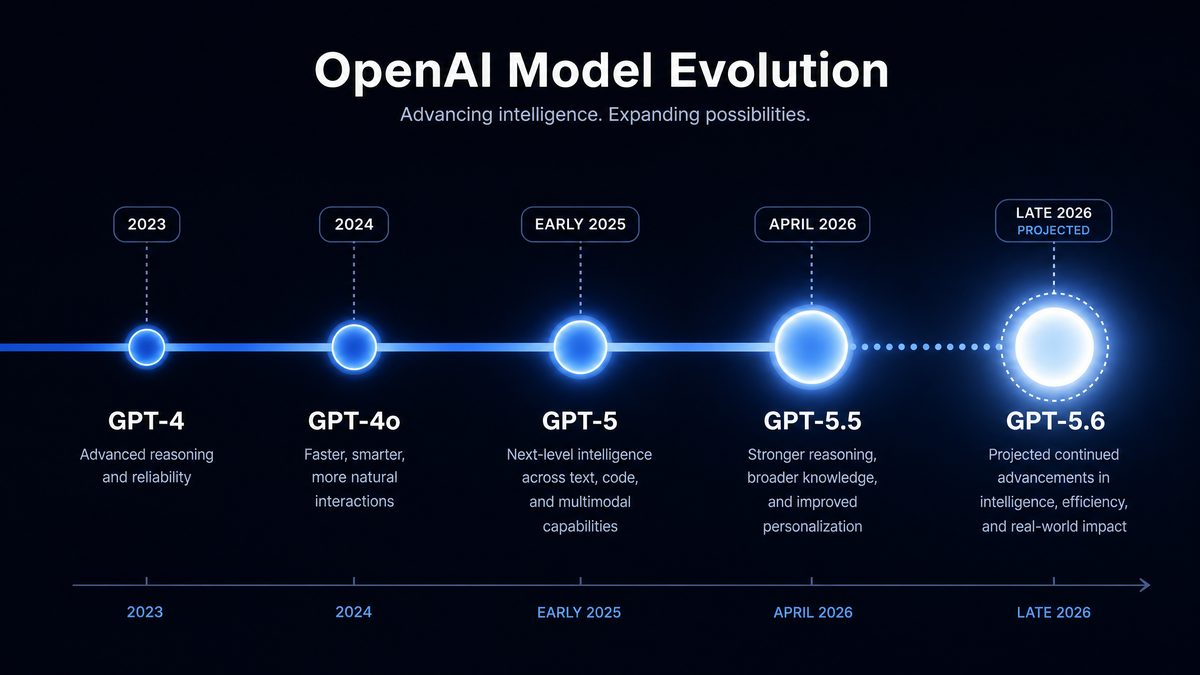
Timeline Recap: GPT-5.5’s Rollout and Its Current State
OpenAI announced GPT-5.5 on April 23, 2026, with immediate API access provided the following day. The model brought significant improvements over GPT-5.0, including enhanced context window sizes expanding from 64k tokens to 128k tokens, more nuanced reasoning capabilities, and improved multi-modal input handling. However, the rollout has been phased, with new features such as real-time memory recall and advanced prompt tuning being gradually enabled over the subsequent weeks.
As of June 2026, GPT-5.5 is largely stable in production environments but still undergoing optimizations related to latency, fine-grained control, and hallucination reduction. OpenAI has also been actively collecting developer feedback on API usage patterns, prompt engineering challenges, and real-world application performance. This feedback loop is crucial for iterative improvements expected in GPT-5.6.
GPT-5.5 Feature Rollout Timeline
| Date | Milestone | Details |
|---|---|---|
| April 23, 2026 | Announcement | Public launch of GPT-5.5 with core API access |
| April 24, 2026 | API Release | API endpoints activated for developers |
| May 10, 2026 | Context Window Expansion | 128k token context support enabled |
| May 25, 2026 | Real-Time Memory Beta | Selective memory recall for chat sessions introduced |
| June 5, 2026 | Prompt Tuning Enhancements | Advanced prompt control features rolled out |
What We Know: Leaks, Hiring Patterns, and Research Signals
While OpenAI maintains strict confidentiality around its roadmap, a confluence of signals points to GPT-5.6’s development trajectory. Several AI researchers connected to OpenAI have published preprints and conference abstracts hinting at architectural experiments and optimization techniques likely to underpin GPT-5.6. These include advancements in sparse attention mechanisms and hybrid symbolic-neural reasoning modules.
Moreover, OpenAI’s hiring activity over the past quarter reveals a surge in roles focused on model scalability, robustness, and safety engineering – areas critical for a next-gen model release. Job listings emphasize expertise in distributed training at trillion-parameter scale, reinforcement learning from human feedback (RLHF) refinement, and system-level latency optimization. This suggests GPT-5.6 will push boundaries not only in raw model power but also in user experience and deployment efficiency.
Insider reports also mention active research on integrating more advanced multi-modal fusion techniques, potentially improving the model’s ability to jointly interpret text, images, video, and audio inputs—streamlining workflows for developers building multi-modal applications.
Predicted Capabilities: What GPT-5.6 Might Improve Over GPT-5.5
Based on available data, experts forecast several key enhancements in GPT-5.6 that could redefine AI application development:
- Extended Context Windows Beyond 128k Tokens: Early research indicates that GPT-5.6 may support context windows approaching 256k tokens, enabling more complex, long-form interactions such as full-length book summarization or extended multi-turn dialogues without loss of coherence.
- Significant Latency Reduction: Through optimized model pruning and quantization techniques, GPT-5.6 is expected to achieve 20-30% faster inference speeds at equivalent hardware cost, critical for real-time applications.
- Improved Factual Accuracy and Hallucination Mitigation: Leveraging enhanced RLHF protocols and retrieval-augmented generation, GPT-5.6 aims to reduce misinformation with better grounding in reliable data sources.
- Advanced Multi-Modal Integration: The model could seamlessly combine inputs from text, images, and audio to generate context-aware responses, a leap forward for creative AI workflows and assistive technologies.
- More Customizable Prompt Engineering: New API features may allow developers fine-grained control over tone, style, and domain expertise without requiring separate fine-tuning, reducing development overhead.
- Robustness to Adversarial Inputs: GPT-5.6 is likely to include stronger defense mechanisms against prompt injection and other security threats, reflecting OpenAI’s commitment to safe deployment.

Current GPT-5.5 Limitations That GPT-5.6 Could Address
Despite GPT-5.5’s remarkable advances, several limitations persist that GPT-5.6 is poised to tackle:
- Context Length Constraints: Although 128k tokens is a substantial increase, certain enterprise use cases—like legal document analysis or complex scientific research—demand even longer context windows.
- Latency and Cost Tradeoffs: GPT-5.5’s high computational requirements limit its use in latency-sensitive applications and cost-sensitive deployments. Developers frequently report the need for more efficient inference without compromising quality.
- Hallucinations and Factual Errors: While improved, hallucinations still occur, particularly in specialized domains lacking robust training data.
- Multi-Modal Flexibility: GPT-5.5 supports multi-modal inputs but struggles with seamless fusion and reasoning across disparate data types.
- Prompt Engineering Complexity: Achieving domain-specific behaviors often requires complex prompt architectures or costly fine-tuning, limiting accessibility for smaller teams.
- Security Vulnerabilities: Prompt injection and adversarial manipulation remain concerns, especially for enterprise deployments handling sensitive data.
OpenAI’s Accelerating Release Cadence: Analysis and Implications
OpenAI’s shift to a faster release cycle—launching GPT-5.5 less than six months after GPT-5.0, and now reportedly developing GPT-5.6 just eight weeks post GPT-5.5 announcement—reflects a strategic pivot. This acceleration likely responds to several factors:
- Competitive Pressure: With Anthropic releasing Fable 5 featuring enhanced interpretability and Google pushing Gemini 3 Pro’s multi-modal prowess, OpenAI must innovate rapidly to maintain market leadership.
- Technological Maturation: Advances in hardware, distributed training, and model optimization allow faster iteration without quality sacrifice.
- Customer Feedback Velocity: Real-time telemetry and usage analytics enable OpenAI to identify pain points and prioritize fixes more dynamically.
- Modular Architecture: OpenAI’s modular approach to model components facilitates incremental upgrades rather than monolithic releases.
However, this cadence introduces challenges. Developers and enterprises face increased pressure to continuously adapt to new APIs and capabilities, potentially raising integration complexity and technical debt. OpenAI will need to bolster its documentation, developer support, and backward compatibility guarantees to mitigate disruption.
Impact on Developers: Should You Build on GPT-5.5 or Wait?
For developers evaluating whether to commit to GPT-5.5 now or hold out for GPT-5.6, the decision hinges on several factors:
- Project Timelines: If your application requires immediate deployment or is mid-development, GPT-5.5’s stable API and feature set are reliable foundations.
- Feature Requirements: Applications demanding ultra-long context windows, real-time multi-modal fusion, or advanced hallucination mitigation might benefit from waiting for GPT-5.6.
- Budget Constraints: Early adopters of GPT-5.5 benefit from competitive pricing tiers. GPT-5.6 is likely to command premium pricing initially, reflecting increased capabilities and infrastructure costs.
- Risk Tolerance: GPT-5.5 has matured through several minor updates, while GPT-5.6, at launch, may encounter initial stability issues typical of major releases.
Developers should also consider the availability of integration tools and ecosystem support, which typically lag slightly behind model announcements. For many, a hybrid approach—starting development on GPT-5.5 while monitoring GPT-5.6 progress closely—may optimize both innovation and stability.
Enterprise Planning Considerations
Enterprises face unique challenges balancing innovation with operational risk. The rapid succession of GPT versions requires careful planning around:
- Infrastructure Scalability: Enterprises must evaluate whether existing cloud or on-premises deployments can accommodate potential increases in computational demand from GPT-5.6.
- Compliance and Security: New models often introduce changes in data handling and security postures. Rigorous validation against regulatory requirements (e.g., GDPR, HIPAA) is essential before production rollout.
- Staff Training and Change Management: IT and development teams will need ongoing training to leverage new API features effectively and manage migration workflows.
- Vendor Engagement: Enterprises should maintain close communication with OpenAI account teams to receive early access, roadmap insights, and support for hybrid deployment strategies.
- Risk Mitigation: Staging environments and phased rollouts remain best practices to minimize business disruption during transitions between GPT versions.
Strategic enterprise adoption plans may include pilot projects leveraging GPT-5.6 capabilities in non-critical workflows, preparing teams for broader deployment once stability and cost efficiency improve.
Competition Context: Anthropic Fable 5 and Google Gemini 3 Pro
OpenAI’s accelerated development cannot be divorced from the broader AI ecosystem dynamics. Anthropic’s Fable 5, released in Q1 2026, emphasizes model interpretability, ethical guardrails, and scalable alignment techniques. Its modular architecture and “constitutional AI” safety approach have attracted enterprise interest, especially among organizations prioritizing transparency.
Meanwhile, Google’s Gemini 3 Pro, launched in late 2025, pushes the envelope in multi-modal AI with seamless integration of natural language, vision, and video understanding. Gemini’s integration with Google Cloud’s infrastructure offers competitive pricing and robust developer tooling, challenging OpenAI’s market share.
The competition is catalyzing innovation but also fragmenting the AI API landscape. Developers and enterprises must evaluate tradeoffs between model capabilities, ecosystem maturity, cost, and vendor lock-in risks.
| Model | Release Date | Key Strengths | Notable Limitations | Target Use Cases |
|---|---|---|---|---|
| OpenAI GPT-5.5 | April 2026 | Large context window (128k tokens), strong multi-modal input, RLHF improvements | Latency, hallucinations, partial multi-modal fusion | Chatbots, content generation, multi-modal assistants |
| OpenAI GPT-5.6 (Upcoming) | Expected Q3 2026 | Extended context (256k tokens), faster inference, advanced hallucination mitigation, improved security | Early release stability unknown, premium pricing expected | Enterprise AI, long-form analysis, real-time multi-modal applications |
| Anthropic Fable 5 | Q1 2026 | Model interpretability, alignment, ethical safety | Limited multi-modal support, smaller ecosystem | Regulated industries, safety-critical applications |
| Google Gemini 3 Pro | Late 2025 | Multi-modal fusion, cloud integration, developer tools | Higher cost, Google ecosystem lock-in | Enterprise AI, multimedia content generation |
Expert Perspectives and Final Thoughts
Leading AI researchers and industry analysts view OpenAI’s move to develop GPT-5.6 ahead of GPT-5.5’s full maturation as a sign of the company’s aggressive innovation strategy. Dr. Lena Kim, AI strategist at FutureTech Insights, notes, “This dual-track development mirrors the fast-paced nature of AI research today. It’s a calculated risk that could pay off by locking in developer mindshare and preempting competitor advances.”
Conversely, some caution that accelerating timelines may lead to fragmentation and integration challenges. Michael Ortega, CTO of a large AI-driven enterprise, advises, “From an enterprise standpoint, stability and predictability are paramount. We recommend a cautious approach—leveraging GPT-5.5 now while preparing for GPT-5.6 through pilot programs and infrastructure scaling.”
Ultimately, OpenAI’s next steps will be pivotal in shaping the AI development ecosystem’s rhythm. Developers and enterprises must stay informed, weigh tradeoffs, and align their AI strategies with their risk tolerance and innovation goals.
For more insights on optimizing AI model adoption and the evolving GPT landscape, explore our deep dives on
For professionals looking to maximize their AI productivity, our comprehensive guide on 50 GPT-5.5 Prompts for Startup Founders: Pitch Decks, Business Plans, Fundraising, and Growth Strategy provides dozens of tested, production-ready prompts that deliver consistent results across complex workflows and real-world business scenarios.
,
Developers seeking hands-on implementation guidance will find our detailed walkthrough on The Death of $29/Month AI Coding: How Token-Based Billing Is Reshaping Developer Tools in 2026 invaluable for understanding the complete setup process, configuration options, and best practices for production deployment.
, and
Developers seeking hands-on implementation guidance will find our detailed walkthrough on Wix + OpenAI Codex Enterprise: Complete Guide to Building AI-Powered E-Commerce Sites invaluable for understanding the complete setup process, configuration options, and best practices for production deployment.
Deep Dive: Architectural Innovations Likely Powering GPT-5.6
One of the most intriguing aspects of GPT-5.6’s anticipated release is the underlying architectural innovations that promise to elevate performance and versatility. Industry insiders and recent OpenAI-affiliated research papers hint at the incorporation of advanced sparse attention mechanisms. These mechanisms selectively focus computational resources on the most relevant parts of the input, enabling the model to efficiently process ultra-long context windows without linearly increasing compute costs. Sparse attention variants such as block sparse, sliding window, and global attention layers are expected to be combined in novel ways optimized for multi-modal fusion.
Another promising enhancement is the integration of hybrid symbolic-neural reasoning modules. Unlike purely neural architectures, these hybrid models incorporate symbolic logic components that can perform explicit reasoning steps, improving explainability and reducing hallucination rates. This approach enables GPT-5.6 to better handle tasks requiring step-by-step inference, such as mathematical problem solving or complex code generation. Early experiments have shown that coupling neural language models with symbolic modules can significantly enhance accuracy in domain-specific applications.
Furthermore, GPT-5.6’s training regimen is expected to employ a more sophisticated curriculum learning strategy, gradually increasing task complexity and multi-modal integration during training. This technique helps the model generalize better and reduces catastrophic forgetting when adapting to new modalities or languages. Collectively, these architectural and training innovations position GPT-5.6 as a more efficient, reliable, and versatile AI foundation model.
Practical Implementation: Preparing Your Applications for GPT-5.6
Developers and businesses looking to leverage GPT-5.6’s new features will need to adapt their AI integration strategies accordingly. One of the most impactful changes is the anticipated doubling of context window size to approximately 256k tokens. Applications such as legal document review platforms, scientific literature summarizers, and long-form content generation tools will benefit immensely. For instance, a legal AI tool could ingest entire case files, statutes, and precedent documents in a single query, dramatically improving the quality of analysis and reducing the need for external memory management.
To illustrate, here is a simplified Python snippet demonstrating how an expanded context window might be utilized in future OpenAI API calls (assuming API support for 256k tokens):
import openai

response = openai.ChatCompletion.create(
    model="gpt-5.6",
    messages=[
        {"role": "system", "content": "You are a legal assistant."},
        {"role": "user", "content": "Analyze the following 200-page contract and summarize key obligations."},
        {"role": "user", "content": contract_text}  # contract_text contains the full contract document
    ],
    max_tokens=2048
)

print(response.choices[0].message.content)
In addition to handling larger inputs, GPT-5.6’s improved latency and inference speed will be critical for real-time applications such as customer service chatbots and interactive tutoring systems. Developers should plan to benchmark their existing applications against GPT-5.6’s API once available, measuring response times and cost implications. Adjustments in request batching, prompt engineering, and caching strategies may be necessary to fully capitalize on the speed improvements.
Security-wise, GPT-5.6’s enhanced robustness against prompt injection attacks means enterprises can deploy AI-powered systems in sensitive environments with greater confidence. However, developers should continue implementing layered security measures, including input sanitization, user authentication, and monitoring for anomalous query patterns.
GPT-5.6 and the Future of Multi-Modal AI Applications
Multi-modal AI—the ability to process and generate content across text, images, audio, and video—is rapidly becoming a cornerstone of intelligent applications. GPT-5.6 is expected to push the envelope by delivering much tighter integration across these modalities, surpassing GPT-5.5’s foundational multi-modal support.
Access 40,000+ AI Prompts for ChatGPT, Claude & Codex — Free!
Subscribe to get instant access to our complete Notion Prompt Library — the largest curated collection of prompts for ChatGPT, Claude, OpenAI Codex, and other leading AI models. Optimized for real-world workflows across coding, research, content creation, and business.
One anticipated breakthrough is the development of a unified embedding space that allows the model to reason jointly about text, images, and audio inputs with minimal modality-specific preprocessing. This will enable applications such as video content summarization combined with real-time audio transcription and contextual commentary generation, all within a single API call.
For example, consider a content creation platform that ingests a lecture video, extracting spoken words via audio processing, analyzing slide images, and generating a detailed summary with action items and follow-up questions. GPT-5.6’s advanced multi-modal capabilities will streamline this process, eliminating the need for separate pipelines and reducing latency.
From a developer perspective, OpenAI is likely to introduce new API endpoints or parameters enabling direct multi-modal input submission, along with fine-grained control over modality weighting and fusion strategies. This will empower creators to tailor AI responses to specific contexts, such as emphasizing visual elements in design workflows or prioritizing audio cues in accessibility tools.
Incorporating GPT-5.6 into existing multi-modal projects will require revisiting data pipelines, model invocation patterns, and UX design to fully leverage integrated contextual understanding. Organizations that invest early in adapting to these new capabilities will gain a competitive edge in delivering immersive, intelligent user experiences.
Optimizing Cost and Performance with GPT-5.6: Strategies for Enterprises
With GPT-5.6’s expected improvements in model size, context length, and inference speed, enterprises must proactively develop cost optimization strategies to maximize ROI while managing computational expenses. One effective approach is dynamic scaling of model features based on application context. For example, enterprises could configure their systems to switch between standard and “extended context” modes depending on the complexity of user queries, thereby balancing cost and performance.
Another strategy involves leveraging GPT-5.6’s anticipated support for quantized and pruned model variants. By intelligently routing less critical or bulk processing tasks to lower-precision or smaller model instances, organizations can reduce cloud compute costs without sacrificing accuracy where it matters most. This requires sophisticated orchestration layers capable of real-time model selection and load balancing.
Enterprises should also invest in analytics and monitoring to identify usage patterns, peak demand periods, and inefficiencies in prompt design. Optimizing prompts to reduce token usage and implementing caching for repetitive queries can yield significant cost savings. Additionally, integrating GPT-5.6 with edge computing resources where possible may reduce latency and bandwidth costs for global deployments.
Finally, negotiating volume-based pricing and custom SLAs with OpenAI will be critical for enterprise users aiming for predictable expenditure. Early engagement with OpenAI’s sales and technical teams can unlock tailored solutions including hybrid on-prem/cloud models, reserved capacity, and dedicated support, all of which contribute to sustainable scaling of AI initiatives.
Integrating GPT-5.6 into Regulated Industries: Compliance and Ethical Considerations
As GPT-5.6 promises enhanced capabilities and wider adoption, its integration into regulated sectors such as healthcare, finance, and government demands rigorous compliance and ethical frameworks. The expanded context window and multi-modal reasoning open new possibilities for applications ranging from medical diagnosis support to financial risk analysis, but also amplify risks related to data privacy, bias, and accountability.
Enterprises must establish rigorous data governance policies ensuring that sensitive information processed by GPT-5.6 meets all applicable regulations, including GDPR, HIPAA, and industry-specific standards. This entails end-to-end encryption, access controls, and audit trails for AI-generated decisions. Using GPT-5.6’s anticipated improved explainability features—stemming from hybrid symbolic-neural reasoning—can aid in producing transparent AI outputs that satisfy regulatory scrutiny.
Addressing ethical concerns includes proactively mitigating bias through diverse training data and continuous fairness evaluations. GPT-5.6’s modular design may allow fine-grained control over output behavior, enabling compliance teams to enforce domain-specific ethical guidelines and filter inappropriate content dynamically.
Moreover, organizations should implement robust human-in-the-loop workflows where critical decisions are reviewed by qualified professionals, ensuring AI augments rather than replaces human judgment. Training staff on the capabilities and limitations of GPT-5.6, combined with clear user communication, fosters trust and responsible AI adoption.
Finally, collaborating with OpenAI on compliance certification programs and participating in industry consortia for AI governance will position enterprises to leverage GPT-5.6’s innovations while maintaining the highest standards of ethical AI deployment.
