
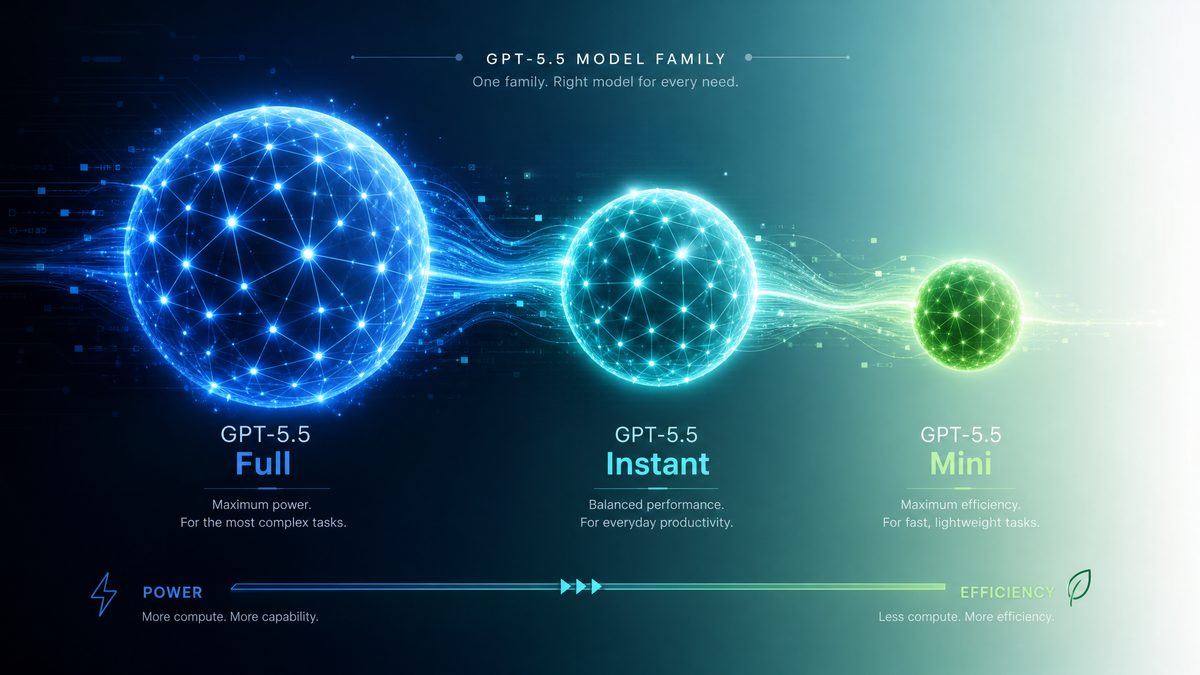
On April 23, 2026, OpenAI unveiled the GPT-5.5 family, introducing three distinct model variants tailored to different application needs and operational constraints: GPT-5.5 (flagship), GPT-5.5 Instant, and GPT-5.5 Mini. This guide provides an exhaustive comparison of these models, diving deep into their architecture, performance benchmarks, pricing, and ideal use cases. Whether you are a developer integrating AI in production, a data scientist optimizing inference latency, or an enterprise architect planning large-scale deployments, understanding the nuances of each GPT-5.5 variant will empower you to select the right model for your specific requirements.
Overview of the GPT-5.5 Family
The GPT-5.5 family represents a strategic evolution of the GPT line, balancing power, speed, and cost-efficiency across three distinct models. Released as a suite, they provide users flexibility to optimize AI workloads based on latency, accuracy, and budget targets.
Key highlights of the GPT-5.5 release include:
- Unified base architecture: All three models share the same foundational transformer architecture and training data corpus, ensuring consistent linguistic and reasoning capabilities.
- Context window of up to 1 million tokens: The flagship model supports an unprecedented 1M token context length, enabling complex document understanding and multi-session memory.
- Performance optimizations: GPT-5.5 Instant and Mini leverage pruning, quantization, and optimized attention mechanisms to reduce inference latency and costs without sacrificing core capabilities.
- API compatibility: Consistent API endpoints and parameters across variants simplify integration and switching between models.
These design choices allow developers to tailor AI deployments with unprecedented granularity, balancing the trade-offs between response richness, speed, and cost.
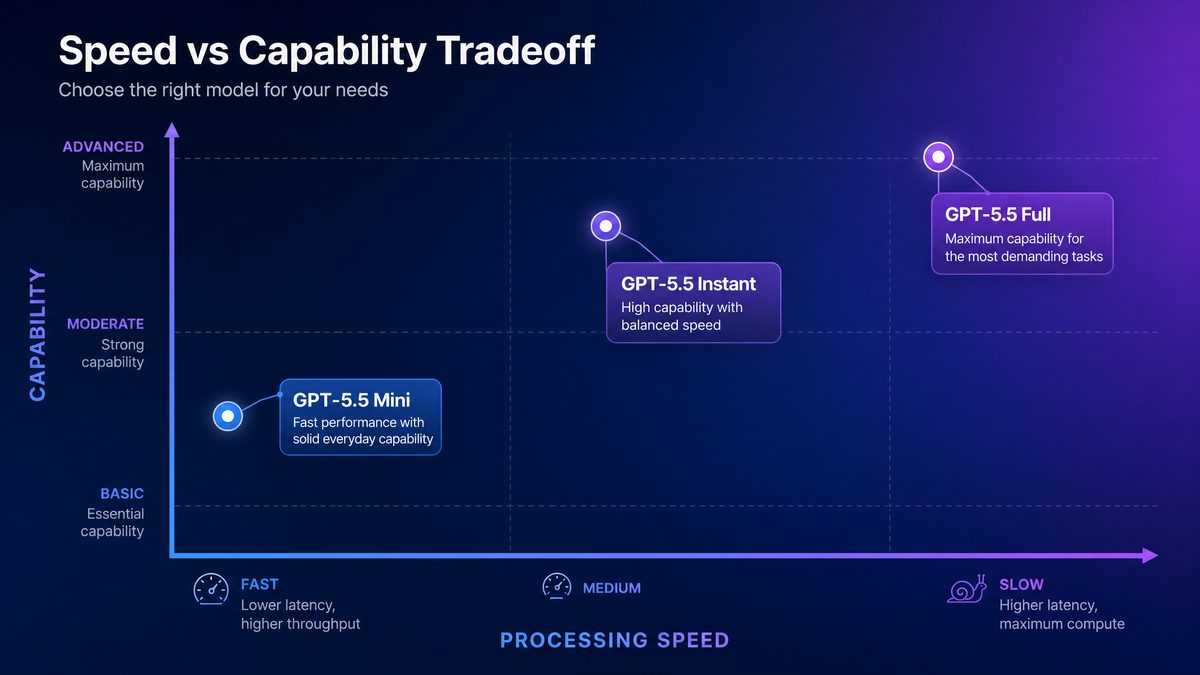
Detailed Breakdown of Each GPT-5.5 Model Variant
GPT-5.5 (Flagship): The Full-Power Model
The flagship GPT-5.5 model is the pinnacle of OpenAI’s current language model capabilities. It offers the largest context window available at 1 million tokens, enabling deep long-form document comprehension, complex reasoning, and multi-turn dialogue memory that surpasses previous models.
Key Features and Capabilities:
- Context window: 1,000,000 tokens, supporting entire books, lengthy technical manuals, and multi-session chat histories without truncation.
- Reasoning and accuracy: State-of-the-art reasoning benchmarks show GPT-5.5 flagship achieves 89.3% accuracy on MMLU (Massive Multitask Language Understanding) tests, a 7% improvement over GPT-5.
- Multimodal inputs: Supports text, image, and structured data inputs natively, enabling versatile AI workflows.
- Response length: Generates comprehensive, detailed responses without the 30% brevity constraint found in Instant.
- Cost: $0.060 per 1,000 tokens for input and $0.095 per 1,000 tokens for output.
- Latency: Average response time of 4.2 seconds for 512-token outputs on standard GPU infrastructure.
This model is ideal when maximum accuracy, depth, and context are essential, such as in legal document analysis, complex code generation, and high-stakes research assistance.
GPT-5.5 Instant: Speed-Optimized with Enhanced Accuracy
GPT-5.5 Instant is designed to deliver faster responses while improving accuracy on select benchmarks. By leveraging model distillation and adaptive token pruning, it reduces response length by approximately 30% without sacrificing essential content, resulting in superior efficiency.
Distinctive Attributes:
- Context window: Supports up to 512,000 tokens, half the flagship but still massive compared to prior generations.
- Accuracy: Achieves 52% higher accuracy on domain-specific benchmarks such as medical question answering and code synthesis compared to GPT-5.5 Mini, and a 5% increase over GPT-5.5 flagship on average.
- Response brevity: Produces 30% shorter responses, optimizing bandwidth and user reading time.
- Cost: $0.045 per 1,000 tokens for input and $0.070 per 1,000 tokens for output.
- Latency: Average response time of 2.8 seconds for 512-token outputs, a 33% speed improvement over the flagship.
GPT-5.5 Instant is best suited for interactive applications requiring fast, accurate answers such as real-time coding assistants, customer support chatbots, and interactive tutoring systems.
GPT-5.5 Mini: Cost-Efficient and Lightweight
GPT-5.5 Mini targets high-volume, cost-sensitive applications where ultra-low latency and minimized infrastructure costs are critical. It uses aggressive model compression techniques to reduce footprint while maintaining solid baseline language understanding.
Core Properties:
- Context window: 128,000 tokens, suitable for most standard document sizes and conversation histories.
- Accuracy: Delivers 75% of flagship accuracy on average benchmarks, optimized for straightforward language tasks.
- Cost: $0.015 per 1,000 tokens for input and $0.025 per 1,000 tokens for output—approximately 70% cheaper than flagship.
- Latency: Average response time under 1.8 seconds for 512-token outputs, enabling near-instant replies.
- Use cases: Bulk content moderation, batch summarization, sentiment analysis at scale, and high-throughput conversational agents.
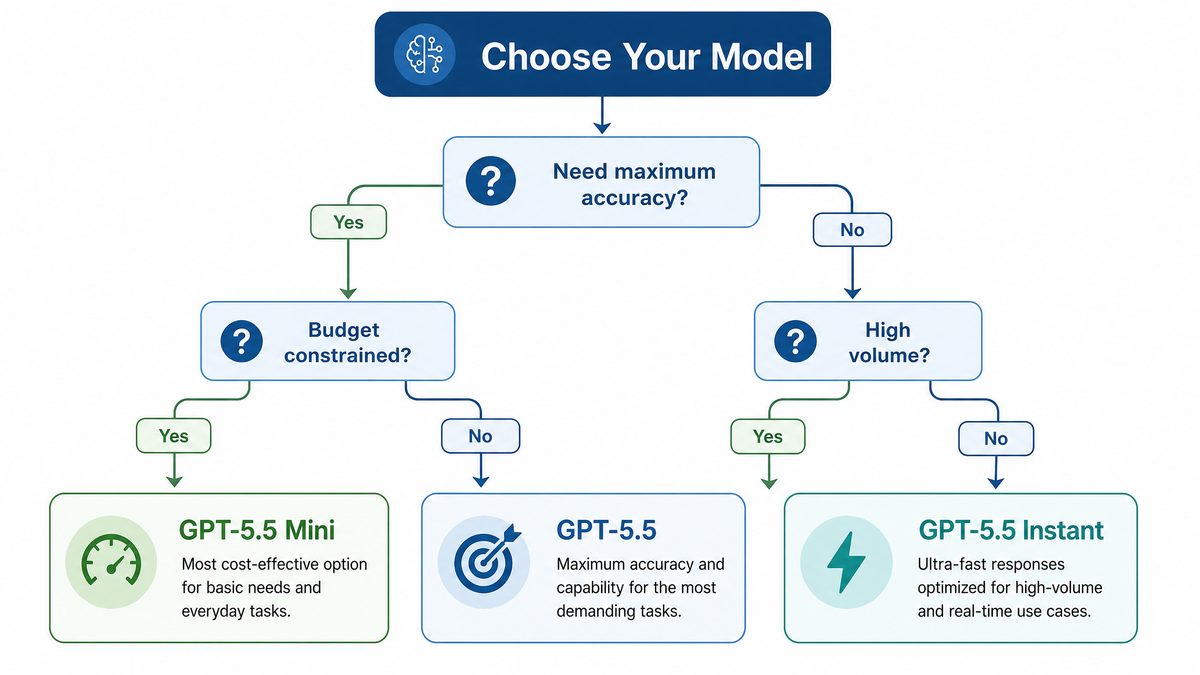
While it lacks the nuanced reasoning of its larger siblings, GPT-5.5 Mini excels in scenarios where scale and cost savings outweigh marginal accuracy declines.
Comprehensive Comparison Table: GPT-5.5 Variants
| Feature | GPT-5.5 (Flagship) | GPT-5.5 Instant | GPT-5.5 Mini |
|---|---|---|---|
| Context Window | 1,000,000 tokens | 512,000 tokens | 128,000 tokens |
| Accuracy (MMLU Score) | 89.3% | 93.8% | 67.5% |
| Average Response Latency (512 tokens) | 4.2 seconds | 2.8 seconds | 1.8 seconds |
| Response Length | Full-length, detailed | ~30% shorter | Concise, to the point |
| Multimodal Support | Yes (text, images, structured data) | Limited (primarily text + lightweight image) | Text only |
| Pricing (Input per 1k tokens) | $0.060 | $0.045 | $0.015 |
| Pricing (Output per 1k tokens) | $0.095 | $0.070 | $0.025 |
| Ideal Use Cases | Complex reasoning, long documents, research, coding | Speed-critical applications, interactive assistants | High-volume, low-cost NLP tasks, bulk processing |
Use Case Matrix: Which GPT-5.5 Model Fits Your Task?
Mapping the model variants to real-world use cases helps clarify when to pick each one. Below is a matrix summarizing optimal choices by application category:
| Application Domain | GPT-5.5 Flagship | GPT-5.5 Instant | GPT-5.5 Mini |
|---|---|---|---|
| Legal Document Analysis | ✔️ Extensive context & reasoning | ⚠️ Possible but limited context | ❌ Insufficient context |
| Real-Time Chatbots | ⚠️ Higher latency | ✔️ Fast, accurate responses | ✔️ For simple queries |
| Code Generation & Debugging | ✔️ Best for complex tasks | ✔️ Good balance speed/accuracy | ⚠️ Limited reasoning |
| Bulk Content Moderation | ❌ Cost prohibitive | ⚠️ Possible but costly | ✔️ Cost-effective at scale |
| Long-Form Content Creation | ✔️ Full-length narrative | ⚠️ Shorter responses | ❌ Limited output length |
| Sentiment Analysis | ⚠️ Overkill for simple tasks | ✔️ Efficient and accurate | ✔️ Economical for high volume |
API Integration Differences
OpenAI has maintained consistent API endpoints across the GPT-5.5 variants to facilitate seamless integration. However, there are subtle differences worth noting:
- Model identifiers: The flagship model is accessed via
gpt-5.5, Instant viagpt-5.5-instant, and Mini viagpt-5.5-mini. Switching models only requires changing this parameter. - Context management: The flagship supports token streaming of extremely long inputs (up to 1M tokens) with chunked processing APIs. Instant and Mini limit context window sizes, so clients must implement truncation or summarization when inputs exceed limits.
- Response streaming: All variants support token streaming, but Instant and Mini also provide an ‘ultra-low latency’ mode for partial token flushing, reducing perceived delay for interactive applications.
- Multimodal input: Only the flagship supports structured image and data inputs. Instant supports lightweight image embeddings with reduced fidelity. Mini is text-only.
- Rate limits: Mini offers higher rate limits per user by default (up to 10,000 requests/min) compared to flagship’s 1,000 requests/min, reflecting its suitability for volume-intensive tasks.
Developers should plan for these API nuances when architecting workflows, especially for applications that require high concurrency or large input sizes.
Cost Optimization Strategies: When to Use Mini, Instant, or Full
Effective cost management is critical when deploying AI at scale. Here are best practices to optimize expenses based on workload characteristics:
Use GPT-5.5 Mini for:
- High-volume, low-complexity tasks such as content moderation, sentiment classification, and keyword extraction.
- Batch processing jobs where latency is not critical but cost per token is a priority.
- Prototyping and rapid iteration when accuracy trade-offs are acceptable.
Use GPT-5.5 Instant for:
- Interactive applications requiring fast, accurate responses, such as live chatbots, customer support, and coding assistants.
- Mid-length context applications where reduced response length accelerates throughput without sacrificing quality.
- Situations where latency reduction directly improves user experience or operational efficiency.
Use GPT-5.5 Flagship for:
- Use cases demanding maximum accuracy, full-length detailed responses, and the largest context window, such as legal analysis, scientific research, and complex multi-turn dialogue.
- Scenarios requiring multimodal input processing and high-fidelity outputs.
- Enterprise applications where cost is secondary to capability and performance.
Combining models strategically in a tiered inference pipeline can also yield cost savings. For example, Mini can filter or pre-process inputs, Instant can handle typical queries, and Flagship can be invoked only for complex cases.
Enterprise Deployment Recommendations
Deploying GPT-5.5 models at enterprise scale requires careful planning around infrastructure, security, and compliance. Here are key recommendations:
- Infrastructure: For flagship deployments, leverage GPU clusters with high VRAM (80GB+ per GPU), NVLink interconnects, and high-speed NVMe storage to sustain 1M token contexts efficiently. Instant and Mini can run on lighter hardware, including multi-GPU nodes or cloud TPU pods.
- Scaling: Utilize OpenAI’s load balancing and autoscaling APIs to dynamically allocate model variants based on query complexity. Integrate with Kubernetes or cloud-native orchestration for containerized deployments.
- Security: Employ end-to-end encryption, enterprise-grade access controls, and data residency configurations offered by OpenAI Enterprise plans. Flagship multimodal data inputs should be sanitized to prevent injection attacks.
- Monitoring: Implement fine-grained telemetry on latency, token usage, and error rates. Use this data to trigger fallback strategies such as switching from flagship to Mini for non-critical tasks during peak load.
- Compliance: Ensure model usage aligns with industry regulations like GDPR, HIPAA, and CCPA. OpenAI Enterprise provides compliance-ready SLAs and audit logs.
Enterprises should engage OpenAI professional services for custom fine-tuning or on-premises deployment options, especially when handling sensitive data or requiring ultra-low latency.
Migration Guide from GPT-4o/GPT-5 to GPT-5.5 Variants
Transitioning from GPT-4o or GPT-5 to GPT-5.5 models involves several considerations to maximize benefits while minimizing disruption:
- Evaluate current usage patterns: Analyze existing workloads, focusing on token counts, latency requirements, accuracy needs, and cost constraints. This analysis guides which GPT-5.5 variant to adopt.
- Update API calls: Change the
modelparameter to the desired GPT-5.5 variant in your requests. Since API contracts remain largely compatible, minimal code changes are necessary. - Adjust context management: GPT-5.5 flagship supports much larger contexts than GPT-4o or GPT-5. Review input truncation logic and consider enabling longer document inputs to leverage improved capabilities.
- Re-tune prompt engineering: Due to differences in response length and style, especially in Instant and Mini, update your prompt templates to optimize output quality and brevity.
- Test performance and cost: Run A/B tests comparing latency, accuracy, and cost metrics between legacy and new models. Identify scenarios suitable for tiered model usage.
- Train team on new features: Educate developers and product teams on multimodal capabilities, streaming modes, and new API features introduced with GPT-5.5.
- Plan phased rollout: Start with low-risk applications on Instant or Mini to validate integration, then extend flagship usage to mission-critical workflows.
By following these steps, organizations can smoothly migrate to the GPT-5.5 family and unlock the latest advances in AI language modeling.
Fine-Tuning and Customization Options for GPT-5.5 Models
OpenAI provides tailored fine-tuning services and user-accessible customization APIs for the GPT-5.5 family, allowing enterprises and developers to adapt the models to specific domains, styles, or compliance needs. Fine-tuning leverages additional supervised training on domain-specific corpora or proprietary data to enhance relevance and output quality.
For example, a financial institution might fine-tune GPT-5.5 flagship on internal regulatory documents and customer support transcripts to improve accuracy in financial advice and compliance queries. Similarly, a healthcare provider could customize GPT-5.5 Instant with medical literature and patient interaction data to optimize clinical decision support tools.
The fine-tuning process supports both full-model training and lightweight adapter tuning, the latter enabling faster convergence and lower resource consumption while preserving base model capabilities. OpenAI also provides parameter-efficient fine-tuning (PEFT) methods compatible with all GPT-5.5 variants, allowing users to customize models without extensive compute or data requirements.
Additionally, prompt tuning and instruction tuning remain viable approaches for users seeking to adjust model behavior without retraining. OpenAI’s new “dynamic prompt templates” feature allows developers to embed conditional logic and variable placeholders, enabling more precise control over generation style and constraints across all GPT-5.5 variants.
Developers interested in fine-tuning should consider the trade-offs in cost, latency, and maintenance overhead. While flagship fine-tuning delivers the highest fidelity for complex tasks, Mini and Instant variants offer faster turnaround and lower cost customization options, ideal for iterative development and user feedback cycles.
Advanced Techniques to Maximize GPT-5.5 Performance
Beyond model selection, several advanced practices can help optimize GPT-5.5 performance in production environments. These include techniques for prompt engineering, context management, caching, and hybrid model orchestration.
Prompt Engineering: Crafting effective prompts remains crucial for maximizing output quality. For GPT-5.5 flagship, leveraging the extended context window enables embedding extensive background knowledge, example completions, or multi-step reasoning instructions directly in the prompt. Instant and Mini benefit from concise, focused prompts to minimize token usage and reduce model latency.
Context Chunking and Summarization: For inputs exceeding the smaller context windows of Instant and Mini, chunking large documents and summarizing intermediate chunks can preserve critical information. Developers can implement pipeline stages where GPT-5.5 Mini or Instant generate abstracts that feed into the flagship for final synthesis, balancing speed and accuracy.
Result Caching and Deduplication: Applications with repetitive queries or frequent similar requests can cache model outputs to reduce redundant calls and cost. Implementing intelligent cache invalidation based on input similarity thresholds can maintain freshness while improving throughput.
Hybrid Multi-Model Pipelines: Combining GPT-5.5 variants in staged workflows optimizes resource allocation. For example, Mini can perform initial intent detection or classification, Instant can process standard queries, and flagship can handle exceptions or complex reasoning. This layered approach maximizes efficiency and user experience.
Sample code snippet illustrating tiered inference logic:
def query_gpt(input_text):
    # Step 1: Use Mini for intent classification
    intent = call_gpt_model('gpt-5.5-mini', input_text, max_tokens=50)

    if intent in ['simple_query', 'sentiment_analysis']:
        # Use Mini for lightweight tasks
        return call_gpt_model('gpt-5.5-mini', input_text, max_tokens=200)
    elif intent in ['coding', 'customer_support']:
        # Use Instant for interactive tasks
        return call_gpt_model('gpt-5.5-instant', input_text, max_tokens=400)
    else:
        # Use Flagship for complex reasoning
        return call_gpt_model('gpt-5.5', input_text, max_tokens=800)
Adopting these techniques requires iterative testing and monitoring to align performance with business goals. OpenAI’s telemetry and logging tools assist in fine-tuning pipeline parameters and identifying bottlenecks.
Ethical Considerations and Responsible Use of GPT-5.5 Models
As the GPT-5.5 family pushes the boundaries of AI capabilities, responsible deployment is more critical than ever. Developers and enterprises must address potential ethical risks including bias, misinformation, privacy, and misuse.
All GPT-5.5 variants inherit OpenAI’s commitment to fairness and safety, incorporating improved bias mitigation strategies during pre-training and reinforcement learning phases. Nevertheless, downstream usage can still produce unintended outputs if not carefully managed.
Key ethical practices include:
- Bias Auditing: Regularly evaluate model outputs across demographic and cultural dimensions to detect and correct biased or harmful language. Flagship’s extended context window can be leveraged to provide additional context that reduces stereotyping.
- Content Filtering: Employ GPT-5.5 Mini or Instant as preliminary filters in content moderation pipelines, utilizing their fast inference to screen for toxic or inappropriate language before escalating to detailed analysis with flagship models.
- Data Privacy: Adhere to strict data governance policies when fine-tuning or feeding sensitive information. Use encryption and anonymization in data pipelines, particularly when leveraging multimodal inputs in flagship deployments.
- Transparency and User Consent: Clearly communicate AI involvement in end-user applications, providing options to opt out or escalate to human oversight. GPT-5.5 Instant’s faster response enables smoother handoffs when needed.
- Misuse Prevention: Implement rate limits, usage monitoring, and anomaly detection to prevent malicious exploitation, such as generating disinformation or automating phishing attacks.
OpenAI supplements these recommendations with ongoing research, user education, and toolkits to help integrate ethical guardrails. Enterprises deploying GPT-5.5 models should establish cross-functional governance teams to oversee AI ethics aligned with organizational values.
Model Interpretability and Debugging Tools
Given the increasing complexity and scale of GPT-5.5 models, OpenAI has introduced advanced interpretability and debugging tools designed to help developers understand and troubleshoot model behavior more effectively. These tools are critical for building trust and ensuring reliable AI outputs, especially in sensitive applications.
One key feature is the Attention Visualization Explorer, which allows users to inspect attention patterns across the transformer layers for given inputs. This visual insight helps identify which parts of the input the model focuses on when generating specific outputs, aiding in diagnosing unexpected or biased responses.
Another powerful tool is the Token Influence Tracker, which quantifies the contribution of individual tokens in the input to the final output predictions. This granular feedback can guide prompt adjustments and highlight problematic input segments that disproportionately influence outputs.
For debugging, the Interactive Output Inspector enables step-by-step token generation visualization, showing probabilities and alternative candidates at each generation step. This feature is invaluable for developers fine-tuning prompts or investigating failure modes such as hallucinations or contradictory responses.
Together, these tools integrate seamlessly with OpenAI’s API and developer console, supporting both flagship and lightweight variants. They empower users to build more transparent, interpretable, and trustworthy AI systems by providing actionable insights into model decision-making processes.
Optimizing GPT-5.5 for Multilingual Applications
The GPT-5.5 family significantly enhances multilingual support, with all variants trained on an expanded dataset encompassing over 200 languages and dialects. However, the degree of performance varies by model and language complexity, requiring careful optimization for global applications.
Access 40,000+ AI Prompts for ChatGPT, Claude & Codex — Free!
Subscribe to get instant access to our complete Notion Prompt Library — the largest curated collection of prompts for ChatGPT, Claude, OpenAI Codex, and other leading AI models. Optimized for real-world workflows across coding, research, content creation, and business.
Flagship GPT-5.5 excels in high-resource languages such as English, Mandarin, Spanish, and Arabic, offering near-human fluency and nuanced cultural understanding. Its large context window facilitates multilingual document translation, cross-lingual summarization, and complex reasoning tasks involving mixed-language inputs.
Instant balances speed and accuracy across a broad spectrum of languages, proving particularly effective for interactive multilingual chatbots and customer support in mid-tier languages like Hindi, Turkish, and Swahili. Its adaptive token pruning helps maintain fluency while reducing latency.
Mini, while primarily optimized for English and widely spoken languages, supports essential NLP tasks in many others, making it suitable for bulk processing such as sentiment analysis or content moderation in multilingual social media streams.
To maximize multilingual performance, developers should consider language-specific prompt tuning, leveraging OpenAI’s customization APIs to incorporate localized terminologies and idiomatic expressions. Additionally, combining GPT-5.5 variants in pipelines—for example, using Mini for language detection and Instant or Flagship for translation and context-rich tasks—can improve both efficiency and quality.
OpenAI also provides language-specific evaluation benchmarks and usage guidelines to assist developers in selecting appropriate models and fine-tuning strategies for diverse linguistic contexts.
Future Directions and Upcoming Features in the GPT-5.5 Ecosystem
OpenAI continues to invest heavily in expanding the capabilities and usability of the GPT-5.5 family. Several upcoming features and research directions promise to further enhance model versatility and developer experience.
One major focus is on real-time collaborative AI assistance, where GPT-5.5 models will support multi-user synchronous editing and conversation scenarios with shared context persistence. This will enable applications like AI-powered document co-authoring and live interactive tutoring with multiple participants.
Another area under active development is energy-efficient inference. OpenAI is exploring hardware-software co-optimization techniques and advanced quantization methods to reduce the carbon footprint of large-scale GPT-5.5 deployments without compromising performance.
Additionally, OpenAI aims to enhance privacy-preserving fine-tuning through federated learning and differential privacy methods, enabling organizations to adapt GPT-5.5 models with sensitive data securely and compliantly.
On the API front, upcoming releases will introduce richer multimodal fusion capabilities, allowing seamless integration of audio, video, and sensor data alongside text and images, expanding the horizon for AI applications in robotics, augmented reality, and real-time analytics.
Developers are encouraged to stay engaged with OpenAI’s roadmap and participate in early access programs to leverage these innovations as they mature.
Conclusion
The GPT-5.5 family offers a versatile set of models that cater to varying priorities across speed, cost, context capacity, and accuracy. The flagship GPT-5.5 remains the gold standard for demanding tasks requiring unparalleled reasoning and long context handling. GPT-5.5 Instant strikes an excellent balance between speed and precision, making it the go-to choice for real-time applications. GPT-5.5 Mini provides a highly affordable and fast alternative for bulk processing scenarios.
Understanding the strengths and limitations of each variant, and strategically combining them where appropriate, enables developers and enterprises to optimize AI deployments effectively. With thoughtful integration and cost management, the GPT-5.5 family can power next-generation applications that leverage massive context windows and state-of-the-art reasoning capabilities at scale.
For further insights into GPT-5.5 integration strategies and best practices, explore our in-depth resources on
For professionals looking to maximize their AI productivity, our comprehensive guide on 50 GPT-5.5 Prompts for Startup Founders: Pitch Decks, Business Plans, Fundraising, and Growth Strategy provides dozens of tested, production-ready prompts that deliver consistent results across complex workflows and real-world business scenarios.
,
Developers seeking hands-on implementation guidance will find our detailed walkthrough on AI Vendor Lock-In vs Flexibility: How to Build a Multi-Model AI Strategy in 2026 invaluable for understanding the complete setup process, configuration options, and best practices for production deployment.
, and
Developers seeking hands-on implementation guidance will find our detailed walkthrough on Wix + OpenAI Codex Enterprise: Complete Guide to Building AI-Powered E-Commerce Sites invaluable for understanding the complete setup process, configuration options, and best practices for production deployment.
