
Codex Security Masterclass: 30 Production-Ready Prompts for Automated Vulnerability Scanning, Patch Generation, and Security Code Review
Introduction: Unlocking the power of the Codex Security plugin
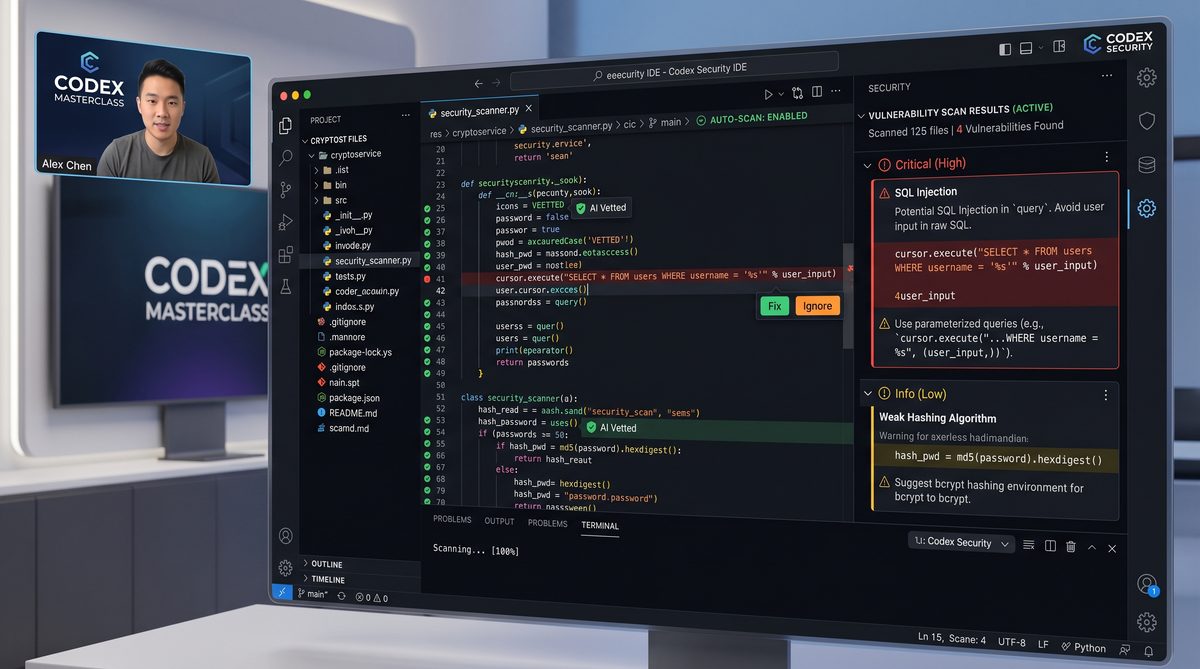
The Codex Security plugin is a programmable engine designed to accelerate and standardize software security operations across a development workflow. It leverages large language models and repository-aware static analysis to automate the discovery, triage, and remediation of vulnerabilities. In production environments, teams need deterministic, auditable, and repeatable prompts and workflows. This masterclass presents 30 production-ready prompts organized into three functional categories—repository-wide scanning and triage, reachability analysis and attack path tracing, and automated patch generation and verification—followed by guidance on chaining them into end-to-end workflows.
This document is designed for security engineers, SREs, DevSecOps practitioners, and platform engineers who will embed these prompts into automation pipelines. Each prompt is accompanied by:
- A concise prompt template ready for the Codex Security plugin
- Input and context expectations
- Expected outputs and schema examples (JSON where applicable)
- Validation and verification strategies
- Operational considerations (performance, noise, false positives)
Throughout the guide we assume the Codex Security plugin has access to the repository (code, dependency manifests, CI configs), an SBOM or package graph, and runtime configuration information (environment variables, feature flags). When integrating with CI systems or orchestration layers, supply the plugin with explicit commit SHAs, pull request numbers, and pipeline metadata. Where reachable, include runtime traces, logs, and CI artifacts for more precise analysis.
Note: This masterclass includes prescriptive prompt phrasing and operational best practices. Use them as a blueprint but validate and tune thresholds for your environment to avoid scanning noise and to align with organizational policies.
Category 1: Repository-Wide Scanning and Triage (Prompts 1-10)
This category contains prompts to perform comprehensive, repository-scoped analysis: detect potential vulnerabilities, quantify risk, produce triage reports, and prepare prioritized worklists for remediation teams. These prompts are the critical first step in any automated security workflow.
Overview and operational model
Repository-wide scanning must balance breadth and depth. The Codex Security plugin should apply lightweight, deterministic rules first (fast path) and then escalate to heavier analyses (deep path). Fast path rules include pattern-based findings (e.g., hard-coded secrets, dangerous deserialization), insecure configuration detection, and dependency vulnerability matching. Deep path analysis involves cross-file taint analysis, semantic vulnerability detection, and supply-chain verification across vendor manifests.
Each prompt below is numbered and includes a sample “Prompt Template”, “Inputs”, “Expected Outputs”, and “Verification / Triage Steps”. The prompt templates are designed for direct use with the plugin—replace placeholders with repository-specific values (e.g., {{commit_sha}}, {{repo_root}}).
Prompt 1 — Repository Snapshot and Metadata Extraction
Purpose: Create a canonical snapshot of the repository and extract metadata that will seed subsequent analyses: language breakdown, build systems, dependency manifests, Dockerfiles, CI workflows, and binary artifacts.
Prompt Template:
"Given the repository at {{repo_root}} and commit {{commit_sha}}, enumerate:
- Top-level languages and directories.
- All dependency manifests (package.json, requirements.txt, go.mod, etc.) and their paths.
- CI configuration files and Dockerfiles.
- Any precompiled binaries or third-party modules.
Return a JSON structure with fields: languages, manifests, dockerfiles, ci_files, binaries, build_systems."
Inputs: repository path, commit SHA
Expected Output (JSON):
{
  "languages": ["TypeScript", "Go", "Python"],
  "manifests": [{"path":"./package.json","type":"npm"}, ...],
  "dockerfiles": ["./Dockerfile", "./services/api/Dockerfile"],
  "ci_files": ["./.github/workflows/ci.yml"],
  "binaries": [],
  "build_systems": ["npm", "go"]
}
Verification: Ensure all known manifest types are present; cross-check file counts. Use this output to scope further prompts.
Prompt 2 — Fast Path Pattern-Based Vulnerability Scan
Purpose: Execute a fast, high-recall scan for common, high-risk patterns (credentials in code, unsafe shell calls, weak crypto, insecure deserialization markers).
Prompt Template:
"Scan all source files identified in the snapshot for high-risk patterns:
- Hard-coded secrets (API keys, tokens, private keys).
- Use of 'eval' or 'exec' with untrusted input.
- Shell command construction via string concatenation.
- Use of weak crypto (MD5, RC4).
For each finding, return: file_path, line_range, pattern_type, code_snippet, confidence (low/med/high)."
Inputs: Files list from Prompt 1
Expected Output: List of findings with contextual snippets and regex-matched evidence.
Operational tips: Incorporate allowlists for frequently used non-sensitive patterns (e.g., test tokens in fixtures) and an initial suppression list derived from historical false positives.
Prompt 3 — Dependency Vulnerability Cross-Reference
Purpose: Identify known CVEs in project dependencies by mapping the manifest data to a vulnerability database (e.g., NVD, OSV, internal DB).
Prompt Template:
"Using the dependency manifests extracted, produce a dependency tree and cross-reference each package version with known vulnerabilities. Output:
- package_name
- version
- dependency_path (top-level -> ... -> package)
- linked_vulnerabilities: [{cve_id, description, severity, cvss_score, fixed_versions}]
Return JSON sorted by severity and exposure risk (is this dependency used in production code?)."
Inputs: manifests, optional SBOM or package-lock
Expected Output: Structured vulnerability list with fix versions when available.
Prompt 4 — Cross-File Taint Seeding
Purpose: Seed variables and data flows that are likely to be tainted based on input sources (HTTP params, file uploads, environment variables). This prepares the static analyzer for cross-file taint propagation.
Prompt Template:
"Identify potentially tainted sources across the repository (e.g., request parameters, os.environ access, CLI args). For each source, provide:
- identifier (variable name or function)
- file path and line of definition
- typical sanitization functions (if any)
Return a JSON array of taint seeds."
Expected Output: Taint seed list that downstream prompts will use to follow propagation paths.
Prompt 5 — Contextual Severity Scoring and Prioritization
Purpose: Apply a contextual scoring model: combine CVSS, exploitability (public PoC known), reachability from Prompt 4, and business impact (service owner, data sensitivity) to produce a prioritized list of issues.
Prompt Template:
"Given the findings (fast path, dependency matches) and the taint seeds, compute a composite severity score for each finding using:
score = normalize(0-100) of {vuln_severity*0.5 + reachability*0.25 + exploitability*0.15 + business_impact*0.1}
Provide a ranked list with rationales and recommended next steps (triage labels: 'urgent', 'high', 'medium', 'low')."
Inputs: Findings from Prompts 2-4, business metadata
Output: Ranked issues with recommended triage labels and justifications.
Prompt 6 — Codeowner and Service Mapping
Purpose: Map each high-priority finding to service owners, codeowners, and responsible teams using CODEOWNERS, repository conventions, and directory-to-team maps.
Prompt Template:
"For each finding, determine the primary and secondary owners based on CODEOWNERS and a repository-to-team mapping. Output:
- finding_id
- path
- primary_owner (team or user)
- secondary_owner
- suggested reviewers"
Operational note: Use this mapping to auto-create PRs or assign issues in tracking systems with the correct owners.
Prompt 7 — False Positive Heuristics and Deduplication
Purpose: Reduce noise by applying heuristics to filter out probable false positives and deduplicate findings across runs (e.g., generated code, vendor code, test fixtures).
Prompt Template:
"Given current findings and historical scan metadata, apply the following filters:
- Exclude vendor/third_party directories unless explicitly configured.
- Suppress known test fixtures when matched.
- Deduplicate findings that match same rule and same code region across commits.
Return a cleaned list and an audit log of suppressed items."
Expected Output: Cleaned findings and suppression audit for compliance.
Prompt 8 — Suggest Mitigation Strategies (High-level)
Purpose: For each high or urgent finding, propose practical remediation approaches with a short rationale and estimated LOC or effort (low/med/high).
Prompt Template:
"For each prioritized finding, provide:
- Short remediation summary (1-2 sentences)
- Suggested code change pattern or config change
- Estimated effort (low/med/high)
- QA checks required (unit tests, integration tests)"
Operational advice: Provide exact function names and file locations to streamline patch generation in Category 3.
Prompt 9 — Generate GitHub/GitLab Issue Template with Evidence
Purpose: Produce a reproducible issue or ticket containing all required evidence, reproduction steps, and suggested remediation to accelerate developer response.
Prompt Template:
"Format a platform-ready issue (Markdown) including:
- Title (concise)
- Description with evidence (file paths, code snippets)
- Severity and rationale
- Reproduction steps
- Suggested fix with code references
- Tests to add
Return the issue body and labels."
Output: Platform-ready issue body to be pushed via the repository integration.
Prompt 10 — Weekly Security Digest and SLA Estimation
Purpose: Aggregate the week’s findings and estimate SLAs for remediation based on triage labels and owner capacity.
Prompt Template:
"Compile a weekly digest:
- New high/urgent findings and owners
- Outstanding items with age distribution
- SLA estimates for each owner (based on workload metadata)
- Suggested prioritization for next sprint
Return a digest in Markdown and an exportable JSON summary."
Operational Note: Deliver this to security leadership and engineering managers to drive accountability.
Security teams using Codex for vulnerability remediation often need to generate comprehensive data analysis reports for executive stakeholders. Our Codex Data Analysis Masterclass with 30 production-ready prompts provides complementary workflows for automated reporting, dashboard generation, and business intelligence that help translate security findings into actionable executive summaries.
Category 2: Reachability Analysis and Attack Path Tracing (Prompts 11-20)
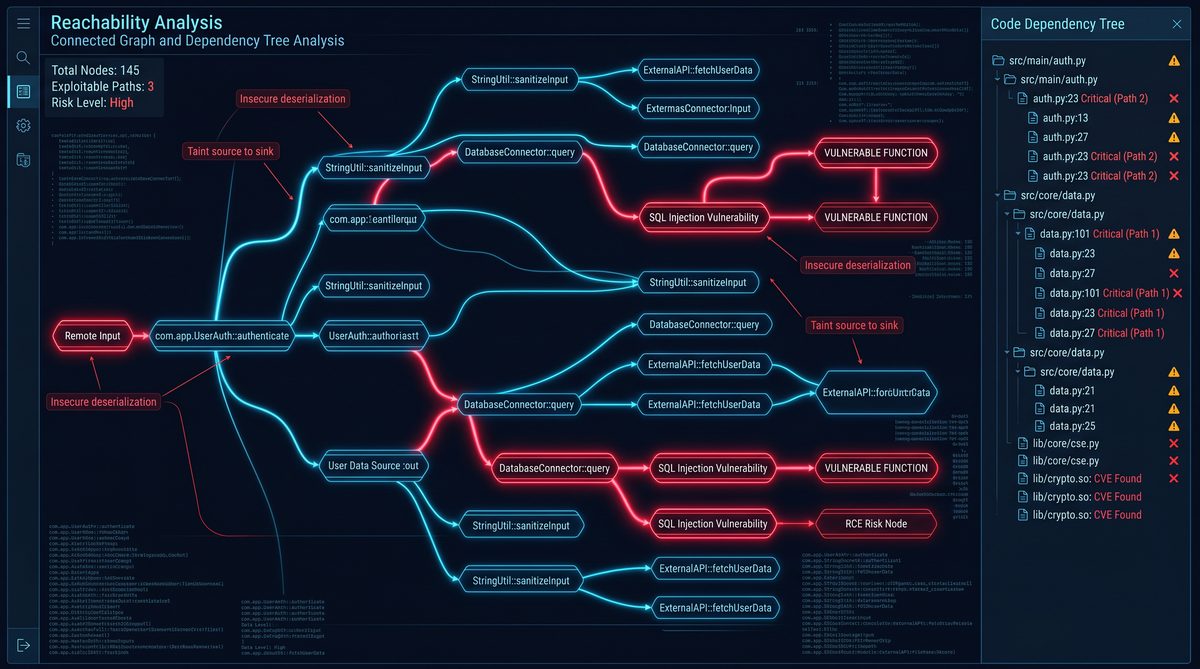
Category 2 focuses on determining which code paths are exploitable in real-world contexts by analyzing reachability, constructing attack graphs, modeling attacker capabilities, and mapping exploit chains to runtime configurations.
Design considerations for reachability analysis
Reachability analysis is the process of identifying whether a vulnerable sink is reachable from a tainted source in the context of application control flow, data flow, configuration, and runtime. Accurate reachability requires:
- Cross-file interprocedural control-flow graph (CFG) and call graph construction
- Data-flow and taint propagation across function boundaries and dynamic constructs (reflection, eval)
- Integration with runtime configurations (feature flags, environment settings) to determine whether risky code paths are active
- Modeling attacker entry points, network exposure, and authentication controls
Prompt 11 — Build Call Graph and Control Flow Index
Purpose: Construct a repository-level call graph and control flow index to support path discovery and to accelerate repeated queries.
Prompt Template:
"Construct an interprocedural call graph for the codebase at commit {{commit_sha}}.
Return:
- Nodes: {id, function_name, file_path, line_range}
- Edges: {from_node_id, to_node_id, type (direct, indirect, callback)}
- Entry points: {HTTP endpoints, CLI handlers, scheduled jobs}
Output in JSON suitable for graph traversal queries."
Verification: Spot-check large services and validate that known handlers (e.g., main HTTP handlers) are present as entry points.
Prompt 12 — Taint Propagation and Reachability Query
Purpose: Given taint seeds, find all reachable sinks and produce prioritized attack paths.
Prompt Template:
"Given taint seeds and the call graph, perform conservative interprocedural taint propagation to locate sinks such as SQL execution, system command execution, file writes in sensitive directories, and dynamic code eval.
For each path, report:
- path_id
- source (file:line)
- sink (file:line and sink type)
- intermediate functions (ordered)
- path_length
- confidence
Return top N paths sorted by risk."
Operational notes: Use both forward and backward analysis: forward from seed sources and backward from known sinks to find converging paths.
Prompt 13 — Runtime Configuration Correlation
Purpose: Correlate code paths with runtime configuration and deployment topology to determine if an attack path is feasible in production.
Prompt Template:
"Using runtime configuration (env vars, config files, deployment descriptors), determine which attack paths are active. For each path, annotate:
- active (boolean)
- deployment_targets (service names, pods)
- exposure (internal_only, external_http, public_api)
Return annotated paths with evidence."
Inputs: Configs, k8s manifests, env files
Example Output: Paths that involve admin-only endpoints marked ‘internal_only’ reduce exploitability.
Prompt 14 — Attack Graph Construction and Visualization Metadata
Purpose: Construct an attack graph that captures possible attacker moves, privileges required, and goals, enabling visualization and human triage.
Prompt Template:
"Create an attack graph where nodes represent attacker states (e.g., 'unauthenticated', 'authenticated_user', 'admin') and edges are exploit steps derived from reachable paths. For each node/edge include:
- preconditions
- attacker capabilities required
- evidence (code paths)
- mitigations
Output JSON compatible with graph tools and include suggestion for visualization layers (colors by severity)."
Use case: Security teams can import the JSON into graph tools to show step-by-step attack chains.
Prompt 15 — Prioritize Attack Paths by Business Impact
Purpose: Merge attack graph priority with business impact to provide a remediation order focusing on the most damaging plausible exploits.
Prompt Template:
"Given attack paths and service criticality metadata (data sensitivity, revenue impact), score each path:
final_score = risk_score * business_impact_factor
Return prioritized remediation recommendations mapped to teams and potential mitigations (short-term vs long-term)."
Operational guidance: Short-term mitigations may include disabling a feature flag or blocking a route at the WAF while a patch is produced.
Prompt 16 — Exploitability Proof-of-Concept (PoC) Draft
Purpose: For high-priority, high-confidence paths, draft a non-executing PoC that demonstrates how an attacker could weaponize the path. The PoC should be safe, disposable, and omit destructive commands—only show the sequence and crafted input that would lead to exploitation.
Prompt Template:
"For each high-confidence path, generate a non-destructive PoC outline showing:
- initial request or input payload
- sequence of actions an attacker performs
- intermediate state snapshots (what the attacker can observe)
- final impact (e.g., data exfil example using logs)
Ensure the PoC avoids destructive actions and includes safety disclaimers."
Ethics and policy: Only authorized users may generate PoCs. Embed audit logging and require elevated access for full exploit scripts.
Prompt 17 — Multi-Service Attack Path Aggregation
Purpose: In microservice topologies, vulnerabilities can be chained across services. Aggregate paths that cross service boundaries and model lateral movement and privilege escalation.
Prompt Template:
"Find path sequences that cross services (e.g., service A -> service B -> service C) and annotate:
- inter-service communication channels (gRPC, HTTP)
- service-to-service auth assumptions (mTLS, JWT checks)
- whether tokens or credentials are propagated
Return cross-service sequences and suggested network mitigations."
Output: A list of cross-service chains with suggested network-level controls and short-term mitigations (circuit breakers, service mesh policies).
Prompt 18 — Exploit Likelihood Synthesis Using External Threat Intelligence
Purpose: Augment attack graph prioritization with external threat intelligence—are the identified vulnerabilities being actively exploited in the wild?
Prompt Template:
"Given vulnerabilities and attack paths, consult threat intelligence sources (OSINT, vendor alerts) and annotate:
- active_exploitation (boolean)
- known_actor_TTPs
- public PoC links (if any)
Return aggregated evidence and adjust exploitability scores accordingly."
Operational note: Integrate with internal TIP or feeds to avoid noisy public alerts.
Prompt 19 — Adaptive Testing Plan for High-Confidence Paths
Purpose: Generate a testing plan for QA/Security teams to validate exploitability safely in a staging environment. Include test harnesses and mock data.
Prompt Template:
"For each high-confidence path, produce a staged test plan:
- environment setup and required fixtures
- step-by-step safe test actions
- observed indicators that confirm exploitability
- rollback and cleanup steps
Return a test-run checklist."
Safety: Tests must never run against production; implement guardrails that enforce commit-based staging tests only.
Prompt 20 — Recommendations for Compensating Controls and Runtime Hardening
Purpose: When immediate code changes are not feasible, propose compensating runtime controls such as WAF rules, runtime policy enforcement, rate-limiting, and network segmentation.
Prompt Template:
"Given prioritized attack paths, recommend compensating controls with:
- short-term mitigation steps (WAF rule example, feature flag toggle)
- medium-term (configuration changes, policy enforcement)
- long-term (code fixes, architectural changes)
Provide exact configuration snippets where possible and a rollback plan."
Operational tip: Include examples for major platform providers (AWS WAF, Cloudflare, Istio) and note any performance impacts.
Category 3: Automated Patch Generation and Verification (Prompts 21-30)
Category 3 covers the generation of code-level patches, multi-file changes, test augmentation, and patch verification steps (unit tests, integration tests, static analyzers) to verify that a patch mitigates the vulnerability without introducing regressions.
Principles for automated patching
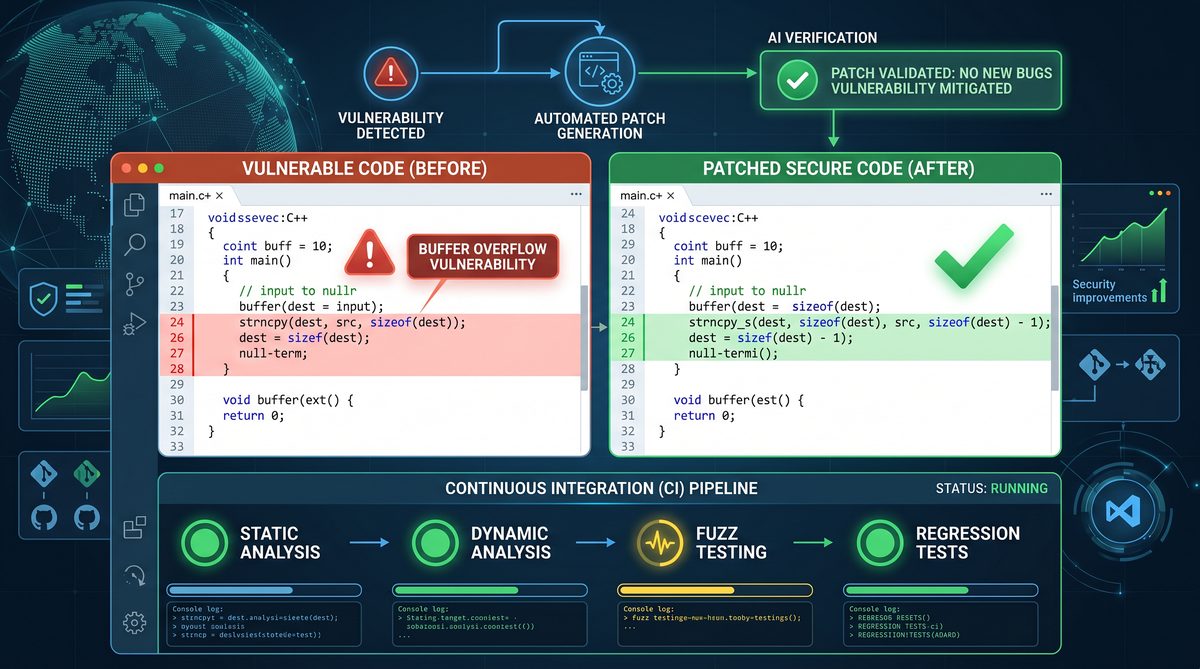
Automated patch generation must be conservative, transparent, and auditable. The Codex Security plugin should:
- Prefer minimal, well-scoped changes with clear rationales
- Include tests and CI checks alongside the patch
- Produce an automated commit message and PR description with security metadata
- Optionally create multiple patch candidates (safe vs. performance-optimized) for reviewer selection
Prompt 21 — Generate Minimal Patch Candidate (Single File)
Purpose: Produce a minimal patch that addresses a specific vulnerability in a single file while preserving behavior and style.
Prompt Template:
"Given file X and vulnerability Y (provide code snippet and line range), produce a minimal patch that:
- Fixes the vulnerability
- Adds meaningful comments explaining the change
- Adds or updates unit tests in the adjacent test module
Return a unified diff with context and test modifications."
Output: Unified diff that can be applied via git apply; include test failing/passing expectations.
Prompt 22 — Multi-File Patch with Dependency Updates
Purpose: For vulnerabilities that require library updates or code adaptations across files, generate synchronized multi-file patches including dependency updates (lockfile changes).
Prompt Template:
"Given dependency vulnerability Z and required upgrade to version >=V, produce:
- code adaptions across files (APIs changed)
- updated dependency manifest and lockfile changes
- migration notes
Return a multi-file patch and a changelog entry for the dependency update."
Operational caveat: Automatically upgrading major versions can introduce breaking changes; include a compatibility checklist and smoke test guidance.
Prompt 23 — Secure-by-Default Refactor Suggestion
Purpose: When a vulnerability stems from insecure patterns (e.g., concatenated SQL queries), propose a refactor to a secure abstraction (prepared statements, parameterized queries) with example code changes and performance considerations.
Prompt Template:
"Given vulnerable function F that constructs SQL via string concatenation, produce:
- a refactor replacing the pattern with parameterized queries or ORM usage
- migration of tests
- bench notes on performance implications
Return the refactor as a patch and a short explanation."
Output: Patch, test changes, and reasoning about performance/compatibility.
Prompt 24 — Create Automated Test Suite for the Vulnerability
Purpose: Produce unit/integration tests that assert the vulnerability is mitigated and prevent regressions. Include negative and positive test cases and edge conditions.
Prompt Template:
"Create tests that replicate the vulnerable input and assert safe behavior:
- Provide fixtures and test data
- Include mocking instructions for network and DB calls
- Provide expected assertions and test names
Return test files matching the project's test framework."
Verification: Add tests to CI configuration so that failing tests block merges until fixed.
Prompt 25 — Patch Commit, PR Metadata, and Security Changelog
Purpose: Format the generated patch into a Git commit and PR with standardized metadata required for security audits.
Prompt Template:
"Compose a git commit message and PR body including:
- CVE or internal tracking ID (if applicable)
- Description of the issue and the fix
- Risk assessment and tests added
- Rollout/rollback guidance
Return cohesive commit message, PR title, and PR body."
Best practice: Include a “security: ” prefix in the commit title and avoid leaking PoC details in public projects.
Prompt 26 — Automated CI Verification Job Definition
Purpose: Generate CI job definitions to verify patches: run tests, static analyzers, linters, and deploy to a staging environment for dynamic checks.
Prompt Template:
"Create a CI job snippet for the repository's CI system (GitHub Actions / GitLab CI) which:
- Installs dependencies
- Runs unit and integration tests
- Executes static security linters
- Optionally runs a dynamic sandboxed smoke test for the patched endpoint
Return YAML configuration for the job and required secrets/permissions notes."
Example: Provide a GitHub Actions job that runs on PR with labeled permission scopes.
Prompt 27 — Regression and Fuzzing Harness Generator
Purpose: Produce a fuzzing or fuzz-driven regression harness to exercise patched areas and catch edge-case regressions.
Prompt Template:
"For the patched functions, create a fuzzing harness using libFuzzer/afl or a language-specific fuzzer. Provide:
- harness code
- input corpus seed files
- fuzzing configuration (time budget, memory limits)
Return harness files and a README for running the fuzzer in CI or locally."
Operational note: Run fuzzing in isolated, resource-limited environments to avoid cost blowouts.
Prompt 28 — Backport Patch Generator and Changelog
Purpose: For projects maintaining multiple release branches, produce backport patches and changelog entries for older supported versions.
Prompt Template:
"Generate backport patches for branches: branch_list (e.g., release-1.0, release-1.1).
- Apply minimal changes that preserve compatibility
- Note conflicts and manual steps required
- Produce changelog entries per branch
Return per-branch patch and conflict notes."
Operational warning: Backports often require manual validation; flag possible incompatibilities.
Prompt 29 — Security Regression Test Integration and Canary Deployment Steps
Purpose: Provide orchestration steps to safely roll out the patch via canary deployments and validate security posture in production-like environments.
Prompt Template:
"Produce a deployment plan:
- Canary deployment steps (percentages, monitoring)
- Health checks and security-specific signals to monitor (error rates, WAF blocks)
- Rollback triggers
Return a runbook for SREs and a timeline for rollout."
Example: Canary to 5% for 24 hours with elevated logging and blacklist rules if errors spike.
Prompt 30 — Post-Deployment Audit and Coverage Report
Purpose: After patch merge and deployment, produce an audit verifying fix effectiveness: re-run analysis, confirm tests passed, evaluate runtime signals, and close the security ticket with evidence.
Prompt Template:
"After deployment, re-run the following:
- Static analysis for the original finding
- Attacker path verification (reachability)
- CI integration tests and fuzzing status
Collect runtime telemetry indicators (error logs, WAF events) for the deployment window and produce an audit report that includes:
- Evidence that vulnerability is mitigated
- Residual risk
- Lessons learned and remediations for process improvements"
Deliverable: A final audit report appended to the security ticket and stored in an archival system for compliance.
The prompt engineering patterns used in this security masterclass apply broadly across professional domains that require systematic, repeatable AI workflows. Our collection of 50 GPT-5.5 prompts for Customer Success Managers demonstrates how similar structured prompting techniques can be adapted for churn prediction, onboarding automation, and health scoring in non-technical business contexts.
Access 40,000+ AI Prompts for ChatGPT, Claude & Codex — Free!
Subscribe to get instant access to our complete Notion Prompt Library — the largest curated collection of prompts for ChatGPT, Claude, OpenAI Codex, and other leading AI models. Optimized for real-world workflows across coding, research, content creation, and business.
How to Build a Custom Codex Security Workflow: Chaining prompts for end-to-end vulnerability remediation
This section synthesizes the prompts into pipeline patterns, orchestration strategies, and governance controls. The goal is to provide reproducible automation blueprints you can adapt to your environment.
High-level pipeline architecture
A production-grade automated remediation pipeline using Codex Security typically follows these stages:
- Snapshot & Metadata Extraction (Prompt 1)
- Parallel Fast Path Scans (Prompts 2, 3, 4) and Initial Triage (Prompt 5)
- Reachability & Attack Path Analysis (Prompts 11-15)
- PoC Drafting and Test Planning (Prompts 16, 19)
- Patch Generation Candidate(s) (Prompts 21-24)
- CI Verification & Canary Rollout (Prompts 26, 29)
- Post-Deployment Audit (Prompt 30)
To orchestrate this pipeline, implement a controller that:
- Triggers on PRs, scheduled scans, or manual requests
- Persists scan metadata and findings as artifact records
- Invokes Codex Security prompts as idempotent steps with explicit inputs
- Enforces human-in-the-loop gates for patch approval and PoC generation
- Logs all actions for auditability and compliance
Example orchestration flow (pseudocode)
# Pseudocode: simplified orchestration
on_event(event):
  snapshot = codex.call(Prompt1, {repo, sha})
  fast_findings = parallel([
    codex.call(Prompt2, {files: snapshot.files}),
    codex.call(Prompt3, {manifests: snapshot.manifests}),
    codex.call(Prompt4, {files: snapshot.files})
  ])
  triage = codex.call(Prompt5, {findings: fast_findings, metadata: repo_metadata})
  high_priority = filter(triage, label in ['urgent','high'])
  for f in high_priority:
    owners = codex.call(Prompt6, {finding: f})
    path_analysis = codex.call(Prompt12, {seed: f.taint_seed, call_graph: codex.call(Prompt11)})
    if path_analysis.confidence > 0.7:
      plan = codex.call(Prompt16, {path: path_analysis.top})
      patch_candidate = codex.call(Prompt21, {finding: f, path: path_analysis.top})
      ci_job = codex.call(Prompt26, {patch: patch_candidate})
      run_ci(ci_job)
      if ci_passed:
        create_pr(patch_candidate, codex.call(Prompt25))
        # optional: auto-merge after human approval
Key properties: Keep steps idempotent and reversible; store artifacts; ensure approvals are auditable.
Human-in-the-loop governance
Automation should accelerate engineering workflows without removing human judgment from sensitive stages. Design approval gates at:
- Pre-PoC generation (sensitive to dual-use)
- Pre-merge for security-critical patches (e.g., authentication)
- Production canary promotion
Implement role-based access controls and require explicit sign-offs. Log reviewer decisions and attach them to audit records for compliance.
CI/CD integration patterns
Embed the Codex Security pipeline in your CI/CD platform with the following patterns:
- Pre-merge scan: run Prompts 1-5 in PRs to block merging of high-risk changes.
- Nightly full-scan: run full pipeline to capture vulnerabilities not associated with a particular PR (e.g., dependency churn).
- On-demand scan: allow product or security teams to trigger full explorations with richer inputs (runtime logs, traces).
Automated remediation best practices
- Prefer patches that include tests and CI definitions (Prompts 24, 26) to ensure reproducibility.
- Produce multiple patch candidates if there are trade-offs (e.g., performance vs. security) and include a decision matrix in the PR body.
- Keep sensitive PoCs within closed systems and require elevated privileges for export.
- Track and measure MTTR (mean time to remediation) and adjust prioritization thresholds to meet SLAs.
Auditability and compliance
Every automated action should generate artifacts for audits: commit SHAs, patch diffs, CI logs, test outcomes, and deployment telemetry. Use a standardized security metadata schema appended to commits and PRs (fields: sec_id, severity, exploitability_score, owner_team, sla_deadline).
Example CI YAML snippet integrating Codex Security calls
name: Codex Security Pipeline

on:
  pull_request:
    types: [opened, synchronize, reopened]

jobs:
  codex-scan:
    runs-on: ubuntu-latest
    steps:
      - uses: actions/checkout@v3
      - name: Run Codex Snapshot
        run: |
          codex-cli snapshot --repo . --sha ${{ github.sha }} --out snapshot.json
      - name: Run Fast Path Scan
        run: |
          codex-cli analyze fast-path --snapshot snapshot.json --out findings.json
      - name: Upload Findings
        uses: actions/upload-artifact@v3
        with:
          name: findings
          path: findings.json
Integration note: Codex CLI calls above represent the Codex Security plugin interface; adapt to your platform-specific API or SDK.
Testing and validation strategy
To build confidence in automated patches, adopt the following multi-layer validation:
- Static verification: rerun the analyzer to confirm the finding is resolved (Prompt 30).
- Unit and integration tests: ensure new tests pass in CI.
- Fuzzing: run regression fuzzers for a bounded time budget.
- Canary deployment: release to limited traffic and monitor security signals for a defined window.
- Post-deployment audit: gather runtime telemetry and update the security ticket with evidence.
Example end-to-end scenario (walkthrough)
Scenario: An application service exposes an endpoint that accepts JSON input and passes concatenated values into a shell command. The initial scan (Prompt 2) finds string-based shell invocation. Taint seeding (Prompt 4) reveals the request body is unvalidated. Call graph construction (Prompt 11) and path tracing (Prompt 12) show a direct path from the public endpoint to the shell invocation. Attack path (Prompt 14) rates the path as ‘external_http’ and high severity.
Action flow:
- Create an issue (Prompt 9) and assign owners (Prompt 6).
- Generate a non-destructive PoC outline (Prompt 16) and an adaptive test plan (Prompt 19).
- Produce a secure-by-default refactor patch (Prompt 23) using parameterized command invocation or reimplementation in native APIs.
- Add tests (Prompt 24) and CI jobs (Prompt 26).
- Run CI and fuzzing (Prompt 27). If passing, create PR (Prompt 25).
- Perform a canary rollout (Prompt 29) and post-deployment audit (Prompt 30).
Operational metrics to measure
| Metric | Description | Target |
|---|---|---|
| Time to Detect | Average time from vulnerability introduction to detection by the pipeline | < 24 hours for CI-detected issues |
| Time to Remediate | Average time from detection to merge of a remediation PR | < 7 days for high severity |
| False Positive Rate | Percentage of findings that are later marked as false positives | < 15% |
| Patch Reversion Rate | Percentage of security patches that are rolled back | < 2% |
Appendix: Prompt Reference Table and Integration Patterns
This appendix provides a compact reference table for the 30 prompts with short purpose and example snippet to accelerate implementation.
| Prompt # | Title | Primary Output |
|---|---|---|
| 1 | Repository Snapshot | JSON metadata (manifests, languages) |
| 2 | Fast Path Scan | Pattern-based findings |
| 3 | Dependency Vulnerability Cross-Reference | Dependency CVE list |
| 4 | Taint Seeding | Taint seeds list |
| 5 | Contextual Prioritization | Ranked issues |
| 6 | Codeowner Mapping | Owner assignments |
| 7 | False Positive Heuristics | Cleaned findings |
| 8 | Mitigation Suggestions | Remediation approaches |
| 9 | Issue Generation | Platform-ready issue body |
| 10 | Weekly Digest | Digest & SLA estimates |
| 11 | Call Graph | Interprocedural graph JSON |
| 12 | Taint Propagation | Attack paths |
| 13 | Runtime Correlation | Active path annotations |
| 14 | Attack Graph | Graph JSON for visualization |
| 15 | Business Prioritization | Prioritized remediation list |
| 16 | PoC Draft | Safe PoC outline |
| 17 | Multi-Service Chains | Cross-service sequences |
| 18 | Threat Intel Enrichment | Active exploitation indicators |
| 19 | Adaptive Test Plan | Staged testing checklist |
| 20 | Compensating Controls | Runtime hardening actions |
| 21 | Minimal Patch | Unified diff |
| 22 | Multi-file Patch | Multi-file diff with dependency updates |
| 23 | Secure Refactor | Refactor patch |
| 24 | Test Suite | Test files and fixtures |
| 25 | Commit & PR Metadata | Commit message & PR body |
| 26 | CI Job Definition | CI YAML snippet |
| 27 | Fuzz Harness | Fuzzing harness and seeds |
| 28 | Backport Generator | Branch-specific patches |
| 29 | Canary Runbook | Deployment and monitoring plan |
| 30 | Post-Deployment Audit | Audit report |
Integration patterns and tips
- Store findings in a canonical, queryable DB so that downstream workflows can access them asynchronously.
- Use a message bus to decouple scan triggers from heavy downstream analyses; this enables horizontal scale for deep path analysis.
- Implement backoff and batching when scanning large monorepos to reduce compute spikes.
- Provide an admin override to pause automated patch generation in critical paths (e.g., authentication modules).
Conclusion
This masterclass provides a practical, production-ready set of prompts for the Codex Security plugin and demonstrates how to chain them into robust automation pipelines. When adopted, these patterns help reduce time-to-detection, accelerate remediation, and improve engineering productivity without compromising auditability or governance.
Key takeaways:
- Structure scanning into fast and deep phases to manage cost and noise.
- Use reachability and runtime correlation to reduce false positives and focus on exploitable paths.
- Automate conservative patch generation and pair it with thorough verification (tests, fuzzing, canary).
- Ensure human approvals at sensitive decision points and maintain meticulous audit trails.
Use the provided prompt templates as starting points and iterate with your security and engineering teams to tune thresholds, suppression lists, and ownership mappings to your environment. The Codex Security plugin becomes most valuable when it is configured to reflect your unique deployment topology, risk model, and operational constraints.
