
The Enterprise Guide to GPT-5.5 Instant for Healthcare: Clinical Applications, Safety Protocols, and Implementation Strategies
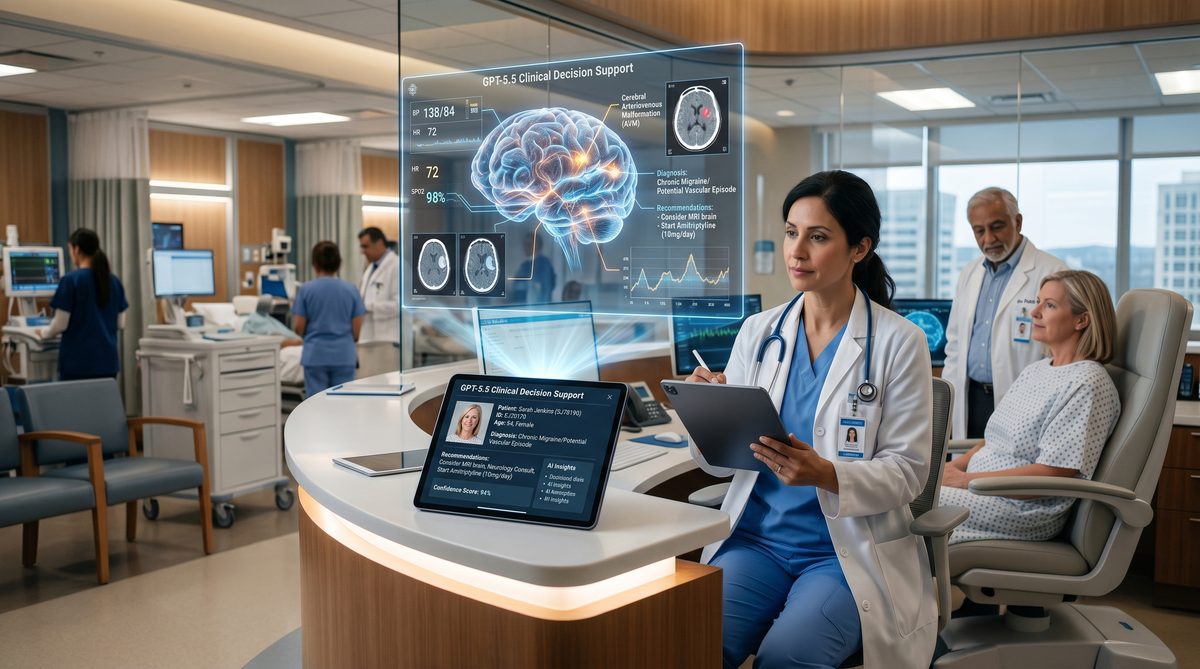
The Enterprise Guide to GPT-5.5 Instant for Healthcare: Clinical Applications, Safety Protocols, and Implementation Strategies
Table of Contents
- Introduction: GPT-5.5 Instant’s milestone of matching frontier Thinking models for health-related queries
- Under the Hood: How GPT-5.5 Instant recognizes urgent care scenarios and safety-critical medical contexts
- Clinical Applications: From medical documentation draft generation to non-diagnostic decision support
- Safety and Governance Protocols: Managing patient privacy, HIPAA compliance considerations, and avoiding hallucinations
- Collaborative Development: How OpenAI collaborated with hundreds of physicians across 60 countries to build health intelligence
- Step-by-Step Enterprise Integration: Deploying GPT-5.5 Instant securely via API in clinical portals
- The Future of AI Health Intelligence: Scaling medical access and reducing administrative burden for healthcare professionals
- Appendices: Reference architectures, risk matrices, sample API calls, and governance checklist
Introduction: GPT-5.5 Instant’s milestone of matching frontier Thinking models for health-related queries
The release of GPT-5.5 Instant with a dedicated health upgrade marks a pivotal inflection point in enterprise AI for healthcare. For the first time, a low-latency, cost-optimized “Instant” model family approaches parity with frontier “Thinking” models in its ability to interpret, triage, and generate clinically contextualized content. This guide is written for enterprise stakeholders—chief medical officers, informatics leads, security and compliance officers, and engineering teams—who must evaluate and operationalize GPT-5.5 Instant within regulated clinical environments.
The model’s upgrade is not merely a marginal improvement in natural language quality. It includes architectural enhancements, specialized training and evaluation datasets, refined safety layers, and deployment features engineered to support clinical workflows at scale. These changes collectively enable GPT-5.5 Instant to perform tasks ranging from drafting documentation and generating evidence-sourced patient education to recognizing potential urgent-care scenarios and supporting non-diagnostic clinical decision-making in a way that is auditable and aligned to regulatory constraints.
This document provides a comprehensive treatment of how GPT-5.5 Instant functions in healthcare settings, how it detects and responds to time-sensitive and safety-critical signals, the clinical applications where it delivers measurable value, and the governance protocols required to mitigate risk while maximizing adoption. We cover implementation patterns, integration architectures, monitoring strategies, legal and compliance lenses (including HIPAA and Business Associate Agreements), and recommended paths for validation and continuous improvement.
Under the Hood: How GPT-5.5 Instant recognizes urgent care scenarios and safety-critical medical contexts
Model Architecture and Safety Layers
GPT-5.5 Instant is built as an efficient derivative of a frontier reasoning architecture. Its core is a transformer-based sequence model with improved context management, sparse attention optimizations, and specialized prompt conditioning layers. Critically for healthcare, the deployment stack includes multiple orthogonal safety layers:
- Input classification layer: A lightweight classifier that detects protected health information (PHI), sensitive topics, or emergency/urgent-care language before model inference.
- Contextual intent detector: A safety-tuned module that assesses whether a user input implies clinical urgency (e.g., “severe chest pain,” “sudden vision loss”) and elevates the handling mode accordingly.
- Response constraint layer: Post-generation filters that enforce policy constraints such as refusal on diagnostic claims in contexts where the enterprise has defined such limits.
- Grounding and citation engine: Retrieval-augmented components that fetch clinical guidelines, local protocols, or curated knowledge base entries to ground outputs and produce citations or source attributions.
- Audit and provenance layer: Per-interaction cryptographic signing and structured meta-data capture that records decision path, evidence references, and risk scores for downstream review and audits.
Urgent Care and Safety-Critical Detection: Technical Mechanisms
Recognizing urgent and safety-critical medical contexts requires more than keyword matching. GPT-5.5 Instant employs a multi-step detection pipeline that combines syntactic, semantic, temporal, and clinical-scope analysis:
- Preprocessing & PHI redaction: Inputs are first tokenized and scanned with PHI detectors to minimize accidental transmission of identifiers. Redaction can be configurable to meet enterprise policy—either redacting client-side before network transmission or within the server-side secure enclave.
- Semantic intent classification: A calibrated classifier produces probability distributions across intent classes such as “administrative,” “education,” “chronic care question,” “acute symptom,” and “self-harm/poisoning.” This classifier is optimized for high recall on urgent categories to minimize false negatives.
- Temporal urgency scoring: For symptom-based inputs, the system computes relative urgency using temporal markers (onset timing, progression velocity) and symptom severity proxies. Example: “sudden severe” + chest pain yields a very high urgency score.
- Contextual escalation rules: Rules that combine classifier outputs with domain heuristics determine the response mode. If urgency exceeds a configured threshold, the model returns triage-safe outputs: emergency guidance, contact local emergency services, and refusal to provide definitive diagnosis.
- Confidence-aware generation: The model produces explicit confidence scores and an explanation trace (structured metadata) that indicates why a case was flagged, which evidence items were matched, and which rules applied.
These mechanisms are tuned for enterprise settings where liability and patient safety are paramount. They are intentionally conservative—erring on the side of escalation—so design requires collaboration between clinical governance and engineering teams to calibrate thresholds for local clinical workflows.
Examples of Urgent-Care Recognition Logic
Consider two sample inputs and how the pipeline reacts:
- Input A: “I have had chest tightness for two days, worsened when I climb stairs, no shortness of breath.” Preprocessing labels this as symptom report. Temporal scoring is medium; severity markers are moderate. Output: suggest urgent clinic evaluation and recommend contacting provider within 24 hours. Include risk rationale and recommended next steps.
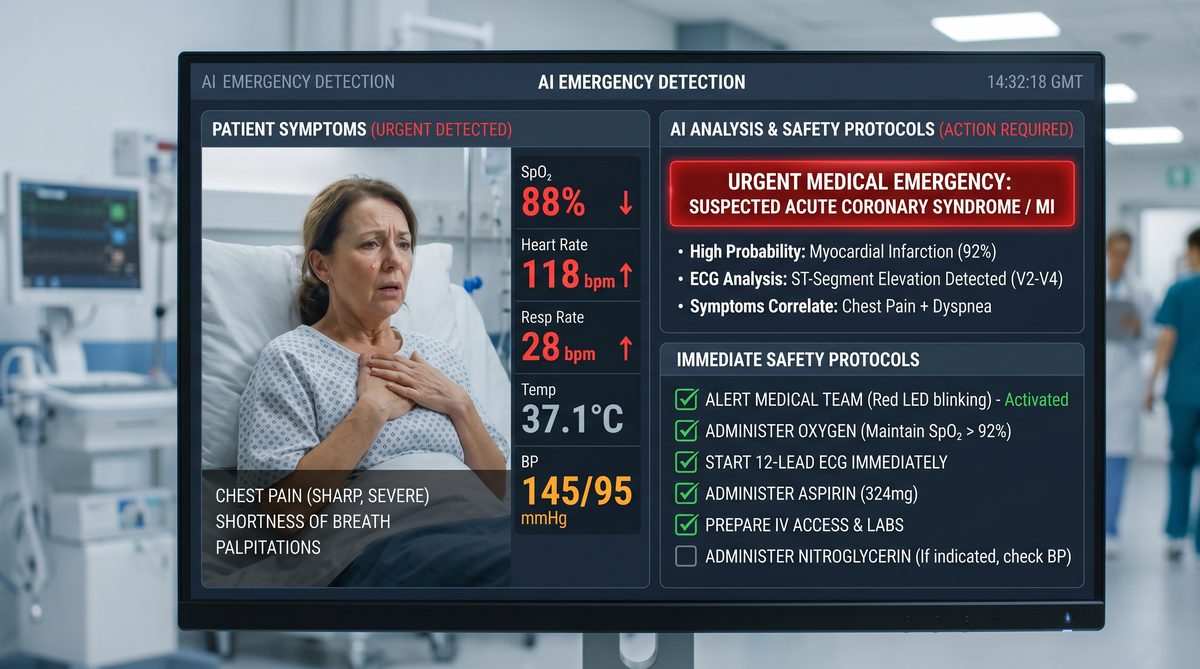
- Input B: “I am experiencing sudden severe chest pain and shortness of breath right now.” High-priority flags triggered: “sudden,” “severe,” respiratory distress. Output: immediate escalation with explicit emergency instructions, refusal to provide non-emergency triage, and advice to call emergency services. The system includes a de-escalation path for false alarms where tele-triage is available.
Model Conditioning for Clinical Safety
GPT-5.5 Instant leverages conditioning tokens and policy prompts to bias generation toward safe, non-diagnostic, and referential responses in healthcare contexts. This approach involves:
- Embedding policy prompts that specify permissible output classes for the session (e.g., “patient education,” “administrative draft,” “non-diagnostic decision support”).
- Prohibiting definitive clinical diagnoses in chat unless connected to a validated clinical decision support (CDS) module with human oversight.
- Enforcing explicit citation requirements when the model references guidelines, drug information, or clinical evidence.
Clinical Applications: From medical documentation draft generation to non-diagnostic decision support
High-Value Use Cases for Healthcare Organizations
GPT-5.5 Instant is applicable across a broad spectrum of clinical and administrative workflows. We classify practical use cases into three buckets—documentation and clerical augmentation, patient-facing communications, and clinician decision support (non-diagnostic).
1. Clinical Documentation and Coding Drafts
One of the most immediate ROI opportunities is automating or accelerating the creation of clinical notes, referral letters, discharge summaries, and coding suggestions. GPT-5.5 Instant can:
- Transform clinician shorthand, voice-transcribed notes, or structured EHR fields into full SOAP notes with suggested problem lists.
- Produce draft CPT and ICD-10 code mappings based on documented encounters with confidence annotations and links to relevant documentation.
- Generate structured HPI (history of present illness) expansions and differential diagnosis templates for clinician review.
Implementation considerations:
- Use local context windows that include only the encounter’s de-identified structured data to limit PHI exposure where possible.
- Apply a clinician-in-the-loop workflow: the model provides a draft, but a licensed clinician must review and sign off before finalization.
- Implement audit logs that map suggested codes to the specific evidence extracted from the note to support coding audits and payor queries.
2. Non-Diagnostic Clinical Decision Support
GPT-5.5 Instant can deliver non-diagnostic CDS features that help clinicians follow local protocols and evidence-based pathways without replacing professional judgment. Examples include:
- Drug dosing calculators with boundary checks for age, weight, renal function; outputs are annotated with dosing rationale and reference sources.
- Alert summarization and prioritization to reduce clinician cognitive load, with explicit rationale for each prioritized alert to mitigate alert fatigue.
- Order set suggestions that map to institutional protocols and document the rationale for each suggested order.
Key design pattern: integrate GPT-5.5 Instant as a contextual advisor that augments—rather than automates—decisions. All recommendations should be accompanied by provenance (e.g., local guideline ID, last updated date) and a clear “clinician-review required” flag.
3. Patient-Facing Communications and Education
Patient education is another high-value area. GPT-5.5 Instant can:
- Generate personalized discharge instructions that are readable at a defined health literacy level and translated into multiple languages.
- Draft pre-visit instructions, medication counseling notes, and post-procedural symptom checklists.
- Produce automated yet clinically sound answers to frequently asked questions about conditions, treatments, and test preparation—always anchored to vetted sources.
Safety considerations include ensuring that the model avoids providing diagnostic reassurance or treatment plans without clinician oversight and that it includes escalation language where symptoms warrant urgent evaluation.
4. Triage and Telehealth Support
In telehealth and virtual triage, GPT-5.5 Instant augments nurse triage lines and chatbots. It can:
- Conduct structured symptom interviews, mapping responses to triage disposition levels while flagging high-risk symptoms for immediate human review.
- Populate triage notes and generate handoff summaries for clinicians taking over care.
- Integrate with telehealth scheduling systems to automate appointment urgency recommendations and suggest available visit modalities (in-person vs virtual).
Clinical Example: SOAP Note Drafting Workflow
The following is a representative workflow for generating SOAP notes using GPT-5.5 Instant while maintaining compliance and clinical oversight:
- Capture encounter: clinician records encounter via structured EHR fields and optional voice transcription; system performs on-device PHI tokenization.
- Preprocess: optional client-side redaction of PHI based on configurable policy (minimize transmitted identifiers).
- Context assembly: pass de-identified structured data (vitals, meds, allergies, labs) and clinician shorthand into GPT-5.5 Instant with a strong policy prompt that restricts output to a draft note template.
- Draft generation: model produces the SOAP note draft, embeds citations to the originating structured data and any referenced guidelines, and includes a generated “confidence and evidence” block.
- Clinician review: the clinician reviews, edits, and signs the note; the system logs the interaction, transformations, and timestamps for audit.
Quantifying Clinical Impact
In pilot settings, organizations have tracked measurable benefits when deploying GPT-5.5 Instant for documentation and triage augmentation. Typical KPIs to track include:
- Clinician documentation time reduction (minutes per patient encounter).
- Pre-signature throughput (number of auto-drafted notes requiring minimal edits).
- Reduction in time-to-decision for triage dispositions.
- Patient satisfaction scores for educational materials and response turnaround time.
It is critical to report these metrics alongside safety metrics (false negative urgency cases, inappropriate recommendations, and escalation accuracy) to ensure balanced evaluation.
Safety and Governance Protocols: Managing patient privacy, HIPAA compliance considerations, and avoiding hallucinations
Legal and Compliance Foundations
Deploying GPT-5.5 Instant in clinical environments requires a layered compliance approach. The legal framework centers on HIPAA in the United States and comparable privacy laws elsewhere (e.g., GDPR, PIPEDA). Core obligations include:
- Business Associate Agreement (BAA): Ensure a BAA or equivalent contractual arrangement with the model provider that covers PHI handling, breach notification, and audit rights.
- Data minimization: Transmit only the minimum required PHI to accomplish the task. Where possible, perform de-identification or tokenization before transmission.
- Access controls: Role-based access control (RBAC) and least privilege must be enforced for any component that can access patient data within the model pipeline.
- Data residency: Configure data residency controls to comply with local laws and enterprise policies (e.g., US-only storage for certain data types).
Technical Controls for Privacy and Security
From an engineering perspective, implement the following technical controls:
- Client-side PHI tokenization: Implement libraries that replace direct identifiers with secure tokens before sending text to the model. Store mappings only within the enterprise secure enclave.
- End-to-end encryption: Use TLS 1.3 between client and service; ensure server-side encryption at rest using FIPS 140-2 validated modules as required by enterprise policy.
- Network isolation and VPC peering: Deploy model endpoints in a private VPC with strict egress rules. Consider using private link or VPN to avoid public internet exposure.
- Audit logging and immutable trails: Log query inputs (where allowed), model outputs, model version, and handling decisions in an immutable audit store with retention policies aligned to legal requirements.
- Role-based masking: When storing outputs, mask sensitive sections based on user role to avoid overexposure of PHI in analytics or telemetry.
Mitigating Hallucinations and Ensuring Content Grounding
Hallucinations—confident but inaccurate outputs—are a primary safety concern. To mitigate hallucinations when using GPT-5.5 Instant:
- Retrieval-Augmented Generation (RAG): Implement a RAG pattern where the model conditions on curated, authoritative clinical knowledge bases (local protocols, peer-reviewed guidelines, formulary entries). This grounds responses and makes them verifiable.
- Source citation enforcement: Require the model to attach citations for any assertion about clinical guidance or drug information. All citations should reference an internal knowledge base or known external standards (e.g., institution protocol IDs).
- Conservative response templates: Use templates that avoid speculative language and include explicit “recommendation vs. information” markers to indicate the role of the output.
- Human-in-the-loop gates: For any output that could materially affect patient care decisions, require clinician review and explicit acceptance before any action is taken.
- Automated contradiction detection: Implement secondary checks that compare model recommendations to deterministic clinical rules; flag discordant outputs for review.
Monitoring hallucinations requires monitoring both model behavior and downstream impacts. Instrument your systems to capture disagreement rates between model-generated suggestions and clinician final actions; significant deviations warrant retraining or prompt adjustments.
Governance Processes and Clinical Oversight
Effective governance combines multidisciplinary committees, validation frameworks, and continuous monitoring:
- Clinical AI Governance Board: A standing committee of clinicians, informaticians, legal counsel, and patient safety officers that approves models, monitors safety KPIs, and manages escalation procedures.
- Validation protocols: Pre-deployment validation using retrospective EHR datasets, prospective shadow-mode trials, and randomized controlled trials where appropriate. Emphasize endpoint metrics that matter clinically (e.g., missed urgent cases, inappropriate recommendations).
- Version control and change management: Treat model, prompt templates, and retrieval indices as versioned artifacts. Require clinical sign-off for updates that alter output behaviors significantly.
- Incident response and patient safety monitoring: Define a rapid response plan for model-related safety incidents, including immediate model quarantine, data collection for root cause analysis, and disclosure procedures consistent with regulatory expectations.
As part of governance, include a documented acceptance threshold for risk metrics (e.g., an acceptable false negative rate for urgent-care detection) and a cadence for re-validation after updates to model weights, knowledge sources, or prompt conditioning.
For clinicians and IT teams seeking a standards reference during governance design, consider adopting and customizing existing frameworks such as the FDA’s Good Machine Learning Practice (GMLP) concepts and ISO 14971 risk management principles adapted for AI systems.
Maintain comprehensive training and enablement materials for end users. Clinician trust grows when users understand model capabilities, limitations, and the evidence base for recommendations—provide interactive training modules and “explainability” features that let users query why a model made a suggestion.
Collaborative Development: How OpenAI collaborated with hundreds of physicians across 60 countries to build health intelligence
Building an enterprise-grade health intelligence model requires deep collaboration with front-line clinicians and domain experts. OpenAI’s iterative development for the GPT-5.5 Instant health upgrade included four major collaborative pillars:
- Global physician panel reviews: Hundreds of clinicians across 60 countries participated in scenario-based reviews, providing annotations, risk calibrations, and regional practice variations that the model needed to recognize.
- Clinical use-case pilots: Multi-site pilots in ambulatory and acute care settings fed back real-world interaction logs (de-identified) and clinician ratings of model suggestions to guide prompt engineering and threshold tuning.
- Ethics and equity advisory boards: Panels ensured the model addressed equity concerns— language inclusivity, health literacy, and culturally relevant explanations—while preventing biased suggestions that could exacerbate health disparities.
- Regulatory and legal consultations: Domain experts guided the compliance framework, operationalizing HIPAA-aligned workflows and region-specific legal controls during system design.
These contributions were operationalized into model behavior via targeted fine-tuning, safety rulebooks, and evaluation suites that mimic clinical complexity. The evaluation suite includes thousands of clinician-authored vignettes spanning urgent care, chronic disease management, pediatric prompts, geriatric considerations, and rare disease contexts to ensure broad coverage.
The collaborative process also produced reproducible best practices for clinical validation, described in the governance appendices below. If your enterprise is designing its own clinical evaluation strategy, consider engaging a geographically diverse physician pool for scenario authoring and scoring, and incorporate metrics for demographic fairness and health literacy performance.
For teams building internal education and training programs, reference the artifact sets produced in these collaborations, including template annotation guides and accepted scoring rubrics for clinical relevance and safety. These assets accelerate local validation and provide consistent clinician-facing messaging. See the institutional validation playbook and training modules for additional implementation patterns
Healthcare professionals seeking to maximize GPT-5.5 Instant’s clinical capabilities will find our dedicated prompting resource invaluable. Our collection of 50 GPT-5.5 prompts specifically designed for healthcare professionals covers clinical decision support, medical documentation, patient communication templates, and research analysis workflows that align with the safety protocols outlined in this guide.
.
Step-by-Step Enterprise Integration: Deploying GPT-5.5 Instant securely via API in clinical portals
High-Level Architecture Patterns
There are two primary architecture patterns for integrating GPT-5.5 Instant into clinical systems:
- Hybrid on-prem + cloud: On-prem components perform PHI tokenization, local retrieval from enterprise knowledge stores, and decision gating; cloud-based model endpoints (with BAA and private networking) handle model inference. This pattern balances latency and compliance.
- Cloud-native secure enclave: All components, including storage and model endpoints, reside in a secure cloud region with HIPAA attestation, private networking, and customers’ VPC isolation. This pattern enables rapid scaling and managed services but requires rigorous contractual assurances about data handling.
Sample Integration Flow
Below is a concrete sequence for integrating GPT-5.5 Instant in a clinical portal for note drafting and triage augmentation:
- Frontend capture: Clinician or patient inputs are captured in the clinical portal UI. Client-side PHI tokenization library replaces direct identifiers with tokens.
- Local retrieval: The portal queries the enterprise knowledge graph for relevant guidelines, previous visit context, and medication lists. Retrieval vectors are computed in-house and returned as evidence snippets.
- Policy check: An in-house policy engine applies RBAC checks and urgency classifiers; if the input is high-risk, the system switches to the “escalation” mode.
- API call to GPT-5.5 Instant: The portal sends a structured request to the model endpoint that includes:
- De-identified message content
- Local retrieval snippets linked to their provenance
- Prompt template specifying output type and constraints
- Desired output schema (e.g., JSON with sectioned note components and citations)
- Post-processing and enforcement: Response constraint layers validate model outputs against deterministic clinical rules and apply format normalization.
- Clinician review and sign-off: A UI presents the draft with highlights of system-cited evidence. The clinician edits and signs; the final document is saved in the EHR with model meta-data attached.
Sample API Request and Response Pattern
The following is an illustrative pseudo-code example of an API request pattern. Adapt the specifics to your vendor SDKs and infrastructure. Note: this example intentionally anonymizes endpoint addresses and uses placeholders for secrets and IDs.
// PSEUDO-CODE: Example API request to GPT-5.5 Instant for note drafting
POST https://model-enterprise.api/gpt-5.5-instant/health/draft
Headers:
  Authorization: Bearer
  X-Request-ID:
  Content-Type: application/json
Body:
{
  "prompt_template_id": "soap-draft-v2",
  "context": {
    "deidentified_encounter": {
      "chief_complaint": "shortness of breath",
      "vitals": {"bp": "130/85", "hr": 110, "o2": 94},
      "medications": ["lisinopril", "atorvastatin"],
      "allergies": ["penicillin"]
    },
    "retrieval_snippets": [
      {"id": "guideline-CHF-2024", "text": "Heart failure guideline excerpt..."},
      {"id": "local-orderset-234", "text": "Local order set: chest pain evaluation..."}
    ]
  },
  "output_schema": {
    "sections": ["Subjective", "Objective", "Assessment", "Plan"],
    "include_citations": true
  },
  "policy": {
    "max_urgency": 0.8,
    "require_clinician_signoff": true
  }
}
Response will include structured SOAP fields, evidence citations, and a diagnostic-avoidance token indicating that the content is for documentation support only. The enterprise should store the response with immutable audit metadata.
Operationalizing Security, Observability and Monitoring
Production integration requires comprehensive operational tooling:
- Telemetry: Log model version, prompt template ID, anonymized input hashes, latency, and an urgency/confidence score for each interaction.
- Real-time monitoring: Set SLOs for latency and error rates; monitor safety metrics (e.g., number of escalations per 1,000 interactions, rate of PHI transmission violations).
- Drift detection: Implement statistical monitoring to detect shifts in input distributions (e.g., new symptom phrases or language use) and output characteristics (e.g., increased hallucination rates).
- Feedback loops: Capture clinician feedback (e.g., “useful,” “not useful,” “dangerous”) on outputs and use it to prioritize retraining and prompt revisions.
Deployment Checklist (Operational)
| Area | Action | Status |
|---|---|---|
| Contracting | Execute BAA and verify provider attestations | Required |
| Network | Configure private networking and VPC peering | Required |
| Security | Enable E2E encryption, tokenization, RBAC | Required |
| Governance | Form Clinical AI Governance Board | Required |
| Validation | Run retrospective and prospective validation tests | Required |
| Monitoring | Implement drift and safety monitoring dashboards | Required |
Access 40,000+ AI Prompts for ChatGPT, Claude & Codex — Free!
Subscribe to get instant access to our complete Notion Prompt Library — the largest curated collection of prompts for ChatGPT, Claude, OpenAI Codex, and other leading AI models. Optimized for real-world workflows across coding, research, content creation, and business.
The Future of AI Health Intelligence: Scaling medical access and reducing administrative burden for healthcare professionals
Scaling Clinical Access and Workforce Augmentation
GPT-5.5 Instant’s health upgrade enables new models of care—particularly for underserved populations and resource-constrained settings. Opportunities include:
- Task-shifting: Augment community health workers with AI-assisted triage and education tools that extend clinicians’ reach while ensuring escalations for safety-critical cases.
- Localized knowledge: Deploy RAG indices populated with region-specific public health guidelines and translated materials to reduce literacy and language barriers.
- Clinician productivity: Free clinician time by automating repetitive tasks—documentation, prior authorization rationale drafts, and patient communications—allowing more time for complex care.
Reducing Administrative Burden
Administrative tasks in health systems represent a significant portion of clinician workload. GPT-5.5 Instant can automate and streamline:
- Insurance appeals and prior authorization draft generation with templated, evidence-aligned narratives and embedded coding rationale.
- Pre-population of referral letters with relevant clinical context, attachments, and suggested urgency levels based on evidence.
- Structured extraction for registries and quality reporting—generate attestations and mappings to quality measures automatically where clinically validated.
Ethical and Societal Considerations for Widespread Deployment
As AI capabilities permeate healthcare, organizations must confront broader ethical implications:
- Equity: Ensure models perform equitably across demographics and languages; include underrepresented groups in validation datasets and engage equity officers in governance.
- Transparency: Provide patients and clinicians with clear disclosures about AI use, data handling, and escalation pathways. Maintain patient autonomy by clarifying when human clinicians make final decisions.
- Workforce transition: Invest in clinician training and role redesign to capitalize on AI augmentation rather than displacing critical human judgment.
Research and Continuous Learning
Enterprises should treat deployed AI systems as learning systems. Mechanisms for continuous improvement include:
- Continuous validation harness: Periodically sample flagged interactions and conduct clinician adjudication to quantify safety and reliability over time.
- Closed-loop feedback: Use clinician edits and outcome data (e.g., re-admission, diagnostic confirmation) to retrain and fine-tune retrieval indices.
- Federated learning approaches: Where data residency or privacy prevents centralization, explore federated fine-tuning methods that aggregate model improvements without sharing raw PHI.
Appendices: Reference architectures, risk matrices, sample API calls, and governance checklist
Appendix A: Risk Matrix for Clinical Use
| Risk | Likelihood | Impact | Mitigation Strategies |
|---|---|---|---|
| Missed urgent case (false negative) | Low (with calibration) | High | High-recall classifiers, conservative thresholds, clinician escalation |
| Hallucinated clinical recommendation | Medium | High | RAG + citations, human-in-loop, contradiction checks |
| PHI leakage | Low | High | Tokenization, BAA, encryption, private networking |
| Regulatory non-compliance | Low | High | Legal review, contractual protections, audit trails |
Appendix B: Governance Checklist
- Execute BAA with model provider and confirm SOC/ISO attestations.
- Form Clinical AI Governance Board with defined charters and meeting cadence.
- Define validation protocol: retrospective tests, shadow-mode pilots, prospective evaluation periods.
- Set safety thresholds and incident response plans with clear escalation paths.
- Implement audit logging, versioning, and immutable trails for all interactions.
- Operationalize clinician training and user-facing disclosures about AI usage and limitations.
Appendix C: Sample Prompt Engineering Patterns
Effective prompt engineering couples template constraints with output schemas and retrieval context. Example pattern for a discharge summary draft:
System prompt:
"You are an assistant that drafts clinician-reviewed discharge summaries. Use only provided evidence snippets and encounter data. Do not provide new clinical advice. Include 'Recommended follow-up' with timeframes. For any uncertain recommendation, flag 'Clinician review required'."

User input:
{deidentified_encounter, retrieval_snippets}

Output schema:
{
  "Diagnosis": "...",
  "HospitalCourse": "...",
  "DischargeMedications": [...],
  "FollowUp": [...],
  "EvidenceCitations": [...]
}
Appendix D: Validation Metrics to Track
- Safety metrics: false negatives for urgent detection, false positives for unnecessary escalation.
- Utility metrics: clinician time saved, proportion of drafts accepted with minimal edits.
- Quality metrics: concordance between model-provided citations and clinician references, rate of hallucinated claims.
- Equity metrics: performance stratified by demographic and language groups.
As you operationalize GPT-5.5 Instant, regularly iterate on prompt templates, retrieval sources, and governance rules. Engage clinicians early and often to tune safety thresholds and ensure acceptance. For specialized implementations that require deeper clinical validation playbooks and software artifacts, consult internal clinical informatics teams and consider partnering with external evaluation bodies.
Finally, remember that GPT-5.5 Instant is a tool to augment clinical workflows—not a substitute for licensed clinical judgment. Its value derives from careful integration, robust governance, continual validation, and respectful collaboration between technologists and clinicians. By following the implementation strategies and safety protocols outlined in this guide, healthcare organizations can harness AI to expand access, reduce administrative burden, and improve the quality of care while maintaining patient safety and regulatory compliance. For enterprise program managers building governance and validation artifacts, use the legal and operational templates and reference playbooks developed during our collaborative research phase
The enterprise deployment considerations for healthcare AI systems mirror broader organizational challenges in managing AI at scale. Our detailed examination of how Samsung Electronics deployed ChatGPT Enterprise to all employees provides valuable lessons on change management, security governance, and phased rollout strategies that healthcare organizations can adapt for their own GPT-5.5 implementations.
.
Authoritative note: This guide synthesizes technical patterns and governance best practices aimed at enterprise deployment of GPT-5.5 Instant for healthcare. It is not a replacement for legal counsel or clinical protocols. Always consult your institution’s legal, compliance, and clinical leadership before deploying AI systems that interact with patient data or clinical decision-making.
