
30 ChatGPT-5.5 Prompts for Content Strategists: Editorial Calendars, SEO Briefs, Audience Research, and Content Repurposing
30 ChatGPT-5.5 Prompts for Content Strategists: Editorial Calendars, SEO Briefs, Audience Research, and Content Repurposing
Table of Contents
- Why These Prompts Matter for Content Operations
- How to Use This Masterclass: Setup, Guardrails, and Output Schemas
- Editorial Calendar Planning Prompts (5)
- SEO Content Brief Prompts (5)
- Audience Persona Research Prompts (5)
- Content Gap Analysis Prompts (5)
- Content Repurposing Workflows (5)
- Performance Analytics Interpretation Prompts (5)
- Automation and API Examples
- QA Checklist and Governance
Why These Prompts Matter for Content Operations
Content strategists today orchestrate multi-channel plans, complex SEO programs, persona-driven narratives, and continuous optimization. The gap between strategy and production often shows up as unclear briefs, inconsistent workflows, and misaligned metrics. The 30 prompts in this masterclass are designed to be immediately usable in production—each one is structured, specific, and output-constrained so you can operationalize large language model (LLM) assistance without adding chaos to your stack.
These prompts emphasize: crisp inputs, scoped outputs, canonical schemas, and governance hooks. You will find JSON-centric formats for system interoperability, optional CSV for spreadsheet import, and instruction patterns that reduce hallucinations by fixing assumptions up front. For teams formalizing content operations, consider complementing these prompts with your internal style manual and process SLAs. For a deeper governance layer, see
For a deeper exploration of enterprise AI governance and compliance tools, our comprehensive guide on How Enterprise AI Governance Is Evolving in 2026 provides detailed strategies, practical examples, and implementation patterns that complement the techniques discussed in this article.
.
How to Use This Masterclass: Setup, Guardrails, and Output Schemas
Before you paste any prompt into your LLM, define your source of truth: the brand voice, positioning statements, ICP segments, product naming conventions, and your content taxonomy. Where possible, maintain these as attached context files. If your deployment supports retrieval, bind these prompts to your knowledge index. If not, embed essentials at the top of each prompt.
Guardrails included in the prompts:
- Clear role statement: define the model’s hat (e.g., “You are a senior content strategist”)
- Assumptions: industry, geos, tone, product category, compliance constraints
- Explicit output schemas: JSON with field-level descriptions to enable validation
- Refusal-handling: instruct models to ask for missing data rather than invent
- Evaluation hooks: success criteria so humans can quickly spot low-quality outputs
If you are standardizing prompt quality across a team, align on an internal scorecard for factuality, utility, and style coherence. A simple rubric will dramatically improve outcomes when combined with structured outputs. See
For a deeper exploration of building production REST APIs with Codex prompts, our comprehensive guide on The Codex API Development Playbook provides detailed strategies, practical examples, and implementation patterns that complement the techniques discussed in this article.
for a ready-to-adopt scoring framework.
Recommended Output Schemas
Most prompts use JSON as the primary output to simplify downstream automation. Below is a generic schema you can adapt:
{
  "$schema": "https://example.com/content-ops.schema.json",
  "type": "object",
  "properties": {
    "artifact_type": { "type": "string", "enum": ["calendar", "brief", "persona", "gap_analysis", "repurpose_plan", "analytics_readout"] },
    "metadata": {
      "type": "object",
      "properties": {
        "brand": { "type": "string" },
        "language": { "type": "string", "default": "en-US" },
        "audience": { "type": "string" },
        "owner": { "type": "string" },
        "generated_at": { "type": "string", "format": "date-time" }
      },
      "required": ["brand", "language", "generated_at"]
    },
    "items": { "type": "array", "items": { "type": "object" } },
    "notes": { "type": "string" }
  },
  "required": ["artifact_type", "metadata", "items"]
}
Where helpful, we also include CSV-ready outputs for editorial calendars and keyword lists. Maintain consistent column headers across your stack to reduce data friction.
Editorial Calendar Planning Prompts (5)
These five prompts cover annual planning, quarterly OKR alignment, backlog grooming, multi-channel cadence, and risk-aware scenario planning. Use them to move from raw strategy to executable calendars in minutes.
Prompt 1: Annual Editorial Roadmap With Theme Clusters and Capacity Constraints
Use this to produce a 12-month plan with themes, quarterly pillars, and resource-aware cadence. The output includes a capacity forecast, topical clusters, and sequencing logic.
- Inputs to replace: BRAND, ICP, GEO, INDUSTRY, PRODUCTS, TEAM_CAPACITY, HOLIDAYS, PRIORITY_THEMES
System:
You are a senior content operations lead. Optimize for clarity, feasibility, and strategic coverage. Never invent data; ask if critical data is missing.

User:
Create a 12-month editorial roadmap for BRAND operating in INDUSTRY across GEO markets.
Assumptions:
- ICP: [describe ICP]
- Product(s): PRODUCTS
- Voice/Tone: authoritative, precise, helpful
- Strategic priorities: PRIORITY_THEMES
- Team capacity (avg/month): TEAM_CAPACITY articles, 4 long-form guides, 8 social threads, 2 webinars
- Blackout dates/holidays: HOLIDAYS
- Compliance constraints: avoid restricted claims; cite sources for stats

Deliver:
1) Quarterly themes and rationale.
2) Monthly topic clusters (primary + 4-6 supporting).
3) Channel mix per topic (blog, webinar, newsletter, LinkedIn, X, YouTube).
4) Resource/capacity forecast vs. plan; flag overloads.
5) Key dates anchored to HOLIDAYS and major industry events (ask if unknown).
6) Risks and mitigations.

Output as JSON with this shape:
{
  "artifact_type": "calendar",
  "metadata": { "brand": "BRAND", "language": "en-US", "audience": "ICP", "generated_at": "<ISO8601>" },
  "items": [
    {
      "quarter": "Q1",
      "theme": "string",
      "rationale": "string",
      "months": [
        {
          "month": "YYYY-MM",
          "primary_topic": "string",
          "supporting_topics": ["string"],
          "channels": [{"channel": "blog|webinar|newsletter|linkedin|x|youtube", "cadence_per_month": 0}],
          "capacity_check": {"planned_assets": 0, "limit": 0, "status": "within_limit|over_capacity", "notes": "string"},
          "key_dates": [{"date": "YYYY-MM-DD", "label": "string"}]
        }
      ]
    }
  ],
  "notes": "risks, mitigations, unknowns"
}
Validation rules:
- If key industry events unknown, insert placeholder and list as unknowns in notes.
- Cadence must not exceed capacity by more than 10% without mitigation.
Prompt 2: Quarter-by-Quarter OKR-Aligned Editorial Plan
Map content directly to OKRs and KRs with measurable intents and attribution notes. Ideal for PMM alignment and leadership reporting.
- Inputs to replace: BRAND, QTR, OKRS, ATTRIBUTION_MODEL, PIPELINE_TARGETS
System:
You are a content strategist aligning editorial to business OKRs. Output must be measurable and traceable.

User:
Build an editorial plan for BRAND for QTR. Align every asset to specific OKRs and KRs:
OKRs: OKRS
Attribution model: ATTRIBUTION_MODEL (e.g., position-based 40/20/40)
Pipeline targets: PIPELINE_TARGETS (by segment)

Deliver:
- Asset backlog (prioritized), with OKR link, hypothesis, leading metric, lagging metric, and attribution note.
- Learning agenda: 5-7 experiments with success thresholds.
- Governance: approver, SME, legal, SEO owner for each asset.

Output JSON:
{
  "artifact_type": "calendar",
  "metadata": { "brand": "BRAND", "language": "en-US", "generated_at": "<ISO8601>" },
  "items": [
    {
      "asset_id": "CAL-QTR-###",
      "title": "string",
      "type": "blog|guide|case_study|webinar|newsletter|deck|ebook",
      "okr": {"objective": "string", "key_results": ["string"]},
      "hypothesis": "string",
      "metrics": {"leading": ["string"], "lagging": ["string"]},
      "attribution_note": "string",
      "governance": {"approver": "string", "sme": "string", "legal": "string", "seo": "string"},
      "priority": "P0|P1|P2",
      "due": "YYYY-MM-DD"
    }
  ],
  "notes": "learning agenda and risk log"
}
Rules:
- Each asset must reference at least one KR.
- Include at least 20% P2 items as optional stretch.
Prompt 3: Multi-Channel Cadence Planner With Asset Atomization
Plan cadence across blog, newsletter, LinkedIn, X, and YouTube, with per-asset atomization guidance and timing windows for maximum reach.
- Inputs to replace: BRAND, PRIMARY_THEMES, CHANNELS, CADENCE_LIMITS, TIMEZONES
System:
You are a lifecycle content architect. Optimize cadence and atomization for reach and retention.

User:
Create a 10-week multi-channel cadence plan for BRAND.
Context:
- Primary themes: PRIMARY_THEMES
- Channels: CHANNELS (e.g., blog, newsletter, LinkedIn, X, YouTube)
- Cadence limits: CADENCE_LIMITS (per channel per week)
- Target time zones: TIMEZONES (e.g., US/Eastern, Europe/Berlin)
- Constraints: avoid overlapping major launches; respect team capacity

Deliver:
- Weekly asset plan with publish windows per channel.
- Atomization map (e.g., 1 guide -> 1 webinar -> 3 LinkedIn posts -> 2 X threads -> 1 newsletter segment).
- UTM taxonomy proposal.

Output CSV (header required):
week,start_date,end_date,theme,asset_id,asset_type,primary_url,channel,slot_local_time,atomized_from,utm_source,utm_medium,utm_campaign,notes
Prompt 4: Backlog Grooming and Prioritization via ICE + SEO Potential
Transform a raw backlog into a prioritized queue using ICE (Impact, Confidence, Ease) plus SEO potential scoring with clear decision rationale.
- Inputs to replace: RAW_BACKLOG_CSV, SCORING_WEIGHTS, SEO_DATA_COLUMNS
System:
You are a PM for content operations. Rank items with transparent scoring. Do not drop any rows; add columns.

User:
Given this CSV backlog, compute ICE scores, blend with SEO potential, and prioritize:
RAW_BACKLOG_CSV

Scoring weights (0-1, sum=1):
SCORING_WEIGHTS (e.g., {"ice": 0.6, "seo": 0.4})

SEO data columns present: SEO_DATA_COLUMNS (e.g., volume, kd, cpc, ctr_benchmark)

Rules:
- Normalize each numeric column 0..1
- ICE = (impact + confidence + ease)/3
- SEO potential = function(volume↑, kd↓, ctr_benchmark↑)
- Final score = ice_weight * ICE + seo_weight * SEO potential
- Add columns: impact, confidence, ease, ice, seo_potential, final_score, rationale

Return CSV with original columns plus new columns, sorted by final_score desc.
Prompt 5: Scenario-based Editorial Calendar With Risk Register
Plan three scenarios—base, upside, downside—with a risk register, triggers, and pivots. Ideal for volatile markets or launch-heavy quarters.
- Inputs to replace: BRAND, QUARTER, RISK_EVENTS, TRIGGERS, PIVOT_GUIDELINES
System:
You are a content strategist modeling scenarios. Scope risk, define triggers, and plan pivots.

User:
Build a scenario-based editorial calendar for BRAND for QUARTER with:
- Scenarios: base, upside, downside
- Known risk events: RISK_EVENTS
- Triggers: TRIGGERS (quant thresholds)
- Pivot guidelines: PIVOT_GUIDELINES

Output JSON:
{
  "artifact_type": "calendar",
  "metadata": { "brand": "BRAND", "language": "en-US", "generated_at": "<ISO8601>" },
  "items": [
    {
      "scenario": "base|upside|downside",
      "assumptions": ["string"],
      "trigger_rules": [{"metric": "string", "operator": ">=|<=|>|<", "threshold": "number", "action": "string"}],
      "plan": [
        {"week": "YYYY-W##", "asset_id": "string", "title": "string", "type": "string", "notes": "string"}
      ],
      "risks": [{"risk": "string", "probability": "low|med|high", "impact": "low|med|high", "mitigation": "string"}]
    }
  ],
  "notes": "dependencies and caveats"
}
SEO Content Brief Prompts (5)
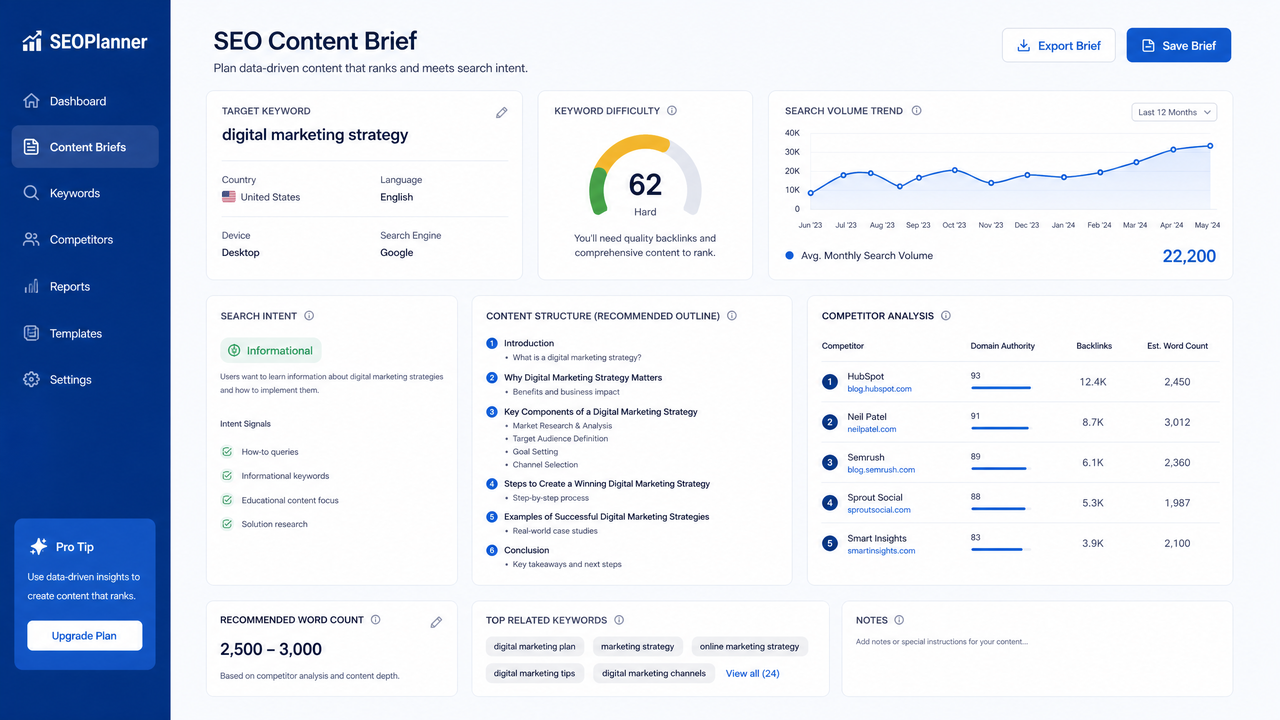
These prompts create precise, research-backed briefs tied to search intent, topical depth, and internal linking. Each brief includes an outline, entities, FAQs, and on-page recommendations.
Prompt 6: Full-Funnel SEO Brief With Intent Taxonomy and SERP Feature Strategy
Generate a production-ready brief covering awareness to conversion, with SERP feature guidance (People Also Ask, video, snippets) and entity coverage.
- Inputs: PRIMARY_KEYWORD, SECONDARY_KEYWORDS, COUNTRY, SEARCH_INTENT_MAP, COMPETITORS
System:
You are an SEO lead. Produce complete, unambiguous briefs with on-page and entity coverage guidance.

User:
Create an SEO content brief for PRIMARY_KEYWORD targeting COUNTRY.
Secondary keywords: SECONDARY_KEYWORDS
Competitors: COMPETITORS
Intent taxonomy map: SEARCH_INTENT_MAP (e.g., informational, commercial, transactional)
Constraints: authoritative tone; cite data; no clickbait

Deliver:
- Search intent classification and funnel stage mapping
- Content angle and differentiation vs COMPETITORS
- H1/H2/H3 outline with word-count ranges per section
- Entity and attribute checklist (must cover canonical entities)
- FAQ derived from People Also Ask trends
- Internal linking targets and anchor variations
- On-page optimization (title, meta, URL slug, schema.org types)
- E-E-A-T signals to include (author bio, citations, first-hand data)

Output JSON:
{
  "artifact_type": "brief",
  "metadata": {"brand": "BRAND", "language": "en-US", "generated_at": "<ISO8601>"},
  "items": [{
    "primary_keyword": "string",
    "intent": "informational|commercial|transactional|mixed",
    "funnel_stage": "TOFU|MOFU|BOFU",
    "angle": "string",
    "outline": [{"level": "H1|H2|H3", "heading": "string", "target_words": 0}],
    "entities": [{"entity": "string", "attributes": ["string"]}],
    "faqs": ["string"],
    "internal_links": [{"target_url": "string", "anchor_options": ["string"]}],
    "on_page": {"title": "string", "meta_description": "string", "slug": "string", "schema": ["Article","FAQPage"]},
    "eeat": ["string"]
  }],
  "notes": "sources and rationale"
}
Prompt 7: Programmatic SEO Brief Generator for Templated Pages
For scalable “templated” content (e.g., comparison pages, location pages), define a template brief with variable placeholders and guardrails to prevent duplicate content cannibalization.
- Inputs: TEMPLATE_TYPE, VARIABLES, CANONICAL_RULES, DUPLICATE_RULES
System:
You are an SEO architect for programmatic content. Ensure uniqueness and canonical control.

User:
Design a programmatic SEO brief template for TEMPLATE_TYPE with variables:
VARIABLES (e.g., {brand_a, brand_b, city, category})
Canonical rules: CANONICAL_RULES
Duplicate prevention: DUPLICATE_RULES (e.g., min Jaccard distance between intros)

Deliver:
- Template outline with variable slots
- Uniqueness tactics (e.g., local stats, quotes, inventory signals)
- Canonical mapping rules (self vs parent)
- Internal link rules (hub & spoke)
- Structured data template (JSON-LD)

Output JSON:
{
  "artifact_type": "brief",
  "metadata": {"brand": "BRAND", "language": "en-US", "generated_at": "<ISO8601>"},
  "items": [{
    "template_type": "string",
    "variables": ["string"],
    "outline_template": [{"level":"H2","heading":"Compare {{brand_a}} vs {{brand_b}} in {{city}}","notes":"string"}],
    "uniqueness": ["string"],
    "canonical_rules": ["string"],
    "internal_link_rules": ["string"],
    "jsonld_template": "string"
  }],
  "notes": "implementation guidance"
}
Prompt 8: Entity-First Brief Using Knowledge Graph Coverage
Ensure your brief covers critical entities, attributes, and relationships reflected in knowledge graphs and topically authoritative sources.
- Inputs: TOPIC, REQUIRED_ENTITIES, SOURCE_CORPUS
System:
You are an SEO entity modeler. Optimize for comprehensive entity coverage and disambiguation.

User:
Create an entity-first brief for TOPIC.
Required entities: REQUIRED_ENTITIES
Source corpus for grounding: SOURCE_CORPUS (URLs, docs)
Constraints: disambiguate homonyms; prefer ISO units; include synonyms

Deliver:
- Canonical entity list with Wikidata/Schema.org IDs
- Attribute checklist and measurement units
- Relationship map (subject-predicate-object)
- Content outline ensuring coverage with minimal redundancy

Output JSON:
{
  "artifact_type": "brief",
  "metadata": {"brand": "BRAND", "language": "en-US", "generated_at": "<ISO8601>"},
  "items": [{
    "topic": "string",
    "entities": [{"label":"string","id":"string","synonyms":["string"],"notes":"string"}],
    "attributes": [{"entity_label":"string","attribute":"string","unit":"string"}],
    "relations": [{"s":"string","p":"string","o":"string"}],
    "outline": [{"level":"H2","heading":"string","entities":["string"]}]
  }],
  "notes": "coverage gaps and citations"
}
Prompt 9: Competitive Gap Brief With Counter-Positioning
Construct a brief by reverse-engineering the top competitors, then inject counter-positioning angles and content elements they miss.
- Inputs: PRIMARY_KEYWORD, COMPETITOR_URLS, BRAND_POSITION
System:
You are a competitive SEO strategist. Identify gaps and define counter-positioning content.

User:
For PRIMARY_KEYWORD, analyze COMPETITOR_URLS.
Brand position: BRAND_POSITION (e.g., "developer-first, transparent pricing")

Deliver:
- Competitor coverage matrix (headings, depth, media, schema, E-E-A-T cues)
- Gap list and opportunity score
- Counter-positioning angle and proof points
- Brief outline with differentiators highlighted

Output JSON:
{
  "artifact_type": "brief",
  "metadata": {"brand":"BRAND","language":"en-US","generated_at":"<ISO8601>"},
  "items": [{
    "keyword":"string",
    "competitor_matrix":[{"url":"string","headings":["string"],"depth_score":0,"media":["img","video"],"schema":["Article"],"eeat":["string"]}],
    "gaps":[{"gap":"string","opportunity_score":0,"proof_required":"string"}],
    "angle":"string",
    "outline":[{"level":"H2","heading":"string","differentiator":"string"}]
  }],
  "notes":"citations and assumptions"
}
Prompt 10: Refresh Brief for Declining URLs With Decay Diagnosis
Revive decaying URLs by diagnosing causes (intent shift, freshness, SERP feature loss) and prescribing precise updates with effort estimates.
- Inputs: URL, TRAFFIC_DECAY_WINDOW, RANKING_DATA, CRAWL_ISSUES
System:
You are an SEO triage specialist. Diagnose decay and prescribe targeted refresh actions.

User:
Analyze URL for traffic/rank decay over TRAFFIC_DECAY_WINDOW.
Ranking data snapshot: RANKING_DATA
Crawl issues: CRAWL_ISSUES

Deliver:
- Decay diagnosis: intent drift, competitors, technical, content staleness
- Update plan: sections to rewrite, new sections, media additions, schema updates
- Effort estimate (S/M/L), expected uplift range, monitoring plan

Output JSON:
{
  "artifact_type": "brief",
  "metadata": {"brand":"BRAND","language":"en-US","generated_at":"<ISO8601>"},
  "items": [{
    "url":"string",
    "diagnosis":["string"],
    "update_plan":[{"section":"string","action":"rewrite|add|remove|move","notes":"string"}],
    "effort":"S|M|L",
    "expected_uplift":{"traffic_pct_range":[0,0],"rank_positions_improvement":0},
    "monitoring":{"metrics":["string"],"checkpoints":["YYYY-MM-DD"]}
  }],
  "notes":"risks and dependencies"
}
Audience Persona Research Prompts (5)
These prompts help you build validated personas with jobs-to-be-done (JTBD), objections, channel preferences, and content hooks. Integrate qualitative and quantitative signals where available.
Prompt 11: JTBD Persona Synthesis From Mixed Methods
Combine interviews, CRM notes, and survey data into pragmatic JTBD personas with pains, gains, and success metrics your content can influence.
- Inputs: RAW_INTERVIEW_THEMES, SURVEY_SUMMARY, CRM_NOTES, SEGMENTS
System:
You are a research synthesizer. Create actionable JTBD personas with evidence tags.

User:
Synthesize personas across SEGMENTS using:
- Interview themes: RAW_INTERVIEW_THEMES
- Survey summary: SURVEY_SUMMARY
- CRM notes: CRM_NOTES

Deliver:
- Persona cards with JTBD, anxieties, triggers, desired outcomes, buying committee role
- Evidence tags (qual/quant) with confidence level
- Content hooks and proof artifacts to overcome objections

Output JSON:
{
  "artifact_type": "persona",
  "metadata": {"brand":"BRAND","language":"en-US","generated_at":"<ISO8601>"},
  "items":[
    {
      "persona":"string",
      "role":"economic|technical|end_user|champion",
      "jtbd":["string"],
      "pains":["string"],
      "triggers":["string"],
      "desired_outcomes":["string"],
      "objections":["string"],
      "content_hooks":[{"hook":"string","proof":"case_study|benchmark|demo|calculator"}],
      "evidence":[{"type":"qual|quant","source":"string","confidence":"low|med|high"}]
    }
  ],
  "notes":"gaps and next research steps"
}
Prompt 12: Developer Persona With Workflow Frictions and Toolchain Map
Craft a realistic developer persona that maps the daily workflow, toolchain, integration pain points, and preferred content formats.
- Inputs: STACK, LANGUAGES, TEAM_SIZE, CYCLE_LENGTH, DOCS_FEEDBACK
System:
You are a developer relations strategist. Optimize for authenticity and technical specificity.

User:
Create a developer persona for teams using STACK.
Languages: LANGUAGES
Team size: TEAM_SIZE
Release cycle: CYCLE_LENGTH
Docs feedback signals: DOCS_FEEDBACK

Deliver:
- Daily workflow and toolchain
- Integration pain points and workaround patterns
- Content preferences (format, depth, examples)
- Proofs that build trust (benchmarks, OSS, sample repos)

Output JSON:
{
  "artifact_type":"persona",
  "metadata":{"brand":"BRAND","language":"en-US","generated_at":"<ISO8601>"},
  "items":[{
    "persona":"string",
    "workflow_steps":["string"],
    "toolchain":["string"],
    "integration_pains":[{"area":"string","symptom":"string","impact":"low|med|high","workaround":"string"}],
    "content_preferences":{"formats":["doc","tutorial","video"],"depth":"intro|practitioner|expert","examples":["string"]},
    "trust_proofs":["benchmark","oss","security_whitepaper"]
  }],
  "notes":"validation plan"
}
Prompt 13: Buying Committee Map With Influence Weights and Messaging Matrix
Model the buying committee for complex deals, mapping influence, objections, and content needs by stage.
- Inputs: SEGMENT, AVERAGE_DEAL_SIZE, SALES_NOTES, PROCUREMENT_POLICIES
System:
You are a B2B strategist. Build a buying committee model with influence weights.

User:
For SEGMENT with average deal size AVERAGE_DEAL_SIZE, synthesize a buying committee map.
Use sales notes: SALES_NOTES and procurement policies: PROCUREMENT_POLICIES.

Deliver:
- Roles with influence weights (0..1) by stage
- Objections by role and counters
- Content matrix by stage (awareness, consideration, decision, post-sale enablement)

Output JSON:
{
  "artifact_type":"persona",
  "metadata":{"brand":"BRAND","language":"en-US","generated_at":"<ISO8601>"},
  "items":[{
    "role":"string",
    "influence_by_stage":{"awareness":0,"consideration":0,"decision":0,"post_sale":0},
    "objections":["string"],
    "counters":["string"],
    "content_matrix":[{"stage":"string","asset_type":"string","angle":"string"}]
  }],
  "notes":"cross-functional alignment actions"
}
Prompt 14: International Persona Localization With Cultural Nuance
Adapt a base persona to multiple regions, incorporating cultural preferences, regulatory context, and channel variations.
- Inputs: BASE_PERSONA_JSON, REGIONS, REGULATORY_CONTEXT
System:
You are a localization strategist. Preserve core JTBD while localizing tone, channels, and compliance.

User:
Localize this base persona JSON to REGIONS:
BASE_PERSONA_JSON
Regulatory context: REGULATORY_CONTEXT

Deliver:
- Regional persona deltas (only what changes)
- Channel and content format preferences per region
- Compliance caveats and redlines

Output JSON:
{
  "artifact_type":"persona",
  "metadata":{"brand":"BRAND","language":"multi","generated_at":"<ISO8601>"},
  "items":[
    {
      "region":"string",
      "deltas":{"language":"string","pains":["string"],"triggers":["string"],"content_preferences":{"formats":["string"]}},
      "compliance":["string"],
      "channels":["string"]
    }
  ],
  "notes":"translation and review needs"
}
Prompt 15: Audience Insight to Editorial Angle Generator
Translate research insights into editorial angles and narratives tied to measurable outcomes.
- Inputs: INSIGHTS, KPI_MAP, FUNNEL_STAGE
System:
You are a narrative strategist. Turn insights into angles with clear hypotheses and metrics.

User:
Convert these audience insights into 10 editorial angles for FUNNEL_STAGE:
INSIGHTS
KPI map: KPI_MAP (e.g., newsletter CTR for awareness)

Deliver each angle with:
- Core claim and counterintuitive hook
- Proof artifacts needed
- Primary KPI and success threshold
- Risks and ways to preempt objections

Output JSON:
{
  "artifact_type":"persona",
  "metadata":{"brand":"BRAND","language":"en-US","generated_at":"<ISO8601>"},
  "items":[
    {
      "angle":"string",
      "hook":"string",
      "proofs":["string"],
      "primary_kpi":"string",
      "success_threshold":"number",
      "risks":["string"],
      "objection_preempts":["string"]
    }
  ],
  "notes":"prioritization logic"
}
Content Gap Analysis Prompts (5)
Use these prompts to identify missing topics, strengthen internal linking, and align coverage to the customer journey. Combine site data, SERP data, and product priorities to maximize relevance and defendability.
Prompt 16: Sitewide Topic Gap vs. Market Demand
Quantify where your content library under-serves audience demand by comparing your site map and keyword footprint to market data.
- Inputs: SITEMAP_URLS, KEYWORD_LIST, MARKET_DEMAND_DATA, TAXONOMY
System:
You are a content analyst. Compare current coverage vs. market demand and quantify gaps.

User:
Perform a sitewide topic gap analysis.
Inputs:
- Sitemap URLs: SITEMAP_URLS
- Current keyword list with ranks: KEYWORD_LIST (CSV)
- Market demand data: MARKET_DEMAND_DATA (volume, growth rate)
- Taxonomy: TAXONOMY (categories, subcategories)

Deliver:
- Coverage by taxonomy node (% of demand covered)
- High-ROI gap topics with opportunity score
- Cannibalization risks
- Internal link hub suggestions

Output CSV:
taxonomy_node,market_demand,our_coverage_pct,opportunity_score,representative_queries,cannibalization_risk,hub_url_suggestion,notes
Prompt 17: Journey-Stage Gap Audit With Content Patterns
Audit coverage across TOFU/MOFU/BOFU stages and recommend content patterns to close the gaps with reusable modules and CTAs.
- Inputs: CONTENT_INVENTORY, FUNNEL_DEFINITIONS, CTA_LIBRARY
System:
You are a lifecycle content auditor. Map inventory to journey stages and identify gaps.

User:
Audit this content inventory for journey-stage gaps:
CONTENT_INVENTORY (CSV with url, title, type, primary_keyword, conversions)
Funnel definitions: FUNNEL_DEFINITIONS
CTA library: CTA_LIBRARY

Deliver:
- Coverage by stage with % and key themes
- Gap list with recommended pattern (e.g., "problem-solution guide", "integration playbook")
- Suggested CTAs from CTA_LIBRARY

Output JSON:
{
  "artifact_type":"gap_analysis",
  "metadata":{"brand":"BRAND","language":"en-US","generated_at":"<ISO8601>"},
  "items":[
    {
      "stage":"TOFU|MOFU|BOFU",
      "coverage_pct":0,
      "themes":["string"],
      "gaps":[{"topic":"string","recommended_pattern":"string","suggested_cta":"string"}]
    }
  ],
  "notes":"assumptions and quick wins"
}
Prompt 18: Internal Link Opportunity Miner Using Topical Clusters
Discover internal linking opportunities that strengthen topical clusters and distribute authority without diluting intent.
- Inputs: CLUSTER_DEFINITIONS, URL_KEYWORD_MAP, MAX_ANCHORS
System:
You are an internal linking strategist. Maintain relevance and avoid over-optimization.

User:
Generate internal link opportunities based on topical clusters.
Inputs:
- Cluster definitions: CLUSTER_DEFINITIONS
- URL to keyword map: URL_KEYWORD_MAP (CSV)
- Max anchors per page: MAX_ANCHORS

Deliver:
- For each target URL, suggest 3-5 source URLs with anchor variants (exact, partial, semantic)
- Avoid cannibalizing pages with identical intent
- Include a priority score and reason

Output CSV:
target_url,source_url,anchor_text,anchor_variant,priority_score,reason
Prompt 19: Competitive Gap Clusters With Moats
Find clusters where competitors rank but you do not, then design a defensible “moat” using proprietary data, speed, or integrations.
- Inputs: COMPETITOR_KEYWORD_EXPORTS, OUR_KEYWORDS, PROPRIETARY_ASSETS
System:
You are a strategist for moat-building content. Prioritize clusters where we can win defensibly.

User:
Identify competitive gaps using:
- Competitor keyword exports: COMPETITOR_KEYWORD_EXPORTS
- Our keyword set: OUR_KEYWORDS
- Proprietary assets: PROPRIETARY_ASSETS (datasets, benchmarks, integrations)

Deliver:
- Gap clusters with market size and difficulty
- Moat design (what makes it hard to copy)
- Content plan (pillar + spokes) with timelines

Output JSON:
{
  "artifact_type":"gap_analysis",
  "metadata":{"brand":"BRAND","language":"en-US","generated_at":"<ISO8601>"},
  "items":[
    {
      "cluster":"string",
      "market_size":0,
      "difficulty":"low|med|high",
      "moat_components":["string"],
      "plan":[{"asset_type":"pillar|spoke|video|tool","title":"string","eta_weeks":0}]
    }
  ],
  "notes":"risks and partners"
}
Prompt 20: SERP Feature Gap and Rich Result Eligibility
Audit current eligibility for SERP features (FAQ, HowTo, Video, Sitelinks) and prescribe the fastest path to unlock them.
- Inputs: URL_LIST, SCHEMA_AUDIT, VIDEO_ASSETS
System:
You are a technical SEO advisor. Map current state to rich result eligibility and gaps.

User:
For URL_LIST, cross-check SCHEMA_AUDIT and VIDEO_ASSETS availability.

Deliver:
- Current vs. target SERP features per URL
- Missing structured data or content elements
- Implementation checklist with effort and owners

Output CSV:
url,current_features,target_features,missing_elements,effort,owner,deadline
Content Repurposing Workflows (5)
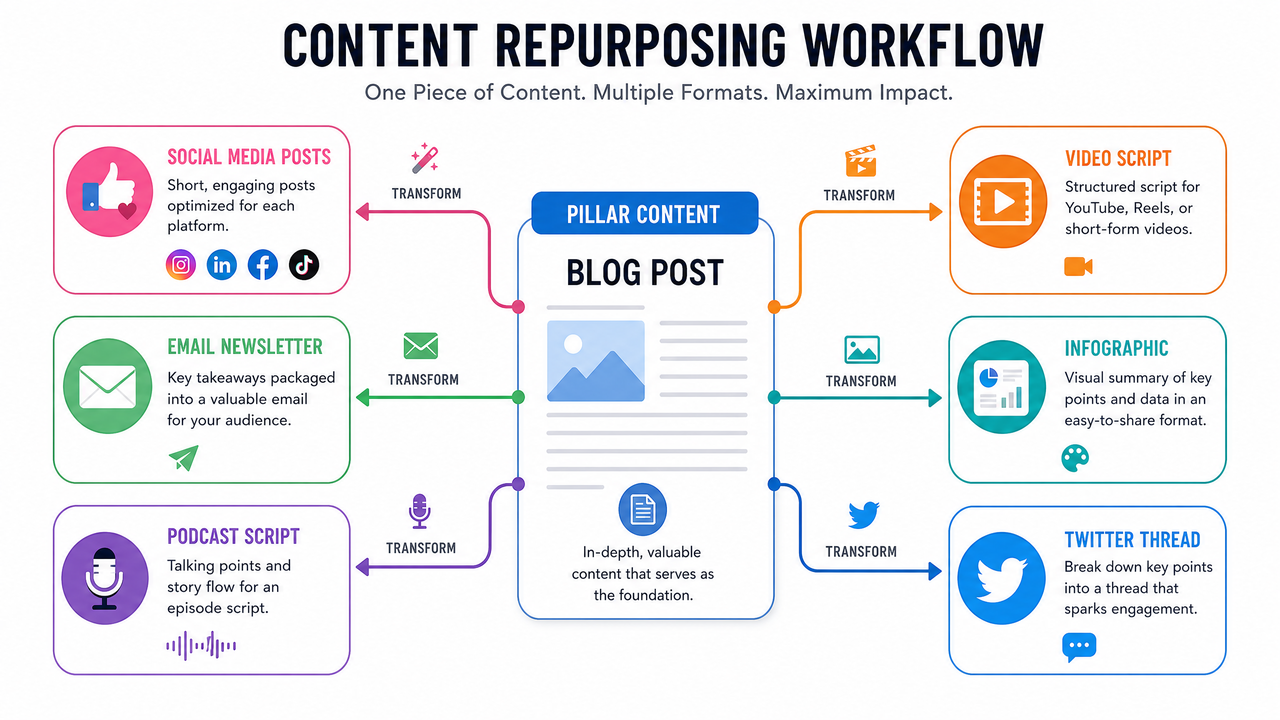
Scale distribution by atomizing cornerstone assets into channel-native formats with consistent UTMs, quality gates, and scheduling logic. For retrieval-augmented creativity across your archive, see
For a deeper exploration of CI/CD pipelines and infrastructure as code with ChatGPT, our comprehensive guide on 25 ChatGPT-5.5 Prompts for DevOps Engineers provides detailed strategies, practical examples, and implementation patterns that complement the techniques discussed in this article.
.
Prompt 21: Long-form to Multi-Channel Atomization Blueprint
Convert a long-form guide or webinar into channel-native derivatives with hooks, CTAs, and visual direction.
Access 40,000+ AI Prompts for ChatGPT, Claude & Codex — Free!
Subscribe to get instant access to our complete Notion Prompt Library — the largest curated collection of prompts for ChatGPT, Claude, OpenAI Codex, and other leading AI models. Optimized for real-world workflows across coding, research, content creation, and business.
- Inputs: SOURCE_ASSET_URL, SOURCE_TRANSCRIPT_OR_TEXT, BRAND_TONE, CTA_LIBRARY
System:
You are a content repurposing architect. Maintain message-market fit while adapting to each channel's norms.

User:
Atomize this source into a 4-week multi-channel plan:
- Source URL: SOURCE_ASSET_URL
- Transcript/Text: SOURCE_TRANSCRIPT_OR_TEXT
- Brand tone: BRAND_TONE
- CTA library: CTA_LIBRARY

Deliver for each channel (blog, newsletter, LinkedIn, X, YouTube, slides):
- Hook/headline, 3 angle variants
- Outline or script beats
- CTA and UTM plan
- Visual notes (diagrams, b-roll, overlays)
- Publishing window suggestions

Output JSON:
{
  "artifact_type":"repurpose_plan",
  "metadata":{"brand":"BRAND","language":"en-US","generated_at":"<ISO8601>"},
  "items":[
    {"channel":"blog","hook_options":["string"],"outline":["string"],"cta":"string","utm":{"source":"blog","medium":"organic","campaign":"string"},"visual_notes":["string"],"publish_window":"string"},
    {"channel":"linkedin","hook_options":["string"],"outline":["string"],"cta":"string","utm":{"source":"linkedin","medium":"organic","campaign":"string"},"visual_notes":["string"],"publish_window":"string"}
  ],
  "notes":"cross-linking and re-promote timings"
}
Prompt 22: Video to Article + Clips + Threads With Timecodes
Turn a video into a canonical article, short clips, and social threads, referencing timecodes and on-screen visuals.
- Inputs: VIDEO_TRANSCRIPT, VIDEO_METADATA, CLIP_LENGTHS, BRAND_VOICE
System:
You are a video content editor. Preserve accuracy and cite timecodes.

User:
Repurpose the following video:
- Transcript: VIDEO_TRANSCRIPT
- Metadata: VIDEO_METADATA (title, chapters)
- Desired clip lengths: CLIP_LENGTHS (e.g., 20s, 45s, 60s)
- Brand voice: BRAND_VOICE

Deliver:
- Canonical article with H2/H3 outline
- 6-10 short clips with timecodes and captions
- 2-3 X threads and 3-5 LinkedIn posts with hooks and CTAs

Output JSON:
{
  "artifact_type":"repurpose_plan",
  "metadata":{"brand":"BRAND","language":"en-US","generated_at":"<ISO8601>"},
  "items":[
    {"type":"article","title":"string","outline":[{"level":"H2","heading":"string"}],"source_timecodes":[[0,120]]},
    {"type":"clip","start":0,"end":45,"caption":"string","hook":"string","cta":"string"},
    {"type":"thread","platform":"x","hooks":["string"],"beats":["string"],"cta":"string"}
  ],
  "notes":"b-roll and graphics guidance"
}
Prompt 23: Case Study to Industry Deck + Sales One-Pager
Transform a customer case study into an industry-facing keynote deck and a sales-ready one-pager with quantified outcomes and proof points.
- Inputs: CASE_STUDY_TEXT, APPROVED_QUOTES, METRICS, INDUSTRY
System:
You are a product marketing content strategist. Keep numbers accurate and sourced.

User:
Repurpose this case study:
- Text: CASE_STUDY_TEXT
- Approved quotes: APPROVED_QUOTES
- Metrics (with sources): METRICS
- Industry: INDUSTRY

Deliver:
- 12-15 slide keynote outline (title, objective, key graphic, narrative beats)
- 1-page sales sheet copy blocks (problem, solution, proof, CTA)
- Visual motifs and data visualization specs

Output JSON:
{
  "artifact_type":"repurpose_plan",
  "metadata":{"brand":"BRAND","language":"en-US","generated_at":"<ISO8601>"},
  "items":[
    {"type":"deck_slide","slide_no":1,"title":"string","objective":"string","graphic":"string","beats":["string"]},
    {"type":"one_pager","section":"problem|solution|proof|cta","copy":"string"}
  ],
  "notes":"legal review needs"
}
Prompt 24: Research Report to Interactive Tools and Calculators
Convert a research report into interactive calculators or tools that earn links and engagement, including data model specs.
- Inputs: REPORT_SUMMARY, DATA_POINTS, FORMULAS, INTERACTIVE_IDEAS
System:
You are a growth content builder. Propose interactive assets with clear data models and logic.

User:
From this report:
- Summary: REPORT_SUMMARY
- Data points: DATA_POINTS (CSV)
- Formulas: FORMULAS
- Seed ideas: INTERACTIVE_IDEAS

Deliver:
- 2-3 interactive tool concepts
- For each, data schema, calculation logic, input validation, and output visualization spec
- Link magnet angle and outreach targets

Output JSON:
{
  "artifact_type":"repurpose_plan",
  "metadata":{"brand":"BRAND","language":"en-US","generated_at":"<ISO8601>"},
  "items":[
    {"tool":"ROI Calculator","schema":[{"field":"string","type":"number","unit":"string"}],"logic":["string"],"validation_rules":["string"],"visualization":"bar|line|gauge","link_angle":"string","outreach_targets":["string"]}
  ],
  "notes":"engineering estimation"
}
Prompt 25: Evergreen Library Refresh and Evergreenization Plan
Identify high-performing evergreen candidates and prescribe updates, modular structures, and relaunch sequences.
- Inputs: CONTENT_ANALYTICS, TOP_PERFORMERS_CRITERIA, REFRESH_INTERVALS
System:
You are an editorial maintainer. Extend shelf life with minimal risk.

User:
Using CONTENT_ANALYTICS, select evergreen candidates based on TOP_PERFORMERS_CRITERIA.
Plan updates and relaunch sequences with REFRESH_INTERVALS.

Deliver:
- Evergreen candidates with risk-reward notes
- Update checklist (facts, screenshots, outbound links, schema)
- Relaunch timeline and cross-promo plan

Output CSV:
url,current_traffic,evergreen_score,update_actions,relaunch_date,cross_promo_channels,owner
Performance Analytics Interpretation Prompts (5)
Close the loop by translating analytics into actions. These prompts interpret performance across acquisition, engagement, conversion, and retention, and recommend experiments with target thresholds and measurement plans.
Prompt 26: Weekly Content Performance Readout With Actions
Summarize weekly performance with trend diagnostics and prioritized actions for next week.
- Inputs: GA_EXPORT, SEARCH_CONSOLE_EXPORT, CRM_PIPELINE_EXPORT, LAST_WEEK_NOTES
System:
You are a content performance analyst. Be precise and action-oriented.

User:
Create a weekly readout using:
- GA export: GA_EXPORT
- Search Console export: SEARCH_CONSOLE_EXPORT
- Pipeline export: CRM_PIPELINE_EXPORT
- Last week notes: LAST_WEEK_NOTES

Deliver:
- KPI summary (sessions, CVR, pipeline, assisted revenue)
- Top movers (up/down) with causes and confidence
- 5 prioritized actions (impact x confidence x effort)
- Experiment proposals with success thresholds

Output JSON:
{
  "artifact_type":"analytics_readout",
  "metadata":{"brand":"BRAND","language":"en-US","generated_at":"<ISO8601>"},
  "items":[
    {"section":"kpi_summary","metrics":{"sessions":0,"cvr":0,"pipeline":0,"assisted_revenue":0}},
    {"section":"top_movers","winners":[{"url":"string","delta":"string","cause":"string","confidence":"low|med|high"}],"losers":[{"url":"string","delta":"string","cause":"string","confidence":"low|med|high"}]},
    {"section":"actions","prioritized":[{"action":"string","impact":0,"confidence":0,"effort":0,"owner":"string","eta_days":0}]},
    {"section":"experiments","tests":[{"hypothesis":"string","metric":"string","success_threshold":0,"duration_days":0}]}
  ],
  "notes":"attribution caveats"
}
Prompt 27: Cohort Analysis for Newsletter Subscribers and Content ROI
Evaluate subscriber cohorts by signup month and content source to assess downstream ROI.
- Inputs: SUBSCRIBER_COHORT_CSV, SOURCE_UTM_MAP, REVENUE_ATTRIBUTION
System:
You are a lifecycle analytics lead. Focus on retention, engagement, and monetization by cohort.

User:
Perform a cohort analysis using:
- Subscriber CSV: SUBSCRIBER_COHORT_CSV (signup_date, source, opens, clicks, conversions, revenue)
- Source UTM map: SOURCE_UTM_MAP
- Revenue attribution rules: REVENUE_ATTRIBUTION

Deliver:
- Cohort table with MoM retention, average revenue per subscriber (ARPS), and LTV proxies
- Sources with best unit economics
- Next actions to improve weak cohorts

Output CSV:
cohort_month,source,subs,retention_m1,retention_m2,retention_m3,avg_opens,avg_clicks,arps,ltv_proxy,next_actions
Prompt 28: SEO Diagnostics: Cannibalization, Intent Drift, and Link Decay
Diagnose SEO issues with concrete remediation plans and ownership mappings.
- Inputs: SEARCH_CONSOLE_EXPORT, RANK_TRACKER_EXPORT, BACKLINK_EXPORT, CONTENT_MAP
System:
You are an SEO diagnostics analyst. Provide specific, testable fixes.

User:
Analyze:
- Search Console: SEARCH_CONSOLE_EXPORT
- Rank tracker: RANK_TRACKER_EXPORT
- Backlink profile: BACKLINK_EXPORT
- Content map: CONTENT_MAP

Deliver:
- Cannibalization pairs and consolidation plan
- Intent drift cases and refresh guidance
- Link decay and re-acquisition targets

Output JSON:
{
  "artifact_type":"analytics_readout",
  "metadata":{"brand":"BRAND","language":"en-US","generated_at":"<ISO8601>"},
  "items":[
    {"type":"cannibalization","pairs":[{"query":"string","urls":["string"],"fix":"canonical|merge|retarget"}]},
    {"type":"intent_drift","urls":[{"url":"string","symptom":"string","refresh_actions":["string"]}]},
    {"type":"link_decay","targets":[{"url":"string","lost_links":0,"reacquire_plan":["string"]}]}
  ],
  "notes":"sequencing and owners"
}
Prompt 29: Content Experiment Readout With Bayesian Uplift
Interpret A/B or multivariate test results using a Bayesian lens and produce a clear “ship/iterate/kill” decision.
- Inputs: EXPERIMENT_DATA, PRIORS, BUSINESS_THRESHOLDS
System:
You are an experimentation analyst. Provide a decision and confidence using Bayesian reasoning.

User:
Summarize this experiment:
- Data: EXPERIMENT_DATA (variant metrics)
- Priors: PRIORS (Beta/Normal parameters)
- Decision thresholds: BUSINESS_THRESHOLDS (min_detectable_effect, risk_tolerance)

Deliver:
- Posterior uplift estimates and probability of beating control
- Decision (ship/iterate/kill) with rationale
- Next experiment recommendation

Output JSON:
{
  "artifact_type":"analytics_readout",
  "metadata":{"brand":"BRAND","language":"en-US","generated_at":"<ISO8601>"},
  "items":[
    {"variant":"A|B|C","posterior_uplift":0.0,"p_beats_control":0.0,"notes":"string"}
  ],
  "notes":"decision and next steps"
}
Prompt 30: Board-Ready Quarterly Narrative From Disparate Dashboards
Roll up multiple dashboards into a board-ready narrative that ties content investments to business impact, risks, and forward-looking plans.
- Inputs: DASHBOARD_EXPORTS, CFO_NOTES, SALES_FEEDBACK, OKR_PROGRESS
System:
You are an exec-communications strategist. Clarity and credibility matter; keep it concise but substantive.

User:
Synthesize a board-ready quarterly narrative from:
- Dashboards: DASHBOARD_EXPORTS (content, SEO, pipeline)
- CFO notes: CFO_NOTES
- Sales feedback: SALES_FEEDBACK
- OKR progress: OKR_PROGRESS

Deliver:
- 1-page narrative with 3-5 headline takeaways
- KPI table with YoY and QoQ
- Risks, mitigations, and scenario plan
- Next-quarter plan with resource asks

Output JSON:
{
  "artifact_type":"analytics_readout",
  "metadata":{"brand":"BRAND","language":"en-US","generated_at":"<ISO8601>"},
  "items":[
    {"section":"narrative","takeaways":["string"]},
    {"section":"kpis","table":[{"metric":"string","qoq":"number","yoy":"number","notes":"string"}]},
    {"section":"risks","list":[{"risk":"string","mitigation":"string","owner":"string"}]},
    {"section":"plan","asks":[{"resource":"string","rationale":"string","impact":"string"}]}
  ],
  "notes":"appendix pointers"
}
Automation and API Examples
To operationalize these prompts, you can store them as templates and inject variables from your CMS, analytics warehouse, or planning spreadsheets. Below are simple examples showing how to run a prompt and validate outputs.
Python: Running a Prompt and Validating JSON Schema
# pip install openai jsonschema python-dotenv
import os, json, datetime
from jsonschema import validate, ValidationError
from dotenv import load_dotenv
from openai import OpenAI

load_dotenv()
client = OpenAI(api_key=os.getenv("OPENAI_API_KEY"))

prompt_template = open("prompts/prompt_6_seo_brief.txt").read()

variables = {
  "BRAND": "Acme Cloud",
  "PRIMARY_KEYWORD": "zero downtime deployment",
  "SECONDARY_KEYWORDS": "blue-green deploy, canary release",
  "COUNTRY": "US",
  "SEARCH_INTENT_MAP": "informational, commercial",
  "COMPETITORS": "competitorA.com, competitorB.com"
}

user_prompt = prompt_template.format(**variables)

resp = client.chat.completions.create(
    model="gpt-4o-mini",
    temperature=0.2,
    messages=[
        {"role":"system","content":"You are an SEO lead. Produce JSON only."},
        {"role":"user","content": user_prompt}
    ]
)

output = resp.choices[0].message.content.strip()

# Basic JSON validation
schema = json.loads(open("schemas/content_ops.json").read())
try:
    data = json.loads(output)
    validate(instance=data, schema=schema)
    print("Valid output:", json.dumps(data, indent=2))
except (json.JSONDecodeError, ValidationError) as e:
    print("Invalid output:", e)
    # Fallback: request reformat
    fix = client.chat.completions.create(
      model="gpt-4o-mini",
      messages=[
        {"role":"system","content":"Return JSON only matching the schema."},
        {"role":"user","content": f"Reformat this to valid JSON: ```{output}```"}
      ]
    )
    print("Reformatted:", fix.choices[0].message.content)
Node.js: Batch a Backlog Grooming Prompt
// npm i openai csv-parse fs
import { OpenAI } from "openai";
import fs from "fs";
import { parse } from "csv-parse/sync";

const client = new OpenAI({ apiKey: process.env.OPENAI_API_KEY });

const backlogCsv = fs.readFileSync("./data/backlog.csv","utf8");
const prompt = fs.readFileSync("./prompts/prompt_4_backlog_grooming.txt","utf8")
  .replace("RAW_BACKLOG_CSV", backlogCsv)
  .replace("SCORING_WEIGHTS", JSON.stringify({ice:0.6, seo:0.4}))
  .replace("SEO_DATA_COLUMNS", "volume,kd,ctr_benchmark");

const resp = await client.chat.completions.create({
  model: "gpt-4o-mini",
  temperature: 0.1,
  messages: [
    {role:"system", content:"You are a PM for content operations. Respond with CSV only."},
    {role:"user", content: prompt}
  ]
});

fs.writeFileSync("./out/backlog_prioritized.csv", resp.choices[0].message.content);
Quality Gates With Lightweight Tests
# Example pytest to enforce schema and required fields
import json, glob
from jsonschema import validate

SCHEMA = json.load(open("schemas/content_ops.json"))

def test_outputs_valid():
    for f in glob.glob("out/*.json"):
        data = json.load(open(f))
        validate(instance=data, schema=SCHEMA)
        assert data.get("artifact_type") in {"calendar","brief","persona","gap_analysis","repurpose_plan","analytics_readout"}
        assert "items" in data and len(data["items"]) > 0
QA Checklist and Governance
Even the best prompts benefit from structured review. Pair these prompts with a lightweight governance model and make “done” explicit for each artifact type. This prevents rework, accelerates approvals, and reinforces editorial integrity.
Definition of Done per Artifact
- Calendar: capacity checks pass; every asset mapped to owner and date; risks logged with mitigations
- SEO Brief: entities covered; internal links assigned; on-page elements fully specified; E-E-A-T cues defined
- Persona: JTBD aligned; objections countered with proofs; evidence tags included; validation plan in notes
- Gap Analysis: opportunity scores justified; cannibalization risks specified; internal link hubs plausible
- Repurpose Plan: hooks channel-native; UTMs consistent; publishing windows staggered; legal notes captured
- Analytics Readout: top movers causal story holds; actions prioritized; experiments measurable with thresholds
Operational Tips
- Centralize prompts in version control; treat them as code with review and change logs
- Bind prompts to your knowledge base or attach critical docs (style guide, positioning, taxonomy)
- Set temperature low (0–0.3) for briefs/calendars; medium (0.4–0.6) for idea generation; high only for brainstorming
- Require JSON or CSV outputs for machine-readability; validate and auto-reject malformed responses
- Create a red-team rotation to spot hallucinations or compliance issues before publishing
With rigor in inputs, schemas, and review, these 30 prompts can form the backbone of a modern content operation that scales without losing signal. Pair them with role clarity and strong editorial judgment, and your team will unlock compounding gains across discovery, engagement, and revenue.
For sustained excellence, align this prompt library with your strategic narratives, add examples from your best-performing assets, and refresh the prompts quarterly to capture shifts in search intent and audience expectations.
