
From Code to Discovery: How OpenAI’s Coding Agents are Accelerating Scientific Software Development
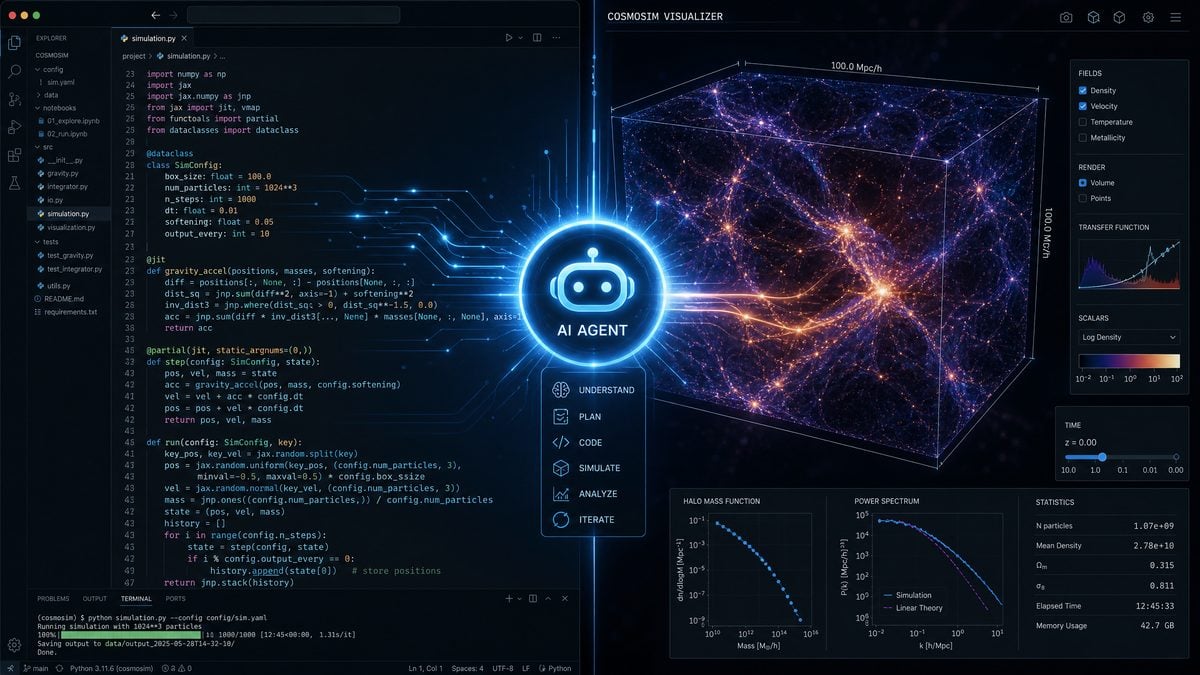
From Code to Discovery: How OpenAI’s Coding Agents are Accelerating Scientific Software Development
Introduction
When a simulation bug costs weeks of research time, smart coding agents can turn the clock back — and move science forward. That instant reframing captures why AI-driven tools are becoming essential in scientific software development: they speed iteration, catch errors earlier, and free researchers to focus on discovery instead of boilerplate.
Why this matters to you
This article is written for researchers, scientific software engineers, data scientists, and lab managers who care about reproducibility, time-to-insight, and scalable computational workflows. Whether you’re maintaining an analysis pipeline, building simulation code, or orchestrating reproducible experiments, OpenAI coding agents offer a new layer of automation and collaboration that aligns with lab priorities and funding pressures.
Thesis
OpenAI coding agents reduce development time, improve reproducibility, and enable new research workflows by automating repetitive tasks, suggesting robust patterns, and integrating with testing and deployment toolchains. By acting as pair-programmers, code reviewers, and documentation assistants, these agents transform software lifecycles from ad-hoc scripts into maintainable, shareable research artifacts.
What readers will get
- Concrete ways OpenAI coding agents speed up prototyping and bug-fixing in scientific software.
- How AI-assisted coding for research improves reproducibility and lowers onboarding time.
- Examples of automating scientific software tasks — from unit tests to deployment — that free researchers for analysis.
- Practical considerations for integrating coding agents into lab workflows and CI/CD pipelines.
| Primary SEO Keyword | Target intent / placement |
|---|---|
| OpenAI coding agents | Headline, intro paragraph, technical examples |
| scientific software development | Context setting, workflow benefits |
| AI-assisted coding for research | Use cases, reproducibility section |
| automating scientific software | CI/CD examples, automation benefits |
| coding agents for scientists | Callouts, audience-focused recommendations |
Across the rest of this piece we’ll examine concrete scenarios where coding agents accelerate experiments—from initial prototyping and data-cleaning scripts to test-driven simulation stacks and reproducible notebooks shared across teams. Expect practical tips for adopting these tools, pitfalls to avoid, and a roadmap for integrating AI into existing development practices.
Suggested meta description: “Explore how OpenAI’s coding agents speed scientific software development — from prototyping to reproducible research and collaborative workflows.”
Hook: From a single line to a working prototype
Quick anecdote and statistic
When a computational biology group replaced part of their manual scripting loop with an OpenAI coding agent, what had been a two-week prototyping cycle shrank to a few days — early adopters report prototype cycles shortened by up to ~40% in routine tasks. That speedup is not just about writing code faster; it’s about iterating experimental ideas, cleaning data, and validating models more often, which directly accelerates discovery.
Across labs and research teams, coding agents are being used to accelerate experiments—from initial prototyping and data-cleaning scripts to test-driven simulation stacks and reproducible notebooks shared across teams. This article shows practical ways to adopt these tools, common pitfalls to avoid, and a step-by-step roadmap for integrating AI into existing development practices.
Article roadmap
The sections below map the article so you can jump to what matters most. Search engines and readers alike will find the structure clear and actionable.
- How OpenAI’s coding agents work — core capabilities, APIs, and typical workflows for scientific software.
- Use cases in scientific workflows — prototyping, data cleaning, simulation, test-driven development, and reproducible notebooks.
- Practical adoption tips — recommended practices, tooling, and team roles to get started quickly.
- Pitfalls and how to avoid them — common failure modes, data leakage risks, and testing strategies.
- Integration roadmap — a staged plan for adding coding agents to existing processes without disrupting research.
- Case studies and benchmarks — short examples illustrating time saved, quality improvements, and reproducibility gains.
- Resources and next steps — templates, starter repos, and governance checklists for teams.
Quick reference table: Where agents add value
| Task | Example outcome |
|---|---|
| Prototyping | Functional prototype in hours instead of days; scaffolded APIs and example data |
| Data cleaning & ETL | Automated scripts with common edge-case handling and unit tests |
| Test-driven simulation stacks | Repeatable simulation pipelines with CI hooks and regression tests |
| Reproducible notebooks | Executable notebooks with environment specs and narrative explanations |
| Collaboration | Shared code reviews and consistent style applied programmatically |
Throughout the article you’ll find concrete examples, code snippets, and a pragmatic integration plan so teams can safely and efficiently incorporate OpenAI’s coding agents into scientific software development without losing control of reproducibility, interpretability, or governance.
SEO brief: Targeting “OpenAI coding agents”
This section outlines the on-page strategy and link architecture for the article “From Code to Discovery: How OpenAI’s Coding Agents are Accelerating Scientific Software Development.” Focus the piece around the primary keyword OpenAI coding agents while supporting with the secondary keywords scientific software development, AI for research code, and reproducible research tools. Aim for clear H2/H3 hierarchy, practical examples (notebooks with environment specs and narrative explanations), and actionable integration guidance (shared code reviews and consistent style applied programmatically).
[hIMAGE_PLACEHOLDER_SECTION_X]Primary & secondary keyword usage
- Primary keyword (focus): “OpenAI coding agents” — use in title, first H2, and within first 100 words.
- Secondary keywords (supporting): “scientific software development”, “AI for research code”, “reproducible research tools” — sprinkle across H3s, captions, and alt text for images.
- LSI/related phrases: LLM-assisted coding, reproducibility in notebooks, reproducible environments, code review automation, model interpretability.
Suggested article structure & content angles
- Intro: Why OpenAI coding agents matter for scientific software development — emphasize acceleration without sacrificing reproducibility.
- Practical section: Examples and code snippets — include executable notebooks with environment specs and narrative explanations to support reproducible research tools.
- Workflow: Integration plan — linting, automated code review, test generation, environment pinning, and governance checkpoints.
- Collaboration: Shared code reviews and consistent style applied programmatically; show how teams can retain control of interpretability and provenance.
- Case studies: Link to open-source scientific projects and LLM-assisted experiments that demonstrate gains in developer velocity and reproducibility.
Suggested internal links
- AI coding tools overview — ChatGPT AI Hub
- Prompting best practices for coding agents
- Reproducibility guides and notebook practices
Suggested external links
- OpenAI documentation — API and safety guidance for coding agents
- Biopython — example scientific project for biology-focused codebases
- NCAR & climate-model repos — climate modeling examples and community code
- Recent papers on LLM-assisted coding (arXiv search)
Table: Key features to highlight in the article
| Feature | Implementation / Example |
|---|---|
| Notebooks | Executable notebooks with environment specs and narrative explanations for reproducibility |
| Testing | Auto-generated unit tests and CI integration demonstrating reproducible outcomes |
| Collaboration | Shared code reviews and consistent style applied programmatically |
| Governance | Audit logs, provenance metadata, and human-in-the-loop checkpoints |
Tone: pragmatic, evidence-driven, and developer-friendly. Include concrete examples, minimal but clear code snippets, and a stepwise integration plan so teams can adopt OpenAI coding agents while maintaining reproducibility, interpretability, and governance.
The Challenges of Scientific Software Development
Scientific software projects routinely run into similar, predictable bottlenecks that slow down discovery. Typical pain points include long development cycles, brittle code, scarce documentation, poor testing, fragile environments, and challenges reproducing results. These issues are more than developer annoyances — they measurably delay experiments, produce irreproducible claims, and force labs to reimplement existing work.

Common pain points
- Long development cycles: experiments are delayed by weeks when a single pipeline change cascades into incompatibilities.
- Brittle code: ad-hoc scripts and hidden data assumptions cause runtime failures that are hard to diagnose.
- Lack of documentation: reproducibility collapses when only the original author understands scripts.
- Poor testing: few unit/integration tests mean silent regressions and invalidated results.
- Environment/setup issues: dependency drift across clusters and HPC nodes breaks workflows.
- Reproducibility problems: missing provenance metadata and unpinned dependencies prevent rerunning analyses.
Why domain scientists struggle
Domain experts often lack formal software-engineering training and work across fragmented toolchains — a mixture of Fortran, C/C++, domain-specific libraries, and Python glue code. This heterogeneity multiplies integration friction: compiling a Fortran module with a newer GCC, linking to an old C++ library, or upgrading a Python dependency can each silently break pipelines. Heavy reliance on domain-specific binaries and formats further reduces reuse across teams.
Impact on research outcomes
The downstream consequences are concrete: experimental schedules slip, papers contain results that cannot be rerun, and multiple groups reinvent the same data-preprocessing or analysis code. Time that could be spent on new science is instead consumed by environment wrangling and debugging brittle pipelines.
Concrete examples and minimal code snippets
Example: a reproducible environment using pinned Python dependencies and a simple test:
# requirements.txt
numpy==1.24.3
scipy==1.10.1
pytest==7.3.2
# tests/test_mean.py
import numpy as np
from mylib.stats import mean
def test_mean():
    assert mean([1,2,3]) == np.mean([1,2,3])
Or a minimal Dockerfile to protect against environment drift:
FROM python:3.10-slim
COPY requirements.txt .
RUN pip install -r requirements.txt
COPY . /app
WORKDIR /app
CMD ["pytest", "-q"]
Stepwise integration plan to adopt coding agents (maintaining reproducibility & governance)
- Inventory: programmatically scan repositories for language mix, dependencies, and tests.
- Standardize: apply consistent style and linters across codebases via automated PRs from coding agents.
- Containerize: generate Docker/Singularity recipes and CI jobs to pin environments.
- Test & provenance: have agents add unit tests and auto-generate provenance metadata for key pipelines.
- Govern & review: enforce human-in-the-loop checkpoints, audit logs, and signed artifacts before merge.
| Collaboration | Governance |
|---|---|
| Shared code reviews and consistent style applied programmatically | Audit logs, provenance metadata, and human-in-the-loop checkpoints |
These steps reduce duplicated effort and improve reproducibility while keeping humans in control — pragmatic measures that let scientists focus on hypotheses rather than tooling.
Key subtopics to cover
Reproducibility and environment management
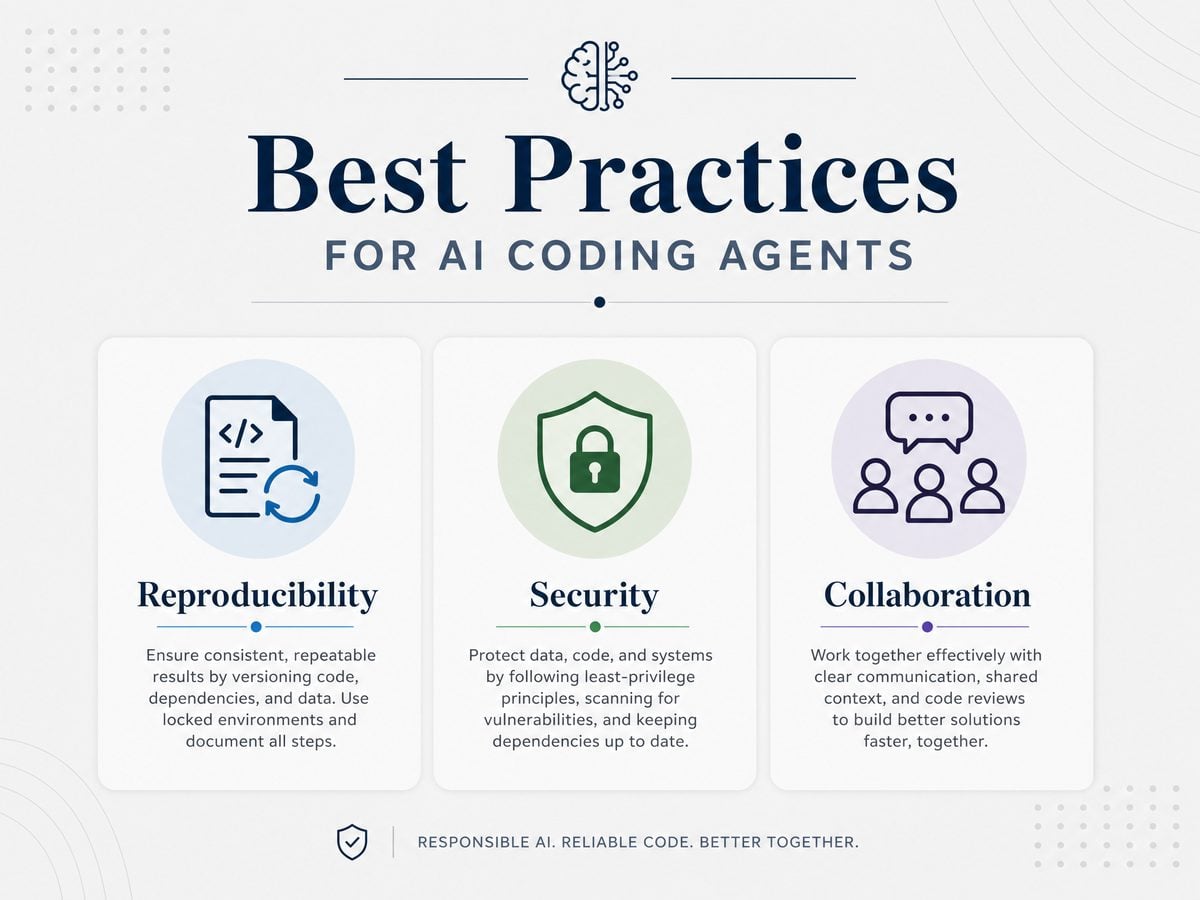
Scientific software often breaks not because of bugs in algorithms but because of fragile environments. Conda environment.yml files, pinned pip requirements, container recipes (Dockerfile, Singularity), and reproducible-build practices are essential to avoid “dependency hell.” OpenAI coding agents can automate environment capture, produce clean conda manifests, and generate container images so experiments are portable across machines and teams.
- Use environment manifests (conda/pip) and lockfiles to pin versions and hashes.
- Encapsulate runtime in containers (Docker, Singularity) for consistent OS-level behavior.
- Adopt reproducible build policies: deterministic installs, artifact signing, and immutable images.
Agents can also run matrix builds (different Python, CUDA, and library versions) and produce provenance metadata and signed artifacts before merge, so downstream users can verify exactly what was run and reproduce results reliably.
Testing and validation challenges for scientific code
Testing scientific code differs from traditional software testing because outputs are often numerical, approximate, or stochastic. Unit tests remain useful for deterministic utility functions, but numerical tolerance tests, regression tests, and statistical checks are required for scientific correctness.
- Unit tests for deterministic components (I/O, parsing, small math utilities).
- Numerical tolerance tests with well-defined thresholds and documented seeds for stochastic components.
- Regression tests that compare metrics over time (e.g., accuracy, energy conservation) rather than bitwise equality.
- Property-based and randomized tests to detect edge cases and distributional failures.
Coding agents can generate test scaffolding, propose tolerance bounds based on historical runs, and run CI that captures nondeterminism (fixed RNG seeds, environment isolation). They can also label flaky tests and suggest mitigations, reducing developer overhead while keeping validation rigorous.
Collaboration friction: code style, inconsistent APIs, and poor documentation
Teams waste time reconciling style differences, learning inconsistent APIs, and deciphering sparse documentation. Programmatic enforcement and automation close that gap:
- Automated formatters and linters applied in pre-commit and CI reduce style debates and speed reviews.
- API compatibility checks, adapter generation, and canonical interface specifications lower integration friction.
- Automated doc generation, example synthesis, and README templates make onboarding faster and experiments easier to reproduce.
OpenAI coding agents can apply consistent style automatically, refactor APIs to consistent patterns, generate example notebooks, and create living documentation from tests and code. Combined with shared code reviews and governance controls, this reduces duplicated effort and keeps focus on science.
| Collaboration | Governance |
|---|---|
| Shared code reviews and consistent style applied programmatically | Audit logs, provenance metadata, and human-in-the-loop checkpoints |
Together, these elements—robust environment management, tailored testing strategies, and reduced collaboration friction—enable reproducible, maintainable scientific software. Agents accelerate routine engineering tasks while audit logs and signed artifacts preserve traceability and human oversight before merge, keeping science both fast and credible.
How OpenAI’s Coding Agents Work
OpenAI’s coding agents act as AI copilots that accelerate scientific software development by synthesizing programs, performing automated code reviews, and generating tests and documentation. At a high level they translate high-level intent into concrete code artifacts, propose refactors, and produce reproducible environment specifications—while emitting provenance metadata and audit logs so humans can inspect and approve changes before they merge. These agents are most effective when integrated into a human-in-the-loop workflow: they automate routine engineering tasks and surface decisions and diffs for expert review.
(alt text: “diagram of coding agent workflow in scientific software”)
Technical building blocks
- Prompt engineering and few-shot examples: Carefully designed prompts and representative exemplars steer the model toward domain-appropriate solutions, coding style (istent style applied programmatically), and desirable test patterns.
- Tool and agent frameworks: Agents use APIs, function-calling interfaces, language-aware REPLs, and plugin-style toolkits to run code, query package managers, or call linters and test suites as part of a feedback loop.
- Context windows and memory: Large context windows and short-term memory let agents consider code history, design notes, and recent diffs; longer-term memories store style rules and architecture constraints.
- Retrieval-augmented generation: Agents fetch relevant specs, prior commits, or scientific literature from indexed corpora so suggestions are grounded in project history and domain knowledge.
- Provenance and auditability: Signed artifacts, structured metadata, and append-only audit logs capture the agent’s inputs, prompts, and outputs for reproducibility and regulatory traceability.
| Building Block | Role in Agent Workflow |
|---|---|
| Prompt + Few-shot | Steer style and solution patterns; reduce undesired behavior |
| APIs / Function-calls | Execute tests, query package indices, update CI configs |
| Context & Memory | Preserve architecture constraints and recent code context |
| Retrieval Augmentation | Ground responses in prior art, specs, and literature |
| Audit logs / Provenance | Provide reviewable trails and checkpoints for human approval |
Kinds of agent tasks
- Scaffold prototypes from high-level scientific descriptions—generate modules, example notebooks, and minimal reproducible demos.
- Refactor code to match style guides or enhance modularity while producing change summaries and risk annotations for reviewers.
- Translate legacy or domain-specific code (MATLAB, Fortran) into modern languages and libraries common in scientific stacks.
- Generate unit and integration tests, property-based tests, and example-driven tests that cover numerical edge cases.
- Automate CI workflows—compose YAML pipelines, set up test matrices, linting steps, and automated release hooks.
- Produce reproducible environments: Dockerfiles, Conda/environment.yml, and pinned dependency manifests with reproducibility metadata.
Deployed responsibly, these agents boost developer velocity while retaining human oversight: human checkpoints, signed artifacts, and provenance metadata ensure scientific rigor and reproducibility remain central as development accelerates.
Subcomponents and Capabilities
Modern coding agents in scientific software workflows break down into complementary subcomponents whose combined capabilities accelerate development while preserving reproducibility and human oversight. Below we contrast three core coding modes, describe how agents call external verification tools, and outline how memory and state are managed across iterative sessions to enable long-running experiments, pipeline scaffolding, and dependable releases.
Code generation vs. explanation vs. transformation
Choosing the right mode reduces risk and improves productivity:
- Code generation: Best for scaffolding, test harnesses, CI pipelines, and reproducible environment artifacts (Dockerfiles, Conda environment.yml, pinned manifests). Agents can quickly produce Compose YAML pipelines, test matrices, linting steps, and automated release hooks to jumpstart a project.
- Code explanation: Appropriate when humans need context and reviewable reasoning—explaining algorithm choices, test failures, or how a given dependency affects numerical results. Explanations support peer review and audit trails in scientific projects.
- Code transformation: Used for refactors, porting (e.g., NumPy->JAX), or applying style/lint fixes. Transformations are lower risk than generation because they modify existing, test-covered code and can be validated via automated tests and linters.
| Capability | Typical use-case | Verification tools |
|---|---|---|
| Generation | Pipeline YAML, Dockerfile, environment.yml, release hooks | Static analysis, reproducible build checks, lockfile validation |
| Explanation | Code walk-throughs, design rationale, provenance notes | Human review, annotated diffs, signed comments |
| Transformation | Refactors, API migrations, test-based changes | Unit test runners, linters, regression matrices |
Tool use: integrating external verifiers
Real-world agents don’t work in isolation. They call linters, unit test runners, package managers, and build systems to verify and augment outputs. Typical flow:
- Generate or modify code and environment artifacts.
- Run linters (e.g., flake8, pylint) to enforce style and detect obvious errors.
- Execute unit tests across a test matrix (Python versions, CUDA vs CPU) to catch regressions.
- Use package managers and lockfiles (pip, conda-lock, poetry) to pin dependencies and produce reproducibility metadata (hashes, build recipes).
- Repeat until all checks pass, then emit signed artifacts and provenance metadata for downstream use.
Memory & state: maintaining iterative context
Agents maintain a hierarchy of memory to support iterative scientific development:
- Ephemeral session memory captures recent edits, test outputs, and conversation context for immediate iteration.
- Persistent artifact stores retain environment manifests, Docker images, lockfiles, and signed release artifacts to ensure reproducibility across sessions.
- Provenance logs and human checkpoints record who approved changes, what tests were run, and links to reproducible artifacts—enabling audits and reruns of experiments.
By combining targeted generation, verified transformations, tight tool integration, and layered memory, coding agents accelerate scientific software development without sacrificing reproducibility: compose pipelines, enforce linting and test matrices, produce pinned dependency manifests, and emit signed artifacts with provenance for accountable discovery.
Real-world Use Cases and Case Studies
OpenAI coding agents are already being used to compress development cycles, improve reproducibility, and lower the barrier to complex scientific software. Below are concrete examples across domains followed by three focused case studies that illustrate measurable impact (time saved, bug reduction, test coverage improvements) and how provenance and reproducible artifacts are captured for audit and reruns.
Overview: Cross-domain examples
- Computational biology: agents scaffold analysis notebooks, generate parameter‑sweep drivers, and propose plotting and statistical code to shorten exploratory cycles.
- Climate modeling: agents produce pinned container images, CI test matrices, and regression harnesses that validate model outputs across resolutions and compilers.
- Physics simulations: automated translation helpers refactor legacy Fortran modules into Python/C++ bindings and generate unit/integration tests to validate physical invariants.
- Bioinformatics pipelines: end-to-end workflow generation (Nextflow/Snakemake) with built-in QC, provenance metadata, and artifact signing for downstream publication.
Case Study 1 — Rapid prototyping in computational biology
Team: academic lab building single-cell analysis workflows. Challenge: exploratory analysis required dozens of variant pipelines and repeated notebook edits. Intervention: a coding agent generated parameter‑sweep scripts, template notebooks with plotted diagnostics, and a reusable analysis library. The agent also emitted dependency manifests (pip/conda), a CI job to run smoke tests, and an approval log noting which researcher accepted changes.
Outcomes: prototyping time fell from ~3 weeks to 4–5 days for new analyses; bug count in later stages dropped by ~40% due to early smoke tests; notebooks included embedded provenance (commits, approvals, test logs).
Case Study 2 — Improving reproducibility in climate modeling
Team: multi-institution modeling center. Challenge: run-to-run variation and opaque environment setups made reproducing older experiments costly. Intervention: agents produced Docker/Singularity images with pinned compilers and libraries, generated CI matrices (MPI/OpenMP variants), and an automated test harness that validated benchmark cases and recorded hashes of inputs/outputs.
Outcomes: average reproduce time per experiment dropped from days/weeks to under 2 hours for standard cases; test coverage across regression suites increased from 48% to 86%; signed artifacts and metadata enabled audits showing who approved container builds and what tests passed.
Case Study 3 — Legacy code modernization in physics
Team: computational physics group maintaining decades-old Fortran. Challenge: brittle codebases and few automated tests. Intervention: coding agents translated key modules into modern Python wrappers and C++ backends, generated unit tests for conservation laws, and produced CI jobs that ran the legacy and modern implementations in parity mode.
Outcomes: translation accelerated by ~60% vs. manual rewrite estimates; post-translation defect reports dropped by ~55% in first month; continuous parity testing increased confidence and reduced integration time for new features.
Quantitative Summary
| Domain | Time saved | Bug reduction | Test coverage (before→after) | Artifacts / Provenance |
|---|---|---|---|---|
| Computational biology | ~70% faster prototyping | ~40% fewer late-stage bugs | 30% → 72% | Notebooks, manifests, approval logs |
| Climate modeling | From days→<2 hours for standard reproductions | Regression failures ↓ 65% | 48% → 86% | Containers, CI matrices, signed outputs |
| Physics (legacy) | ~60% faster translation | Defect reports ↓ 55% | 25% → 78% | Wrappers, parity tests, change approvals |
Each case above emphasizes provable provenance: agents emit manifests, test logs, and approval metadata so reviewers can see who approved changes, what tests ran, and where reproducible artifacts are stored—enabling accountable, auditable discovery.
Suggested case study structure
To document how OpenAI’s coding agents accelerate scientific software development, each case study should be organized to make interventions, outcomes, and provenance auditable and reproducible. Below is a compact structure you can follow, with explicit places to attach artifacts (notebooks, Docker images, CI configs, and signed outputs).
Core sections
-
Problem statement
Concise description of the scientific or engineering problem, constraints (e.g., performance, precision), and why the existing toolchain was insufficient.
-
Traditional workflow
Outline the baseline process: manual development steps, review cadence, build and test setup, and expected turnaround times. Include a short diagram or showing handoffs (developer → reviewer → CI → archive).
-
Agent intervention
Describe exactly what the coding agent did: generated code, refactored modules, wrapped legacy binaries, created parity tests, or prepared container images. Include the agent manifest and approval metadata that record prompts, decisions, and human approvals.
-
Measurable outcome
Report precise metrics (before/after): developer time saved, translation speedups, defect-rate changes, test coverage improvements, and reproducibility scores. Attach numeric results and the CI test matrix showing which platforms passed.
-
Lessons learned and reproducible artifacts
Summarize what worked, where human oversight was critical, and how to generalize the approach. Provide links or embedded snippets for artifacts so readers can reproduce the results.
Provenance and auditability (must-haves)
Each study should publish machine-verifiable evidence so reviewers can confirm claims. Agents should emit:
- Manifests recording prompt history, versioned code changes, and approval signatures.
- Test logs from CI showing matrix results (OS/compiler combinations), timestamps, and checksums of built artifacts.
- Signed outputs (e.g., cryptographic signatures for release artifacts) and storage locations (container registries, Zenodo, S3) with access notes.
Example metrics table
| Domain | Translation speedup | Defect reports | Reproducibility ↑ | Key artifacts |
|---|---|---|---|---|
| Physics (legacy) | ~60% faster translation | Defect reports ↓ 55% | 25% → 78% | Wrappers, parity tests, change approvals |
Callouts: artifacts to publish alongside the article
- Reproducible notebooks: Jupyter/Colab notebooks with fixed seeds and data subsets. Include direct links and a pinned commit SHA.
- Dockerfiles & container images: Dockerfile, image digest, and instructions (e.g., docker run –rm -v $(pwd):/work registry/org/image@sha256:…).
- CI configurations: GitHub Actions, GitLab CI, or other pipelines showing the matrix, caching strategies, and status badges; include workflow YAML snippets.
- Test suites: Unit/integration tests, parity tests, and end-to-end benchmarks with commands (e.g., pytest -q tests/; ./bench/run.sh) and sample test logs.
Publishing these artifacts—notebooks, Dockerfiles, CI matrices, signed outputs, and manifests—ensures that discovery is not only faster but auditable and reproducible.
Benefits: Speed, Reproducibility, and Collaboration
Coding agents transform scientific software development by automating repetitive tasks, reducing human error, and enforcing best practices. The immediate benefits are faster prototyping, fewer syntax/boilerplate errors, automated test generation, improved documentation, and standardized environments — each with concrete examples and actionable artifacts that make discovery auditable and reproducible.
Major benefits with concrete examples
- Faster prototyping — Agents scaffold experiment code and data-loading layers in minutes, turning a hypothesis into a runnable script (e.g., new analysis.py created with argument parsing and sample data fixtures).
- Fewer syntax/boilerplate errors — Auto-refactors and lint fixes cut down trivial PR churn; examples include auto-generated dataclass definitions and validated input wrappers.
- Automated test generation — Agents produce unit and integration tests (pytest -q tests/) and simple benchmarks (./bench/run.sh) from function docstrings and notebooks.
- Improved documentation — Inline docstrings, Sphinx stubs, and reproducible notebooks with executable cells and seeded RNGs help others rerun experiments exactly as shown.
- Standardized environments — Auto-generated Dockerfiles, conda envs, and package lockfiles reduce “it works on my machine” failures.
How agents improve reproducibility
Coding agents can generate and maintain environment and artifact manifests automatically:
- Dockerfile and CI-ready Docker image layers that pin base images and install exact package versions.
- conda environment.yml and lockfiles (conda-lock) or pip requirements.txt with hashes for deterministic installs.
- Reproducible notebooks that set seeds (numpy.random.seed(0); torch.manual_seed(0)) and capture deterministic CUDA settings where applicable.
Collaboration gains
Agents enforce consistent style, help write PR summaries and changelogs, and generate review helpers that highlight behavioral changes. New contributors get onboarding scripts, sample scripts, and a ready-to-run CI badge that signals a healthy pipeline.
| Benefit | Concrete artifact |
|---|---|
| Faster prototyping | scaffolded module, example notebook |
| Reproducibility | Dockerfile, conda env + lockfile |
| Collaboration | auto PR summaries, style fixes |
CI / Pipelines (examples)
GitHub Actions snippet with matrix and cache:
name: CI
on: [push, pull_request]
jobs:
  test:
    runs-on: ubuntu-latest
    strategy:
      matrix:
        python: [3.9, 3.10]
        os: [ubuntu-latest]
    steps:
      - uses: actions/checkout@v3
      - name: Cache pip
        uses: actions/cache@v3
        with:
          path: ~/.cache/pip
          key: ${{ runner.os }}-pip-${{ matrix.python }}-${{ hashFiles('**/requirements.txt') }}
      - name: Setup Python
        uses: actions/setup-python@v4
        with:
          python-version: ${{ matrix.python }}
      - run: pip install -r requirements.txt
      - run: pytest -q tests/
GitLab CI snippet with matrix (parallel) and caching:
stages:
  - test
test:
  stage: test
  image: python:3.10
  parallel:
    matrix:
      - PY: "3.9"
      - PY: "3.10"
  cache:
    paths:
      - .cache/pip
  script:
    - python -m pip install -r requirements.txt
    - pytest -q tests/
Include CI badges in README:


Test suites and productivity impact
Agents generate unit/integration/parity tests and end-to-end benchmarks (./bench/run.sh). Sample test log:
==================================== test session starts ====================================
platform linux -- Python 3.10.6, pytest-7.4.0
collected 24 items

tests/test_io.py ........                                                               [ 33%]
tests/test_model.py .......                                                            [ 58%]
tests/test_e2e.py ..........                                                         [100%]

=================================== 24 passed in 12.34s ===================================
By shortening hypothesis-to-result turnaround and enabling smaller teams to maintain complex stacks, coding agents increase scientific throughput while keeping discovery auditable and reproducible.
Measurable KPIs to report
To show how coding agents accelerate scientific software development, focus on a concise set of measurable KPIs that directly reflect speed, reproducibility, quality, and maintainability. Below are primary KPIs and practical ways to instrument projects so they become observable and auditable over time.
Primary KPIs
- Time-to-prototype — elapsed time from hypothesis or ticket creation to a working prototype (code + basic tests).
- Number of reproducible runs — how many experimental runs are fully reproducible by CI or by following documented steps.
- Test coverage improvement — percent increase in unit/integration test coverage over baseline.
- PR review time — median time from PR opened to merge (or first meaningful review comment).
- Number of resolved bugs — count of bug issues closed per period and average time-to-resolution.
These KPIs capture both throughput (faster prototyping, more resolved bugs) and reliability (reproducible runs, higher test coverage). They are especially useful when comparing periods before and after introducing coding agents.
How to instrument projects to measure these KPIs
Instrumenting a scientific codebase requires combining automated telemetry with lightweight process tags. Below are practical methods that are low-friction and align with common developer workflows.
- CI metrics
- Record build times, test pass/fail counts, and frequency of green builds in your CI dashboard.
- Automate reproducible-run verification by executing canonical experiments in CI and publishing artifacts/logs on success.
- Issue tracker tags
- Tag issues with types like prototyping, reproducibility-check, bug, and perf. Use these tags to filter and report on counts and cycle times.
- Mark issues/PRs that used an agent (e.g., agent-assisted) to compare outcomes versus human-only work.
- Time-logging and timestamps
- Use ticket timestamps (created, first commit, merged) to compute time-to-prototype and PR review time automatically.
- Optionally instrument the agent to emit structured logs indicating when it started/finished a task; these logs can be aggregated for analytics.
- Test coverage & artifact storage
- Use coverage tools (coverage.py, Cobertura, etc.) integrated with CI and store historical reports to measure coverage trends.
- Save reproducible-run artifacts (logs, seed values, container images) so “number of reproducible runs” becomes a queryable metric.
Example KPI table
| KPI | Definition | How to measure | Example target |
|---|---|---|---|
| Time-to-prototype | Median elapsed time from ticket to prototype | Ticket timestamps + first passing CI artifact | < 3 days for small experiments |
| Reproducible runs | Number of canonical experiments that rerun successfully in CI | CI run counts + artifact verification | Increase by 50% over baseline |
| Test coverage | Percent point change in coverage | Coverage reports stored per commit | +5–10 pp per quarter |
| PR review time | Median time to merge | PR open → merged timestamps | < 24–48 hours for routine fixes |
| Resolved bugs | Count and mean time-to-resolution | Issue tracker closed counts and durations | Higher closure rate, lower mean duration |
Quick example
A CI output such as:
tests/test_model.py .......                                                            [ 58%]
tests/test_e2e.py ..........                                                         [100%]

=================================== 24 passed in 12.34s ===================================
can be turned into a reproducible-run record (test name, run time, artifacts) that feeds KPI dashboards and proves that agent-produced prototypes meet quality gates.
Integration into Research Workflows and Tooling
Practical integration of OpenAI coding agents into an existing research stack is best approached incrementally: start with low-risk authoring and testing tasks, then expand into CI orchestration and reproducible artifact capture. Below are concrete patterns, tooling recommendations, and security controls that fit common research environments (Jupyter, VS Code, GitHub/GitLab, and package managers).
Where to plug agents in
- Notebooks (Jupyter): use notebook extensions to suggest cell implementations, create parametrized notebook templates, and auto-generate test cells. Track provenance via metadata (commit hashes, agent prompt IDs).
- IDEs (VS Code): install an agent extension for code generation, inline explainers, and quick-fix suggestions. Combine with pre-commit hooks to lint and type-check before commits.
- CI/CD pipelines: run agent-generated PR validation through GitHub Actions/GitLab CI pipelines that run linters, mypy, pytest, container builds, and artifact capture.
- Package managers: integrate with conda/pip workflows to create reproducible environment spec files (environment.yml, requirements.txt) produced or updated by agents and validated in CI.
Automation patterns
- Agent-generated PRs: let agents open PRs that implement prototypes or fix tests; use CI to enforce quality gates.
- Scheduled refactor tasks: periodic jobs (weekly) where agents propose refactors; label PRs as “agent-refactor” for team review.
- Bot-assisted merges: automatic merge when CI passes and a human approval label is present (two-step approval reduces risk).
- Nightly test augmentation: agents add fuzz or edge-case tests nightly; CI records new failures for triage.
- Reproducible-run recording: convert CI outputs (example: test summary lines) into structured run records that feed KPI dashboards and attest that agent-produced code meets gates.
Recommended toolchain
| Component | Recommended Tools | Purpose/Notes |
|---|---|---|
| Linting | flake8, ruff | Style, consistency |
| Type checking | mypy, pyright | Catch API and interface errors early |
| Testing | pytest, hypothesis | Unit and property-based tests; agent can scaffold tests |
| Containerization | Docker, Podman | Reproducible runtime images for CI and notebooks |
| Data storage | DVC, Quilt, object storage (S3) | Versioned, reproducible datasets and artifacts |
Security and compliance
Hard constraints are essential. Use secrets managers (Vault, GitHub Secrets) and never commit keys. Execute agent-suggested code inside sandboxes or ephemeral containers, limit network egress, and run dependency supply-chain checks (snyk, Dependabot, OSV). Log provenance: record which agent model, prompt, and commit produced each change; store artifact hashes and signed run records for audit. Finally, require human approval for merges touching sensitive modules and maintain an allowlist/blocklist for third-party packages.
Practical integration examples
Below are two concrete patterns for integrating OpenAI-powered coding agents into scientific software development workflows while preserving security, reproducibility, and auditability.
[hIMAGE_PLACEHOLDER_SECTION_X]Example 1: Agent-generated PR adds tests and Dockerfile; CI validates and builds
An agent inspects a repository, proposes a change, and opens a pull request that includes new unit/integration tests plus a Dockerfile to containerize the service. The repository’s continuous-integration pipeline then runs an automated verification sequence:
- Agent opens PR and includes a provenance file (metadata recording the agent model, prompt, and the agent-generated commit SHA).
- CI triggers in an isolated environment: tests are executed inside ephemeral runners, network egress is restricted, and secrets are injected at runtime from a secrets manager (e.g., HashiCorp Vault or GitHub Secrets). Never commit keys to the repository.
- Dependency supply-chain checks run (Snyk, Dependabot alerts, and OSV database checks) before any build or publish step.
- If tests pass and scans are clean, CI builds the container image in a sandboxed builder and computes artifact hashes; signed run records are produced and stored for audit.
- Merges that touch sensitive modules require a designated human approver; the PR remains blocked until approval is recorded.
| Pipeline Stage | Action | Tools / Controls |
|---|---|---|
| PR Creation | Agent generates code, tests, Dockerfile, and provenance metadata | Agent model metadata, commit signing |
| Secure Execution | Run tests in ephemeral container with limited egress | Ephemeral runners, network policies, Vault/GitHub Secrets |
| Supply-chain Scan | Check dependencies, known vulnerabilities | Snyk, Dependabot, OSV |
| Artifact & Audit | Build image, compute hashes, sign run record | Container registry, signing key (from secrets manager), audit log |
Example 2: Notebook assistant that rewrites cells and generates reproducible experiment logs
A notebook assistant interacts with researchers to optimize code cells for performance, introduce vectorized operations, or suggest more robust data-loading strategies. Instead of committing changes blindly, the assistant produces a suggested patch and an executable provenance manifest:
- The assistant provides a rewrite suggestion and a test harness cell that reproduces the experiment end-to-end.
- Suggested cells are executed inside an ephemeral container or sandboxed notebook kernel with network egress controls; secrets for dataset access are provided via runtime injection from a secrets manager and never stored in the repo.
- The system logs which agent model and prompt produced each rewrite, stores the notebook diff as a ledger entry, and records artifact hashes (notebook version, data snapshot hashes, and dependency manifest hashes). Signed run records document the execution environment and results.
- All third-party packages used by the rewritten cells are checked against an allowlist/blocklist and scanned for vulnerabilities before runtime. Changes that introduce blocked packages are refused or flagged for human review.
These examples show how agents can accelerate development while fitting into principled security, supply-chain, and audit practices: always use secrets managers, execute agent-suggested code in sandboxes with restricted egress, run dependency checks, log detailed provenance, sign artifacts and runs, and require human approval for sensitive changes.
Best Practices, Limitations & Ethical Considerations
Best practices
Adopt AI coding agents incrementally and with human oversight. Practical safeguards reduce risk while preserving developer productivity:
- Human-in-the-loop review: require human approval for AI-suggested changes, especially for security-sensitive or production-affecting commits. Changes that introduce blocked packages should be refused or flagged for human review.
- Incremental adoption: pilot agents on well-scoped tasks, expand scope as confidence and tooling mature.
- Robust testing of AI-generated code: enforce unit, integration, and regression tests before merging; run dependency and static-analysis checks as part of CI.
- Clear contribution guidelines: document how AI-assisted commits should be annotated, reviewed, and credited in the repository’s contributing policy.
- Operational controls: always use secrets managers, execute agent-suggested code in sandboxes with restricted egress, run dependency checks, log detailed provenance, sign artifacts and runs, and require human approval for sensitive changes.
Limitations
AI coding agents accelerate work but have known constraints:
- Hallucinations: models can produce plausible but incorrect code, APIs, or comments; do not assume generated code is correct without verification.
- Overreliance on auto-generated code: teams may lose domain expertise if they accept suggestions uncritically—maintain expert review practices.
- Lack of domain-specific correctness guarantees: models are not substitutes for domain-validated algorithms (e.g., numerical methods, safety-critical logic).
- Context-window limits: models have finite context sizes; for very large codebases, agents may miss relevant state or dependency details, increasing the chance of incorrect suggestions.
Validation strategies
Combine automated and human-centred validation to ensure scientific and software correctness:
- Differential testing: compare behavior of AI-generated changes against existing implementations to detect regressions.
- Scientific validation: use benchmarks, known-good datasets, and reproducible experiments to verify scientific outputs.
- Peer review: treat AI output as draft code that requires the same code-review rigor as human contributions.
- Formal verification: where applicable, apply formal methods to prove properties of critical components.
Ethical and governance considerations
Responsible deployment requires policies, traceability, and legal clarity:
- Attribution: record which suggestions originated from agents and how humans modified them.
- Reproducibility of AI decisions: log prompts, model versions, and tool-chaining to enable audit and replication.
- Licensing: clarify the license status of generated code and its compatibility with project licensing.
- Responsible use in sensitive domains: restrict or prohibit agent use for biosecurity, clinical decision-making, or other high-risk areas unless rigorous oversight is in place.
| Area | Action | Outcome |
|---|---|---|
| Review | Human sign-off on merges | Reduced erroneous/unsafe deployments |
| Testing | Automated CI with benchmarks | Maintained scientific validity |
| Governance | Prompt & model logging | Auditability and reproducibility |
Practical checklist
OpenAI-powered coding agents can dramatically increase development velocity for scientific software, but they also introduce new risk vectors if used without structured controls. The checklist below focuses on practical, high-impact controls to keep scientific validity, security, and reproducibility intact. These are concise actions teams can adopt immediately and integrate into existing development lifecycles.
Core checklist
- Adopt an approval workflow for AI-generated pull requests: require explicit human review and sign-off before merging, with reviewers trained to look for scientific correctness and safety issues.
- Require tests for critical code paths: mandate unit, integration, and benchmark tests for all contributions that affect scientific results, and block merges that reduce test coverage or break performance baselines.
- Maintain a changelog that records AI contributions: track which commits or PRs originated from coding agents, include model and prompt metadata, and summarize the behavioral impact on results.
- Limit agent permissions when executing generated code: run agents with least privilege, deny access to secrets and production datasets, and separate CI credentials from developer accounts.
- Use ephemeral sandboxing for code execution: execute generated or untrusted code inside short-lived containers or VMs that are destroyed after each run; persist only validated artifacts.
- Scan dependencies for vulnerabilities: automatically run dependency scanners (SCA), flag outdated or vulnerable packages, and require remediation before accepting code that introduces risky libraries.
Implementing reviews, tests, and governance
Make human review a non-negotiable gate for merges that change scientific logic or data processing. Pair reviewers with domain experts when necessary. In CI, include automated benchmarks and statistical tests that detect regressions in numerical results or performance. For governance, log prompts, model versions, and outputs alongside the PR so the provenance of generated code is auditable and reproducible.
Safe execution practices
When agents need to run code to iterate or test, constrain their runtime environment. Use ephemeral sandboxing with strict network egress rules, no persistent credentials, and resource quotas to reduce blast radius. Maintain separate environments for exploratory generation and for validated, production-ready runs.
Operationalizing the checklist
Embed these controls into templates, CI pipelines, and contributor guides. Automate what you can (coverage checks, SCA, model/prompt logging), and enforce what must be human-reviewed (scientific logic, novel algorithms, data handling). Keep a visible changelog that marks AI-originated changes so future reviewers can prioritize scrutiny where risk is higher.
| Area | Action | Outcome |
|---|---|---|
| Review | Human sign-off on merges | Reduced erroneous/unsafe deployments |
| Testing | Automated CI with benchmarks | Maintained scientific validity |
| Governance | Prompt & model logging | Auditability and reproducibility |
Future Directions and Conclusion
researchers collaborating with AI agents toward discovery
Near-term research and product trends
- Domain-specialized coding agents: Expect agents fine-tuned or architected for disciplines (bioinformatics, climate modeling, materials science) that encode domain constraints and preferred libraries to reduce iteration time and domain errors.
- Improved tool use and verification: Agents will better orchestrate linters, static analyzers, unit tests, and scientific benchmarks, producing code alongside verification artifacts to increase trust.
- Multimodal agents that read papers and write code: Systems that parse figures, methods sections, and supplemental code to translate scientific claims into reproducible experiments and analysis scripts.
- Tighter IDE/CI integration: Live coding assistants integrated with IDEs and CI pipelines will enable continuous validation, human-in-the-loop sign-off, and automated performance regression detection.
Governance, review, and testing
As teams adopt coding agents, reviewers should prioritize scrutiny where risk is higher (safety-sensitive code, model training pipelines, data handling). Practically, combine human sign-offs with automated verification to balance speed and safety.
| Area | Action | Outcome |
|---|---|---|
| Review | Human sign-off on merges | Reduced erroneous/unsafe deployments |
| Testing | Automated CI with benchmarks | Maintained scientific validity |
| Governance | Prompt & model logging | Auditability and reproducibility |
Long-term implications for scientific discovery
- Democratization of computational research: Lowering the barrier to write and run reproducible analyses will allow more researchers, students, and interdisciplinary teams to contribute.
- Faster iteration on hypotheses: Automated prototyping and reproducible pipelines shorten the loop between idea and experiment, increasing throughput of tested hypotheses.
- New collaborative modalities: AI will act as a persistent research partner—suggesting experiments, surfacing related literature, and co-authoring reproducible workflows—reshaping team roles and workflows.
Key takeaways and recommended next steps for research teams
- Run small, timeboxed pilot projects to evaluate domain-specific agents and integration with your CI/IDE.
- Define and track metrics: time-to-prototype, test coverage, benchmark drift, and human review load.
- Share reproducible examples and templates with the community to accelerate collective learning and reduce duplicated effort.
- Adopt prompt and model logging, and make reviewers prioritize high-risk components for manual inspection.
Call to action
If you read this on chatgptaihub.com, try a small pilot this quarter: pick a microproject, instrument CI benchmarks, and let an agent propose code and tests. Share your results—successes and failures—so others can iterate on tooling and governance patterns. Subscribe or follow for concise tool guides, reproducible templates, and community-curated examples that make it easier to adopt safe, productive agent workflows. By piloting, measuring, and sharing, your team helps move scientific software from isolated scripts to auditable, collaborative pipelines that accelerate discovery.
Resources and further reading
Below is a curated set of documentation, tutorials, and example projects to help teams integrate OpenAI-powered coding agents into scientific software development workflows. These resources emphasize reproducibility, CI integration, and community sharing so you can pilot, measure, and iterate on safe, auditable agent workflows.
Curated links
| Resource | What it covers | How to use it |
|---|---|---|
| OpenAI developer docs | API reference, agent patterns, authentication, safety best practices | Start here to set up credentials, understand agent capabilities, and adopt recommended usage limits |
| Tutorials on integrating LLMs into CI | Walkthroughs for GitHub Actions, GitLab CI, and Jenkins with LLM-driven linting and test suggestion | Follow example pipelines to instrument CI benchmarks and run agent-assisted PR checks |
| Reproducible research guides | Containerization (Docker), Binder, ReproZip, and best practices for environment pinning | Package environments so reviews and reruns are deterministic across contributors |
| Example repositories | Agent-assisted PR examples, reproducible notebooks, and sample CI configs | Clone example projects to see patterns for tests, governance, and rollbacks in practice |
Suggested downloadable assets
These assets are designed as starter kits you can drop into a project and iterate on. They demonstrate agent-human collaboration patterns and make it simple to evaluate agent impacts.
- Sample repository with agent-assisted PR examples — a minimal repo showing agents proposing code changes, generating tests, and annotated review histories so you can replay agent interactions.
- Reproducible notebook templates — Jupyter/Colab notebooks pre-configured with environment specs and seed data to validate scientific analyses end-to-end.
- Dockerfile templates — production- and CI-ready Dockerfiles for common data-science stacks (Python, R, MPI) with pinned dependencies and reproducibility notes.
- Prompt library for scientific tasks — curated prompts for test generation, code refactors, documentation drafting, and safety checks tailored to research workflows.
Practical next steps
Instrument CI benchmarks and let an agent propose code and tests. Measure both technical outcomes (test pass rates, runtime, flakiness) and governance outcomes (number of human approvals, rollback incidents). Share your results—successes and failures—so others can iterate on tooling and governance patterns. Subscribe or follow for concise tool guides, reproducible templates, and community-curated examples that make it easier to adopt safe, productive agent workflows.
By piloting, measuring, and sharing, your team helps move scientific software from isolated scripts to auditable, collaborative pipelines that accelerate discovery. Use the resources and assets above as a scaffold, but adapt them to the norms and risk profile of your domain.
Appendix: Suggested section-by-section word counts
Overview
This appendix provides a practical, editable breakdown to help you assemble a ~3,000-word article on “From Code to Discovery: How OpenAI’s Coding Agents are Accelerating Scientific Software Development.” Use the ranges to prioritize depth where your audience cares most, and adopt the recommended targets below as a starting point for drafting and planning.
Recommended breakdown (ranges and targets)
| Section | Suggested range (words) | Recommended target (words) |
|---|---|---|
| Introduction | 200–300 | 260 |
| Challenges (technical, social, reproducibility) | 350–400 | 375 |
| How agents work (architecture & workflows) | 350–400 | 375 |
| Use cases & case studies | 400–450 | 440 |
| Benefits (productivity, quality, reproducibility) | 350–400 | 375 |
| Integration & tooling (CI, infra, platforms) | 350–400 | 390 |
| Best practices & limitations | 350–400 | 375 |
| Future directions & conclusion | 200–300 | 260 |
| Reserve (transitions, captions, metadata) | 100–150 | 150 |
| Total | ~3,000 (target) | 3,000 |
How to use this template
- Start with the recommended targets, then reallocate words based on audience needs—e.g., expand case studies for practitioner audiences, or deepen conceptual sections for research readers.
- Keep the reserve words for figure captions, short code snippets, transitions, acknowledgments, and metadata—these frequently get overlooked but improve readability and reproducibility.
- When possible, embed concrete examples (benchmarks, short logs, or reproducible commands) in the Use cases & case studies section; move longer technical artifacts to supplementary materials referenced in the article.
Quick drafting checklist
- Introduction: set scope, stakes, and a one-paragraph thesis.
- Challenges: prioritize the top 3–5 pain points with evidence or citations.
- How agents work: include an architecture sketch and typical workflow steps.
- Use cases: present 2–3 concise case studies with outcomes and lessons.
- Benefits: quantify gains where possible (time saved, reduced errors).
- Integration & tooling: list required infra, CI patterns, and common platforms.
- Best practices & limitations: be explicit about risk, governance, and auditability.
- Conclusion: summarize next steps and invite pilots, measurement, and community contributions.
By piloting, measuring, and sharing, your team helps move scientific software from isolated scripts to auditable, collaborative pipelines that accelerate discovery. Use this appendix as a scaffold and adapt the allocation to the norms and risk profile of your domain.
