
⚡ TL;DR — Key Takeaways
- 38-page premium playbook on building production multi-agent AI systems in 2026
- For platform engineers, senior ML leads, and staff-plus engineers already shipping to production
- Covers topologies, memory, tools, MCP, reliability, cost, evals, security, and a 90-day rollout plan
- Includes 3 detailed case studies with real cost and quality metrics from live systems
- Free with a chatgptaihub.com subscriber signup, delivered as a PDF within minutes

Why Multi-Agent Orchestration Is the Platform Skill of 2026
If you lead a platform team or a senior ML organization, you have probably felt the shift over the last twelve months. In late 2024, most enterprise AI was still single-turn chat wrappers. By the end of 2025, your product teams were asking for agents. In 2026, they are asking for fleets of agents that plan, delegate, verify, and act, and they want them in production yesterday.
The pressure is not imaginary. According to the Menlo Ventures State of AI in the Enterprise report, 61 percent of Fortune 1000 companies now run at least one production system with three or more coordinating agents. Nineteen percent operate what they call agent fleets of ten or more. This shift was enabled by GPT-5.1 Pro’s 400K context windows, Claude Opus 4.7 hitting 94 percent on SWE-Bench Verified, Gemini 3.1 Pro’s structured tool use, and the maturation of orchestration frameworks like LangGraph 0.4, CrewAI Enterprise, and Microsoft AutoGen 0.7.
What has not matured at the same pace is the engineering discipline around these systems. Most multi-agent deployments we audit look like elegant prompt chains wearing a distributed systems Halloween costume. They ship, they demo well, and they fall over the moment a real user session diverges from the happy path. The gap between a compelling demo and a system that survives Black Friday is not a prompt engineering problem. It is a platform engineering problem.
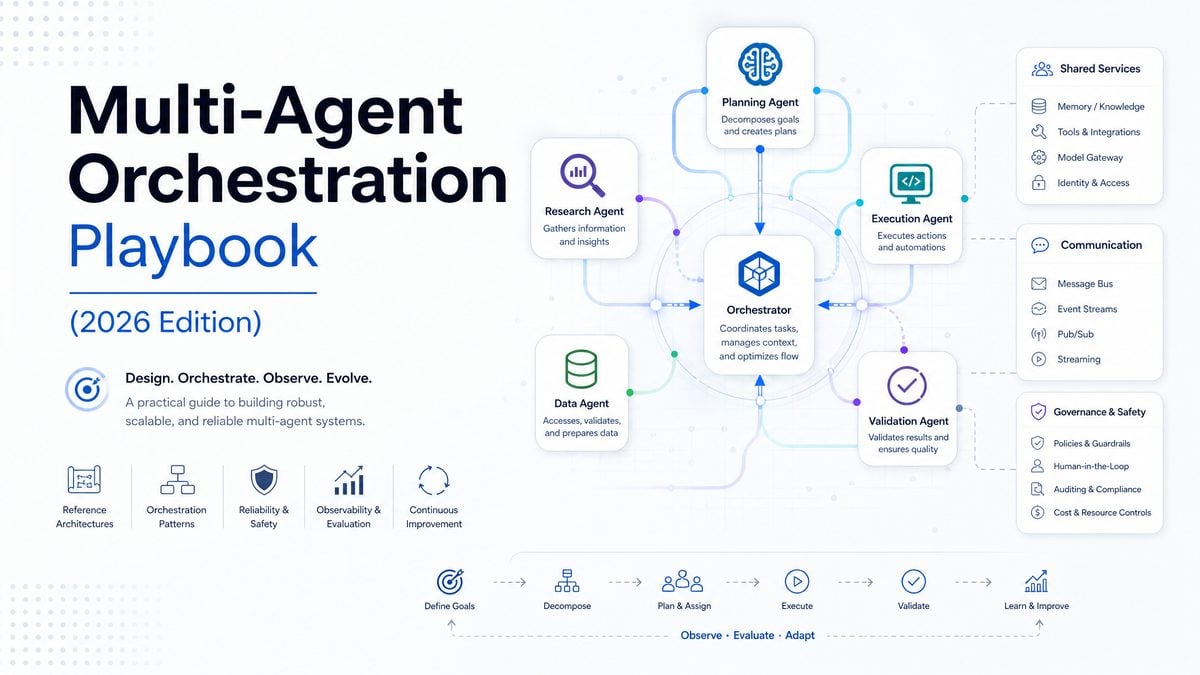
That gap is exactly what our new 38-page playbook, Multi-Agent Orchestration: Building Production-Ready AI Systems, was written to close. It is not a survey. It is a field manual for senior engineers who already know how to run reliable distributed systems and now need to translate that instinct into the agent domain. Below is a preview of what you will learn inside, and how to grab your copy.
The Mental Model: Agents Are Unreliable Microservices That Speak English
The single biggest mindset shift in the playbook comes in Chapter 2. Stop thinking about agents as prompts. Start thinking about them as unreliable, non-deterministic, expensive microservices that happen to communicate in English. Once you make that shift, every good habit you have as a platform engineer suddenly applies: contracts, schemas, timeouts, retries, budgets, observability, sandboxes, circuit breakers.
We define every production-grade agent as six components: a model binding, a versioned system prompt, a schema-validated tool set, a three-tier memory interface, an execution policy, and an observability surface. If any of the six is missing on an agent you are about to ship, you do not have a production agent. You have a demo. This checklist alone has caught more architectural problems in our client reviews than any other single artifact we hand teams.
The playbook goes deeper on the concept of contracts, not prompts. When agent A hands off to agent B, the transport is a versioned JSON schema, not a paragraph of prose. Natural language lives inside string fields, not as the wire format. We walk through concrete case work where a fintech team reduced their multi-agent error rate from 11.4 percent to 0.6 percent purely by moving from natural-language handoffs to schema-validated ones, with no model changes. The chapter closes with an observability spec, span by span, that you can hand to your platform team on Monday morning.
You will not get the full checklist or the schema spec in this post. Those are inside the playbook. What you should take away right now is that the boring engineering disciplines you already have are your biggest advantage over teams that treat agents as a magic new thing.

Choosing Your Topology and Your Framework Without Regret
Chapters 3 and 4 are the parts of the playbook readers tell us they wish existed a year ago. The 2026 orchestration landscape has settled into a small number of serious contenders, and picking wrong will cost you three months. We break down LangGraph 0.4, Microsoft AutoGen 0.7, CrewAI Enterprise, OpenAI Agents SDK 1.0, Anthropic’s Claude Agent SDK, Google Vertex AI Agent Builder, LlamaIndex Workflows, Temporal, Restate, and DBOS across the axes that actually matter: durability, human-in-the-loop primitives, checkpointing, streaming, tracing, and portability across models.
We do not crown a winner. Instead, we give you a decision tree. If your team is under five engineers and you need production in under a month, we point you one way. If you are a platform team expecting the system to run for years with auditable durable execution, we point you another. If you are RAG-heavy, coding-heavy, or need multi-vendor portability as a hard requirement, we point you elsewhere again. The wrong question is which framework is best. The right question is which framework matches your reliability requirements, your team’s distributed systems maturity, and your existing infra.
Then we go into topology. The five canonical patterns are the supervisor, hierarchical team, debate, blackboard, and pipeline. Each has a home. Supervisors excel at bounded workflows with a clear objective. Hierarchies fit open-ended engineering tasks like coding platforms. Debate wins on high-stakes reasoning, backed by recent DeepMind papers showing 4 to 9 point gains on GPQA when running three-way debate over GPT-5.1 and Gemini 3.1 Pro. Blackboards fit long-running processes like customer accounts that live for months. Pipelines are the humble linear chain that, honestly, 60 percent of the multi-agent systems we audit would have been better shipped as.
The playbook contains a diagram, a code sketch, and the workload signature for each topology, plus a hard-earned list of failure modes. If you have ever watched a supervisor become a bottleneck at 40 concurrent runs, you will find your fix on page 14.
Reliability, Cost, and the Seven Levers That Cut Inference Bills 10x
Chapters 7 and 9 are where the playbook earns its keep for finance-conscious engineering leaders. Every model call, tool call, and inter-agent handoff will fail in production. In September 2025, an OpenAI incident took down GPT-5.1 for 96 minutes across US regions. In February 2026, Anthropic degraded Claude Opus 4.7 latency by 4x for six hours. Your system must survive these events, not just retry blindly into them.
The playbook walks through three layers of resilience: per-call retries with exponential backoff, provider fallback via LiteLLM or Portkey, and workflow-level durability via a checkpointer or a workflow engine like Temporal, Restate, or DBOS. We cover idempotency for non-idempotent models, budget-based circuit breakers, and the reason your beautiful supervisor topology deadlocks on turn 47 the moment a Claude call times out.
Then we turn to cost. We name seven concrete levers that, applied together, can take a system from 42 cents per session to 4 cents: model routing, prompt caching, batch APIs, structured outputs, context compression, early stopping, and distillation to open-weights models like Llama 4 8B or Qwen3 14B. A Series C fintech we worked with in Q4 2025 reduced their monthly inference spend from 380K to 71K dollars over six weeks by systematically pulling these levers, with no measurable quality regression on their eval suite.
Model routing gets its own section because most teams do it wrong. The naive approach is a classifier that reads the query and picks a model. It works poorly because hardness reveals itself mid-execution. The mature approach is graduated escalation. Start on the cheap model. If validation, self-critique, or a confidence threshold fails, escalate to the mid-tier, and only then to the flagship. Inside the playbook you will find the escalation-rate metric to watch and the target range that tells you your routing is actually saving money.

Evaluation, Security, and Real-World Case Studies
Three more chapters round out the technical core of the book. Chapter 8 covers evaluation at three layers: unit-level for individual agents, trajectory-level for multi-step flows, and production-level via continuous trace sampling. We give you the calibration criteria for LLM-as-judge, including the Cohen’s kappa threshold below which your rubric is wrong, plus a trace-mining workflow that turns your production logs into a living eval suite that grows with your product.
Chapter 10 covers the security model. Prompt injection is not solved in 2026, especially indirect injection through retrieved documents and tool outputs. Multi-agent systems amplify the risk because one compromised agent can propagate through handoffs. We detail the dual-agent gating pattern that has been effective at catching injection-driven action attempts in production, the data governance model for cross-agent handoffs with OpenFGA or Cedar, and the human oversight design that avoids rubber-stamping while keeping the loop closed on high-risk actions.
Chapter 11 is our readers’ favorite: three anonymized but detailed case studies. A hedge fund that dropped company deep-dive research from 6 hours to 22 minutes at 3.80 dollars per report. A SaaS company handling 62 percent of 4 million monthly users’ support tickets end to end at 11 cents per handled ticket with a 4.5 CSAT. A 3,000-engineer enterprise that built an internal coding platform on the Claude Agent SDK and Temporal, closing 47 percent of eligible tickets without human code changes. Each case includes the topology, the models, the mistakes, and the exact fix that unblocked scale.
Finally, Chapter 12 gives you a 90-day rollout plan broken into weekly milestones with explicit go or no-go gates at day 30, day 60, and day 90. It is opinionated, it is realistic, and multiple readers have told us they used it verbatim as the internal project plan for their agent platform.
Who This Playbook Is For, and How to Get It
This is not an introductory guide. If you have never called an LLM API, start elsewhere and come back in a quarter. This playbook is written for platform engineers, senior ML leads, and staff-plus engineers who already run production systems and now need to add multi-agent orchestration to their platform without embarrassing themselves in front of the CFO or the incident review board.
Every chapter assumes you understand distributed systems basics: retries, timeouts, idempotency, checkpointing, observability, and blast radius. What it does not assume is that you have internalized how those concepts translate to a world where your microservices are non-deterministic and cost 40 cents per call. Making that translation, chapter by chapter, is the entire point of the book.
By the time you finish, you will have a mental model for agents as runtime primitives, a decision tree for framework selection, five topology patterns with clear selection criteria, a three-tier memory design, an MCP-based tool architecture, a resilience and cost playbook, a three-layer evaluation strategy, a security and governance model, three battle-tested case studies to reference, and a 90-day rollout plan you can adapt to your organization.
The playbook is free with a chatgptaihub.com subscriber signup. We publish premium technical content like this monthly, and subscribers get first access along with the accompanying tools, prompts, and reference implementations we cannot fit inside a PDF. Drop your email, confirm, and you will receive the 38-page PDF within minutes. If you build something with it, or if you want to argue with a chapter, reply to the welcome email. We read every response and the best feedback shapes the next edition. See you inside.
⚡ PREMIUM DROP · FREE WITH SIGNUP
Download the full Multi-Agent Orchestration Playbook — FREE
12 chapters · 40+ pages of actionable playbook for AI professionals. Plus full access to our 40,000+ prompt library. Instant email delivery.
Get the Free Playbook →No spam. Instant PDF delivery. Unsubscribe anytime.
Frequently Asked Questions
What exactly is inside the playbook?
The playbook is 12 chapters across 38 pages, structured for progressive depth. It opens with a mental model for treating agents as unreliable microservices, then walks through framework selection, the five canonical topology patterns, three-tier memory design, MCP-based tool architecture, reliability engineering, evaluation strategy, cost optimization with seven concrete levers, security and governance, three anonymized production case studies, and a week-by-week 90-day rollout plan. Every chapter names real 2026 tools, models, and companies, and includes concrete numbers from live systems rather than generic overviews.
Who is this for, and who is it not for?
It is written for platform engineers, senior ML leads, and staff-plus engineers who already run production distributed systems and now need to add multi-agent orchestration to their platform. It assumes you understand retries, timeouts, idempotency, checkpointing, and observability. It is not an introductory guide to LLMs or prompt engineering. If you have never called an LLM API or shipped a service to production, this playbook will land above your current level and you should come back after a quarter of foundational work.
How do I get the playbook and how much does it cost?
The playbook is free with a chatgptaihub.com subscriber signup. Enter your email in the signup form on this page, confirm your address, and you will receive the 38-page PDF via email within minutes. There is no credit card required and no upsell. Your subscription also unlocks future premium playbooks, reference implementations, and prompt libraries that we publish monthly for subscribers, along with early access to case study interviews and tooling reviews.
What credentials back the guidance in this playbook?
The playbook synthesizes patterns we have seen across dozens of production multi-agent deployments in 2025 and 2026, including fintech, SaaS support, and internal developer platforms. It cites public benchmarks like SWE-Bench Verified, NoLiMa, RULER, and GPQA, published incidents from OpenAI and Anthropic, and referenced work from Anthropic's multi-agent research post, DeepMind, and the Menlo Ventures State of AI in the Enterprise report. Case studies are anonymized to protect clients but reflect real architectures, real metrics, and real mistakes with the fixes that resolved them.
Will this playbook still be relevant as models keep changing?
Yes. Model versions will keep moving, but the disciplines in the playbook are architectural. Contracts over prompts, three-tier memory, graduated model routing, durable execution, three-layer evaluation, and dual-agent gating for security are patterns that survive model turnover. The playbook names 2026 models like GPT-5.1 Pro, Claude Opus 4.7, Gemini 3.1 Pro, and Claude Haiku 4.5 in concrete examples, but the recommendations are structured so that swapping in the next generation of models does not invalidate the design. We also publish a refreshed edition annually.
What should I do after I finish reading?
The playbook ends with a 90-day rollout plan that we recommend you adapt to your organization. Start by picking one narrow, high-value use case and building a single well-instrumented agent with all six runtime components in place. Only compose additional agents once the first one hits your quality bar in production traces. Subscribers also get access to our follow-up deep dives on evaluation harnesses, MCP server design patterns, and case study interviews. Reply to the welcome email with what you build or where you disagree, and that feedback shapes future editions.
