
Fine-Tuning LLMs for Production 2026: LoRA, QLoRA & Full Fine-Tune Recipes with Unsloth & Axolotl
⚡ TL;DR — Key Takeaways
- What it is: An evidence-based, practitioner’s playbook for production fine-tuning of large language models in 2026—covering LoRA, QLoRA, and full fine-tuning with Unsloth and Axolotl.
- Who it’s for: ML and platform engineers evaluating when to rely on prompting and RAG, when to add adapters, and when a full fine-tune is warranted.
- Key ideas: Fine-tuning can improve task adherence, formatting, and stability for well-scoped tasks when paired with high-quality data and rigorous evaluation. Results are workload-dependent.
- What’s inside: Decision frameworks, dataset curation, LoRA/QLoRA fundamentals, Unsloth/Axolotl workflows, reproducibility checklists, evaluation and monitoring aligned with recognized guidance, and deployment patterns including adapter serving.
- Bottom line: Treat fine-tuning as an engineering discipline: choose the smallest intervention that solves the problem, measure on a representative holdout, and plan for rollback.
Why Fine-Tuning Belongs in a 2026 Production Toolkit
In 2026, many teams continue to achieve strong baselines with prompt engineering and retrieval-augmented generation (RAG). These methods remain essential—particularly for knowledge retrieval, freshness, and when you need to avoid training entirely. At the same time, adapter-based fine-tuning (for example, LoRA) and efficient strategies such as QLoRA have matured into practical, incremental tools for making models follow task-specific style, schema, or guardrails more reliably without retraining the entire model. The approach you choose should follow a simple principle: start with the smallest change that solves the problem, measure it carefully, and only increase complexity if the data indicate you should.
Two ingredients help explain why adapter-based fine-tuning is widely considered in 2026 production plans:
- Technique maturity: The LoRA method is explicitly designed to adapt a model by training small low-rank matrices while keeping the base model weights frozen. This typically reduces the number of trainable parameters and memory costs, while preserving the original model’s knowledge; see the LoRA paper for the core idea and its motivation (LoRA: Low-Rank Adaptation of Large Language Models).
- Pragmatic efficiency: QLoRA describes a way to fine-tune models efficiently by keeping the base model in 4-bit quantized form (NF4) and training LoRA adapters on top, together with techniques such as double quantization and paged optimizers that reduce memory footprint during training (QLoRA: Efficient Finetuning of Quantized LLMs).
Serving has also improved. For example, vLLM’s documented adapter support shows how LoRA adapters can be selected per request with a compatible base model, avoiding the need to run a separate process for every variant. This is useful for multi-tenant deployments or A/B evaluation of adapters on shared infrastructure (vLLM LoRA Adapters).
These approaches do not remove the need for thorough evaluation. Even small changes can affect capability boundaries, tone, and safety properties. A production decision should be supported by a representative holdout and clear rollback criteria. The sections below provide a step-by-step decision framework, practical fine-tuning recipes using Unsloth and Axolotl, and concrete mechanisms to evaluate and deploy responsibly in line with recognized guidance such as the NIST AI RMF for generative AI (NIST AI 600-1).
A Simple Decision Framework: Prompting, RAG, Adapters, or Full Fine-Tune?
Before you configure a training job, evaluate the problem characteristics. A practical framework is to work from least to most invasive change:
Step 1 — Start with Prompting
- When it helps: You primarily need better formatting, clearer instructions, or more examples. Prompt engineering and few-shot exemplars can improve determinism and output structure substantially for instruction-following tasks.
- When to move on: If outputs remain inconsistent across inputs that are semantically similar, or if the task requires domain adaptation beyond what instructions alone can achieve.
Step 2 — Add RAG for Knowledge and Freshness
- When it helps: The task depends on domain-specific or time-sensitive facts, long documents, or records you can index and retrieve at inference time. RAG limits what the model must “memorize.”
- When to move on: If you still see stylistic or schema deviations, or you need consistent transformation (for example, structured extraction to a strict JSON schema) where a learned adapter can help the model adhere to formatting and decision boundaries.
Step 3 — Train a LoRA Adapter
- When it helps: You have a well-scoped task and representative labeled data. LoRA introduces small trainable matrices into specific layers of the transformer, keeping base weights frozen (LoRA). This can improve style adherence, schema conformance, and stability without changing the base model’s core knowledge.
- QLoRA variant: When GPU memory is the constraint, QLoRA allows you to keep the base model quantized (for example, 4-bit NF4) while training a LoRA adapter on top (QLoRA).
- When to move on: If an adapter cannot recover the behavior you need (for example, specialized reasoning patterns, extra-long context that must be handled natively, or domain behaviors that require broader adaptation).
Step 4 — Consider Full Fine-Tuning
- When it helps: The task requires deeper changes than an adapter can express, or you need to adapt capabilities across many components of the network. Full fine-tuning involves updating base model weights and requires more stringent evaluation for potential regression and safety changes.
- Prerequisites: High-confidence datasets, reproducible training setups, and a deployment plan that includes guardrails, monitoring, and rollback. When in doubt, start with adapters and escalate if measurement supports the decision.
Choosing a base model also matters. Teams that fine-tune often begin from widely used, publicly documented families. For example, Meta describes models under the Llama 4 umbrella in its official communications; their blog provides an overview of model directions and capabilities (Meta: The Llama 4 herd). Whatever base model you choose, confirm its license, tokenizer, and official template(s), and record them in your reproducibility log (see below).
LoRA and QLoRA in Practice: Concepts, Trade-offs, and Pitfalls
LoRA in a nutshell
LoRA adds low-rank adapters to selected weight matrices while freezing the base model. The original paper frames this as a way to reduce the number of trainable parameters and improve efficiency by factorizing the update in a lower-rank subspace (LoRA). For production engineers, the practical implication is that:
- Training resource needs are generally smaller than full fine-tuning because you train added matrices rather than all base parameters.
- It is straightforward to keep multiple adapters for the same base model (for example, per-tenant or per-task variants) and swap them in serving, subject to your inference stack’s capabilities.
- Because the base model remains frozen, you can revert to the base configuration easily for rollback or A/B comparisons.
QLoRA: efficient adapters over a quantized base
QLoRA refines the idea by leaving the base model quantized (commonly 4-bit NF4) during fine-tuning and training LoRA adapters on top. The paper introduces several engineering choices—NF4 quantization, double quantization to further compress state, and paged optimizers to manage memory more effectively on commodity hardware (QLoRA). For teams constrained by memory, QLoRA can enable adapter training on larger bases than would otherwise be feasible. It also helps when you need to iterate quickly across candidate datasets or hyperparameters.
When adapters are not enough
Adapters are not a universal answer. Situations that may call for full fine-tuning include domain behaviors that span many layers (for example, broad reasoning changes, deep style shifts coupled with nontrivial abstractions), or when adapters show diminishing returns on carefully measured holdouts. Full fine-tuning turns the base parameters trainable, which increases the need for cautious evaluation and post-training monitoring for unintended changes (such as forgetting of general skills or shifts in safety behavior). In all cases, document your training seed, optimizer, learning rate schedule, data ordering, and evaluation plan.
Production Recipes with Unsloth and Axolotl
You can fine-tune adapters and, where appropriate, full models using community tooling. Two commonly used options are Unsloth and Axolotl. The guidance below follows their public documentation; it is not a benchmark comparison and does not make speed or dominance claims.
Unsloth: documented, step-by-step adapter fine-tuning
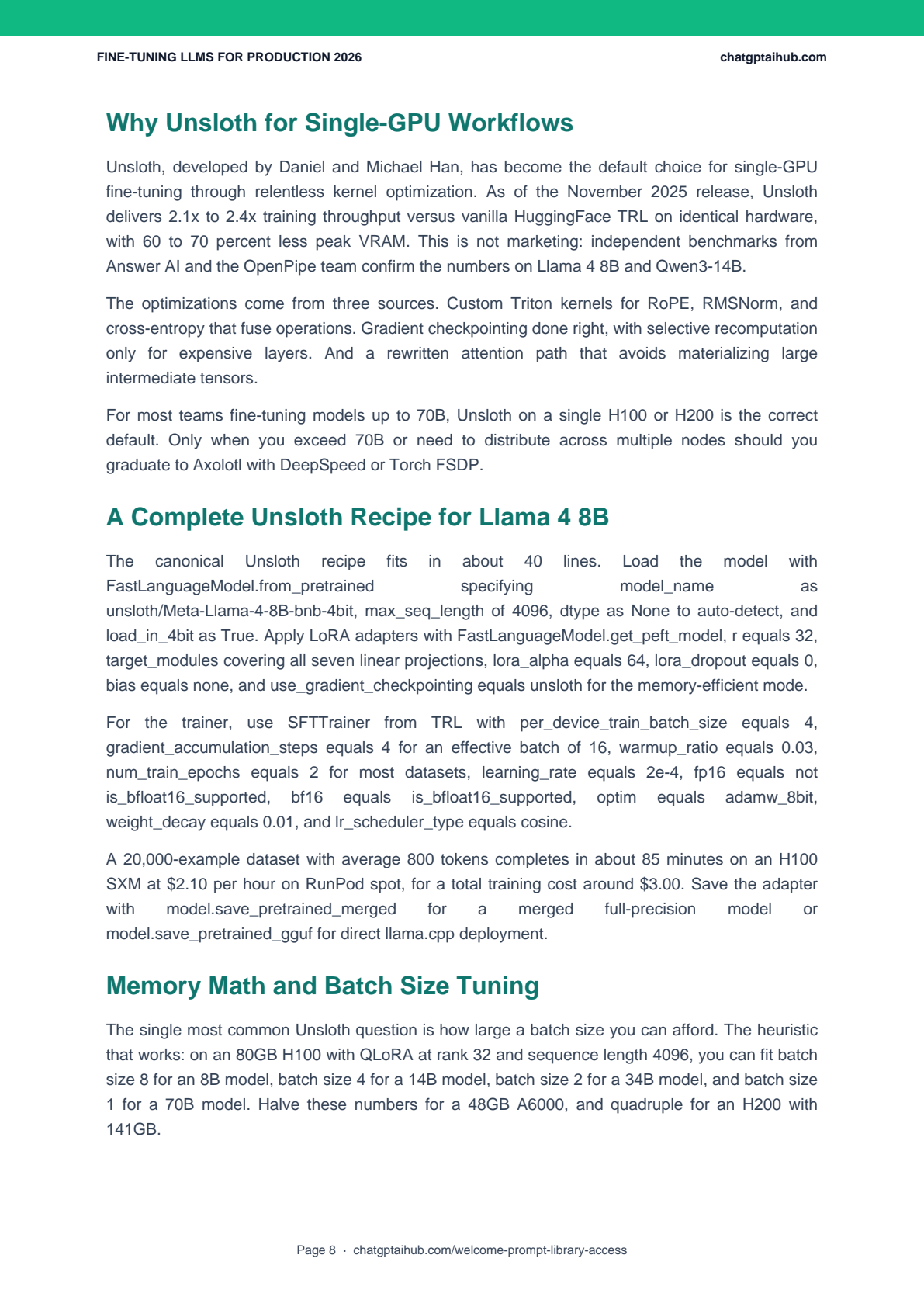
Unsloth provides a step-by-step fine-tuning guide that covers data preparation, configuration, running training, and measuring results on a held-out set (Unsloth Fine-tuning LLMs Guide). The documentation discusses:
- Setting up LoRA or QLoRA with clear configuration options.
- Dataset formatting (for example, chat templates) and how mismatches can affect outcomes.
- Evaluating trained adapters, including the need for representative holdouts.
In production, follow the documented settings for your base model and tokenizer. Many issues trace back to template or tokenizer drift between training and serving. Record both in your reproducibility log.
Axolotl: YAML-driven configurations for LoRA/QLoRA and full fine-tuning
Axolotl’s quickstart illustrates YAML-based configurations for different fine-tuning modes, including LoRA and QLoRA setups, and full fine-tuning where appropriate (Axolotl Quickstart). The configuration style lends itself to version-controlled experiments, CI integration, and team review:
- Keep a minimal, well-commented YAML per experiment.
- Pin model and tokenizer revisions and log them at runtime.
- Automate evaluation runs that produce comparable metrics across experiments.
A reproducibility log you can adopt today
Every training run should produce a concise, reviewable record. Use a one-row-per-experiment worksheet to make decisions evidence-based and auditable. Below is a simple table with fields to capture for each run.
| Model (name + revision) | Tokenizer (name + revision) | Chat template | Mode | Train tokens | Precision / Quant | GPU(s) | LR / Scheduler | Batch / Accum. | Run time | Held-out metric(s) | Notes (data, seed, bugs) |
|---|---|---|---|---|---|---|---|---|---|---|---|
| — | — | — | LoRA / QLoRA / Full FT | — | e.g., FP16, NF4 | — | — | — | — | Task-specific on representative holdout | — |
Tip: enforce consistent templates from data creation through training and serving. Many regressions stem from accidental template drift.
Serving and Deployment Patterns: Adapters at Scale
Training is only half the story. The other half is stable, measurable serving. When using adapters, you often want to consolidate variants behind a single base model for operational simplicity and to simplify A/B testing. vLLM’s documented LoRA adapter support shows how to associate a request with a selected adapter, which can help you deliver multiple task or tenant variants through the same process (vLLM LoRA Adapters).
Recommended production patterns
- Adapter routing: Choose adapters by task or tenant identifier at request time. Keep a registry that maps identifiers to specific adapter revisions. Roll forward by pinning new adapter revisions and maintaining a short rollback window.
- Shadow evaluation: Route a slice of traffic to a candidate adapter and compare task-level metrics to a control adapter or base model. Use deterministic test prompts where possible to isolate differences.
- Schema enforcement: For structured outputs, use response schemas and strict parsing. If the model is expected to emit JSON or other constrained formats, enforce a contract and log deviations for analysis.
- Tracing and observability: Emit structured spans that include model revision and adapter revision so you can correlate behavior shifts with releases.
Rollback and compatibility
- Rollback design: Always maintain a stable baseline (adapter or base) so you can switch quickly if monitoring detects regression.
- Compatibility checks: When you update the base model, revisit all adapters. Adapters are specific to the base; retesting is required if you change the base, tokenizer, or template.
If your organization is building or governing AI agents on top of fine-tuned models, complementary operational practices such as access control, audit trails, and pre-deployment testing are critical. For deeper coverage of enterprise governance patterns, see AI Agent Governance for Enterprises: Complete Guide to Security, Compliance, and Risk Management in 2026. For test automation around APIs and model integrations, see API Testing and Automation for AI Applications: The Complete 2026 Guide.
Evaluation That Reflects Production Reality
Evaluation is not a single number; it is a process. The most robust production setups combine multiple lenses and emphasize reproducibility and decision hygiene. The NIST AI RMF for generative AI emphasizes risk identification, measurement, and governance—ideas that translate directly into evaluation planning (NIST AI 600-1).
Layer 1 — Task-specific metrics
- Representative holdout: Create and refresh a labeled set that mirrors production distributions. For extraction, measure per-field precision and recall; for classification, consider macro/micro averages; for generation, define rubric-based grading criteria.
- Sampling and refresh: Refresh at a stable cadence (for instance, monthly) to detect drift. Keep a fixed “consistency panel” for long-term comparability, and a “freshness panel” to reflect evolving inputs.
Layer 2 — Capability preservation
- General checks: Ensure adapters or full fine-tunes do not unintentionally degrade general skills the application depends on. These checks can be lightweight but should be stable and documented.
Layer 3 — LLM-as-judge (carefully calibrated)
- Use cases: For qualitative comparisons and faster iteration, LLM-as-judge can be useful when it is calibrated to human labels for your task. Randomize candidate order to reduce position bias and periodically recheck agreement.
- Limits: Treat LLM-as-judge as a complement to human evaluation, not a substitute—especially when outputs carry compliance or safety implications.
Layer 4 — Shadow deployment and post-deploy monitoring
- Shadow phase: Before promoting an adapter or full fine-tune, send a portion of real traffic to the candidate and compare task metrics, error classes, and user-visible issues against a control.
- Monitoring: After release, monitor structured metrics (schema adherence, latency distributions, fallback rates) and qualitative indicators (support tickets, analyst feedback). Maintain clear rollback thresholds.
To systematize this work, embed testing into CI/CD. Run a fixed test battery nightly and on change. If your workloads involve autonomous or semi-autonomous agents, red-team testing is valuable—see 30 ChatGPT Prompts for AI Agent Safety Testing for prompts that can complement internal scenarios.
Compliance and Governance: Navigating Evolving Requirements
Regulation and organizational governance expectations are evolving. Two anchors can help frame responsible practice in 2026: the EU AI Act’s risk-based approach and widely referenced voluntary guidance for risk management, such as the NIST AI RMF for generative AI.
EU AI Act: staged, risk-based scope
The European Union has adopted an AI Act that introduces obligations tied to risk categories with staged application over time. The European Commission’s public materials outline the framework and timing conceptually. Organizations that operate in or serve users in the EU should review the Act’s scope, risk definitions, and relevant dates as they apply to their systems (European Commission: AI Act). As with any regulation, seek qualified legal counsel for interpretation applicable to your context; do not assume uniform obligations across all AI systems or immediate applicability on a fixed date.
NIST AI RMF for generative AI
NIST’s publication on AI risk management for generative systems encourages practices such as robust evaluation, monitoring, documentation, and human oversight across the AI lifecycle (NIST AI 600-1). Even where not mandatory, the framework offers a helpful checklist for aligning engineering processes with risk-awareness, including:
- Clear statements of intended use and out-of-scope behavior.
- Documented datasets, training choices, and known limitations.
- Operational controls such as rate limits, audit logs, and escalation paths.
For a deeper review of enterprise controls, roles, and decision rights, see AI Agent Governance for Enterprises: Complete Guide to Security, Compliance, and Risk Management in 2026.
From Plan to Practice: An End-to-End Workflow
1) Frame the problem and choose the minimal intervention
- Define a measurable task and the success criteria. Start with prompting and RAG, then move to adapters if measurements show a persistent gap.
- Pick a base model whose license and capabilities fit your use case. Record model and tokenizer revisions and any official chat template you adopt. Example references: Meta’s Llama 4 overview.
2) Build or curate a representative dataset
- Prioritize real samples that reflect production inputs. If you use synthetic data, validate it against a human-labeled subset before scaling.
- Deduplicate aggressively and segment by scenario. Separate data for training, validation, and final holdout; keep the holdout untouched for final decisions.
- Ensure formatting is unambiguous. If you expect strict JSON, teach and evaluate strict JSON.
3) Configure training with Unsloth or Axolotl
- Unsloth: Follow the documented fine-tuning guide for LoRA/QLoRA setup, dataset formatting, and evaluation (Unsloth Fine-tuning LLMs Guide).
- Axolotl: Use a minimal YAML config that pins model/tokenizer revisions and specifies LoRA/QLoRA or full fine-tune settings (Axolotl Quickstart).
- For QLoRA, confirm that quantization settings (for example, NF4) align with the paper’s guidance and your hardware characteristics (QLoRA).
4) Evaluate thoroughly before you deploy
- Run your multi-layer evaluation suite: task-specific holdout, capability preservation checks, calibrated LLM-as-judge (if applicable), and a shadow phase.
- Record results in the reproducibility log table shown earlier. Decisions should be data-driven; if the adapter does not meet criteria, iterate on the dataset or revert to the baseline and reassess.
5) Deploy with guardrails and monitoring
- Serve adapters behind a base model if your stack supports it (see vLLM LoRA Adapters), and maintain a routing registry for variants and rollbacks.
- Automate canary and shadow promotion with pre-defined rollback conditions. Ensure observability correlates behavior with model and adapter revisions.
- Document intended use, known limitations, and escalation paths, echoing principles from NIST AI 600-1.
What’s Inside: The 12-Chapter Playbook
| # | Chapter |
|---|---|
| Ch. 1 | When Fine-Tuning Beats Prompting and RAG: A Measured Decision Framework |
| Ch. 2 | Data Curation: Building Representative, Clean, and Unambiguous Datasets |
| Ch. 3 | LoRA and QLoRA Fundamentals for Today’s Model Families |
| Ch. 4 | Unsloth: Practical Adapter Fine-Tuning and Evaluation |
| Ch. 5 | Axolotl: YAML-Driven LoRA/QLoRA and Full Fine-Tuning |
| Ch. 6 | Full Fine-Tuning: Evaluation, Drift Risk, and Rollback Planning |
| Ch. 7 | Evaluation That Reflects Production Reality |
| Ch. 8 | Serving Adapters and Models at Production Scale |
| Ch. 9 | Worked Walkthrough: From Prompt Baseline to Adapter Deployment |
| Ch. 10 | MLOps for Fine-Tuning: Versioning, Reproducibility, and Monitoring |
| Ch. 11 | Safety, Compliance, and Red-Teaming Practices |
| Ch. 12 | Toolchain Cheat Sheet and Checklists |
FREE DOWNLOAD
Get the Full 38-Page Playbook
Access the complete recipes, configs, and checklists for LoRA, QLoRA, and full fine-tuning with Unsloth and Axolotl—built for production teams.
Get Free Access Now →Tooling Landscape You Should Know (Without Hype)
Training frameworks
- Unsloth: Public documentation shows how to configure LoRA/QLoRA, prepare datasets, and run held-out evaluation (Unsloth Fine-tuning LLMs Guide).
- Axolotl: YAML-based configuration for LoRA/QLoRA and full fine-tuning, suitable for versioning and reproducibility (Axolotl Quickstart).
Adapter serving
- vLLM: The documented LoRA adapter feature enables per-request adapter selection with a shared base model—helpful for multi-variant serving and A/B tests (vLLM LoRA Adapters).
Risk, governance, and documentation
- NIST AI RMF (generative): Voluntary guidance on evaluation, monitoring, and governance practices across the lifecycle (NIST AI 600-1).
- EU AI Act overview: Official materials from the European Commission on the Act’s risk-based approach and staged timing (European Commission: AI Act).
Common Failure Modes (and How to Avoid Them)
1) Template and tokenizer drift
Symptom: Accuracy or formatting degrade unexpectedly despite similar training and inference data. Prevention: Lock and log model, tokenizer, and chat template revisions for training and serving. Add a start-up check in serving to print registered template identifiers and adapter revisions.
2) Mis-specified task or rubric
Symptom: The model “fails” on ambiguous or inconsistent requirements. Prevention: Define rubrics with unambiguous pass/fail or scoring criteria; link every rubric item to representative examples in the dataset.
3) Fragile synthetic data
Symptom: Good numbers in validation but inconsistent production performance. Prevention: Calibrate synthetic data against human-labeled samples before scaling; refresh synthetic data and recheck periodically.
4) Inadequate serving observability
Symptom: Hard-to-reproduce bugs or regressions after deployment. Prevention: Emit traces with model/tokenizer/adapter revisions, prompt hashes, temperature/top-p settings, and output schema errors. Build dashboards that separate configuration changes from data-driven issues.
5) Skipping shadow rollout
Symptom: Surprises after full promotion. Prevention: Always run a shadow phase with clear success metrics and conservative rollback triggers.
Useful Links
- LoRA: Low-Rank Adaptation of Large Language Models (arXiv)
- QLoRA: Efficient Finetuning of Quantized LLMs (arXiv)
- Unsloth Fine-tuning LLMs Guide
- Axolotl Quickstart
- vLLM: LoRA Adapter Support
- European Commission: AI Act — Overview and Timing
- NIST AI 600-1: Risk Management Framework for Generative AI
- Meta AI: The Llama 4 herd
Conclusion: A Measured Way to Put Fine-Tuning in Production
Fine-tuning in 2026 is best approached as a measured, engineering-first practice—not as a default and not as a last resort. Start small with prompting and RAG; add adapters when you need more determinism or schema adherence; escalate to full fine-tuning only when carefully collected data and evaluation justify the change. Anchor your work in reproducibility: pin model and tokenizer revisions, record configuration and seeds, and evaluate with representative holdouts and shadow rollouts. When you deploy, combine adapter-aware serving with strong observability and clear rollback rules.
If you want a concise, step-by-step reference that distills these practices into checklists, example configs, and deployment patterns, download the full playbook below. It compiles the essentials—LoRA and QLoRA foundations, Unsloth and Axolotl workflows, evaluation strategies aligned with recognized guidance, and deployment recipes—so your team can fine-tune with confidence and accountability.
Frequently Asked Questions
What exactly do I get when I sign up?
You receive the Fine-Tuning LLMs for Production 2026 playbook (PDF) with practical recipes and checklists for LoRA, QLoRA, and full fine-tuning using Unsloth and Axolotl, along with configuration examples and evaluation templates designed for production teams.
How technical is this playbook? Will I follow it as a PM or founder?
It is written for practitioners who can read Python and are comfortable with ML concepts such as learning rates, batching, and evaluation metrics. Non-engineering stakeholders will still find the decision framework, evaluation guidance, and governance sections useful for planning and review.
Is it current for 2026 model families?
The playbook focuses on methods (LoRA, QLoRA, full fine-tuning) and workflows that apply across model families. Where model-specific details matter (naming, templates, licensing), we point to official vendor documentation—for example, Meta’s public overview of the Llama 4 family—so you can confirm specifics that apply to your chosen base.
How is this different from free tutorials?
Most tutorials show how to run a training script. This playbook centers on production decisions—when to fine-tune, how to build representative datasets, how to evaluate and deploy safely (including adapter serving), and how to document and monitor models after release. It is designed to complement vendor docs with a production-first perspective.
Why should I trust the recommendations?
We cite primary sources for the methods (for example, the LoRA and QLoRA papers) and point to official documentation (Unsloth, Axolotl, vLLM). We emphasize reproducibility, explicit criteria, and rollback planning so you can validate each recommendation against your own data and constraints.
What should I do after reading the playbook?
Run one end-to-end iteration on a bounded task: establish a prompt and RAG baseline, train a small LoRA/QLoRA adapter with Unsloth or Axolotl, evaluate on a representative holdout, and attempt a shadow rollout. For adjacent topics, consider our guides on API testing and automation and enterprise AI governance.
