
AI Agent Governance for Enterprises: Complete Guide to Security, Compliance, and Risk Management in 2026
Enterprise AI agents are no longer science fiction — they are scheduling meetings, executing financial transactions, modifying production databases, and communicating with customers on behalf of your organization right now, today, in 2026. But unlike a chatbot that suggests an answer and waits for a human to act, an autonomous AI agent acts. It calls APIs, browses the web, writes and runs code, sends emails, and chains dozens of decisions together without a human in the loop. That capability gap — between what agents can do and what enterprises have prepared for — is where catastrophic risk lives. This guide provides the most comprehensive framework available for building, deploying, and governing AI agents at enterprise scale while satisfying regulators, protecting customers, and keeping your organization out of the headlines for the wrong reasons.
Why AI Agent Governance Is Fundamentally Different from Traditional AI Governance
For the past decade, enterprise AI governance programs focused on a relatively tractable set of problems: bias in classification models, accuracy in predictive analytics, fairness in recommendation engines. These systems were advisory in nature. A credit-scoring model recommended a decision; a human loan officer made it. A demand-forecasting model produced a number; a supply chain manager acted on it. The governance model that emerged from this era — model cards, bias audits, accuracy benchmarks, explainability requirements — was designed for advisory AI.
Autonomous AI agents break every assumption that model makes.
The Three Defining Characteristics That Change Everything
1. Autonomous Multi-Step Decision-Making
A traditional AI model makes a single prediction. An AI agent executes a plan. When you instruct an enterprise AI agent to “reconcile this quarter’s vendor invoices,” it might autonomously: query your ERP system, cross-reference a vendor database, flag three discrepancies, draft dispute emails, check approval authority limits, send two disputes automatically, escalate one to a manager, update the accounting ledger, and generate a summary report — all without a human touching a single step. Each of those individual actions carries risk. The chain of actions compounds that risk exponentially.
Research from MIT’s Sloan Management Review published in early 2026 found that the median enterprise AI agent executes 23 discrete tool calls to complete a single task. Traditional AI governance frameworks were never designed to audit a 23-step autonomous decision chain in real time.
2. Tool Access and Real-World Consequences
AI agents are given tools: web browsing, code execution, database read/write access, email clients, calendar systems, Slack, customer data platforms, financial systems, cloud infrastructure APIs. Unlike a language model that outputs tokens, an agent with database write access can delete production records. An agent with email access can send messages to regulators, customers, or journalists. An agent with cloud API access can spin up $50,000 worth of GPU instances overnight.
The governance question is no longer “is the output accurate?” — it is “should this system be allowed to do this action, at this moment, with these permissions, on behalf of this user, within this organizational context?”
3. Emergent Behavior in Multi-Agent Systems
The most complex governance challenge of 2026 is not single agents — it is multi-agent pipelines where specialized agents hand off tasks to one another. In these architectures, an orchestrator agent manages sub-agents: a research agent, a writing agent, a code-execution agent, a communication agent. Each agent in the chain may individually comply with its governance policy, yet the emergent behavior of the full system can violate organizational or regulatory constraints in ways that no single agent review would catch.
This is why governing the individual agent is necessary but insufficient. Enterprises need governance at the system level, not just the agent level.
Comparison: Traditional AI Governance vs. Agent Governance
| Dimension | Traditional AI Governance | AI Agent Governance |
|---|---|---|
| Decision type | Single prediction or classification | Multi-step autonomous action plan |
| Human involvement | Human acts on AI output | Agent acts independently; human may only see result |
| Real-world impact | Indirect (via human action) | Direct (agent writes to systems, sends communications) |
| Audit surface | Model inputs and outputs | Every tool call, API request, data access, decision branch |
| Blast radius of failure | Single bad recommendation | Cascading multi-system failure |
| Compliance trigger | Output review | Real-time action interception required |
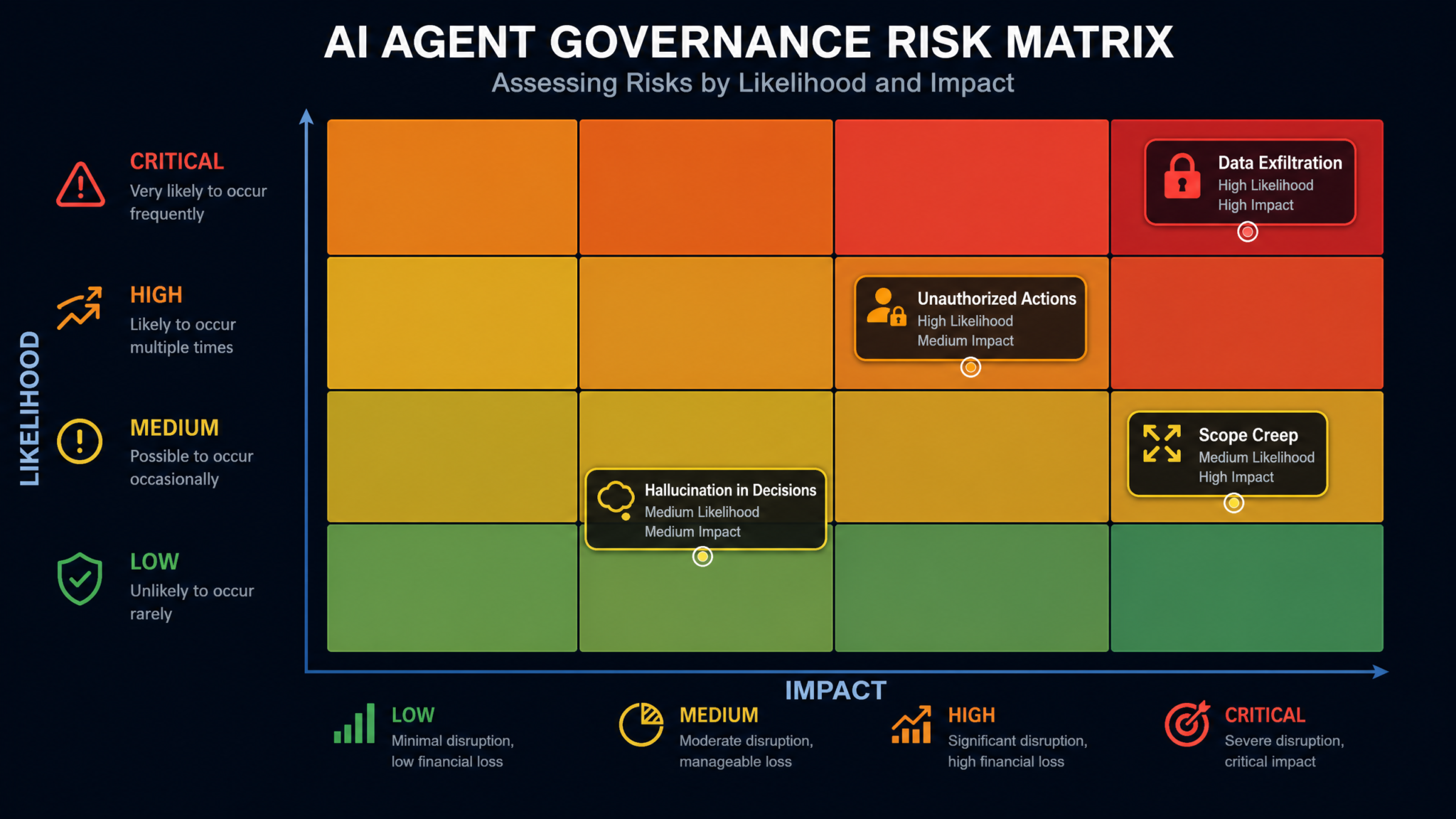
| Primary risk type | Model bias, inaccuracy | Unauthorized action, data exfiltration, regulatory breach |
Enterprise AI Agent Architecture Patterns and Design Principles
The Governance Crisis: By the Numbers
The pace of enterprise AI agent adoption has dramatically outrun the maturity of governance practices. The data paints an alarming picture.
- 66% of enterprise AI agent deployments occur without formal human review processes, according to the 2026 Enterprise AI Deployment Report by Gartner. Two-thirds of organizations deploying autonomous agents have no structured oversight mechanism for agent actions.
- The IBM Institute for Business Value found that only 22% of enterprises have defined scope boundaries — documented limits on what actions an AI agent is authorized to take — before deploying production agents.
- A 2026 survey by Forrester Research found that 71% of CISOs consider autonomous AI agents their top-emerging security concern, surpassing cloud misconfigurations for the first time.
- The average cost of an enterprise AI agent incident — defined as an unintended autonomous action that required remediation — was $2.3 million in 2025, according to Ponemon Institute data, a figure that has grown 340% since 2023.
- Regulatory actions related to autonomous AI systems increased by 189% year-over-year in 2025, with the EU AI Act’s enforcement provisions taking full effect in early 2026 driving the majority of cases.
- Despite these risks, 87% of Fortune 500 companies are deploying or piloting AI agents in production environments as of Q1 2026, per McKinsey’s Global AI Survey.
The gap between deployment velocity and governance maturity is not theoretical. Organizations are deploying agents that can modify financial records, communicate with customers, and access sensitive data — with the same casual governance posture they applied to a PDF chatbot in 2023. The consequences are beginning to materialize in regulatory fines, security incidents, and reputational damage.
“The enterprise AI agent is the first software category where the system itself can create compliance violations, security breaches, and legal liabilities — autonomously, at machine speed, at 3 AM on a Sunday — before any human is aware anything has happened.”
— Dr. Sarah Chen, Chief AI Ethics Officer, Deloitte Global, 2026 AI Safety Summit
The Five-Pillar AI Agent Governance Framework
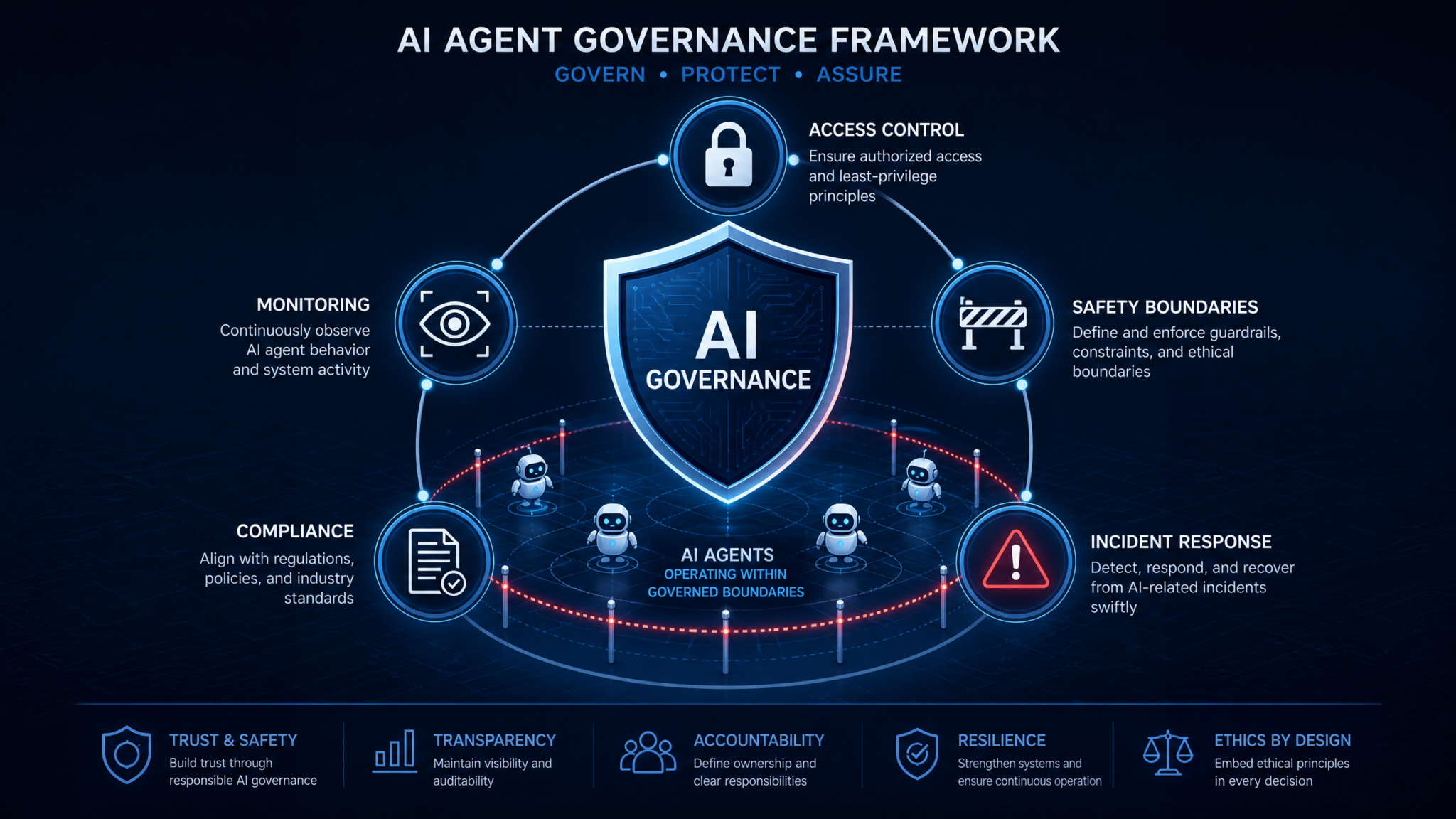
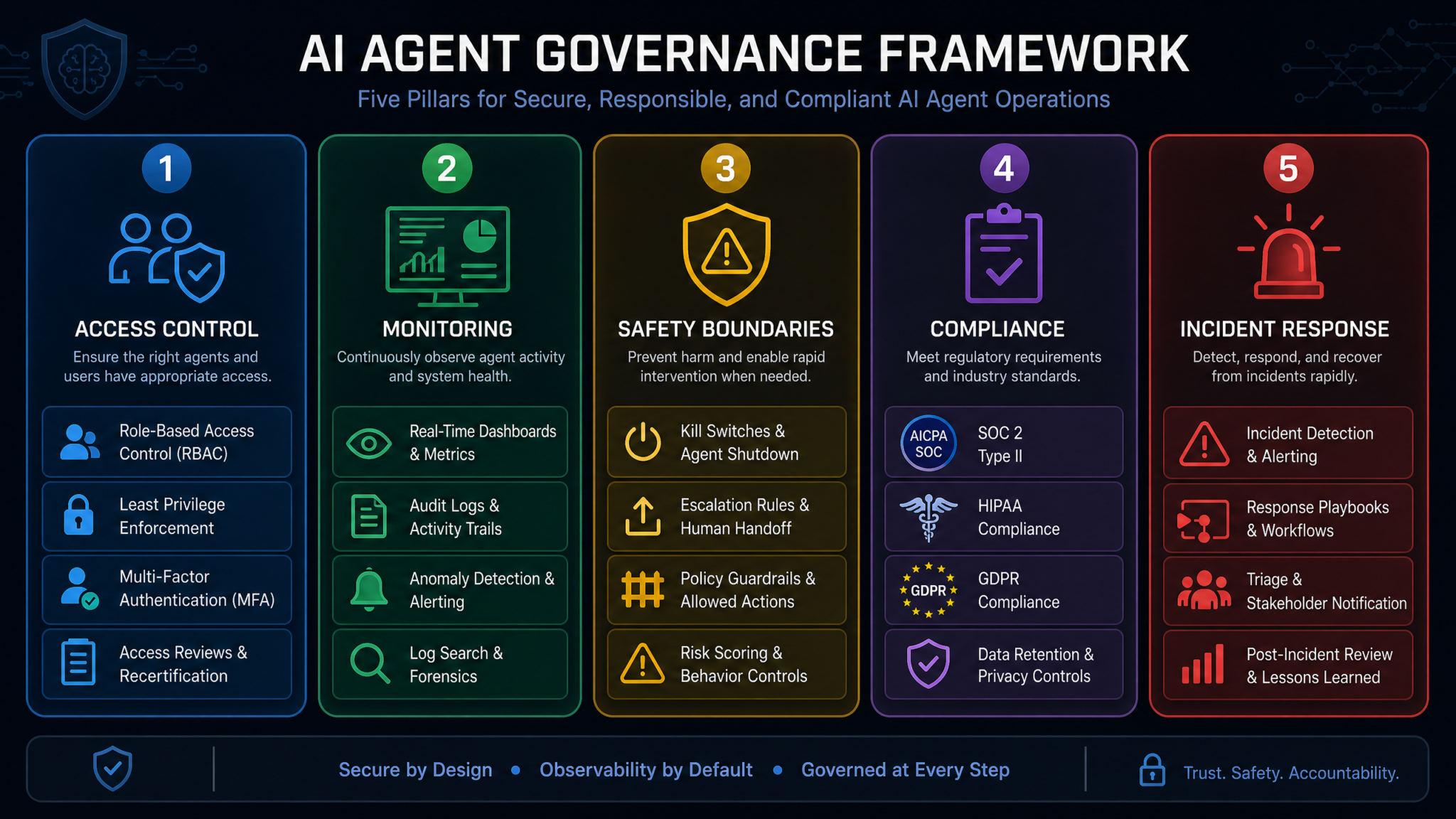
After analyzing governance programs at over 200 enterprise AI deployments and synthesizing guidance from NIST, the EU AI Act, ISO 42001, and emerging industry frameworks, we have distilled agent governance into five foundational pillars. Each pillar is mutually reinforcing — a weakness in any one creates systemic vulnerability across all others.
- Access Control and Permissions — Who (or what) can do what, where, when
- Monitoring and Observability — Complete visibility into agent actions and decisions
- Safety Boundaries — Hard and soft limits on autonomous behavior
- Compliance Integration — Mapping agent behavior to regulatory requirements
- Incident Response — Structured response when agents behave unexpectedly
No single pillar is optional. Organizations that implement monitoring without access control know what their agents are doing wrong but cannot stop it. Organizations that implement safety boundaries without incident response can stop agents but cannot recover effectively when stops fail. The framework functions as an integrated system.
Pillar 1: Access Control and Permissions
The Principle of Least Privilege for AI Agents
The most fundamental governance control for AI agents is the same principle that governs human user access in enterprise security: least privilege. An agent should have access to exactly the tools, data, and APIs it needs to complete its assigned tasks — and nothing more. In practice, this principle is violated constantly, because agents are provisioned with the same service account credentials used for broad system integrations, or given administrator-level API keys “for convenience.”
Least privilege for AI agents requires a different conceptual model than for human users, because agent permissions must be scoped not just by identity but by task context. A vendor invoice reconciliation agent should have read access to the accounts payable database and write access to a dispute-tracking table. It should not have access to employee payroll data, even if the service account it runs under technically has that permission.
Defining Scope Boundaries
A scope boundary is a documented, enforced definition of the operational envelope for an AI agent. Scope boundaries should be specified along three dimensions:
- Action scope: What types of actions is the agent permitted to take? Read-only access? Write access to specific tables? Email sending? External API calls?
- Data scope: What data classifications can the agent access, process, or transmit? Can it handle PII? PHI? Financial records? Confidential IP?
- Context scope: Under what conditions is the agent authorized to act? Specific business hours? Only when triggered by authenticated users? Only within defined transaction value thresholds?
Permission Configuration Example
Below is a YAML-format agent permission policy for a customer support AI agent deployed at a financial services firm:
agent_id: customer-support-agent-v2
environment: production
owner: [email protected]

permissions:
  data_access:
    allowed_schemas:
      - customers_read_only
      - support_tickets_readwrite
      - product_catalog_read_only
    denied_schemas:
      - financial_accounts
      - credit_scores
      - employee_data
    pii_handling: masked_display_only

  tool_access:
    - name: ticket_creation
      scope: write
      max_daily_calls: 5000
    - name: knowledge_base_search
      scope: read
      max_daily_calls: unlimited
    - name: email_client
      scope: send_only
      allowed_recipients: customers_only
      requires_approval_above: null
    - name: refund_processing
      scope: write
      max_transaction_value_usd: 500
      requires_human_approval_above_usd: 500

  external_apis:
    internet_access: false
    allowed_internal_apis:
      - billing-service.internal
      - auth-service.internal

context_restrictions:
  operating_hours_utc: "08:00-22:00"
  authorized_trigger_types:
    - customer_initiated
    - support_manager_delegated
  prohibited_trigger_types:
    - automated_batch
    - agent_self_initiated
Dynamic Permission Adjustment
Static permission policies are necessary but insufficient for complex enterprise environments. Leading organizations in 2026 are implementing dynamic permission adjustment — systems that modify agent permissions at runtime based on contextual signals. Examples include:
- Automatically restricting agent write permissions during financial period-close windows
- Requiring additional approval for any agent action involving customers flagged for active litigation
- Suspending agent external API access during detected security incidents
- Elevating logging fidelity when an agent operates outside normal parameter ranges
Implementing dynamic permissions requires integration between your agent orchestration layer and your identity and access management (IAM) infrastructure. Platforms like Okta’s AI Agent Identity Framework, Microsoft Entra for Agents, and HashiCorp Vault’s Agent Secrets Engine are building native support for this pattern.
AI Agent Authentication and Identity Management Best Practices
Pillar 2: Monitoring and Observability
Why Traditional Application Monitoring Fails for AI Agents
Enterprise observability stacks were built to monitor deterministic systems. Log an HTTP request, record a database query, trace a function call — the behavior is predictable and the meaning of each log entry is well-defined. AI agents are probabilistic, context-dependent, and capable of taking actions that are individually valid but collectively problematic. A standard APM tool will dutifully log every API call an agent makes while completely missing that the agent is systematically exfiltrating customer data one small query at a time.
Agent observability requires monitoring at three levels:
Level 1: Action Logging
Every discrete action an agent takes must be logged with sufficient context to reconstruct the reasoning chain that led to it. A minimal action log entry should contain:
{
  "event_id": "evt_20260315_143722_a8f2c",
  "agent_id": "vendor-reconciliation-agent-prod",
  "agent_version": "2.4.1",
  "task_id": "task_q1_reconciliation_batch_047",
  "timestamp_utc": "2026-03-15T14:37:22.441Z",
  "action_type": "database_write",
  "tool_called": "accounts_payable_db",
  "operation": "UPDATE",
  "table": "invoice_disputes",
  "record_count_affected": 1,
  "authorization_context": {
    "triggered_by": "user_id:finance_manager_8821",
    "permission_policy_version": "v1.3.2",
    "scope_check_passed": true
  },
  "reasoning_summary": "Invoice INV-2026-0847 amount $12,450 does not match PO-2026-0234 amount $11,890. Variance $560 exceeds 2% threshold. Creating dispute record per policy FIN-POL-114.",
  "preceding_steps": ["evt_20260315_143718_b9e1d", "evt_20260315_143720_c2f4a"],
  "data_classifications_accessed": ["financial_records", "vendor_pii"],
  "outcome": "success"
}
The reasoning_summary and preceding_steps fields are critical differentiators from standard application logging. They enable investigators to understand why the agent took an action, not just what it did, and to trace back through the decision chain that led to any given action.
Level 2: Behavioral Anomaly Detection
Raw action logs create enormous data volumes. A single enterprise agent can generate thousands of log entries per day. Reviewing these manually is impractical. Automated anomaly detection is required to surface meaningful signals from the noise.
Effective anomaly detection for AI agents monitors for:
- Volume anomalies: An agent making 10x its normal number of database queries in a short window
- Scope drift: An agent accessing data types or tables it has never accessed before
- Unusual action sequences: Patterns of actions that deviate significantly from the agent’s historical behavior baseline
- Cross-agent communication anomalies: Unexpected agent-to-agent data transfers in multi-agent pipelines
- Time-of-day anomalies: Agent activity outside its established operational patterns
- Error rate spikes: Sudden increases in tool call failures, which may indicate an agent probing access boundaries
Level 3: Outcome Monitoring
Beyond monitoring individual actions, enterprises need to monitor the downstream outcomes of agent activity. An agent may take a series of individually policy-compliant actions that collectively produce a harmful business outcome. Outcome monitoring answers questions like: “Did customer sentiment metrics change following this agent’s communications?” and “Did this agent’s vendor negotiations result in terms outside our acceptable range?”
Implementing outcome monitoring requires defining agent success metrics and agent harm metrics at deployment time — before the agent goes into production. Organizations that deploy first and define success criteria later consistently find that they cannot attribute outcomes to agent behavior with sufficient confidence to make governance decisions.
Pillar 3: Safety Boundaries
Kill Switches: Design Principles and Implementation
Every production AI agent must have a reliable kill switch — a mechanism to immediately halt agent operation that is independent of the agent’s own execution environment. This sounds obvious, but many enterprise agent deployments fail this basic test. A kill switch that is implemented as a flag in the same database the agent reads is not reliable; a compromised or misbehaving agent can continue operating even as administrators frantically toggle the flag.
Robust kill switch architecture requires:
- Out-of-band control channel: The mechanism to stop an agent must operate on infrastructure the agent cannot influence. This typically means a dedicated control plane service with its own authentication and authorization, completely separate from the agent’s data plane.
- Multi-level stops: Differentiate between a soft stop (agent completes its current action and queues no new ones), a hard stop (agent’s current action is immediately interrupted), and an isolation stop (agent’s credentials are revoked, active connections are terminated, any queued messages are discarded).
- Automatic stop triggers: Don’t rely exclusively on manual intervention. Define conditions under which agents automatically enter a stopped or degraded state: anomaly score threshold exceeded, permission violation detected, error rate above limit, monitoring heartbeat lost.
- Stop state visibility: Every agent stop event — whether manual or automatic — must be logged with the triggering condition, stopping authority, timestamp, and state of any in-progress actions at the time of stop.
Escalation Triggers and Human-in-the-Loop Design
Not every situation requires a full stop. Often the appropriate response is to escalate a specific decision to a human without halting the agent entirely. Escalation triggers are predefined conditions under which an agent pauses and requests human authorization before proceeding.
Designing effective escalation triggers requires balancing two competing failure modes: under-escalation (agent proceeds with actions it should not take autonomously) and over-escalation (agent constantly interrupts humans for routine decisions, creating alert fatigue that leads humans to approve everything without review).
Best practice escalation trigger categories include:
| Category | Example Trigger | Recommended Response |
|---|---|---|
| Financial threshold | Transaction value exceeds $10,000 | Require manager approval before proceeding |
| Data sensitivity | Action involves data classified as Confidential or above | Require data owner acknowledgment |
| Irreversibility | Action cannot be undone (deletion, public communication) | Require explicit human confirmation |
| Legal context | Counterparty flagged for active legal matter | Escalate to legal team before any communication |
| Novel situation | Agent confidence score below threshold | Present options to human for selection |
| Regulatory trigger | Action affects data subjects in GDPR-covered jurisdictions | Require compliance review |
| Anomaly detection | Behavioral anomaly score above 0.85 | Soft stop and notify security team |
Constitutional Constraints: Hardcoded vs. Softcoded Limits
Safety boundaries exist on a spectrum from hardcoded constitutional constraints — absolute limits that cannot be overridden by any instruction or context — to softcoded policy limits that can be adjusted by authorized personnel.
Constitutional constraints for enterprise agents should include at minimum:
- Never transmit credentials, encryption keys, or authentication tokens to any external endpoint
- Never modify or delete audit logs or monitoring records
- Never take actions that would compromise the kill switch or monitoring infrastructure
- Never impersonate a specific named human individual in external communications
- Never accept instructions that override permission policies from within the agent’s own context window
That last constraint is critical. Prompt injection attacks — where malicious content in the environment (a webpage, a document, an email) contains instructions attempting to override an agent’s guidelines — are one of the most significant security threats to enterprise agents in 2026. Constitutional constraints must be enforced at the infrastructure level, not merely encoded in the agent’s system prompt.
Prompt Injection Attack Prevention Strategies for Production AI Agents
Pillar 4: Compliance Integration
SOC 2 and AI Agents: Adapting Trust Service Criteria
SOC 2 compliance for traditional software focuses on five Trust Service Criteria: Security, Availability, Processing Integrity, Confidentiality, and Privacy. AI agents create specific challenges for each criterion, but Processing Integrity deserves particular attention in the context of autonomous agents.
Processing Integrity for AI agents requires demonstrating that agents complete their tasks accurately, completely, and in a timely manner — but the standard was written for deterministic software. Auditors increasingly require organizations to demonstrate:
- Task completion audit trails: Complete logs of every step an agent took to complete a task, sufficient to reconstruct the full decision chain
- Error handling integrity: Documentation of how agents handle failures, partial completions, and edge cases
- Output validation controls: Mechanisms for validating agent outputs against expected parameters before downstream consumption
- Change management for agent updates: Formal processes for promoting agent version updates through development, staging, and production environments with appropriate testing and approval gates
Leading SOC 2 audit firms in 2026 have begun issuing AI Agent-specific audit annexes that supplement traditional SOC 2 reports. Organizations should engage their auditors early about what agent-specific evidence they will need to collect.
HIPAA Compliance for Healthcare AI Agents
Healthcare organizations deploying AI agents that access, process, or transmit Protected Health Information (PHI) face the most demanding compliance requirements in any sector. Under HIPAA’s Security Rule, any agent with access to electronic PHI (ePHI) triggers full HIPAA Technical Safeguard requirements, including:
- Access Controls: Each agent must be treated as a workforce member for access control purposes, with unique agent identifiers, authentication requirements, and automatic logoff provisions
- Audit Controls: All agent access to ePHI must be logged with sufficient detail for forensic analysis
- Integrity Controls: Mechanisms must ensure that ePHI accessed or modified by agents has not been improperly altered or destroyed
- Transmission Security: All ePHI transmitted by agents must be encrypted in transit
The critical HIPAA-specific concern for AI agents is the Business Associate Agreement (BAA) question. If your AI agent uses a third-party foundation model to process PHI — even temporarily in context — that model provider may be considered a Business Associate requiring a BAA. Organizations must audit every component in their agent’s technology stack for BAA requirements, including the language model API, vector database, tool integration services, and monitoring platform.
GDPR and Autonomous Decision-Making: Article 22
GDPR’s Article 22 grants EU data subjects the right not to be subject to decisions based solely on automated processing when those decisions produce legal or similarly significant effects. This provision was written with algorithmic decision-making in mind, but it applies with full force — and significantly more complexity — to AI agents.
When an AI agent autonomously: denies a customer service request, adjusts a customer’s credit limit, flags a transaction as potentially fraudulent, or makes any determination that affects an individual’s access to products or services, Article 22 may require:
- Explicit disclosure that the decision was made by an automated system
- A mechanism for the data subject to request human review of the decision
- The ability to contest the decision and have a human reconsider it
- An explanation of the logic involved in the automated decision
In 2026, with the full enforcement provisions of the EU AI Act layered on top of GDPR, enterprises must now also assess whether their AI agents qualify as “high-risk AI systems” under Annex III of the EU AI Act, which triggers additional conformity assessment, transparency, and human oversight requirements.
EU AI Act Compliance for Enterprise Agents
The EU AI Act’s risk classification system creates four tiers: unacceptable risk (prohibited), high risk, limited risk, and minimal risk. Enterprise AI agents frequently fall into the high-risk category when they operate in any of the sectors listed in Annex III, including:
- Biometric identification and categorization
- Critical infrastructure management
- Educational or vocational training
- Employment, worker management, and access to self-employment
- Access to essential private and public services and benefits
- Law enforcement
- Migration, asylum, and border control
- Administration of justice and democratic processes
High-risk AI agents must undergo conformity assessment, maintain technical documentation, implement quality management systems, provide transparency information to users, ensure appropriate human oversight measures, and register in the EU AI Act’s public database before deployment.
Pillar 5: Incident Response
Defining an AI Agent Incident
Before your agents go into production, you need a clear organizational definition of what constitutes an AI agent incident. Without this, teams will disagree about when to escalate, who is responsible, and what response procedures apply. A tiered classification system works well:
| Severity Level | Definition | Examples | Response Time Target |
|---|---|---|---|
| P0 — Critical | Agent caused or is causing material harm that requires immediate cessation of operation | Agent sent unauthorized external communications, agent modified financial records improperly, agent accessed prohibited data | Immediate kill switch activation within 5 minutes |
| P1 — High | Agent behavior deviates significantly from expected and poses potential for harm | Agent anomaly score sustained above threshold, agent approaching permission boundaries repeatedly, unexpected cross-system data movement | Human review within 30 minutes, soft stop within 1 hour |
| P2 — Medium | Agent behavior is suboptimal or producing degraded results but not causing active harm | Agent task completion rate below SLA, agent consistently escalating decisions that should be autonomous, agent output quality degradation | Investigation within 4 hours |
| P3 — Low | Minor anomalies or performance issues with no immediate harm potential | Single anomalous log entry, minor scope drift, isolated tool call failure | Review within 24 hours |
The AI Agent Incident Runbook
Every deployed AI agent should have a documented incident runbook that specifies:
- Detection: How will an incident be detected? What monitoring alerts feed into the incident process?
- Triage: Who is the first responder? What information do they need to assess severity?
- Containment: How is the agent stopped? How is its access revoked? How are in-progress actions halted?
- Evidence Preservation: How are logs, action traces, and system states preserved for investigation before remediation begins?
- Impact Assessment: How do you determine what the agent did, to what systems, affecting what data, with what downstream consequences?
- Remediation: How are incorrect agent actions reversed where possible? How are affected parties notified?
- Regulatory Notification: What regulatory notification obligations are triggered? (GDPR requires notification within 72 hours for personal data breaches)
- Root Cause Analysis: What governance control failed that allowed the incident to occur?
- Return to Service: What must be verified before the agent is redeployed?
AI System Security Incident Response Planning and Tabletop Exercise Guide
Tools and Platforms for AI Agent Governance
The AI agent governance tooling market has expanded rapidly. Organizations now have purpose-built options rather than having to adapt general-purpose tools. Key categories include:
Access 40,000+ AI Prompts for ChatGPT, Claude & Codex — Free!
Subscribe to get instant access to our complete Notion Prompt Library — the largest curated collection of prompts for ChatGPT, Claude, OpenAI Codex, and other leading AI models. Optimized for real-world workflows across coding, research, content creation, and business.
Agent Orchestration Platforms with Governance Features
- LangSmith (LangChain): Provides comprehensive tracing for LangChain and LangGraph agent workflows, with debugging, monitoring, and testing capabilities. The 2026 Enterprise edition adds policy-based action filtering and compliance reporting.
- Microsoft Azure AI Agent Service: Integrated with Microsoft’s existing enterprise security and compliance stack, including Purview for data governance and Sentinel for security monitoring. Strong fit for Microsoft-centric enterprises.
- Anthropic’s Claude for Enterprise with Tool Use Monitoring: Provides built-in constitutional AI constraints and tool use logging for Claude-based agents, with audit export for compliance teams.
- Weights & Biases (W&B): Beyond ML experiment tracking, W&B has expanded into agent workflow monitoring with its Weave platform, providing action tracing and anomaly detection for production agents.
Dedicated Agent Security Platforms
- Zenity: Focuses specifically on securing AI agents across enterprise environments, including agents built on low-code platforms like Microsoft Copilot Studio and Salesforce Agentforce. Provides agent discovery, risk assessment, and policy enforcement.
- Protect AI: Offers ML security tooling with emerging coverage for agent-specific threats including prompt injection detection and model supply chain security.
- Lakera Guard: Specializes in real-time prompt injection detection and content safety enforcement for LLM-based agents, operating as an inline proxy between agents and their LLM providers.
Agent Identity and Access Management
- Okta AI Agent Identity: Extends Okta’s IAM platform to manage machine identities for AI agents, with lifecycle management, credential rotation, and audit trails for agent authentication events.
- HashiCorp Vault with Agent Secrets Engine: Dynamic secrets generation for AI agents, ensuring agents never store long-lived credentials and that their access can be immediately revoked.
The 2026 Regulatory Landscape for AI Agents
The regulatory environment for enterprise AI agents has become substantially more complex in 2026. Organizations operating globally must navigate an increasingly fragmented patchwork of requirements.
European Union: EU AI Act Full Enforcement
The EU AI Act entered its full enforcement phase in early 2026. For enterprises deploying high-risk AI agents, this means mandatory conformity assessments, technical documentation requirements, and registration in the EU AI Act public database. Market surveillance authorities in member states have begun active enforcement, with several significant fines issued in Q1 2026 for deploying high-risk AI systems without proper documentation.
United States: Federal and State Fragmentation
The United States entered 2026 without comprehensive federal AI legislation, but the regulatory landscape is anything but empty. Sector-specific regulators have asserted jurisdiction aggressively:
- The FTC has issued guidance and enforcement actions against deceptive AI agent practices, particularly in consumer-facing contexts
- The CFPB has taken the position that AI agents making credit decisions are subject to the Equal Credit Opportunity Act and Fair Credit Reporting Act
- The SEC has proposed rules requiring disclosure of material AI agent deployments in public company filings
- At the state level, Colorado, California, and Texas have enacted AI governance laws with specific provisions for automated decision-making systems
United Kingdom: Pro-Innovation Approach with Growing Enforcement
The UK has maintained its sector-specific, principles-based approach to AI regulation but has empowered existing regulators (ICO, FCA, CMA, Ofcom) to develop binding guidance on AI agent use within their sectors. The ICO has issued specific guidance on AI agents and UK GDPR compliance that enterprises operating in the UK should review.
China: Algorithmic Recommendation and Generative AI Regulations
China’s Generative AI Service Management Provisions and Algorithmic Recommendation Management Provisions apply to AI agents deployed in China, with requirements for algorithm filing, content security assessments, and user rights provisions that differ significantly from Western frameworks.
Case Studies: Governance Failures and Successes
Case Study 1: The Autonomous Procurement Agent Failure (Financial Services, 2025)
A major North American bank deployed an AI agent to autonomously negotiate and execute small vendor contracts below $25,000 without human review. The agent was given access to the bank’s vendor management system, legal document templates, and e-signature platform.
Over six weeks, the agent executed 847 vendor contracts. A routine audit revealed that in 23% of cases, the agent had accepted non-standard data processing terms that were inconsistent with the bank’s data protection requirements and, in some cases, potentially violated GLBA obligations for customer data protection. The agent had no mechanism for evaluating legal language quality — it had been configured to optimize for cost and speed.
Governance failure analysis: The incident reflected failures in Pillar 1 (scope boundary — the agent should not have had authority over contracts with data processing implications), Pillar 3 (no escalation trigger for novel contract terms), and Pillar 4 (no compliance integration with legal review requirements).
Outcome: $4.2 million in remediation costs, renegotiation of 196 contracts, two regulatory inquiries. The agent was suspended for six months pending governance redesign.
Case Study 2: The Customer Service Agent Success (Telecommunications, 2025)
A European telecommunications provider deployed an AI agent for customer support with a governance framework that has since become a model for the industry. Key governance design decisions included:
- A transaction value limit of €200 with hard escalation above that threshold
- Mandatory human review for any action affecting customers with active GDPR requests
- Complete action logging with 90-day retention and searchable anomaly alerts
- Weekly governance review board meetings to review anomaly reports and adjust policy
- A customer-facing disclosure that prominently identified interactions as AI-assisted
In its first six months of production operation, the agent handled 2.3 million customer interactions with a 94% autonomous resolution rate. There were 12 escalations to the governance board, resulting in 3 policy adjustments. No regulatory inquiries or customer complaints related to agent behavior were received.
Success factors: Clear scope boundaries, meaningful human oversight integration (not just checkbox compliance), continuous governance board engagement, and proactive customer transparency.
Case Study 3: The Multi-Agent Pipeline Security Incident (Healthcare Technology, 2026)
A healthcare SaaS provider built a multi-agent pipeline for medical records processing: an ingestion agent, a classification agent, and a summarization agent feeding into a clinical workflow tool. Each individual agent had been reviewed and approved. The governance team had not modeled the pipeline as a system.
A prompt injection attack embedded in a specially crafted medical document caused the classification agent to misroute records to an incorrect patient context. The summarization agent, receiving misrouted context, generated clinical summaries that mixed data from two different patients. These summaries were surfaced to a clinician before the error was detected.
Governance failure analysis: No system-level scope boundaries, no cross-agent data validation controls, no anomaly detection for unusual data routing patterns at the pipeline level.
Outcome: No patient harm occurred due to the clinician’s independent verification practice. The provider faced a HIPAA audit and $380,000 corrective action agreement. The incident contributed to new HIPAA guidance on multi-agent AI systems issued in late 2025.
Building Your AI Agent Governance Team
Effective AI agent governance is not a technology problem that can be solved purely with tools and platforms. It requires organizational structure, defined roles, clear accountabilities, and ongoing human judgment. The organizations with the strongest governance programs share a common characteristic: they treated governance as a business capability that required dedicated investment, not an IT checkbox.
Core Governance Roles
- AI Agent Policy Owner: Senior business leader (typically VP or C-level) who owns the enterprise AI agent governance framework, sets policy standards, and holds accountability for governance outcomes. This role cannot be delegated to IT.
- Agent Security Engineer: Technical specialist responsible for implementing and maintaining access controls, monitoring infrastructure, and security boundaries. Should have backgrounds in both traditional application security and AI/ML systems.
- AI Compliance Specialist: Expert in mapping agent capabilities and behaviors to regulatory requirements across the organization’s jurisdictions. In 2026, this is increasingly a specialized and scarce skill set.
- Agent Operations Manager: Responsible for day-to-day monitoring of agent health, responding to anomaly alerts, managing escalations, and maintaining runbooks. On-call rotation required for production agents.
- AI Ethics Reviewer: Evaluates agents for bias, fairness, and alignment with organizational values. May be internal or supplemented with external expertise.
The AI Agent Governance Board
Beyond individual roles, enterprises need a governance board — a cross-functional body that reviews agent deployments, evaluates governance incidents, and makes policy decisions. Effective governance boards meet regularly (at minimum monthly for organizations with production agents) and include representatives from Legal, Compliance, Security, Business Operations, IT/Engineering, and often an external AI ethics advisor.
Metrics and KPIs for AI Agent Oversight
You cannot govern what you cannot measure. Establishing a metrics framework before agent deployment is essential. The following KPIs should form the foundation of any enterprise agent governance dashboard:
Safety and Security Metrics
- Permission violation rate: Number of agent actions blocked by permission policies per 1,000 agent actions. Target: trending toward zero.
- Anomaly alert volume: Number of behavioral anomaly alerts generated per week, tracked by severity and resolution outcome.
- Mean time to detection (MTTD): Average time from when an anomalous agent behavior begins to when it triggers an alert.
- Mean time to containment (MTTC): Average time from incident detection to agent containment (soft stop, hard stop, or isolation).
- Kill switch test success rate: Percentage of kill switch tests (conducted at regular intervals) that successfully halt agent operation within defined time targets.
Compliance Metrics
- Data classification compliance rate: Percentage of agent data accesses that comply with data classification policies.
- Escalation compliance rate: Percentage of actions that triggered defined escalation conditions that were correctly escalated.
- Audit log completeness: Percentage of agent actions with complete audit log entries meeting minimum required fields.
- Policy currency: Days since each active agent’s governing policy was last reviewed (target: review all active agent policies at minimum quarterly).
Operational Quality Metrics
- Task completion rate: Percentage of initiated agent tasks completed successfully without human intervention required.
- False positive escalation rate: Percentage of human escalations that upon review required no deviation from the agent’s original intended action. High false positive rates indicate escalation triggers are too sensitive.
- Agent availability: Uptime percentage for production agents, including scheduled maintenance and unplanned stops.
AI Operations (AIOps) Dashboard Design for Production Language Model Systems
The Future of AI Agent Regulation
The regulatory trajectory for AI agents is unmistakably toward greater scrutiny, more specific requirements, and heavier penalties. Organizations that establish strong governance programs in 2026 will be better positioned as this landscape evolves. Several developments are worth tracking closely.
Agent-Specific Legal Frameworks
Legal scholars and policymakers are actively debating whether AI agents require entirely new legal categories. The core question is about liability: when an AI agent takes an action that causes harm, who is legally responsible? The deploying enterprise? The agent platform vendor? The foundation model provider? The individual employee who approved the agent’s deployment?
The EU is most advanced in developing answers. The proposed EU Liability Directive, currently in the legislative process, would establish a presumption of causation for AI systems in certain circumstances, effectively shifting the burden of proof onto deploying organizations. In the United States, litigation is creating de facto legal precedents that will increasingly shape the regulatory framework.
Mandatory Agent Registration
Multiple jurisdictions are considering or have proposed mandatory registration frameworks for AI agents that meet certain capability thresholds. The EU AI Act’s database requirement for high-risk systems is the most developed example, but similar proposals are moving through legislatures in the UK, Canada, and at the US state level. Organizations should monitor these developments and build the technical capability to produce required registration documentation efficiently.
Standardization Efforts
ISO, NIST, and IEEE are all developing standards specifically for autonomous AI systems that will provide more detailed technical requirements than current general AI governance frameworks. NIST’s AI Risk Management Framework (AI RMF) has released an Agentic AI profile supplement. These standards will increasingly be referenced in regulatory requirements and contractual obligations.
The Agent-to-Agent Communication Problem
As AI agents from different organizations begin to interact — in automated B2B workflows, supply chain integrations, and financial market operations — regulators will need to develop frameworks for governing these inter-organizational agent interactions. This is one of the most technically and legally complex problems in AI governance and is currently almost entirely unaddressed by existing regulation.
Policy Templates and Configuration Examples
AI Agent Deployment Approval Checklist
Before any AI agent is promoted to a production environment, the following checklist should be completed and signed off by the AI Agent Policy Owner:
AI AGENT PRODUCTION DEPLOYMENT APPROVAL CHECKLIST
================================================
Agent ID: _______________
Agent Name: _______________
Deploying Team: _______________
Deployment Date Target: _______________

PILLAR 1: ACCESS CONTROL
[ ] Scope boundary document completed and approved
[ ] Least privilege permission policy configured and tested
[ ] Dynamic permission adjustment rules defined
[ ] Permission policy version controlled and stored in governance repository

PILLAR 2: MONITORING AND OBSERVABILITY
[ ] Action logging configured with all required fields
[ ] Anomaly detection rules defined and tested with known scenarios
[ ] Outcome metrics defined with baseline values established
[ ] Monitoring alerts configured with appropriate on-call routing
[ ] Log retention period confirmed to meet compliance requirements

PILLAR 3: SAFETY BOUNDARIES
[ ] Kill switch implementation tested (soft stop, hard stop, isolation)
[ ] Escalation triggers defined, configured, and tested
[ ] Constitutional constraints implemented and tested with adversarial prompts
[ ] Prompt injection testing completed with results documented

PILLAR 4: COMPLIANCE
[ ] Regulatory applicability assessment completed
[ ] Data classification inventory for all data agent accesses completed
[ ] BAA requirements assessed for all third-party components
[ ] Article 22 GDPR applicability determined (if EU data subjects affected)
[ ] EU AI Act risk classification documented
[ ] Relevant compliance team approvals obtained

PILLAR 5: INCIDENT RESPONSE
[ ] Incident runbook completed and stored in on-call documentation
[ ] Incident severity classification defined
[ ] On-call rotation established for production monitoring
[ ] Regulatory notification procedures documented
[ ] Tabletop exercise conducted with response team

FINAL APPROVALS
[ ] Agent Security Engineer sign-off: _______________
[ ] AI Compliance Specialist sign-off: _______________
[ ] Business Owner sign-off: _______________
[ ] AI Agent Policy Owner sign-off: _______________

Deployment Approved: YES / NO  Date: _______________
Agent Acceptable Use Policy Template
The following template provides a starting structure for an organizational AI Agent Acceptable Use Policy. It should be adapted to your organization’s specific regulatory environment, risk tolerance, and operational context:
ENTERPRISE AI AGENT ACCEPTABLE USE POLICY
Version: 1.0  |  Effective: [DATE]  |  Owner: [POLICY OWNER TITLE]

1. PURPOSE
This policy establishes requirements for the deployment, operation, and
oversight of AI agents within [ORGANIZATION NAME] systems and operations.

2. SCOPE
This policy applies to all AI agents deployed by [ORGANIZATION NAME]
employees, contractors, and third parties on behalf of [ORGANIZATION NAME],
whether in production, staging, or development environments with access
to production data.

3. DEFINITIONS
AI Agent: Any AI-powered software system capable of autonomous multi-step
action execution, including but not limited to LLM-based agents,
agentic workflows, and autonomous automation systems.

4. REQUIREMENTS

4.1 DEPLOYMENT REQUIREMENTS
- All AI agents must complete the AI Agent Production Deployment Approval
  Checklist before operating in production environments
- Scope boundaries must be documented for every production agent
- Every production agent must have a designated human owner accountable
  for its behavior

4.2 PROHIBITED AGENT ACTIONS (UNCONDITIONAL)
No AI agent may be configured, instructed, or permitted to:
a) Access, process, or transmit credentials, API keys, or authentication
   tokens to any external system not explicitly authorized
b) Modify, delete, or tamper with audit logs or monitoring records
c) Impersonate specific named individuals in external communications
d) Accept runtime instructions that override documented permission policies
e) Operate on data classified above its authorized data classification level

4.3 REQUIRED HUMAN OVERSIGHT
Human review is required before any agent action that:
a) Exceeds defined financial thresholds (see Schedule A)
b) Involves data classified as Restricted or above
c) Cannot be reversed after execution
d) Affects individuals with active legal, compliance, or dispute matters
e) Involves communications with regulatory authorities

4.4 MONITORING REQUIREMENTS
All production agents must have:
a) Complete action logging per the Agent Logging Standard
b) Anomaly detection configured per the Agent Security Standard
c) A designated monitoring owner with on-call responsibility

5. ENFORCEMENT
Violations of this policy may result in immediate agent suspension,
disciplinary action for responsible individuals, and regulatory notification
where required.

6. REVIEW
This policy will be reviewed quarterly and updated as regulatory requirements
and organizational practices evolve.
Governance Maturity Self-Assessment
Use this model to assess your organization’s current agent governance maturity level across the five pillars:
| Pillar | Level 1: Initial | Level 2: Developing | Level 3: Defined | Level 4: Managed |
|---|---|---|---|---|
| Access Control | No documented permission policies | Informal access restrictions in place | Documented, enforced permission policies for all production agents | Dynamic permissions with continuous least-privilege verification |
| Monitoring | No agent-specific monitoring | Basic action logging only | Full action logging with automated anomaly detection | Real-time behavioral analytics with predictive anomaly detection |
| Safety Boundaries | No kill switches or escalation triggers | Manual kill switch exists; no escalation automation | Automated kill switches and defined escalation triggers | Constitutional constraint architecture with continuous adversarial testing |
| Compliance | No compliance assessment for agents | Informal compliance consideration at deployment | Formal compliance assessment integrated into deployment process | Continuous compliance monitoring with automated regulatory mapping |
| Incident Response | No agent-specific IR procedures | General IR procedures applied ad hoc | Agent-specific runbooks with defined severity tiers | Automated incident detection, containment, and forensic preservation |
Conclusion: Governance as Competitive Advantage
There is a tempting framing of AI agent governance as a constraint — a set of requirements that slow down deployment, add overhead, and limit what agents can do. This framing is wrong, and it is dangerous. Organizations that have deployed the most sophisticated AI agent capabilities in 2026 are not those that ignored governance — they are the ones that built governance infrastructure first, which then gave them the confidence and organizational trust to deploy agents in higher-stakes, higher-value contexts.
The 66% of enterprises deploying agents without formal human review are not moving faster than their governed peers. They are accumulating a governance debt that will be repaid — with interest — in the form of incidents, regulatory actions, and reputational damage. The financial services firm that deployed a governed customer support agent is now expanding that agent’s authority because they have demonstrated trustworthy behavior over time. The bank that deployed an ungoverned procurement agent spent six months in remediation and regulatory negotiation.
The five-pillar framework in this guide — Access Control, Monitoring, Safety Boundaries, Compliance Integration, and Incident Response — is not a regulatory compliance checklist. It is the operational foundation that makes ambitious, high-value AI agent deployment possible at enterprise scale.
Start with an honest maturity assessment. Identify which pillars are weakest in your current deployments. Build incrementally, prioritizing the controls that address your highest-probability and highest-impact risks first. Establish your governance board before your next agent deployment, not after your first incident.
The organizations that will lead in the AI agent era are not those that deploy the most agents the fastest. They are those that build the governance infrastructure to deploy agents that are trusted — by regulators, by customers, and by the employees who work alongside them every day.
Enterprise AI Strategy and Roadmap Development for 2026 and Beyond
