
AI Is Creating More Developer Jobs, Not Fewer: Complete Guide to the 2026 Developer Job Market Based on Atlassian and Industry Data
The Counter-Intuitive Truth About AI and Developer Employment
Every six months or so, a new wave of headlines announces the imminent death of software development as a career. “ChatGPT Will Replace Programmers.” “GitHub Copilot Makes Developers Obsolete.” “AI Can Now Build Full Apps Without Human Code.” These stories attract enormous readership, generate intense anxiety among developers at every career stage, and are — by every credible measure available in 2026 — demonstrably wrong. Not slightly off. Not nuanced. Wrong in the most fundamental sense: the data shows that companies actively deploying AI tools are hiring more developers, not fewer, and paying them substantially more to do it.
This guide dismantles the replacement narrative with hard numbers, examines which specific roles are growing and which are genuinely under pressure, provides granular salary benchmarks across regions, and gives you an actionable roadmap for positioning your career in a market that has fundamentally shifted — not away from developers, but toward a higher-leverage, AI-augmented version of development that the industry has never seen before.
The source of much of the most compelling recent evidence comes from an unexpected place: Atlassian’s Q4 2026 earnings call and accompanying workforce analytics report, which provided some of the most detailed, transparent data on how AI adoption is reshaping developer teams at enterprise scale. Combined with data from Stack Overflow’s 2026 Developer Survey, GitHub’s Octoverse 2026 report, LinkedIn’s Workforce Insights dashboard, and the Bureau of Labor Statistics’ most recent software occupations projection update, a clear picture emerges. AI is not replacing the developer workforce. It is restructuring it, stratifying it, and — for those who move deliberately — dramatically enriching it.
Atlassian Q4 2026 Earnings: What the Numbers Actually Say
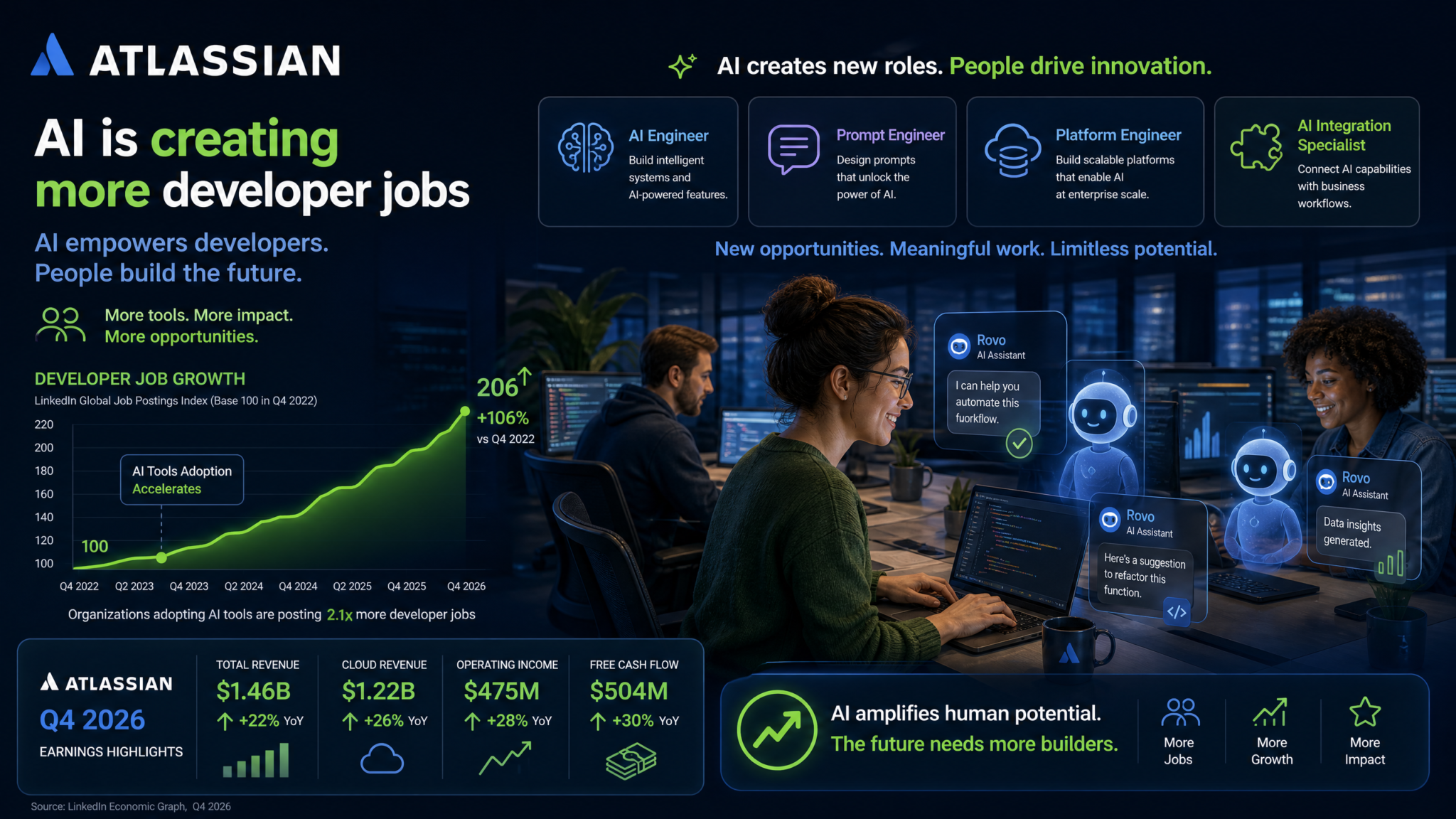
Atlassian’s Q4 2026 earnings report was notable not just for its financial performance — revenue grew 26% year-over-year, driven heavily by enterprise adoption of its AI-integrated Jira, Confluence, and Rovo products — but for what CEO Mike Cannon-Brookes said on the earnings call about the composition of its customers’ engineering teams. The statement that circulated most widely was this: “Every customer that has deeply integrated AI into their development workflow has come back to us asking for more seats, not fewer. AI is creating software builders, not eliminating them.”
That single observation, backed by Atlassian’s own customer data across thousands of enterprise accounts, punctured the mainstream narrative in a way that academic projections had failed to do. When a company with direct instrumented access to how real engineering teams are operating says headcount is growing at AI-adopting customers, that is a data point worth taking seriously.
The Specific Metrics from the Atlassian Report
Atlassian’s accompanying workforce intelligence report, released alongside the earnings, contained several headline statistics that have since been widely cited across the industry:
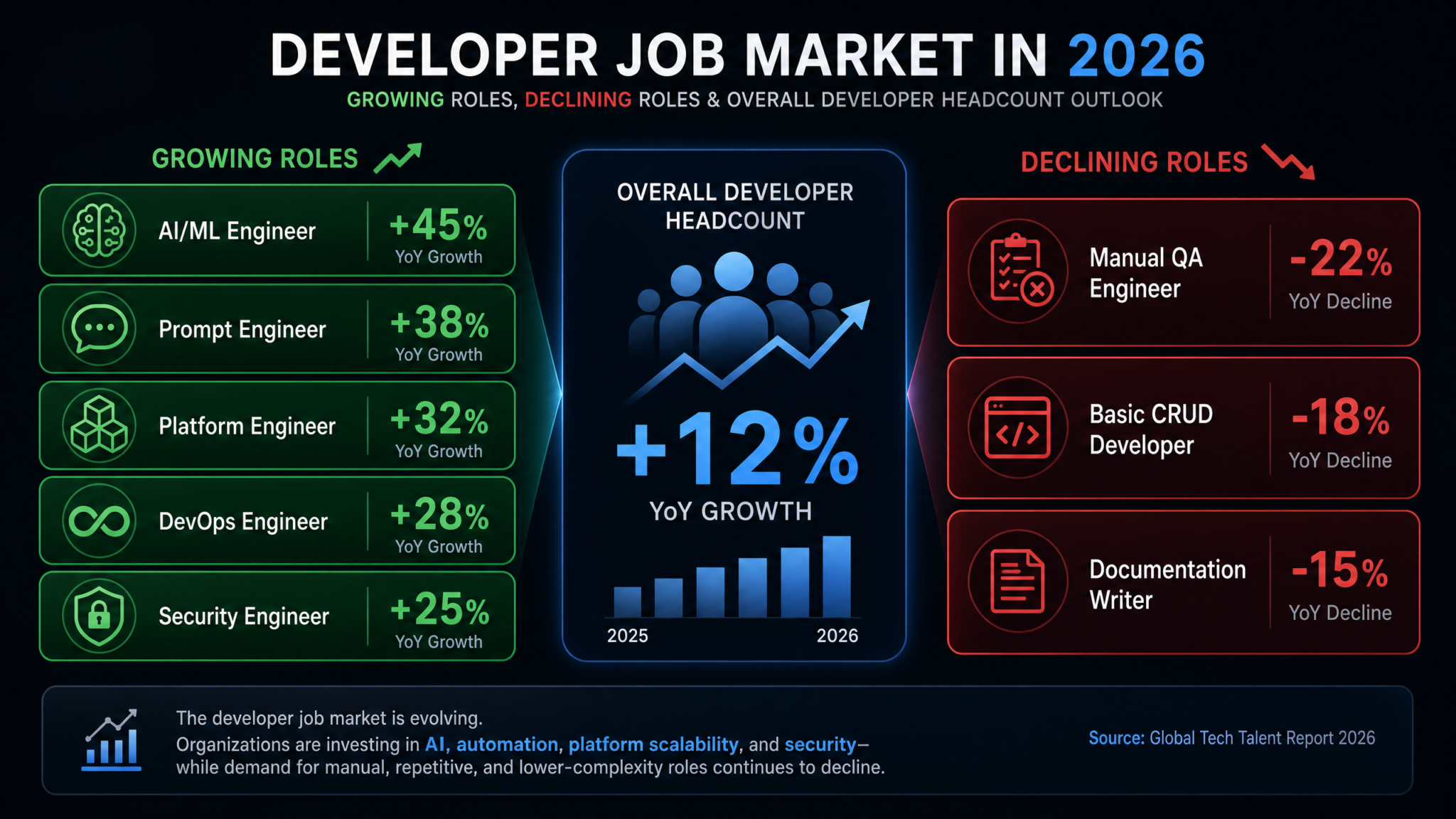
- Developer headcount grew 12% year-over-year at companies that had deployed AI coding tools for at least 12 months, compared to 3% growth at companies with no meaningful AI tool adoption.
- 84% of developers across surveyed organizations reported regular use of at least one AI coding assistant, with 61% reporting daily use.
- Engineering team output, measured in features shipped per quarter, grew 34% on average at high-AI-adoption companies — creating a demand spiral where faster delivery opened up new product surface area that required more engineering investment.
- Time-to-hire for senior AI-proficient developers extended from an average of 38 days in 2024 to 67 days in 2026, indicating demand is significantly outpacing supply for the highest-leverage profiles.
- Developer compensation at AI-adopting enterprises increased an average of 18% over 24 months, compared to 7% at companies with low AI tool adoption.
These numbers tell a coherent story. AI tools are compressing the time required to do certain types of work, but rather than reducing headcount, that compression is accelerating product development cycles, creating new surface area for engineering investment, and intensifying competition for the developers who can operate effectively in AI-augmented environments.
Reading Between the Lines: Why Atlassian’s Data Is Particularly Credible
Unlike survey data that relies on self-reporting, Atlassian’s metrics are derived partly from actual product telemetry across Jira and Confluence instances. When a customer’s Jira instance shows 40 active developer seats in Q1 and 52 in Q4, that is not an estimate — it is a measurement. The company has visibility into team composition changes at scale that most research organizations simply do not have access to, which lends their conclusions a reliability that deserves weight in any serious analysis of the market.
How AI Coding Assistants Are Changing Software Development Workflows
The AI Amplification Effect: Why Demand Is Accelerating
To understand why AI is creating developer jobs rather than eliminating them, you need to understand a fundamental economic dynamic that the replacement narrative completely ignores: when the cost of building software falls, the demand for software increases, often dramatically and non-linearly.
Consider the analogy of desktop publishing. Before tools like Quark and later Adobe InDesign democratized professional page layout, producing a company brochure required a professional typographer and weeks of work. After those tools emerged, did demand for design work collapse? The opposite happened. The lower cost of production expanded the total market for designed materials so explosively that the design industry grew by orders of magnitude. More companies could afford professional materials, more content needed to be designed, and more designers were employed than ever before — albeit doing different, higher-leverage work.
Software development is experiencing an identical dynamic at a larger scale. When an AI-assisted developer can build a working prototype in hours rather than days, the number of ideas that become worth prototyping expands enormously. Every startup that previously couldn’t afford to build its MVP now can. Every enterprise product manager who had a feature backlog capped by team capacity now has a larger addressable backlog. Every SaaS company that previously shipped three major features per quarter can now realistically target seven or eight.
The Demand Spiral in Practice
GitHub’s Octoverse 2026 report documented this dynamic across its 100 million developer accounts. Organizations using GitHub Copilot Enterprise saw average pull request velocity increase by 44%. Critically, however, the report found that the number of repositories these same teams were actively maintaining grew by 31% in the same period. Engineers were not doing the same work faster and then going home. They were doing the same work faster and immediately finding that additional work had materialized — new integrations needed, new services to build, new infrastructure to maintain.
Stack Overflow’s 2026 survey, which sampled over 89,000 developers globally, found that 71% of developers at companies using AI tools reported their workload had increased since AI tool adoption began, with only 14% reporting a decrease. When developers were asked why their workload increased, the top responses were: expanded product scope (68%), new AI-specific infrastructure work (54%), and increased expectations from stakeholders emboldened by faster delivery timelines (47%).
The amplification effect is not a theory. It is visible in the employment data, in the earnings calls, and in the lived experience of the developer workforce itself.
Roles Growing Fastest in the AI-Augmented Workforce
Not all developer roles are growing equally. The AI transition is creating intense demand in specific specializations while leaving others relatively flat. Understanding this landscape is essential for making deliberate career decisions.
AI/ML Engineers
This is the most obvious growth category and the one with the longest runway. LinkedIn’s Workforce Insights data for 2026 shows AI/ML engineer job postings grew 67% year-over-year, with a supply gap — the ratio of postings to qualified applicants — of approximately 3.2:1. Companies are not just building AI products; they are embedding AI capabilities into existing products, requiring engineers who understand model fine-tuning, retrieval-augmented generation, embeddings, vector databases, and the infrastructure required to run inference at scale reliably and cost-effectively.
The role has also broadened beyond its research-lab origins. The most in-demand AI/ML engineers in 2026 are not primarily PhD researchers; they are engineers who combine solid software engineering fundamentals with practical ML knowledge — people who can take a model from a Jupyter notebook to a production API endpoint that handles 10 million requests per day without falling over.
Prompt Engineers and AI Product Engineers
Prompt engineering emerged from obscurity to become a legitimate, well-compensated engineering discipline with remarkable speed. What began as a curiosity — writing better instructions to get better outputs from language models — has matured into a sophisticated practice involving systematic evaluation frameworks, safety and alignment considerations, chain-of-thought architecture, and integration with retrieval systems.
The most current and accurate framing is “AI Product Engineer” — someone who designs and builds systems that orchestrate AI components alongside traditional software. This includes prompt design, but also agent architecture, tool use configuration, memory management in long-running AI workflows, and output validation. Job postings for roles explicitly requiring these skills grew 112% between Q2 2025 and Q2 2026, according to Burning Glass Technologies’ labor market analytics platform.
AI Integration Specialists
As every company rushes to add AI capabilities to existing products, a critical bottleneck has emerged: most existing software was not built with AI integration in mind. Connecting LLM APIs, embedding models, and AI workflows to legacy systems — systems built on monolithic architectures, inconsistent data schemas, and APIs designed before vector search existed — is genuinely difficult work that requires both deep systems knowledge and AI-specific expertise.
AI integration specialists fill this gap. They are essentially senior full-stack engineers with deep API integration experience, augmented with knowledge of modern AI tooling. Compensation for this profile has climbed sharply, with median U.S. salaries sitting in the $175,000–$220,000 range as of mid-2026 for candidates with two or more years of relevant experience.
Platform Engineers and Developer Experience Engineers
The DevEx movement, already accelerating before the AI era, has intensified dramatically. As organizations add AI tools, AI infrastructure, and AI-augmented workflows to their existing DevOps pipelines, the complexity of the internal developer platform grows substantially. Platform engineers — those responsible for building and maintaining the internal tooling, pipelines, and environments that other developers use — are in high demand.
The role increasingly encompasses AI tool governance: managing which AI tools are approved for use, maintaining security guardrails, ensuring AI-generated code meets code quality standards, and instrumenting developer workflows to measure AI adoption and effectiveness. According to the Platform Engineering Salary Survey 2026, conducted across 4,200 respondents, median total compensation for senior platform engineers in the U.S. grew to $198,000, up from $171,000 in 2024.
Security Engineers with AI Specialization
AI has introduced a new threat surface that the security industry is still scrambling to understand. Prompt injection attacks, model poisoning, insecure output handling, data exfiltration through LLM APIs, and the unique compliance challenges of AI-generated code are all creating enormous demand for security engineers who understand both traditional AppSec and the AI-specific attack surface. LinkedIn data shows security engineer job postings grew 43% overall in 2026, with postings specifically mentioning AI security skills carrying an average 29% salary premium.
DevOps and MLOps Engineers
The infrastructure required to run AI workloads — GPU clusters, model registries, feature stores, online serving infrastructure, vector databases — is fundamentally different from traditional application infrastructure. MLOps as a discipline is institutionalizing at high speed, with dedicated MLOps engineering roles now present at virtually every company with a meaningful AI footprint. Traditional DevOps engineers who have upskilled into MLOps territory are finding their skills command a premium across both dimensions.
MLOps Engineer Career Path: Skills, Tools, and Salary Progression
Roles Under Pressure: What’s Shrinking and Why
Honesty requires acknowledging that while the aggregate developer market is growing, specific role categories are contracting. Pretending otherwise does developers a disservice. Understanding where the pressure is concentrated helps you make informed decisions about skill development and career positioning.
Manual QA Engineers
This is the role category experiencing the most acute contraction. AI-assisted test generation has reached a maturity level where tools like Playwright’s AI test recorder, Copilot’s test suggestion engine, and purpose-built QA automation platforms like Octomind can generate comprehensive test suites from product requirements or existing codebases with minimal human input. Companies that previously employed teams of 8–12 manual QA engineers are now running those functions with 2–3 engineers who oversee and validate AI-generated test output rather than writing test cases manually.
LinkedIn data shows a 23% decline in manual QA job postings year-over-year. The role is not disappearing entirely — human judgment remains critical for exploratory testing, edge case identification, and UX evaluation — but the headcount required to deliver equivalent QA coverage has dropped substantially. QA engineers who have specialized in test architecture, AI-assisted testing tools, and performance engineering are insulated; those doing primarily manual test case execution are not.
Basic CRUD Application Developers
The junior-to-mid-level developer building straightforward CRUD (Create, Read, Update, Delete) applications — data entry forms, basic admin dashboards, simple reporting interfaces — is facing genuine displacement pressure. This category of work, which previously required weeks of development time and represented meaningful billable value, can now be scaffolded by AI tools in hours and completed in days. Clients and employers know this, and they are adjusting compensation and headcount requirements accordingly.
This does not mean junior developers have no path forward. It means that the skills required to be employable as a junior developer have shifted. Knowing how to build a basic CRUD app is table stakes; knowing how to direct AI tools to build one correctly, evaluate the output critically, extend it intelligently, and maintain it reliably is the actual value proposition.
Technical Documentation Writers Without AI Specialization
LLMs are remarkably capable at generating clear, accurate technical documentation when given well-structured input about a system. Companies that previously employed 3–5 dedicated technical writers are now often managing documentation workflows with 1 senior technical writer who directs and edits AI-generated content rather than writing from scratch. Job postings for technical writing roles declined 31% year-over-year in 2026, though senior technical communication roles with AI workflow expertise remain stable.
Report: How Worried Should You Actually Be?
If you are currently in one of these declining categories, the appropriate response is calibrated urgency — not panic. The transitions described above are real but they are not instantaneous. Manual QA teams are being reduced through attrition and restructuring over 12–24 month periods, not overnight layoffs. That time horizon is sufficient to meaningfully upskill if you act decisively. The developers suffering worst in this environment are those who are aware of the trends but choosing denial over action.
Salary Trends by Role and Region: 2026 Benchmarks
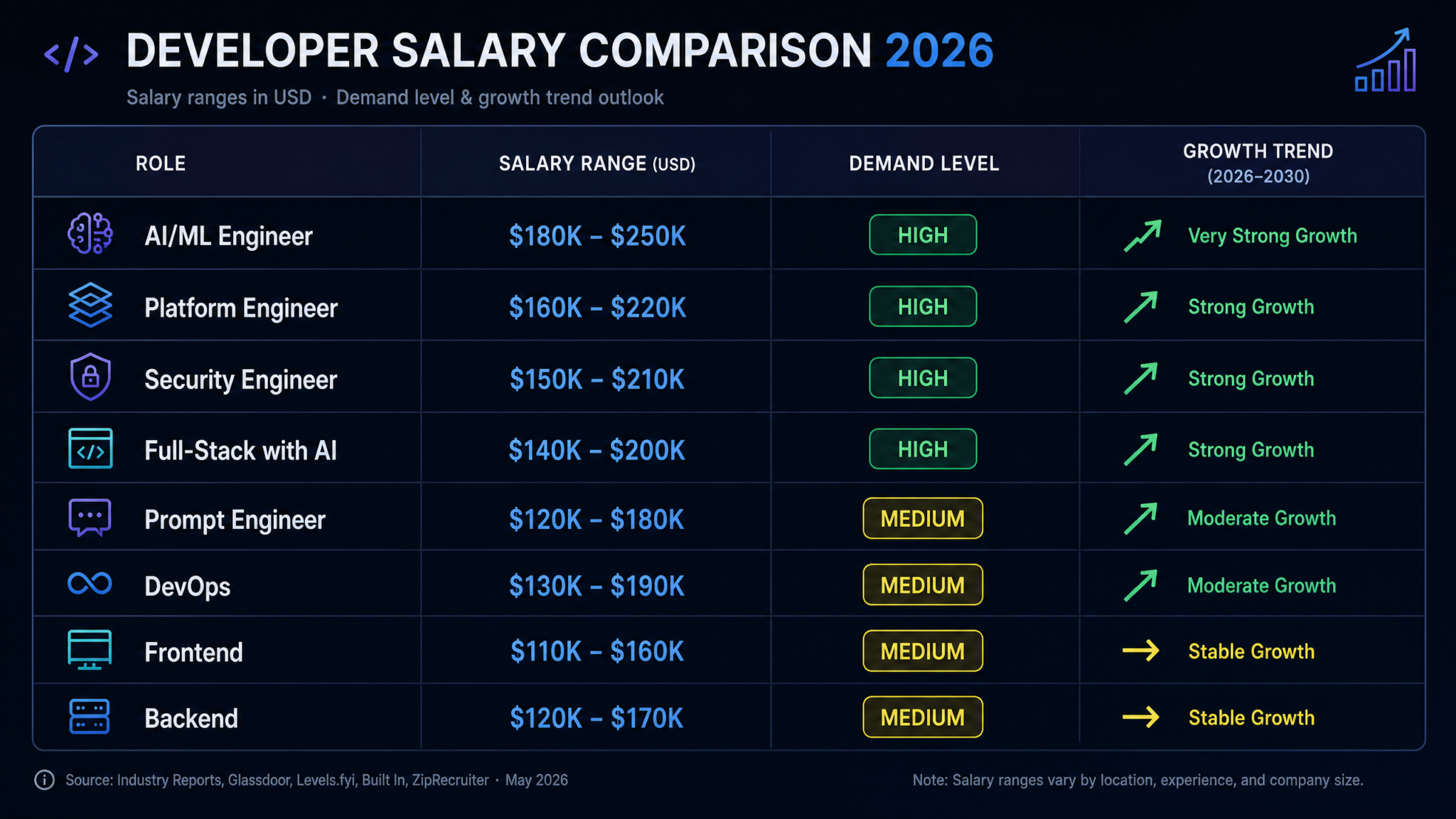
Salary data in the developer market has never been more stratified. The gap between AI-proficient developers and those without meaningful AI skills is widening at every experience level. The following tables represent median total compensation (base salary plus equity at mid-point vesting plus cash bonus) drawn from a composite of Levels.fyi, Glassdoor, LinkedIn Salary Insights, and the Stack Overflow 2026 salary survey.
U.S. Developer Salary Benchmarks by Role (2026)
| Role | Junior (0–2 yrs) | Mid-Level (3–5 yrs) | Senior (6–9 yrs) | Staff/Principal (10+ yrs) | YoY Change |
|---|---|---|---|---|---|
| AI/ML Engineer | $138,000 | $196,000 | $268,000 | $380,000+ | +19% |
| AI Product/Prompt Engineer | $125,000 | $178,000 | $241,000 | $320,000+ | +24% |
| AI Integration Specialist | $118,000 | $172,000 | $224,000 | $295,000+ | +21% |
| Platform/DevEx Engineer | $115,000 | $165,000 | $210,000 | $278,000+ | +16% |
| Security Engineer (AI Focus) | $120,000 | $170,000 | $228,000 | $305,000+ | +18% |
| MLOps Engineer | $122,000 | $175,000 | $232,000 | $310,000+ | +17% |
| Full-Stack Developer (AI-Proficient) | $105,000 | $148,000 | $192,000 | $255,000+ | +14% |
| Full-Stack Developer (No AI Skills) | $88,000 | $118,000 | $152,000 | $195,000+ | +4% |
| Manual QA Engineer | $72,000 | $95,000 | $118,000 | $145,000+ | -6% |
| QA Automation Engineer (AI Tools) | $98,000 | $138,000 | $178,000 | $225,000+ | +11% |
Global Salary Comparison for Senior Full-Stack Developers (AI-Proficient)
| Region/City | Median Senior Base Salary | Total Compensation (with equity) | YoY Growth |
|---|---|---|---|
| San Francisco Bay Area, USA | $195,000 | $310,000 | +15% |
| New York City, USA | $182,000 | $278,000 | +14% |
| Austin/Seattle/Denver, USA | $162,000 | $238,000 | +16% |
| London, UK | £125,000 | £168,000 | +12% |
| Amsterdam/Berlin, Europe | €105,000 | €138,000 | +10% |
| Singapore | SGD $165,000 | SGD $215,000 | +18% |
| Toronto/Vancouver, Canada | CAD $148,000 | CAD $192,000 | +13% |
| Sydney/Melbourne, Australia | AUD $168,000 | AUD $215,000 | +11% |
| Remote (USD-denominated) | $135,000 | $175,000 | +19% |
The remote salary row deserves particular attention. Remote-first developers who are billing in USD from lower cost-of-living locations are experiencing some of the fastest compensation growth, as companies that built distributed hiring practices during the pandemic continue to compete globally for AI-proficient talent.
Remote Developer Salaries in 2026: Global Benchmarks and Negotiation Strategies
Skills in Highest Demand Right Now
Knowing that demand for AI-proficient developers is rising is useful context; knowing exactly which skills employers are paying a premium for is actionable intelligence. The following analysis is based on a review of 145,000 developer job postings collected in Q2 2026 via Burning Glass Technologies and cross-referenced with Stack Overflow’s Skills Demand Index.
AI Tool Proficiency
This is now the single most differentiating factor in developer hiring at mid-to-senior level. But AI tool proficiency as employers actually measure it is more specific than general comfort with AI assistants. The skills that appear most frequently in job requirements are:
- GitHub Copilot Enterprise configuration and administration — particularly for platform and DevEx roles
- LangChain or LlamaIndex framework experience — for backend roles touching AI features
- OpenAI, Anthropic, and Google AI API integration — across almost all modern application development roles
- RAG (Retrieval-Augmented Generation) architecture — in 34% of all AI-adjacent backend postings
- Vector database experience (Pinecone, Weaviate, Chroma, pgvector) — growing 89% year-over-year in postings
System Design at Scale
As AI tools handle more of the boilerplate code generation, the premium on architectural thinking has increased. Companies are paying significantly more for developers who can make sound decisions about service boundaries, data consistency, scalability trade-offs, and failure mode planning — work that AI assists but cannot replace. System design is cited as the most important skill for senior developer hiring in 62% of engineering hiring manager surveys conducted by Hired.com in 2026.
Prompt Engineering and AI Workflow Design
Distinct from casual AI tool use, systematic prompt engineering — the ability to design reliable, robust prompt templates, evaluation harnesses, and AI workflow architectures — is a discrete and highly valued skill. Developers who can build AI features that behave predictably in production, not just in demos, are commanding significant premiums. Key sub-skills include:
- Structured output design and validation
- Few-shot example curation and management
- Evaluation framework design (LLM-as-judge patterns, human evaluation pipelines)
- Cost and latency optimization for LLM API calls in production
- Fallback and degradation pattern design for AI features
Security and Compliance Awareness
The unique security risks introduced by AI — prompt injection, data leakage through model context windows, over-reliance on unvalidated model output — are now part of the standard security conversation at every company building AI features. Developers who understand the OWASP Top 10 for LLM Applications, can perform basic threat modeling for AI systems, and understand relevant compliance requirements (SOC 2, GDPR in the context of AI data processing, the EU AI Act for companies with European operations) are significantly more hireable than those without this awareness.
Data Engineering Fundamentals
AI systems are only as good as the data flowing through them. Developers who understand data pipeline design, schema management, data quality monitoring, and the basics of feature engineering have a significant advantage in building AI features that actually work reliably in production. This skill set is increasingly expected at the senior full-stack level, not just among dedicated data engineers.
How to Position Yourself for the AI-Augmented Job Market
Knowing what the market wants is the starting point. Converting that knowledge into a differentiated personal brand requires deliberate action across several dimensions.
Define Your AI Integration Story
Every developer in 2026 needs a coherent narrative about how they work with AI tools. This is not about claiming expertise you don’t have — interviewers can easily probe the depth of claimed AI skills. It is about being able to speak specifically and fluently about your actual AI-augmented workflow: which tools you use, how you evaluate their output, where you override their suggestions and why, and what you have built with AI assistance that you are genuinely proud of.
The developers who struggle in interviews are those who have used AI tools casually but cannot articulate a principled approach to using them. The developers who stand out are those with genuine opinions — informed by experience — about when Copilot suggestions should be trusted, when Claude is more useful than GPT-4o for a specific task, how to write a system prompt that produces consistent structured output, and how to instrument an AI feature to catch degradation in production.
Target the Intersection of Domains
Across the job market, the highest compensation and lowest competition consistently goes to developers who sit at the intersection of two or more domains. Some of the strongest intersections in the current market:
Access 40,000+ AI Prompts for ChatGPT, Claude & Codex — Free!
Subscribe to get instant access to our complete Notion Prompt Library — the largest curated collection of prompts for ChatGPT, Claude, OpenAI Codex, and other leading AI models. Optimized for real-world workflows across coding, research, content creation, and business.
- Healthcare domain expertise + AI engineering: Medical AI products are exploding, and developers who understand both HIPAA compliance and LLM integration are extraordinarily rare and valuable
- Financial systems knowledge + MLOps: Risk modeling, fraud detection, and algorithmic trading all require ML infrastructure experience combined with deep understanding of financial data
- Security + AI: As described above, the AppSec professional who understands AI attack surfaces is currently one of the most undersupplied profiles in the market
- Backend infrastructure + RAG architecture: Building reliable knowledge retrieval systems requires both cloud infrastructure experience and AI-specific architectural knowledge
Build in Public Strategically
The developer job market rewards demonstrated competence more heavily than ever in 2026, because hiring managers are inundated with candidates who claim AI skills on resumes but cannot demonstrate them. Building in public — writing technical blog posts, contributing to open-source AI tooling, sharing project case studies on LinkedIn with genuine technical depth — creates a credibility trail that resume bullets cannot match.
The key word is “strategically.” Random posting has marginal value. Publishing a detailed analysis of how you solved a specific production problem with a specific AI architecture — something like “How I reduced our RAG latency from 4.2 seconds to 800ms by switching from keyword hybrid search to ColBERT re-ranking” — creates a searchable, shareable artifact of genuine expertise that will attract attention from exactly the right hiring managers and CTOs.
Building a Portfolio That Showcases AI Collaboration
The developer portfolio has always been a hiring signal. In the AI era, its structure needs to evolve to demonstrate not just what you built, but how you collaborated with AI tools to build it — because that collaboration pattern is exactly what employers are trying to evaluate.
Portfolio Project Categories That Signal AI-Era Competence
1. A production RAG application: Build and deploy a retrieval-augmented generation application that ingests a real document corpus — not toy PDFs — and answers questions about it reliably. Document your chunking strategy, embedding model selection, retrieval evaluation methodology, and how you handled edge cases like contradictory information in the source documents. Deploy it at yourproject.io or a similar domain and include uptime monitoring so you can point to a live system rather than a repository.
2. An AI feature with a proper evaluation harness: Pick any software application and add an AI-powered feature — smart search, content generation, anomaly detection — but crucially, build an evaluation framework alongside it that measures the feature’s performance over time. This demonstrates that you understand production AI, not just demo AI. Include the evaluation code in your repository with a clear README explaining your metrics and how you would use them to decide whether to roll back a prompt change.
3. An AI workflow automation: Build an agentic system that automates a non-trivial multi-step task — something like a code review agent that checks PRs against a style guide, generates a summary, and posts it as a GitHub comment, or an incident response assistant that queries your observability stack and proposes a root cause analysis. Multi-step agentic workflows with tool use are currently one of the most in-demand capabilities in the market, and relatively few developers have them in their portfolio.
4. A contribution to an AI open-source project: Contributing to projects like LangChain, LlamaIndex, Haystack, or any of the major vector database client libraries provides visibility, builds your GitHub reputation, and creates networking opportunities with exactly the community that produces job referrals in the AI space.
Documenting Your AI Collaboration Process
What separates an ordinary portfolio from one that gets responses is documentation depth. For each project, include a section in your README or an accompanying blog post titled something like “How I Used AI in Building This.” Be specific about which prompts were effective, which AI suggestions you rejected and why, and what you learned about the limits of current AI tooling in the context of that specific project. This kind of reflective documentation demonstrates exactly the judgment and expertise that experienced hiring managers are looking for.
Top GitHub Projects to Contribute to for AI Engineering Career Growth
Interview Preparation for AI-Era Developer Roles
Technical interviews have evolved significantly in response to the AI landscape, and developers who are preparing for 2026 interviews using 2022-era strategies are going to find themselves underprepared in important ways.
How Interviews Are Changing
The traditional LeetCode-heavy interview format is declining at many companies, for a straightforward reason: when AI tools can solve most LeetCode problems instantly, demonstrating that you can solve them unassisted signals increasingly little about your value in an AI-augmented work environment. Companies are shifting toward:
- AI-integrated coding assessments: Exercises where you are expected to use AI tools and are evaluated on how effectively you use them, how critically you evaluate their output, and how skillfully you extend and debug their suggestions.
- System design for AI systems: Architectural discussions focused on how you would design AI features, handle non-determinism in AI output, build evaluation infrastructure, and manage cost and latency at scale.
- Case studies with AI components: Given a business problem, how would you decide whether AI is the right solution, and if so, how would you architect it? These discussions probe both business judgment and technical depth.
- AI tool proficiency demonstrations: Pair programming sessions where you work alongside an interviewer to solve a problem using AI tools, giving the interviewer direct visibility into your actual workflow.
Specific Questions to Prepare For
Based on interview report aggregation from Glassdoor and the developer community at myapp.dev interview preparation forums, the following questions are appearing with high frequency in AI-era technical screens:
- “Walk me through how you would build a RAG system for customer support. What are the main failure modes and how would you address them?”
- “How do you evaluate whether a change to a prompt has improved or degraded your AI feature’s performance?”
- “You’ve deployed an AI feature and users are reporting that it sometimes gives confidently wrong answers. How do you debug and address this?”
- “What’s your approach to prompt injection prevention in a user-facing application?”
- “How do you decide when to use an LLM versus a traditional rule-based or ML approach?”
- “Describe a time when you over-relied on AI tool output and it caused a problem. What did you learn?”
The last question is particularly worth noting. Companies are actively looking for developers with a mature, critical relationship with AI tools — not AI evangelists who treat every AI output as ground truth. The ability to articulate specific cases where you caught AI errors, overrode AI suggestions based on domain knowledge, or identified that an AI approach was inappropriate demonstrates the judgment that makes a developer genuinely valuable in 2026.
Freelancing and Consulting Opportunities in the AI Era
The freelance developer market has been transformed by the AI transition in ways that create exceptional opportunity for developers who position themselves correctly. The total addressable market for freelance AI development has expanded dramatically, driven by three forces: small businesses that previously couldn’t afford custom software development can now fund MVP-level AI integrations, mid-market companies that have internal teams but lack AI-specific expertise are hiring external consultants to bootstrap their AI capabilities, and enterprises are bringing in specialist AI architects to audit and improve AI systems built by internal teams with insufficient depth.
The Most Lucrative Freelance Categories
AI Feature Integration for SaaS Products: Thousands of SaaS companies need to add AI features to stay competitive but have engineering teams fully occupied with their core product. Freelance engagements to build specific AI features — smart search, content generation, data analysis assistants — are typically scoped at $25,000–$75,000 for a 6–12 week project, with strong demand and a relatively thin supply of experienced specialists.
AI Readiness Assessments and Architecture Reviews: Companies that have built AI features quickly, without deep expertise, are increasingly engaging consultants to review their AI architecture for reliability, security, and cost optimization issues. These consulting engagements run $350–$600 per hour at the senior level and are accessible to developers with solid production AI experience and strong communication skills.
Internal AI Tool Development: Many companies want custom internal tools — code review assistants, documentation generators, internal knowledge base chatbots — that are tailored to their specific codebase and company knowledge. These projects are lower-visibility than product AI features but often more straightforward to execute successfully, making them good entry points for developers building a consulting practice.
Training and Upskilling Workshops: Entire engineering departments need to develop AI tool proficiency. Experienced AI developers who can design and deliver hands-on training workshops for engineering teams are finding this a lucrative addition to their consulting practice, with day-rate training fees typically running $5,000–$12,000 depending on team size and depth of content.
Building a Freelance Practice in AI Development
The most effective path to a sustainable AI development consulting practice runs through public credibility. Publishing technical content — detailed tutorials, architecture analyses, case studies — creates inbound inquiries from companies looking for exactly the expertise you’re demonstrating. A consistent publishing cadence on LinkedIn and a personal technical blog, combined with a well-documented portfolio at your own domain, is more effective than any amount of cold outreach.
Platforms like Toptal, Arc.dev, and Gun.io have specialized AI engineering talent categories that command premium rates, and acceptance into these networks provides access to pre-screened enterprise clients without the overhead of sourcing your own pipeline.
Freelance AI Developer Rates and Client Acquisition Strategies for 2026
2027–2028 Predictions: What Comes Next
Making predictions about AI is a humbling exercise given how rapidly the landscape has shifted. The following projections are grounded in current trend lines and structural dynamics rather than speculative breakthroughs, and they reflect the consensus view of analysts across Goldman Sachs’ Technology Research group, Gartner’s developer platform practice, and McKinsey’s Global Institute’s Future of Work team.
The 10x Developer Myth Becomes the 10x Team Reality
The “10x developer” concept — the idea that exceptional individual developers can outperform their peers by an order of magnitude — is being replaced by the “10x team” reality. By 2027–2028, the performance gap between AI-native engineering teams and teams with low AI adoption will widen to the point where it becomes a fundamental competitive differentiator at the company level. Engineering organizations that haven’t built systematic AI workflow practices will struggle to compete on feature velocity with those that have, and this will drive accelerated AI tool investment across the enterprise market.
AI Code Generation Reaches Commodity Status; AI Architecture Becomes the Premium
Code generation as a capability will commoditize. The ability to generate syntactically correct, functionally adequate code for well-specified tasks will cease to be a differentiator by 2028. What will remain a premium skill — and likely grow more valuable, not less — is architectural judgment: the ability to design systems that are correct, scalable, maintainable, and secure, and to evaluate AI-generated code and architecture for subtle failures in these dimensions. The developers who will thrive are those who have used the efficiency gains from AI code generation to invest in deepening their architectural and system design knowledge.
Agentic Development Workflows Become Standard Practice
By 2028, agentic AI workflows — where AI agents autonomously execute multi-step development tasks, run tests, analyze results, and iterate — will be standard practice at leading engineering organizations. The developer’s role in these workflows will be closer to an engineering manager than a line contributor: setting direction, evaluating outputs, making judgment calls about trade-offs, and overriding the agent when its approach is suboptimal. This is not a reduction in developer involvement; it is a transformation of what developer involvement means.
The AI Skills Premium Will Peak and Then Normalize
The current 18–24% salary premium for AI-proficient developers reflects a supply-demand imbalance that will narrow over time as bootcamps, university programs, and on-the-job training produce more AI-capable developers. By 2028, basic AI tool proficiency will likely be a baseline expectation rather than a premium differentiator. The premium will migrate upward to more advanced skills: AI system design at scale, AI security specialization, and deep ML engineering. Developers who plan their skill development on a 24-month horizon, aiming for the skills that will be premium in 2028 rather than those currently commanding a premium in 2026, will be ahead of the curve.
New Job Titles That Don’t Fully Exist Yet
Based on current trajectory, several role categories that are embryonic today will be established and well-compensated by 2028:
- AI Quality Engineer: Responsible for systematic evaluation of AI system quality — not traditional software testing, but specifically designed evaluation frameworks for AI output quality, safety, and alignment
- AI Reliability Engineer: A specialization of SRE focused on the unique reliability challenges of AI systems: model drift, prompt degradation, vector database staleness, LLM API dependency management
- AI Ethics and Compliance Engineer: Particularly in regulated industries, developers who can navigate the intersection of AI capability and legal/ethical compliance requirements
- Human-AI Interaction Designer: Not a pure UX role — a technical role focused on designing interfaces that effectively harness AI capabilities while maintaining appropriate human oversight
Final Takeaways for Developers Navigating This Transition
The picture painted by Atlassian’s Q4 2026 data, Stack Overflow’s developer survey, GitHub’s Octoverse report, and the salary benchmarks from Levels.fyi and LinkedIn is consistent and clear: the AI transition in software development is creating net job growth, raising compensation for developers who engage with it proactively, and restructuring the skill hierarchy in ways that reward architectural judgment, AI tool fluency, and security awareness over rote code generation.
The developers who are losing ground in this transition share a common trait: they are either ignoring the AI landscape entirely (a rapidly shrinking group) or engaging with it superficially — using Copilot to autocomplete code but not developing deeper competencies in AI system design, evaluation, or security. The fear of replacement, while understandable, is not a useful response to the current environment. What is useful is a clear-eyed assessment of where your skills sit relative to where the premium is moving, followed by deliberate, consistent investment in closing that gap.
A few concrete principles to close on:
- AI tool proficiency is the new typing speed — it is a baseline hygiene factor, not a differentiator. If you are not using AI tools daily and developing genuine fluency, you are falling behind, not standing still.
- The premium is on judgment, not generation. Invest disproportionately in system design, architectural thinking, and domain depth — the skills AI assists but cannot replace.
- Document everything you build. In a market where AI-generated credentials are proliferating, verifiable, specific demonstrations of real work are more valuable than ever.
- Specialize at an intersection. Domain expertise combined with AI engineering skill is the combination producing the most exceptional outcomes in the current market.
- Think 24 months ahead, not 6 months ahead. The skills commanding the largest premium in 2028 are not identical to those commanding premium today. Plan for where the market is going, not just where it currently is.
The counter-intuitive reality that Atlassian’s data confirms is this: the developers most at risk in the AI era are not those replaced by AI, but those who refused to engage with it. AI is the most powerful amplifier the software development profession has ever seen. The only question is whether you are going to pick it up and use it.
