
Cal Newport’s Deep Work, Supercharged by ChatGPT: The 2026 Implementation Guide
The Age of Distraction and the Urgent Need for Deep Work
In the modern knowledge economy, the ability to focus without distraction on a cognitively demanding task is a superpower. Cal Newport, in his seminal book, “Deep Work: Rules for Focused Success in a Distracted World,” defines this skill as the key to unlocking extraordinary results. Deep work is what allows you to quickly master complicated information and produce better results in less time. It’s the skill that will make you a top performer in your field.
However, we live in an age of unprecedented distraction. The constant barrage of emails, Slack notifications, social media updates, and the allure of the open office have created a culture of “shallow work”—non-cognitively demanding, logistical-style tasks, often performed while distracted. This shallow work, while necessary at times, does little to create new value in the world and is easy to replicate. The result? A workforce that is busy but not productive, constantly connected but rarely focused.
But what if you could reclaim your focus? What if you could systematically cultivate the ability to go deep, to concentrate intensely, and to produce work of exceptional quality and speed? And what if you could leverage the most powerful AI tool ever created to help you do it? This is not a far-fetched dream; it’s the reality of supercharging Cal Newport’s Deep Work philosophy with ChatGPT. This guide will show you how.
Understanding Cal Newport’s Deep Work Philosophy
Before we dive into the practical application of ChatGPT, it’s crucial to grasp the core tenets of Newport’s philosophy. Deep work is not just about ‘working hard’; it’s a systematic approach to structuring your work life to maximize your cognitive output. The philosophy is built on a simple but profound equation:
High-Quality Work Produced = (Time Spent) x (Intensity of Focus)
Most professionals focus on the ‘Time Spent’ variable, trying to cram more hours into their day. Newport argues that the real leverage comes from maximizing the ‘Intensity of Focus.’ An hour of uninterrupted, deep focus can produce more value than a full day of fragmented, shallow work. The ability to perform deep work is becoming increasingly rare at the exact same time it is becoming increasingly valuable in our economy. As a consequence, the few who cultivate this skill, and then make it the core of their working life, will thrive.
The Four Rules of Deep Work
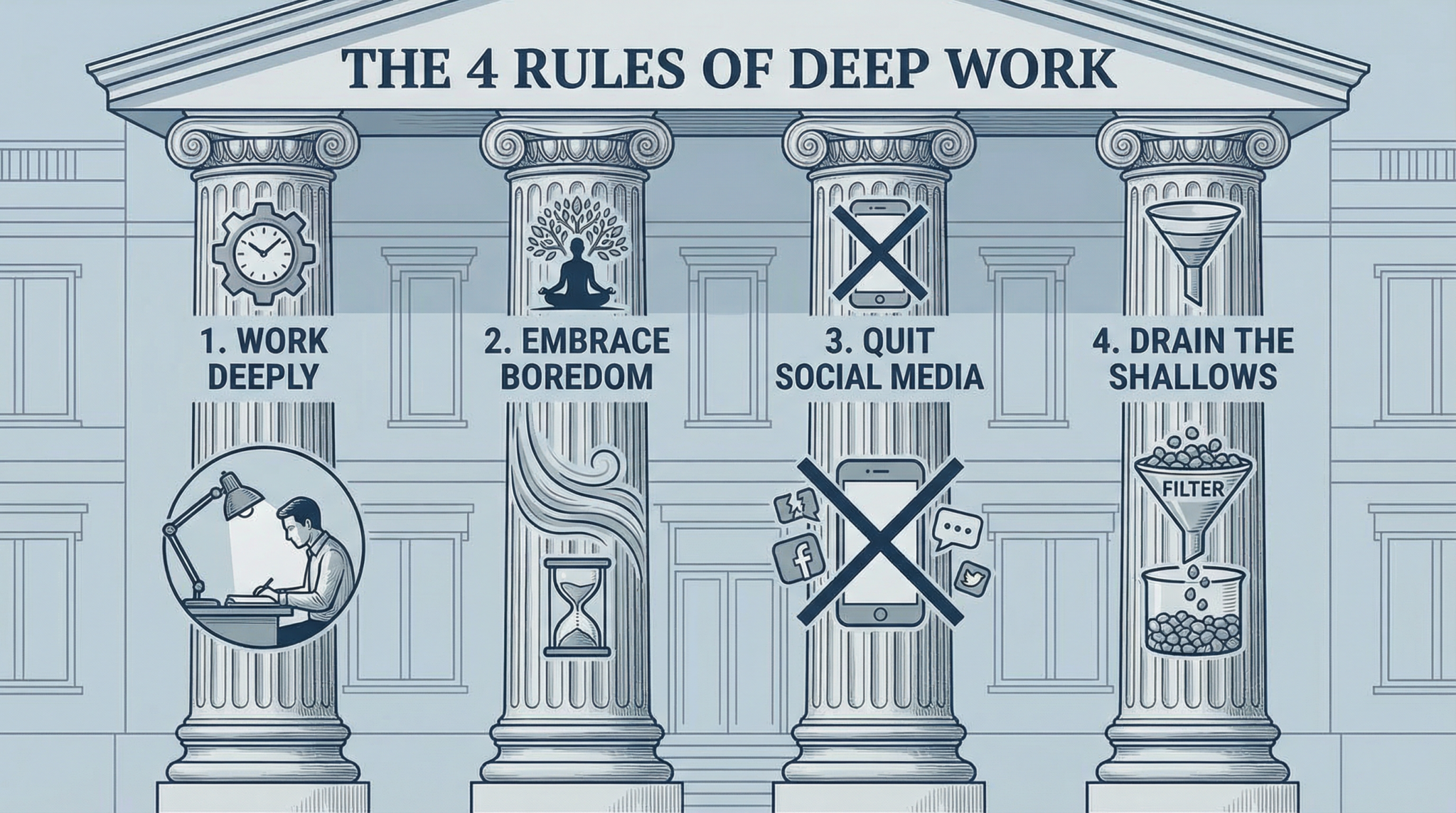
Newport outlines four fundamental rules to help you cultivate a deep work practice. We will explore how ChatGPT can act as a co-pilot in implementing each of these rules.
- Work Deeply: This rule is about building routines and rituals to help you go into a state of deep work. It’s about creating a structure that minimizes the need to expend willpower on a moment-to-moment basis.
- Embrace Boredom: To succeed with deep work, you must rewire your brain to be comfortable with a lack of novel stimuli. This means weaning yourself off the constant distraction of social media, news, and other digital junk food.
- Quit Social Media: Newport advocates for a pragmatic and ruthless approach to your tool selection. If a tool doesn’t provide a significant, positive, and direct impact on your professional or personal goals, you should abandon it.
- Drain the Shallows: This rule is about minimizing the amount of shallow work you do. It involves scheduling your day, quantifying the depth of your work, and being deliberate about what you say ‘yes’ to.
Designing Your Personalized Deep Work Ritual with ChatGPT
A Deep Work Ritual is a set of pre-defined steps you take to enter a state of intense focus. The goal is to automate the transition into deep work, removing friction and decision fatigue. This is where ChatGPT becomes an invaluable partner. You can use it to design a ritual that is perfectly tailored to your personality, work style, and environment. Here is the exact prompt to use:
Act as a recognized expert in deep work techniques, guiding the incorporation of deep work into a routine for enhanced focus. Your task is to share practical steps, offer insights into creating an optimal deep work environment, and highlight potential outcomes of consistently practicing deep work. Provide a step-by-step guide on transitioning into deep work, emphasizing the importance of eliminating distractions and fostering a conducive work setting. Offer tips for maintaining focus and managing interruptions. Additionally, outline the potential positive outcomes that can result from consistently practicing deep work. My first request is to: [Insert your work environment/goals here]
How to Use the Prompt Effectively
The key to making this prompt work is the final sentence: “My first request is to: [Insert your work environment/goals here].” This is where you provide the context ChatGPT needs to give you a truly personalized plan. Here are a few examples:
- For a software developer: “My first request is to: design a deep work ritual for a remote software developer working on a complex codebase. I struggle with Slack interruptions and the temptation to check Hacker News.”
- For a marketing manager: “My first request is to: create a deep work plan for a marketing manager in a busy open office. I need to balance deep work (strategy, campaign planning) with collaborative meetings and urgent requests.”
- For a freelance writer: “My first request is to: build a deep work routine for a freelance writer working from a home office. My biggest challenges are social media distractions and managing a variable client workload.”
ChatGPT will then generate a detailed, step-by-step plan for your Deep Work Ritual. This might include:
- A specific time and location for your deep work sessions.
- A pre-work routine, such as clearing your desk, getting a cup of coffee, or a short meditation.
- A clear statement of what you intend to accomplish during the session.
- A post-work shutdown ritual to help you disengage and recharge.
The real power of this approach is its iterative nature. You can go back to ChatGPT and refine the ritual over time. For example, you could ask: “That\’s a good start, but I find it hard to resist checking my phone. Can you suggest some specific strategies to create a phone-free deep work environment?”
Best ChatGPT Prompts for Productivity
Slaying the Dragons of Distraction: AI-Powered Strategies
Even with the best-laid plans, distractions are inevitable. The key is to have a pre-meditated strategy for dealing with them. Here’s how you can use ChatGPT to create a personalized defense against the most common culprits.
Taming the Slack/Teams Beast
Constant notifications from team chat apps are the enemy of deep work. You can use ChatGPT to create a communication protocol for your team. For example, you could prompt it with:
“My team relies heavily on Slack for communication, which makes it hard to focus. Generate a polite but firm Slack status message that I can use during my deep work blocks. Also, draft a short memo to my team explaining my new deep work schedule and how to best reach me for urgent matters.”
ChatGPT can also help you batch-process your communications. For instance, you can feed it a transcript of a busy Slack channel and ask it to: “Summarize the key decisions, action items, and questions from this Slack conversation that directly involve me.”
Conquering the Email Avalanche
Email is another major source of shallow work. Use ChatGPT to draft email templates that help you manage expectations and reduce back-and-forth. For example:
“I need to get my inbox under control. Generate a set of email templates for common situations, such as: acknowledging receipt of a non-urgent request and stating when I will get to it; politely declining a meeting that could be an email; and delegating a task to a team member.”
You can also use AI-powered email clients like Superhuman or the new features in Gmail and Outlook to automatically summarize and prioritize your emails, allowing you to quickly identify what needs your attention and what can be ignored.
Surviving the Open Office
The open office is perhaps the most challenging environment for deep work. While you can’t change the architecture, you can change how you operate within it. Use ChatGPT to brainstorm solutions:
“I work in a noisy open office and find it impossible to concentrate. My company is resistant to remote work. Suggest a combination of physical, social, and technological strategies I can use to create a ‘bubble’ of deep work in this environment. Include recommendations for noise-cancelling headphones, conversation starters to explain my need for focus, and tools I can use.”
ChatGPT might suggest a combination of high-quality noise-cancelling headphones, a physical sign on your desk (e.g., a
‘Deep Work in Progress’ sign), and a conversation script to politely defer interruptions from colleagues. It can help you craft the exact language to use to minimize social friction.
25 Advanced ChatGPT Prompting Techniques
Training Your Brain for Sustained Focus: Embracing Boredom in the Digital Age
One of Cal Newport’s most counter-cultural but crucial pieces of advice is to “embrace boredom.” In a world saturated with digital stimuli, our brains have been rewired to crave constant novelty. This makes it incredibly difficult to sustain focus on a single, challenging task. To do deep work, you must retrain your brain’s ability to concentrate. ChatGPT can be your personal trainer in this endeavor.
Your Personalized Focus Training Plan
You can use ChatGPT to create a progressive plan to build your focus endurance. Try this prompt:
“Act as a cognitive behavioral therapist specializing in focus and attention. I want to train my ability to concentrate and resist distractions. Currently, I can only work for about 15 minutes before I feel the urge to check my phone or switch tasks. Design a 4-week progressive training plan that will help me build up to a 90-minute deep work session. The plan should include specific exercises, techniques for managing intrusive thoughts, and a schedule for ‘boredom practice’.”
ChatGPT might suggest a plan that includes:
- Week 1: Start with 25-minute focused work sessions (the Pomodoro Technique), followed by a 5-minute break *without* digital devices. Practice ‘productive meditation’ (focusing on a single professional problem) during your commute or a walk.
- Week 2: Increase work sessions to 40 minutes. Schedule 15 minutes of ‘internet-free’ time each evening, where you read a physical book or simply sit with your thoughts.
- Week 3: Push your work sessions to 60 minutes. When you feel the urge to switch tasks, write down the distracting thought and a time when you will address it later.
- Week 4: Attempt your first 90-minute deep work block. Schedule a full hour of ‘digital detox’ before bed.
By offloading the planning to ChatGPT, you can focus your mental energy on the execution. The AI can provide the structure and encouragement you need to stick with the training, even when it feels uncomfortable.
Draining the Shallows: Conducting a Shallow Work Audit with AI
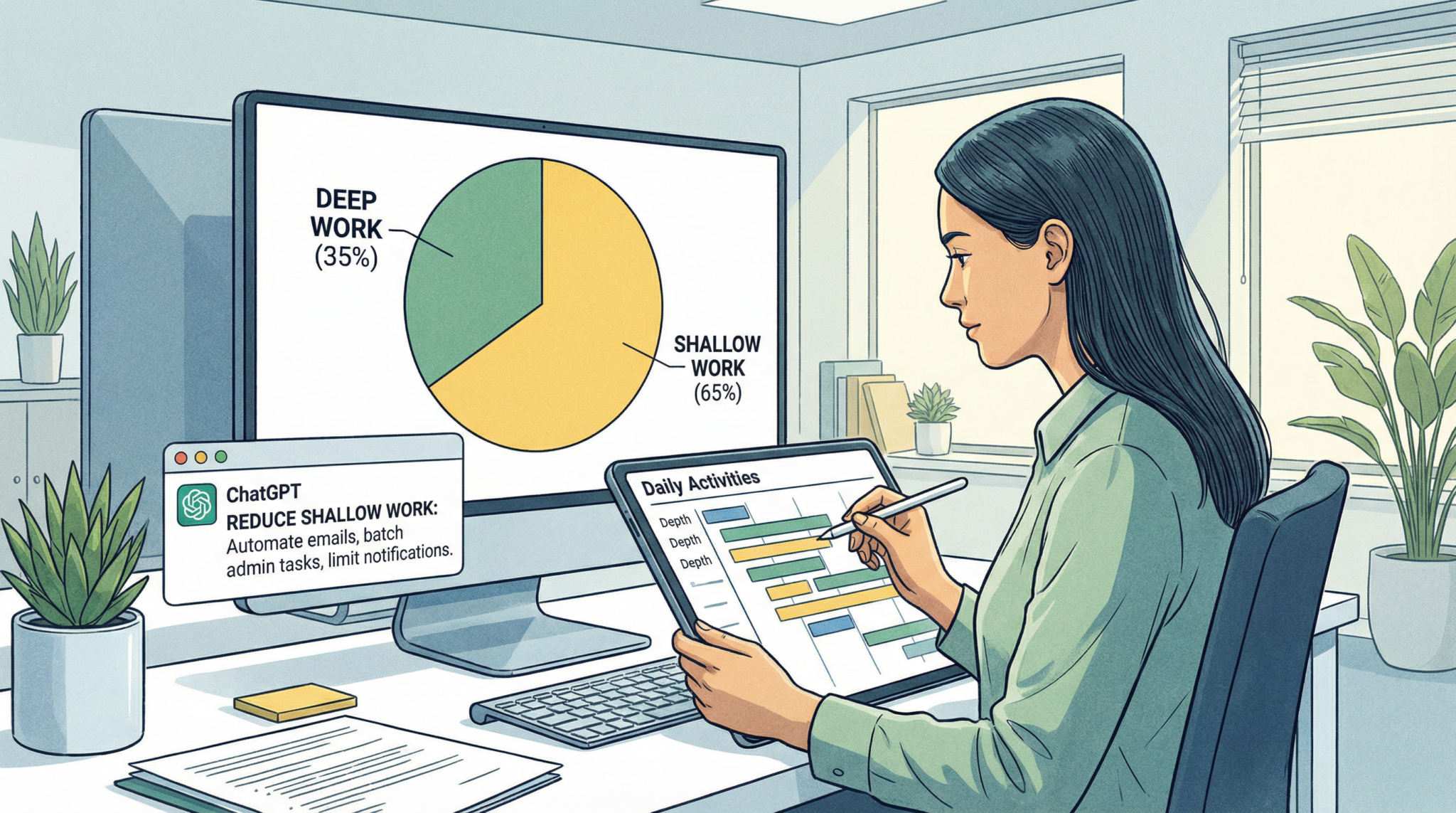
To make more time for deep work, you must first understand where your time is currently going. Many knowledge workers are shocked to discover how much of their day is consumed by shallow, low-value tasks. You can use ChatGPT to conduct a “shallow work audit” and create a plan to reclaim your time.
Step 1: Data Collection
For one week, keep a detailed log of your work activities. You can use a simple text file or a spreadsheet. For each 30-minute block of your workday, write down what you were doing. Be honest and specific. A typical entry might look like this:
9:00 AM – 9:30 AM: Responded to emails, checked Slack notifications.
9:30 AM – 10:00 AM: Attended daily stand-up meeting.
10:00 AM – 10:30 AM: Tried to start writing the quarterly report, but got distracted by a news article.
Step 2: AI-Powered Analysis
At the end of the week, feed your entire work log into ChatGPT with the following prompt:
“I have logged my work activities for the past week. Please analyze this log to identify my main sources of shallow work. Categorize my activities into ‘Deep Work’, ‘Shallow Work’, and ‘Administrative’. Calculate the percentage of my time spent in each category. Based on this analysis, suggest 3 specific strategies I can use to reduce my shallow work and increase my deep work time. Here is my log: [Paste your entire work log here].”
Step 3: Implementing the Recommendations
ChatGPT will provide a data-driven analysis of your work habits and concrete, actionable recommendations. For example, it might suggest:
- Time Blocking: Schedule specific, non-negotiable blocks for deep work in your calendar.
- Office Hours: Establish “office hours” for colleagues to ask you questions, rather than allowing constant interruptions.
- The 30% Rule: Dedicate no more than 30% of your day to shallow work. Use a tool like RescueTime or Clockify to track this automatically.
This AI-powered audit provides an objective, non-judgmental look at your work habits, making it easier to see where you can make improvements. It’s a powerful way to hold yourself accountable and make a conscious shift towards a more productive and fulfilling work life.
From Theory to Practice: Real-World Deep Work Schedules for Knowledge Workers
The principles of deep work are universal, but their application can vary dramatically depending on your role and environment. Here are a few sample deep work schedules, which you can adapt or use as inspiration. You can even ask ChatGPT to refine them for your specific needs: “Here is a sample deep work schedule for a project manager. My situation is slightly different because [explain your unique constraints]. Can you adapt this schedule for me?”
Schedule 1: The Monastic Approach (For Researchers, Authors, or Coders)
This approach involves eliminating or radically minimizing shallow obligations. It’s not for everyone, but it offers the greatest potential for sustained deep work.
| Time | Activity |
|---|---|
| 8:00 AM – 12:00 PM | Deep Work Block 1: Four hours of uninterrupted focus on the most critical cognitive task. No email, no Slack, no phone. |
| 12:00 PM – 1:00 PM | Lunch and a long walk. No digital devices. This is time for the mind to rest and consolidate information. |
| 1:00 PM – 3:00 PM | Deep Work Block 2: Two more hours of focused work, perhaps on a secondary but still demanding task. |
| 3:00 PM – 4:00 PM | Shallow Work Batch: Process all emails, respond to Slack messages, and handle administrative tasks in one consolidated block. |
| 4:00 PM | Shutdown Complete. End of the workday. |
Schedule 2: The Bimodal Approach (For Consultants or Executives)
This approach involves dividing your time into distinct deep and shallow periods. For example, you might dedicate two full days a week to deep work, and the other three to meetings, calls, and other shallow tasks.
| Day | Focus |
|---|---|
| Monday & Tuesday | Deep Work Days: Out-of-office reply is on. No scheduled meetings. Focus entirely on a major project, strategic plan, or creative endeavor. |
| Wednesday – Friday | Shallow Work Days: Open for meetings, collaboration, client calls, and administrative tasks. The goal is to batch all the shallow work into these days to protect the deep work days. |
Schedule 3: The Rhythmic Approach (For Most Knowledge Workers)
This is the most common and practical approach. It involves creating a regular, daily habit of deep work. The key is consistency.
| Time | Activity |
|---|---|
| 9:00 AM – 11:00 AM | Daily Deep Work Ritual: Two hours of focused work on your most important task. This is a sacred, non-negotiable time block. |
| 11:00 AM – 1:00 PM | Collaborative work, meetings, and email. |
| 1:00 PM – 2:00 PM | Lunch. |
| 2:00 PM – 4:00 PM | A mix of shallow tasks and less demanding work. |
| 4:00 PM – 5:00 PM | Plan for the next day and perform a shutdown ritual. |
The key is not to perfectly replicate one of these schedules, but to use them as a starting point. Experiment, track your results, and use ChatGPT as your coach to build a system that allows you to consistently produce high-quality, valuable work.
Access 40,000+ AI Prompts for ChatGPT, Claude & Codex — Free!
Subscribe to get instant access to our complete Notion Prompt Library — the largest curated collection of prompts for ChatGPT, Claude, OpenAI Codex, and other leading AI models. Optimized for real-world workflows across coding, research, content creation, and business.
Frequently Asked Questions (FAQ)
Can ChatGPT really help me with Deep Work, or is it just another distraction?
This is a valid concern. Like any powerful tool, ChatGPT can be a distraction if used improperly. However, the key is to use it strategically and intentionally, as outlined in this guide. By using ChatGPT to *plan* your deep work sessions, create strategies for focus, and audit your time, you are using it *outside* of your focused blocks. It becomes a coach and a planner, not a co-worker. The goal is to leverage AI to do the shallow work of preparation, so you can dedicate your precious cognitive resources to the deep work itself.
How long does it take to see the benefits of Deep Work?
The benefits of deep work are both immediate and cumulative. You will likely feel a sense of accomplishment and focus after your very first successful deep work session. However, the profound, career-altering benefits that Cal Newport describes—such as mastering complex skills and becoming a top performer in your field—are the result of consistent practice over weeks, months, and years. Think of it like physical exercise. You feel good after one workout, but you transform your body by going to the gym consistently for a long time. The key is to start small, build momentum, and make deep work a regular part of your professional life.
Is it possible to do Deep Work if I have a very collaborative job with many meetings?
Absolutely, but it requires a different approach. If your job is highly collaborative, the “Monastic” approach to deep work is likely unrealistic. Instead, the “Rhythmic” or “Bimodal” approaches are more suitable. The key is to be very intentional about scheduling. You might block out the first 90 minutes of every day for deep work before your meetings begin. Or you could schedule “meeting-free” afternoons twice a week. It’s about communicating your schedule to your team and training them to respect your focused time. You can use ChatGPT to help you draft the exact language to use with your colleagues to make this a smooth process.

