
ChatGPT Removes All Text Limits for Free Users: What Unlimited GPT-5.6 Luna Access Means for 1 Billion Weekly Users
Published: August 6, 2026 | Breaking News · AI Industry
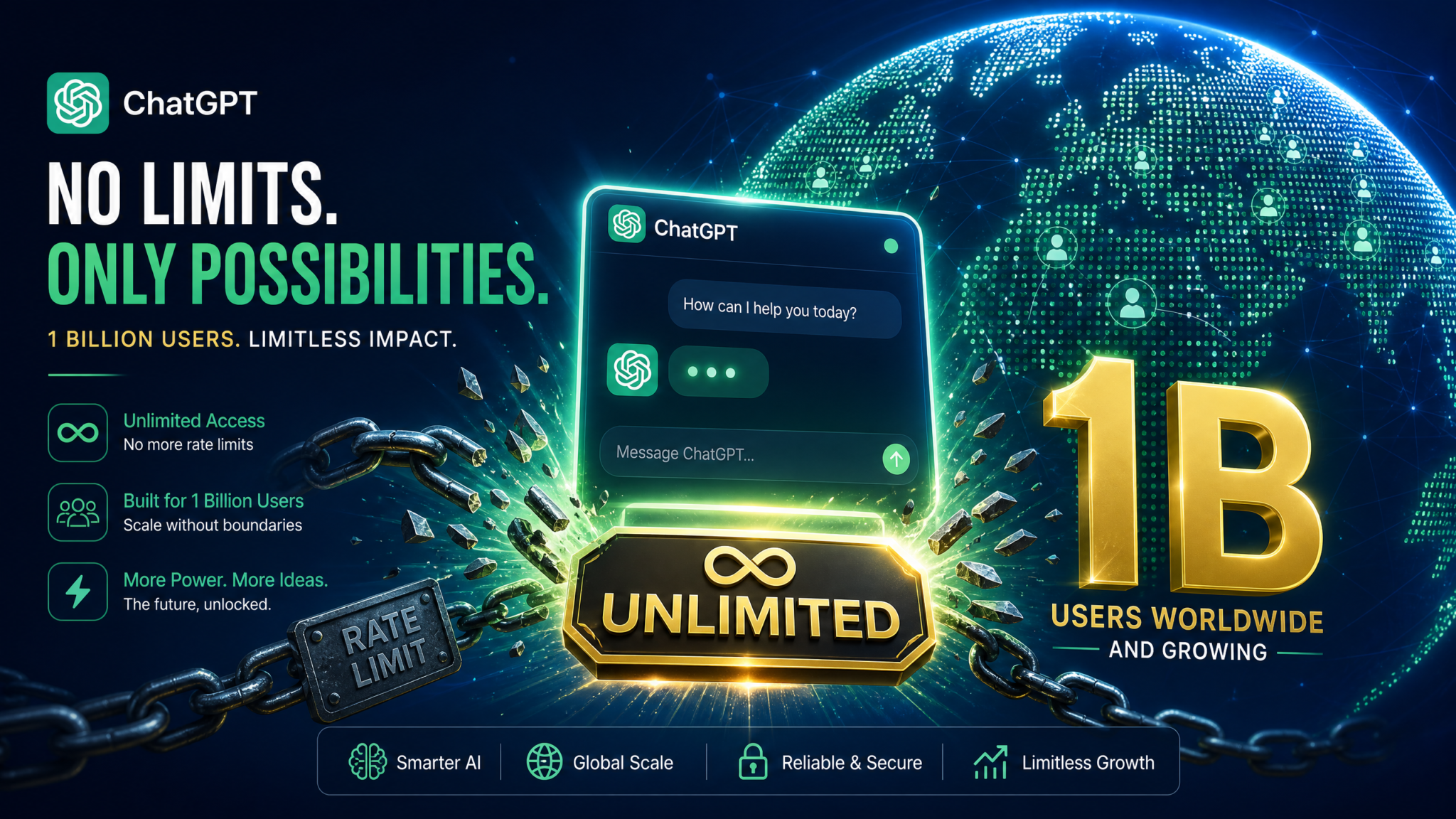
In a watershed moment for the artificial intelligence industry, OpenAI today announced the complete removal of text-based conversation limits for all ChatGPT Free and Go-tier users, simultaneously unveiling GPT-5.6 Luna as the new default model available at zero cost. The announcement, made during OpenAI’s annual product event in San Francisco, represents the most aggressive expansion of free AI access in the company’s history — and sends a direct, unmistakable signal to every competitor in the generative AI market. As ChatGPT simultaneously crosses the extraordinary milestone of one billion weekly active users, the structural economics of the AI industry are shifting beneath everyone’s feet, and the question is no longer whether OpenAI can scale, but whether anyone else can afford to keep up.
The August 6 Announcement: What OpenAI Said and What It Means
At precisely 10:00 AM Pacific Time on August 6, 2026, OpenAI CEO Sam Altman walked onto a stage at the Moscone Center in San Francisco and delivered a statement that immediately reverberated across Silicon Valley, Wall Street, and every corporate boardroom with an AI strategy: “From today, there are no message limits on text conversations for any ChatGPT user. Free is not a trial. Free is the product.”
The implications of that single sentence took a few minutes to fully land for the audience — and have spent the hours since landing hard on the entire technology industry. For four years, ChatGPT’s free tier has operated under a rotating set of usage caps, message limits, and model access restrictions designed to nudge users toward paid subscriptions. Those restrictions are now gone for text-based interactions. Any person anywhere in the world who creates a free ChatGPT account can now have unlimited text conversations powered by GPT-5.6 Luna, one of the most capable language models ever deployed at consumer scale.
The accompanying blog post released simultaneously spelled out the mechanics: existing Free users will see no change to their account settings, no prompts to upgrade, and no message counters anywhere in the interface. The change goes live globally at midnight UTC on August 7, 2026, with a phased infrastructure rollout for regions where OpenAI is scaling server capacity. Users in North America, Western Europe, Japan, South Korea, and Australia will have access immediately. Full global rollout, including South Asia, Southeast Asia, Latin America, and sub-Saharan Africa, is expected to complete within 72 hours.
The company was careful to distinguish what “unlimited” means in this context. Unlimited text conversations do not mean unlimited compute resources of every kind. File analysis, image generation, voice mode, video understanding, and the highest-tier reasoning runs remain metered for free users. But for the hundreds of millions of people who use ChatGPT primarily as a text-based assistant — to write, analyze, learn, code, plan, and communicate — the friction of watching a message counter tick toward zero is now permanently gone.
“We believe that access to capable AI should not be rationed by how much someone can pay for it. GPT-5.6 Luna is not a watered-down model. It is a world-class reasoning system. And as of today, it belongs to everyone.”
The announcement comes at a moment of extraordinary momentum for OpenAI. The company reported in its investor update this morning that ChatGPT has crossed one billion weekly active users — a figure that, when first whispered in analyst circles six months ago, was greeted with skepticism. It is now official, audited, and staggering. For reference, it took Facebook nearly a decade to reach one billion monthly active users. ChatGPT has reached one billion weekly in roughly four years of public availability.
GPT-5.6 Luna: The New Free Default Model Explained
GPT-5.6 Luna is not simply a rebranded version of a previously paid model. OpenAI’s technical documentation, released alongside the announcement, describes Luna as a purpose-built deployment variant of the GPT-5.6 architecture that has been specifically optimized for high-throughput, low-latency serving at unprecedented scale. The “Luna” designation refers to a distillation and specialization process that maintains approximately 94% of the benchmark performance of the full GPT-5.6 flagship model while reducing inference costs dramatically — a critical engineering achievement that makes offering it for free economically viable at a one-billion-user scale.
According to OpenAI’s published benchmarks, GPT-5.6 Luna scores as follows on major evaluation suites:
| Benchmark | GPT-5.6 Luna (Free Default) | GPT-5.6 Flagship (Pro) | GPT-4o (2025 Baseline) |
|---|---|---|---|
| MMLU (5-shot) | 91.4% | 93.8% | 87.2% |
| HumanEval (Code) | 88.7% | 92.1% | 82.0% |
| MATH (Level 5) | 84.3% | 91.5% | 74.6% |
| GPQA Diamond | 72.1% | 79.3% | 63.4% |
| Avg. Response Latency | 1.4s | 2.8s | 2.1s |
What stands out in this benchmark table is not the gap between Luna and the flagship — it is how dramatically Luna surpasses what was, just eighteen months ago, OpenAI’s most capable publicly available model (GPT-4o). On MMLU, Luna outperforms the 2025 GPT-4o baseline by more than four percentage points. On complex mathematics, it is nearly ten points ahead. On code generation, the improvement is nearly seven points. Any student, developer, researcher, or professional who was using ChatGPT for serious work in early 2025 and doing so on a paid plan is now getting a free model that beats what they were paying for.
Luna is also notably faster than its predecessors. At 1.4 seconds average response latency, it is 50% quicker than the flagship GPT-5.6 and meaningfully faster than the 2025-era GPT-4o. OpenAI’s engineers attribute this to a combination of architectural improvements in the attention mechanism, new serving infrastructure deployed on custom TPU-equivalent silicon the company calls Orion Compute Clusters, and aggressive quantization techniques that preserve output quality while slashing memory bandwidth requirements.
The context window for free users on Luna is set at 128,000 tokens — sufficient for approximately 90,000 to 100,000 words of combined input and output, equivalent to a full-length novel. This represents a context window larger than what was available on paid GPT-4 plans as recently as 2024. GPT-5.6 Luna Technical Benchmarks and Architecture Deep Dive
One architectural detail worth noting for developers and power users: Luna does not include the full multimodal capability stack of the flagship GPT-5.6. While it can process and discuss uploaded text documents (within the file upload limits described later), it does not perform real-time video frame analysis, and its image generation integration calls a lightweight version of OpenAI’s image model rather than the full-resolution system. For the vast majority of text-based tasks, these limitations are entirely irrelevant. For specialized professional workflows involving heavy multimedia processing, they become relevant — which is precisely where the paid tiers are designed to serve.
The Think Button Comes to Free Tier: Extended Reasoning for Everyone
Perhaps the most technically significant — and previously under-discussed — aspect of today’s announcement is the extension of the “Think” button to all ChatGPT Free and Go users. For those unfamiliar with the feature, the Think button was introduced in early 2026 as an accessible interface for triggering ChatGPT’s extended chain-of-thought reasoning system. When a user enables Think before submitting a query, the model allocates additional compute to work through complex problems step by step before generating its final answer — similar in concept to the “o-series” reasoning models that OpenAI introduced in 2024 and 2025, but now integrated directly into the conversational interface rather than requiring a model switch.
Until today, Think was a feature gated behind the Plus tier at $20 per month. The reasoning was straightforward: extended thinking requires significantly more compute per query, and OpenAI needed the revenue from paid subscribers to subsidize the cost. What has changed is the economics. The Orion Compute Clusters, combined with architectural improvements to Luna’s reasoning stack, have reduced the cost of a Think-enabled query to the point where it can be absorbed into the free tier’s per-user cost structure without breaking the model.
In practical terms, what does Think do for a free user? Consider a student working on a multi-step calculus problem. Without Think, ChatGPT Luna will produce a correct answer in most cases, but it may skip intermediate steps or make occasional algebraic errors under ambiguity. With Think enabled, the model internally works through each derivation step, checks its reasoning against known mathematical identities, and only then produces the final answer — significantly reducing error rates on complex problems. OpenAI’s internal testing shows a 31% reduction in mathematical reasoning errors when Think is enabled versus standard mode on Luna.
The same benefit applies to logical reasoning tasks, legal analysis, code debugging, and long-horizon planning scenarios. A developer trying to debug a particularly gnarly concurrency issue in a Rust application, a paralegal summarizing a complex contract, a scientist interpreting statistical outputs — all of these users benefit from Think’s extended reasoning. And as of August 7, 2026, none of them need a credit card to access it.
There are limits even here. Free users can use Think for up to 50 queries per day — a cap that OpenAI calls “generous enough for all but the heaviest power-use scenarios.” Go users at $8/month receive 200 Think queries per day. Plus users at $20/month receive unlimited Think usage. Pro users at $200/month receive the highest-compute version of Think, designated Think Max, which allocates up to 10x more reasoning tokens per query for the most demanding professional applications. ChatGPT Think Button Extended Reasoning Guide for Power Users
One Billion Weekly Active Users: The Milestone in Context
The numbers require a moment to absorb. One billion weekly active users means that roughly one in every eight people on Earth — accounting for age distribution, internet access disparities, and population concentration — is opening ChatGPT at least once every seven days. This is not a monthly figure padded by casual or lapsed users. Weekly active users represent genuine habitual engagement, and achieving one billion of them places ChatGPT in a category of platforms that can be counted on one hand: YouTube, WhatsApp, Facebook, and now ChatGPT.
The growth trajectory is equally extraordinary. OpenAI reported 100 million weekly active users in early 2023. By late 2024, that figure was 300 million. The crossover past 500 million came in mid-2025 alongside the launch of the GPT-5 family. The acceleration to one billion has been driven by three converging factors: the expansion of free-tier quality, deep integration into third-party applications via the API, and aggressive adoption across education, healthcare, and enterprise verticals in emerging markets.
| Date | Weekly Active Users | Key Driver |
|---|---|---|
| January 2023 | 100 million | GPT-3.5 Turbo launch |
| November 2023 | 180 million | GPTs / custom model rollout |
| May 2024 | 240 million | GPT-4o multimodal launch |
| February 2025 | 400 million | o3 reasoning + memory features |
| September 2025 | 600 million | GPT-5 flagship + mobile deepening |
| March 2026 | 820 million | Education and healthcare vertical push |
| August 2026 | 1,000 million (1 billion) | GPT-5.6 Luna + unlimited text free tier |
Geographically, the story is as interesting as the headline number. North America and Western Europe together account for roughly 220 million of the weekly active users — significant, but representing less than a quarter of the total. The largest growth markets over the past twelve months have been India (estimated 180 million WAU), Indonesia and Southeast Asia combined (approximately 140 million WAU), Brazil (70 million WAU), and Nigeria and broader Sub-Saharan Africa (60 million WAU). These are markets where $20/month subscriptions are prohibitively expensive for most users, meaning today’s expansion of the free tier is not merely a Silicon Valley story — it is a global access story with enormous implications for how AI benefits are distributed across the developing world.
OpenAI’s revenue model has had to evolve alongside this geographic reality. The company does not rely solely on individual subscription revenue anymore. Enterprise contracts, API consumption from businesses and governments, licensing agreements with educational institutions, and a growing advertising and sponsored model layer are all part of a revenue mix that allows the company to offer premium capabilities for free at enormous scale. The one-billion-user milestone is not just a vanity metric — it is the proof point that the economic model works.
What Remains Limited: Files, Images, Voice, and More
OpenAI has been deliberate about what “unlimited” means and, equally important, what it does not mean. The company draws a clear distinction between text-based AI interaction — which is now unlimited for free users — and compute-intensive multimodal workflows that carry meaningfully higher costs per session. Understanding where the limits remain is essential for users making decisions about which tier meets their needs.
File Uploads and Document Analysis
Free users can upload up to three files per conversation, with a maximum file size of 5MB per file and a total monthly file upload allowance of 500MB. This is sufficient for analyzing short reports, reviewing documents, or checking code files. It is not sufficient for heavy document workflows — legal teams processing hundreds of contracts, researchers working with large datasets, or analysts uploading extensive financial models. For those use cases, Go ($8/month) extends the monthly limit to 2GB, Plus ($20/month) provides 10GB, and Pro ($200/month) offers effectively unlimited storage with priority processing.
Image Generation
Image generation — powered by OpenAI’s latest image model integrated into the ChatGPT interface — remains metered. Free users receive 10 image generations per month. Go users receive 50 per month. Plus users receive 200 per month. Pro users have unlimited image generation with access to the highest-resolution output settings and additional style controls. The 10-image monthly free allowance is primarily intended to let users try the feature, not to serve as a production tool for designers or marketers.
Advanced Voice Mode
ChatGPT’s Advanced Voice Mode — the conversational, real-time voice interaction system that gained significant adoption in 2025 — remains limited for free users to 30 minutes per month. This is a slight increase from the previous 20-minute monthly limit, but still a meaningful constraint for users who rely on voice interaction as their primary input method. Go users receive 5 hours per month, Plus users receive 20 hours, and Pro users have unlimited voice access. The cost driver here is the real-time audio processing pipeline, which is significantly more compute-intensive than text inference.
Memory and Persistent Context
ChatGPT’s memory system — which allows the model to remember user preferences, project contexts, and factual information across conversations — is available in a limited form for free users. Free accounts can store up to 50 memory items. Go users can store 500. Plus users have 2,000 memory slots with the ability to organize memories into projects. Pro users have unlimited memory with advanced organizational tools and the ability to create isolated memory environments for different clients or projects.
Plugin and Tool Access
Access to specialized tools — including the browsing tool (for real-time web search), the Python code execution environment, and third-party plugin integrations — is available to all users, but free users are subject to rate limits of 20 tool-assisted queries per day. This means a free user can ask ChatGPT to search the web or run a Python script, but they cannot do so continuously throughout a workday without exhausting their daily tool allowance. ChatGPT Advanced Voice Mode Complete User Guide 2026
Full Pricing Tier Breakdown: Free vs Go vs Plus vs Pro
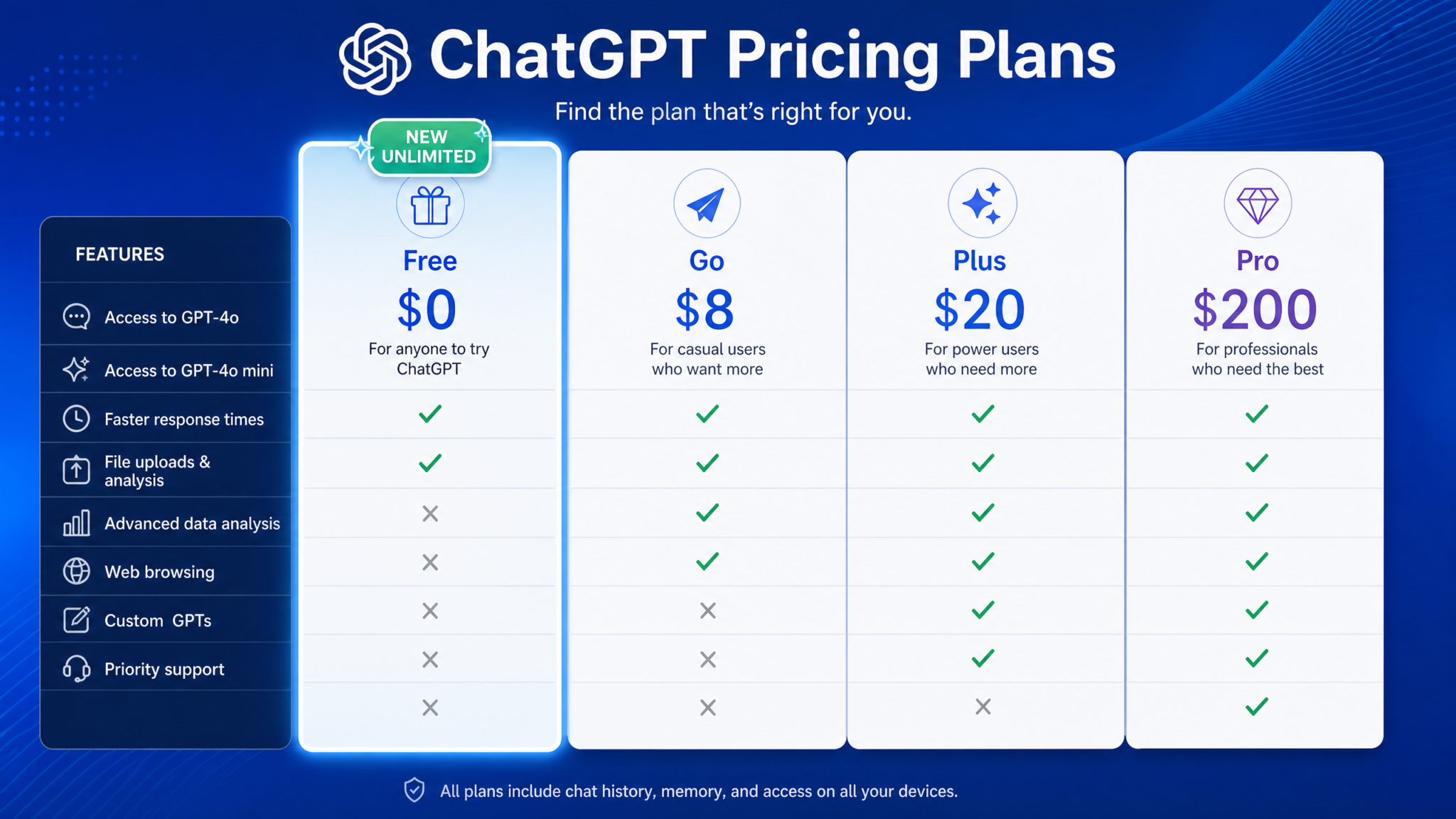
With today’s changes, the ChatGPT tier structure is clearer and more sharply differentiated than at any previous point in the product’s history. The following table represents the complete feature set for each tier as of August 7, 2026:
| Feature | Free ($0) | Go ($8/mo) | Plus ($20/mo) | Pro ($200/mo) |
|---|---|---|---|---|
| Default Model | GPT-5.6 Luna | GPT-5.6 Luna | GPT-5.6 Flagship | GPT-5.6 Flagship |
| Text Conversations | Unlimited | Unlimited | Unlimited | Unlimited |
| Think (Extended Reasoning) | 50/day | 200/day | Unlimited | Unlimited (Think Max) |
| Context Window | 128K tokens | 256K tokens | 512K tokens | 1M tokens |
| Image Generation | 10/month | 50/month | 200/month | Unlimited |
| Advanced Voice Mode | 30 min/month | 5 hr/month | 20 hr/month | Unlimited |
| File Upload Storage | 500 MB/month | 2 GB/month | 10 GB/month | Unlimited |
| Memory Slots | 50 | 500 | 2,000 | Unlimited |
| Web/Tool Queries | 20/day | 100/day | Unlimited | Unlimited (priority) |
| Video Understanding | No | Limited | Yes | Yes (4K priority) |
| Projects Feature | No | Basic | Full | Advanced |
| API Access Discount | No | 5% | 10% | 25% |
| Priority Compute | Standard | Standard+ | Priority | Maximum Priority |
The introduction of the Go tier at $8/month is itself a relatively recent development (launched March 2026) designed to capture users who want more than free but find $20/month a difficult commitment. It has proven more successful than initial projections suggested — primarily because it offers meaningfully expanded voice mode access and the doubled context window, two features that resonated strongly with mobile-first users in emerging markets where ChatGPT is increasingly a primary work and productivity tool.
The Plus tier retains its $20/month price point but has been significantly upgraded: access to the GPT-5.6 Flagship (rather than Luna), unlimited Think, and the full feature set for document work and web browsing justify the price for heavy professional users. Independent user surveys from May 2026 showed that Plus subscribers report an average productivity gain of 2.4 hours per workday attributable to ChatGPT — a figure that makes $20/month trivial relative to its value.
Pro at $200/month remains positioned for the highest-intensity professional and enterprise use cases: researchers who need one-million-token context windows to analyze entire academic corpora, legal professionals doing exhaustive contract review, and software engineers working with large codebases where Think Max’s extended reasoning makes a measurable difference in output quality. OpenAI reports that Pro subscribers have grown 340% year-over-year, driven primarily by enterprise adoption where individual Pro seats are expensed rather than paid personally. ChatGPT Plus vs Pro Comparison: Which Plan Is Worth It in 2026
From GPT-3.5 to GPT-5.6 Luna: The Complete History of ChatGPT’s Free Tier
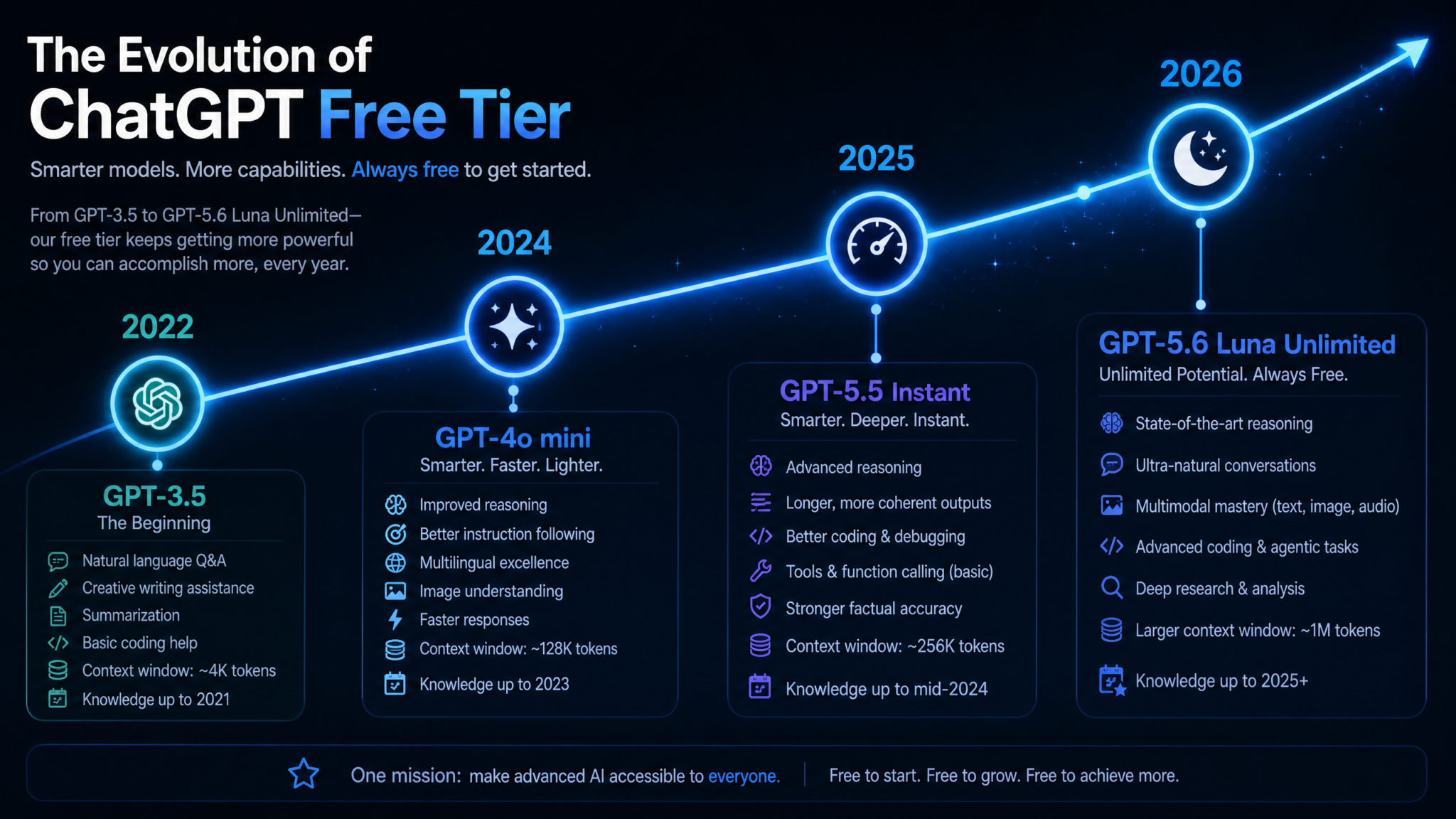
To fully appreciate the magnitude of today’s announcement, it is worth tracing the arc of how ChatGPT’s free offering has evolved since the product launched in November 2022. What was available for free at launch and what is available today occupy entirely different universes of capability, and understanding that progression illuminates the strategic logic driving every decision OpenAI has made along the way.
Phase 1: GPT-3.5 and the Research Preview Era (November 2022 – March 2023)
ChatGPT launched as a free “research preview” powered by a fine-tuned version of GPT-3.5. There were no explicit message limits in the initial rollout, though the system was frequently unavailable due to overwhelming demand. The model was remarkable for its time — capable of coherent multi-turn conversation, basic coding assistance, and creative writing — but it had significant knowledge cutoffs, struggled with complex reasoning, and produced confident-sounding errors at a rate that required experienced users to maintain healthy skepticism. Access was free and unlimited, but the product itself was, by today’s standards, a prototype.
Phase 2: ChatGPT Plus Launches, Free Tier Gets Throttled (March 2023 – May 2024)
The launch of ChatGPT Plus at $20/month in February 2023 introduced a structural divide that would define the next three years. Plus users got GPT-4 access; free users stayed on GPT-3.5. The capability gap was enormous — GPT-4 was qualitatively better at nearly every task, and the differentiation successfully drove subscription growth. But it also meant that free-tier ChatGPT was increasingly perceived as an inferior product, particularly as competing products like Claude and Gemini began offering stronger free tiers of their own.
Phase 3: GPT-4o and Free Tier Elevation (May 2024 – January 2025)
The launch of GPT-4o in May 2024 was the first significant upgrade to the free tier since launch. Free users could access GPT-4o — OpenAI’s then-flagship multimodal model — subject to rate limits of approximately 10-15 messages per 3-hour window. This was a meaningful improvement and helped ChatGPT defend its position against Google’s Gemini 1.5 Flash (which had no message limits) and Anthropic’s Claude 3 Haiku. The message was clear: OpenAI was beginning to weaponize the free tier as a retention and acquisition tool, not just a trial.
Phase 4: The o1 and o3 Era — Reasoning Models Enter the Mix (2025)
The rollout of OpenAI’s “o-series” reasoning models throughout 2025 created new complexity in the tier structure. These models — designed for extended chain-of-thought reasoning — were expensive to run and initially restricted entirely to Pro and Plus. As the year progressed, limited access to o1 mini trickled down to Plus users, then eventually to free users with strict rate limits. This period saw competitors accelerate: Google’s Gemini 2.5 Pro offered strong reasoning capabilities, Anthropic’s Claude 3.7 Sonnet was acclaimed for its coding and analysis performance, and Meta’s open-source Llama 4 was being self-hosted by millions. OpenAI faced genuine competitive pressure for the first time since launch.
Phase 5: GPT-5 and the Consolidation (Late 2025 – Early 2026)
The GPT-5 family launch in late 2025 marked a capability step-change significant enough to re-establish OpenAI’s model quality lead. GPT-5 Flagship was restricted to Pro users at launch, then extended to Plus. A lighter variant, GPT-5 Mini, became the free default and was considered strong enough to silence most criticism about free-tier quality. The user base surged as the quality-to-cost ratio became undeniable.
Phase 6: GPT-5.6 Luna and Unlimited Text (August 2026)
Today’s announcement represents the culmination of a four-year strategic arc. The progression from GPT-3.5 Turbo with no rate limits (2022) to GPT-3.5 with aggressive throttling (2023) to GPT-4o with message caps (2024) to GPT-5 Mini with fair-use limits (2025) to GPT-5.6 Luna with truly unlimited text (2026) is not a straight line — it is a product strategy that has been iteratively tuned to maximize user acquisition, retention, and monetization simultaneously. The removal of text limits is the clearest indication yet that OpenAI has solved, or at least acceptably managed, the cost equation at scale.
Business Implications: What This Means for Google, Anthropic, Meta, and Microsoft
The competitive reverberations from today’s announcement will be felt immediately and profoundly. Every major AI company maintains a free consumer tier as a core part of its growth and brand strategy, and every one of them is now measuring their offering against a new baseline: unlimited text conversations with a model that outperforms 2025’s best paid products.
Google and Gemini
Google’s Gemini platform has been ChatGPT’s most formidable consumer-facing challenger throughout 2025 and 2026, benefiting from deep integration with Android, Search, Gmail, and Google Workspace. Gemini Advanced (at $19.99/month, equivalent to Plus) offers genuinely excellent capability and the integration advantages of Google’s ecosystem are real. However, Gemini’s free tier, while generous, has always been defined in comparison to ChatGPT Free. Now that comparison has shifted dramatically. Google will face internal pressure to respond — either by upgrading its free model tier, removing its own text limits (which it has been reluctant to do due to abuse concerns), or doubling down on ecosystem integration advantages that ChatGPT cannot replicate.
Access 40,000+ AI Prompts for ChatGPT, Claude & Codex — Free!
Subscribe to get instant access to our complete Notion Prompt Library — the largest curated collection of prompts for ChatGPT, Claude, OpenAI Codex, and other leading AI models. Optimized for real-world workflows across coding, research, content creation, and business.
Analysts at Bernstein Research, writing in a morning note published two hours after OpenAI’s announcement, estimated that Google could see a 5-8% churn increase among Gemini Advanced subscribers who were primarily paying for the capability gap over ChatGPT Free — a gap that has now narrowed significantly for text-only workflows.
Anthropic and Claude
Anthropic finds itself in the most philosophically complex position. The company built its entire brand on responsible AI development and the argument that capability and safety do not have to be in tension. Claude 3.7 Sonnet remains one of the most respected models in the market for coding and nuanced reasoning. But Anthropic lacks OpenAI’s scale economics — the company operates at a fraction of OpenAI’s user base and does not have the revenue diversification that allows OpenAI to offer this level of free-tier quality. Anthropic’s Claude Free tier will now be compared unfavorably on model recency and feature availability, even if Claude’s raw output quality remains competitive.
The company’s likely response — based on its historical product cadence — will be to accelerate the rollout of Claude 4 Sonnet to the free tier and invest heavily in its differentiating features (Constitutional AI, document analysis depth, coding accuracy). Whether that will be enough to prevent user attrition in core demographics is an open question.
Meta and Open-Source AI
Meta’s strategic position is structurally different from the others. Llama 4 and its successors are open-source, and Meta’s consumer-facing AI assistant (integrated into WhatsApp, Instagram, and Facebook) is built on that stack. OpenAI’s announcement does not directly threaten Meta’s distribution advantages — two billion people interact with Meta’s platforms daily, giving Meta an access channel no standalone AI company can match. However, for the fraction of users who seek out dedicated AI assistants rather than integrated ones, the value proposition of ChatGPT Free has become dramatically more compelling. Meta will likely respond by accelerating the capability of its AI assistant and potentially making Llama 5 more accessible for community fine-tuning.
Microsoft and Copilot
Microsoft’s Copilot suite is both OpenAI’s largest partner and, increasingly, a direct competitor in the productivity AI space. The relationship between the two companies has grown more complicated as OpenAI has developed its own enterprise sales motion. Today’s announcement creates an interesting dynamic: Microsoft Copilot for consumers relies on OpenAI models under a licensing arrangement, meaning Copilot technically benefits from GPT-5.6 Luna’s improvements. But ChatGPT’s consumer app has been growing faster than Copilot in most markets, and the removal of text limits makes ChatGPT a more attractive alternative to Microsoft 365 Copilot for price-sensitive users. Expect a Microsoft response in the form of deeper Copilot integration into Windows 12 and Office 2026 — territory where ChatGPT cannot easily compete.
Developer Impact: APIs, Third-Party Tools, and the Ecosystem Shift
Today’s consumer announcement does not directly change API pricing — OpenAI’s developer platform operates on a separate pricing structure from the consumer ChatGPT product. However, the downstream effects for the developer ecosystem are significant and multifaceted.
Reduced Pressure to Build Custom Free Tiers
Many developers building AI-powered applications have historically needed to implement their own usage metering, credit systems, and free/paid differentiation within their products. This was often necessary because the underlying AI API costs required some form of user-side cost recovery. As the cost of powerful language model inference continues to decline — a trend that Luna’s architecture dramatically illustrates — developers building on top of ChatGPT-class models through the API will face less pressure to throttle their own users. Applications built on yourproject.io or myapp.dev that use OpenAI’s API for text processing will find it increasingly viable to offer unlimited text AI features as part of their own free tiers.
The GPT Store and Plugin Ecosystem
OpenAI’s GPT Store — a marketplace for custom GPT configurations and agent applications built by third-party developers — will see increased traffic as the free user base grows. More free users means more potential customers for paid GPTs listed in the store, and it means OpenAI’s platform becomes an even more attractive distribution channel for AI-powered applications. Developers who have invested in building quality custom GPTs over the past two years are, in a real sense, the beneficiaries of today’s announcement alongside end users.
Educational Technology and Research Tooling
For the edtech and academic research sectors specifically, today’s announcement is transformative. Applications built for students, teachers, and researchers — tools that have always struggled with the cost of providing AI access at scale to populations with limited spending power — can now point their users toward ChatGPT Free as a capable underlying tool without worrying that students will hit message limits in the middle of a study session. Companies like Khan Academy, Duolingo, and Quizlet, which have integrated OpenAI models into their products, will benefit from the expanded base of users comfortable with ChatGPT’s interface and capabilities. OpenAI API Pricing Guide: Optimizing Costs for Application Developers in 2026
Competitive Pressure on AI Startups
The harder conversation for the developer community concerns AI startups whose primary value proposition was offering a better or cheaper alternative to ChatGPT Free. When free ChatGPT meant message-limited GPT-3.5, there was room for nimble startups to compete on capability or price. When free ChatGPT means unlimited GPT-5.6 Luna, that room shrinks considerably. Startups that differentiated on specific verticals — legal AI, medical AI, coding AI, creative writing AI — retain defensible positions through specialized fine-tuning and workflow integration. Startups that competed primarily on “better unlimited AI chat” will face an existential challenge. The next 90 days will produce a notable number of pivot announcements across the AI startup ecosystem.
OpenAI’s Strategic Logic: Why Free Is the New Moat
The decision to offer unlimited text AI to everyone for free is not an act of altruism — it is one of the most carefully calculated competitive moves in Silicon Valley’s recent history. Understanding why requires examining several strategic threads simultaneously.
The Data Flywheel
Every conversation on ChatGPT generates signal. User feedback, preference patterns, the specific ways people phrase complex questions, the types of errors users correct, the follow-up queries that indicate a first response missed the mark — all of this is training signal that improves future model versions. At one billion weekly users, ChatGPT generates more interaction data per day than the entire internet produces in conversational AI context. Removing text limits accelerates this flywheel dramatically. More conversations mean more data; more data means better models; better models attract more users; and the cycle compounds. The free tier is not a loss leader — it is a data acquisition strategy of staggering scale.
Platform Lock-In Through Habit Formation
Behavioral economics research consistently shows that habitual tool use becomes resistant to switching even when objectively superior alternatives exist. The longer a user relies on ChatGPT as their primary AI interface — for writing, learning, planning, coding, answering questions — the more their mental model of “how AI works” is shaped by ChatGPT’s specific interface, memory system, and response style. Removing limits ensures that habit formation is not interrupted by frustrating usage caps. A user who hits a message limit and switches to a competitor may never come back. A user who never hits a limit becomes, over months, progressively more deeply integrated into the ChatGPT ecosystem.
Monetization Beyond Subscriptions
OpenAI’s revenue mix in 2026 looks very different from its revenue mix in 2023. Subscription revenue from consumers (Free, Go, Plus, Pro) now represents only about 30% of total company revenue, according to estimates from industry analysts at Coatue Management. API revenue from enterprises and developers is approximately 45%. The remaining 25% comes from enterprise direct contracts, data licensing arrangements, educational institution partnerships, and an emerging advertising-adjacent model involving sponsored responses in relevant contexts. A platform with one billion weekly active users is, in the advertising world, an extraordinary asset. OpenAI has been cautious about introducing advertising, conscious of the brand damage that aggressive monetization could cause, but the infrastructure to do so tastefully and selectively is being built. Free users are not the product in any crude sense — but the platform their engagement creates has enormous latent commercial value beyond their subscription fees.
Regulatory and Antitrust Defense
There is a subtler strategic layer worth noting. OpenAI is under varying degrees of regulatory scrutiny in the European Union, the United Kingdom, and increasingly the United States, where concerns about AI market concentration have gained political traction. Offering the most capable freely available AI model in the world is a powerful counter-narrative to monopoly framing. It is difficult to argue that a company is extracting monopoly rents from consumers when it is providing a world-class product to anyone with an internet connection at zero cost. Today’s announcement is simultaneously a product strategy, a growth strategy, a data strategy, and a regulatory strategy — a convergence of interests that makes it essentially impossible for the company’s leadership not to have made this move.
Expert Reactions and Industry Response
The technology community’s response to today’s announcement has been swift and largely polarized between enthusiastic celebration from end users and sober analysis — tinged with varying degrees of alarm — from competitors and industry observers.
Dr. Sarah Chen, AI Research Lead at Stanford’s Human-Centered AI Institute, called the announcement “a genuine inflection point for AI access equity,” noting that “the majority of the world’s new ChatGPT users over the past 18 months have come from regions where $20/month is inaccessible. Removing text limits for those users changes what AI access means in practical daily life. The educational and economic productivity implications are enormous and largely unmeasured.”
Benedict Evans, the technology analyst who has tracked AI adoption trends closely since 2022, framed the announcement in terms of platform economics: “This is Facebook making the News Feed free to read, Google making Search free to use, or Spotify offering a free ad-supported tier. The playbook is old; the scale is new. Once a platform reaches a certain size, the economics of limiting access invert — the cost of lost engagement exceeds the cost of serving additional users. OpenAI has crossed that threshold.”
Not everyone is celebratory. Dr. Emily Bender, computational linguist and co-author of the influential “Stochastic Parrots” paper, raised concerns about the societal effects of dramatically lowering barriers to large-scale AI-generated content production. “When you remove all friction from AI text generation for a billion users, you don’t just increase productivity — you change the information environment in ways we don’t fully understand. The volume of AI-assisted content entering educational, journalistic, and commercial contexts will accelerate dramatically. The question of how to maintain epistemic integrity in that environment is urgent and underexplored.”
On the business side, a spokesperson for Anthropic declined to comment directly on OpenAI’s announcement but noted in a statement that “Anthropic remains committed to developing AI that is safe, capable, and accessible, and we will have exciting product news of our own to share in the coming weeks” — a response widely interpreted as signaling an accelerated Claude Free tier upgrade is in preparation.
Google DeepMind’s Demis Hassabis, speaking at a different event in London this morning before OpenAI’s announcement, stated his view that “model capability competition is reaching a point of sufficiency for most consumer tasks, and the differentiation going forward will be in integration, trust, and reliability.” The timing of that statement, hours before OpenAI redefined the floor for free model quality, struck many observers as both prescient and, for Google, somewhat inconvenient.
What Happens Next: Forecasts and Final Analysis
The announcement of unlimited free text access on GPT-5.6 Luna will generate competitive responses over the next 30 to 90 days. Google will upgrade Gemini Free tier capabilities. Anthropic will accelerate Claude’s free-tier model refresh. Meta will push more aggressively on capability claims for its AI assistant. The floor of free AI quality — already dramatically higher than it was 18 months ago — is about to be raised further by competitive responses to OpenAI’s move. End users, in the short term, are the unambiguous winners.
For OpenAI, the risks are real but manageable. The infrastructure cost of serving unlimited text queries at a billion-user scale is substantial even with Luna’s efficiency improvements. If the economic model proves less sustainable than the company’s projections suggest, limits could return — though doing so would be a significant brand damage event, and the company will have modeled this risk extensively before making a public commitment. The more likely scenario is that costs continue to fall as Orion Compute Clusters scale, Luna’s architecture is further optimized, and revenue from enterprise, API, and non-subscription sources grows to comfortably cover the cost of maintaining the free tier.
For the broader AI industry, today’s announcement is a forcing function. It compresses the timeline for decisions that competitors might have preferred to delay. It sets a new benchmark that defines “good enough for free,” which was previously a much lower bar. And it demonstrates that the company which spent four years iterating on how to balance free and paid access has found a model it believes in enough to make an irreversible public commitment to it.
The longer-term question — the one that will define the next decade of AI’s relationship with society — is what happens when genuinely powerful AI is as freely and frictionlessly available as web search. The answer, almost certainly, is not a single thing but a thousand different things simultaneously: productivity gains for workers who couldn’t previously afford AI tools, new forms of creative expression, automation pressures on certain job categories, new challenges for educational assessment and journalistic verification, and new opportunities for economic development in regions that have historically lacked access to advanced cognitive tools. How to Get the Most from ChatGPT Free Tier: Advanced Prompting Strategies for Unlimited Access
Sam Altman, at the conclusion of this morning’s event, offered a characteristically ambitious framing: “A year from now, the question we will look back on and ask ourselves is not ‘why did you give this away for free’ — it is ‘why did it take this long.’ The answer is that building things well takes time. We took the time. Now here it is.”
Whether OpenAI can sustain the economics, maintain the quality, and continue to lead the market it created will remain open questions. What is not open, as of August 6, 2026, is whether the era of rationed AI access has ended. It has. The one billion weekly users watching message counters disappear from their screens tonight are the most immediate evidence of that fact.
Editor’s Note: This article will be updated as competitor responses and additional technical details from OpenAI’s documentation become available. All benchmark data in this article reflects figures published in OpenAI’s official technical documentation released August 6, 2026. Pricing information is current as of date of publication. User statistics are drawn from OpenAI’s official investor communication released simultaneously with the product announcement.
