
ChatGPT Work vs Claude Cowork — The Definitive 2026 Platform Battle (Featured)
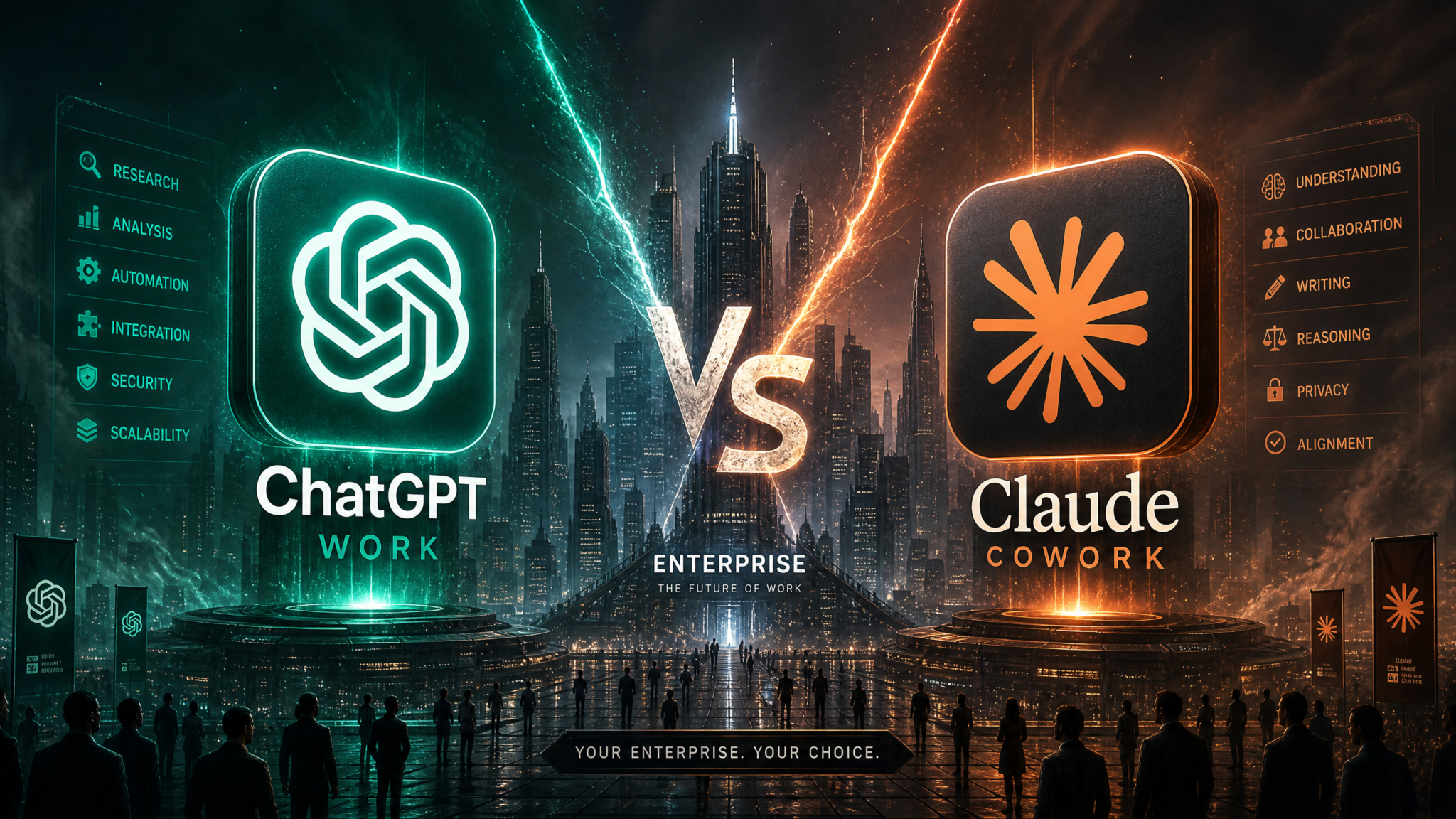
LLM Platforms
Governance
Security
TL;DR — Which should you pick in 2026?
If you need a one-paragraph answer: choose the platform that best aligns with your deployment model, data protection posture, and the dominant use cases in your portfolio. ChatGPT Work tends to shine for organizations already invested in the OpenAI ecosystem, omnichannel interactions, and workflow automation features integrated with a rich third-party ecosystem. Claude Cowork tends to excel when nuanced reasoning, long-context synthesis, and safety-first constraints are paramount, especially for teams leveraging AWS or Google Cloud model hosting. For many enterprises, a dual-vendor strategy—standardizing governance while letting teams select the best tool per job—yields the highest ROI.
When implementing these advanced strategies, it is often helpful to reference our deeper analysis on ChatGPT Work vs Claude Cowork, which explores the technical nuances of ChatGPT Work vs Claude Cowork: The Definitive 2026 Comparison for Enterprise Teams in the context of modern AI workflows.
Definitions: What we mean by “ChatGPT Work” and “Claude Cowork”
Product branding evolves rapidly. For clarity in this guide:
- ChatGPT Work: We use this term to mean the business- and enterprise-grade workspace offerings from OpenAI built on ChatGPT and its model family, including team-oriented features such as shared spaces, administrative controls, enterprise-grade security, and governance. Depending on your contract, your organization may be using a plan named Teams, Business, Enterprise, or similar. The functional focus is the same: safe, governed, collaborative use of OpenAI models for work.
- Claude Cowork: We use this term to mean Anthropic’s team/enterprise workspace capabilities surrounding Claude models, including collaboration features, knowledge sharing, and administrative controls. Depending on your contract and cloud provider, you may interact with Claude via Anthropic’s own apps, or via cloud platforms (e.g., AWS, Google Cloud) that host Anthropic models. The focus is the same: safety-forward, reliable workplace AI built around Claude.
When implementing these advanced strategies, it is often helpful to reference our deeper analysis on ChatGPT Work vs Claude Cowork, which explores the technical nuances of ChatGPT Work vs Claude Cowork: The Definitive 2026 Comparison for Enterprise Teams in the context of modern AI workflows.
Methodology: How this comparison was built
Our approach prioritizes outcomes, not hype. We evaluate platforms based on:
- Principled capability categories: multimodal I/O, long-context, tool use/agents, collaboration, governance, admin, and developer extensibility.
- Enterprise guardrails: security, privacy, compliance, and auditability.
- Operational fitness: performance, reliability, rate limiting, analytics, cost controls, and vendor lock-in mitigations.
- Realistic use cases: where each platform tends to excel, and the patterns that make solutions maintainable.
- Neutral benchmarking methodology: how to design your own evals to align with your unique workloads, rather than copying someone else’s leaderboard.
Time-sensitive note: This analysis is designed to remain useful for 2026 planning. Concrete configuration guidance is vendor-neutral where possible; verify details that depend on specific SKUs, APIs, or SLAs that may have changed after publication.
Platform overview at a glance
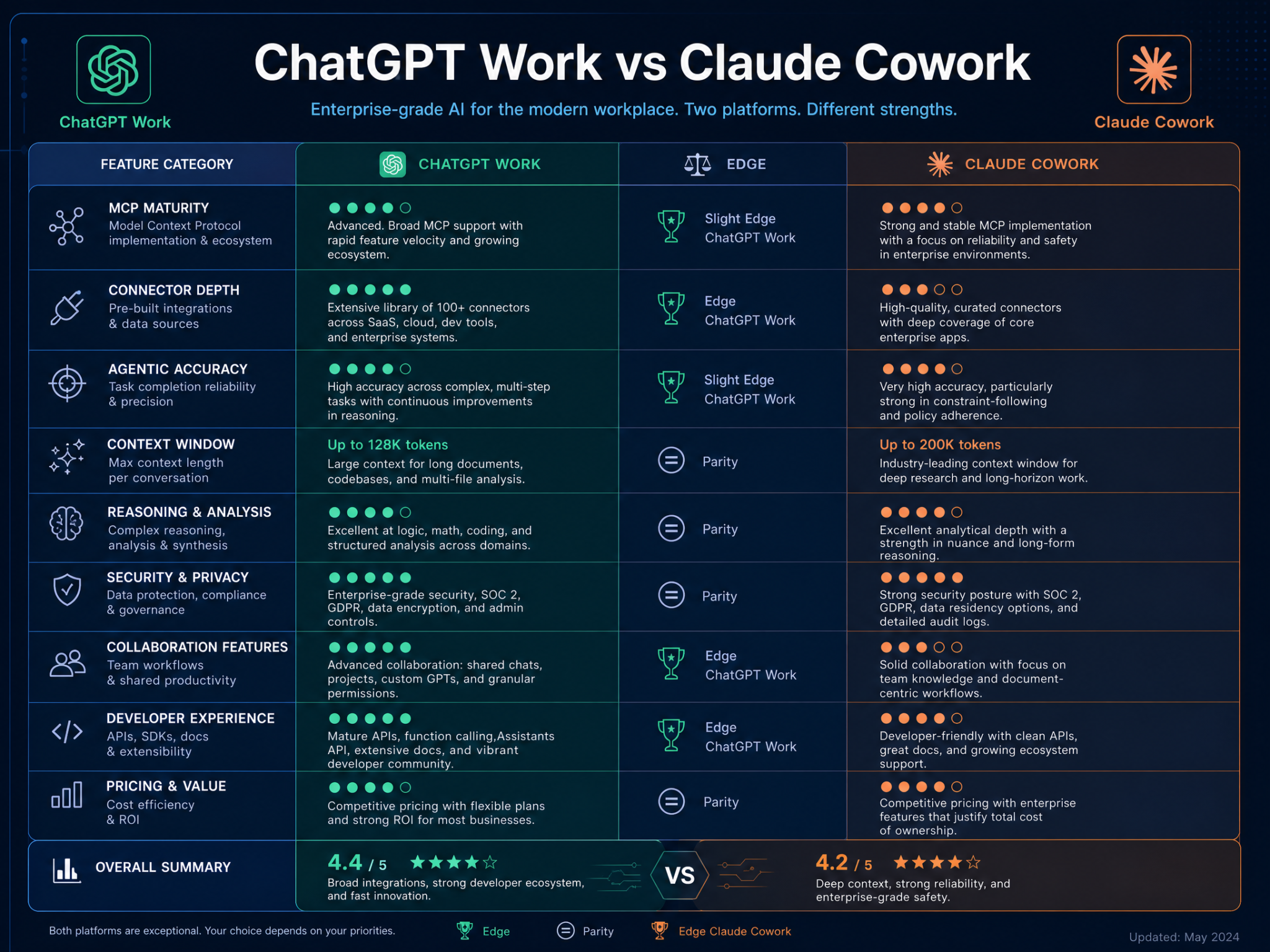
OpenAI ecosystem (ChatGPT Work perspective)
- Model family: GPT-4 class models and successors, with options spanning high-intelligence, balanced, and lightweight “mini” models. Historically strong at multimodal input/output, including text, image, and real-time voice in certain experiences.
- Interaction surfaces: ChatGPT app (web, mobile, often desktop), API access for builders, and integrations through a growing partner ecosystem. Vendor-managed enterprise workspaces typically include admin controls, SSO/SCIM support, and data-use limitations suitable for corporate adoption.
- Developer enablement: Customizable experiences (e.g., GPTs or configurable agents), tools for retrieval augmentation, and workflow automation primitives that connect LLM reasoning with third-party systems.
- Cloud options: Direct OpenAI access and, for many enterprises, access to OpenAI models via Microsoft Azure’s managed service, offering additional enterprise controls, observability, and regional options.
Anthropic ecosystem (Claude Cowork perspective)
- Model family: Claude 3-class models and successors with a strong reputation for helpfulness, honesty, and nuanced reasoning. Known for robust long-context performance and safety-forward design.
- Interaction surfaces: Claude app (web), enterprise/team features that structure knowledge and collaboration, and API access. Anthropic’s models are widely available through cloud providers, such as AWS (Amazon Bedrock) and Google Cloud (Vertex AI), enabling deep integration with enterprise infrastructure.
- Developer enablement: Strong tool-use capabilities, long-context retrieval patterns, and safety-aligned tuning guidance. Features for organizing projects and knowledge bases help enterprise teams keep instructions and source material consistent.
- Cloud options: Native Anthropic services plus multi-cloud hosting through major providers. This can aid with data residency, IAM alignment, and proximity to enterprise systems.
Core capabilities compared
This section walks capability-by-capability through what most enterprises value when evaluating ChatGPT Work vs Claude Cowork.
1) Reasoning and instruction following
- ChatGPT Work: Strong general reasoning, excellent instruction-following, and robust few-shot prompting. Particularly good at blending modalities when the task requires both interpretation and presentation (e.g., analyze a chart and draft an email with the analysis).
- Claude Cowork: Renowned for careful, coherent reasoning and a conservative safety posture. Often praised for staying within constraints, revealing uncertainty, and handling long, complex instructions gracefully.
Guidance: If your workloads demand precise adherence to role, tone, and policy, both platforms can be tuned via system prompts, templates, and guardrails. Run side-by-side evals with your policies and edge cases—no generic benchmark will capture your risk posture.
2) Long-context understanding and synthesis
- ChatGPT Work: Supports large context windows (100k+ tokens class, depending on model/version). Good at summarization, cross-document comparison, and structured synthesis.
- Claude Cowork: Long-context has been a standout strength, with models designed to reason over and faithfully summarize lengthy documents and codebases.
Guidance: When your tasks involve contracts, RFPs, or multi-repo code analysis, prefer models with long-context track records and pair them with retrieval strategies that cap token costs and keep responses grounded.
3) Multimodal input/output
- ChatGPT Work: Historically strong in multimodal capabilities—vision understanding, image generation support via partner or first-party capabilities, and fluid real-time/voice experiences in certain clients.
- Claude Cowork: Competent vision understanding and image analysis; image generation is typically handled via partner tools. Focus often placed on analysis, reasoning about visuals, and integrating with documents and artifacts.
Guidance: If voice agents, interactive demos, or image-generation-in-the-loop are a major part of your roadmap, validate latency, stability, and licensing concerns in pre-purchase pilots.
4) Tool use and agent patterns
- ChatGPT Work: Provides robust function calling/tool use and ecosystem-level automation. Often integrates with widely used productivity suites and developer tools through partners and custom connectors.
- Claude Cowork: Strong function calling with emphasis on predictable tool invocation and safety rails. Often paired with cloud-native orchestrators (e.g., Bedrock Agents or Vertex extensions) for enterprise integration.
Guidance: Start simple—single-agent with a handful of tools—then graduate to multi-agent orchestration. Measure not only latency and quality but also failure-handling and observability.
5) Knowledge management and retrieval
- ChatGPT Work: Offers approaches to persistent knowledge within workspaces, plus patterns for retrieval-augmented generation (RAG). Good fit for teams building curated GPTs/agents around company content.
- Claude Cowork: Offers project/workspace constructs to pin instructions and provide shared knowledge. API access aligns well with enterprise RAG stacks hosted in your cloud of choice.
Guidance: Avoid dumping entire wikis into context. Instead, design retrieval pipelines with chunking, access controls, citation generation, and freshness checks. Prefer storage outside the LLM where feasible.
6) Extensibility and ecosystem
- ChatGPT Work: Broad partner ecosystem; fast-moving features for customizing experiences and automating tasks. Strong pull for organizations that want ready-to-go integrations.
- Claude Cowork: Deep cloud integrations and safety-first tooling. Strong appeal to enterprises standardizing on AWS or Google Cloud for IAM, monitoring, and data residency.
Guidance: The right choice often reflects where your data and identity live. Co-locating LLM access with your cloud minimizes friction.
7) Safety, moderation, and policy alignment
- ChatGPT Work: Mature safety systems and policy controls. Enterprise plans typically support data isolation and admin-level policy enforcement.
- Claude Cowork: Safety is a first principle—models tuned to avoid risky outputs and to clearly signal uncertainty. Enterprise controls support consistent policy application.
Guidance: Codify prohibited behaviors, escalation paths, and content filters. Evaluate both platforms with real red-team prompts adapted to your domain.
Collaboration, knowledge, and automate-to-orchestrate
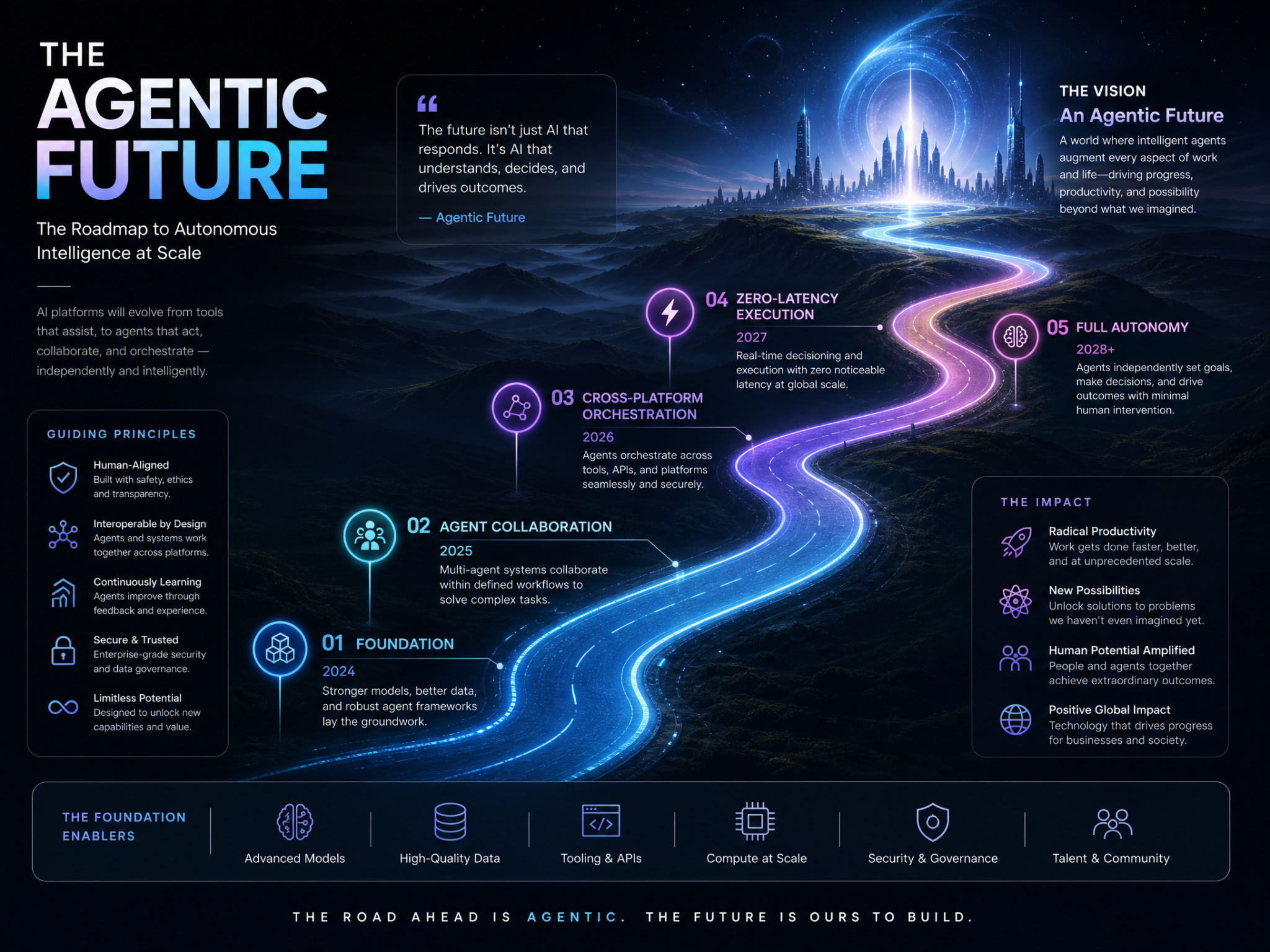
Workspace structures and shared context
Both platforms offer workspace constructs where teams can co-create prompts, share resources, and standardize instructions. Successful teams treat the workspace as a living knowledge system:
- Standard operating prompts: Canonical templates for code review, data analysis, QA, editorial styles, and legal hygiene.
- Shared knowledge bases: Curated documents with ownership, freshness SLAs, and explicit sources-of-truth.
- Guardrails and roles: Clear role instructions for the model—what it can do, what it must never do, and how to ask for help when uncertain.
From automations to orchestrated agents
Start with targeted automations—well-bounded tasks with clear success criteria (e.g., summarize a support ticket to three bullets with links). Over time, orchestrate multi-step flows where the AI delegates to tools and checks its own work.
- Single-step: “Transform inbound text to clean JSON given a schema.”
- Multi-step: “Ingest a spec, propose test cases, create a PR with tests, request human approval.”
- Closed-loop: “Monitor metrics; if anomaly, open an incident draft, gather logs, notify on-call with a concise report.”
In ChatGPT Work, you’ll often leverage agent customization and workflow features alongside partner integrations. In Claude Cowork, you’ll typically emphasize long-context instructions, strong tool schemas, and orchestration through your cloud of choice (e.g., Bedrock/Vertex) for consistency with enterprise pipelines.
Security, privacy, compliance, and governance
Security and governance are non-negotiable for enterprise AI. Both platforms provide enterprise-grade measures; the exact features and attestations depend on plan and region. Use this checklist to evaluate readiness:
Security controls
- Identity and access: SSO (SAML/OIDC), SCIM provisioning, role-based access, and conditional access policies.
- Isolation and data handling: Clear statements on whether prompts/outputs are used for training by default (enterprise offerings commonly opt out by default). Understand retention windows and deletion guarantees.
- Encryption: TLS in transit and robust at-rest encryption. Confirm KMS options when using cloud-hosted models (Azure for OpenAI; AWS/GCP for Anthropic).
- Network controls: IP allowlists, private networking options where offered via cloud providers, and egress restrictions for tool calls.
Compliance
- Common frameworks: SOC 2, ISO 27001, GDPR readiness. Sector-specific: HIPAA BAA availability, PCI-DSS scoping considerations, and public-sector certifications (e.g., FedRAMP) where applicable.
- Data residency: If residency matters, consider accessing models via your preferred cloud region (Azure OpenAI for GPT models; AWS Bedrock/Google Vertex for Anthropic models), and confirm the data path end-to-end.
Governance and risk
- Policy enforcement: Organization-level content policies, audit logs, eDiscovery alignment, and DLP integrations.
- Prompt injection defenses: Tool schemas that validate inputs, explicit allow/deny lists, and pattern-based checks before executing any external calls.
- Red-teaming: Routine adversarial testing with domain-specific attacks (e.g., financial fraud prompts for banking; PII exfiltration attempts for healthcare).
- Human-in-the-loop: Approval gates for risky actions (e.g., pushing code, making purchases, sending customer communications).
Admin, observability, and cost control
Enterprise success depends on strong admin experiences and cost hygiene. Both ChatGPT Work and Claude Cowork provide administrative controls; exact capabilities vary by plan.
Admin essentials
- Provisioning: SCIM for lifecycle management; group-based entitlements; guest or external collaborator policies.
- Policies: Workspace-level prompt libraries, content filters, attachment controls, and external tool access approvals.
- Logging and audit: Exportable logs for prompts, tool invocations, and admin actions. Consider SIEM integration for alerting.
Observability
- Usage analytics: Seats, active users, top use cases, and high-spend workflows.
- Quality insights: Ratings, retry rates, and flagged content incidents. At the API level, capture token counts, latency, and error codes.
- Eval integration: Track win-rate against baselines, ground-truth agreement, and safety violations over time.
Cost control
- Right-modeling: Map tasks to the most cost-effective capable model. Use “mini” or streamlined models for classification and short transforms.
- Context discipline: Keep prompts lean, cache reusable context, and rely on retrieval rather than dumping entire wikis.
- Batching and caching: Pre-compute common results, use semantic caching, and version prompts to stabilize outputs.
- Guardrails against runaway costs: Set budgets, alerts, and per-agent ceilings. Require approvals for high-cost flows.
Performance: Reasoning, coding, multimodal, and long-context
A credible performance comparison requires repeatable evals on your tasks and your data. Rather than absolute numbers (which go stale quickly), use this rubric to structure your tests across ChatGPT Work and Claude Cowork:
Reasoning and instruction following
- Eval set: 100–300 domain prompts with ground-truth rubrics. Include adversarial cases and stress tests.
- Metrics: Pass rate, grading by SMEs, hallucination incidents, and response consistency under temperature jitter.
Coding and code reasoning
- Eval set: Katas across your stack, repo-aware tasks (e.g., modify a module, add tests). Include dependency management and build steps.
- Metrics: Compile/test pass rate, PR quality (lint, style, coverage), time-to-fix with minimal guidance.
Multimodal I/O
- Eval set: Visual QA, table/graph interpretation, document OCR+reasoning, voice latency/user experience where relevant.
- Metrics: Accuracy on structured extraction, reasoning fidelity on visuals, end-to-end latency including tool hops.
Long-context
- Eval set: Contracts, specs, or multi-file code; questions requiring cross-reference and exact citation.
- Metrics: Citation accuracy, recall/precision for key facts, faithfulness, and cost per task.
Reliability under load
- Eval set: Concurrency tests simulating your peak patterns, with API retries and backoff.
- Metrics: Error rates, throttle behavior, tail latencies (P95/P99), and degradation under tool failures.
Pricing, TCO, and procurement strategy
Prices, quotas, and SKUs evolve. Instead of relying on static numbers, structure your cost analysis around:
Cost dimensions
- Seats: Team or enterprise seats with feature entitlements (SSO, admin controls, shared spaces).
- Consumption: Prompt/response tokens, image/vision costs, and tool call overhead. For API-heavy use, model selection drives cost dramatically.
- Hidden costs: Engineering time for RAG, evals, and governance; data storage; observability; red-teaming; cloud egress; partner integrations.
- Opportunity cost: Time-to-value, adoption rate, and quality lift versus current baselines.
Procurement patterns
- Single vendor: Simplifies governance and training; risks lock-in and suboptimal fit for niche tasks.
- Dual-platform: Standardize policy and logging; let teams pick ChatGPT Work or Claude Cowork case-by-case.
- Cloud alignment: If your data, IAM, and observability live in Azure, OpenAI via Azure can reduce friction. If AWS/GCP dominate, Anthropic via Bedrock/Vertex can speed approvals and align with your infosec model.
ROI model
- Benefit buckets: Cycle-time reduction, quality lift, incident avoidance, and net-new capabilities (24/7 agents).
- Measurement: Baseline tasks, randomized assignment to AI vs control, rigorous throughput/quality metrics, and monthly trend tracking.
- Budget discipline: Start with constrained pilots; scale only where evals sustain a win-rate and where human-in-the-loop costs don’t erase savings.
Use cases and playbooks by function
Below are representative playbooks and where teams often find an edge with ChatGPT Work vs Claude Cowork. The best choice depends on your context, but these patterns are a practical starting point.
Engineering
- Code generation and refactoring: Use repository-aware prompts, retrieval of API docs, and test-driven prompts. Evaluate both platforms with your stack; some teams report higher adherence-to-style with specific models.
- PR review and security scanning: Define explicit checklists; integrate with CI to post AI-assisted comments gated by human review.
- Runbooks and on-call: Generate incident summaries, propose mitigations, and create follow-up Jira tasks automatically.
Data and analytics
- SQL generation with guardrails: Provide schema context, safe templates, and a sanitizer that blocks destructive operations.
- BI narrative layers: Convert dashboards into executive briefings with trend analysis and caveats grounded by citations.
- Data catalog Q&A: RAG over your catalog and lineage metadata; ensure PII redaction and role-aware answering.
Product and design
- Spec drafting: Convert user feedback into structured PRDs with acceptance criteria and risk lists.
- UX copy and A/B ideas: Generate variants on tone-targeted copy; pair with analytics to pick winners quickly.
- Design artifact critique: Summarize feedback across stakeholders; propose prioritized changes with rationales.
Marketing and comms
- Campaign briefs: Draft multi-channel plans with budgets, timelines, and KPI frameworks; refine via SME review.
- SEO content: Generate outlines, then source-grounded drafts. Never publish without editorial checks for brand and legal compliance.
- Localization: Style- and region-aware translations with glossaries and legal disclaimers.
Sales and success
- RFP response automation: Long-context synthesis across boilerplate and product docs; enforce truthfulness with citations.
- Account research: Summaries of public filings and news with a bias toward verifiable facts and links.
- CS ticket triage: Classify, summarize, and propose first responses. Human-in-the-loop to prevent brand risk.
Legal and compliance
- Contract review assistance: Highlight unusual clauses, compare to playbooks, and suggest redlines for attorney review.
- Policy drafting: Create first drafts of policies based on templates; ensure SMEs finalize and approve.
- Regulatory watch: Summarize changes by region and impact area; schedule SME briefings.
HR and operations
- Job descriptions and interview plans: Standardize competencies, question banks, and rubrics.
- Onboarding flows: Personalized learning paths using curated internal content; progress tracking via LMS.
- Policy Q&A: Role-aware assistants that cite HR policies and escalate ambiguous cases.
Deployment patterns and integration architecture
Organizations adopt these platforms via three complementary paths:
1) SaaS workspace
- Who it’s for: Knowledge workers needing fast value and light integration.
- Benefits: Minimal setup, built-in collaboration, centralized admin.
- Risks: Potential shadow tooling if use cases outgrow workspace boundaries; plan entitlements matter.
2) API-integrated apps
- Who it’s for: Product and engineering teams embedding AI into workflows and customer experiences.
- Benefits: Full control over prompts, tools, and data; custom UX; observability via your stack.
- Risks: You own reliability, testing, and governance; must handle model/version drift and cost tuning.
3) Cloud-hosted models with enterprise controls
- Who it’s for: Enterprises standardizing on Azure (for OpenAI), AWS, or Google Cloud (for Anthropic).
- Benefits: IAM alignment, network controls, data residency, existing observability pipelines.
- Risks: Requires cloud proficiency; feature timelines may differ from direct vendor apps.
Reference architecture patterns
- RAG layer: Vector store + document processing + policy-aware retrieval. Keep sources versioned and cite in outputs.
- Tooling gateway: A broker that validates tool calls, sanitizes inputs/outputs, and logs every action for audit.
- Eval harness: Offline tests before production, canary prompts in prod, and continuous quality monitoring.
- Policy engine: Centralize allow/deny patterns for PII, secrets, and regulatory-sensitive topics.
How to benchmark both platforms fairly
Beware of leaderboard thinking. A fair benchmark reflects your tasks, your risks, and your quality bar.
Steps
- Define success: Business KPIs (cycle time, defect rate), not just token-level metrics.
- Curate eval sets: 200–500 tasks spanning easy, typical, and edge cases with ground truth or expert rubrics.
- Normalize prompts: Same structure, same retrieval corpus, same tool schemas across platforms.
- Blind grading: SMEs score anonymized outputs. Track hallucinations and unsafe suggestions explicitly.
- Stress test: Concurrency, long-context extremes, and failure-injection for tools and retrieval.
- Cost and latency: Capture end-to-end, including retrieval and tools, not just model time.
Report
- Outcome chart: Win/loss/tie versus baseline by use case.
- Risk profile: Safety incidents per 100 tasks, with examples and mitigations.
- Ops view: Error budgets, throttling behavior, and recovery strategies.
Change management and adoption at scale
Platform choice is step one; change management determines ROI. Treat this as a product rollout:
30-60-90 plan
- Days 0–30: Security review, pilot groups, baseline measurements, and prompt/policy libraries.
- Days 31–60: Expand to 3–5 high-ROI use cases; integrate evals and cost dashboards; publish training modules.
- Days 61–90: Scale to additional teams; implement governance reviews; formalize agent approval workflows.
Training tracks
- End users: Prompt patterns, policy do’s and don’ts, feedback loop.
- Builders: Tool schemas, retrieval patterns, evals, and observability.
- Admins: Provisioning, analytics, incident response, and audits.
Guardrail culture
- Red-team days: Quarterly exercises with incident write-ups and fixes.
- Pattern libraries: Share successful prompts and workflows; retire unsafe patterns quickly.
- Transparent comms: Share adoption metrics and safety status with leadership.
Migration, portability, and exit planning
Avoid lock-in by planning for portability from day one.
Design for portability
- Abstract prompts: Keep core instructions in a repo with variables for model-specific quirks.
- Schema-first tools: Define JSON schemas for tool I/O; validate at the broker layer, not per-model.
- RAG independence: Store embeddings and documents in your systems; swap embedding/model providers via adapters.
- Eval baselines: Keep historical evals to measure regression when switching or upgrading models.
When to consider dual-vendor
- Distinct workloads: Long-context synthesis vs. high-polish multimodal interactions.
- Regional constraints: Data residency dictates cloud choice; use each platform where it’s strongest.
- Resilience: If model outages are a concern, failover to a second platform for critical tasks.
Exit checklist
- Data export: Prompts, outputs, logs, and knowledge bases in portable formats.
- Key revocation: Rotate credentials and secrets; audit for lingering integrations.
- Policy clean-up: Update SOPs and training to reflect the new platform.
Decision framework and checklist
Use this to guide a pragmatic selection between ChatGPT Work vs Claude Cowork:
Strategic alignment
- Cloud alignment: Is your IAM/observability stack primarily Azure (favor OpenAI via Azure) or AWS/GCP (favor Anthropic via Bedrock/Vertex)?
- Use case mix: Heavy long-context and cautious governance (tilt to Claude)? Multimodal/real-time and automation ecosystem (tilt to ChatGPT)?
- Risk posture: Which platform better matches your safety constraints and oversight preferences?
Operational fitness
- Latency and throughput: Which meets your P95/P99 requirements under realistic load?
- Admin and analytics: Which provides clearer usage visibility and budget controls?
- Tooling and RAG: Which integrates more smoothly with your data and workflows?
Cost and ROI
- Seat vs consumption mix: Where will users spend most time—within the workspace or in custom apps?
- Model right-sizing: Do you have clear guidelines for when to use high-intelligence vs mini models?
- Scale plan: Can you prove value with 2–3 pilots before expanding?
Final call pattern
- Pilot both on matched tasks and governance.
- Pick a default platform and keep the other as a “specialist” or failover.
- Review quarterly as models and features evolve.
When implementing these advanced strategies, it is often helpful to reference our deeper analysis on ChatGPT Work vs Claude Cowork, which explores the technical nuances of ChatGPT Work vs Claude Cowork: The Definitive 2026 Comparison for Enterprise Teams in the context of modern AI workflows.
FAQ
Is one platform categorically “better” than the other?
No. Both are excellent and improving. Your best choice depends on use cases, cloud posture, governance needs, and integration patterns.
Can we safely use either platform with sensitive data?
Yes, provided your plan and configuration support enterprise-grade data handling, retention controls, encryption, and access policies. Always validate data-use terms for your specific plan and consider hosting via your cloud provider for additional controls.
What about data residency?
Data residency options vary by vendor and plan. Accessing OpenAI via Azure or Anthropic via AWS/GCP can align model access with your regional and compliance requirements. Confirm end-to-end data flows.
How do we prevent hallucinations?
Ground answers via retrieval with citations, constrain outputs with schemas, set conservative temperatures, and require human review where risk is high. Track incidents and add tests to your eval harness.
How often should we re-evaluate our choice?
Quarterly. Model upgrades and new features can shift the balance; re-run a subset of your evals and check cost/performance deltas.
Should we adopt a dual-platform strategy?
Many enterprises do. Maintain unified governance and logging while allowing teams to select the best platform per use case.
Bottom line
For 2026 planning, treat ChatGPT Work vs Claude Cowork as complementary strengths rather than binary rivals. If your organization prioritizes a broad automation ecosystem, polished multimodal experiences, and a rapid path from idea to integrated workflow, ChatGPT Work offers a compelling center of gravity. If your north star is conservative, faithful reasoning over long contexts, with cloud-native safety and governance, Claude Cowork is a natural anchor—especially when paired with AWS or Google Cloud enterprise controls.
The winning pattern for most enterprises: establish a default platform, maintain a second for specialized strengths and resilience, and invest in governance, evals, and change management. Models evolve; your architecture and culture should make switching and upgrading routine, safe, and measurable.
When implementing these advanced strategies, it is often helpful to reference our deeper analysis on ChatGPT Work vs Claude Cowork, which explores the technical nuances of ChatGPT Work vs Claude Cowork: The Definitive 2026 Comparison for Enterprise Teams in the context of modern AI workflows.
Appendix: Templates and checklists
A) Policy starter template
- Purpose: Describe permitted AI use cases and prohibited behaviors.
- Data handling: Define what data can be used, retention rules, and approved tools.
- Human oversight: Specify approval gates and escalation paths.
- Security: Secrets handling, PII redaction, and logging requirements.
- Compliance: Reference applicable laws and internal policies.
- Governance: Ownership, review cadence, and exception processes.
B) Prompt pattern checklist
- System role: Who the assistant is; constraints and tone.
- Task: What success looks like; acceptance criteria.
- Context: Minimal necessary facts; retrieval references if any.
- Output schema: JSON or sections with headings; citations if applicable.
- Safety: Refusal policy, ambiguity-handling, and “ask-for-clarification” triggers.
C) RAG design checklist
- Ingestion: Deduplicate, chunk, and embed with metadata (owner, version, timestamp).
- Access control: Enforce row-level security; never leak cross-tenant content.
- Retrieval: Hybrid search, reranking, and freshness filters.
- Citations: Include source IDs and permalinks; penalize uncited claims.
- Feedback: Capture clickthrough and SME ratings to retrain retrieval.
D) Benchmark harness outline
- Corpora: 300–500 tasks per use case with gold answers/rubrics.
- Runners: Parallel executors with rate-limit awareness and retry/backoff.
- Metrics: Pass rate, SME score, latency, token cost, safety incidents.
- Reports: Diff to baseline, regression alerts, and annotated examples.
E) 12-month roadmap sketch
- Q1: Foundation—policy, pilots, eval harness, admin dashboards.
- Q2: Scale—expand to top-3 functions, introduce tool use with approvals.
- Q3: Reliability—failover strategies, chaos testing, cost optimizations.
- Q4: Maturity—governance reviews, playbook standardization, ROI reporting.
