
Codex E-Commerce Masterclass: 30 Production-Ready Prompts for Building Product Catalogs, Checkout Flows, Inventory Management, and AI-Powered Recommendation Engines
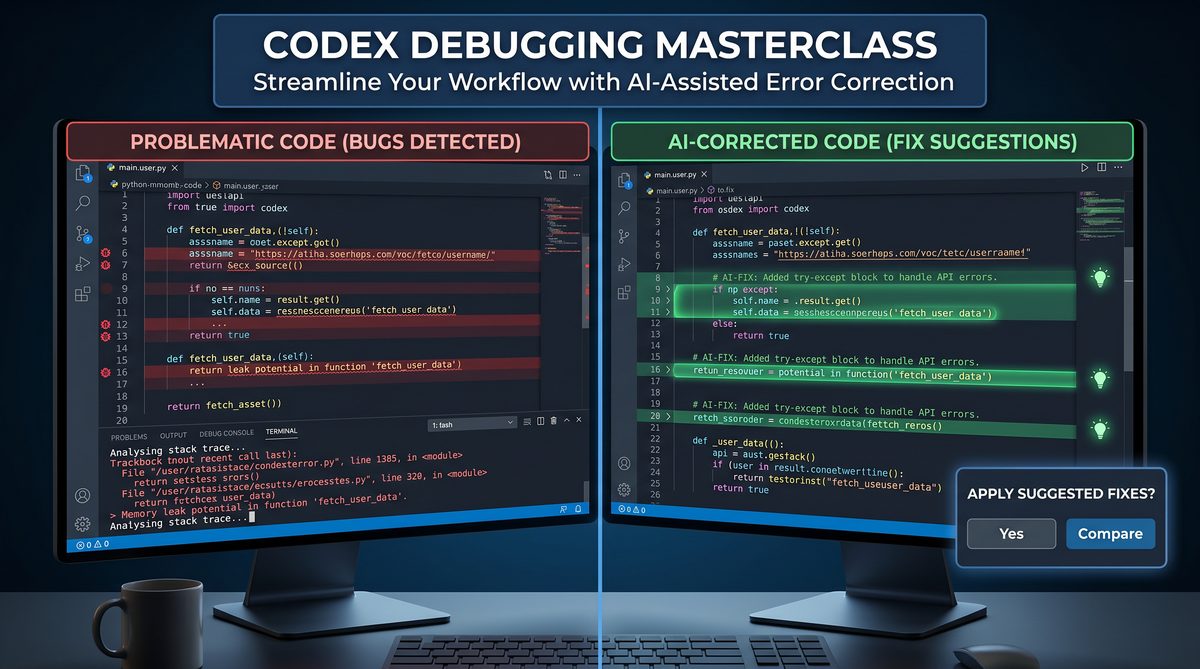
Welcome to the definitive Codex e-commerce masterclass—a comprehensive technical guide meticulously crafted for software engineers developing scalable, production-grade e-commerce systems. This compendium transcends simplistic tutorials and isolated code snippets by presenting 30 expertly engineered, production-ready prompts that drive the creation of end-to-end system components with OpenAI Codex.
Each prompt is densely packed with domain-specific requirements and operational nuances, purpose-built to generate critical system artifacts: from versioned database migrations, robust transactional services, and safely idempotent webhook handlers, to embedded observability frameworks and secure payment integrations compliant with PCI DSS and GDPR standards. Expect outputs featuring detailed API contracts, exhaustive unit and integration tests, sandboxed simulation harnesses, and richly annotated concurrent code explanations addressing race conditions and failure modes.
In modern e-commerce architecture, achieving low latency and high correctness across complex subsystems—such as search relevance tuning, catalog data integrity, dynamic pricing promotions, payment reconciliation, inventory reservation, and personalized recommendation—is paramount. Tailored and precise Codex prompts empower engineers to accelerate development while embedding best engineering practices, feature toggles, health checks, and rate limiting mechanisms, all seamlessly integrating into CI/CD pipelines and service meshes.
Utilize the following sections as a strategic AI prompt playbook. Each entry includes: (1) an explicit Codex prompt blockquote ready for direct input, (2) contextual expected inputs to guide generation, (3) a deep-dive technical explanation illuminating design decisions and trade-offs, and (4) a rigorous implementation checklist to audit, test, and fortify the resulting artifacts.
The 30 prompts are categorized into three high-impact domains: Product Catalog & Metadata Generation, Checkout, Cart & Payment Flows, and Inventory Management & AI Recommendation Engines.
Section 1: Advanced Codex Prompts for Product Catalog & Checkout System Generation
This section focuses on generating resilient product catalog architectures and orchestrating complex checkout flows leveraging Codex’s AI-assisted development capabilities. Engineers will discover prompts engineered to build normalized database schemas with zero-downtime migrations, metadata enrichment pipelines, GraphQL and REST integration layers, and fault-tolerant checkout orchestrators capable of handling concurrency, fault injection, and idempotent operations.
Designed for production environments under high concurrency and strict compliance constraints, these prompts insist on generating framework-specific code (Node.js, Go, Java, Python, Ruby), idempotency keys, comprehensive test harnesses simulating race and failure conditions, and OpenAPI contracts to enforce API integrity via contract-based testing in CI environments.
Teams employing event-driven architectures will find prompts that generate idempotent event processors, semantically versioned event schemas with automated migration notes, and robust reconciliation jobs designed for distributed consistency. For full-stack reproducibility, several prompts allow simultaneous generation of server-side code, client SDKs (e.g., TypeScript, Kotlin, Swift), and end-to-end test suites, all conforming to shared OpenAPI schema definitions.
To maintain organizational standards and security, these prompts incorporate governance scaffolds such as static code analysis outputs, secrets detection, dependency vulnerability scanning, and pull request review checklists embedded in generated artifacts.
Section 2: Inventory Management & AI-Powered Recommendation Engine Prompts
Inventory management and AI-driven recommendation engines represent the backbone of modern e-commerce competitiveness. Inventory constraints directly impact ranking algorithms and personalization pipelines; therefore, these prompts enable engineers to build deterministic stock reservation services that respect business policies—such as lead times, region-specific catalogs, and supplier exclusivity—while enforcing inventory-aware recommendations.
Codex is guided to generate hybrid recommendation pipelines combining classic term-matching inverted indices and state-of-the-art dense semantic embeddings, with late-binding business rules to uphold inventory and regional compliance constraints. Recommendations are instrumented with offline evaluation harnesses—calculating precision, recall, and uplift via multi-armed bandit experiments—and online telemetry for measuring freshness, latency SLAs, and model drift.
Engineers are encouraged to specify data freshness and staleness SLAs explicitly, enabling Codex to produce code that manages TTLs, publishes fine-grained change events for reactive consumers, and emits detailed metrics such as items_with_stale_inventory to alert operational teams. Health endpoints follow best practices by conditionally failing open or closed based on feature criticality.
For deeper operational integration, prompts recommend embedding AI components into progressive rollout strategies and controlled experimentation paradigms.
Section 3: The Complete Catalog of 30 Production-Ready Codex Prompts
The culmination of this masterclass is a ready-to-use catalog of 30 modular prompts. Each prompt can be copied directly as input for OpenAI Codex, with placeholders for your environment-specific parameters, and accompanied by detailed implementation checklists to guide production rollout, security review, and continuous improvement workflows.
These prompts deliberately specify language stacks, framework versions, testing requirements, API contracts, and operational integrations—serving as extensible templates adaptable to your organization’s unique codebases and compliance constraints.
Category A — Product Catalog & Metadata Generation (Prompts 1–10)
Prompt 1 — Normalized Product Schema and Migration Generator
Generate a production-ready, versioned PostgreSQL 13+ database schema for a normalized e-commerce product catalog, including rollback-capable migrations for tables like products, product_versions, attributes, attribute_values, categories, media assets, prices (region/currency differentiated), and a detailed audit trail. Incorporate optimized indexes (GIN/GIST/BTREE), partitioning strategies for pricing data, migration idempotency guards, semantic version headers, and operational runbooks to enable zero-downtime online migrations. Provide a Go-based migration runner utilizing context-aware SQL transactions, exponential backoff on transient errors, and unit tests employing ephemeral PostgreSQL instances for validation.
Expected Inputs:
- Runner language preference (default: Go)
- PostgreSQL target version
- Timezone handling policy
- Price table partitioning key
Technical Explanation: This prompt enforces best-in-class database design principles incorporating immutable versioning for product data, performant indexing strategies, and safe, audited migration procedures. Idempotent migrations ensure safe retries in CI/CD pipelines. Testcontainers facilitate automated integration testing validating schema correctness and rollback capabilities.
Implementation Checklist:
- Execute migrations under staged traffic mirroring scenarios.
- Run data validation queries to verify staging-to-production parity.
- Automate runbook tasks using infrastructure-as-code tools.
- Verify backup integrity and rehearse recovery operations.
- Enable audit logs and alerting to detect schema drift or failed rollbacks.
Useful Links
- How to Build a Research Assistant with Claude Code in 2026: Step-by-Step
- The 2026 Prompt Library: 5 Templates for AI Coding
- Best Practices for Event-Driven Architectures in E-Commerce
- Comprehensive Guide to PCI DSS Compliance for Payment Systems
- Optimizing Hybrid Search and Recommendation Pipelines
Closing Insights & Best Practices for Production-Ready AI-Driven E-Commerce Systems
This evolving Codex prompt playbook is an authoritative blueprint for engineers aiming to harness AI-assisted coding in building enterprise-grade e-commerce platforms. Each prompt is precisely designed to coerce Codex into generating end-to-end production artifacts, spanning schema migrations, robust APIs, resilient workflows, secure audit trails, and comprehensive test suites.
To maximize ROI, align prompts with your internal platform versions, coding standards, and governance protocols. Treat all AI-generated outputs as engineering drafts—critical human review, security audits, and rigorous QA remain indispensable before production deployment.
For organizations scaling AI prompt adoption, embed these prompts within your templating systems, standardize PR review checklists, and automate static analysis and dependency scanning. Maintain contract-first service definitions with OpenAPI and GraphQL to synchronize generated SDKs and tests, achieving consistency across clients and services.
Remember, production excellence extends beyond code to envelop process, governance, and observability. These prompts accelerate development but emphasize generating telemetry, monitoring hooks, and health endpoints essential for operational reliability.
Iteratively customize prompts by incorporating company-specific guardrails—compliance annotations, enforced linters, centralized logging schemas—to bridge the gap between innovative AI-assisted development and robust, compliant software delivery.
