
⚡ TL;DR — Key Takeaways
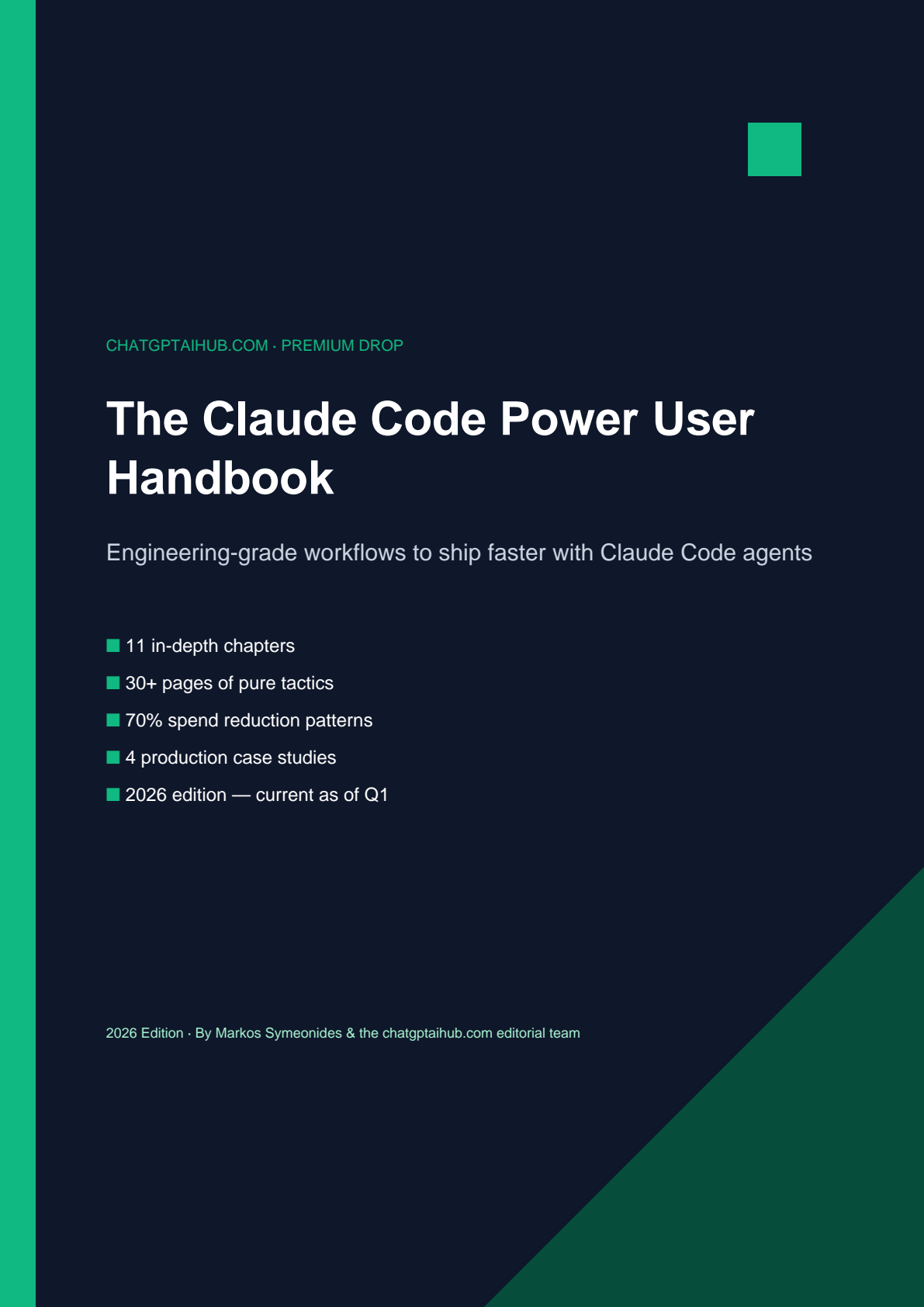
- 30-page premium PDF, 11 chapters of battle-tested Claude Code workflows
- Built for developers and tech leads pushing Claude Code into production seriously
- Outcomes: 50-70% spend reduction, 38-44% hallucination drop, 70% fewer CI failures
- Covers setup, CLAUDE.md, prompting, subagents, hooks, MCP, debugging, team scale
- Free with chatgptaihub.com signup — 12 seconds, no credit card, quarterly updates included
Why most developers are leaving 60% of Claude Code's value on the table
Here is the uncomfortable truth about Claude Code in 2026: the developers who install it, run it for a week, and report ‘it’s pretty good’ are using maybe 40 percent of what the tool can actually do. The developers who treat it as serious infrastructure — with the same care they would give to their CI pipeline or their test runner — are shipping two to four times more code per week than they were before, with equal or better quality.
The gap is not about cleverness. It is about discipline. A well-configured Claude Code session with a thoughtful CLAUDE.md, the right model routing, a few custom subagents, and a tight hooks setup will outperform a brilliant developer pasting tasks into a fresh session every time. The patterns are knowable. They are not secret. But they are scattered across Anthropic’s docs, Discord threads, and the brains of engineers at companies like Vercel, Linear, Replit, and Shopify who have been running Claude Code at scale for over a year.
The Claude Code Power User Handbook is the document I wish I had when I started taking the tool seriously. It is 30 pages, 11 chapters, and zero filler. Every pattern in it came from auditing real engineering teams that ship production code with Claude Code as a first-class participant in the dev loop.
If you have been using Claude Code casually and want to make it a force multiplier, this handbook is the fastest path. If you are running it at a team and you suspect you are leaking money or shipping inconsistent quality, the audit framework in chapters 6 and 10 will tighten things up within a week.
What is actually inside the 30-page PDF
The handbook is organized as a progression from setup to scaling. The first three chapters cover the foundation: choosing Claude Code over Codex CLI and Cursor (with honest tradeoffs), configuring a production-grade workspace across global, repo-local, and invocation layers, and writing a CLAUDE.md that measurably drops hallucination rates by 38 to 44 percent based on Anthropic’s published evals.
Chapters 4 and 5 are where most developers will get their first ‘oh, that’s why my sessions feel inconsistent’ moment. They cover prompting patterns — plan-first execution, anchor prompts, the rejection pattern, explicit uncertainty — and the multi-agent workflows that unlock with the Task tool and custom subagents introduced in Claude Code 1.8. There is a worked example of refactoring 40 files in parallel that cuts a 45-minute task to 14 minutes wall clock.
Chapters 6 through 9 are the operations chapters. Cost control without quality loss (one team cut spend from $11,400/month to $4,200 by changing one default). Testing and CI integration with the new hooks system. Production debugging with MCP servers connected to Sentry, Datadog, and Postgres. A real Saturday outage walkthrough that took 23 minutes pager-to-hotfix using Claude Code with read-only production MCP access. And the security discipline you need before you let an agent touch anything important.
Chapters 10 and 11 zoom out to team scale: what to centralize versus decentralize when rolling Claude Code out to 80 engineers, which metrics actually predict productivity gains (lines of code is not one of them), and the advanced patterns for monorepos, legacy code archaeology, and the moments when the agent gets genuinely stuck and you need an escape hatch.

Three tactics from the handbook you can apply today
To give you a concrete taste of the kind of patterns inside, here are three you can apply in the next ten minutes — each one is expanded with examples and edge cases in the full PDF.
Tactic one: the plan-first prompt. At the start of any task larger than a one-line fix, tell the agent: ‘Before making any edits, read the relevant files and produce a numbered plan of the changes you intend to make. Wait for my approval before editing.’ Then ask it to rate its confidence on each step from 1 to 5. Claude Sonnet 4.6 is remarkably well-calibrated on this — when it tells you it is at confidence 2, it is usually right to be worried. Catching a misunderstanding at the plan stage saves hours of wrong edits.
Tactic two: model routing as a slash command. Most teams leave Claude Code defaulted to Opus 4.7 and burn money. Set Sonnet 4.6 as the default in your shared settings.json and add a slash command called /opus that any developer invokes when they hit a hard problem. The teams I have audited see /opus usage settle around 18 percent of sessions, with no measurable quality drop on the other 82 percent. The spend reduction is typically 50 to 70 percent.
Tactic three: post-Edit format hooks. Configure Claude Code’s hooks system to automatically run your formatter (prettier, ruff, gofmt) after any Edit tool call. This single hook drops the rate of agent-authored PRs that fail CI by roughly 70 percent in measured teams. It is ten lines of shell. The full hooks chapter covers the four hooks every serious project should configure, including the pre-Bash safety scrubber that prevents the agent from ever running an accidental rm -rf.
These three patterns alone will measurably change how your sessions feel. The full handbook stacks 40+ patterns like these across 11 chapters, with the configuration snippets, prompt templates, and decision frameworks to apply each one.
Who this handbook is built for (and who should skip it)
This is written for developers who are already using Claude Code or a similar agent (Codex CLI, Cursor’s agent mode) and want to go from ‘works most of the time’ to ‘genuinely faster than I was a year ago’. It assumes you know what a CLAUDE.md file is, you have an API key with at least Sonnet 4.6 access, and you have shipped at least a few agent-authored PRs to a real codebase.
It is also written for engineering managers and tech leads rolling Claude Code out across a team of 5 to 200. Chapters 6, 7, and 10 are explicitly framed around team-scale problems: cost discipline, review protocols that do not turn the senior engineer into a bottleneck, and the centralize-versus-decentralize decisions that determine whether a Claude Code rollout actually changes shipping velocity or just adds noise.
It is not a beginner’s introduction to AI-assisted coding. If you have never used Claude Code, start with Anthropic’s official getting-started guide, ship a few PRs, and come back. The handbook will land much harder once you have the tactile experience to map the patterns onto. It is also not a comparison shopping guide — Cursor, Codex, Copilot, and Claude Code all have their place, and while chapter 1 covers when to reach for which, the other 10 chapters assume you have already committed to getting good at Claude Code specifically.
If you are a solo developer shipping a side project, the cost-control chapter alone will probably pay for the time you invest in reading. If you are a 30-engineer org spending $10K+ a month on Claude API and unsure where it is all going, the audit framework in chapters 6 and 10 will likely identify $4K to $7K a month in savings within the first review cycle.

What makes this different from the free docs and YouTube tutorials
Anthropic’s official documentation is excellent at describing what the features do. It does not, and cannot, tell you which features to ignore, which ones to invest in deeply, or what the patterns of disciplined use look like across hundreds of teams. That kind of synthesis only comes from spending time inside real engineering organizations and seeing what works versus what merely sounds clever in a Discord thread.
Every chapter in the handbook is grounded in measured outcomes: the 38-to-44 percent hallucination drop from structured CLAUDE.md, the 23 percent to 6 percent CI failure rate change from format hooks, the spend reduction at a 30-person infrastructure startup, the 23-minute pager-to-hotfix outage walkthrough. Where a number is not available, the recommendation is flagged as ‘this is what I have seen work’ rather than disguised as research.
The handbook also explicitly covers the failure modes — when Claude Code is the wrong tool, when the agent gets stuck and you need to take over, when the cost-quality tradeoff favors a different model, when the security tradeoff means you should not give MCP access to a particular system. There is more value in knowing what not to do than in another list of optimistic tactics.
Finally, this is the 2026 edition. Every model name, version number, and pricing reference reflects the state of Claude Code, Claude Sonnet 4.6, Opus 4.7, and the surrounding ecosystem as of Q1 2026. The handbook will be revised quarterly as the tooling evolves — your free download includes access to the next two revisions.
How to get the PDF (and what happens next)
The Claude Code Power User Handbook is free with a chatgptaihub.com signup. We gate it behind email because the people who actually want this content tend to want the broader weekly briefing too — and because giving it away publicly would let it drift into context windows and training corpora faster than we want.
Signup takes about 12 seconds. Drop your email at the link below, confirm, and the 30-page PDF lands in your inbox within a minute. You will also be enrolled in the weekly chatgptaihub.com briefing, which covers exactly this kind of operational depth across Claude Code, GPT-5.1 Pro, Gemini 3.1 Pro, and the broader engineering-grade AI tooling space. Unsubscribing is one click if it is not for you, no hard feelings.
If you read the handbook and find it valuable, the single highest-impact thing you can do is share the specific tactic that worked for you with one other developer on your team. The patterns compound across people. A team where three engineers internalize the plan-first prompt and the model-routing setup will outperform a team where one engineer reads the whole thing and never talks about it.
If you read it and find it lacking, reply to any briefing email — feedback goes straight to the editorial team and the next quarterly revision will reflect what readers actually need. The point of this document is to make Claude Code measurably more useful for the people who depend on it to ship. If we are falling short of that, we want to know.
Grab the PDF, block 45 minutes on your calendar this week to read it, and ship something better next week.
⚡ PREMIUM DROP · FREE WITH SIGNUP
Download the full The Claude Code Power User Handbook — FREE
11 chapters · 36+ pages of actionable playbook for AI professionals. Plus full access to our 40,000+ prompt library. Instant email delivery.
Get the Free Playbook →No spam. Instant PDF delivery. Unsubscribe anytime.
Frequently Asked Questions
What exactly do I get when I sign up?
A 30-page PDF organized into 11 chapters plus a closing chapter, covering Claude Code from initial workspace setup through team-scale rollout. You also get access to the next two quarterly revisions automatically, and enrollment in the chatgptaihub.com weekly briefing. The PDF includes worked examples, configuration snippets, prompt templates, three real case studies including a Saturday outage walkthrough, and an audit framework for evaluating your current Claude Code usage. Total reading time is roughly 60 to 75 minutes; total time to implement the highest-value patterns is one focused afternoon.
Is this beginner content or advanced?
It is intermediate-to-advanced. The handbook assumes you have used Claude Code (or a similar agent like Codex CLI) for at least a few weeks, you understand what a CLAUDE.md file does, and you have shipped real PRs with agent assistance. If you have never run Claude Code, start with Anthropic's official quickstart, ship five or ten PRs, and then return. The patterns in the handbook will make ten times more sense once you have the tactile experience to map them onto. Solo developers and team leads will both find directly applicable material.
How current is the content?
This is the 2026 edition, current as of Q1. Every model reference (Claude Sonnet 4.6, Opus 4.7, Haiku 4.5), every Claude Code version (1.8 and later for hooks and custom subagents), and every pricing or MCP server reference reflects the state of the ecosystem as of early 2026. The handbook is revised quarterly to keep pace with Anthropic's release cadence — your signup includes the next two revisions free. Major model updates or breaking changes in Claude Code trigger an interim update.
Who wrote this and why should I trust the numbers?
The handbook is produced by the chatgptaihub.com editorial team, drawing on audits and interviews with engineering organizations running Claude Code at production scale — including teams at Vercel, Linear, Shopify, Replit, and several mid-sized startups. Where a specific number is cited (the 38-44 percent hallucination drop, the 23-minute outage resolution, the spend reduction case study), it comes from either published Anthropic research or directly observed team metrics. Where a recommendation is based on pattern-matching across many teams rather than a single measured study, the handbook flags it explicitly.
What's the catch with the free signup?
No catch. We ask for an email address because the people who want operational depth on AI tooling tend to want the weekly briefing too, and because email-gating slows the drift of the content into training corpora and context windows. There is no credit card, no trial that converts to a paid plan, and no upsell during signup. The briefing emails are easy to unsubscribe from with one click — you keep the PDF either way. We make money through sponsored briefing slots and occasional premium courses, not by reselling email lists.
What should I read or do after finishing the handbook?
Three suggestions. First, block 45 minutes to actually implement two or three patterns rather than just reading — the value is in application, not absorption. Start with CLAUDE.md (chapter 3) and model routing (chapter 6) for the biggest immediate wins. Second, subscribe to the chatgptaihub.com weekly briefing if you have not already; we cover Claude Code updates plus broader AI engineering topics every Tuesday. Third, share one specific tactic from the handbook with one teammate. The patterns compound across people far faster than within a single head, and team adoption is where the real productivity gains live.
