
Dell AI Factory + OpenAI Codex: How On-Premises AI Agents Are Changing Enterprise Software Development
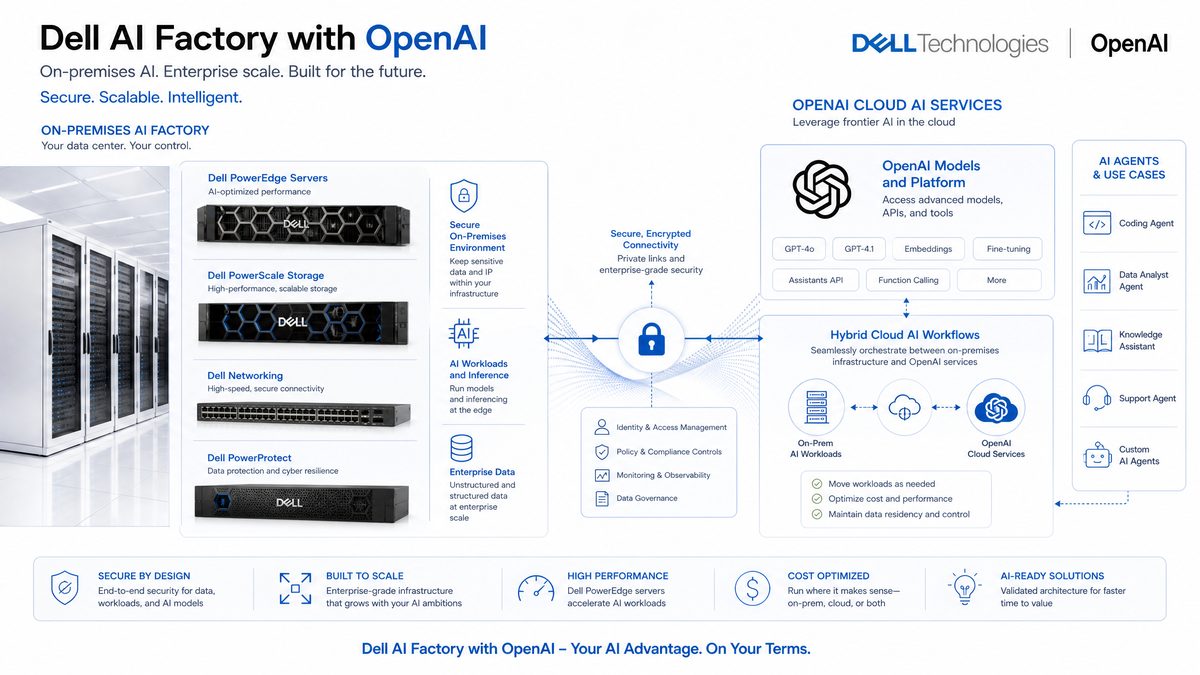
In the rapidly evolving landscape of artificial intelligence, enterprises are increasingly seeking solutions that provide the agility of AI-powered development tools without compromising security, compliance, or control. The recent partnership between Dell Technologies and OpenAI represents a significant step forward in this direction. By integrating OpenAI’s Codex—a cutting-edge AI coding agent—with Dell’s AI Data Platform and the Dell AI Factory, organizations can now deploy on-premises and hybrid AI coding agents that reshape how software development and automation are conducted within regulated industries.
This article provides an in-depth exploration of the Dell AI Factory and OpenAI Codex partnership, emphasizing technical integration, real-world use cases, security benefits, and the strategic advantages of hybrid AI deployment models in enterprises. We also include expert insights from Dell CTO Ihab Tarazi and offer a comprehensive roadmap for implementation, comparing these hybrid solutions to traditional cloud-only AI development approaches.
The Dell OpenAI Codex Partnership: A New Paradigm in Enterprise AI Development
The collaboration between Dell Technologies and OpenAI is aimed at bridging the gap between powerful AI capabilities and enterprise-grade infrastructure. OpenAI Codex, an AI agent designed to understand and generate code, is now accessible through Dell’s AI Factory—a platform that enables AI model development, deployment, and management within customer-controlled environments.
This partnership is significant because it enables enterprises to leverage AI coding assistants without relying solely on public cloud infrastructures, which often pose compliance, latency, or data sovereignty challenges. The Dell AI Factory supports hybrid and on-premises deployments, allowing organizations to maintain rigorous control over sensitive data while accelerating development cycles via AI augmentation.
Dell AI Data Platform: The Backbone of Hybrid AI Integration
At the core of this integration lies the Dell AI Data Platform, a robust infrastructure designed to support AI workloads at scale. It provides seamless orchestration, data management, and compute resources that feed into AI models like OpenAI Codex. Its hybrid architecture allows enterprises to run AI workloads both on-premises and in the cloud, combining flexibility with governance.
The platform supports containerized deployment of AI models, enabling rapid scaling and integration with existing CI/CD pipelines. Additionally, it offers enhanced data governance features such as encryption, auditing, and role-based access control, critical for industries like healthcare and finance where compliance with HIPAA, GDPR, or PCI DSS is mandatory.
Through the Dell AI Data Platform, organizations can ingest proprietary codebases, documentation, and domain-specific datasets securely, which Codex can then use to generate context-aware code suggestions, automate testing scripts, or even refactor legacy software components. This level of integration is unprecedented in enterprise AI tooling.
Technical Architecture: How Dell AI Factory Enables On-Premises OpenAI Codex Deployment
The technical architecture of the Dell AI Factory combined with OpenAI Codex is designed to facilitate secure, scalable, and efficient AI coding assistance within enterprise environments. Below is a detailed breakdown of the system components and their interactions.
| Component | Description | Role in AI Coding Agent Deployment |
|---|---|---|
| Dell AI Factory | A platform for building, deploying, and managing AI models on-premises or in hybrid cloud environments | Hosts OpenAI Codex containers, manages model lifecycle, and integrates with enterprise development tools |
| OpenAI Codex | The AI coding assistant model capable of interpreting natural language prompts and generating code | Provides coding suggestions, automates code generation and testing, and accelerates software development |
| Dell AI Data Platform | Hybrid data platform offering secure data ingestion, storage, and orchestration for AI workloads | Feeds sanitized and compliant datasets to Codex for context-aware code generation |
| Enterprise DevOps Tools | Existing CI/CD pipelines, code repositories, and testing frameworks | Integrates with Codex suggestions to automate code commits, reviews, and deployment processes |
| Security and Compliance Framework | Encryption, access controls, audit logs, and compliance policies | Ensures that AI processing adheres to industry regulations and internal security policies |
By containerizing OpenAI Codex and orchestrating it through the Dell AI Factory, enterprises gain unprecedented control over AI-driven development workflows while maintaining strict governance. The use of container orchestration technologies such as Kubernetes within Dell AI Factory allows for dynamic scaling of Codex instances based on workload demand. This ensures that the AI coding assistant can handle fluctuating request volumes efficiently without compromising performance or availability.
Data Flow and Contextualization for Code Generation
An essential aspect of the architecture is the seamless integration between the Dell AI Data Platform and OpenAI Codex. The AI Data Platform ingests code repositories, documentation, and domain-specific knowledge bases, which are then sanitized to remove sensitive information and structured to comply with organizational data policies. This curated data is fed into Codex as contextual input, enabling the model to generate code that is not only syntactically correct but also aligned with enterprise coding standards, frameworks, and security guidelines. For example, when generating API integration code, Codex leverages up-to-date internal API schemas and security protocols provided through the data platform to tailor its outputs accordingly.
Operational Management and Lifecycle Automation
Dell AI Factory’s lifecycle management capabilities automate the deployment, updating, and rollback of OpenAI Codex containers. Through integration with existing DevOps pipelines, updates to the Codex model or its supporting infrastructure can be tested in staging environments before being promoted to production. This reduces downtime and mitigates risks associated with model drift or compatibility issues. Additionally, telemetry collected from Codex usage—such as types of code generated, error rates, and user feedback—is aggregated and a
In healthcare, AI-assisted coding tools must navigate complex regulatory frameworks such as HIPAA in the United States and GDPR in the European Union, which impose strict requirements on patient data privacy and security. Codex’s architecture ensures that any AI-generated code or data processing pipelines comply with these mandates by integrating data anonymization techniques and enforcing least-privilege principles on data access. For instance, when generating code to interface with electronic health record (EHR) systems, Codex can be configured to automatically exclude or mask protected health information (PHI), reducing the risk of inadvertent data exposure. Additionally, the ability to produce auditable logs of AI interactions supports compliance reporting and incident response activities within healthcare organizations.
Financial institutions benefit from Codex’s capabilities by automating the generation of secure and compliant software components that adhere to standards such as PCI DSS for payment processing and SOX for financial reporting. Codex can assist in writing code that implements robust authentication, encryption, and transaction logging mechanisms essential for mitigating fraud and ensuring data integrity. Moreover, its integration with continuous auditing tools allows financial firms to maintain real-time oversight over code changes, facilitating faster detection of compliance deviations. For example, Codex-enabled development pipelines can automatically generate and validate audit trails for all code deployments within trading platforms, ensuring transparency and regulatory adherence.
Government Applications and Regulatory Oversight
Government agencies, often constrained by legacy systems and stringent procurement policies, require AI tools that can produce maintainable, secure, and standards-compliant code. Codex supports modernization efforts by generating code that adheres to government-specific coding standards such as the Federal Information Security Management Act (FISMA) and National Institute of Standards and Technology (NIST) guidelines. These standards demand rigorous documentation, security controls, and change management—features inherently supported by Codex’s auditability and role-based access controls. Additionally, Codex can expedite the development of citizen-facing applications by automating compliance checks for accessibility standards like Section 508, ensuring equitable acces
Furthermore, deploying AI agents on-premises offers distinct advantages in maintaining data sovereignty and controlling sensitive information flow. Unlike cloud-based AI services, which often require transmitting data to third-party servers, on-premises solutions ensure that all data processing occurs within the organization’s secure network perimeter. This containment is critical for industries such as finance, healthcare, and defense, where exposure of personally identifiable information (PII), protected health information (PHI), or classified data could lead to severe legal and reputational consequences. By eliminating reliance on external infrastructure, organizations can enforce stringent access controls and monitor data usage in real time, thereby reducing the attack surface and preventing data leakage.
Another key security benefit lies in the ability to customize AI agents to comply with internal audit standards and industry-specific compliance frameworks such as HIPAA, GDPR, SOC 2, and FISMA. On-premises AI systems can be configured to generate audit trails for all automated actions, including code generation, data manipulation, and decision-making processes. These logs are invaluable for forensic analysis and regulatory reporting, enabling organizations to demonstrate adherence to compliance mandates during audits. For example, a financial institution using an on-premises AI agent can track precisely how customer data is handled in automated workflows, ensuring that every step complies with anti-money laundering (AML) regulations.
Enhanced Risk Management Through Tailored Security Policies
On-premises AI agents can be tightly integrated with an organization’s existing security infrastructure, such as identity and access management (IAM) systems, encryption key management, and network segmentation protocols. This integration allows for granular enforcement of security policies tailored to the organization’s risk profile. For instance, AI agents can be programmed to restrict access to sensitive datasets based on user roles or operational contexts, minimizing insider threats. Additionally, organizations can implement bespoke anomaly detection mechanisms that monitor AI agent behavior for unusual patterns indicative of compromise or malfunction, enabling proactive incident response.
Moreover, controlling the update and training cycles of on-premises AI models allows organizations to vet and validate new features or datasets before deployment, mitigating risks associated with model drift, biased outputs, or unintended compliance violations. This level of control is often unattainable with cloud-hosted AI services, where continuous updates are managed externally and may introduce unforeseen vulnerabilities or regulatory gaps.
Case Study: On-Premises AI in Healthcare Compliance
A leading healthcare provider recently implemented on-premises AI agents to automate the generation of clinical decision support tools while ensuring HIPAA compliance. By processing patient data exclusively within their secure data centers, they minimized the risk of PHI exposure. The AI agent was configured to embed the latest regulatory guidelines into its algorithms, automatically updating treatment protocols in response to new medical standards. This approach not only enhanced patient safety through consistent compliance but also streamlined audit processes by maintaining comprehensive, immutable records of AI-driven clinical recommendations.
In summary, on-premises AI agents deliver unparalleled security and compliance benefits by preserving data locality, enabling tailored governance, and facilitating rigorous auditability. These capabilities empower organizations in regulated sectors to harness AI innovation confidently, balancing cutting-edge technology adoption with strict adherence to legal and ethical standards.
Use Cases for Regulated Industries: Healthcare, Finance, and Government
Enterprises operating in regulated sectors face stringent requirements around data privacy, security, and auditability. The hybrid and on-premises AI deployment enabled by Dell and OpenAI Codex is especially transformative in these domains.
Healthcare
Healthcare organizations must comply with HIPAA regulations that restrict sharing patient data outside secure environments. Deploying Codex on-premises via Dell AI Factory enables developers to use AI-assisted coding while keeping sensitive data in-house. This setup accelerates the development of Electronic Health Record (EHR) integration modules, clinical decision support software, and medical device firmware without risking data leaks.
For example, AI agents can assist in generating FHIR-compliant APIs, automate validation scripts to verify data integrity, and produce documentation aligned with regulatory standards. The ability to fine-tune Codex on domain-specific datasets improves accuracy in healthcare-specific coding tasks.
Finance
Financial institutions are bound by regulations such as PCI DSS and SOX that demand strict control over code that handles payment processing or financial reporting. On-premises Codex deployment ensures that proprietary algorithms and transaction data never leave the secure environment. AI agents can help automate compliance reporting, generate risk analysis models, and streamline code audits.
Moreover, latency-sensitive trading platforms benefit from local AI code generation and debugging assistance, avoiding delays inherent in cloud-only models. This reduces time-to-market for new financial products and improves operational resilience.
Government
Government agencies must safeguard classified and sensitive information while modernizing legacy systems. The Dell AI Factory enables deployment of AI coding agents within government data centers or approved cloud enclaves. Codex can assist in migrating legacy COBOL or Java applications to modern frameworks by generating automated refactoring scripts and documentation.
Additionally, AI-driven code reviews help identify security vulnerabilities and enforce agency-specific coding policies. The partnership supports compliance with standards like FedRAMP and NIST SP 800-53, providing audit trails and role-based access to AI models and data.

Security and Compliance Benefits of On-Premises AI Agents
One of the most compelling reasons for enterprises to adopt on-premises AI coding agents lies in the enhanced security and compliance capabilities. Public cloud AI services, while powerful, introduce concerns around data sovereignty, exposure to multi-tenant environments, and regulatory restrictions.
Deploying OpenAI Codex within the Dell AI Factory on-premises infrastructure addresses these issues directly:
- Data Residency: Sensitive source code and datasets remain within enterprise firewalls and data centers, eliminating the risk of external data breaches.
- Access Control: Integration with enterprise identity and access management (IAM) systems restricts AI model usage to authorized personnel only.
- Auditability: Detailed logs of AI interactions, code generation requests, and developer activity provide traceability for compliance audits.
- Network Security: AI agents operate in isolated, containerized environments with strict network segmentation, preventing lateral movement risks.
- Model Customization and Control: Enterprises can fine-tune Codex models on proprietary datasets without sharing data externally, maintaining intellectual property confidentiality.
These security benefits are crucial for industries facing regulatory scrutiny and help foster trust in AI technologies by mitigating risks associated with uncontrolled data exposure.
Quote from Dell CTO Ihab Tarazi
“The Dell Technologies and OpenAI partnership marks a new era for enterprise AI. By enabling on-premises deployment of powerful AI agents like Codex, we empower organizations to accelerate innovation while maintaining the highest standards of security and compliance. This hybrid approach is not just a technical solution—it’s a strategic imperative for industries where control over data and code is non-negotiable.” — Ihab Tarazi, CTO, Dell Technologies
Comparing Hybrid On-Premises AI Deployment with Cloud-Only Approaches
To understand the strategic value of the Dell AI Factory and OpenAI Codex partnership, it is essential to compare hybrid/on-premises AI deployments with traditional cloud-only models.
| Criteria | Hybrid On-Premises AI Deployment | Cloud-Only AI Deployment |
|---|---|---|
| Data Control & Residency | Full control; data and code remain within enterprise environment | Data transmitted to cloud provider; potential regulatory issues |
| Latency | Low latency due to local execution | Higher latency depending on network conditions |
| Security | Enhanced security with enterprise-grade infrastructure and policies | Relies on cloud provider’s security; shared environment risks |
| Scalability | Scalable within enterprise resources; hybrid cloud can augment | Virtually unlimited scalability |
| Compliance | Easier to enforce specific regulatory requirements | May require complex contractual agreements and audits |
| Customization | Full customization and fine-tuning of AI models on proprietary data | Limited customization; proprietary data often cannot be used for training |
| Cost Model | CapEx heavy; predictable operational expenses | OpEx model; potentially variable costs |
This comparison underscores why regulated enterprises often prefer a hybrid or on-premises approach, despite the operational overhead, to ensure that AI deployments align with their strategic and compliance mandates.
Implementation Roadmap for Enterprises Adopting Dell AI Factory with OpenAI Codex
Adopting on-premises AI coding agents requires a well-planned roadmap that addresses infrastructure, integration, security, and organizational readiness. Below is a step-by-step guide for enterprises embarking on this journey:
1. Assess Current Infrastructure and AI Readiness
Evaluate existing data center capabilities, AI infrastructure, and DevOps maturity. Identify gaps in compute, storage, and networking that may impact AI workload performance. Engage with Dell Technologies consulting teams to map out AI Factory deployment options.
2. Define Use Cases and Compliance Requirements
Identify specific development workflows that will benefit most from Codex AI assistance. Document regulatory and security requirements relevant to your industry. This step ensures that AI integration aligns with business goals and compliance frameworks.
3. Deploy Dell AI Factory and AI Data Platform
Install and configure the Dell AI Factory platform on-premises or in hybrid environments. Set up the AI Data Platform to ingest and manage proprietary datasets securely. Validate connectivity and integration with enterprise IAM and security tools.
4. Integrate OpenAI Codex Containers
Deploy OpenAI Codex as containerized services within Dell AI Factory. Customize and fine-tune Codex models using domain-specific codebases and documentation. Establish APIs and plugins to integrate Codex with developer IDEs and CI/CD pipelines.
5. Implement Security Controls and Monitoring
Configure encryption, access controls, and audit logging for AI interactions. Integrate with SIEM tools and compliance dashboards. Conduct penetration testing and security assessments for the AI environment.
6. Pilot and Iterate
Run pilot projects with select development teams to validate AI coding assistance efficacy and compliance adherence. Collect feedback, refine model tuning, and optimize workflows. Establish training programs to upskill developers on AI-enabled development tools.
7. Scale and Govern
Expand AI Factory and Codex deployment across departments. Implement governance frameworks to monitor AI usage, mitigate risks, and ensure continuous compliance. Regularly update AI models and platform components following Dell and OpenAI releases.

Conclusion: The Future of Enterprise AI Development with Dell and OpenAI
The Dell Technologies and OpenAI Codex partnership ushers in a new era where powerful AI coding agents can be securely deployed on-premises or in hybrid environments, addressing the unique challenges faced by regulated enterprises. By leveraging Dell AI Factory and the AI Data Platform, organizations gain the ability to accelerate software development cycles, improve code quality, and maintain rigorous compliance and security standards simultaneously.
This hybrid approach to AI deployment is not merely a technical innovation but a strategic enabler that reconciles the need for AI-driven agility with the uncompromising demands of data governance and regulatory compliance. As industries such as healthcare, finance, and government continue to digitize and modernize, on-premises AI coding agents powered by Dell and OpenAI will become foundational to their innovation pipelines.
Enterprises looking to harness these benefits should carefully follow a structured implementation roadmap, leveraging Dell’s deep expertise in enterprise infrastructure and OpenAI’s advances in AI coding intelligence. The future of enterprise development is here, and it is hybrid, secure, and collaborative.
For a deeper exploration of this topic, see our comprehensive guide on How Enterprise Dev Orgs Used OpenAI Codex to Ship Features 10x Faster: A 2026 Case Study, which provides additional context and practical examples for enterprise teams.
For a deeper exploration of this topic, see our comprehensive guide on How to Build a Multi-Agent Workflow with Codex CLI: From Planning to Production, which provides additional context and practical examples for enterprise teams.
Author: Markos Symeonides
Get Our Free AI Prompt Library
Access our curated collection of production-ready prompts for ChatGPT, GPT-5.5, and Codex. Updated weekly with new templates for developers, marketers, and business professionals.
