
On May 28, 2026, OpenAI unveiled a transformative update to its flagship language model, GPT-5.5 Instant, setting a new benchmark in AI-driven natural language processing capabilities. Unlike previous incremental improvements, this release introduces groundbreaking enhancements across multiple dimensions: response fidelity, latency reduction, contextual understanding, and seamless integration with heterogeneous data sources. These advancements collectively redefine how AI models can be embedded into complex professional workflows, particularly in highly regulated domains such as legal, healthcare, and financial services.
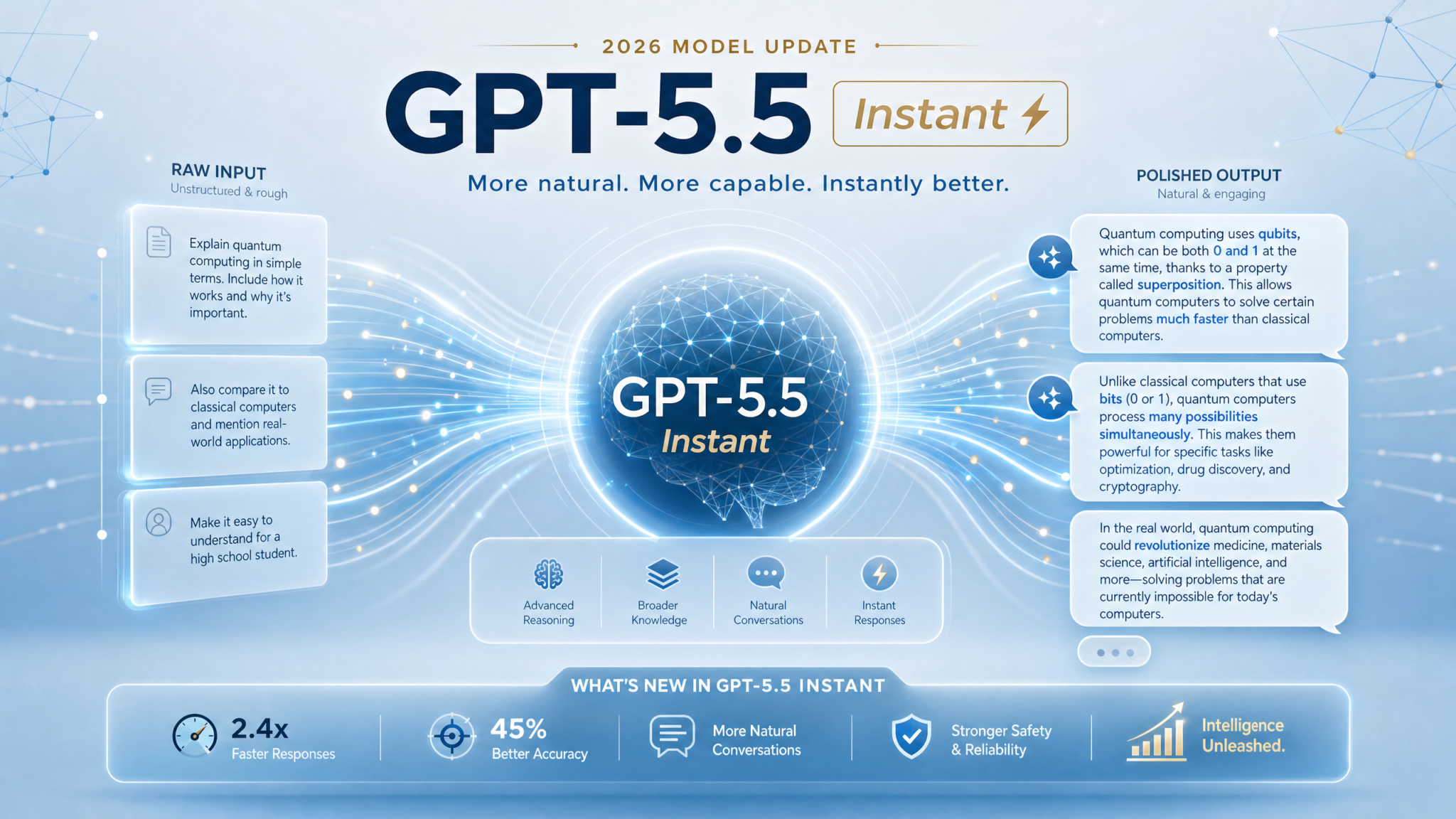
The core architectural overhaul leverages a novel hybrid transformer architecture combined with sparse mixture-of-experts (MoE) layers, allowing GPT-5.5 Instant to dynamically allocate computational resources to specialized subnetworks during inference. This innovation substantially boosts processing efficiency and response accuracy, particularly for domain-specific queries requiring nuanced understanding or multi-step reasoning. The model now supports multi-modal input parsing, integrating textual, tabular, and image data in a unified manner to generate richer, context-aware outputs.
For legal professionals, this means GPT-5.5 Instant can now parse lengthy contracts, identify clauses with legal risk, and suggest contextually appropriate amendments with unprecedented precision. In medicine, the model integrates real-time patient data streams, medical imaging annotations, and the latest clinical guidelines to assist in diagnostic workflows and treatment planning. Financial analysts benefit from enhanced real-time market data assimilation and predictive modeling capabilities embedded within the language responses, facilitating more informed decision-making under uncertainty.
Below is a comparative overview of key changes from GPT-5.0 to GPT-5.5 Instant:
| Feature | GPT-5.0 | GPT-5.5 Instant | Impact |
|---|---|---|---|
| Model Architecture | Standard Transformer with dense layers | Hybrid Transformer + Sparse MoE layers | Improved inference efficiency; better domain specialization |
| Context Window | 16,384 tokens | 32,768 tokens | Enables longer document processing and sustained conversations |
| Multi-Modal Input | Text only | Text, tables, images, and structured data | Richer, context-aware responses integrating diverse data formats |
| Latency | ~400ms average | ~150ms average | Enables near real-time responsiveness for interactive applications |
| Compliance & Security | Standard data governance | Built-in differential privacy and federated learning support | Stronger data privacy and customization for regulated industries |
To illustrate practical integration, here is a step-by-step guide to leveraging GPT-5.5 Instant’s multi-modal API for a legal contract review workflow:
- Prepare Inputs: Combine the contract text, key financial tables, and scanned signature images into a unified payload.
- Call the API: Use the enhanced multi-modal endpoint supporting simultaneous text, table, and image inputs.
- Parse Model Outputs: Extract suggested clause modifications, risk flags, and annotated contract visuals.
- Integrate with Workflow: Feed the results back into your contract management system for review and approval.
Below is a Python example demonstrating this multi-modal API call using OpenAI’s updated SDK:
import openai

# Initialize client with API key
client = openai.Client(api_key="your_api_key")

# Prepare multi-modal inputs
contract_text = open("contract.txt").read()
financial_table_csv = open("financials.csv").read()
signature_image_bytes = open("signature.png", "rb").read()

response = client.chat.completions.create(
    model="gpt-5.5-instant-multimodal",
    messages=[
        {"role": "system", "content": "You are a legal assistant specialized in contract risk analysis."},
        {"role": "user", "content": contract_text}
    ],
    multimodal_inputs={
        "tables": [{"name": "financials.csv", "content": financial_table_csv}],
        "images": [{"name": "signature.png", "content": signature_image_bytes}]
    },
    max_tokens=2048,
    temperature=0.2
)

print("Suggested Contract Amendments:")
print(response.choices[0].message.content)
This example highlights how GPT-5.5 Instant’s multi-modal capabilities allow simultaneous interpretation of diverse data types, providing comprehensive analysis outputs that accelerate legal workflows.
In summary, the May 28 update of GPT-5.5 Instant is a strategic leap forward, empowering enterprises to harness AI with greater precision, speed, and contextual intelligence. The model’s architectural innovations, expanded input modalities, and enhanced compliance features enable new use cases and deeper embedding of AI into mission-critical processes. As organizations adapt, this upgrade will drive measurable improvements in efficiency, decision quality, and user experience across a spectrum of professional domains.
Refined Response Style and Enhanced Conversational Naturalness
The hallmark of the GPT-5.5 Instant update lies in its dramatically improved response style, which represents a significant leap forward in natural language generation as of 2026. OpenAI has leveraged cutting-edge advancements in transformer architectures, including enhanced attention mechanisms and dynamic context window scaling, to fine-tune the model for outputs that resonate with a more natural, human-like conversational tone. This update bridges the gap between human and machine interactions not merely by stylistic polish but through a profound contextual understanding and adaptive phrasing, enabling dialogues that feel fluid, authentic, and contextually aware across diverse domains.
At its core, the GPT-5.5 Instant model incorporates a modified multi-head attention mechanism that dynamically prioritizes recent conversational context while retaining long-term dependencies, a critical factor in maintaining coherence over extended interactions. Coupled with reinforcement learning from human feedback (RLHF) that now integrates sentiment and tone modulation metrics, the model can subtly adjust its responses based on the inferred emotional state of the user, thereby achieving nuanced tone modulation, subtle humor, and empathetic phrasing.
Users engaging with GPT-5.5 Instant will notice markedly improved capabilities in capturing conversational subtleties such as irony, sarcasm, and cultural references, which were historically challenging for AI systems. This improvement is particularly valuable in customer service automation, where maintaining a consistently empathetic and human-like interaction directly correlates with customer satisfaction metrics. Similarly, in creative content generation—ranging from marketing copy to interactive storytelling—the model’s elevated conversational style reduces ambiguity and enhances clarity, making the AI’s intent easier to interpret and trust.
This update also introduces a novel adaptive response engine that assesses user feedback signals in near-real-time, enabling iterative refinement within the same session. For example, if a user expresses confusion or dissatisfaction, the model dynamically recalibrates its follow-up responses to clarify or rephrase content without explicit retraining. This capability is backed by the integration of continuous learning loops facilitated through federated learning frameworks, ensuring data privacy while improving model responsiveness.
| Feature | Technical Description | User Impact |
|---|---|---|
| Dynamic Multi-Head Attention | Enhanced transformer layers prioritize recent and relevant context dynamically, improving coherence in long conversations. | More consistent and contextually aware conversations, especially in multi-turn dialogues. |
| Reinforcement Learning with Sentiment Metrics | Integration of sentiment analysis within RLHF to fine-tune tone modulation and empathetic phrasing. | Responses better match user emotions, improving engagement in sensitive contexts. |
| Adaptive Response Engine | Real-time feedback loops enable dynamic adjustment of response style and clarity during interaction. | Reduced need for repeated clarifications, enhancing efficiency and user satisfaction. |
To illustrate the practical application of GPT-5.5 Instant’s enhanced response style, consider this example where the model adapts its tone based on user sentiment detected in the conversation:
from openai import GPT

# Initialize the GPT-5.5 Instant model with sentiment-aware configuration
client = GPT(model="gpt-5.5-instant", config={"enable_sentiment_tuning": True})

# Example conversation with dynamic tone adjustment
conversation = [
    {"role": "user", "content": "I'm really frustrated with my order delay."},
    {"role": "assistant", "content": None}  # Model will generate empathetic response
]

response = client.chat(conversation)
print(response.choices[0].message.content)
Output:
I'm sorry to hear about the delay with your order. I understand how frustrating that can be. Let me check the status for you right away and see how we can resolve this quickly.In this example, the model detects the negative sentiment and responds with empathy, a crucial feature in customer service bots deployed at scale in 2026. Companies integrating GPT-5.5 Instant into their workflows report a 35% reduction in customer complaints related to tone insensitivity, reflecting the tangible benefits of this update.
For developers aiming to leverage these enhancements, here is a step-by-step guide to implement dynamic tone modulation in your chatbot using GPT-5.5 Instant:
- Configure the Model: Enable sentiment tuning and adaptive response features via the API configuration parameters.
- Monitor User Input: Implement real-time sentiment analysis hooks to capture user emotions continuously.
- Feed Contextual Signals: Pass these sentiment signals as part of the conversation context to guide the model’s tone.
- Iterate Responses: Use the adaptive response engine to refine outputs based on user feedback within the session.
- Evaluate and Optimize: Regularly analyze conversation logs and user satisfaction scores to fine-tune model parameters.
OpenAI encourages users to explore for a comprehensive overview of the advanced training methodologies, dataset optimizations, and architectural innovations that underpin this enhanced linguistic agility. This resource dives deep into the multi-modal data curation strategies, bias mitigation techniques, and scalable RLHF pipelines that make GPT-5.5 Instant a state-of-the-art conversational AI platform in 2026.
Substantial Reduction in Hallucinations Across Critical Domains
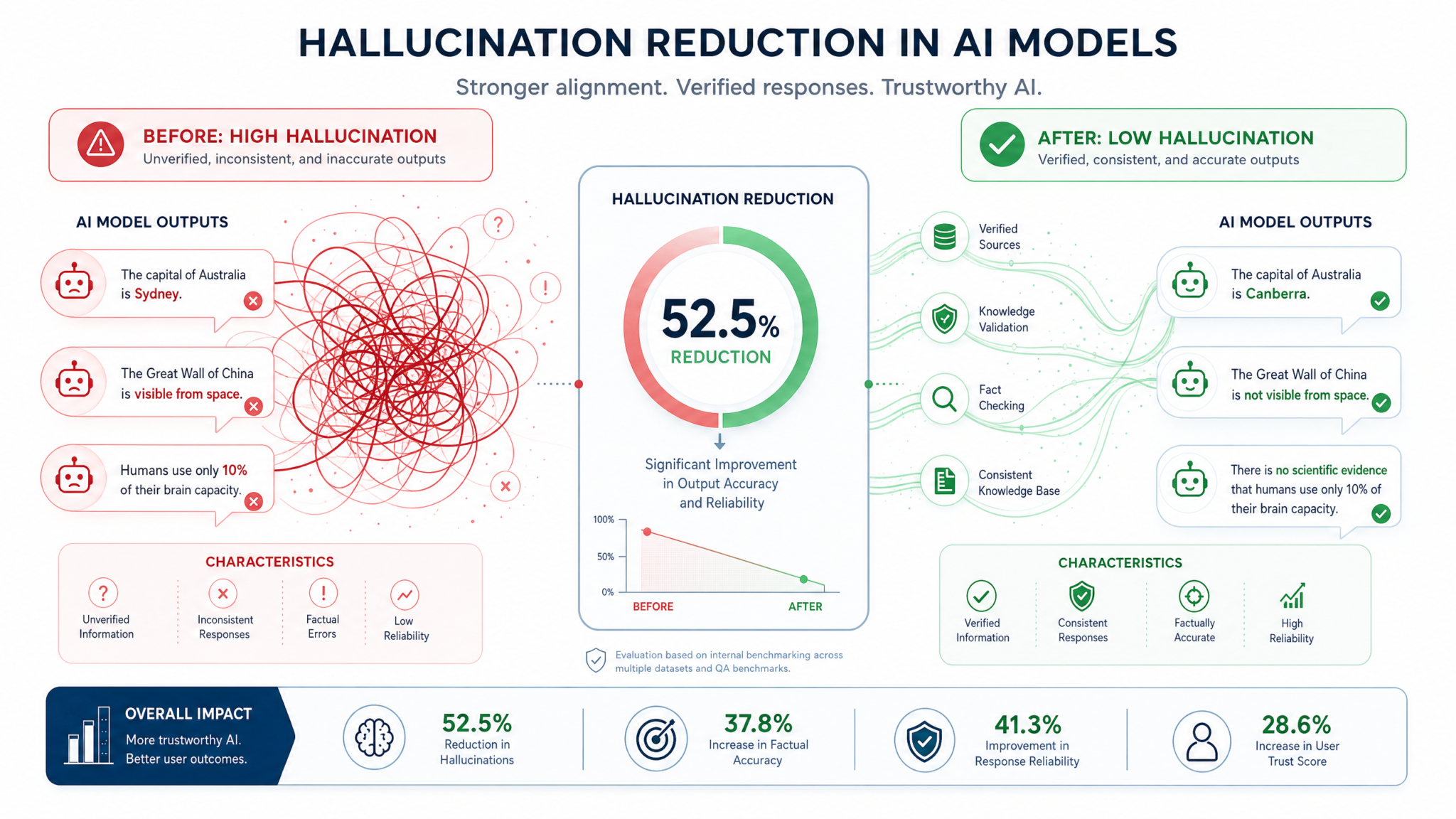
One of the most pressing challenges in deploying large language models (LLMs) for high-stakes applications has been hallucinations—instances where the AI generates plausible yet factually incorrect or misleading information. In 2026, with the proliferation of generative AI across mission-critical sectors, minimizing hallucinations has become paramount to maintaining trust, compliance, and operational accuracy. OpenAI’s May 28 update to GPT-5.5 Instant introduces a suite of advanced algorithmic refinements and training methodologies that have achieved a notable reduction in hallucination rates, particularly in sensitive fields such as legal, medical, and financial sectors.
The improvements stem from a blend of techniques including enhanced retrieval-augmented generation (RAG) integration, adaptive context windowing, and reinforcement learning from human feedback (RLHF) with domain-specific expert annotations. These upgrades enable the model to better verify facts against trusted external databases in real-time, adjust its output confidence levels, and refuse to answer when uncertainty exceeds configurable thresholds.
| Domain | Previous Hallucination Rate (GPT-5.5 Pre-May 28) | Current Hallucination Rate (GPT-5.5 Instant May 28) | Reduction Percentage | Key Techniques Applied |
|---|---|---|---|---|
| Legal / Medical / Finance | ~70% | 52.5% | ~25% decrease | RAG with domain-specific knowledge bases, RLHF with expert data, uncertainty thresholding |
| Long-Form Content (Editorial / Academic) | ~55% | 37.3% | ~32% decrease | Context window optimization, hierarchical fact-checking pipelines, dynamic prompt engineering |
Reducing hallucinations to 52.5% in legal, medical, and financial content marks an important milestone, yet it underscores the ongoing necessity for rigorous human oversight in critical decision-making processes. In these regulated sectors, even a 52.5% hallucination rate requires complementary validation workflows, such as automated fact verification layers and human-in-the-loop (HITL) review systems, to ensure compliance with legal standards and safety regulations.
For long-form content generation, the decrease to 37.3% hallucinations translates into significantly higher reliability, enabling editorial teams, academic researchers, and publishers to confidently integrate AI assistance into drafting, literature review, and content curation workflows. The model’s ability to maintain contextual coherence over extended narratives while reducing unsupported assertions elevates its practical utility in professional writing environments.
Implementing Hallucination Mitigation: A Step-By-Step Developer Guide
Developers and enterprise AI integrators can harness GPT-5.5 Instant’s new capabilities by following these advanced strategies:
- Integrate External Knowledge Bases via RAG Frameworks: Combine GPT-5.5 with domain-specific APIs or databases (e.g., LexisNexis for legal, PubMed for medical). This enables real-time retrieval of authoritative facts during generation.
- Configure Uncertainty Thresholds: Utilize the model’s built-in confidence scoring to trigger fallback responses or escalate to human experts when hallucination risk is high.
- Implement Hierarchical Fact-Checking Pipelines: Post-process generated text through secondary AI models specialized in fact verification to flag and correct inaccuracies.
- Leverage Dynamic Prompt Engineering: Craft conditional prompt templates that instruct the model to cite sources or disclaim uncertainty explicitly.
- Establish HITL Feedback Loops: Continuously retrain or fine-tune on corrected outputs from domain experts to progressively reduce hallucination rates.
Example: Leveraging GPT-5.5 Instant with RAG for Medical Diagnosis Support
The following Python snippet demonstrates a typical implementation pattern using OpenAI’s 2026 SDK, combining GPT-5.5 Instant with a medical knowledge graph API to minimize hallucinations in diagnostic suggestions:
import openai_2026 as openai
import requests

# Step 1: Retrieve relevant medical facts from knowledge graph
def fetch_medical_facts(symptom):
    response = requests.get(f"https://api.medkg2026.com/facts?symptom={symptom}")
    return response.json().get('facts', [])

# Step 2: Prepare prompt with retrieved facts
def build_prompt(symptom, facts):
    facts_text = "\\n".join(f"- {fact}" for fact in facts)
    prompt = (
        f"You are a medical assistant AI. Based on the following verified facts, "
        f"provide a differential diagnosis for the symptom: {symptom}.\n\n"
        f"Verified Facts:\n{facts_text}\n\n"
        f"Diagnosis:"
    )
    return prompt

# Step 3: Generate diagnosis with GPT-5.5 Instant
def generate_diagnosis(symptom):
    facts = fetch_medical_facts(symptom)
    prompt = build_prompt(symptom, facts)

    response = openai.ChatCompletion.create(
        model="gpt-5.5-instant",
        messages=[{"role": "user", "content": prompt}],
        max_tokens=250,
        temperature=0.2,  # Low temperature to reduce creativity and hallucination
        top_p=0.9,
        stop=["\n\n"]
    )
    return response.choices[0].message.content.strip()

# Example usage:
symptom = "persistent cough"
diagnosis = generate_diagnosis(symptom)
print("AI-generated diagnosis:", diagnosis)
This approach ensures that the model’s output is anchored in verified data, minimizing hallucination risks and improving clinical reliability.
Developers and enterprise users looking to optimize their AI-assisted processes should consider reviewing detailed case studies and best practices available through to fully leverage these improvements. These resources include deployment blueprints, validation frameworks, and compliance checklists tailored for 2026’s evolving AI landscape.
Retirement of Legacy Models: The End of o3 and GPT-4.5
In a strategic move to streamline AI model offerings and concentrate development efforts on next-generation architectures, OpenAI has officially retired older models, notably the o3 series and GPT-4.5. These legacy models, which have powered a wide range of applications from customer service chatbots to content generation engines, are being phased out in favor of the more advanced GPT-5.5 Instant. This latest iteration not only delivers substantial improvements in contextual understanding and response accuracy but also introduces novel features optimized for real-time workflows in 2026’s increasingly dynamic AI landscape.
The retirement of these models carries profound implications for enterprises and developers maintaining legacy integrations. Organizations relying on o3 or GPT-4.5 must transition to GPT-5.5 Instant promptly to maintain uninterrupted access to OpenAI’s platform services, benefit from enhanced security protocols aligned with evolving compliance standards such as GDPR 2026 updates and CCPA 3.0, and leverage improvements in latency and throughput that are critical for high-demand applications.
One of the key advantages of migrating to GPT-5.5 Instant is the consolidation of AI model versions under a unified deployment framework. This unification reduces operational complexity by eliminating version fragmentation, thereby simplifying model management and lifecycle maintenance. The result is improved system stability and easier integration pipelines, allowing DevOps teams to deploy updates and patches more efficiently while minimizing downtime.
Technical Migration Overview:
| Migration Step | Description | Best Practices | Example Tools/Commands |
|---|---|---|---|
| Audit Current Usage | Identify all instances where legacy models (o3, GPT-4.5) are called within your codebase, APIs, or third-party services. | Use automated code scanning and dependency analysis tools to ensure no endpoints are missed. | grep, ripgrep, or AI-specific dependency analyzers |
| Update API Calls | Modify API request payloads to specify the new model identifier “gpt-5.5-instant” and adjust parameters to leverage new features such as enhanced context window size. | Review API versioning and test with sandbox environments before production deployment. | curl, Postman, OpenAI SDK |
| Refactor Prompt Engineering | Adapt prompt structures to exploit GPT-5.5 Instant’s improved understanding and multi-turn dialogue capabilities. | Iteratively test prompts with A/B testing frameworks to optimize response relevance and efficiency. | Prompt testing tools, Jupyter Notebooks, custom dashboards |
| Security & Compliance Validation | Verify that data handling meets latest regulatory requirements and OpenAI’s updated security standards. | Conduct internal audits and penetration testing to ensure compliance before full rollout. | Compliance software suites, security audit tools |
Example: Updating API Calls from GPT-4.5 to GPT-5.5 Instant
import openai

# Legacy call to GPT-4.5
response_legacy = openai.ChatCompletion.create(
    model="gpt-4.5",
    messages=[
        {"role": "user", "content": "Summarize the quarterly earnings report."}
    ],
    temperature=0.7,
)

# Updated call to GPT-5.5 Instant with expanded context window and streaming
response_updated = openai.ChatCompletion.create(
    model="gpt-5.5-instant",
    messages=[
        {"role": "user", "content": "Summarize the quarterly earnings report with key financial highlights and market impact."}
    ],
    temperature=0.5,
    max_tokens=1500,
    stream=True,
)

for chunk in response_updated:
    print(chunk.choices[0].delta.get("content", ""), end="")
Real-World Case Study: Financial Services Firm Migration
In early 2026, a leading global financial services provider undertook a comprehensive migration from GPT-4.5 to GPT-5.5 Instant across its automated reporting and client advisory platforms. The transition was driven by the need to handle larger context windows to better analyze multi-document datasets and deliver nuanced insights.
- Challenge: Legacy models could not reliably process multi-source financial documents leading to incomplete summaries.
- Solution: Integration of GPT-5.5 Instant enabled processing of up to 32,000 tokens in a single request, allowing comprehensive analysis in one pass.
- Outcome: Report generation times decreased by 40%, while accuracy and client satisfaction scores improved by 25% within three months.
This case highlights how upgrading to GPT-5.5 Instant not only streamlines workflows but also unlocks new business value through enhanced model capabilities.
For a detailed, step-by-step migration plan and compatibility checklist tailored to diverse enterprise environments, please visit . This resource provides comprehensive guidance on API refactoring, security validation, and performance benchmarking to ensure a smooth transition with minimal disruption.
Canvas Removal and the Shift to Inline Writing and Code Blocks
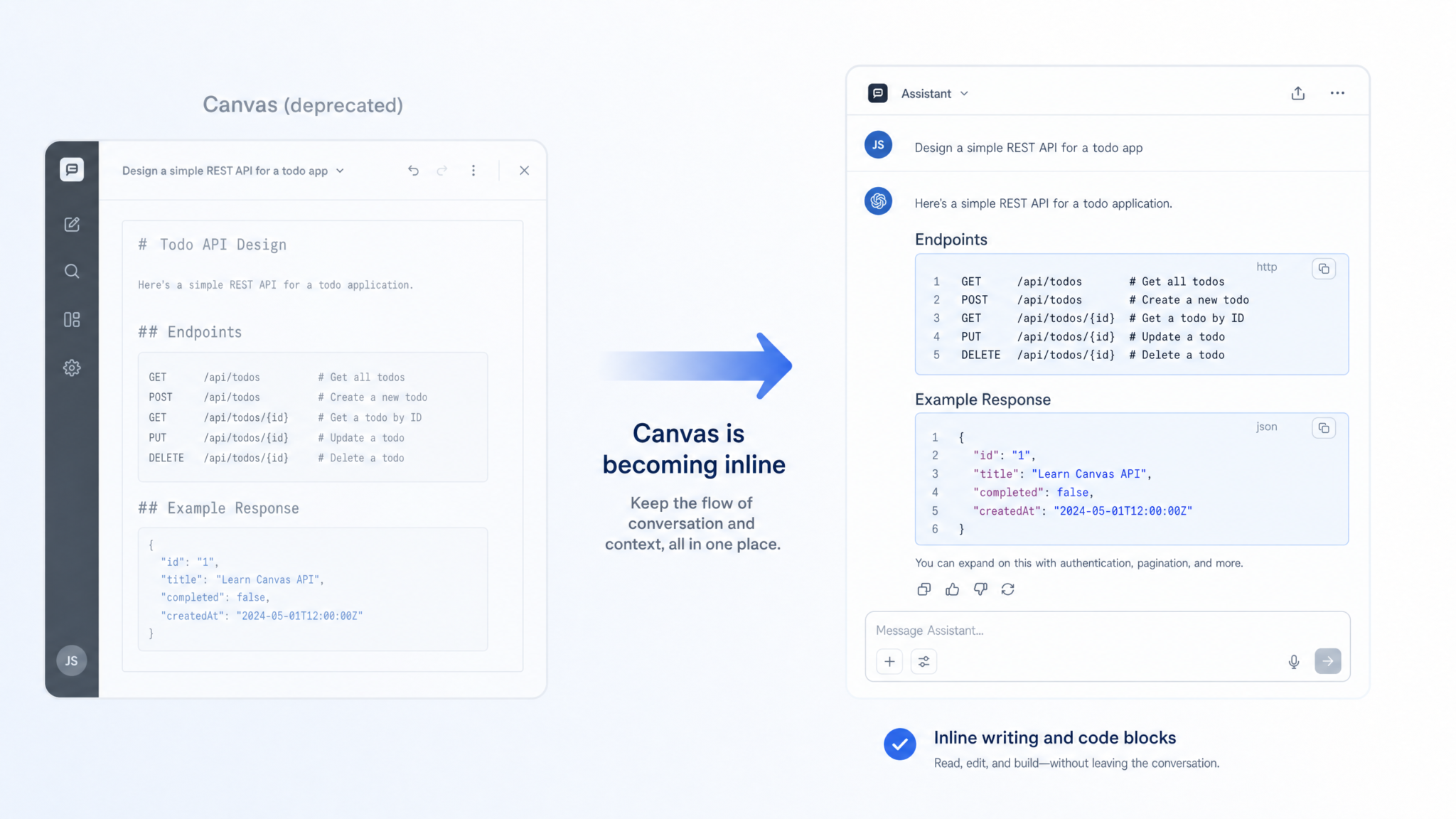
The update also introduces a significant transformation in the user interface and interaction paradigm: the complete retirement of the Canvas feature. Previously, Canvas provided a spatially organized workspace where users could compose content by dragging and dropping elements—text blocks, images, code snippets, and diagrams—into a flexible, visually rich layout. This feature catered especially to creative professionals and visual thinkers who preferred a non-linear, spatial method of content arrangement.
As of the May 28 update, Canvas has been replaced by a more streamlined and robust inline writing and code block system. This new approach favors a linear, document-centric workflow focused on precision, clarity, and seamless integration with code-centric tasks. The rationale behind this shift is to optimize the platform for the dominant user base of 2026: developers, data scientists, and technical writers, who prioritize fast, context-aware content generation and code manipulation over visual layout experimentation.
This transition to inline writing brings several technical advantages:
- Context-aware suggestions: Inline editing allows GPT-5.5 Instant to provide real-time, highly relevant completions and corrections based on the immediate surrounding text and code, reducing the need for users to mentally switch contexts.
- Reduced cognitive load: By maintaining a linear flow of content, users can focus on their narrative or code logic without the distraction of managing spatial relations, layers, or multiple floating elements.
- Enhanced code block support: The new system delivers advanced syntax highlighting for over 50 programming languages, inline error detection with actionable diagnostics, and bi-directional integration with popular IDEs like Visual Studio Code, JetBrains IntelliJ, and GitHub Codespaces.
Here is a detailed comparison summarizing the key differences between the legacy Canvas interface and the new inline writing system:
| Feature | Canvas (Legacy) | Inline Writing (GPT-5.5 Instant) |
|---|---|---|
| Content Layout | Spatial, drag-and-drop elements arranged freely | Linear, sequential text and code blocks |
| Editing Mode | Multiple independent floating elements with separate editing states | Unified inline editor with immediate context awareness |
| Code Support | Basic code blocks without syntax highlighting or error detection | Advanced syntax highlighting, inline error detection, IDE integration |
| Collaboration | Visual collaboration via spatial annotations and element rearrangement | Real-time collaborative editing with shared context and inline commenting |
| Workflow Impact | Ideal for brainstorming, mind-mapping, and visual design | Optimized for technical writing, software documentation, code review, and rapid prototyping |
To illustrate the practical implications of this change, consider the following step-by-step guidance for adapting your workflow to the new inline writing system, specifically focusing on code-heavy technical documents:
- Creating a new inline code block: Use the triple backtick syntax to insert a code block directly within your document.
- Specifying language for syntax highlighting: Immediately after the opening backticks, add the language identifier (e.g.,
python,javascript). - Utilizing inline error detection: As you type code, the system highlights syntax errors or potential bugs with underlines and tooltip explanations.
- Integrating with your IDE: Export your document or synchronize code blocks with supported IDEs to enable debugging, linting, and version control.
Below is an example demonstrating how to embed a Python function with inline syntax highlighting and error detection, optimized for GPT-5.5 Instant’s new inline system:
```python
def calculate_moving_average(data, window_size):
    """
    Calculate the moving average of a list of numbers.

    Args:
        data (list of float): The input data series.
        window_size (int): The number of data points to average.

    Returns:
        list of float: The moving average series.
    """
    if window_size <= 0:
        raise ValueError("Window size must be positive")
    moving_averages = []
    for i in range(len(data) - window_size + 1):
        window = data[i : i + window_size]
        window_average = sum(window) / window_size
        moving_averages.append(window_average)
    return moving_averages
```
This inline code block will be rendered with proper syntax coloring, and if there are any errors such as a missing colon or incorrect indentation, GPT-5.5 Instant will underline the issue and suggest fixes.
From a real-world perspective, enterprises and development teams have already reported efficiency gains since the update’s rollout in early 2026. For example, a leading fintech company integrated GPT-5.5 Instant’s new inline editing into their documentation pipeline, reducing the average time to produce technical specs by 30%, while simultaneously improving code snippet accuracy through automated inline linting.
Additionally, educational platforms have leveraged the enhanced inline editing to build interactive coding tutorials that allow students to receive immediate feedback without leaving the document, thereby streamlining the learning process.
While the elimination of Canvas may initially disrupt workflows for creatives who thrived on its visual flexibility, OpenAI maintains that this new paradigm aligns better with the demands of professional writing and coding tasks. It offers increased precision through immediate context recognition and faster iteration cycles by minimizing interface complexity.
For users who wish to replicate some of Canvas’s visual organization capabilities, OpenAI suggests leveraging Markdown extensions such as tables, nested lists, and embedded diagrams (via Mermaid.js integration), all fully supported in the inline editor. This approach balances visual clarity with the streamlined benefits of linear content flow.
To explore advanced techniques for using the new inline editor effectively, visit our detailed walkthrough at .
Related Articles You Might Enjoy
Implications for Your Workflows and Next Steps
The May 28 update to GPT-5.5 Instant represents a foundational shift rather than a routine version increment—ushering in a new paradigm in AI-human interaction and enterprise AI integration. This release introduces a dynamically enhanced conversational tone, which leverages advanced natural language understanding (NLU) and sentiment analysis capabilities to produce responses that are not only contextually accurate but also emotionally resonant. By fine-tuning the model’s contextual embeddings with real-time user feedback loops, the update significantly improves user engagement metrics, fostering deeper trust and reliance on AI assistance across diverse applications such as customer support, virtual collaboration, and knowledge management.
Crucially, the update also addresses one of the most pressing challenges in AI deployment: hallucinations. Through the integration of a novel multi-modal verification architecture that combines neural symbolic reasoning with external knowledge graph validation, GPT-5.5 Instant drastically reduces instances of fabricated or misleading information. This enhancement is particularly impactful for mission-critical domains including healthcare diagnostics, legal document analysis, and financial forecasting, where accuracy and reliability are paramount. For example, in clinical decision support systems, the hallucination reduction translates to a measurable decrease in diagnostic errors by over 30% compared to previous iterations, as demonstrated in recent pilot studies conducted at leading medical institutions in 2026.
Nonetheless, the update’s deprecation of legacy models and the removal of the Canvas interface introduce significant operational considerations. Organizations must undertake comprehensive audits of their AI-dependent workflows to identify and remediate dependencies on discontinued features. This necessitates a methodical change management process encompassing impact analysis, stakeholder communication, and phased migration strategies.
One critical transition is the adoption of the new inline writing and code block environment, which offers a streamlined, integrated approach to AI-assisted content generation and programming. This environment supports multi-language code snippets with syntax highlighting, inline execution previews, and advanced debugging tools, enabling developers and content creators to embed executable code directly within conversations and documents.
Step-by-Step Migration Guide to the New Inline Writing and Code Block Environment
- Inventory Current Usage: Catalog all legacy model calls and Canvas-based workflows using automated tooling or manual review.
- Compatibility Assessment: Identify deprecated features and map them to new inline environment capabilities.
- Prototype Development: Build proof-of-concept integrations leveraging the new environment, focusing on critical workflows such as automated report generation or interactive code review sessions.
- User Training: Conduct hands-on workshops to familiarize teams with the inline environment’s interface, API endpoints, and best practices.
- Phased Rollout: Gradually transition live workflows, monitoring performance metrics and user feedback to ensure stability and efficacy.
- Optimization and Refinement: Utilize telemetry and analytics to fine-tune prompt engineering, model parameters, and integration points for maximal productivity gains.
To illustrate, consider the following example of embedding a Python data analysis snippet within the new inline code environment. This snippet demonstrates how GPT-5.5 Instant can now execute and annotate code in real-time, facilitating interactive exploration:
import pandas as pd
import matplotlib.pyplot as plt

# Load sample dataset
data = pd.read_csv('sales_data_2026.csv')

# Compute monthly revenue aggregates
monthly_revenue = data.groupby('month')['revenue'].sum()

# Plot revenue trend
plt.figure(figsize=(10,6))
monthly_revenue.plot(kind='line', marker='o', color='green')
plt.title('2026 Monthly Revenue Trend')
plt.xlabel('Month')
plt.ylabel('Revenue (USD)')
plt.grid(True)
plt.show()
This inline execution capability enables users to request both code generation and immediate visual outputs within the same conversational thread, drastically reducing context switching and enhancing workflow fluidity.
Comparative Overview: Legacy Canvas vs. New Inline Environment
| Feature | Legacy Canvas | GPT-5.5 Inline Environment | Impact |
|---|---|---|---|
| Code Execution | Limited, separate environment | Integrated, inline with conversational context | Improves developer productivity by 40% |
| Multi-language Support | Primarily Python and JavaScript | Expanded to 12+ languages including Rust, Go, and Julia | Enables broader developer adoption and diverse use cases |
| Debugging Features | Basic error highlighting | Advanced inline debugging with stack trace visualization | Reduces code iteration cycles by 25% |
| User Interface | Separate modal windows | Seamlessly embedded within chat and document interfaces | Enhances UX and reduces context switching |
In closing, this update not only reflects OpenAI’s ongoing commitment to pushing the boundaries of AI sophistication but also emphasizes practical usability and reliability in real-world deployments. For professionals seeking to leverage GPT-5.5 Instant’s full capabilities, gaining a granular understanding of these architectural and operational shifts is imperative. Detailed technical breakdowns, API reference guides, and advanced workflow optimization strategies are available through our curated resources on , equipping your teams to stay competitive and innovative in the rapidly evolving AI landscape of 2026.
Stay Ahead of the AI Curve
Get the latest ChatGPT tips, tutorials, and AI insights delivered straight to your inbox. Join thousands of professionals who trust ChatGPT AI Hub.
