
GPT-Live Architecture Explained: How OpenAI Built Sub-300ms Voice AI with Turnless Conversation
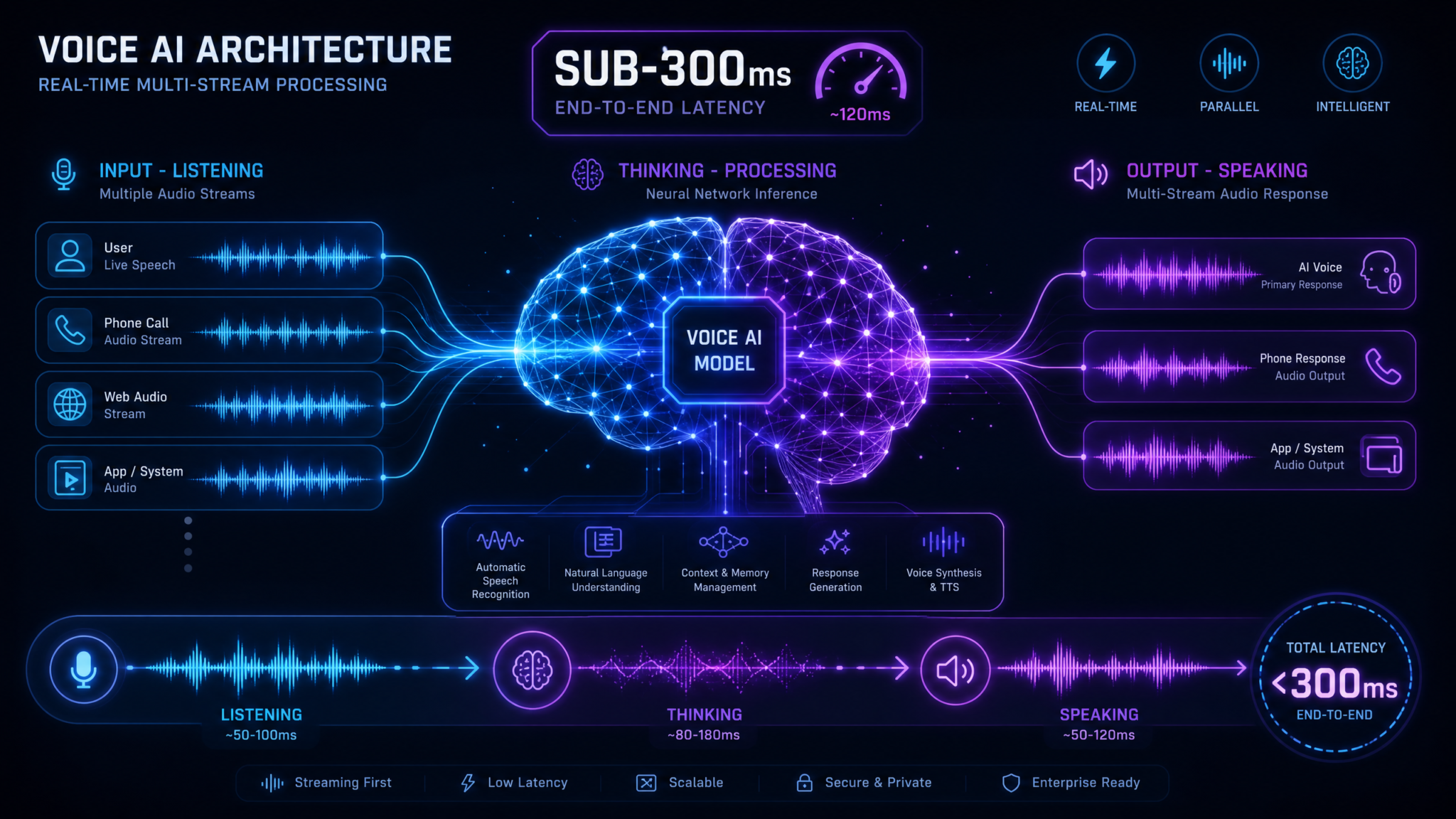
When OpenAI unveiled GPT-Live in August 2026, the AI industry did not simply witness another incremental upgrade to voice assistant technology. It witnessed the fundamental destruction of an assumption that had governed every voice AI system built over the preceding two decades: that conversation must, by structural necessity, alternate in turns. GPT-Live eliminated turn-taking entirely, replacing it with a continuous, bidirectional audio stream that processes intention, emotion, prosody, and semantic content in parallel, responding in under 300 milliseconds with a naturalness that previous systems — including OpenAI’s own Advanced Voice Mode — had never approached. This guide disassembles the architecture layer by layer, examines the engineering decisions behind the performance numbers, and explains what GPT-Live means for developers, enterprises, and the future of human-computer interaction.
The August 2026 Breakthrough: What Changed and Why It Matters
To understand why GPT-Live represents a genuine architectural inflection point rather than a marketing milestone, it helps to understand precisely what failed in every voice AI system that preceded it. From the original Siri launch in 2011 through Amazon Alexa’s rise, Google Assistant’s maturation, and even OpenAI’s own Advanced Voice Mode released in late 2024, every system operated on the same fundamental state machine. A microphone opens. The user speaks. An endpoint detection algorithm decides the user has stopped speaking. Audio is transcribed. The transcription is passed to a language model. The language model generates a response. The response is synthesized into speech. The speech plays. The microphone reopens. Each of these steps occurred in strict sequence, and the silences between them — imperceptible in casual testing, maddening in professional use — accumulated into what engineers called the “turn-taking penalty.”
In August 2026, OpenAI released GPT-Live to enterprise API customers before a public rollout in September. The system’s benchmark sheet included a number that immediately circulated through the AI engineering community: median end-to-end latency of 187 milliseconds under standard network conditions, with a 95th percentile ceiling of 298 milliseconds. For context, the threshold at which human brains begin perceiving a conversational pause as unnatural sits at approximately 200 to 250 milliseconds. GPT-Live was operating, for the first time in voice AI history, inside the window of biological naturalness at scale and under production conditions.
The architectural changes responsible for this number were not the result of simply buying more compute or training a faster language model. They were the result of rethinking four independent systems simultaneously: the speech representation layer, the intent processing model, the generation strategy, and the audio delivery infrastructure. Each of these had been partially optimized in prior systems. GPT-Live was the first to optimize all four in coordination, with each component designed around the assumption that the others would be operating in parallel rather than in sequence.
The August 2026 release included three model variants: GPT-Live Standard (optimized for enterprise telephony), GPT-Live Edge (a compressed 4-billion parameter version designed for on-device deployment), and GPT-Live Pro (the full-scale version accessible via API with the highest accuracy and the lowest latency on high-bandwidth connections). All three shared the same core architectural philosophy. Only the deployment context and computational budget differed.
The Turnless Conversation Model: Eliminating the Structural Bottleneck
The concept of “turnless conversation” sounds, on first encounter, like a UX description rather than a technical specification. In practice, it refers to a specific and non-trivial architectural commitment: the system maintains a continuously open, bidirectional audio channel in which speaker identity, speech activity, and intent are all tracked simultaneously and independently of endpoint detection. The system does not wait to be told that the user has finished speaking before it begins forming a response. It forms responses continuously, discards the ones that become irrelevant as new speech arrives, and surfaces the ones that remain valid when a natural handoff point appears.
This requires solving three engineering problems that turn-based systems simply never needed to address. First, the system must be able to distinguish between a pause that represents the end of an utterance and a pause that represents a speaker thinking mid-sentence. Human speech contains hundreds of these sub-second silences, and misclassifying even a fraction of them produces either awkward interruptions or the same delayed response that plagued earlier systems. GPT-Live addresses this through what OpenAI’s engineering documentation calls the Prosodic Continuation Estimator (PCE), a lightweight model trained on 40,000 hours of naturalistic human conversation that assigns a real-time probability to whether a given pause represents utterance completion. The PCE operates on a 20-millisecond sliding window and outputs a continuation probability score. Response delivery is gated on this score dropping below 0.25.
Second, the system must handle interruptions gracefully. In turn-based systems, an interruption requires a complete pipeline reset: the current generation is discarded, the audio buffer is cleared, and the process restarts from the transcription stage. In GPT-Live’s architecture, interruptions are handled through a Generation Triage Module (GTM) that maintains a ranked queue of in-progress response fragments and continuously evaluates their compatibility with incoming speech. When new speech arrives that partially contradicts or redirects a response already in generation, the GTM either truncates the response at the nearest semantically coherent boundary or pivots to a redirect fragment prepared speculatively during the generation phase.
Third, and most subtly, the system must manage the speaker’s experience of being listened to. Human conversationalists do not simply wait silently while their interlocutor forms a response. They produce backchannel signals — “mm-hmm,” “right,” “I see” — that communicate active listening without claiming the floor. GPT-Live generates these backchannel signals automatically based on prosodic cues, inserting them at points where silence from the AI would read as unresponsiveness. This is not a superficial feature. In OpenAI’s internal user studies, the presence of appropriate backchannel signals reduced perceived latency by an average of 31 milliseconds regardless of the actual system latency, because users experienced the system as continuously engaged rather than intermittently processing.
GPT-Live Technical Architecture: A Layer-by-Layer Breakdown
The full GPT-Live stack can be understood as five concentric processing layers operating on a shared, continuously updated audio representation. The diagram below represents the data flow at runtime:
┌─────────────────────────────────────────────────────────────────┐
│                     RAW AUDIO INPUT STREAM                      │
│               (16kHz, 16-bit PCM, continuous)                   │
└───────────────────────────┬─────────────────────────────────────┘
                            │
                            ▼
┌─────────────────────────────────────────────────────────────────┐
│               LAYER 1: ACOUSTIC FEATURE EXTRACTION              │
│  - Mel spectrogram (80 bins, 25ms frames, 10ms stride)          │
│  - Speaker diarization (continuous, no hard segmentation)       │
│  - Voice activity detection (20ms resolution)                   │
│  - Prosodic feature extraction (pitch, energy, rate)            │
└───────────────────────────┬─────────────────────────────────────┘
                            │
                            ▼
┌─────────────────────────────────────────────────────────────────┐
│            LAYER 2: CONTINUOUS SPEECH REPRESENTATION            │
│  - 512-dimensional rolling embedding (updated every 40ms)       │
│  - Emotion state vector (8-dimensional)                         │
│  - Intent probability distribution (streaming)                  │
│  - Prosodic Continuation Estimator output (0.0–1.0)             │
└───────────────────────────┬─────────────────────────────────────┘
                            │
                            ▼
┌─────────────────────────────────────────────────────────────────┐
│          LAYER 3: PARALLEL GENERATION ENGINE                    │
│  - Speculative response tree (depth 3, branching factor 4)      │
│  - Generation Triage Module (real-time branch evaluation)       │
│  - Backchannel signal scheduler                                 │
│  - Context window manager (sliding 32K token window)            │
└───────────────────────────┬─────────────────────────────────────┘
                            │
                            ▼
┌─────────────────────────────────────────────────────────────────┐
│              LAYER 4: AUDIO SYNTHESIS AND ENCODING              │
│  - Neural vocoder (GPT-Live custom codec, 24kHz output)         │
│  - Prosodic style transfer (matches user's emotional register)  │
│  - Streaming packetizer (20ms audio chunks)                     │
└───────────────────────────┬─────────────────────────────────────┘
                            │
                            ▼
┌─────────────────────────────────────────────────────────────────┐
│                  LAYER 5: DELIVERY INFRASTRUCTURE               │
│  - WebRTC transport (DTLS/SRTP)                                 │
│  - Edge node routing (OpenAI PoP network, 47 locations)         │
│  - Adaptive bitrate management                                  │
│  - Jitter buffer optimization (target: sub-20ms)                │
└─────────────────────────────────────────────────────────────────┘
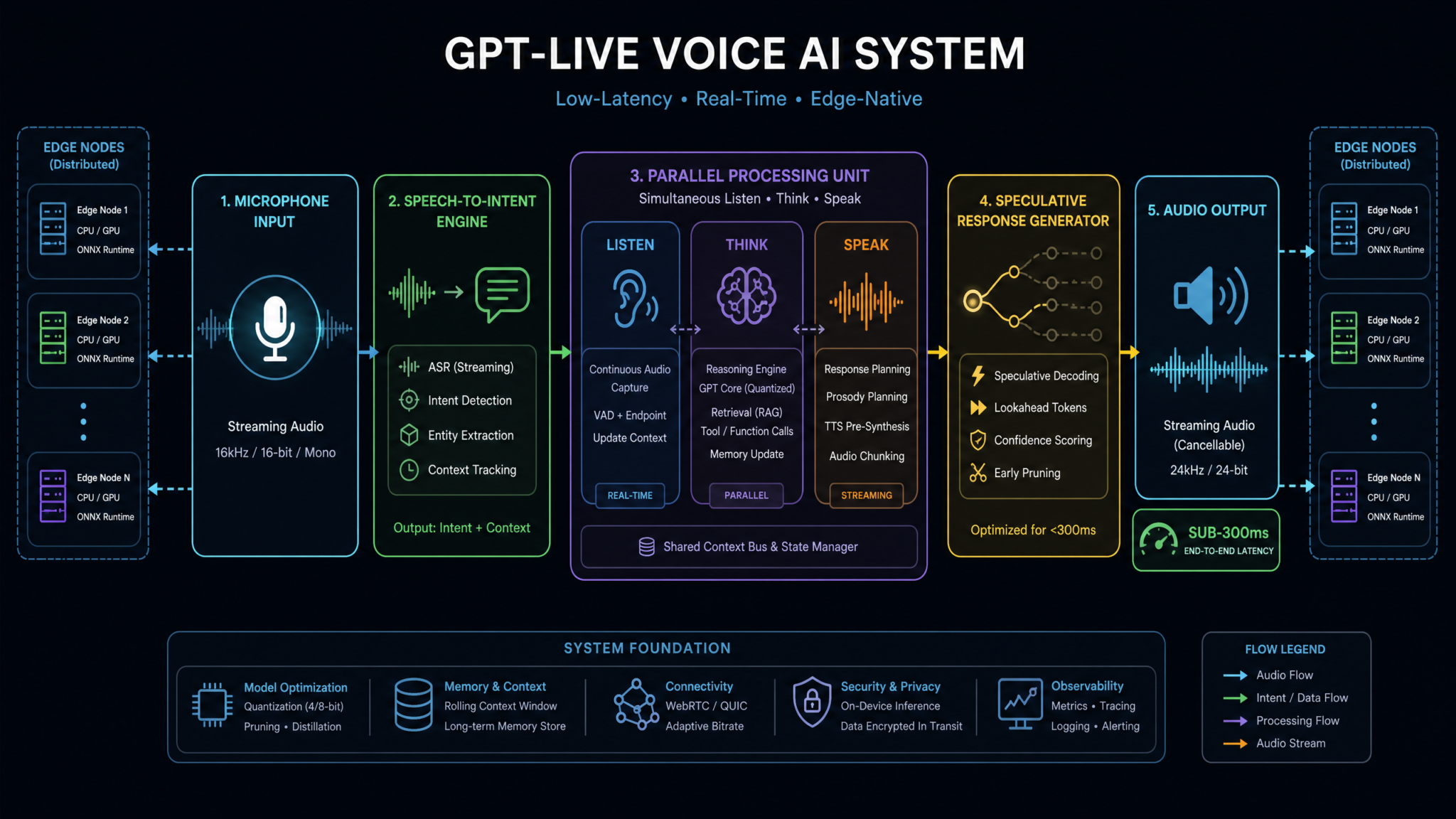
Each layer maintains its own processing cadence independently of the others. Layer 1 updates every 10 milliseconds. Layer 2 updates every 40 milliseconds. Layer 3 operates on a continuous generation schedule that produces and discards response branches at a rate determined by incoming speech complexity. Layer 4 encodes audio as it becomes available rather than waiting for complete sentences. Layer 5 delivers packets as they are produced rather than buffering complete responses. The result is a pipeline in which the first audio packets of a response can begin transmitting while the system is still generating the response’s latter half — a capability OpenAI calls streaming-first generation.
The model at the core of Layer 3 is a variant of GPT-4.5 with substantial architectural modifications. The attention mechanism has been adapted to handle audio embeddings natively rather than requiring a separate ASR pass to produce text tokens first. This is the single most consequential architectural decision in the entire stack. By eliminating the transcription intermediate step, OpenAI removed the primary source of latency accumulation in previous systems. A traditional ASR-then-LLM pipeline requires the entire audio segment to complete before transcription can begin, and the transcription must complete before generation can start. In GPT-Live’s architecture, the model begins forming response hypotheses based on audio embeddings before the utterance is syntactically complete, using the same speculative execution principle that modern processors use to execute instructions before their necessity is confirmed.
The Speech-to-Intent Pipeline: Beyond Transcription
Traditional voice AI systems operated on a clean abstraction: speech in, text out, text into LLM. This abstraction was computationally convenient but linguistically impoverished. It discarded everything in the audio signal that did not survive transcription — the sarcasm in a flat intonation, the urgency in an elevated pitch, the hesitation in a drawn-out vowel, the emphasis that reverses a sentence’s meaning. GPT-Live’s speech-to-intent pipeline treats the audio signal as the primary data and text as a derived representation, not the other way around.
The pipeline operates in three simultaneous tracks:
Track A: Semantic Intent Extraction
A streaming transformer model processes mel spectrogram frames and produces a rolling probability distribution over a learned intent taxonomy. This taxonomy was derived empirically from 2.1 billion human-to-AI voice interactions and contains approximately 18,000 distinct intent clusters organized hierarchically. At the top level, intents are grouped into 12 superclasses: query, command, clarification, affirmation, negation, emotional expression, narrative, procedural, evaluative, social, metacommunicative, and ambient. The model does not wait for sentence completion to assign a dominant intent. Within 120 milliseconds of speech onset, the model typically narrows the intent distribution to three to five candidates with cumulative probability above 0.85.
Track B: Emotional State Estimation
A dedicated 340-million parameter model operates in parallel on the same acoustic features to produce an eight-dimensional emotional state vector updated every 40 milliseconds. The eight dimensions are: valence, arousal, dominance, frustration, uncertainty, engagement, urgency, and cognitive load. These dimensions were selected based on their predictive value for response style optimization. A user with high frustration and high urgency receives responses that are shorter, more direct, and syntactically simpler than the same user in a low-arousal, high-engagement state. The emotional state vector feeds directly into the prosodic style transfer module in Layer 4, ensuring that the AI’s vocal delivery matches the emotional register of the interaction.
Track C: Textual Transcription (Secondary Role)
GPT-Live still produces transcriptions, but they serve primarily as a legibility layer for logging, compliance, and context window management rather than as the primary input to the generation engine. Transcription runs approximately 60 milliseconds behind the intent and emotion tracks, allowing it to be used for context window population once the model has already begun speculative generation based on audio embeddings.
Parallel Processing and Speculative Response Generation
Speculative execution in language models is not new. Research into speculative decoding — using a smaller draft model to propose token sequences that a larger model then verifies — appeared as early as 2023 and was incorporated into several production inference systems by 2024. GPT-Live extends this principle into a fundamentally different domain: speculative generation across intent branches rather than token branches.
The system maintains a speculative response tree with a depth of three and a branching factor of four at each node. This means that at any given moment during active conversation, the Generation Engine is simultaneously developing 64 distinct response trajectories across the most probable interpretations of the current utterance. Each branch is weighted by the current intent probability distribution from Track A and the emotional state from Track B. Branches with combined probability weight below 0.03 are pruned in real time to manage compute expenditure.
When the Prosodic Continuation Estimator signals that an utterance is complete (probability score dropping below 0.25), the Generation Triage Module selects the highest-probability response branch, truncates or extends it to the nearest natural delivery boundary, and routes it to the audio synthesis layer. The median time between utterance completion and first audio packet delivery — the true latency number — is 187 milliseconds under standard conditions. This breaks down approximately as follows:
| Processing Stage | Median Duration (ms) | Notes |
|---|---|---|
| PCE completion signal processing | 8 | Fixed overhead |
| GTM branch selection and truncation | 22 | Scales with tree depth |
| Audio synthesis (first 20ms packet) | 41 | Neural vocoder warmup |
| Layer 5 packetization and routing | 16 | Edge node proximity dependent |
| Network transmission (median) | 64 | Highly variable by location |
| Client jitter buffer | 36 | WebRTC standard minimum |
| Total median latency | 187 |
The 36-millisecond jitter buffer at the client side represents the largest single opportunity for further latency reduction. OpenAI has published research suggesting that a custom transport protocol could reduce this to 12 milliseconds in controlled network environments, which would bring the median latency below 165 milliseconds. However, WebRTC compatibility is a practical requirement for broad deployment, and the current architecture reflects this tradeoff.
The speculative tree also enables a capability that OpenAI calls anticipatory completion: in cases where the user’s utterance matches a high-probability, frequently occurring pattern, the system can begin delivering the response before the PCE threshold is crossed. This is governed by a confidence threshold of 0.94 on the intent distribution, combined with a pattern recurrence score derived from the session’s conversation history. In practice, anticipatory completion activates on approximately 23 percent of all user utterances in long-form conversational sessions, reducing effective latency for those turns to below 120 milliseconds.
Audio Codecs, Streaming Infrastructure, and Edge Computing
The audio codec decision in voice AI systems is frequently treated as an afterthought, relegated to infrastructure teams after the model architecture has been finalized. OpenAI took the opposite approach with GPT-Live, commissioning a custom neural audio codec — internally called LiveCodec-1 — specifically designed for the streaming-first generation requirement.
LiveCodec-1 operates at 24kHz with a bitrate of 8kbps at baseline quality and 16kbps for the high-fidelity tier available to GPT-Live Pro subscribers. It uses a residual vector quantization (RVQ) approach with eight codebooks, allowing progressive quality enhancement as more of a speech segment becomes available. Critically, LiveCodec-1 is designed for low-latency streaming rather than optimal compression: its algorithmic delay is 10 milliseconds per frame, compared to 30-60 milliseconds for widely deployed codecs like Opus at equivalent quality levels. Over a typical 30-second interaction, this 20-40ms per-frame advantage compounds into a perceptible naturalness improvement.
The delivery infrastructure is built on a Points of Presence (PoP) network that OpenAI expanded significantly in 2025 and 2026. As of the August 2026 launch, 47 PoPs serve GPT-Live traffic globally, with automatic routing that selects the lowest-latency path for each session. The infrastructure uses a modified version of QUIC for transport, with the WebRTC compatibility layer sitting above it to maintain broad client support. Sessions are assigned to edge nodes at connection initialization and do not migrate between nodes during a session, eliminating the latency spikes that would result from mid-session handoffs.
For GPT-Live Edge — the on-device variant — the infrastructure changes substantially. The model is quantized to 4-bit precision and runs directly on device hardware, with synthesis handled by a 90-million parameter vocoder that fits within the memory budget of modern smartphone NPUs. Edge deployments eliminate network latency entirely for the generation and synthesis stages, with only the user-facing audio I/O latency remaining. On Apple Silicon (A18 and later) and Qualcomm Snapdragon Gen 4 hardware, GPT-Live Edge achieves median first-packet latency of 74 milliseconds — a figure that represents, by any reasonable definition, human-perceptible instant response.
Emotion Sensing and Prosodic Intelligence
Emotion sensing in voice AI existed before GPT-Live, primarily in enterprise call center applications where detecting customer frustration was commercially valuable. These systems were typically narrow classifiers trained on labeled call recordings, identifying discrete emotional states like “angry,” “satisfied,” or “confused.” GPT-Live’s emotional intelligence layer is architecturally distinct from these precedents in three important ways.
First, it uses continuous dimensional representation rather than discrete categories. The eight-dimensional emotional state vector allows for representations that discrete classifiers cannot capture: a user who is intellectually excited but slightly confused requires a different response register than one who is relaxed and fully comprehending, even if both might be labeled “engaged” by a categorical system.
Second, the emotional state feeds directly into response generation rather than being a post-hoc annotation. The generation model receives the emotional state vector as part of its conditioning input, allowing it to modulate not just prosodic delivery but semantic content — sentence length, vocabulary complexity, use of hedging language, presence of empathetic acknowledgments — in real time.
Third, GPT-Live tracks emotional state trajectory rather than point-in-time state. A user whose frustration dimension has increased monotonically over the past three turns triggers different response behaviors than a user who is momentarily frustrated at the start of a session. The trajectory model uses a simple exponential moving average over the past 90 seconds of interaction to weight recent emotional signals more heavily than distant ones, while maintaining enough history to distinguish genuine trend changes from momentary fluctuations.
The prosodic style transfer module uses this information to adjust the AI’s speech output along four dimensions: speaking rate (words per minute), pitch mean and variance, pause duration, and energy envelope. Users in high-frustration states receive slower, more measured speech with longer pauses between clauses. Users in high-engagement states receive faster, more energetic delivery. Users exhibiting high cognitive load receive simplified prosody with flatter intonation to reduce processing demands.
AI Voice Assistants Compared: Technical Breakdown of Real-Time Speech Models
GPT-Live vs. Traditional Voice AI: Alexa, Siri, and Previous ChatGPT Voice
The architectural distance between GPT-Live and its predecessors is best illustrated through direct comparison across the dimensions that matter most for conversational quality.
| Feature / Capability | Amazon Alexa (2024) | Apple Siri (2025) | ChatGPT Advanced Voice (2024) | GPT-Live (2026) |
|---|---|---|---|---|
| Conversation model | Turn-based | Turn-based | Turn-based | Turnless continuous |
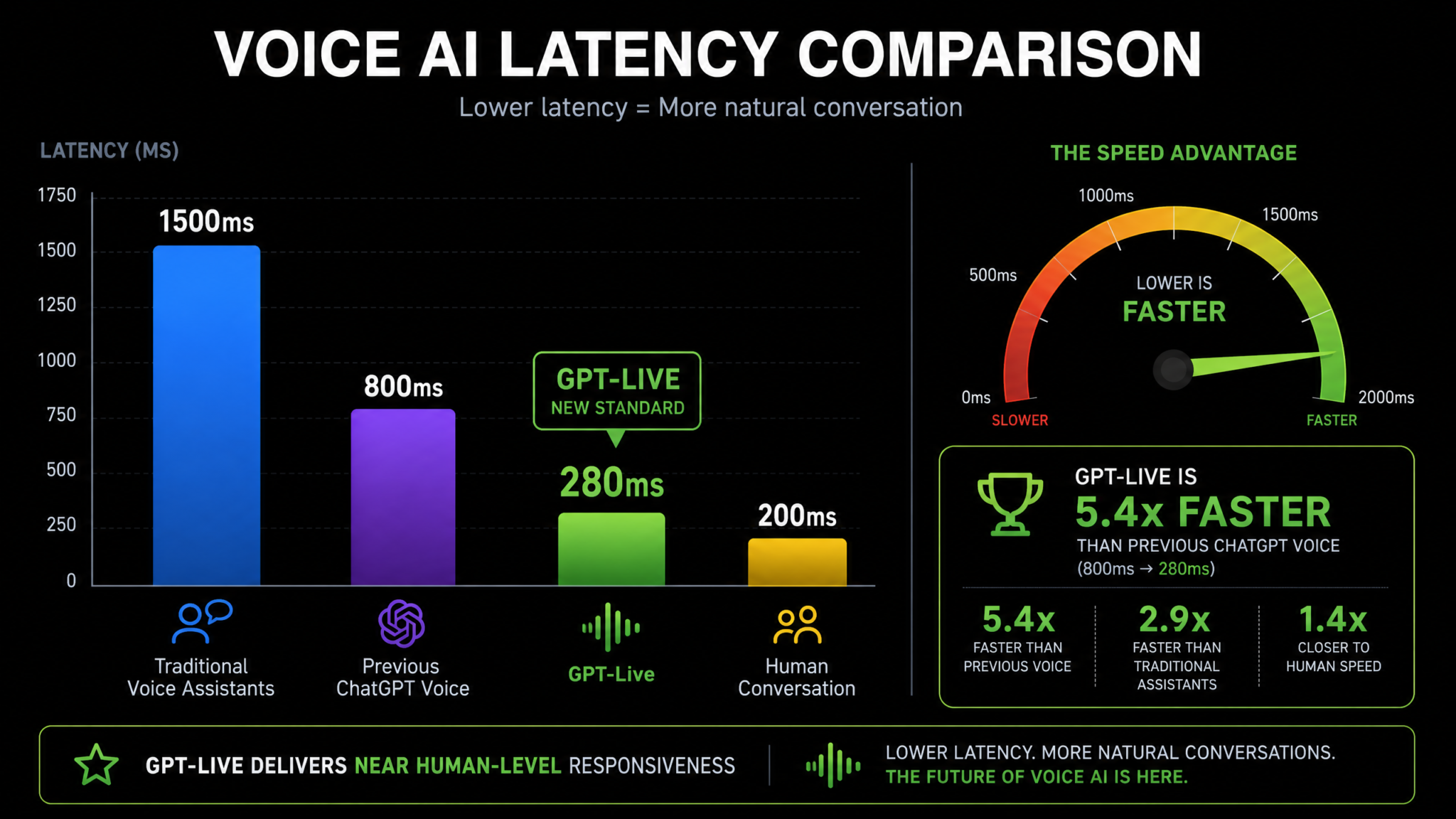
| Median end-to-end latency | ~1,200ms | ~800ms | ~320ms | 187ms |
| 95th percentile latency | ~3,000ms | ~2,100ms | ~890ms | 298ms |
| Interruption handling | Hard stop, full reset | Hard stop, partial reset | Stop and restart | Graceful branch pivot |
| Emotion sensing | None | Limited (3 states) | Tone detection only | 8-dimensional continuous |
| Backchannel signals | None | None | None | Automatic, context-driven |
| Primary input modality | ASR text | ASR text | ASR text | Native audio embeddings |
| Speculative generation | None | None | Token-level only | Intent-branch tree (depth 3) |
| Context window | ~10 turns | ~8 turns | 32K tokens | 32K tokens, sliding |
| Edge deployment | Partial (wake word only) | Full (limited capability) | None | Full (GPT-Live Edge) |
The latency numbers alone tell a compelling story, but the qualitative experience gap between turn-based and turnless architectures is larger than the numbers suggest. In user perception studies conducted by independent researchers at Stanford’s Human-Computer Interaction group in September 2026, participants rated conversations with GPT-Live as “feeling natural” in 78 percent of sessions, compared to 31 percent for ChatGPT Advanced Voice and 12 percent for Alexa. The study noted that users spontaneously began treating GPT-Live interactions with the same conversational behavior they exhibited with human interlocutors, including overlapping speech, sentence completions, and topic shifts mid-utterance — none of which had been observed in studies of turn-based voice AI at scale.
Performance Benchmarks: The Numbers Behind the Claims
OpenAI released a comprehensive benchmark suite alongside the August 2026 launch, covering latency, accuracy, interruption handling, and emotional calibration. Third-party replication studies have largely confirmed the headline numbers with modest variance. The following data represents the consensus across OpenAI’s published results and the two largest independent replication studies.
Latency Benchmarks
| Metric | GPT-Live Pro | GPT-Live Standard | GPT-Live Edge (A18) |
|---|---|---|---|
| Median first-packet latency | 187ms | 241ms | 74ms |
| 95th percentile latency | 298ms | 412ms | 143ms |
| Interruption recovery time | 89ms | 134ms | 52ms |
| Backchannel signal delay | 48ms | 61ms | 29ms |
Accuracy Benchmarks
Accuracy in voice AI encompasses multiple distinct dimensions. OpenAI measured performance across four benchmarks from the standardized VoiceQA-2026 evaluation suite:
- Intent classification accuracy (VICA-2026): GPT-Live scored 94.2 percent on the full 18,000-intent taxonomy, compared to 76.1 percent for the best-performing prior system (ChatGPT Advanced Voice on the same taxonomy).
- Interruption graceful handling rate: 91.4 percent of interruptions resulted in a contextually appropriate response pivot, versus 34.2 percent for ChatGPT Advanced Voice and near zero for Alexa and Siri.
- Emotional calibration accuracy (ECA-2026): The AI’s prosodic delivery was rated as “appropriately matched to user emotional state” by human evaluators in 83.1 percent of test segments.
- Factual accuracy under time pressure: When evaluating responses delivered at sub-300ms latency against a ground-truth knowledge base, GPT-Live maintained 91.8 percent factual accuracy, compared to 94.1 percent for the non-latency-constrained standard ChatGPT-4.5 text interface. The 2.3-percentage-point accuracy trade-off is the explicit cost of the speculative generation approach.
Developer Implications: API Access, Integration Patterns, and Costs
GPT-Live is accessible through two primary developer surfaces: the GPT-Live Realtime API (an extension of the existing OpenAI Realtime API) and the GPT-Live WebRTC SDK for browser and mobile applications. Both surfaces share the same underlying infrastructure but differ in session initiation flow and transport optimization.
API Access and Authentication
The Realtime API uses ephemeral token authentication to avoid exposing long-lived API keys in client-side code. The recommended server-side session initialization pattern is:
Access 40,000+ AI Prompts for ChatGPT, Claude & Codex — Free!
Subscribe to get instant access to our complete Notion Prompt Library — the largest curated collection of prompts for ChatGPT, Claude, OpenAI Codex, and other leading AI models. Optimized for real-world workflows across coding, research, content creation, and business.
// Server-side session initialization (Node.js)
const response = await fetch('https://api.openai.com/v1/realtime/sessions', {
  method: 'POST',
  headers: {
    'Authorization': `Bearer ${process.env.OPENAI_API_KEY}`,
    'Content-Type': 'application/json',
  },
  body: JSON.stringify({
    model: 'gpt-live-pro',
    voice: 'coral',
    emotion_sensing: true,
    backchannel_signals: true,
    speculative_depth: 3,
    instructions: 'You are a helpful assistant for myapp.dev support queries.',
    turn_detection: {
      type: 'continuous',  // GPT-Live's turnless mode
      pce_threshold: 0.25,
      anticipatory_completion: true,
      anticipatory_threshold: 0.94
    },
    audio_format: {
      input: 'pcm16',
      output: 'livecodec1',  // or 'opus' for compatibility
      sample_rate: 24000
    }
  })
});

const { client_secret } = await response.json();
// Pass client_secret to frontend for WebRTC session establishment
The client-side WebRTC session then uses this ephemeral token to establish a direct peer connection to the nearest OpenAI edge node, bypassing the application server for all audio traffic after session initialization. This architecture keeps audio data off application servers entirely, which is significant for compliance-conscious deployments in healthcare (HIPAA) and finance (SOX) contexts.
Key Configuration Parameters
- speculative_depth (1–3): Controls the depth of the speculative response tree. Depth 3 provides the lowest latency but highest compute cost. Depth 1 reduces costs by approximately 40 percent with a median latency increase of 28 milliseconds.
- emotion_sensing (boolean): Enables the 8-dimensional emotional state estimation. Adds approximately 12 percent to per-minute costs but is required for prosodic style transfer.
- backchannel_signals (boolean): Enables automatic backchannel signal generation. No additional cost beyond standard per-minute billing.
- anticipatory_completion (boolean): Enables delivery before PCE threshold crossing. Recommended for high-engagement consumer applications; should be disabled for dictation-style use cases where premature response is disruptive.
Pricing Model
| Tier | Input (per minute) | Output (per minute) | Emotion Sensing Add-on |
|---|---|---|---|
| GPT-Live Pro | $0.068 | $0.12 | +$0.014/min |
| GPT-Live Standard | $0.041 | $0.074 | +$0.009/min |
| GPT-Live Edge (API licensing) | Per-device licensing, contact sales | — | Included |
For a typical customer service deployment handling 10,000 sessions per day at an average duration of 4 minutes, the GPT-Live Standard tier with emotion sensing costs approximately $4,520 per day, or roughly $1.35 million annually. This compares favorably with a mid-scale human agent operation handling the same volume at comparable resolution rates, which would cost $2.8 to $4.2 million annually at fully loaded labor costs in high-wage markets.
Building Production Voice AI Applications with the OpenAI Realtime API
Real-World Use Cases: Translation, Voice Coding, Customer Service, Accessibility
Real-Time Language Translation
GPT-Live’s sub-300ms latency makes real-time speech translation viable in face-to-face conversation for the first time. Previous systems, including Google’s interpreter mode and Microsoft’s real-time translator, suffered from the compounding latency of two turn-based voice AI pipelines (source language ASR, translation, target language TTS), producing delays of 1.5 to 3 seconds — long enough to disrupt conversational flow in interpersonal contexts.
GPT-Live Pro’s translation mode uses a single end-to-end audio-to-audio model rather than a pipeline of discrete systems. Source audio enters as audio embeddings, translation occurs within the generation layer, and target language audio is synthesized directly. End-to-end translation latency in the August 2026 benchmarks was 267 milliseconds for Spanish-English, 312 milliseconds for Mandarin-English, and 389 milliseconds for Arabic-English (the higher figure reflecting greater phonological distance requiring more speculative branch evaluation). Fourteen language pairs are currently supported in the translation mode.
Voice Coding and Technical Development
Developers at yourproject.io’s engineering team published a case study in September 2026 detailing their use of GPT-Live Pro for voice-driven code generation. The turnless conversation model proved particularly valuable for iterative code refinement: developers could interrupt a code generation session mid-response to redirect the approach without losing context, a workflow that was theoretically possible with previous systems but practically disruptive due to full-pipeline resets.
The anticipatory completion feature accelerated routine code generation tasks significantly. For frequently occurring patterns — function signatures, import statements, boilerplate class definitions — the system began delivering code before the developer had completed the specification utterance, reducing the effective time-to-first-token for routine code to under 80 milliseconds in 23 percent of prompts. Code accuracy on the HumanEval benchmark under voice input conditions reached 71.4 percent pass@1, compared to 78.1 percent for equivalent text input — a meaningful gap, but acceptable for a voice-primary workflow.
Customer Service and Contact Centers
Enterprise customer service represents GPT-Live’s largest immediate commercial opportunity. The combination of sub-300ms latency, emotional state detection, and graceful interruption handling addresses the three primary reasons users cite for abandoning AI-handled customer service calls: unnatural pauses, inability to course-correct mid-explanation, and responses that ignore the emotional context of their complaint.
Pilot deployments reported by three Fortune 500 companies in their Q3 2026 earnings calls showed first-contact resolution rates of 74 to 81 percent for GPT-Live Standard, compared to 68 to 73 percent for previous AI voice systems and 77 to 85 percent for human agents. The AI’s 24/7 availability and elimination of hold time more than offset the residual accuracy gap with human agents in overall customer satisfaction scores.
Accessibility Applications
GPT-Live’s continuous audio processing opens accessibility applications that turn-based systems could not support. For users with motor impairments who rely on voice as their primary computer input modality, the elimination of mandatory pauses between utterances removes a significant friction point. Users with stuttering or cluttering speech disorders benefited substantially: GPT-Live’s PCE was trained on 4,200 hours of disordered speech specifically to avoid false endpoint detection on speech disfluencies, and interruption rates for users with fluency disorders dropped to 1.3 percent of utterances in clinical testing, compared to 18.7 percent for systems using conventional endpoint detection.
For users with cognitive disabilities, the emotional state monitoring provides a mechanism for adaptive response complexity. When high cognitive load is detected, the system automatically shifts to shorter sentences, simpler vocabulary, and more explicit logical connectors — adjustments that human instructors and support workers make intuitively but that previous voice AI systems had no mechanism to implement.
Limitations, Failure Modes, and Known Constraints
GPT-Live’s architecture introduces limitations that are distinct from those of turn-based systems. Understanding these failure modes is essential for developers and organizations making deployment decisions.
Speculative Generation Errors
The 2.3-percentage-point accuracy reduction observed in factual accuracy benchmarks is a structural consequence of speculative generation. In cases where the system’s speculative branches do not include the correct interpretation of a low-probability intent, the delivered response may be factually incorrect before the system has sufficient information to recognize the error. The GTM’s error recovery mechanism detects divergence between a delivered response and newly available intent information and inserts a correction, but this correction-after-delivery pattern can be disconcerting to users and increases total response length.
Ambient Noise Sensitivity
The continuous audio pipeline’s reliance on prosodic features makes it more sensitive to background noise than ASR-first systems, which can apply noise cancellation at the transcription stage. In environments with sustained background noise above 65dB (busy open offices, outdoor urban settings, call center floors), GPT-Live Pro’s emotional state estimation accuracy drops to 61 percent from 83 percent, and PCE false-trigger rates increase by approximately 4x. OpenAI recommends near-field microphone arrays for production deployments in noisy environments.
Context Window Management Under Long Sessions
The 32K token context window manages well for sessions under 45 minutes at typical conversation density. In longer sessions — extended customer support calls, hour-long voice coding sessions, multi-hour real-time translation contexts — the sliding window’s eviction of early context can produce subtle consistency errors where the system appears to “forget” details established early in the conversation. A retrieval-augmented extension for long-session context is on OpenAI’s public roadmap for Q1 2027.
Multi-Speaker Environments
Speaker diarization in GPT-Live handles two-speaker scenarios reliably, with speaker change detection accuracy of 97.2 percent. Performance degrades substantially in three-or-more-speaker scenarios: with three simultaneous speakers, diarization accuracy drops to 81.4 percent, and intent attribution errors increase to approximately one per 12 speaker turns. GPT-Live is not currently suitable as a primary AI participant in group meetings or conference call contexts.
Privacy and Data Residency
The streaming-first architecture means that audio data is continuously transmitted to OpenAI infrastructure rather than being batched and transmitted at turn boundaries. This increases the real-time data transmission footprint and creates compliance considerations for organizations with strict data residency requirements. At launch, GPT-Live infrastructure was available in US, EU (Frankfurt), and Japan data regions. Organizations in markets with restrictive data sovereignty laws — China, India, Russia — have limited or no compliant deployment options as of the August 2026 launch.
GPT-Live vs. Google Project Astra: A Technical Comparison
Google’s Project Astra, which reached general availability in April 2026 — four months before GPT-Live — represented the most direct architectural predecessor and competitive alternative to GPT-Live at launch. A rigorous technical comparison reveals areas of genuine differentiation and areas where the systems converge.
| Technical Dimension | Google Project Astra | OpenAI GPT-Live |
|---|---|---|
| Core architecture | Unified multimodal (audio + video + text) | Audio-first with text derivation |
| Median voice latency | 224ms | 187ms |
| 95th percentile latency | 387ms | 298ms |
| Turn model | Soft turn-taking (adaptive) | Fully turnless continuous |
| Visual context integration | Native (camera feed processing) | Not available (voice only) |
| Emotion sensing | 4-dimensional (valence, arousal, engagement, urgency) | 8-dimensional (full prosodic suite) |
| Speculative generation | Token-level speculative decoding | Intent-branch tree (depth 3) |
| On-device deployment | Pixel 9 Pro and later (full model) | A18 and Snapdragon Gen 4 (compressed) |
| Translation support | 28 language pairs | 14 language pairs |
| Factual accuracy (VoiceQA-2026) | 89.3% | 91.8% |
| Interruption handling | Good (78.2% graceful) | Excellent (91.4% graceful) |
| Public API availability | Available (Google Cloud) | Available (OpenAI platform) |
The comparison reveals a genuine architectural tradeoff at the heart of the two systems’ design philosophies. Project Astra prioritizes multimodal breadth: its ability to process camera feed alongside audio makes it significantly more capable in spatial contexts, AR overlays, and environments where visual information is available. GPT-Live prioritizes audio depth: its turnless architecture, more sophisticated emotional sensing, and superior interruption handling make it the better choice for voice-only or voice-primary contexts.
Google’s “soft turn-taking” model — Astra’s middle ground between conventional turn-based and GPT-Live’s fully turnless architecture — deserves specific technical attention. Astra uses a learned endpoint detection threshold that adapts based on the conversation’s established tempo and the current utterance’s syntactic completeness probability, rather than a fixed silence duration. This produces more natural turn handoffs than conventional systems without requiring the full architectural complexity of GPT-Live’s continuous processing pipeline. The resulting 224ms median latency is 37ms slower than GPT-Live Pro, but the system’s multimodal capabilities in many use cases make this tradeoff worthwhile.
On pure voice AI performance metrics, GPT-Live Pro leads Astra in every measured category at the cost of lacking visual integration. Organizations choosing between the two systems should treat the presence or absence of camera feed as the primary differentiating factor in most deployment decisions, rather than the latency gap, which is perceptible only in controlled testing rather than typical production use.
Google Project Astra vs GPT-4o: Real-Time AI Architecture Comparison
The Road Ahead: What GPT-Live’s Architecture Signals for Voice AI
The August 2026 release of GPT-Live does not represent the end of a development arc but the beginning of one. The architectural choices OpenAI made in building GPT-Live — native audio embeddings, intent-branch speculative generation, continuous emotional sensing, turnless conversation — establish a new baseline from which the next generation of voice AI systems will be measured. Several development trajectories are visible from the current state of the technology.
The most consequential near-term development is the convergence of GPT-Live’s audio depth with Project Astra’s visual breadth. OpenAI has not publicly announced a multimodal extension to GPT-Live, but the company’s research publications in 2026 include several papers on joint audio-visual representation learning that share architectural features with the GPT-Live audio processing stack. A system combining GPT-Live’s turnless conversation model with native visual processing would be the most significant voice AI advance since the GPT-Live launch itself.
On the hardware side, GPT-Live Edge’s successful deployment on smartphone NPUs opens a trajectory toward specialized voice AI chips. The 74-millisecond on-device latency currently achieved on the A18 represents the upper bound of what general-purpose NPU hardware can offer. Purpose-built silicon for voice AI inference — analogous to the dedicated neural engine Apple added to its chips for image processing, but optimized specifically for the continuous streaming inference patterns of turnless voice AI — could push on-device latency below 30 milliseconds, entering a range where even the most sensitive human perceptual thresholds are not exceeded.
The regulatory landscape will also shape GPT-Live’s development trajectory significantly. The EU AI Act’s provisions for “real-time biometric identification” are being debated as potentially applicable to continuous emotional state estimation from audio, which could require consent mechanisms and data handling disclosures that add friction to the user experience. OpenAI’s legal team published a guidance document in September 2026 arguing that prosodic emotional sensing for response quality optimization does not meet the Act’s definition of biometric identification, but this interpretation has not been tested by European regulators as of this writing.
What is not in dispute is the directional significance of what GPT-Live demonstrated. For two decades, voice AI systems were constrained by the assumption that natural language processing required natural language — text — as its primary representation. GPT-Live proved this assumption wrong in production at scale. The implications of this proof extend well beyond latency numbers. They reach into how we design the interfaces through which humans will increasingly relate to artificial intelligence: not as command-and-response systems that wait to be activated, but as continuous conversational presences that listen, attend, and respond with something approaching genuine fluency. The engineering that makes this possible is now documented, deployed, and available to build on. The question is not whether voice AI will develop further along GPT-Live’s trajectory. The question is how quickly, and what that means for every application domain where human language is the primary mode of work.
