
How to Detect AI-Generated Content with Anthropic’s New Watermarking System: Complete Technical Guide for Publishers and Developers
On August 2, 2026, Anthropic officially activated its mandatory AI content watermarking system across all Claude model outputs — a landmark moment in the history of AI transparency and one of the most significant technical compliance milestones triggered by the EU AI Act’s phased enforcement timeline. Whether you run a digital publication, manage a CMS for a media company, build developer tooling, or simply need to verify whether content submitted to your platform originated from an AI model, understanding how this watermarking system works — and how to detect it — is now a professional baseline requirement, not an optional enhancement.
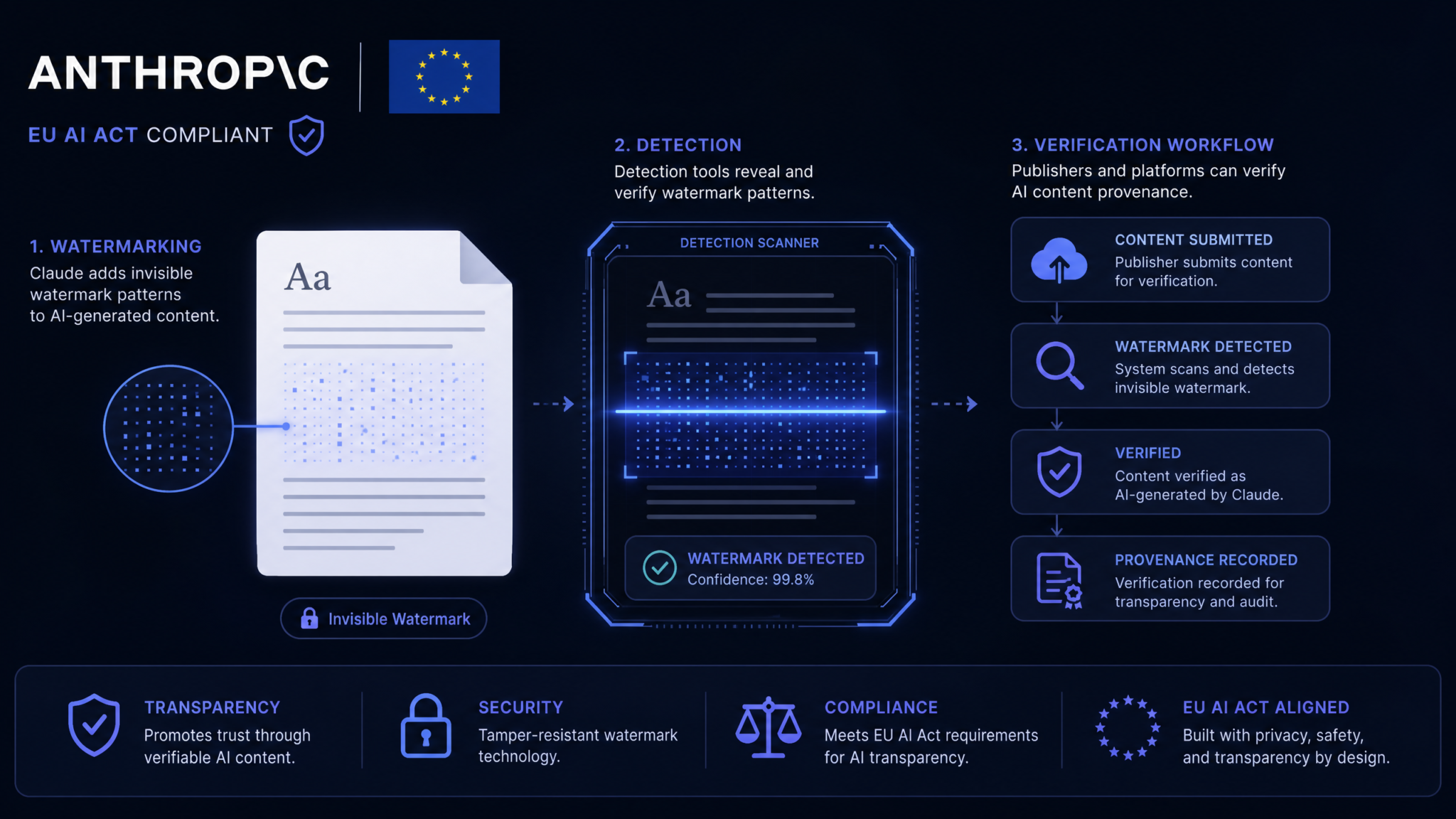
This guide walks you through every layer of Anthropic’s watermarking architecture: the statistical mechanics of invisible text watermarks, image provenance metadata via C2PA standards, the full detection API with real request and response examples, automated screening pipelines, CMS integration strategies, and the thorny edge cases that trip up even experienced teams. We also benchmark Anthropic’s detection approach against existing third-party tools like GPTZero and Originality.ai, and we address the legal obligations publishers now face under EU and emerging global frameworks.
Background: Why Mandatory Watermarking Arrived in 2026
The EU AI Act, which entered full enforcement for high-risk AI systems in August 2025, included a specific provision under Article 50(1) requiring providers of general-purpose AI models to implement “technical measures ensuring that AI-generated content is detectable as such.” The deadline for text and image watermarking across commercial frontier models was set at August 1, 2026, with a one-day grace period that Anthropic used to finalize its production rollout before the August 2 activation.
Anthropic was not alone in this timeline. OpenAI, Google DeepMind, and Meta AI all launched compliant watermarking systems within the same 30-day window. However, Anthropic’s implementation is notable for three reasons: it uses a dual-layer approach (statistical text watermarking combined with C2PA metadata for multimodal outputs), it provides a publicly documented detection API with generous rate limits for verified publishers, and it has published a detailed technical paper describing the watermarking algorithm at a level sufficient for third-party verification — a significant transparency commitment relative to competitors.
For publishers and developers, the practical implications are substantial. Platforms that allow user-submitted content — from academic journals and news organizations to freelance marketplaces and corporate intranets — now have access to a verified, first-party signal for AI provenance. The question is no longer whether detection is possible; it is how to build detection into your workflows reliably and responsibly.
“Watermarking is not a silver bullet, but it is the most technically robust provenance signal we have at scale. The key is building detection infrastructure that understands both what the signal means and where it fails.”
— Anthropic Technical Blog, August 2, 2026
Step 1 — How Invisible Text Watermarks Work
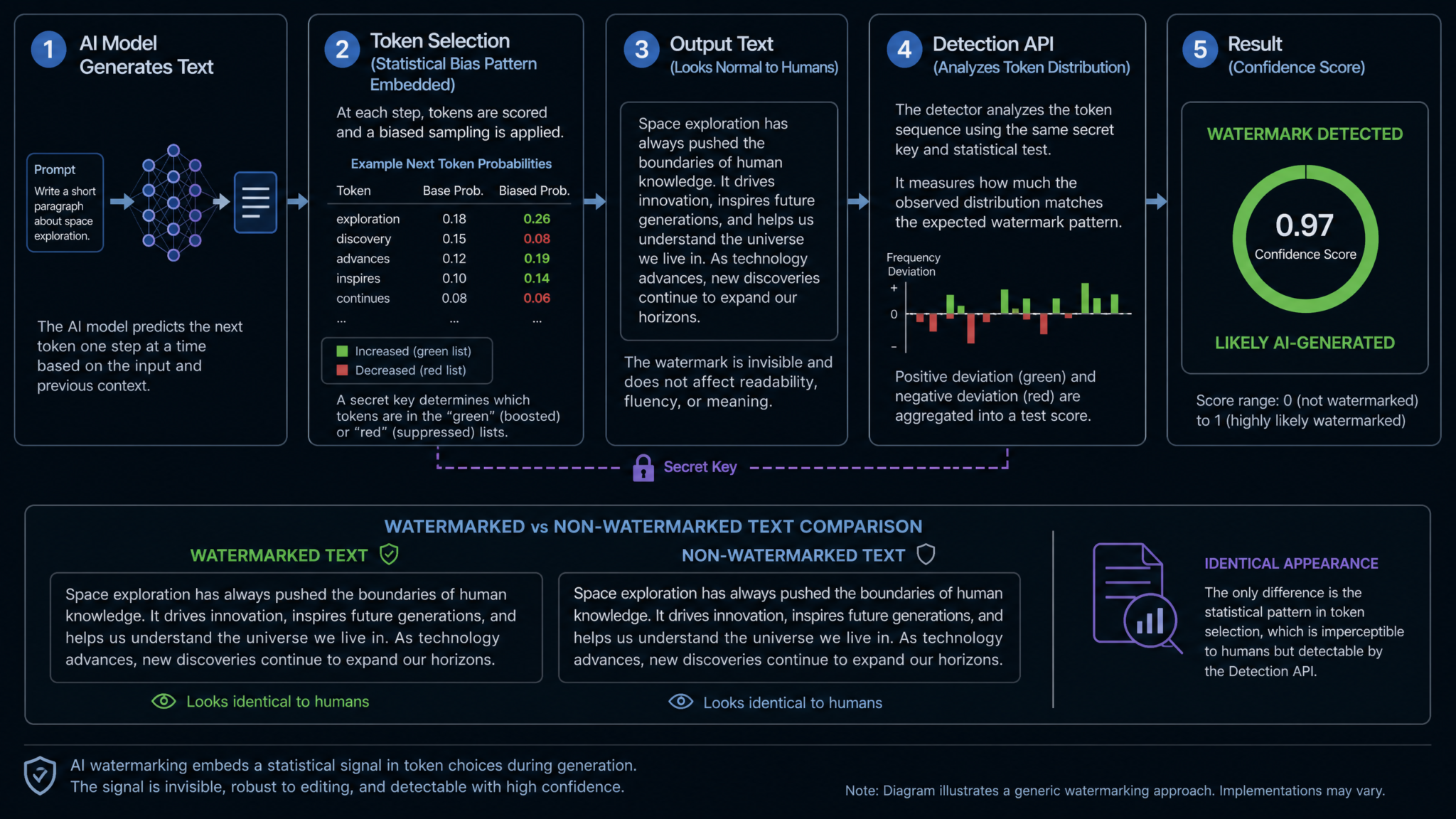
The Core Mechanism: Statistical Token Biasing
To understand Anthropic’s text watermarking, you need to understand one fundamental concept: large language models generate text by selecting tokens probabilistically. At every generation step, the model computes a probability distribution over its entire vocabulary — which can be 100,000+ tokens — and samples from that distribution. The selected token is appended to the output, and the process repeats.
A text watermark works by introducing a subtle, structured bias into that sampling process. Anthropic’s implementation uses a variant of the “green list / red list” approach first formally described in the 2023 Kirchenbauer et al. paper from the University of Maryland, extended with several proprietary refinements that increase robustness against paraphrasing attacks. Here is how the mechanism operates at a conceptual level:
- Pseudorandom partitioning: For each token position, the system generates a pseudorandom partition of the vocabulary into two sets — a “favored” set and a “disfavored” set — using a secret key combined with a hash of the preceding context tokens.
- Soft logit adjustment: The log-probabilities (logits) of tokens in the favored set are increased by a small delta value (typically 1.5–2.5 on the log scale), nudging the model toward selecting from the favored partition without completely excluding disfavored tokens.
- Natural text preservation: Because the bias is applied softly and the partitioning changes at every token position, the resulting text reads naturally to human readers. Statistically, however, favored tokens appear at a measurably higher rate than chance would predict.
- Detection via z-score analysis: A detector that knows the secret key can recompute the partition for each token position in a candidate text, count how many tokens fall in the favored set, and compute a z-score against the null hypothesis of no watermark. A z-score above a threshold (typically 4.0 for high-confidence detection) indicates watermarked content.
Why This Is Invisible to Human Readers
The critical insight is that the bias operates at the vocabulary level in a way that is semantically transparent. Consider the sentence “The economic policy created widespread concern among investors.” If the watermarking system had favored “concern” over “worry” or “anxiety” at that token step, neither the author nor a reader has any reason to notice — all three words are semantically equivalent in context. Across a 500-word article, hundreds of such micro-selections create a statistically detectable pattern while producing prose that is indistinguishable in meaning or quality from non-watermarked output.
Anthropic’s published benchmarks show that for texts of 200 tokens or more, the watermark detection achieves a false positive rate below 0.01% at a true positive rate of approximately 95%. For texts shorter than 100 tokens — short-form content like social media posts or product descriptions — accuracy drops significantly, which we address in the edge cases section.
The Role of the Secret Key
The security of the watermark depends on the secrecy of the partitioning key. Anthropic maintains this key server-side and exposes it only through the authenticated detection API — meaning you cannot run detection locally without API access. This is a deliberate architectural choice that prevents bad actors from reverse-engineering the partition to deliberately select disfavored tokens and defeat the watermark.
The key is not a single static value but a per-request secret derived from a master key, the model version, and a timestamp bucket (rounded to one-hour windows), which means detection must occur within a reasonable time frame and that compromising one request’s key does not compromise the entire system.
Step 2 — Image Provenance Data and C2PA Metadata
What C2PA Is and Why It Matters
For images and other media generated by Claude’s multimodal capabilities, Anthropic uses the Coalition for Content Provenance and Authenticity (C2PA) standard — specifically C2PA Specification 2.1, which became the EU AI Act’s recommended technical standard in early 2026. C2PA defines a structure for embedding cryptographically signed provenance metadata — called Content Credentials — directly into media files.
Unlike text watermarks, which embed signals statistically within the content itself, C2PA metadata is stored in the file’s binary structure (in EXIF-compatible fields for JPEG/PNG, or in dedicated manifest boxes for WebP and HEIC). The metadata includes:
- Generator assertion: Identifies the AI model and provider that created or modified the asset, including model version and generation timestamp.
- Digital signature: A cryptographic signature over the content hash and metadata, signed with Anthropic’s C2PA certificate, verifiable against a public certificate chain.
- Training data assertion: A declaration of whether the model was trained on data including the submitted content (relevant for fine-tuned models).
- Edit history: If an AI-generated image was subsequently modified by a human or another tool, each modification step is recorded as a new signed assertion in the manifest chain.
Verifying C2PA Credentials Programmatically
Verification can be done through Anthropic’s API or using the open-source c2pa-node library (maintained by the Content Authenticity Initiative) if you prefer local verification for images. For most publisher workflows, the API approach is simpler and automatically handles certificate chain validation against Anthropic’s published trust list.
// Using c2pa-node for local image verification
const { createC2pa } = require('c2pa');
const fs = require('fs');

async function verifyImageProvenance(imagePath) {
  const c2pa = await createC2pa();
  const buffer = fs.readFileSync(imagePath);

  const result = await c2pa.read({
    buffer,
    mimeType: 'image/jpeg'
  });

  if (!result || !result.active_manifest) {
    return { verified: false, reason: 'No C2PA manifest found' };
  }

  const manifest = result.active_manifest;
  const aiAssertions = manifest.assertions.filter(
    a => a.label === 'c2pa.ai.generative' || a.label === 'c2pa.training-mining'
  );

  return {
    verified: true,
    isAIGenerated: aiAssertions.length > 0,
    generator: manifest.claim_generator,
    signatureValid: manifest.signature_info?.issuer?.includes('anthropic.com'),
    timestamp: manifest.signature_info?.time
  };
}
One important nuance: C2PA metadata can be stripped from images during certain operations — format conversion, screenshot capture, social media upload processing, or aggressive compression. This means absence of C2PA metadata does not prove an image is not AI-generated; it may simply mean the credentials were lost in transit. The detection API handles this scenario by returning a credentials_absent status rather than a not_ai_generated determination.
C2PA Content Credentials Implementation Guide for Media Platforms
Step 3 — Using Anthropic’s Detection API
Authentication and Rate Limits
The Anthropic Watermark Detection API uses the same API key infrastructure as the generation APIs, but with a distinct permission scope. In the Anthropic Console, you must explicitly enable the watermark:read scope for any API key you intend to use for detection. This separation prevents accidental cross-use and allows organizations to issue detection-only credentials to third-party auditors without exposing generation capabilities.
Rate limits for the detection endpoint are tiered as follows as of the August 2026 launch:
| Account Tier | Requests/Minute | Max Text Length | Image Support |
|---|---|---|---|
| Free | 10 | 2,000 tokens | No |
| Developer | 100 | 10,000 tokens | Yes (5MB) |
| Publisher (verified) | 1,000 | 100,000 tokens | Yes (20MB) |
| Enterprise | Custom | Unlimited | Yes (unlimited) |
Publisher verification requires submitting your organization’s EU publisher registration or equivalent credential through the Anthropic Console. Verification is typically completed within 72 hours for publications with existing verified identities on the EU’s trusted publisher registry.
API Endpoint and Request Format
The detection endpoint is located at https://api.anthropic.com/v1/watermark/detect and accepts POST requests with a JSON body. Here is the complete request structure for text detection:
POST https://api.anthropic.com/v1/watermark/detect
Content-Type: application/json
X-Api-Key: YOUR_API_KEY_WITH_WATERMARK_SCOPE
Anthropic-Version: 2026-08-01

{
  "content_type": "text",
  "text": "The article content you want to analyze goes here...",
  "options": {
    "confidence_threshold": "high",
    "return_token_analysis": false,
    "model_filter": null
  }
}
The confidence_threshold parameter accepts three values: "low" (z-score ≥ 2.5, suitable for internal flagging), "medium" (z-score ≥ 3.5, suitable for editorial review triggers), and "high" (z-score ≥ 4.5, suitable for definitive determinations). The model_filter parameter, if set to a specific Claude version string like "claude-4-opus-20260501", restricts detection to watermarks from that specific model — useful for forensic investigations where model version attribution matters.
Response Format
A successful detection response looks like this:
{
  "id": "wd_01J9KX2MFQP8RVNTH4ZL7",
  "content_type": "text",
  "detection_result": "ai_generated",
  "confidence": "high",
  "z_score": 5.847,
  "p_value": 2.6e-9,
  "watermark_source": {
    "provider": "anthropic",
    "model_family": "claude",
    "model_version": "claude-4-sonnet-20260301",
    "generation_window": "2026-07-15T14:00:00Z/2026-07-15T15:00:00Z"
  },
  "coverage": {
    "tokens_analyzed": 412,
    "tokens_minimum_met": true,
    "estimated_ai_fraction": 1.0
  },
  "flags": [],
  "processing_time_ms": 87
}
The detection_result field returns one of four values: "ai_generated", "not_ai_generated", "inconclusive" (insufficient tokens or ambiguous statistics), or "credentials_absent" (for images where C2PA metadata was stripped). The estimated_ai_fraction field in the coverage object is particularly valuable for mixed-content detection, which we cover in Step 6.
Python Integration Example
import anthropic
import time
from typing import Optional

class WatermarkDetector:
    def __init__(self, api_key: str):
        self.client = anthropic.Anthropic(api_key=api_key)
        self.base_url = "https://api.anthropic.com/v1/watermark/detect"

    def detect_text(
        self,
        text: str,
        confidence: str = "high",
        return_token_analysis: bool = False
    ) -> dict:
        """
        Detect Anthropic watermarks in a text string.
        Returns structured detection result.
        """
        # Minimum viable token count check (rough estimate)
        word_count = len(text.split())
        if word_count < 75:
            return {
                "result": "inconclusive",
                "reason": "text_too_short",
                "word_count": word_count
            }

        response = self.client.post(
            "/v1/watermark/detect",
            json={
                "content_type": "text",
                "text": text,
                "options": {
                    "confidence_threshold": confidence,
                    "return_token_analysis": return_token_analysis
                }
            }
        )

        data = response.json()

        return {
            "result": data["detection_result"],
            "confidence": data["confidence"],
            "z_score": data["z_score"],
            "model_version": data.get("watermark_source", {}).get("model_version"),
            "ai_fraction": data["coverage"]["estimated_ai_fraction"],
            "processing_ms": data["processing_time_ms"]
        }

    def detect_batch(self, texts: list[str], delay_ms: int = 100) -> list[dict]:
        """Process multiple texts with rate-limit-aware batching."""
        results = []
        for i, text in enumerate(texts):
            result = self.detect_text(text)
            results.append({"index": i, "detection": result})
            if i < len(texts) - 1:
                time.sleep(delay_ms / 1000)
        return results


# Usage
detector = WatermarkDetector(api_key="YOUR_KEY_HERE")
result = detector.detect_text(article_text)
print(f"Result: {result['result']} | Z-Score: {result['z_score']:.3f}")
Step 4 — Building a Detection Workflow for Publishers
The Four-Gate Content Screening Model
For publishers receiving contributed content — whether from freelancers, wire services, or reader submissions — a layered detection workflow provides both thoroughness and efficiency. The following four-gate model is designed to minimize unnecessary API calls while maximizing detection coverage:
Gate 1 — Pre-submission heuristics (local, free): Before invoking the API, run cheap local checks: word count validation (flag texts under 150 words as too short for reliable watermark detection), format validation (check for structural signals that correlate with AI generation, such as extremely consistent paragraph lengths or absence of first-person voice where expected), and metadata review (check document creation timestamps, author field values, and software identifiers in DOCX/PDF metadata).
Gate 2 — Anthropic Detection API call: Pass Gate 1 survivors to the detection API with confidence_threshold: "medium". Store the full JSON response, including the z-score, for audit logging. Route results to one of three buckets: confirmed AI-generated (z-score ≥ 4.5), flagged for review (z-score 2.5–4.5), or cleared (z-score < 2.5).
Gate 3 — Cross-tool verification for flagged content: Items in the “flagged for review” bucket should be run through at least one additional detection tool (see the comparison section) and subjected to editor review. This two-signal approach significantly reduces the operational impact of false positives on legitimate human-written submissions.
Gate 4 — Human editorial judgment: No automated detection result should be the sole basis for rejection. Content that returns a confirmed AI-generated result should be surfaced to an editor with the detection metadata, who makes the final determination — particularly important given the legal liability implications of false accusations and the legitimate use cases for disclosed AI-assisted writing.
Automated Screening Pipeline Architecture
For high-volume platforms, a queue-based pipeline is more efficient than synchronous API calls. The following architecture pattern using a message queue handles throughput spikes gracefully:
# Conceptual pipeline structure (using Redis Queue)
# File: detection_pipeline.py

import redis
from rq import Queue
from rq.job import Job

redis_conn = redis.Redis(host='redis.yourproject.io', port=6379)
detection_queue = Queue('watermark_detection', connection=redis_conn)

def enqueue_content_for_detection(content_id: str, text: str, metadata: dict):
    """
    Add content to the detection queue.
    Returns job ID for status polling.
    """
    job = detection_queue.enqueue(
        'workers.detection_worker.process_detection',
        args=(content_id, text, metadata),
        job_timeout=120,
        result_ttl=86400,  # Keep results for 24 hours
        failure_ttl=604800  # Keep failures for 7 days for audit
    )
    return job.id

def get_detection_result(job_id: str) -> dict:
    """Retrieve detection result by job ID."""
    job = Job.fetch(job_id, connection=redis_conn)
    if job.is_finished:
        return {"status": "complete", "result": job.result}
    elif job.is_failed:
        return {"status": "failed", "error": str(job.exc_info)}
    else:
        return {"status": "pending", "position": job.get_position()}
Building AI-Resistant Content Moderation Pipelines for Digital Publishers
Step 5 — Integrating Watermark Detection into Your CMS
WordPress Integration
For WordPress-based publishers, watermark detection integrates most cleanly as a custom plugin that hooks into the post submission workflow. The following implementation uses the transition_post_status hook to trigger detection when content moves from draft to pending review status:
<?php
/**
 * Plugin Name: Anthropic Watermark Detection
 * Description: Screens submitted posts for AI watermarks before editorial review.
 * Version: 1.0.0
 */

add_action('transition_post_status', 'awmd_check_watermark_on_status_change', 10, 3);

function awmd_check_watermark_on_status_change($new_status, $old_status, $post) {
    if ($new_status !== 'pending' || $old_status === 'pending') {
        return;
    }

    if (!in_array($post->post_type, ['post', 'page'])) {
        return;
    }

    $content = wp_strip_all_tags($post->post_content);
    $word_count = str_word_count($content);

    if ($word_count < 75) {
        update_post_meta($post->ID, '_awmd_result', 'too_short');
        return;
    }

    $api_key = get_option('awmd_api_key');
    $response = wp_remote_post('https://api.anthropic.com/v1/watermark/detect', [
        'headers' => [
            'Content-Type'    => 'application/json',
            'X-Api-Key'       => $api_key,
            'Anthropic-Version' => '2026-08-01'
        ],
        'body' => json_encode([
            'content_type' => 'text',
            'text'         => $content,
            'options'      => ['confidence_threshold' => 'medium']
        ]),
        'timeout' => 30
    ]);

    if (is_wp_error($response)) {
        update_post_meta($post->ID, '_awmd_result', 'api_error');
        return;
    }

    $body = json_decode(wp_remote_retrieve_body($response), true);

    update_post_meta($post->ID, '_awmd_result', $body['detection_result']);
    update_post_meta($post->ID, '_awmd_z_score', $body['z_score']);
    update_post_meta($post->ID, '_awmd_model', $body['watermark_source']['model_version'] ?? 'unknown');
    update_post_meta($post->ID, '_awmd_checked_at', current_time('mysql'));

    // Flag high-confidence AI detections for editor attention
    if ($body['detection_result'] === 'ai_generated' && $body['z_score'] >= 4.5) {
        awmd_notify_editors($post, $body);
    }
}

function awmd_notify_editors($post, $detection_data) {
    $editors = get_users(['role' => 'editor']);
    foreach ($editors as $editor) {
        wp_mail(
            $editor->user_email,
            'AI Content Flag: ' . $post->post_title,
            sprintf(
                "Post #%d flagged as AI-generated (z-score: %.2f, model: %s). Please review before publication.",
                $post->ID,
                $detection_data['z_score'],
                $detection_data['watermark_source']['model_version'] ?? 'unknown'
            )
        );
    }
}
Custom CMS and Headless Architecture Integration
For headless CMS systems (Contentful, Sanity, or custom-built systems), the detection logic lives in your API middleware layer rather than in the CMS itself. The recommended pattern is a webhook-triggered serverless function that intercepts content before it reaches the editorial review queue:
// Serverless function for headless CMS webhook
// File: functions/detect-watermark.js
// Deploy to: yourproject.io/api/detect-watermark

export default async function handler(req, res) {
  if (req.method !== 'POST') {
    return res.status(405).json({ error: 'Method not allowed' });
  }

  const { contentId, text, contentType, submittedBy } = req.body;

  // Validate webhook signature
  const signature = req.headers['x-cms-signature'];
  if (!verifyWebhookSignature(signature, req.body, process.env.CMS_WEBHOOK_SECRET)) {
    return res.status(401).json({ error: 'Invalid webhook signature' });
  }

  try {
    const detectionResponse = await fetch('https://api.anthropic.com/v1/watermark/detect', {
      method: 'POST',
      headers: {
        'Content-Type': 'application/json',
        'X-Api-Key': process.env.ANTHROPIC_DETECTION_KEY,
        'Anthropic-Version': '2026-08-01'
      },
      body: JSON.stringify({
        content_type: 'text',
        text: text,
        options: { confidence_threshold: 'medium' }
      })
    });

    const detection = await detectionResponse.json();

    // Store result in your content database
    await updateContentRecord(contentId, {
      watermark_detection: detection.detection_result,
      watermark_z_score: detection.z_score,
      watermark_checked_at: new Date().toISOString(),
      ai_model_detected: detection.watermark_source?.model_version || null
    });

    // Route content based on result
    const routingDecision = routeContent(detection);
    await updateContentStatus(contentId, routingDecision.status);

    return res.status(200).json({
      contentId,
      detection: detection.detection_result,
      routing: routingDecision
    });

  } catch (error) {
    console.error('Detection failed:', error);
    // Fail open — don't block content if detection fails
    await updateContentStatus(contentId, 'pending_review');
    return res.status(200).json({
      contentId,
      detection: 'api_unavailable',
      routing: { status: 'pending_review' }
    });
  }
}

function routeContent(detection) {
  if (detection.detection_result === 'ai_generated' && detection.z_score >= 4.5) {
    return { status: 'ai_flagged', priority: 'high' };
  } else if (detection.z_score >= 2.5) {
    return { status: 'review_required', priority: 'normal' };
  }
  return { status: 'cleared', priority: 'normal' };
}
Step 6 — Handling Edge Cases
Paraphrased AI Content
One of the most significant practical challenges is detecting AI content that has been substantially paraphrased by a human — or, increasingly, run through a “humanizer” tool specifically designed to defeat watermark detection. Anthropic’s watermarking system was designed with paraphrase resistance in mind: the pseudorandom partitioning is applied at the semantic context level, meaning that synonym substitution alone does not defeat the watermark. However, if approximately 30% or more of tokens are replaced with alternatives, detection accuracy begins to degrade.
The API response includes a paraphrase_resistance_note flag in the flags array when the statistical pattern is consistent with paraphrasing attacks — specifically when the z-score is lower than expected for the token count, suggesting partial signal destruction. When you see this flag, treat the result as lower confidence than the raw z-score indicates, and consider supplementing with third-party semantic analysis tools.
For editorial purposes, a practical policy is: content that scores z ≥ 3.0 with a paraphrase_resistance_note flag should be treated as AI-generated for disclosure purposes, even though it may not meet the “high confidence” threshold for definitive attribution. The legal landscape increasingly supports disclosure based on reasonable suspicion rather than forensic certainty.
Mixed Human and AI Text
Mixed content — where a human author incorporated substantial AI-generated passages into otherwise human-written text — is handled through the estimated_ai_fraction field. When return_token_analysis: true is set in the request, the API returns a token-level probability array that can be used to identify which passages are most likely AI-generated.
A practical threshold for publishers: content with estimated_ai_fraction above 0.4 (more than 40% likely AI-generated) warrants disclosure even if some human contribution is evident. Content with 0.2–0.4 AI fraction typically indicates AI-assisted writing (AI used for drafting sections, heavily edited by human) and should be handled according to your platform’s specific AI-assisted content policy.
Translated Content
Translation is the most technically challenging edge case. When Claude generates content in English and a human subsequently translates it into French or Spanish, the token-level watermark is entirely destroyed — translation replaces every token with tokens from a different vocabulary. The watermark detection will return "not_ai_generated" for such content despite its AI origin.
The converse case — a human writes in a non-English language and asks Claude to translate it — is equally problematic. The translated output carries Claude’s watermark, but the original intent was human-authored. Anthropic acknowledges this limitation explicitly in their August 2026 technical documentation and recommends that translation workflows either (a) request Claude to apply a “translation provenance” tag in the prompt that will trigger a distinct flag in the watermark signal, or (b) use C2PA metadata workflows where the generation and translation steps are logged as separate assertions in the content credential chain.
Very Short Content
Content under approximately 150 words (100 tokens) produces unreliable watermark detection due to insufficient statistical power. For short-form content — social media posts, image captions, pull quotes, product titles — the text watermark system is not reliable. For these use cases, rely on C2PA metadata if the content originated from a multimodal workflow, or implement process-level controls (requiring authors to document their workflow for short-form AI-generated content) rather than automated detection.
Step 7 — Legal and Compliance Considerations
EU AI Act Article 50 Obligations
Under Article 50 of the EU AI Act, the disclosure obligations fall on two distinct parties: the AI provider (Anthropic, OpenAI, etc.) and the deployer — meaning any business that uses an AI system to produce content distributed to users. If you use Claude to generate articles for your news website, you are a deployer, and Article 50(1) requires you to ensure that AI-generated content is labeled in a way that is “clear, legible, and prominently visible.”
Access 40,000+ AI Prompts for ChatGPT, Claude & Codex — Free!
Subscribe to get instant access to our complete Notion Prompt Library — the largest curated collection of prompts for ChatGPT, Claude, OpenAI Codex, and other leading AI models. Optimized for real-world workflows across coding, research, content creation, and business.
The minimum disclosure requirement is a statement that content was produced or substantially assisted by AI, placed at the beginning or immediately adjacent to the content, using terminology accessible to a general audience. The specific language “AI-generated” or “Created with AI assistance” meets the threshold; vague terms like “computer-assisted” do not.
Importantly, the EU AI Act’s disclosure obligations apply regardless of whether your platform uses detection technology. Detection is a compliance tool for incoming content you did not generate yourself; disclosure is a compliance obligation for content you did generate or commission using AI. These are related but legally distinct requirements.
Liability for False Positives and False Negatives
Publishers face a nuanced liability landscape around detection results. Incorrectly labeling a human-written article as AI-generated (false positive) can constitute defamation in some EU member states if it damages the author’s professional reputation. Anthropic’s terms of service for the detection API explicitly state that detection results are “probabilistic signals, not legal determinations” and that publishers bear full responsibility for their editorial use of detection results.
Best practice from the legal community: never communicate a detection result directly to a contributor without a human review step. Your internal records should show that the detection result informed an editorial decision, not that it was the sole basis for any adverse action against a contributor. Maintain detection audit logs for a minimum of three years — the maximum statute of limitations period for contractual disputes in most EU jurisdictions.
GDPR Considerations
When you submit content to Anthropic’s detection API, you are transferring data to a third-party processor. If that content contains personal data (which is common in submitted articles, guest posts, or user-generated content), you must ensure your data processing agreement with Anthropic’s API services covers this processing purpose. Anthropic’s current DPA for the EU covers detection API usage under the “model safety and content integrity services” category — verify that this category is active in your signed DPA before deploying detection at scale.
Comparing Anthropic Detection with Third-Party Tools
The Current Detection Landscape
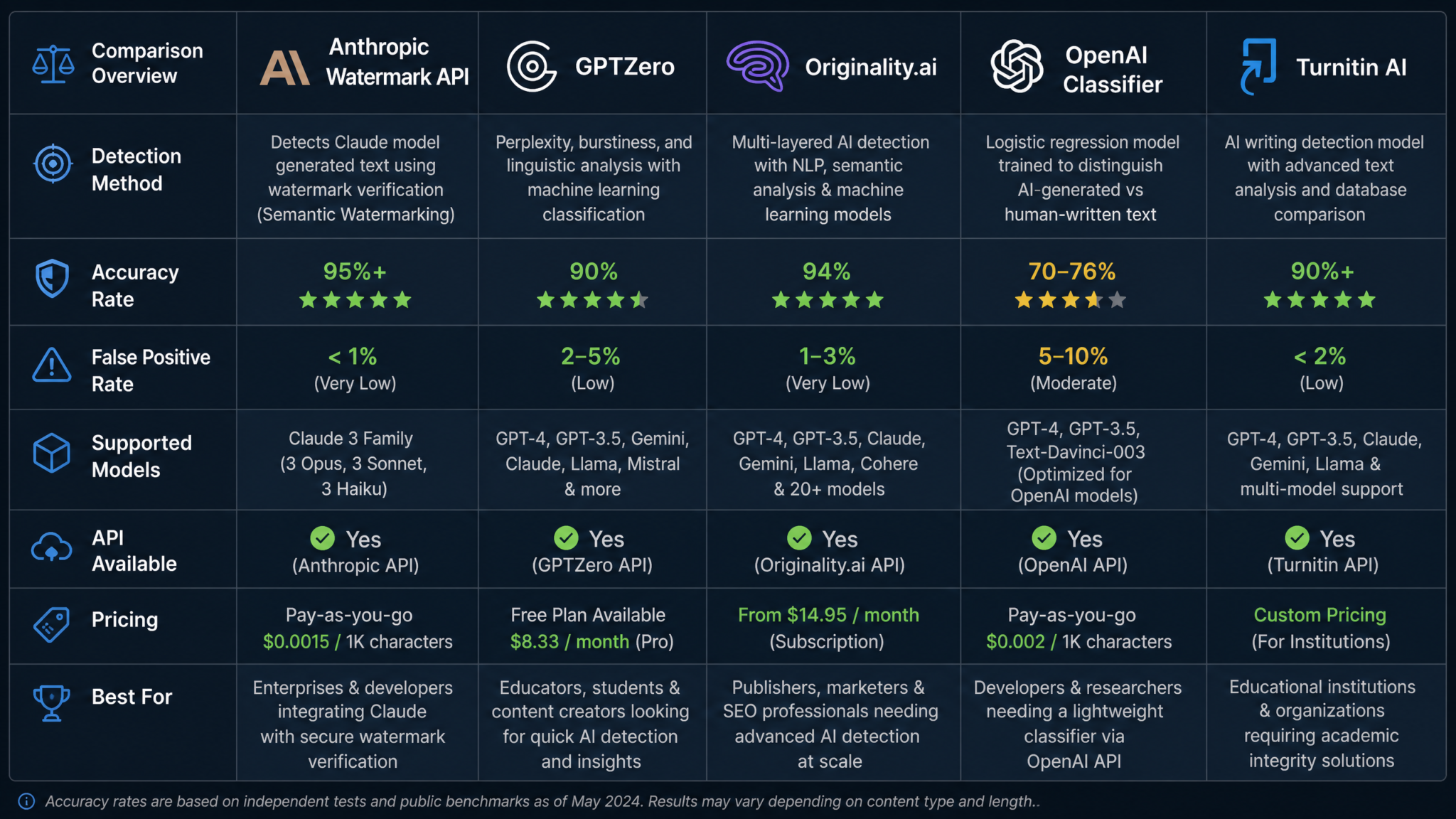
Anthropic’s first-party detection API represents a fundamentally different class of signal compared to third-party AI detection tools. Understanding this distinction is critical for building robust workflows that do not over-rely on any single approach.
| Tool | Detection Method | True Positive Rate | False Positive Rate | Paraphrase Resistance | Claude-Specific |
|---|---|---|---|---|---|
| Anthropic Detection API | Cryptographic watermark (first-party) | ~95% (200+ tokens) | <0.01% | High (30%+ token change needed) | Yes — only detects Claude output |
| GPTZero | Perplexity + burstiness statistical model | ~82% (general AI) | ~9% | Low (synonym replacement defeats it) | No — multi-model |
| Originality.ai | Fine-tuned classifier ensemble | ~88% (trained set) | ~7% | Moderate | No — multi-model |
| OpenAI Text Classifier (v3) | OpenAI watermark + neural classifier | ~94% (GPT-4 family) | <0.1% | High (watermark-based) | OpenAI models only |
| Copyleaks AI Detector | Sentence-level neural classifier | ~79% | ~12% | Low | No — multi-model |
When to Use Each Tool
Anthropic Detection API alone: Sufficient when you are exclusively concerned with Claude-generated content and content is 200+ tokens. The signal is highly reliable and legally defensible due to its cryptographic foundation. Ideal for platforms that have contractually restricted AI tool use to Claude only.
Anthropic API + GPTZero: The recommended combination for general-purpose publisher screening. Anthropic’s API catches Claude content with high precision; GPTZero’s statistical approach catches GPT-4, Gemini, Llama, and other models with reasonable (if imperfect) accuracy. The combination reduces overall false negative rate for non-Claude AI models substantially.
Originality.ai: Best suited for SEO and web content contexts where its training set (heavily weighted toward marketing and blog content) aligns with the content type being screened. Its plagiarism detection layer also catches AI content that was generated by processing existing web content — a use case the pure watermark tools miss entirely.
OpenAI’s classifier for OpenAI-generated content: Analogous to Anthropic’s API — use it when you specifically need to detect GPT-family output with high confidence. Organizations running multi-model environments should maintain active subscriptions to both first-party detection APIs and layer them in series.
A critical limitation to understand about all third-party classifiers: their training data is frozen at a point in time. New model versions, particularly fine-tuned models with altered output distributions, can evade statistical classifiers entirely until those classifiers are retrained. Watermark-based detection does not have this limitation — it is robust to model updates because the watermarking key infrastructure persists across model versions.
GPTZero vs. Originality.ai — Which AI Content Detector Should Publishers Use in 2026
Limitations, False Positives, and Responsible Deployment
Known Limitations of Anthropic’s System
Honest deployment of any detection technology requires acknowledging its failure modes. Anthropic’s watermarking system has several documented limitations that publishers should build their policies around:
API access requirement: Unlike local statistical detectors, the watermark cannot be verified without API access. This creates a single point of failure — if Anthropic’s detection API is unavailable (planned maintenance, outages), your detection pipeline fails. Implement fallback logic that routes content to manual review rather than blocking publication when the API is unavailable, as demonstrated in the CMS integration examples above.
Pre-launch content blindspot: Content generated by Claude before August 2, 2026 does not contain watermarks. If your platform has a backlog of submissions or if contributors submit articles they generated weeks or months before the watermarking system activated, the API will return "not_ai_generated" for AI-generated text. This is technically accurate (no watermark is present) but misleading in intent. Third-party classifiers are your only detection option for pre-launch AI content.
Model scope limitation: The detection API only detects content generated by Anthropic models. It cannot detect content from GPT-4o, Gemini 1.5, Llama 3, Mistral, or any other non-Anthropic model. Publishers who treat a “no watermark detected” result as equivalent to “not AI-generated” are making a category error with serious operational consequences.
Audio and video: The August 2026 launch covers text and images only. Audio transcripts and video content from Claude Voice or multimodal video generation capabilities are not yet covered by the detection API. Anthropic has indicated audio and video C2PA support is planned for Q1 2027.
Understanding False Positive Rates in Practice
The sub-0.01% false positive rate is measured on a balanced benchmark dataset. In real-world deployment, publishers see higher effective false positive rates for two reasons: certain writing styles (highly structured academic writing, legal drafting, technical documentation) produce statistical patterns that resemble watermarked content at a medium-confidence threshold; and content from non-English-language native speakers writing in English sometimes produces unusual token distributions that inflate z-scores slightly.
Practical guidance for false positive management: calibrate your routing thresholds based on your content type. A general news publisher can safely use z-score ≥ 4.0 as a “send to editor review” threshold. An academic journal accepting submissions from non-native English speakers should raise that threshold to 4.5 or higher and always route flagged content to a human reviewer rather than automated rejection.
Ethical Deployment Principles
Several principles should govern organizational policies around watermark detection, regardless of technical capability:
- Detection informs, never decides: No contributor should face consequences — rejection, payment withholding, account suspension — based solely on a detection result without human review.
- Transparency with contributors: If your platform uses automated AI detection, this should be disclosed in your contributor guidelines. Surprising a contributor with a detection flag without prior notice of your detection policies is both a trust issue and a potential legal vulnerability.
- Proportionality in response: A positive detection result for disclosed AI-assisted writing in an “AI allowed with disclosure” policy context requires a different response than an undisclosed AI-generated submission to a platform that prohibits AI authorship. Build your response workflows to reflect your specific policies, not a one-size-fits-all “AI bad” posture.
- Audit all detection decisions: Every detection result that informed an editorial action should be logged with the full API response, the content ID, the decision made, and the human reviewer who made it. This audit trail is your legal protection and your quality improvement mechanism.
What This Means for Content Authenticity in 2026 and Beyond
A New Layer in the Trust Stack
The activation of mandatory AI watermarking across frontier models represents not the solution to AI content attribution — but the foundation for one. Watermarks are one component in what security researchers call the “content trust stack”: a layered architecture of provenance, verification, and disclosure that mirrors how cybersecurity handles software integrity. Just as HTTPS certificates verify server identity and code signing verifies software origin, AI watermarks verify content generation provenance.
What 2026 has established is the bottom layer of this stack. The industry is actively building the middle layers: interoperable Content Credentials standards that allow a piece of content to carry a verifiable provenance chain across platforms; publisher trust registries that link verified human author identities to their published work; and AI disclosure widgets (already mandated on EU news sites with circulation over 50,000) that surface provenance information to readers on demand.
The Arms Race Reality
It would be naive to conclude this guide without acknowledging the adversarial dimension. Within days of Anthropic’s August 2 watermarking launch, multiple “watermark removal” tools appeared in developer forums, claiming to eliminate the statistical signal through careful paraphrasing algorithms. Some of these tools are effective against weaker implementations; Anthropic’s specific variant, with its context-sensitive pseudorandom partitioning, resists naive synonym replacement, but sufficiently aggressive rewording will degrade the signal.
The realistic operational picture for the next 12–18 months: determined bad actors with technical sophistication can defeat watermark detection through aggressive paraphrasing or by using non-watermarked models. Publishers should not treat watermark detection as a complete defense against AI content fraud. It is, however, highly effective against the large majority of cases — unsophisticated users who paste Claude output directly into submission forms, automated content farm operations, and casual misuse. For the sophisticated adversarial cases, detection must be supplemented by editorial judgment, contributor relationship management, and platform-level fraud analysis.
The Long-Term Trajectory
The direction of travel is clear. The EU AI Act’s watermarking provisions will expand to cover more content types, shorter texts, and a broader range of AI systems (including open-source models above a certain compute threshold, currently under legislative review). US federal AI transparency legislation, while not yet enacted at publication time, has significant bipartisan support and is likely to include analogous watermarking provisions by 2027.
For publishers and developers building systems today, the investment in watermark detection infrastructure is not a short-term compliance exercise — it is the foundation for a content authenticity architecture that will become more comprehensive and more legally significant over the coming years. Building robust, auditable, human-in-the-loop detection workflows now positions your organization ahead of the compliance curve while establishing the editorial trust standards that will define reputable publishing in an era of AI-generated content abundance.
The technical tools are now available. The legal framework is in place. The remaining variable is organizational commitment to using these tools thoughtfully, honestly, and in service of the fundamental goal: ensuring that readers can trust the provenance of the content they consume.
Quick Reference: Detection API Cheat Sheet
| Parameter | Value | Notes |
|---|---|---|
| Endpoint | POST /v1/watermark/detect |
Base URL: api.anthropic.com |
| API Version Header | 2026-08-01 |
Required for watermark endpoints |
| Required Scope | watermark:read |
Enable in Anthropic Console |
| Minimum text length | ~150 words / 100 tokens | Below this: inconclusive result |
| High-confidence threshold | z-score ≥ 4.5 | False positive rate < 0.01% |
| Medium-confidence threshold | z-score ≥ 3.5 | Suitable for editorial review trigger |
| Inconclusive range | z-score < 2.5 | Treat as not detected |
| Image format | C2PA v2.1 metadata | JPEG, PNG, WebP, HEIC supported |
| Covers pre-Aug 2 content | No | Use third-party classifiers for legacy content |
| Non-Claude models detected | No | Layer with GPTZero for full coverage |
