
How to Use GPT-5.3-Codex for Self-Improving Code: Recursive AI Development Patterns and Practical Implementation

GPT-5.3-Codex is the newest installment in OpenAI’s code-focused family, designed to reason faster and act more reliably across large, real-world codebases. In this in-depth tutorial, we explore how to set it up, orchestrate recursive self-improvement loops, and safely deploy practical patterns—automated refactoring, test-driven self-optimization, performance profiling with auto-fixes, and documentation self-generation—so your software can improve itself continuously under human guidance. Along the way, we examine reported approaches for how OpenAI leveraged GPT-5.3-Codex to improve its own systems and offer concrete, reproducible examples you can adapt to your stack.
Note: Capabilities and product details evolve quickly. Treat this guide as a practical playbook grounded in current best practices for applied AI coding and recursive development, adapted to the GPT-5.3-Codex paradigm. Always validate against up-to-date official docs and your organization’s policies.
What GPT-5.3-Codex Is and How It Differs from Previous Codex Models
GPT-5.3-Codex is a code-specialized model in the GPT-5.x family. It is engineered to deliver tighter integration with developer workflows, repository-scale context handling, and more predictable tool-use behavior. OpenAI emphasizes 25% faster reasoning throughput on complex, multi-step coding tasks compared to prior Codex-class models in this lineage, enabling more efficient recursive development loops and faster turnaround in CI-integrated automation.
While earlier Codex models excelled at translating natural language into working code and generating tests on demand, GPT-5.3-Codex focuses on high-fidelity reasoning over larger contexts: entire repositories, dependency graphs, and multi-language codebases. This makes it better suited for architectural refactors, performance optimization sprints, and continuous documentation maintenance—tasks that demand both breadth of understanding and depth of reasoning.
Key Differentiators
- Faster multi-step reasoning: GPT-5.3-Codex reportedly offers approximately 25% faster reasoning on complex pipelines, especially when chained with tools (search, profiling, static analysis). This speedup compounds across loops, making automation cycles more viable in CI windows.
- Repository-scale context: Designed to accept summaries, embeddings, and structural maps (e.g., dependency graphs) for disambiguation across large monorepos and multi-service ecosystems.
- Structured tool-use: Improved function calling and tool orchestration, enabling stable interactions with profilers, linters, test runners, build tools, and code indexers.
- Deterministic modes and reproducibility aids: Options for pinned reasoning paths, constrained decoding, and diff-only output increase safety and auditability in automated refactor flows.
- Guardrail-aware prompting: Templates and system schemas that steer the model to respect license headers, secrets handling, secure coding checklists, and organizational conventions.
Quick Comparison Overview
| Capability | Older Codex (pre-5.x) | GPT-5.3-Codex |
|---|---|---|
| Reasoning Throughput | Strong for snippet-level tasks | ~25% faster on multi-step, repo-scale tasks |
| Context Management | File or small bundle focus | Repository-aware, embedding and structure-informed |
| Tool-Oriented Actions | Basic function calling | Richer tool schemas with stable multi-call plans |
| Refactor Robustness | Good at local refactors | Architectural refactors with integration constraints |
| Governance & Guardrails | Manual prompts | Built-in patterns for compliance and safety checklists |
If you are coming from GPT-4.1/4.5-level Codex models, expect two major improvements: more reliable long-horizon planning over codebases and faster iteration during recursive improvement. This synergy is what makes GPT-5.3-Codex notably effective in continuous refactoring and self-optimization workflows.
The Concept of Recursive Self-Improvement in AI Coding
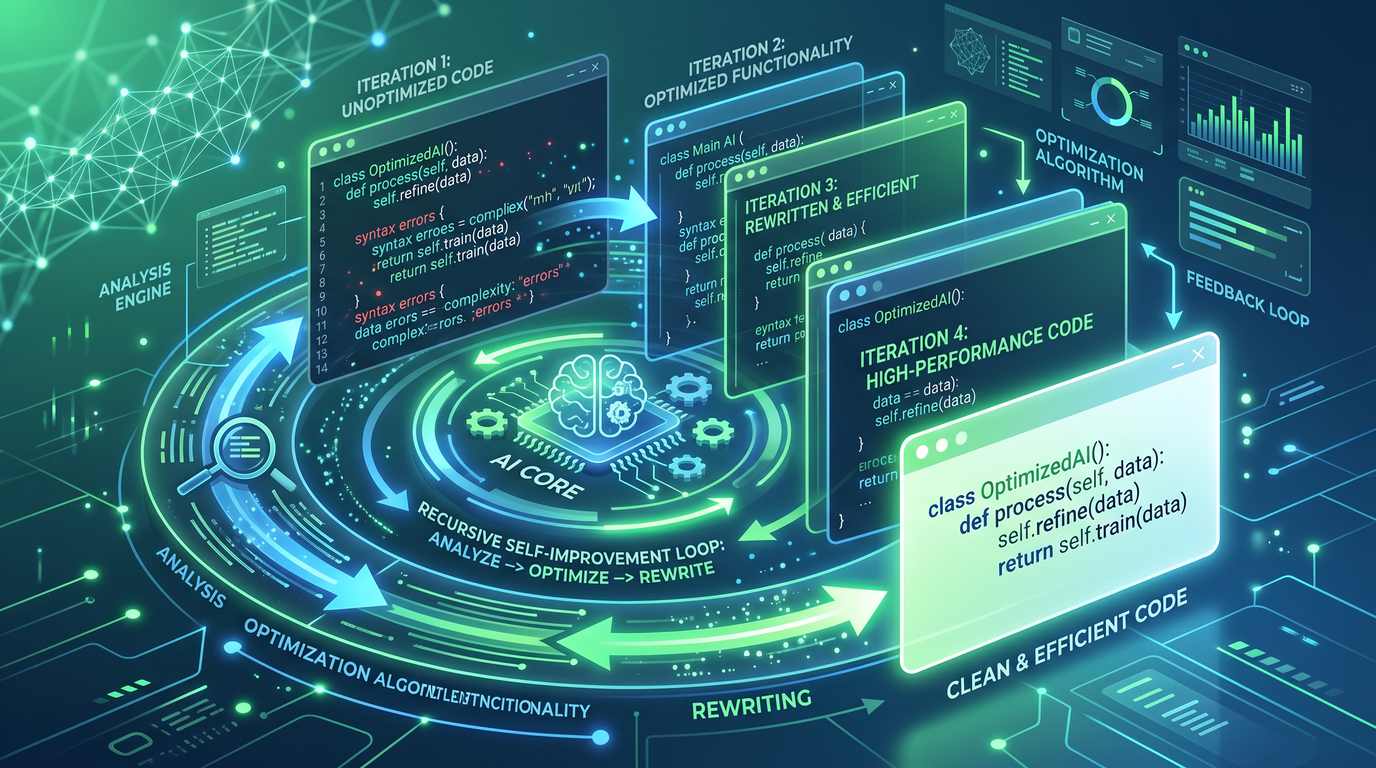
Recursive self-improvement in software development is the practice of using an AI system not only to write code but also to propose, implement, test, evaluate, and generalize improvements to its own code or the surrounding tooling. Practically, this means an AI agent performs an improvement cycle repeatedly:
- Observe: Gather signals (test failures, profiler output, code smells, linter warnings, user issues).
- Hypothesize: Produce candidate changes and reasoning traces linking cause to effect.
- Act: Produce diffs or patches that address root causes directly.
- Validate: Run tests, linters, performance benchmarks, security checks; compare against baselines.
- Decide: Accept changes if thresholds are met; otherwise roll back and learn from failure.
- Generalize: Distill lessons into codemods, templates, or guidelines for future cycles.
This loop can run on a schedule, on-demand, or as a background agent in CI. With GPT-5.3-Codex, the loop can be more aggressive due to faster reasoning and improved tool-use: it can analyze more context, propose more cohesive changes, and converge more quickly while staying within CI time budgets.
Two ingredients are essential for stability:
- High-quality feedback signals: robust tests, performance baselines, static analysis results, and policy checkers define objective acceptance criteria.
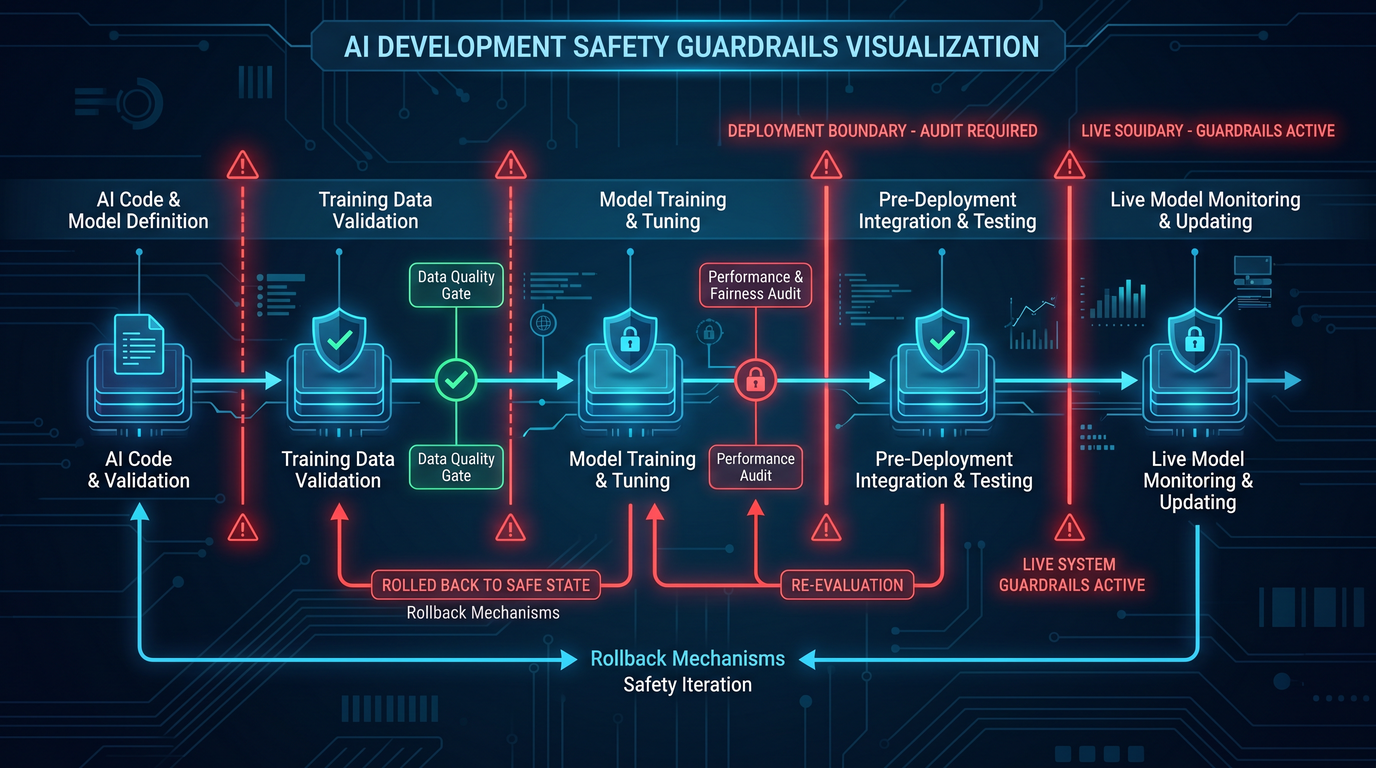
- Guardrails and gating: branch protections, human-in-the-loop (HITL) approvals for risky changes, and rollback mechanisms prevent regressions from escaping into production.
While the term “self-improvement” evokes autonomy, in real-world engineering it is best understood as a form of tight human–AI collaboration. The AI does the heavy lifting—exploration, drafting, execution—while humans define the mission, the acceptance tests, and the governance envelope. For more structured guidance, see
Recursive AI development workflows benefit enormously from well-crafted prompts that minimize hallucinations in generated code. Our Codex Prompt Engineering Playbook provides 15 battle-tested prompts specifically designed to optimize AI-generated code quality, reduce common errors, and improve test coverage across iterative development cycles. The Codex Prompt Engineering Playbook: 15 Prompts for Optimizing AI-Generated Code.
and
When evaluating whether GPT-5.3-Codex’s self-improving capabilities outperform other AI coding tools, our comprehensive 2026 comparison of Cursor, Claude Code, GitHub Copilot, OpenAI Codex, Windsurf, and Devin provides benchmark data across code generation accuracy, refactoring quality, and autonomous task completion rates. The 2026 AI Coding Agent Comparison: Cursor vs Claude Code vs Copilot vs Codex.
.
How OpenAI Used GPT-5.3-Codex to Improve Its Own Codebase
OpenAI has described GPT-5.3-Codex as a key enabler for internal tooling and iterative improvements, including work that fed back into the model’s ecosystem. Without relying on proprietary details, we can outline a representative pattern that reflects common industry practice for model-assisted development in large codebases:
A Representative Internal Improvement Pipeline
-
Establish a gold-standard evaluation harness:
- Extensive unit and integration test libraries for critical paths.
- Performance dashboards and baseline datasets for throughput, latency, and memory.
- Security and compliance checks baked into CI (SAST, secret scanning, license audits).
-
Instrument code and workflows:
- Profilers in production and staging environments to collect flamegraphs and hotspots.
- Structured telemetry for error rates, timeouts, and performance regressions.
- Semantic code search and embedding indices for cross-file and cross-service navigation.
-
Run AI-driven proposal loops:
- Use GPT-5.3-Codex to propose diffs targeting hotspots, code smells, flaky tests, and outdated patterns.
- Generate RFC-style rationales and risk assessments for each PR.
- Auto-generate targeted tests or benchmarks alongside code changes.
-
Validate with strict CI gating:
- Block merges unless tests pass, performance budgets are met, and policies are satisfied.
- Require human review for sensitive areas or architectural changes.
- Automate rollback or quarantine for regressions detected post-merge.
-
Harvest learnings:
- Distill frequently recurring fixes into codemods and lint rules.
- Update system prompts and tool schemas to encode newly learned constraints.
- Enrich the eval harness to cover newly discovered edge cases.
This cyclical process allows the model to continuously suggest and validate improvements under strict controls. The practical lesson for your team: the better your tests, benchmarks, and policy gates, the more you can safely automate.
Setting Up GPT-5.3-Codex in Your Development Environment
Prerequisites
- Access to the GPT-5.3-Codex model in your OpenAI account.
- Project with a test suite (e.g., pytest, Jest, Go test) and CI pipeline (GitHub Actions, GitLab CI, CircleCI, Azure Pipelines, etc.).
- Linters, formatters, and security scanners enabled (ESLint/Prettier, Flake8/Black, Bandit, Semgrep, Trivy, etc.).
- A repository index or embeddings store if your repo is large (e.g., ctags, tree-sitter index, semantic embeddings keyed by path).
Install and Configure the SDK
Use the latest OpenAI SDK. Pin explicit versions for reproducibility in CI.
Python
pip install --upgrade openai

# .env or CI secrets
export OPENAI_API_KEY="your_api_key"
from openai import OpenAI
client = OpenAI()
def propose_refactor(system, context, diffspec):
response = client.responses.create(
model="gpt-5.3-codex",
reasoning={"effort": "medium"},
temperature=0.2,
system=system,
input=[{
"role": "user",
"content": [
{"type": "text", "text": f"Context:\\n{context}\\n\\nTask:\\n{diffspec}"}
]
}],
tool_choice="none",
)
return response.output_textNode.js
npm install openai --save

# .env or CI
export OPENAI_API_KEY="your_api_key"
import OpenAI from "openai";
const client = new OpenAI();
export async function proposeRefactor(system, context, diffspec) {
const response = await client.responses.create({
model: "gpt-5.3-codex",
reasoning: { effort: "medium" },
temperature: 0.2,
system,
input: [
{
role: "user",
content: [{ type: "text", text: `Context:\n${context}\n\nTask:\n${diffspec}` }],
},
],
});
return response.output_text;
}Repository Awareness
GPT-5.3-Codex performs best when it’s aware of file boundaries, dependency graphs, and code conventions. Supply summaries rather than raw megabytes of code:
- Static index: Parse symbols, imports, call graphs via tree-sitter or language servers; extract summaries per module.
- Embeddings: Pre-compute embeddings for files and functions to retrieve the most relevant context for each task.
- Context packs: Provide a compact “context pack” per request: target file, dependent files, interface definitions, related tests, and coding standards.
Minimal System Prompt for Safe Refactoring
system = """
You are GPT-5.3-Codex acting as a safe refactor assistant.
Rules:
- Never remove or weaken security, logging, or error handling without explicit instruction.
- Preserve public APIs and backward compatibility unless told otherwise.
- Always produce a unified diff (git-style) limited to requested files.
- Include a brief risk assessment and test plan in a fenced block tagged <analysis> ... </analysis>.
- Respect license headers and file formatting conventions.
- If uncertain, ask clarifying questions instead of guessing.
"""
CI Integration
Add a job that runs on a schedule or on demand. The job should:
- Select a target scope (files, directories, smells, hotspots).
- Construct a context pack (summaries, test links, recent failures).
- Call GPT-5.3-Codex to generate a diff.
- Apply the diff on a branch and run tests, linters, and benchmarks.
- Gate merge based on thresholds; require human review for sensitive areas.
Practical Patterns for Self-Improving Code
The following patterns are building blocks you can mix and match. Each pattern pairs a stable loop structure with GPT-5.3-Codex prompts and tool-use for predictable, incremental improvement.
Automated Refactoring Loops
Automated refactoring loops target safe, well-scoped code modernizations: dependency bumps, codemods, API migrations, complexity reductions, and dead-code elimination. GPT-5.3-Codex suggests diffs; CI validates via tests and linters.
Loop Outline
- Collect smells: cyclomatic complexity, lengthy functions, duplicate code, deprecated APIs.
- Build a context pack: file summaries, interface contracts, associated tests, style guide.
- Ask GPT-5.3-Codex for a minimal diff with an analysis plan.
- Apply diff on a feature branch; run tests, style, type checks, and SAST.
- Accept if all pass and performance remains within thresholds; otherwise revert and log feedback.
Before/After: Python Complexity Reduction
Before: deeply nested control flow.
# path: metrics/calc.py
def score(items, weights, penalty):
    total = 0
    for i, it in enumerate(items):
        if i < len(weights):
            if it is not None:
                if it > 0:
                    total += it * weights[i]
                else:
                    total += penalty
            else:
                total += 0
        else:
            if it:
                total += it
            else:
                total += penalty
    return total
After: guard clauses and helper extraction.
# path: metrics/calc.py
def _weighted_or_penalty(value, weight, penalty):
    if value is None:
        return 0
    return value * weight if value > 0 else penalty

def score(items, weights, penalty):
    total = 0
    wlen = len(weights)
    for i, it in enumerate(items):
        if i < wlen:
            total += _weighted_or_penalty(it, weights[i], penalty)
        else:
            total += it if it else penalty
    return total
Driver Script (Python)
import subprocess, json, os
from openai import OpenAI

client = OpenAI()

SYSTEM = """
You are a precise refactorer. Output only unified diffs for requested files.
Do not modify public API semantics. Include <analysis>...</analysis> at end.
"""

def file_summary(path):
    with open(path, "r", encoding="utf8") as f:
        code = f.read()
    return f"# File: {path}\\n\\n{code[:4000]}"  # truncate for demo

def run_refactor(target_files, task):
    context = "\\n\\n".join([file_summary(p) for p in target_files])
    prompt = f"Task: {task}\\nTarget files: {', '.join(target_files)}\\n"
    resp = client.responses.create(
        model="gpt-5.3-codex",
        temperature=0.1,
        system=SYSTEM,
        input=[{"role":"user", "content":[{"type":"text", "text": context + "\\n\\n" + prompt}]}],
    )
    return resp.output_text

def apply_diff(diff_text):
    p = subprocess.run(["git", "apply", "-p0", "--index"], input=diff_text.encode(), capture_output=True)
    if p.returncode != 0:
        raise RuntimeError(p.stderr.decode())

def validate():
    r = subprocess.run(["pytest", "-q"], capture_output=True)
    return r.returncode == 0, r.stdout.decode() + r.stderr.decode()

if __name__ == "__main__":
    files = ["metrics/calc.py"]
    task = "Reduce cyclomatic complexity safely; preserve behavior; add helper where needed."
    diff = run_refactor(files, task)
    apply_diff(diff)
    ok, out = validate()
    print("TESTS OK" if ok else "TESTS FAILED", "\\n", out)
Tips
- Restrict scope: target one file or subsystem per loop.
- Require unified diffs and analysis blocks for auditability.
- Persist failures as examples to improve prompts and guardrails.
Test-Driven Self-Optimization
In this pattern, you combine correctness tests with performance targets. GPT-5.3-Codex proposes optimizations but must preserve behavioral tests. It can also write or refine benchmarks to prevent regressions.
Loop Outline
- Identify slow paths using profiler output or timing logs.
- Specify KPIs: max latency, throughput, memory cap; include a target, e.g., “reduce p95 latency by 15%.”
- Provide the hot code and relevant interfaces plus a benchmark harness.
- Request minimal diffs that preserve tests and pass the benchmark threshold.
- Accept if KPIs are met; otherwise roll back and allow a second attempt with richer context.
Before/After: JavaScript Hot Path Optimization
Before: naive filtering and mapping in separate passes.
// path: src/filterMap.js
export function filterMap(arr, predicate, mapper) {
  const filtered = arr.filter(predicate);
  return filtered.map(mapper);
}
After: single-pass reduce.
// path: src/filterMap.js
export function filterMap(arr, predicate, mapper) {
  let out = [];
  for (let i = 0; i < arr.length; i++) {
    const x = arr[i];
    if (predicate(x)) out.push(mapper(x));
  }
  return out;
}
Benchmark Harness (Jest + Benchmark)
// path: __bench__/filterMap.bench.js
import { filterMap as fm } from "../src/filterMap";

const big = Array.from({ length: 200000 }, (_, i) => i);

test("filterMap p95 under 12ms", () => {
  const t0 = performance.now();
  const out = fm(big, x => x % 3 === 0, x => x * 2);
  const t1 = performance.now();
  expect(out.length).toBeGreaterThan(0);
  expect(t1 - t0).toBeLessThan(12); // baseline budget
});
Prompt Snippet
Task: Optimize the provided function for large arrays.
Constraints:
- Maintain exact behavior.
- Keep memory usage stable or lower.
- Ensure benchmark "filterMap p95 under 12ms" passes.
- Return a unified diff only, touching src/filterMap.js.
Notes
- Store historical benchmarks to prevent drift and establish credible baselines.
- Teach the model to avoid micro-optimizations that reduce readability without measurable gains.
Performance Profiling and Auto-Fix Cycles
Performance auto-fix cycles combine profiler artifacts (flamegraphs, CPU samples, heap snapshots) with GPT-5.3-Codex to propose targeted diffs. The model uses structured context—call stacks, sample counts—to reason about hotspots.
Input Artifacts
- Flamegraph or top hotspots with sample counts and self/total time.
- Source snippets for the top N frames.
- Constraints: latency budgets, memory ceilings, concurrency invariants.
Example: Python Profiling Pipeline
# path: tools/prof_and_fix.py
import json, subprocess, tempfile
from openai import OpenAI
client = OpenAI()

SYSTEM = """
You are a performance engineer. Suggest minimal safe patches.
Return unified diffs and a short <analysis>...</analysis> plan.
"""

def profile_and_collect():
    r = subprocess.run(["python", "-m", "cProfile", "-o", "out.prof", "app.py"], capture_output=True)
    subprocess.run(["snakeviz", "-s", "out.prof"])  # or convert to text via pstats
    # For demo, suppose we have parsed hotspots.json
    with open("hotspots.json") as f:
        return json.load(f)

def propose_fix(hotspots, code_context):
    text = json.dumps(hotspots, indent=2)[:8000]
    ctx = code_context[:8000]
    resp = client.responses.create(
        model="gpt-5.3-codex",
        temperature=0.15,
        system=SYSTEM,
        input=[{"role":"user", "content":[{"type":"text", "text": f"Hotspots:\\n{text}\\n\\nSource:\\n{ctx}"}]}],
    )
    return resp.output_text

def apply_and_test(diff):
    subprocess.run(["git", "apply", "--index", "-p0"], input=diff.encode())
    r = subprocess.run(["pytest", "-q"], capture_output=True)
    return r.returncode == 0

if __name__ == "__main__":
    hotspots = profile_and_collect()
    with open("src/slow_module.py") as f:
        ctx = f.read()
    diff = propose_fix(hotspots, ctx)
    ok = apply_and_test(diff)
    print("Applied" if ok else "Reverted")
Notes
- Keep diffs minimal and repeatable; large rewrites increase risk.
- Use pinned decoding settings or deterministic modes to stabilize CI outcomes.
- Include memory and concurrency constraints explicitly in the prompt.
Documentation Self-Generation
GPT-5.3-Codex can maintain docstrings, READMEs, changelogs, and architectural overviews. Pair it with lint rules that require documentation updates on public API changes. This reduces drift and onboarding friction.
Loop Outline
- Detect public API changes via typed signatures or export lists.
- Generate docstrings and usage examples using GPT-5.3-Codex.
- Validate with doctests and example code execution.
- Gate merges if docs are missing or doctests fail.
Before/After: Rust Docstrings and Examples
Before: no docs.
// path: src/lib.rs
pub fn normalize(v: &[f64]) -> Vec<f64> {
    let sum: f64 = v.iter().sum();
    if sum == 0.0 { return v.to_vec(); }
    v.iter().map(|x| x / sum).collect()
}
After: doc comment with example and edge cases.
// path: src/lib.rs
/// Normalize a slice of f64 so elements sum to 1.0.
/// Preserves zeros and returns the input if the sum is 0.0.
///
/// # Examples
/// ```
/// let v = vec![2.0, 2.0, 6.0];
/// let out = normalize(&v);
/// let s: f64 = out.iter().sum();
/// assert!((s - 1.0).abs() < 1e-9);
/// ```
///
/// # Edge cases
/// - All zeros: returns original values.
/// - Negative values: allowed; sum may be zero, in which case input is returned unchanged.
pub fn normalize(v: &[f64]) -> Vec<f64> {
    let sum: f64 = v.iter().sum();
    if sum == 0.0 { return v.to_vec(); }
    v.iter().map(|x| x / sum).collect()
}
Doc Generation Script (Node)
import fs from "fs";
import OpenAI from "openai";
const client = new OpenAI();

const SYSTEM = `
You are a documentation assistant.
- Generate accurate API docs with examples and edge cases.
- Use the project's style (Rust doc comments).
- Do not change code semantics. Return a unified diff.
`;

async function docify(path) {
  const code = fs.readFileSync(path, "utf8").slice(0, 8000);
  const prompt = `Add doc comments with examples for public items in ${path}.`;
  const res = await client.responses.create({
    model: "gpt-5.3-codex",
    temperature: 0.2,
    system: SYSTEM,
    input: [{ role: "user", content: [{ type: "text", text: code + "\\n\\n" + prompt }] }],
  });
  return res.output_text;
}

(async () => {
  const diff = await docify("src/lib.rs");
  fs.writeFileSync("docs.patch", diff);
  console.log("Wrote docs.patch");
})();
Code Examples with Before/After Comparisons
Below are additional cross-language transformations that GPT-5.3-Codex can propose in a recursive loop.
1) Python: Safe API Deprecation
Before: direct removal breaks consumers.
# path: api/users.py
def get_user(id):
    ...
def get_user_by_id(id):  # duplicate
    return get_user(id)
After: deprecate and forward with warnings; update docs elsewhere in the loop.
# path: api/users.py
import warnings

def get_user(id):
    ...

def get_user_by_id(id):
    warnings.warn(
        "get_user_by_id is deprecated; use get_user",
        DeprecationWarning,
        stacklevel=2,
    )
    return get_user(id)
2) Go: Concurrency-Safe Caching
Before: map access without locks.
// path: cache/cache.go
var store = map[string]string{}

func Get(k string) string {
  return store[k]
}

func Set(k, v string) {
  store[k] = v
}
After: sync.RWMutex for thread safety.
// path: cache/cache.go
package cache

import "sync"

var (
  store = map[string]string{}
  mu    sync.RWMutex
)

func Get(k string) string {
  mu.RLock()
  defer mu.RUnlock()
  return store[k]
}

func Set(k, v string) {
  mu.Lock()
  defer mu.Unlock()
  store[k] = v
}
3) TypeScript: Stronger Types and Exhaustiveness
Before: weak union checks.
// path: src/status.ts
type State = "idle" | "loading" | "done" | "error";

export function label(s: State) {
  if (s === "idle") return "Idle";
  if (s === "loading") return "Loading";
  if (s === "done") return "Done";
  return "Error";
}
After: exhaustive switch with never-check.
// path: src/status.ts
type State = "idle" | "loading" | "done" | "error";

export function label(s: State) {
  switch (s) {
    case "idle": return "Idle";
    case "loading": return "Loading";
    case "done": return "Done";
    case "error": return "Error";
    default: {
      const _exhaustive: never = s;
      return _exhaustive;
    }
  }
}
Safety Guardrails for Recursive AI Development
Guardrails are essential for turning recursive improvement from an experiment into a reliable engineering practice. GPT-5.3-Codex includes features and prompting patterns that help, but you must implement strong organizational controls as well.
Core Principles
- Minimize scope per cycle; maximize validation depth.
- Treat AI agents as junior contributors who must pass all checks and reviews.
- Ensure total reversibility: branches, diffs, and rollback tooling are non-negotiable.
- Record provenance: prompts, outputs, and rationales logged for audits.
Recommended Guardrails
- Branch protection: require tests, benchmarks, and code owner approval for sensitive paths.
- Diff-only outputs: prohibit direct file rewrites; apply unified diffs through VCS.
- Policy-as-code: license headers, secret scanning, dependency policy checks in CI.
- Security posture: enforce secure coding checklists (e.g., OWASP) via prompts and linters.
- Deterministic modes: pinned decoding temperatures, reproducible seeds in CI.
- Change budgets: limit lines changed and files touched per loop.
- Sandboxed execution: run tests and examples in containers with least privilege.
Risk Scenarios and Mitigations
- Hallucinated APIs: mitigate with type-checking, stub detection, and compile gates.
- Silent performance regressions: enforce benchmarks and fail builds on budget violations.
- Security regressions: add SAST/DAST passes and forbid weakening auth/logging without approvals.
- License drift: mandate license checks on every modified file; reject diffs that alter headers improperly.
- Data leakage: prevent logging of secrets in prompts; scrub contexts and redact sensitive strings.
Policy Example: Secure Refactor System Prompt Addendum
- Do not introduce network calls, telemetry, or new dependencies without explicit instruction.
- Never output secrets or tokens; if encountered, stop and request redaction.
- Do not change authentication, authorization, or encryption code without labeled approval.
- Ensure error handling remains at least as informative as before.
- Favor small diffs with measurable benefits and documented rationale.
When to Use GPT-5.3-Codex vs GPT-5.5 vs Codex Standard
Model selection balances speed, cost, and capability. Here’s a practical guide for common scenarios.
GPT-5.3-Codex
- Best for: repository-scale refactors, performance auto-fixes, doc generation with code context, CI-integrated loops.
- Why: fast, structured reasoning over code; robust diff generation; tool orchestration.
- Trade-offs: may be overkill for simple code-completion or snippet-level Q&A.
GPT-5.5 (general-purpose)
- Best for: cross-domain reasoning, complex product decisions, multi-modal analysis (design docs, product specs, user research) coupled with some code.
- Why: broader domain knowledge and multi-modal fluency when coding is part of a larger task.
- Trade-offs: less specialized for code diffs and tool schemas than 5.3-Codex.
Codex Standard (earlier generation)
- Best for: snippet synthesis, small function refactors, straightforward test generation.
- Why: solid baseline for quick tasks and constrained budgets.
- Trade-offs: weaker at repository-scale reasoning and recursive loops.
Decision Hints
- If you’re automating multi-step improvement cycles with CI gates, choose GPT-5.3-Codex.
- If you’re prototyping or doing multi-modal planning plus some coding, try GPT-5.5 for the plan and 5.3-Codex for the implementation.
- If you’re only generating a small function or one-off test, Codex Standard can be sufficient.
Real-World Use Cases and Limitations
Use Cases
- Monorepo modernization: apply codemods to thousands of files with strict test gates.
- API migration: incrementally update call sites to new interfaces with deprecation scaffolding.
- Performance remediation: prioritize top hotspots weekly and land small, safe wins.
- Security hygiene: eliminate insecure patterns, strengthen logging and error handling.
- Developer experience: generate and maintain up-to-date docs, changelogs, and examples.
- Data pipelines: optimize transformations, parallelize bottlenecks under correctness tests.
Limitations
- Test coverage dependency: loops are only as safe as your tests and policies.
- Cost and time: repository-scale context and iterative loops can be resource-intensive.
- Ambiguity in large systems: if conventions are weak and architecture is inconsistent, diffs may destabilize integrations.
- Toolchain variance: flaky tests or non-deterministic benchmarks reduce reliability.
- Domain-specific constraints: low-level or safety-critical code requires extensive HITL and formal methods beyond AI loops.
End-to-End Implementation: Building a Self-Improving Refactor Bot
This section walks through a concrete build: a bot that runs nightly, proposes safe refactors, validates them, and raises pull requests. We’ll demonstrate with GitHub Actions and a Python-based orchestrator, but you can port this to any CI/CD platform.
1) Define Improvement Objectives
- Reduce cyclomatic complexity in target modules by 10%.
- Replace deprecated library calls with new APIs.
- Enforce documentation on all public functions and classes.
- Keep test pass rate at 100%; avoid performance regressions.
2) Context Builder
# path: tools/context_builder.py
import os, json, glob
from pathlib import Path

def read_snippet(path, limit=4000):
  try:
    with open(path, "r", encoding="utf8") as f:
      return f.read()[:limit]
  except Exception:
    return ""

def build_context(file_patterns):
  files = []
  for pat in file_patterns:
    files.extend(glob.glob(pat, recursive=True))
  summaries = []
  for f in files:
    code = read_snippet(f)
    if code:
      summaries.append({"path": f, "code": code})
  return json.dumps({"files": summaries})
3) Refactor Orchestrator
# path: tools/refactor_bot.py
import os, subprocess, json, tempfile
from openai import OpenAI
from context_builder import build_context

client = OpenAI()
SYSTEM = """
Role: Senior refactorer using GPT-5.3-Codex.
Output: unified diffs only; include <analysis>risk and tests</analysis> at end.
Policies:
- Preserve public APIs and security posture.
- Keep diffs small and self-contained.
- Ask clarifying questions if the task is ambiguous.
"""

def run(cmd, check=True, **kwargs):
  p = subprocess.run(cmd, capture_output=True, text=True, **kwargs)
  if check and p.returncode != 0:
    raise RuntimeError(p.stderr)
  return p.stdout

def make_branch(name):
  run(["git", "checkout", "-b", name])

def apply_diff(diff_text):
  p = subprocess.run(["git", "apply", "--index", "-p0"], input=diff_text.encode())
  return p.returncode == 0

def validate():
  test = subprocess.run(["pytest", "-q"])
  return test.returncode == 0

def create_pr(title, body):
  # Assumes gh CLI installed and authenticated
  run(["gh", "pr", "create", "--fill", "--title", title, "--body", body])

def main():
  target = ["metrics/**/*.py"]
  context = build_context(target)
  task = "Reduce cyclomatic complexity by extracting helpers and guard clauses; keep behavior."
  resp = client.responses.create(
    model="gpt-5.3-codex",
    temperature=0.1,
    system=SYSTEM,
    input=[{"role":"user", "content":[{"type":"text", "text": f"Context:\\n{context}\\n\\nTask:\\n{task}"}]}],
  )
  out = resp.output_text
  # Split out analysis block if present
  diff = out.split("<analysis>")[0].strip()
  analysis = out[out.find("<analysis>"):] if "<analysis>" in out else ""

  branch = "bot/refactor-complexity"
  make_branch(branch)
  if not apply_diff(diff):
    print("Failed to apply diff; aborting"); return
  if not validate():
    run(["git", "reset", "--hard"]); print("Tests failed; reverted"); return
  run(["git", "commit", "-m", "Bot: reduce complexity (safe refactor)"])
  run(["git", "push", "-u", "origin", branch])
  create_pr("Bot: Reduce complexity in metrics module", analysis or "Automated refactor")

if __name__ == "__main__":
  main()
4) GitHub Actions Workflow
# path: .github/workflows/refactor-bot.yml
name: Refactor Bot

on:
  schedule:
    - cron: "0 3 * * 1-5" # weekdays at 03:00 UTC
  workflow_dispatch: {}

jobs:
  refactor:
    runs-on: ubuntu-latest
    permissions:
      contents: write
      pull-requests: write
    steps:
      - uses: actions/checkout@v4
      - uses: actions/setup-python@v5
        with:
          python-version: "3.11"
      - name: Install deps
        run: |
          python -m pip install --upgrade pip
          pip install -r requirements.txt
          pip install openai
      - name: Run bot
        env:
          OPENAI_API_KEY: ${{ secrets.OPENAI_API_KEY }}
          GITHUB_TOKEN: ${{ secrets.GITHUB_TOKEN }}
        run: |
          python tools/refactor_bot.py
5) Benchmarks and Policy Gates
Enhance the workflow with benchmarks and policy checks. Fail the job if performance budgets or policy constraints are violated.
- name: Run benchmarks
  run: |
    npm ci
    npm run bench

- name: Security checks
  run: |
    pip install bandit
    bandit -q -r .

- name: License checks
  run: |
    pip install scancode-toolkit
    scancode --license --summary --json-pp scancode.json .
6) Human-in-the-Loop Review
Mark bot PRs with a label like “bot-refactor” and assign code owners. Require approvals for directories containing sensitive code (auth, crypto, billing).
Monitoring and Evaluation: Measuring Code Health Over Time
To know whether recursive improvement is working, measure outcomes at the system and process levels:
Engineering Health Metrics
- Test pass rate stability and time-to-green in CI.
- Performance budgets: p50/p95 latencies and memory footprints.
- Refactor yield: lines deleted vs. added, complexity reductions, duplication removed.
- Defect trends: bug rate post-merge, reverts, flaky tests resolved.
- Security posture: SAST/DAST findings over time, secret leaks prevented.
- Documentation coverage: percentage of exported symbols with docs and examples.
AI Loop Metrics
- Proposal quality: acceptance rate of AI-generated diffs.
- Cycle time: proposal-to-merge duration per loop.
- Intervention rate: fraction of loops needing human edits or rollbacks.
- Context efficiency: tokens per accepted change; adjusted cost per merged PR.
Dashboard Suggestions
- CI artifact ingestion: store test, bench, and policy outputs for trend analysis.
- Change classification: tag each merged refactor by category (complexity, API, perf, docs).
- Weekly review: top wins, top regressions, lessons learned to update prompts and gates.
FAQ and Troubleshooting
What if GPT-5.3-Codex proposes diffs that don’t apply cleanly?
Ensure it outputs unified diffs with correct paths and context lines. Provide the exact file contents and ask it to regenerate the diff against that snapshot. Consider adding a step for the model to rebase its diff after a failed apply by re-reading the latest file state.
How do I prevent large, risky changes?
Enforce line/file change budgets in your prompts and reject diffs exceeding thresholds. Prefer multi-PR journeys with small steps. Use branch protections and code-owner reviews.
Can I combine planning with a general model and implementation with Codex?
Yes. Use a general model for high-level RFCs and design choices, then hand off implementation diffs to GPT-5.3-Codex with precise constraints and tool schemas.
What about binary files or generated code?
Exclude binaries and minimize changes to generated files. If necessary, update the source of generation and rerun the generator; validate diffs on source, not artifacts.
How do I handle secrets and PII in context?
Redact secrets and sensitive data before sending context to the model. Bake redaction into your context builder. Forbid the model from logging secrets in system prompts.
Why are benchmarks flaky?
Stabilize with warm-ups, fixed seeds, isolated runners, and repeated runs with percentiles. Fail only if performance degrades beyond noise thresholds.
How can I make recursive loops faster?
Use embeddings to fetch only relevant files. Summarize code sections, cache context packs, and leverage GPT-5.3-Codex’s faster reasoning with low temperature and deterministic modes.
Access 40,000+ AI Prompts for ChatGPT, Claude & Codex — Free!
Subscribe to get instant access to our complete Notion Prompt Library — the largest curated collection of prompts for ChatGPT, Claude, OpenAI Codex, and other leading AI models. Optimized for real-world workflows across coding, research, content creation, and business.
Conclusion and Next Steps
GPT-5.3-Codex marks a turning point for practical recursive self-improvement in software engineering. Its faster reasoning and repository-aware tool-use enable loops that were previously too slow or too brittle for day-to-day CI. By pairing strict guardrails with targeted patterns—automated refactoring, test-driven optimization, performance auto-fixes, and documentation self-generation—you can safely scale continuous improvement across your codebase.
Success hinges on the strength of your tests, policies, and observability. Start small: pick one subsystem, activate a nightly loop with clear budgets, and measure acceptance rates and code health metrics. As your confidence grows, expand scope, codify learnings in prompts and tools, and let the bot tackle more ambitious migrations. For deeper playbooks and pattern libraries, revisit
Self-improving code patterns work particularly well when applied to microservice architectures where each service can be independently tested and refined. Our Codex Microservices Playbook offers 20 prompts for designing, implementing, and testing distributed systems with AI-assisted iterative improvement. The Codex Microservices Playbook: 20 Prompts for Distributed Systems.
and .
Ultimately, recursive AI development is not about replacing engineers; it’s about amplifying them. The better your constraints, the better your automation. With GPT-5.3-Codex, you now have a powerful collaborator that can propose, test, and explain improvements—at the pace your CI can sustain and your governance can trust.
