
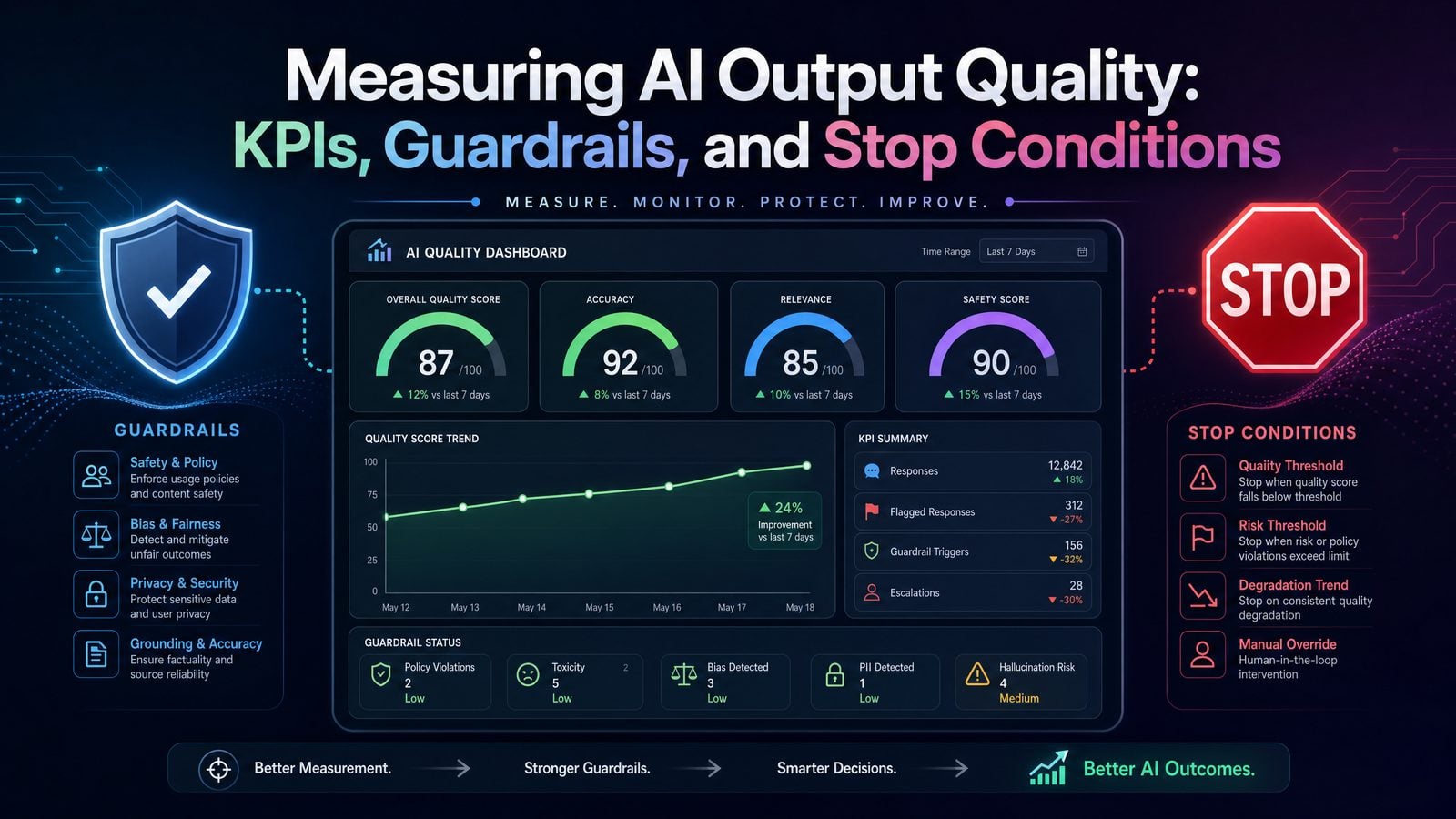
In the rapidly evolving landscape of artificial intelligence, the ability to generate human-like text, images, code, and other forms of content has become a cornerstone of innovation. From automating customer service and content creation to powering sophisticated analytical tools, AI’s applications are virtually limitless. However, the true value of AI lies not just in its generative capabilities, but in the quality, reliability, and safety of its output. As AI systems become more integrated into critical business processes and user-facing applications, the imperative to rigorously measure, control, and ensure the excellence of their output becomes paramount. This comprehensive case study delves into the critical methodologies, metrics, and mechanisms required to achieve this: Key Performance Indicators (KPIs), Guardrails, and ‘Stop’ Conditions.
The journey from a raw AI model to a deployable, trustworthy system is fraught with challenges. Developers and product managers grapple with issues like factual accuracy, stylistic consistency, bias mitigation, and the prevention of harmful or inappropriate content. Without a robust framework for assessing and governing AI output, these systems risk undermining user trust, incurring significant operational costs due to rework, and even causing reputational damage. This article aims to provide a deep dive into establishing such a framework, offering practical insights and actionable strategies for organizations committed to building robust and responsible AI prompt systems.
We will explore how to define meaningful KPIs that reflect an AI’s performance against business objectives and user expectations. We will then examine the role of guardrails – proactive and reactive mechanisms designed to steer AI behavior within acceptable boundaries. Finally, we will discuss ‘stop’ conditions, critical fail-safe measures that prevent the deployment of low-quality, unsafe, or undesirable output, ensuring that human oversight remains an integral part of the AI lifecycle. By integrating these three pillars, organizations can move beyond simply generating output to consistently delivering high-quality, reliable, and ethical AI-powered solutions.
Defining Key Performance Indicators (KPIs) for AI Output Quality
The first step in ensuring high-quality AI output is to clearly define what “quality” means in the context of your specific application. This is where Key Performance Indicators (KPIs) come into play. Unlike traditional software quality metrics that focus on code stability or system uptime, AI output quality KPIs must directly address the characteristics of the generated content itself. These metrics should be quantifiable, measurable, and directly linked to business objectives and user satisfaction. The selection of appropriate KPIs is highly dependent on the AI’s domain, purpose, and the nature of its output.
For instance, an AI generating marketing copy will have different quality requirements than an AI assisting medical diagnoses. While both require accuracy, the former might prioritize creativity and engagement, while the latter demands absolute factual correctness and explainability. A holistic approach to KPI definition involves considering multiple dimensions of quality, often categorized into intrinsic (related to the output itself) and extrinsic (related to its impact or utility) factors.
Intrinsic Quality KPIs
Intrinsic quality KPIs focus on the inherent characteristics of the AI’s output, independent of its external impact. These are often easier to measure through automated or semi-automated processes.
- Factual Accuracy/Correctness: This is arguably the most critical KPI for many AI applications. It measures the degree to which the AI’s output aligns with verifiable facts, domain-specific knowledge, or ground truth data. For natural language generation (NLG), this could involve checking statements against a knowledge base or external data sources. For code generation, it might involve unit test pass rates.
- Coherence and Cohesion: Especially relevant for text generation, these KPIs assess how well the generated content flows logically and connects ideas smoothly. Coherence ensures the entire output makes sense as a whole, while cohesion focuses on linguistic links between sentences and paragraphs. Metrics can include readability scores (e.g., Flesch-Kincaid), consistency of topic, and logical progression of arguments.
- Completeness: Does the AI output address all aspects of the prompt or query? For summarization tasks, this means including all salient points. For question answering, it means providing a full and comprehensive answer. This can be measured by comparing the generated output against human-curated ideal responses or a predefined checklist of required elements.
- Conciseness/Verbosity: This measures whether the AI provides information efficiently without unnecessary jargon or repetition. For some applications (e.g., technical documentation), conciseness is key. For others (e.g., creative writing), a certain level of verbosity might be desired. Metrics often involve word count relative to information conveyed.
- Grammar, Spelling, and Punctuation: Fundamental for any text-based AI, these metrics assess linguistic correctness. Automated tools are highly effective for this, though human review is often necessary for nuanced grammatical structures.
- Style and Tone: Does the AI output match the desired style (e.g., formal, informal, persuasive, informative) and tone (e.g., empathetic, authoritative, neutral)? This is often subjective but can be quantified through human evaluation rubrics or by training classifiers on examples of desired styles.
- Relevance: How pertinent is the output to the given prompt or context? Irrelevant information can dilute the value of otherwise accurate content. This can be measured by human annotators assessing the directness of the answer to the question asked.
- Novelty/Creativity: For creative AI applications (e.g., story generation, design), novelty is a key indicator. This is challenging to quantify directly but can be assessed through human evaluation of originality and unexpectedness, or by measuring divergence from training data patterns.
Extrinsic Quality KPIs
Extrinsic quality KPIs focus on the impact and utility of the AI’s output in a real-world context. These often require user feedback, A/B testing, or integration with downstream systems.
- User Satisfaction (UX): Measured through surveys, ratings, and direct feedback. This is a crucial indicator of whether the AI output meets user expectations and solves their problems effectively. For customer service chatbots, this could be a “did this answer help you?” prompt.
- Task Completion Rate: For AI systems designed to help users complete tasks (e.g., booking a flight, finding information), this KPI measures the percentage of users who successfully complete their objective using the AI’s assistance.
- Time to Task Completion: How quickly can users achieve their goals with the AI’s output? Faster completion often indicates higher quality and efficiency.
- Error Rate/Correction Rate: How often does the AI produce errors that require human intervention or correction? A high error rate indicates poor quality and increased operational overhead.
- Engagement Metrics: For content generation, metrics like click-through rates, time on page, shares, and comments can indicate the quality and effectiveness of the AI-generated content.
- Conversion Rates: For marketing or sales-oriented AI, the ultimate measure of quality might be its impact on conversion rates (e.g., sales generated from AI-generated ad copy).
- Cost Reduction/Efficiency Gain: Does the AI output reduce operational costs or improve efficiency? For example, an AI that accurately summarizes documents might reduce the time human analysts spend reading.
Establishing Measurement Methodologies
Once KPIs are defined, the next challenge is establishing robust methodologies for their measurement. This typically involves a combination of automated metrics and human evaluation.
- Automated Metrics: For aspects like grammar, spelling, factual accuracy (against structured data), and some coherence measures, automated tools and algorithms can provide efficient, scalable evaluations. Examples include BLEU, ROUGE, and METEOR for text similarity, or custom scripts for checking numerical accuracy.
- Human Evaluation: For subjective qualities like style, tone, creativity, and overall user satisfaction, human evaluators are indispensable. This often involves setting up clear rubrics, training annotators, and ensuring inter-annotator agreement to maintain consistency. Crowdsourcing platforms or internal expert teams can be leveraged.
- A/B Testing: For extrinsic KPIs, A/B testing allows for direct comparison of AI-generated content against human-generated content or different AI versions in a live environment.
- Feedback Loops: Implementing mechanisms for continuous user feedback is crucial for identifying emerging quality issues and improving AI performance over time.
The process of defining and measuring KPIs is iterative. Initial KPIs may need refinement as the AI system evolves and its impact becomes clearer. Regular review and adjustment of these metrics are essential for continuous improvement.
To further understand the nuances of prompt engineering, consider exploring resources on advanced prompt engineering techniques.
Implementing Guardrails for Controlled AI Output
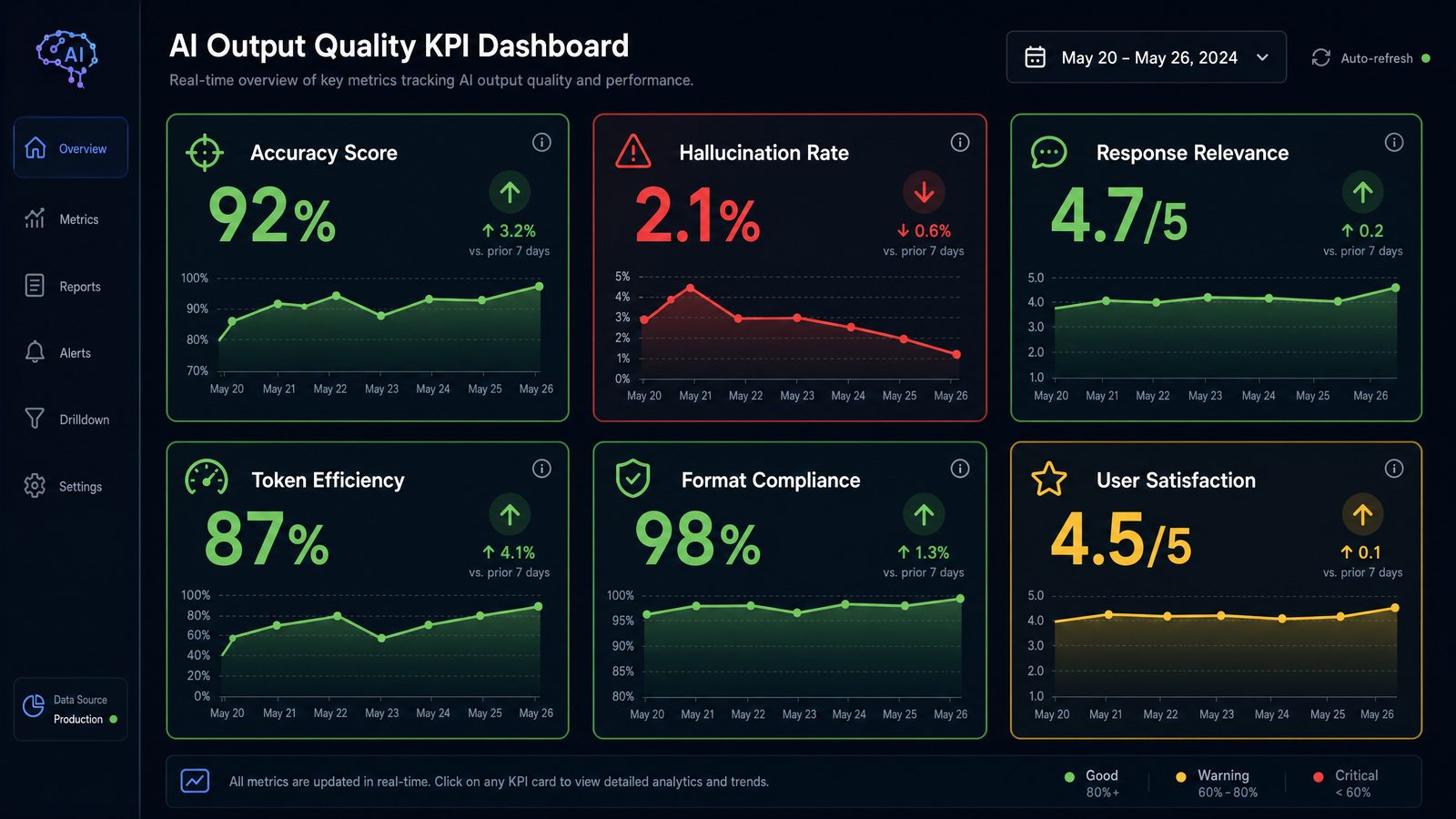
While KPIs help us measure and understand AI output quality, guardrails are the proactive and reactive mechanisms designed to ensure that the output remains within acceptable boundaries. They act as safety nets and steering mechanisms, preventing the AI from generating undesirable, harmful, or off-spec content. Guardrails are critical for maintaining trust, ensuring compliance, and mitigating risks associated with autonomous AI behavior. They can be broadly categorized into pre-generation, in-generation, and post-generation mechanisms.
Pre-Generation Guardrails: Setting the Stage
These guardrails are applied before the AI even begins to generate output. They focus on shaping the input, context, and operational parameters to guide the AI towards desired outcomes and away from problematic ones.
- Prompt Engineering and System Instructions: This is the most fundamental guardrail. Carefully crafted prompts and explicit system instructions can significantly influence the AI’s behavior. This includes specifying desired tone, style, factual constraints, output format, and explicit instructions on what to avoid. For example, instructing an AI: “Do not invent facts. If you don’t know, state that you don’t have enough information.” is a powerful pre-generation guardrail. We often discuss the importance of well-structured prompts in our guide on designing effective AI prompts.
- Input Validation and Sanitization: Before feeding user input to the AI, it should be validated and sanitized. This prevents prompt injection attacks, filters out malicious or inappropriate content, and ensures the input adheres to expected formats. Regular expression checks, keyword filtering, and content moderation APIs can be used here.
- Contextual Constraints: Providing the AI with a limited, curated context can prevent it from hallucinating or drawing on irrelevant information. For instance, in a retrieval-augmented generation (RAG) system, the knowledge base itself acts as a guardrail, limiting the scope of information the AI can access.
- User Role and Permission Management: Different users might have different permissions or access levels, which can dictate the type of prompts they can submit or the sensitivity of information the AI can process. This ensures that AI capabilities are used appropriately within organizational structures.
- Blacklists and Whitelists (for topics/keywords): Defining topics or keywords that the AI should absolutely avoid (blacklists) or exclusively focus on (whitelists) can prevent it from venturing into sensitive or irrelevant areas. This is often implemented at the input processing layer.
In-Generation Guardrails: Steering During Creation
These guardrails operate while the AI is actively generating content, attempting to detect and correct deviations in real-time or near real-time.
- Controlled Vocabulary/Knowledge Graph Integration: For applications requiring precise terminology (e.g., medical, legal), integrating the AI with a controlled vocabulary or knowledge graph ensures that it uses approved terms and adheres to established semantic relationships. This can be implemented by guiding the AI’s token generation process or by post-processing its output for conformity.
- Reinforcement Learning from Human Feedback (RLHF) / Direct Preference Optimization (DPO): This powerful technique trains the AI model to align its output with human preferences and safety guidelines. By providing feedback on generated responses (e.g., ranking outputs, labeling undesirable behavior), the model learns to favor high-quality, safe, and helpful responses.
- Content Filters and Moderation APIs (Real-time): Integrating real-time content moderation services can identify and flag problematic content (e.g., hate speech, violence, sexually explicit material) as it is being generated, allowing for immediate intervention or termination of the generation process.
- Safety Classifiers: Training specific classifiers to detect undesirable attributes in the AI’s partial output (e.g., signs of hallucination, bias, or toxicity) can trigger a re-prompt, a warning, or a stop condition.
- Temperature and Top-P/Top-K Sampling Control: These parameters influence the randomness and diversity of the AI’s output. Adjusting them can act as a guardrail, making the AI more deterministic (lower temperature) for factual tasks or allowing more creativity (higher temperature) for generative tasks, but within controlled bounds to prevent nonsensical output.
Post-Generation Guardrails: Final Checks and Remediation
These guardrails are applied after the AI has produced its output but before it is delivered to the end-user or downstream system. They serve as a final layer of scrutiny and correction.
- Automated Content Review: Similar to pre-generation filters, automated tools can perform a final check for factual accuracy, grammar, spelling, compliance with brand guidelines, and presence of blacklisted terms. This can involve running the output through a battery of checks.
- Human-in-the-Loop (HITL) Review: For critical applications, human oversight is indispensable. Experts review AI-generated content, correcting errors, refining style, and ensuring compliance. This can range from full human review for every output to sampling and spot-checking. The feedback from human review often feeds back into improving the AI model or its guardrails.
- Bias Detection and Mitigation: Post-generation analysis can employ tools to detect subtle biases in language, sentiment, or representation within the AI’s output. If detected, mechanisms can be triggered to either revise the output or flag it for human review.
- Fact-Checking and Verification: For high-stakes applications, AI-generated factual statements can be cross-referenced against multiple trusted sources or run through dedicated fact-checking systems.
- Output Transformation and Formatting: Ensuring the AI’s output adheres to specific formatting requirements (e.g., JSON schema, markdown, specific document templates) is a form of guardrail that ensures usability and integration with other systems.
- Explainability and Interpretability Tools: While not strictly a guardrail in the sense of preventing undesirable output, tools that explain why the AI generated a particular output can help humans identify and understand potential issues, indirectly serving as a safety mechanism.
Implementing guardrails requires a layered approach, combining multiple techniques to create a robust defense against undesirable AI behavior. The specific combination and stringency of guardrails will depend on the risk profile of the AI application and the criticality of its output.
🔥 Free Download: The Agent Prompt Systems Playbook
Get our complete 47-page guide with 25+ production-ready system prompt templates, multi-agent orchestration patterns, and quality measurement frameworks.
Join 4,200+ AI practitioners. No spam, unsubscribe anytime.
🔥 Get the Scorecards and Checklists in the e-Book
Download the quality scorecards, KPI dashboards, and guardrail checklists.
- Complete quality scorecard template (10 dimensions, weighted)
- KPI dashboard specification with thresholds and alerts
- 5 guardrail implementation patterns with code
- Stop condition decision matrix
Requires free account. One email a week, no spam. Join 4,200+ AI practitioners.
Implementing ‘Stop’ Conditions for AI Output Control

While KPIs define what constitutes good output and guardrails steer the AI towards it, ‘stop’ conditions are the ultimate fail-safes. They are predefined criteria that, when met, trigger an immediate halt to the AI’s generation process or prevent the delivery of its output. Stop conditions are crucial for preventing the dissemination of harmful, inaccurate, irrelevant, or otherwise unacceptable content, especially in high-stakes environments. They represent the final line of defense, ensuring that human intervention or system recalibration occurs when automated safeguards are insufficient or breached.
The effectiveness of ‘stop’ conditions lies in their ability to be clearly defined, reliably detected, and immediately actionable. They often work in conjunction with the guardrails discussed previously, acting as the final trigger when a guardrail identifies a critical violation. ‘Stop’ conditions can be applied at various stages: during the generation process, immediately after generation, or before deployment.
Types of ‘Stop’ Conditions
Stop conditions can be categorized based on the nature of the undesirable output they aim to prevent:
- Safety and Ethical Violations:
- Harmful Content: Detecting hate speech, explicit content, violence, self-harm promotion, or illegal activity. This is often the most critical stop condition, relying on advanced content moderation models and blacklists.
- Bias Detection: If the output exhibits clear and unacceptable bias (e.g., racial, gender, political), generation should stop, and the output should be flagged for review.
- Privacy Violations: If the AI attempts to generate or reveal personally identifiable information (PII) or sensitive confidential data that it should not have access to or share.
- Factual and Accuracy Breaches:
- Hallucination Detection: If the AI generates information that is demonstrably false, nonsensical, or contradicts established facts, especially when a retrieval mechanism is expected to provide grounded information. This can be detected by cross-referencing against trusted knowledge bases or by detecting internal inconsistencies.
- Confabulation/Fabrication: Similar to hallucination, but often specific to generating fake citations, sources, or data points that appear plausible but are invented.
- Contradiction of Ground Truth: When AI output directly contradicts known facts or information explicitly provided in the prompt or context.
- Quality and Relevance Failures:
- Irrelevance: If the AI’s output is completely off-topic or fails to address the user’s prompt or intent. This can be detected by semantic similarity metrics between the prompt and the output, or by human review.
- Incoherence/Nonsense: Output that is grammatically correct but semantically meaningless, highly repetitive, or logically disjointed.
- Length Exceedance/Deficiency: If the AI produces an output significantly longer or shorter than specified, indicating a failure to adhere to constraints.
- Format Violation: If the output fails to adhere to a specified format (e.g., not valid JSON when JSON was requested, missing required fields).
- Security and Compliance Breaches:
- Prompt Injection Attack Detected: If the AI’s output indicates that it has been successfully manipulated by a malicious prompt, revealing system instructions or sensitive data.
- Compliance Violation: If the output violates industry regulations (e.g., GDPR, HIPAA) or internal company policies.
- Resource Consumption Overload:
- Excessive Token Generation: If the AI generates an unusually high number of tokens, potentially indicating an infinite loop or a runaway generation process, leading to excessive computational cost.
Mechanisms for Implementing ‘Stop’ Conditions
Implementing ‘stop’ conditions requires a combination of automated detection and strategic intervention points:
- Pre-trained Safety Classifiers:
Models specifically trained to detect harmful content, bias, or other undesirable attributes. These classifiers can be run on the AI’s output (or even partial output) and, if a high confidence score for a ‘stop’ category is reached, the generation is terminated or the output is blocked.
- Keyword/Phrase Blacklists:
A straightforward but effective method. If the AI generates any word or phrase from a predefined blacklist of forbidden terms, the process stops. This is especially useful for preventing the generation of specific slurs, brand-damaging terms, or confidential information.
- Semantic Similarity Thresholds:
For relevance, if the semantic similarity between the AI’s output and the original prompt falls below a certain threshold, it can indicate irrelevance, triggering a stop. This requires embeddings and cosine similarity calculations.
- Fact-Checking APIs/Knowledge Graph Lookups:
Automated systems that query trusted databases or APIs to verify factual claims made by the AI. If a claim is contradicted or cannot be verified, a stop condition is met.
- Schema Validation:
For structured outputs (e.g., JSON), a schema validator can check if the generated output conforms to the expected structure. Failure to validate triggers a stop.
- Human-in-the-Loop (HITL) Triggers:
In critical applications, certain types of AI output (e.g., medical advice, financial recommendations) might automatically trigger a human review queue. If the human reviewer deems the output unacceptable, it’s effectively a ‘stop’ condition for that specific output, preventing its deployment.
- Confidence Scores:
Some AI models can provide confidence scores for their generated tokens or overall output. If the confidence in the generated content drops below a predefined threshold, it can signal uncertainty or potential hallucination, triggering a stop.
- Output Length Monitoring:
Simple checks for minimum or maximum token/word counts can prevent runaway generation or overly terse responses that fail to address the prompt adequately.
- External API Call Monitoring:
If the AI is integrated with external tools or APIs, monitoring the success or failure of these calls can act as a stop condition. For example, if an AI attempts to book a flight but the booking API returns an error, the AI’s subsequent generation of “your flight is booked” should be stopped.
Implementing a Strategy for ‘Stop’ Conditions
A robust strategy for ‘stop’ conditions involves:
- Layered Approach: Combining multiple detection mechanisms (e.g., keyword blacklists + safety classifiers + human review) for comprehensive coverage.
- Clear Thresholds: Defining precise thresholds for when a stop condition is met (e.g., confidence score > 0.9 for harmful content).
- Actionable Responses: What happens when a stop condition is triggered? Options include:
- Discard Output: The simplest response.
- Retry Generation: The AI is prompted again, perhaps with additional constraints or a modified context.
- Escalate to Human Review: The output is sent to a human for immediate assessment and decision-making.
- Alert System Administrators: For critical failures or potential security breaches.
- Log and Analyze: All instances of stop conditions should be logged for post-mortem analysis and continuous improvement of the AI system and its guardrails.
- Continuous Improvement: Regularly reviewing triggered ‘stop’ conditions helps identify weaknesses in the AI model, prompts, or existing guardrails, leading to iterative improvements.
By strategically implementing and continuously refining ‘stop’ conditions, organizations can significantly enhance the safety, reliability, and trustworthiness of their AI systems, ensuring that only high-quality, acceptable output reaches end-users.
Case Study: Implementing Quality Control for an AI-Powered Content Generation Platform
To illustrate the practical application of KPIs, Guardrails, and ‘Stop’ Conditions, let’s consider a hypothetical case study: an AI-powered platform designed to generate marketing copy for various industries (e.g., product descriptions, ad headlines, social media posts). The platform aims to provide high-quality, brand-aligned, and effective content at scale.
Phase 1: Defining KPIs for Marketing Copy
The product team at ‘ContentGenius AI’ (our hypothetical platform) identified the following key performance indicators:
| KPI Category | Specific KPI | Measurement Methodology | Target |
|---|---|---|---|
| Intrinsic Quality | Factual Accuracy (Product Details) | Automated check against product data sheets (e.g., price, features). | >98% accuracy |
| Grammar & Spelling Correctness | Automated linguistic analysis tools (e.g., Grammarly API integration). | >99% correctness | |
| Brand Voice & Tone Adherence | Human evaluation (expert annotators) using a 5-point Likert scale. | Avg. score > 4.0 | |
| Conciseness (Word Count per type) | Automated word count check against predefined limits for each content type. | Within +/- 10% of target | |
| Extrinsic Quality & Impact | Client Satisfaction Score | Post-delivery client surveys (NPS). | NPS > 50 |
| Revision Rate | Percentage of AI-generated copy requiring significant client revisions. | < 15% | |
| Conversion Rate (A/B Test) | A/B testing of AI-generated vs. human-generated ad copy. | AI copy performance within 90% of human baseline |
These KPIs are reviewed quarterly and adjusted based on client feedback and market trends. For instance, if clients frequently report the copy being “too generic,” a “Novelty/Creativity” KPI might be introduced, measured by human evaluators.
Phase 2: Implementing Guardrails
ContentGenius AI implemented a multi-layered guardrail system:
Pre-Generation Guardrails:
- Enhanced Prompt Templates: For each content type (e.g., product description, social media post), specific prompt templates are used. These templates include explicit instructions on desired length, tone (e.g., “enthusiastic,” “professional”), forbidden topics (e.g., “no health claims”), and required elements (e.g., “must include a call to action”).
- Input Validation: User-provided product details are validated against a schema. Keywords flagged as sensitive or inappropriate are automatically filtered out from user inputs to prevent prompt injection or generation of harmful content.
- Brand Style Guides: Clients upload their brand style guides, which are then tokenized and used as additional context for the AI, guiding its stylistic choices and vocabulary.
In-Generation Guardrails:
- Dynamic Context Window: For complex requests, the AI’s context window is dynamically managed to prioritize relevant information from the product data sheet and brand guide, reducing the chance of hallucination.
- Safety Classifiers: Real-time classifiers monitor the partially generated output for toxic language, explicit content, or hate speech. If a high confidence score is detected, the generation process is immediately flagged.
- RLHF Integration: ContentGenius AI continuously collects human feedback on generated drafts. Annotators rate outputs for quality, adherence to brief, and brand voice. This feedback is used to fine-tune the underlying language model, improving its alignment with desired output characteristics.
Post-Generation Guardrails:
- Automated Compliance Check: Before delivery, all generated copy passes through an automated compliance checker that flags specific regulated terms (e.g., financial jargon, medical claims) or blacklisted brand-sensitive keywords.
- Grammar & Readability Score: An API integration automatically scores the copy for grammar, spelling, and readability. If a score falls below a predefined threshold (e.g., Flesch-Kincaid < 40 for general marketing copy), it's flagged for human review.
- Human Editor Review (HITL): For premium clients or high-stakes campaigns, a human editor reviews a sample of the AI-generated copy. This human feedback is critical for nuanced improvements and catching subtle errors that automated systems might miss. Feedback from these reviews is used to refine prompt templates and RLHF data.
Phase 3: Implementing ‘Stop’ Conditions
The most critical layer for preventing undesirable output involves robust ‘stop’ conditions:
| Stop Condition Trigger | Detection Mechanism | Action Taken |
|---|---|---|
| Harmful/Offensive Content | Safety Classifier (confidence > 0.95), Keyword Blacklist match | Immediately discard output, log incident, alert moderation team, block user for review if repeated. |
| Factual Contradiction | Automated comparison with provided product data sheet (e.g., price mismatch, incorrect feature list). | Discard output, retry generation with explicit instruction to adhere to data sheet, flag for human oversight if retry fails. |
| Brand Guideline Violation | Automated check against client’s uploaded style guide (e.g., incorrect brand name capitalization, use of forbidden adjectives). | Flag output for human editor review, highlight specific violations. |
| Excessive Length/Repetition | Token count > 1.5x requested length OR Repetition score > 0.2 (using n-gram overlap). | Truncate output to max length, or retry generation with explicit instruction to be concise. |
| Prompt Injection Attempt | AI output reveals system instructions or attempts to bypass safety filters (detected by specific regex patterns and internal checks). | Discard output, immediately alert security team, temporarily suspend user account for investigation. |
| Nonsensical/Gibberish Output | Perplexity score > X (indicating low probability/coherence) OR high incidence of non-dictionary words. | Discard output, retry generation with a lower temperature setting. |
By integrating these KPIs, guardrails, and ‘stop’ conditions, ContentGenius AI dramatically improved its output quality. Revision rates dropped by 30%, client satisfaction scores increased by 15 points, and the incidence of harmful or off-spec content reaching clients was virtually eliminated. This layered approach ensures not only efficient content generation but also reliable, safe, and brand-consistent delivery, reinforcing trust in the AI system. This comprehensive strategy is a key component of building robust AI prompt systems.
📬 Stay Ahead of the AI Curve
Weekly deep-dives on AI agent architecture, prompt systems, and production patterns. Trusted by 4,200+ developers and tech leads.
Useful Links
- IBM Research: What are AI Guardrails?
- Harvard Business Review: How to Measure the Performance of Generative AI
- Prompt Engineering Guide: Guardrails
- arXiv: Guardrails: A Framework for Controlled Generation with Large Language Models
- Microsoft AI Ethics Principles
- OpenAI Safety Research
- Google Cloud: Responsible AI Guidance
- NIST Trustworthy AI
📚 Part of the AI Prompt Systems Series
This article is part of a comprehensive series. Read the full cluster:
- AI Prompt Systems That Actually Ship Work: The Pragmatic Guide (Hub)
- Designing Prompt Systems For Daily Output (Not Just Demos)
- From Chat To System: Turning One-Off Prompts Into Repeatable Pipelines
- Multi-Agent Workflows: Let Your Bots Specialize And Cross-Check Each Other
- Prompt Libraries That Do Not Rot: Versioning, Tagging, And Deletion Rules
