

What changed on August 29, 2026, and why enterprise API teams should care
On August 29, 2026, OpenAI marked mutual TLS and X.509 workload identity federation generally available for the OpenAI API. The release notes state that organizations can configure certificates and X.509 identity providers in the Platform console and control access through organization roles and permissions. For enterprise administrators, that matters because the security boundary for API access can now include both ordinary API authentication and cryptographic proof that the calling workload holds an accepted client certificate.
This guide treats those two capabilities as related but separate controls. Mutual TLS, or mTLS, verifies a client certificate during the TLS handshake before the API request is processed. X.509 workload identity federation uses a TLS client-certificate identity to obtain a short-lived OpenAI access token, which can replace a long-lived API key in the workload. The X.509 federation flow does not remove the need for mTLS: OpenAI’s documentation states that the workload then calls the API with both the short-lived token and an accepted certificate.
The practical result is a stronger identity chain for machine-to-machine traffic. A conventional API integration often depends on a bearer credential stored in a secrets manager, CI system, Kubernetes secret, local environment variable, or application configuration store. If that credential is copied into an unauthorized environment, the receiving API may not be able to distinguish the legitimate service from the impostor. With mTLS enabled on OpenAI’s dedicated mTLS hosts, the caller must also prove possession of the private key corresponding to an accepted certificate. With X.509 workload identity federation, the workload can additionally avoid embedding a static OpenAI API key and instead exchange its certificate-backed identity for a short-lived OpenAI access token.
That distinction is the foundation for the rest of this guide: mTLS is a transport-layer client-authentication gate, while X.509 workload identity federation is a token-issuance pattern that uses certificate identity as an input. Treating them as interchangeable leads to dangerous designs. Treating them as complementary lets security teams reduce static-secret exposure, constrain API access to known workload identities, and implement certificate rotation as a planned operational process instead of an emergency response.
The OpenAI API Security decision in OpenAI API Mutual TLS and X.509 Workload Identity: Complete Enterprise Security Guide is easier to apply when teams also understand Codex API Integration Masterclass: 30 Production-Ready Prompts for Building Custom Endpoints, Webhook Handlers, Authentication Flows, and Rate-Limited Service Architectures. That article focuses specifically on codex API Integration Masterclass: 30 Production-Ready Prompts for Building Custom Endpoints, Webhook Handlers, Authentication Flows, and Rate-Limited Service Architectures, providing the adjacent implementation, comparison, or governance context needed to use this section without treating the two topics as interchangeable.
The Enterprise AI Governance decision in OpenAI API Mutual TLS and X.509 Workload Identity: Complete Enterprise Security Guide is easier to apply when teams also understand How Enterprise AI Governance Is Evolving in 2026: From Microsoft Purview to OpenAI’s Built-In Compliance Tools. That article focuses specifically on how Enterprise AI Governance Is Evolving in 2026: From Microsoft Purview to OpenAI’s Built-In Compliance Tools, providing the adjacent implementation, comparison, or governance context needed to use this section without treating the two topics as interchangeable.
The threat model: what mTLS and X.509 federation are designed to reduce
The most important threat is not “someone breaks TLS.” Ordinary HTTPS already encrypts traffic and authenticates the server to the client. The enterprise risk addressed here is different: a workload that possesses a valid bearer credential may be accepted even if it is running in the wrong environment, under the wrong operator, or from an attacker-controlled host. A leaked API key can be used wherever the platform accepts that key unless additional controls prevent the request from succeeding.
mTLS narrows that risk by requiring the client to present a certificate that OpenAI has been configured to accept. The certificate is not merely a label in a request header; it is verified as part of the TLS connection using cryptographic proof of private-key possession. An attacker who only copied an API key would still fail if they could not also present an accepted client certificate and complete the TLS handshake against the dedicated mTLS endpoint.
X.509 workload identity federation narrows a second risk: the operational burden and blast radius of long-lived API keys. Instead of storing a static OpenAI API key in a service, the workload exchanges a TLS client-certificate identity for a short-lived OpenAI access token. OpenAI’s guide states that the flow produces no refresh token. That detail is operationally significant: if the token expires, the workload must perform the exchange again rather than silently refreshing through a long-lived secondary credential.
These controls do not eliminate every attack path. OpenAI’s mTLS documentation states that mTLS does not perform CRL or OCSP checks, so revocation cannot be treated as a real-time certificate-status dependency in the OpenAI request path. The same guide states that mTLS is incompatible with Private Link. Teams that rely on private network connectivity patterns must account for that limitation before committing to an architecture that assumes both controls can be combined.
The useful security question is therefore not “does mTLS make API abuse impossible?” It does not. The better question is: “Which credential theft or workload impersonation scenarios become harder, easier to detect, or easier to contain?” If an attacker steals only an API key, mTLS can block use from a host without the certificate. If an attacker steals only a client certificate without the corresponding private key, the certificate alone should not satisfy the TLS proof. If an attacker compromises the actual workload host that holds both token and key material, mTLS does not by itself prevent requests; containment then depends on project permissions, organization roles, monitoring, rotation, and incident response.
How mTLS changes ordinary OpenAI API authentication
OpenAI’s mTLS guide describes mTLS as adding client-certificate verification on top of ordinary API authentication. That phrase is important. mTLS does not replace bearer credentials. A request to an mTLS host still needs ordinary API authentication, while the TLS session must also include an accepted client certificate. In practical terms, the platform is checking both “does this request carry an accepted API credential?” and “did the TLS client prove possession of an accepted certificate?”
OpenAI documents dedicated mTLS hosts: mtls.api.openai.com, mtls-us.api.openai.com, and mtls-eu.api.openai.com. Enterprise teams should not assume that enabling mTLS on the organization automatically changes behavior for every existing client pointed at the ordinary API host. Clients that are meant to use mTLS must be configured to call the dedicated mTLS host and to present the configured client certificate and private key during the TLS handshake.
OpenAI’s documentation also states that mTLS supports organization and project activation, as well as CEL certificate filters. The operational meaning is that administrators can scope where mTLS is required and can express certificate-attribute acceptance rules. A conservative rollout normally begins with a single non-production project, a narrow certificate population, and explicit verification that only the intended workloads can complete calls through the mTLS endpoint.
| Control layer | Verified OpenAI behavior | Practical implication for administrators |
|---|---|---|
| Ordinary API authentication | mTLS does not replace bearer credentials. | Keep managing API credentials or access tokens; do not remove application authentication because a certificate is present. |
| Client-certificate verification | mTLS adds certificate verification on dedicated mTLS hosts. | Configure clients to use the mTLS host and present the certificate and private key during connection setup. |
| Organization and project activation | OpenAI documents activation at organization and project level. | Roll out by project and avoid forcing untested certificate requirements onto unrelated integrations. |
| Certificate filters | OpenAI documents CEL certificate filters. | Use certificate attributes to restrict which issued workload certificates are accepted instead of trusting every certificate from a broad source. |
| Revocation checks | OpenAI states mTLS does not perform CRL or OCSP checks. | Plan containment around disabling configuration, rotating certificates, narrowing filters, and replacing credentials rather than relying on live revocation lookup. |
The following is a simplified example, not a complete production prescription. It shows the two-authentication-layer mental model: the client presents a certificate at the TLS layer and also sends a bearer credential at the HTTP layer. Use the host and credential type that match your configured OpenAI deployment and follow OpenAI’s current API documentation for request body details.
# Example only: illustrate the mTLS + bearer-auth pattern.
# The client certificate and private key participate in the TLS handshake.
# The Authorization header remains ordinary API authentication.

curl https://mtls.api.openai.com/ \
  --cert /path/to/workload-client.crt \
  --key /path/to/workload-client.key \
  -H "Authorization: Bearer $OPENAI_ACCESS_TOKEN"
For platform teams, the most common deployment error is enabling a new security layer without updating the calling libraries, proxies, service meshes, and egress controls that actually create the outbound TLS session. A workload may have the right bearer credential but still fail if its HTTP client cannot present a client certificate. Conversely, a client may present a certificate successfully but fail ordinary API authentication if the token or API key is missing, expired, revoked, or unauthorized for the target organization or project.
How X.509 workload identity federation fits into the authentication chain
OpenAI’s X.509 workload identity federation guide states that a workload exchanges a TLS client-certificate identity for a short-lived OpenAI access token. The workload then calls the OpenAI API with both the token and an accepted certificate. The flow is therefore best understood as API-key replacement, not certificate replacement. It reduces dependence on static OpenAI API keys inside workloads, but it still requires the mTLS certificate path for API calls.
This distinction is especially important when designing secret storage. If a team says, “we adopted X.509 federation, so we no longer need mTLS,” the design is inconsistent with OpenAI’s documented flow. If a team says, “we adopted mTLS, so we no longer need bearer authentication,” that is also inconsistent with OpenAI’s mTLS guide. The supported pattern is layered: certificate-backed workload identity is used to obtain a short-lived OpenAI access token, and the API call is made with both that token and an accepted client certificate.
The “no refresh token” behavior should influence service design. A long-running worker, batch job, or daemon must be able to request a new short-lived access token when needed. Operators should treat token acquisition failures as a first-class dependency failure, not as an unexpected application bug. Recommended practice is to expose clear telemetry for token-exchange attempts, token age, certificate expiration, mTLS handshake failures, and API authorization failures, while avoiding logging private keys, full bearer tokens, or sensitive certificate material.
| Question | mTLS answer | X.509 workload identity federation answer |
|---|---|---|
| What problem does it primarily address? | Verifies that the API client holds an accepted client certificate during TLS setup. | Lets a workload obtain a short-lived OpenAI access token from a TLS client-certificate identity. |
| Does it replace bearer authentication? | No. OpenAI states mTLS adds verification on top of ordinary API authentication. | It can replace an API key with a short-lived access token, but the resulting API call still uses bearer-style authentication. |
| Does it replace the client certificate? | No. The client certificate is the core mTLS credential. | No. OpenAI states the workload calls the API with both the token and an accepted certificate. |
| Does it issue a refresh token? | Not applicable to the mTLS handshake itself. | No. OpenAI’s guide states that the flow produces no refresh token. |
A useful architecture pattern is to assign each production workload a certificate identity that maps to its operational role, environment, and project boundary. The exact certificate fields and filter expressions must be designed against your certificate authority profile and OpenAI’s documented CEL certificate-filter support. The decision rule is simple: certificate identity should be specific enough that accepting one workload does not accidentally accept every service that happens to share the same issuing chain.
Why Codex uses other workload-identity methods
OpenAI’s X.509 workload identity federation documentation states that the X.509 federation flow is available for the OpenAI API but not Codex. For Codex, OpenAI points to OIDC or SPIFFE JWT-SVID workload identity instead. Enterprise teams should treat that as a product boundary, not as a temporary implementation detail to route around unless OpenAI’s documentation changes.
The operational reason to call this out early is that many organizations run both API workloads and developer-agent workflows under one governance program. A platform team may want a single “workload identity” standard across services, build systems, agents, and developer tooling. OpenAI’s documented support does not allow that standard to be expressed as X.509 federation for Codex. If the workload is calling the OpenAI API, X.509 federation is in scope. If the workload is Codex, use the documented Codex-compatible methods: OIDC or SPIFFE JWT-SVID.
This boundary prevents a common misconfiguration: issuing X.509 client certificates to every automation component and assuming all OpenAI products will exchange those identities the same way. The OpenAI API mTLS and X.509 federation guides support a specific API authentication architecture. Codex has a separate supported workload-identity path. Governance documents, runbooks, and identity-provider diagrams should show those paths separately so auditors and operators do not infer nonexistent cross-product support.
Operational warning: Do not describe X.509 workload identity federation as “OpenAI workload identity for everything.” Based on OpenAI’s documentation, it is an OpenAI API flow, not a Codex flow. Codex uses OIDC or SPIFFE JWT-SVID workload identity.
The opening deployment decision: keys, certificates, tokens, or all three?
The right starting point depends on the risk you are trying to reduce. If your immediate concern is that copied API credentials could be used from unauthorized environments, begin with mTLS on a non-production project and verify that only clients with accepted certificates can call the dedicated mTLS host. If your immediate concern is long-lived API keys inside workloads, evaluate X.509 workload identity federation so services can obtain short-lived OpenAI access tokens instead of storing static OpenAI API keys. If both risks matter, design the combined flow from the beginning, because OpenAI’s X.509 federation pattern still expects API calls to use an accepted certificate.
Recommended rollout sequence: first inventory API clients, projects, owners, runtime environments, and credential storage locations; second, choose a certificate issuance pattern that can support rotation with overlap; third, configure a narrow OpenAI mTLS policy in the Platform console; fourth, validate client behavior against the dedicated mTLS host; fifth, introduce X.509 workload identity federation for workloads that are ready to replace API keys with short-lived tokens; and sixth, document failure modes for expired certificates, failed token exchanges, and authorization denials. This sequence is a recommendation, not an OpenAI-stated requirement, but it aligns with the documented need for accepted certificates, bearer authentication, role and permission control, and certificate rotation with overlap.
The rest of this guide will build on that foundation: mTLS is the certificate gate, X.509 federation is the short-lived token path, ordinary API authorization still matters, certificate rotation is mandatory operational work, and Codex must be handled through its documented OIDC or SPIFFE JWT-SVID workload-identity methods rather than the API’s X.509 federation flow.
Reference architecture: trust anchors, certificate gates, and X.509 token exchange

OpenAI’s August 29, 2026 general availability release makes mutual TLS and X.509 workload identity federation configurable in the Platform console, with access governed through organization roles and permissions. Architecturally, this creates two separate but complementary control planes: an mTLS control plane that decides whether a presented client certificate is acceptable, and an X.509 federation control plane that decides whether that certificate identity may be exchanged for a short-lived OpenAI access token. Treat those as separate layers because the official guidance is explicit that mTLS does not replace bearer authentication, and X.509 federation replaces an API key but not mTLS.
At the network boundary, API clients that use mTLS must call OpenAI’s dedicated mTLS hosts rather than the ordinary API host. The documented hosts are mtls.api.openai.com, mtls-us.api.openai.com, and mtls-eu.api.openai.com. A workload identity deployment should therefore make the target hostname a first-class configuration value, not a hard-coded string buried in application code, because region routing, staging rollout, and emergency fallback procedures all depend on knowing which client fleet is using which mTLS endpoint.
| Architecture layer | What it verifies | Primary configuration location | Operational warning |
|---|---|---|---|
| Dedicated mTLS host | The client connects to an mTLS-specific OpenAI hostname and presents a TLS client certificate during handshake. | Client HTTP/TLS configuration, service mesh egress policy, proxy policy, or workload runtime configuration. | OpenAI documents mTLS as incompatible with Private Link, so do not design a deployment that assumes both controls can be stacked. |
| Trust anchor | The presented client certificate chains to a configured certificate authority or other accepted trust anchor. | OpenAI Platform console mTLS certificate configuration. | OpenAI does not perform CRL or OCSP checks for this feature, so revocation response must rely on certificate removal, filter changes, rotation, and short validity windows. |
| Certificate filter | The certificate also satisfies configured CEL certificate filters, such as environment, subject, or SAN-based rules. | OpenAI Platform console mTLS settings at the applicable organization or project scope. | A broad trust anchor without a restrictive filter can unintentionally accept every workload certificate issued by that CA. |
| X.509 identity provider | The certificate identity is recognized as an allowed workload identity for federation. | OpenAI Platform console X.509 identity provider configuration. | X.509 federation is available for the OpenAI API, but the official guide says it is not available for Codex. |
| Service-account mapping | The verified certificate attributes map to an OpenAI service account authorized for the intended API use. | OpenAI organization/project identity and access configuration. | Many workloads sharing one service account make incident response and least-privilege review harder. |
Trust anchors: what OpenAI should trust, not which app should call the API
A trust anchor is the certificate authority material that lets OpenAI validate a client certificate chain. In a typical enterprise design, the trust anchor is not the leaf certificate installed on a pod, VM, job runner, or service mesh sidecar. It is the issuing root or intermediate authority that OpenAI should trust for a defined population of workloads. This distinction matters because a CA-level trust anchor can authorize future certificates automatically, while a leaf-only design forces frequent console changes and increases the chance of emergency outages during rotation.
The safer enterprise pattern is to dedicate one issuing path to OpenAI API workloads instead of reusing a general-purpose internal PKI hierarchy. For example, an organization might have a corporate root CA, an intermediate CA for production service identities, and a subordinate issuing profile specifically for OpenAI API workloads. The OpenAI-side trust anchor can then be paired with filters that require OpenAI-specific subject alternative names, workload namespaces, or environment markers. This prevents a certificate issued for an unrelated database, proxy, or internal service from becoming acceptable merely because it chains to the same broad enterprise CA.
OpenAI’s mTLS guide states that certificate rotation should be performed with overlap. The practical meaning is that the new trust path and the old trust path must both validate during a planned transition window, while clients are gradually updated to present new certificates. Do not replace a CA, intermediate, or certificate filter in a single irreversible step unless you have verified that every client fleet has already switched. A failed chain validation happens before application-level retry logic can fix the request, so certificate cutovers need the same change-management discipline as DNS, root CA, and production ingress changes.
Recommendation: maintain a small inventory for every OpenAI-facing certificate authority: owner, environment, issuing system, validity period, expected certificate subject/SAN pattern, associated OpenAI organization or project, rotation date, and emergency disable procedure. This inventory is more useful during an incident than a generic PKI diagram because it connects trust material to API blast radius.
Organization versus project activation
OpenAI documents both organization and project activation for mTLS. Use the organization scope when the same certificate acceptance policy should be treated as a baseline control across the organization. Use project scope when teams need a phased rollout, separate trust anchors, different filters, or an isolated validation path before making mTLS the default for a broader API estate. The project-scope option is especially useful when production, staging, and regulated workloads have different certificate issuers or different service-account mappings.
| Activation choice | When it fits | Example decision rule | Risk to manage |
|---|---|---|---|
| Organization activation | Central platform teams manage OpenAI API access and want one baseline mTLS policy for the organization. | Use when all projects can rely on the same CA family and the same certificate naming convention. | A bad filter or expired trust anchor can affect many projects at once, so changes need central review and rollback planning. |
| Project activation | Individual product teams need independent rollout, workload separation, or environment-specific controls. | Use when production and non-production workloads have different PKI issuers or different OpenAI service accounts. | Project-by-project policy drift can accumulate unless the platform team reviews trust anchors and filters regularly. |
| Hybrid rollout | Teams pilot mTLS at project scope, then promote a hardened policy to organization scope after evidence collection. | Use when the enterprise is migrating from API keys to X.509 federation and wants a staged failure domain. | Clients must be tested against the correct mTLS host and scope before promotion. |
Access to the mTLS configuration itself should be restricted through the documented organization roles and permissions. The relevant permissions are api.mtls.read for viewing mTLS configuration and api.mtls.write for modifying it. A production administrator who can change trust anchors or certificate filters can effectively decide which workloads may reach protected API paths, so api.mtls.write should be treated like a privileged security-administration permission rather than a routine developer permission.
For separation of duties, grant api.mtls.read to platform operators, security reviewers, and incident responders who need visibility into certificate policy. Grant api.mtls.write only to the small group that owns API authentication controls and has an approved change process. If your organization uses separate PKI and OpenAI platform teams, require both groups to approve trust-anchor changes: the PKI team validates issuance scope and AKI behavior, while the OpenAI platform team validates project impact and service-account mappings.
Certificate-chain requirements, AKI, and rotation design
The client must present a certificate chain that OpenAI can validate back to a configured trust anchor. In practical TLS deployments, that means the workload presents its leaf certificate and the required intermediate certificates, while the trust anchor configured in OpenAI represents the accepted issuer path. Missing intermediates are a common production failure mode because many local test clients can validate using cached intermediates, while a remote verifier cannot build the chain unless the client or server-side trust configuration supplies the necessary material.
Authority Key Identifier, usually abbreviated AKI, is important because it links a certificate to the authority that issued it. In an enterprise PKI with multiple intermediates, cross-signing, or parallel rotation, AKI helps chain builders select the correct issuer. The operational rule is simple: make AKI part of the certificate issuance profile for OpenAI-facing workload certificates, verify that it matches the intended issuer, and test chain validation before deploying the certificate to production clients. During CA rotation, mismatched AKI and Subject Key Identifier values can produce failures that look like generic TLS handshake errors from the application’s perspective.
| Certificate property | Architecture purpose | Recommended validation before rollout |
|---|---|---|
| Leaf certificate validity period | Limits exposure if a workload certificate is copied or a workload identity is retired. | Confirm the certificate is currently valid and expires after the planned deployment window, not during it. |
| Complete intermediate chain | Allows OpenAI to build a path from the workload certificate to the configured trust anchor. | Test from the same runtime, sidecar, proxy, or language TLS library that production uses. |
| Authority Key Identifier | Identifies the issuing authority and reduces ambiguity during issuer selection. | Compare AKI on the leaf with the issuer’s Subject Key Identifier as part of certificate linting. |
| Subject Alternative Name | Provides stable workload identity attributes for filters and provider mappings. | Prefer predictable URI or DNS SAN conventions over mutable common names. |
| Client authentication usage | Constrains the certificate profile to TLS client authentication use. | As a recommended issuance practice, include client-auth usage in the OpenAI workload certificate profile. |
# Illustrative certificate lint checklist for an OpenAI-facing workload certificate.
# This is an operator checklist, not an OpenAI API object.

certificate_profile:
  purpose: "OpenAI API mTLS client authentication"
  environment: "production"
  required_checks:
    - leaf_certificate_is_not_expired
    - leaf_certificate_chains_to_openai_configured_trust_anchor
    - intermediate_certificates_are_presented_by_client_runtime
    - authority_key_identifier_matches_expected_issuer
    - san_contains_stable_workload_identity
    - certificate_rotation_overlap_window_is_scheduled
  operational_notes:
    - "OpenAI mTLS does not perform CRL or OCSP checks."
    - "Emergency disablement should remove or narrow trust, or tighten the certificate filter."
    - "Clients must use mtls.api.openai.com, mtls-us.api.openai.com, or mtls-eu.api.openai.com."
Certificate filters and X.509 provider attributes
OpenAI’s mTLS guide supports CEL certificate filters. In architecture terms, a trust anchor answers “was this certificate issued by an authority I trust?” while a CEL filter answers “is this particular certificate one I want to accept for this organization or project?” The filter layer is where enterprises should encode workload boundaries such as environment, namespace, service name, or certificate SAN convention. A filter should be narrow enough that an unrelated certificate from the same CA does not pass.
The Workload Identity Federation decision in OpenAI API Mutual TLS and X.509 Workload Identity: Complete Enterprise Security Guide is easier to apply when teams also understand ChatGPT Is Now a Login Provider: What It Means for Developers and the Future of Identity. That article focuses specifically on chatGPT Is Now a Login Provider: What It Means for Developers and the Future of Identity, providing the adjacent implementation, comparison, or governance context needed to use this section without treating the two topics as interchangeable.
The most robust provider mappings use stable certificate attributes that are controlled by the workload identity platform, not values that individual application teams can freely choose. In Kubernetes, that might be a URI SAN convention tied to namespace and service account. In a VM-based platform, it might be a DNS SAN or URI SAN issued only by a machine-identity CA. The exact attribute names available in the Platform console should be taken from OpenAI’s current X.509 provider UI and documentation, but the design principle is consistent: map from verifiable certificate identity to the narrowest OpenAI service account that can perform the required API task.
# Illustrative policy design document for certificate filtering and provider mapping.
# This is not a copy-paste OpenAI console export. Adapt attribute names to the
# exact fields exposed by the OpenAI Platform console.

openai_mtls_policy:
  scope: "project: production-customer-support"
  trust_anchor: "OpenAI workload issuing CA - prod"
  certificate_filter_intent:
    require_environment: "prod"
    require_workload_namespace: "customer-support"
    require_identity_prefix: "spiffe://company.example/prod/customer-support/"
  accepted_hosts:
    - "mtls.api.openai.com"
    - "mtls-us.api.openai.com"
    - "mtls-eu.api.openai.com"

x509_identity_provider:
  provider_name: "prod-customer-support-x509"
  attribute_sources:
    workload_identity: "certificate URI SAN"
    issuer_context: "certificate issuer chain"
    environment: "certificate SAN or issuance profile"
  service_account_mappings:
    - certificate_identity: "spiffe://company.example/prod/customer-support/summarizer"
      openai_service_account: "svc-openai-prod-support-summarizer"
      allowed_project: "production-customer-support"
    - certificate_identity: "spiffe://company.example/prod/customer-support/classifier"
      openai_service_account: "svc-openai-prod-support-classifier"
      allowed_project: "production-customer-support"
Service-account mappings: keep identity, authorization, and audit aligned
Service-account mappings are the authorization hinge in an X.509 federation deployment. The certificate proves a workload identity, the provider recognizes that identity, and the mapping determines which OpenAI service account receives the short-lived access token. If two unrelated workloads map to the same OpenAI service account, later audit records and incident scoping become less precise. If one workload maps to several service accounts without a clear reason, operators may not know which access path to disable during an incident.
A practical mapping rule is one workload identity per OpenAI service account unless there is a documented operational reason to share. Separate production from staging, batch from online traffic, and customer-facing from internal automation. If the same application has two materially different API roles, such as “generate user-facing responses” and “perform offline evaluation,” use different workload certificates or different certificate attributes so the provider can map them to different service accounts.
| Mapping pattern | Use it when | Avoid it when |
|---|---|---|
| One certificate identity to one OpenAI service account | You need clear auditability, fast disablement, and least privilege. | Almost never; this is the default enterprise pattern. |
| Many certificate identities to one OpenAI service account | The identities are replicas of the same workload across equivalent nodes or regions. | The workloads have different owners, data classes, environments, or incident-response procedures. |
| One certificate identity to multiple OpenAI service accounts | You have a controlled broker that selects a role for a specific task and logs that decision. | Ordinary applications could accidentally request a broader role than intended. |
The five-part exchange flow
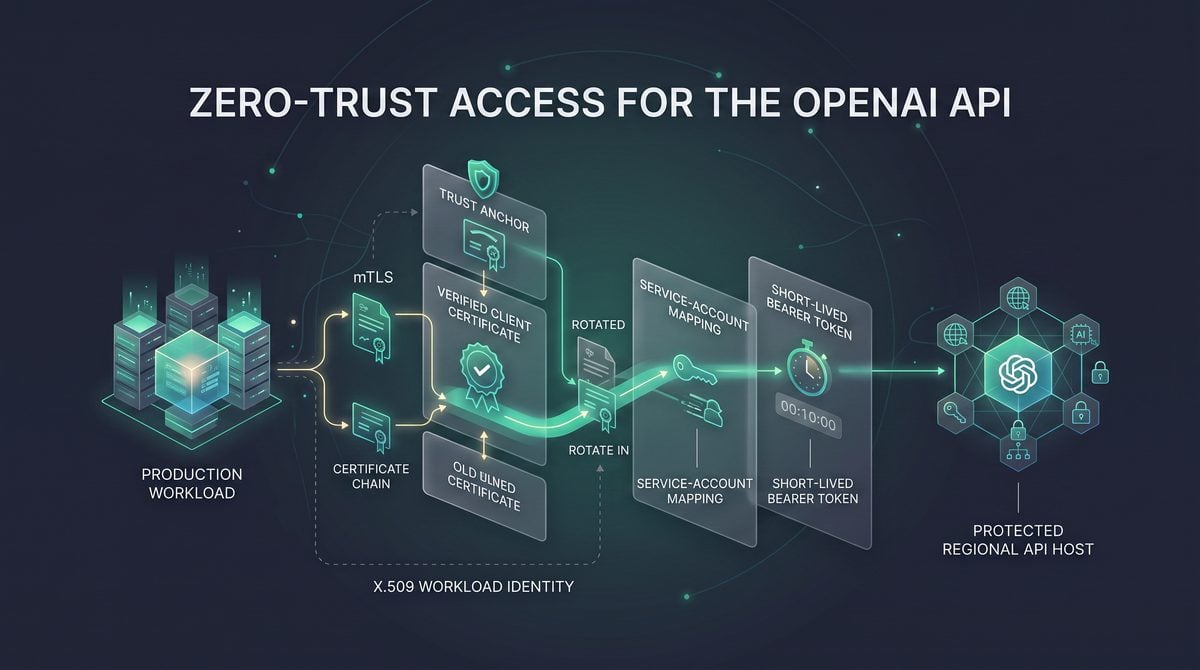
The complete request path has five parts. First, the workload connects to one of OpenAI’s dedicated mTLS hosts and presents its client certificate chain during the TLS handshake. Second, OpenAI validates that the chain terminates at a configured trust anchor and satisfies the applicable organization or project certificate filter. Third, the X.509 identity provider evaluates the verified certificate attributes and matches them to a configured service-account mapping. Fourth, OpenAI issues a short-lived access token for that service account; the official X.509 guide states that no refresh token is produced. Fifth, the workload calls the OpenAI API using the short-lived token while continuing to present an accepted certificate over mTLS.
- mTLS connection: the client uses
mtls.api.openai.com,mtls-us.api.openai.com, ormtls-eu.api.openai.comand presents its certificate chain. - Certificate acceptance: OpenAI checks the chain against configured trust anchors and applies the relevant CEL certificate filters.
- Provider evaluation: the X.509 identity provider reads certificate identity attributes that the administrator has chosen for workload recognition.
- Token issuance: the workload receives a short-lived OpenAI access token for the mapped service account, without a refresh token.
- API call: the workload sends API requests with both the accepted client certificate and the short-lived bearer token.
This flow has an important failure-mode advantage over static API keys: a copied token alone is not enough if the API call still requires an accepted client certificate, and a copied certificate alone is not enough if the attacker cannot obtain a valid short-lived token for the mapped service account. The design is not a substitute for secret handling, endpoint egress control, or runtime hardening, but it gives enterprise administrators two independently managed revocation levers: certificate trust/filter policy and service-account federation policy.
# Illustrative application runtime configuration.
# Field names are examples for an internal deployment manifest, not OpenAI SDK parameters.

openai_api_client:
  base_url: "https://mtls-us.api.openai.com"
  authentication_mode: "x509_workload_identity_federation"
  mtls:
    client_certificate_file: "/var/run/workload-certs/tls.crt"
    client_private_key_file: "/var/run/workload-certs/tls.key"
    certificate_chain_file: "/var/run/workload-certs/chain.pem"
  token_exchange:
    provider: "prod-customer-support-x509"
    service_account_expected: "svc-openai-prod-support-summarizer"
    refresh_token_expected: false
  safeguards:
    fail_closed_if_certificate_missing: true
    fail_closed_if_token_exchange_fails: true
    log_certificate_expiry_days_remaining: true
    alert_before_certificate_expiry_days: 14
The last configuration example is intentionally written as an internal manifest rather than a claimed OpenAI endpoint contract. Use it to align platform, PKI, and application teams on the values that must exist somewhere in the deployment: the mTLS hostname, certificate file paths or secret mounts, provider identity, expected service account, failure behavior, and expiry alerting. The exact OpenAI console fields and SDK wiring should be implemented from the current official mTLS and X.509 workload identity federation documentation at the time of deployment.
Staged deployment and rotation runbook for OpenAI API mTLS and X.509 federation

This deployment runbook treats mutual TLS and X.509 workload identity federation as separate controls that are deployed together only after each one is proven independently. OpenAI’s August 29, 2026 release made mutual TLS and X.509 workload identity federation generally available for the API, with configuration in the Platform console and access controlled through organization roles and permissions. The operational implication is that security teams should not treat the feature as a client-library toggle; it changes endpoint selection, certificate lifecycle, project activation, token acquisition, monitoring, and incident rollback.
Recommendation: start in a noncritical project, not in an organization-wide production scope. OpenAI’s mTLS guide supports organization and project activation, so the safest first stage is a disposable or low-impact project with one known workload, one certificate chain, one trust anchor, and one explicit owner. This limits blast radius if a certificate filter, trust-anchor chain, client key permission, or regional hostname is misconfigured.
Deployment stages and exit criteria
| Stage | Primary action | Exit criteria | Common rollback |
|---|---|---|---|
| 1. Noncritical project test | Enable mTLS for one test project and one client certificate identity. | Client can call the API through an OpenAI mTLS host while still using ordinary bearer authentication. | Disable project activation or restore the previous accepted trust anchor and filter configuration. |
| 2. Certificate filter validation | Apply CEL certificate filters that match only the intended certificate attributes. | Expected certificate succeeds; nearby negative test certificates fail. | Revert to the last known-good filter or remove the newly added filter from the test project. |
| 3. X.509 token exchange | Exchange the client-certificate identity for a short-lived OpenAI access token. | Workload calls the API with both the accepted certificate and the short-lived token. | Return the test workload to API-key authentication while the mTLS certificate path remains unchanged. |
| 4. Regional host verification | Test mtls.api.openai.com, mtls-us.api.openai.com, or mtls-eu.api.openai.com according to the project’s approved routing policy. |
DNS, firewall, proxy, certificate presentation, and bearer-token behavior are verified for the chosen host. | Route back to the previously approved host; do not silently substitute regions without policy approval. |
| 5. Production rollout | Expand by project or workload class, preserving overlap between old and new trust anchors during rotation. | Production error budget remains within tolerance and certificate expiration alerts are active. | Re-enable the previous trust anchor, pause rollout, and shift affected workloads back to the prior credential path. |
The table deliberately separates mTLS from X.509 federation. OpenAI’s mTLS support adds client-certificate verification on top of ordinary API authentication; it does not replace bearer credentials. OpenAI’s X.509 workload identity federation replaces an API key with a short-lived OpenAI access token, but the subsequent API call still needs both the accepted certificate and the token. Teams that skip this distinction often misdiagnose failures: a TLS handshake error, a certificate-filter denial, an expired token, and a permission denial can all look like “auth is broken” unless logs preserve the stage that failed.
Stage 1: prove mTLS with an API key before adding token exchange
Begin with a call that changes only the transport endpoint and client-certificate presentation. Use one of OpenAI’s dedicated mTLS hosts and keep the ordinary bearer credential path intact for this first test. The goal is to confirm that the certificate chain, private key, network route, and OpenAI mTLS project activation are correct before introducing workload identity federation.
export OPENAI_API_KEY="sk-sample-not-real"
export OPENAI_MTLS_HOST="https://mtls.api.openai.com"

curl --fail-with-body --silent --show-error \
  --cert /etc/openai-mtls/client-chain.pem \
  --key /etc/openai-mtls/client.key \
  --header "Authorization: Bearer ${OPENAI_API_KEY}" \
  --header "Content-Type: application/json" \
  "${OPENAI_MTLS_HOST}/v1/responses" \
  --data '{
    "model": "<api-model-name>",
    "input": "Return the word ok."
  }'
This pattern is intentionally conservative: the certificate and key are local files, the bearer value is supplied from a process environment for the test, and the endpoint uses an OpenAI mTLS host rather than the ordinary API host. In production, prefer a workload secret manager, hardware-backed key store, or orchestrator-mounted secret over ad hoc shell exports. Environment variables are convenient during a controlled test, but they can be exposed through process inspection, crash dumps, shell history, or CI job logs if the platform is not hardened.
The Zero Trust AI Infrastructure decision in OpenAI API Mutual TLS and X.509 Workload Identity: Complete Enterprise Security Guide is easier to apply when teams also understand OpenAI Secure MCP Tunnel Explained: Connect ChatGPT to Private Servers Without Public Exposure. That article focuses specifically on openAI Secure MCP Tunnel Explained: Connect ChatGPT to Private Servers Without Public Exposure, providing the adjacent implementation, comparison, or governance context needed to use this section without treating the two topics as interchangeable.
Stage 2: use overlapping trust anchors for rotation
OpenAI’s mTLS guide requires certificate rotation with overlap, so do not replace a certificate authority or trust anchor in a single destructive change. The practical pattern is add, distribute, observe, cut over, and then remove. Add the new trust anchor or accepted certificate path while the old one remains valid; distribute new client certificates to workloads; verify that new certificates are accepted; shift traffic; then remove the old trust anchor after every workload has migrated and after the rollback window has expired.
- Add the new anchor: configure the new certificate authority or accepted chain in the Platform console without deleting the existing working anchor.
- Keep filters narrow: update CEL certificate filters so they accept the old and new intended identities during the overlap window, but not arbitrary certificates from the same issuer.
- Distribute new certificates: mount or install the new certificate chain and private key on a small canary set first.
- Run positive and negative tests: confirm the new certificate works and an unauthorized certificate from the same environment does not.
- Shift traffic: move workloads in batches, tracking TLS failures, HTTP authorization errors, token exchange failures, and latency introduced by retries.
- Retire the old anchor: remove the old trust anchor only after inventory confirms that no active workload still presents the old certificate.
Operational warning: OpenAI’s mTLS guide states that CRL and OCSP checks are not performed. That means incident response cannot rely on certificate revocation status being checked dynamically by the API edge. Your practical revocation levers are configuration changes such as removing a trust anchor, tightening a certificate filter, changing provider mappings, disabling project activation where appropriate, or rotating the workload identity. Rotation overlap is therefore not just a maintenance convenience; it is the mechanism that lets you revoke one path while keeping another known-good path alive.
Stage 3: distribute certificates without turning private keys into ordinary secrets
Certificate distribution should be owned by the same platform process that distributes database credentials, service mesh identities, or production signing material. A PEM file that contains only the certificate chain is not secret in the same way a private key is, but bundled PEM files often accidentally include both. Treat every file path and archive as sensitive until automation verifies its contents. Require file permissions that restrict key access to the workload identity under which the process runs.
# Example hardening commands for a Linux workload host or container image layer.
# Adjust user, group, and path names to your platform standard.

sudo install -d -o openai-client -g openai-client -m 0700 /etc/openai-mtls
sudo install -o openai-client -g openai-client -m 0644 client-chain.pem /etc/openai-mtls/client-chain.pem
sudo install -o openai-client -g openai-client -m 0600 client.key /etc/openai-mtls/client.key

sudo -u openai-client test -r /etc/openai-mtls/client-chain.pem
sudo -u openai-client test -r /etc/openai-mtls/client.key
Recommendation: store certificate metadata in inventory, not just in a secret store. At minimum, track owning team, project, environment, issuing authority, subject or SAN identity, not-before date, not-after date, deployment batch, and the OpenAI project where the identity is accepted. This metadata is what lets an incident commander answer whether removing a trust anchor will affect one service, one cluster, or a business-critical batch pipeline.
Stage 4: exchange the X.509 identity for a short-lived OpenAI access token
After mTLS works with ordinary bearer authentication, add X.509 workload identity federation. OpenAI’s X.509 federation guide describes a workload exchanging a TLS client-certificate identity for a short-lived OpenAI access token, then calling the API with both the token and an accepted certificate. The flow replaces an API key, produces no refresh token, and is available for the OpenAI API but not Codex. Codex uses OIDC or SPIFFE JWT-SVID workload identity instead, so do not reuse this X.509 runbook for Codex automation.
# Pattern: token exchange using the configured X.509 provider.
# Use the exact token-exchange URL and request body from your OpenAI Platform
# X.509 provider configuration and official guide; do not invent the path.

export OPENAI_X509_TOKEN_URL="https://mtls.api.openai.com/<x509-token-exchange-path-from-provider-config>"

curl --fail-with-body --silent --show-error \
  --cert /etc/openai-mtls/client-chain.pem \
  --key /etc/openai-mtls/client.key \
  --header "Content-Type: application/json" \
  --request POST \
  "${OPENAI_X509_TOKEN_URL}" \
  --data @token-request.json \
  --output /run/openai-access-token.json
The token-exchange request should be generated by deployment automation or a small credential helper, not copied into application business logic. Because the OpenAI X.509 flow produces no refresh token, the workload must perform a new exchange when the short-lived token expires. Cache the access token only for its documented lifetime, refresh before expiration with jitter to avoid synchronized spikes, and fail closed if the token file cannot be parsed or was produced by an unexpected certificate identity.
# Pattern: API call after token exchange.
# Adapt token parsing to the response shape documented for your provider.

export OPENAI_ACCESS_TOKEN="$(jq -r '.access_token' /run/openai-access-token.json)"
export OPENAI_MTLS_HOST="https://mtls.api.openai.com"

curl --fail-with-body --silent --show-error \
  --cert /etc/openai-mtls/client-chain.pem \
  --key /etc/openai-mtls/client.key \
  --header "Authorization: Bearer ${OPENAI_ACCESS_TOKEN}" \
  --header "Content-Type: application/json" \
  "${OPENAI_MTLS_HOST}/v1/responses" \
  --data '{
    "model": "<api-model-name>",
    "input": "Return the word ok."
  }'
The API Key Rotation Best Practices decision in OpenAI API Mutual TLS and X.509 Workload Identity: Complete Enterprise Security Guide is easier to apply when teams also understand AI Agents Are Hacking Real Systems: Complete Guide to AI Agent Security, Credential Management, and Containment in 2026. That article focuses specifically on aI Agents Are Hacking Real Systems: Complete Guide to AI Agent Security, Credential Management, and Containment in 2026, providing the adjacent implementation, comparison, or governance context needed to use this section without treating the two topics as interchangeable.
Stage 5: monitoring, alerting, and rollback signals
Monitoring must separate transport, identity, and authorization signals. A TLS handshake failure usually indicates certificate presentation, chain, key, host, or proxy trouble. A token-exchange failure usually indicates provider configuration, certificate filter mismatch, project activation, or a malformed request body. An API authorization failure after token exchange usually indicates token scope, organization roles and permissions, project mismatch, or a bearer token that is expired or not the token expected by the workload.
| Signal | What to record | Immediate operator action |
|---|---|---|
| Certificate expiration approaching | Certificate fingerprint, subject/SAN, issuer, not-after date, workload owner. | Start overlap rotation before the emergency window; do not wait for the final day. |
| TLS handshake failure | Host, workload, certificate deployment version, proxy path, recent secret changes. | Canary the previous certificate/key pair and verify the OpenAI mTLS host selection. |
| Token exchange failure | Provider name, project, certificate identity, response status, deployment version. | Pause rollout and compare the presented identity with the configured provider and CEL filters. |
| API 401 or 403 after token exchange | Project, service identity, role mapping, token age, target API path. | Check roles and permissions before rotating certificates; the certificate may be valid while authorization is not. |
| Unexpected success from an unauthorized certificate | Certificate chain, subject/SAN, filter version, project activation scope. | Treat as a security incident; tighten filters or remove the accepting trust anchor. |
A rollback plan should be written before production activation. For a certificate-filter error, restore the previous filter version. For a bad trust-anchor migration, re-enable the previous anchor during the overlap window. For a broken X.509 exchange helper, return the affected workload to its prior API-key credential only if that fallback is still approved and monitored. For network-path issues, remember that OpenAI’s mTLS guide states mTLS is incompatible with Private Link, so a Private Link migration path and an mTLS migration path must be tested as separate architectures rather than combined into one assumed route.
Stage 6: least privilege and regional-host testing
Least privilege should be enforced at three layers: the certificate identity should identify one workload or narrow workload class, the X.509 provider mapping should bind that identity to the intended OpenAI access path, and OpenAI organization roles and permissions should grant only the project capabilities that workload needs. Avoid a shared “AI client certificate” used by multiple services, because it makes audit trails weaker and forces broad rollback when one service is compromised.
Regional-host testing must be explicit. OpenAI documents mtls.api.openai.com, mtls-us.api.openai.com, and mtls-eu.api.openai.com as dedicated mTLS hosts. Test the exact hostname your policy requires from every runtime environment, including build workers, production clusters, batch networks, and disaster-recovery regions. This test should verify DNS resolution, firewall allowlists, TLS inspection exemptions where applicable, certificate presentation, token exchange, and a minimal API call. Do not infer broader residency, compliance, or failover behavior from the hostname alone; use the host as a routing and mTLS endpoint control documented by OpenAI, and bind any regional policy to your organization’s formal requirements.
The final promotion gate is simple: no production workload should depend on a certificate that lacks an owner, an expiry alert, a tested replacement path, and a documented rollback. mTLS and X.509 federation materially improve workload authentication only when certificate identity, token issuance, project permissioning, and operational rotation are treated as one controlled system rather than four independent configuration tasks.
Verification order: debug the first failing control, not the loudest symptom
For production troubleshooting, treat OpenAI API mTLS and X.509 workload identity federation as a sequence of gates. A later gate cannot compensate for an earlier failure, and the observable error may differ depending on where the request is rejected. A TLS-handshake failure, for example, may never produce a normal OpenAI JSON API error because the HTTP request was not accepted after client-certificate negotiation.
- Host selection comes first. mTLS calls must use the dedicated mTLS hosts documented by OpenAI:
mtls.api.openai.com,mtls-us.api.openai.com, ormtls-eu.api.openai.com. A client that presents a certificate to the ordinary API host is not following the documented mTLS path. - TLS client-certificate validation happens before application authorization. The client must present a certificate chain that OpenAI can validate against the configured certificate material or trust anchors for the organization or project. If the chain is incomplete, expired, malformed, or outside the configured trust boundary, the request fails before ordinary API permission checks matter.
- Certificate filters narrow acceptance. If CEL certificate filters are configured, the certificate must satisfy those expressions after the certificate is parsed. This is where administrators should distinguish production workloads from development workloads, approved issuers from unapproved issuers, and intended service identities from broad CA trust.
- Bearer authentication is still required. OpenAI’s mTLS guide states that mTLS adds client-certificate verification on top of ordinary API authentication. It does not replace bearer credentials by itself. If the request uses an API key, the key must still be valid and authorized.
- X.509 federation replaces the API key, not mTLS. In the X.509 workload identity flow, the workload exchanges its TLS client-certificate identity for a short-lived OpenAI access token. The subsequent API call still uses both the access token and an accepted client certificate.
- Organization and project permissions remain controlling layers. General availability on August 29, 2026, included configuration through the Platform console and access control through organization roles and permissions. Certificate acceptance is not a grant of unrestricted API authority.
| Failure layer | Likely observable symptom | Operational check |
|---|---|---|
| Wrong host | Client connects successfully but not through the mTLS enforcement path, or the expected mTLS behavior is absent. | Verify the base URL is one of the documented mTLS hosts and that regional routing matches the deployment requirement. |
| TLS handshake | TLS library error, proxy error, connection reset, or no OpenAI JSON body. | Inspect the presented client certificate, private-key match, chain order, intermediate inclusion, hostname, and TLS termination path. |
| CEL filter | Certificate is valid but not accepted for the configured organization or project policy. | Compare the certificate’s subject, issuer, SANs, and other documented attributes against the configured CEL expression. |
| Bearer credential or federated token | HTTP-level authentication or authorization error. | Check API key status, token acquisition, token lifetime, service-account mapping, and project permissions. |
CEL filters: keep trust anchors broad enough to rotate, but filters narrow enough to govern
CEL filters are the practical bridge between public-key infrastructure and API governance. A trust anchor can establish that a certificate was issued by an approved authority, but that alone may be too broad for enterprise access control. Filters should express which identities, environments, and certificate properties are acceptable for a specific OpenAI organization or project.
Recommendation: design filters around stable identity claims rather than incidental formatting. Prefer attributes that your internal PKI policy guarantees across renewals, such as a controlled issuer, a workload DNS SAN pattern, or an environment-specific identity convention. Avoid filters that depend on values your certificate automation may change during routine renewal unless that change is part of the policy.
| Filter objective | Practical rule | Operational warning |
|---|---|---|
| Separate production from non-production | Require an environment-specific identity convention in the certificate attributes exposed to CEL. | Do not rely only on separate deployment pipelines; a copied certificate and key can bypass pipeline intent if the filter is too broad. |
| Restrict by workload identity | Match the documented certificate attribute that your PKI uses as the workload’s canonical identity. | Common names are often less reliable than SAN-based identity in modern certificate profiles; follow your PKI standard and OpenAI’s documented attribute model. |
| Support rotation | Write filters that accept both current and next certificate generations during an overlap window. | A filter that accepts only one exact serial number can cause avoidable outages during automated renewal unless the runbook updates it first. |
| Reduce blast radius | Use different filters or project activation boundaries for different service classes. | A single broad filter for every workload turns certificate issuance into an authorization bottleneck and complicates incident response. |
// Recommendation pattern, not a copy/paste policy:
// Use the exact CEL attributes documented by OpenAI and exposed in the Platform console.
// The intent is: approved issuer + production workload identity + expected service namespace.

approved_issuer(attribute_from_certificate)
&& workload_identity_matches_prod_namespace(attribute_from_certificate)
&& service_name_is_in_allowed_set(attribute_from_certificate)
When a filter rejects a certificate, the right fix is usually not to loosen the expression globally. First confirm whether the certificate was issued under the intended profile, whether the workload is using the expected certificate file, and whether rotation introduced a new identity value that was not part of the approved naming plan. Treat filter edits as policy changes, not as ad hoc troubleshooting.
Stable error codes and logging: automate on documented fields, not prose
OpenAI’s documentation describes stable error codes for these controls. In operations code, route on the documented machine-readable code when an HTTP error body is returned, and avoid parsing human-readable messages because wording can change without changing the underlying condition. This matters for alert routing: a certificate-policy rejection, an expired token, and a permission failure should page different owners.
Not every failure will produce an API error response. A TLS client-certificate failure can terminate before HTTP processing, leaving only the client TLS stack, sidecar, proxy, or load balancer with the useful evidence. For this reason, enterprise deployments should log two categories of data: HTTP-layer OpenAI errors when available, and local TLS-layer diagnostics from the component that presents the certificate.
Recommendation: log the certificate fingerprint or serial number on the client side, the certificate profile or issuing CA, the mTLS host used, the credential mode used for the call, and the deployment identity of the workload. Do not log private keys, bearer tokens, or full certificate bundles into application logs. These fields make it possible to distinguish “wrong certificate deployed” from “right certificate but wrong project permission” during an incident.
Current limitations that must be designed around
The documented limitations are not minor footnotes; they determine whether the architecture is compatible with your organization’s network, PKI, and incident-response assumptions. The safest design is one that assumes these constraints will remain true until OpenAI documents otherwise.
| Documented limitation | Security or reliability implication | Recommended design response |
|---|---|---|
| No CRL or OCSP checks by OpenAI for mTLS certificate revocation | Revoking a certificate in your CA system is not, by itself, sufficient to make OpenAI reject that certificate immediately. | Use OpenAI configuration changes, trust-anchor removal, certificate-filter tightening, and credential rotation as the active containment steps. |
| No AIA intermediate retrieval | OpenAI will not fetch missing intermediate certificates from Authority Information Access URLs to repair an incomplete chain. | Ensure clients present the required chain and test chain completeness before production rollout and before every certificate-profile change. |
| Private Link incompatibility | The documented mTLS hosts are not compatible with Private Link, so a design that requires Private Link for all API traffic cannot simply add this mTLS path. | Choose between the controls based on policy priority, or keep workloads that require Private Link on the supported non-mTLS network architecture. |
| 50-certificate limit | Excessive one-certificate-per-workload designs can exhaust configuration capacity, especially when rotation overlap is required. | Use an intentional CA hierarchy, grouping strategy, and CEL filters rather than uploading every leaf certificate where a constrained trust anchor is more maintainable. |
| Short-lived X.509 federated access token with no refresh token | A workload must repeat the certificate-backed exchange when it needs a new token; there is no long-lived refresh credential to store or revoke. | Implement token acquisition in the workload or sidecar path, cache only for the documented lifetime, and handle expiration as a normal retryable authentication event. |
| X.509 federation is available for the OpenAI API but not Codex | Codex cannot be brought under this exact X.509 flow. | Use the Codex-supported workload identity methods documented by OpenAI, including OIDC or SPIFFE JWT-SVID where applicable. |
The absence of CRL and OCSP fetching changes incident response more than it changes steady-state operations. If a private key is suspected to be exposed, do not assume that revocation in the corporate CA will block OpenAI API use. The containment plan must include disabling or narrowing the relevant OpenAI mTLS configuration, rotating any API keys still paired with mTLS, rotating the compromised certificate and private key, and reviewing federated token issuance during the exposure window.
The absence of AIA intermediate retrieval changes rollout testing. A certificate that validates on a developer laptop may still fail in production if the laptop silently used cached intermediates. Production clients should present the full required chain as configured by your TLS library, and deployment validation should run in clean environments that do not depend on local certificate caches.
The AI Security Incident Response decision in OpenAI API Mutual TLS and X.509 Workload Identity: Complete Enterprise Security Guide is easier to apply when teams also understand 15 ChatGPT-5.5 Prompts for Cybersecurity Professionals: Threat Analysis, Incident Response, and Security Audits. That article focuses specifically on 15 ChatGPT-5.5 Prompts for Cybersecurity Professionals: Threat Analysis, Incident Response, and Security Audits, providing the adjacent implementation, comparison, or governance context needed to use this section without treating the two topics as interchangeable.
Decision criteria for enterprise adoption
Adopt mTLS when the organization needs a network-presented workload proof in addition to bearer authentication. This is especially useful when API keys alone are not acceptable because a copied key could be used from an unauthorized runtime. mTLS raises the bar by requiring possession of the approved private key and certificate, provided the private key is protected outside ordinary application configuration.
Adopt X.509 workload identity federation when the organization wants to remove static OpenAI API keys from eligible OpenAI API workloads. The tradeoff is operational complexity: workloads must obtain short-lived tokens, handle token expiry, keep certificate presentation working, and maintain the X.509 provider mapping. This is usually worthwhile for services already integrated with internal PKI automation.
Do not adopt this stack just to check a compliance box if the platform team cannot operate certificate rotation, filter review, emergency trust changes, and token-exchange monitoring. A poorly operated certificate system can create fragile outages and misleading security assumptions. The minimum readiness bar is a tested rotation runbook, a rollback path, owner mapping for every trust configuration, and logs that distinguish TLS, filter, token, and permission failures.
| Use case | Recommended posture | Reasoning |
|---|---|---|
| Existing API-key workloads with moderate risk | Start with mTLS plus existing bearer credentials. | This proves certificate delivery, host routing, and filter behavior before changing application credential acquisition. |
| High-assurance service-to-service API workloads | Use mTLS plus X.509 workload identity federation. | This removes static API keys while retaining certificate proof on the API call itself. |
| Workloads that must use Private Link | Do not assume mTLS can be layered onto that path. | OpenAI documents mTLS as incompatible with Private Link. |
| Codex automation | Use Codex-supported OIDC or SPIFFE JWT-SVID workload identity. | OpenAI documents X.509 federation for the OpenAI API, not Codex. |
Conclusion: make the certificate a governed identity, not just a TLS artifact
OpenAI’s August 29, 2026 general availability of mutual TLS and X.509 workload identity federation gives enterprise API teams a stronger way to bind OpenAI API access to approved workloads. The important architectural point is that the controls are layered: mTLS verifies an accepted client certificate, X.509 federation can replace an API key with a short-lived access token, and organization or project permissions still decide what the caller may do.
The strongest deployments will avoid both extremes: they will not rely on static bearer keys alone for sensitive service workloads, and they will not treat certificate issuance as a blanket authorization grant. Use constrained trust anchors, CEL filters, rotation overlap, short-lived tokens, and precise incident runbooks. The result is not “set and forget” security; it is a manageable control plane where certificate identity, token issuance, and OpenAI permissions reinforce one another.
Access 40,000+ AI Prompts for ChatGPT, Claude & Codex — Free!
Subscribe to get instant access to our complete Notion Prompt Library — the largest curated collection of prompts for ChatGPT, Claude, OpenAI Codex, and other leading AI models. Optimized for real-world workflows across coding, research, content creation, and business.
Useful Links
- OpenAI API Mutual TLS guide
- OpenAI X.509 workload identity federation guide
- OpenAI consolidated release notes
- ChatGPT release notes
