
OpenAI’s Industrial Policy Blueprint: Four-Day Workweek, Robot Taxes, and the AI Economy of 2026
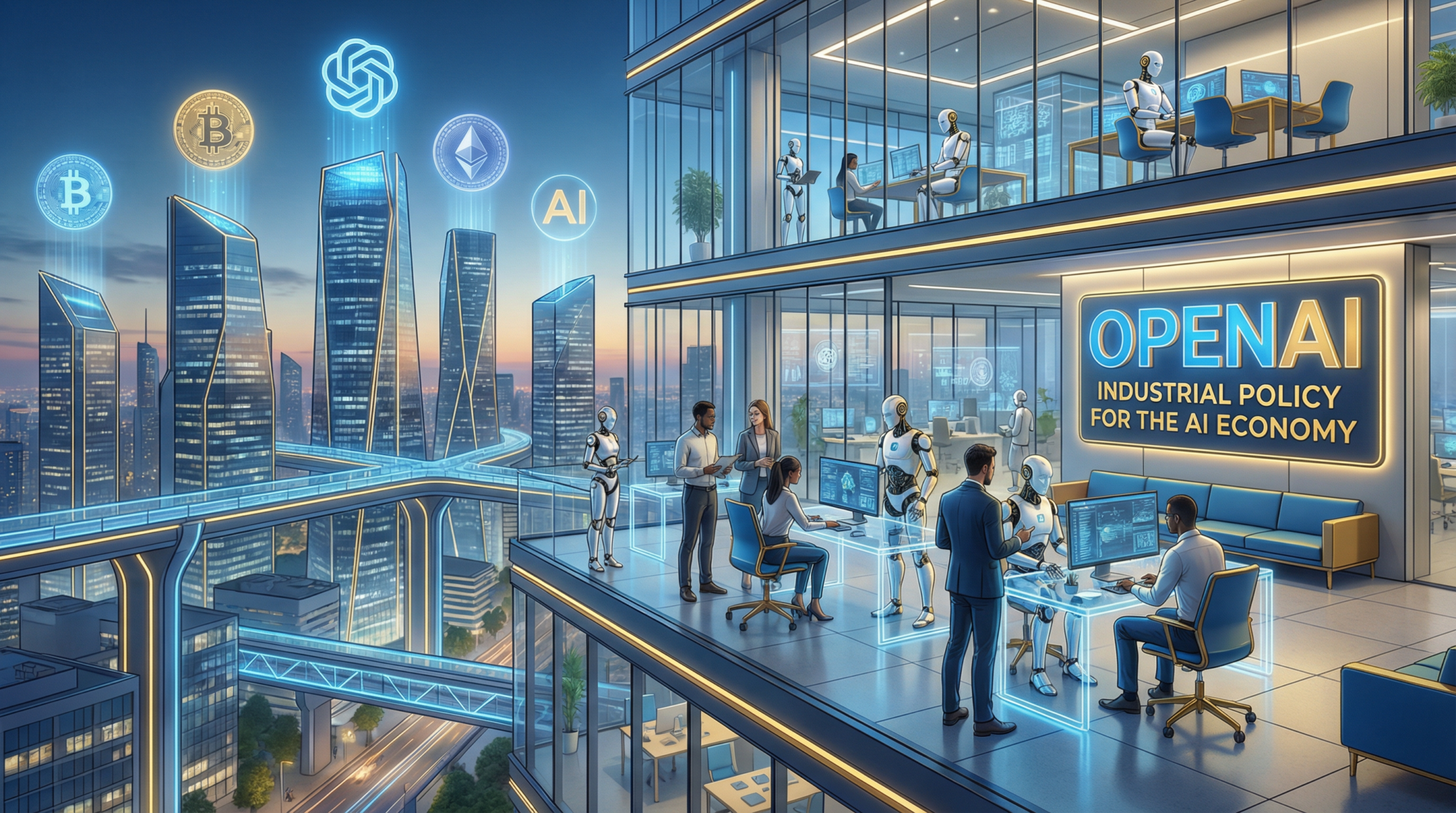
OpenAI’s April 2026 Industrial Policy Proposals: A Paradigm Shift in Economic Governance
In April 2026, OpenAI, now a pivotal player in the global technological and economic landscape with a valuation soaring to $852 billion, unveiled a comprehensive industrial policy framework aimed at addressing the profound socio-economic challenges posed by rapid automation and AI integration. This ambitious policy package centers on three transformative initiatives: the establishment of a public wealth fund, the implementation of robot taxes, and the introduction of a subsidized four-day workweek. In doing so, OpenAI signals a strategic pivot from traditional labor taxation towards capital taxation models, seeking to redefine wealth distribution and labor dynamics in the AI era.
Contextualizing OpenAI’s $852 Billion Valuation
OpenAI’s valuation, reaching an unprecedented $852 billion by early 2026, reflects not only its technological prowess but also its rising influence on global economic structures. The company’s AI models have permeated diverse sectors, from healthcare and finance to manufacturing and creative industries, creating vast value streams but concurrently displacing millions of traditional jobs. This duality—immense wealth generation coupled with labor market disruption—has propelled OpenAI to propose policies that reconcile innovation with inclusive economic growth.
Historically, tech behemoths with expansive valuations have faced increasing scrutiny over wealth concentration and socio-economic inequality. OpenAI’s policy proposals thus represent a proactive approach, aiming to preempt potential regulatory backlash by engaging in policy innovation that aligns corporate success with public welfare.
Public Wealth Fund: Democratizing AI-Driven Capital Gains
One of the cornerstone proposals is the creation of a public wealth fund designed to capture a share of the capital returns generated by AI technologies deployed at scale. This fund would operate akin to sovereign wealth funds such as Norway’s Government Pension Fund Global, but with a specific mandate to redistribute wealth created by AI-driven productivity gains.
Mechanics and Structure
- Capitalization: The fund would be initially capitalized through levies on AI-generated revenues and robot taxes (discussed below), supplemented by contributions from OpenAI and other major AI developers.
- Governance: A multi-stakeholder board including government officials, technologists, labor representatives, and public interest advocates would oversee the fund to ensure transparency and equitable decision-making.
- Investment Strategy: Profits would be reinvested in public goods such as education, healthcare, and infrastructure, as well as distributed as universal dividends to citizens to counteract income disparities exacerbated by automation.
This model draws from economic theories of shared capital ownership, notably the work of economist Thomas Piketty, who advocates for mechanisms to prevent wealth concentration by redistributing returns on capital. By institutionalizing a public wealth fund, OpenAI aims to transform AI-generated capital gains into broadly shared prosperity rather than private accumulation.
Robot Taxes: Redefining the Tax Base in an Automated Economy
The second major initiative is the introduction of a robot tax—a levy on the deployment of AI-driven automation technologies that replace human labor. This concept, though controversial, is gaining traction as nations grapple with declining labor tax revenues amid rising automation.
Historical Precedents and Theoretical Foundations
The idea of taxing automation is not entirely new. In the 1930s, economist John Maynard Keynes predicted technological unemployment and suggested policy measures to mitigate its effects. More recently, South Korea and parts of the European Union have experimented with taxing robot usage or automation-related gains. OpenAI’s proposal refines these approaches, advocating for a tax calibrated to the economic value generated by robotic and AI systems, rather than a flat tax per machine.
From a theoretical standpoint, robot taxes align with the shift from labor to capital taxation. As AI systems replace jobs, the traditional labor tax base erodes, threatening social welfare programs funded by income taxes. By taxing the capital embodied in AI and robotics, governments can preserve revenue streams necessary for social safety nets.
Implementation Challenges and OpenAI’s Solutions
- Valuation Metrics: OpenAI proposes sophisticated algorithms to assess the productivity impact of AI systems, ensuring tax fairness and avoiding stifling innovation.
- International Coordination: Given the global nature of AI deployment, OpenAI recommends coordinated international frameworks to prevent tax avoidance and regulatory arbitrage.
- Incentives for Responsible AI: The tax structure includes exemptions or rebates for AI applications that augment rather than replace human labor, encouraging symbiotic human-AI collaboration.
These measures reflect OpenAI’s commitment to balancing economic growth with social responsibility, acknowledging the complex dynamics of technological disruption.

Subsidized Four-Day Workweek: Reimagining Work in the AI Age
The third prong of OpenAI’s policy package is the promotion of a subsidized four-day workweek, designed to improve quality of life, increase productivity, and distribute available work more equitably amid labor displacement.
Economic Rationale and Empirical Evidence
Reduced work hours have been the subject of extensive research since the early 20th century, with figures such as Henry Ford pioneering the five-day workweek in the 1920s. More recent studies from Iceland, New Zealand, and Japan demonstrate that shorter workweeks can maintain or even boost productivity while enhancing worker well-being.
OpenAI’s proposal involves government subsidies to companies adopting four-day workweeks, offsetting initial adjustment costs and incentivizing broader adoption. This is particularly relevant in sectors heavily impacted by AI automation, where remaining human labor can be redistributed rather than eliminated outright.
Social and Economic Benefits
- Improved Work-Life Balance: Reduced hours facilitate mental health, family time, and community engagement.
- Job Creation: By spreading work across more employees, job opportunities can increase, mitigating unemployment risks.
- Environmental Impact: Less commuting and lower office energy consumption contribute to sustainability goals.
This initiative resonates with broader societal shifts towards valuing leisure and well-being alongside economic output, marking a fundamental redefinition of work in the AI era.
The Shift from Labor to Capital Taxation: A Structural Transformation
OpenAI’s proposals collectively exemplify a significant shift in taxation philosophy, moving away from reliance on labor income taxes towards capital-based taxation. This transition has deep economic and political implications.
Economic Imperatives
Automation and AI reduce the share of income derived from human labor, shrinking the tax base. Capital, embodied in AI systems and intellectual property, becomes the primary driver of wealth creation. Tax systems must evolve accordingly to sustain public finances and social programs.
Political Economy Considerations
Capital taxation has historically faced resistance due to the mobility of capital and concerns about investment deterrence. However, with AI technologies rooted in data and intellectual assets, taxing capital gains linked to AI becomes more feasible. OpenAI’s public wealth fund and robot tax proposals aim to implement these principles pragmatically, addressing investor concerns through transparency and reinvestment strategies.
Historical Precedents: Learning from the Past
OpenAI’s policy framework draws inspiration from historical precedents where technological revolutions prompted economic restructuring and policy innovation.
- Industrial Revolution: The rise of mechanized labor led to labor laws, social insurance systems, and progressive taxation to manage social upheaval.
- Post-WWII Era: Expansion of welfare states and progressive capital taxation helped balance economic growth with social equity.
- Dot-com Boom: Emergence of new taxation frameworks for digital economies highlighted the need for adaptable fiscal policies.
By situating AI within this continuum, OpenAI acknowledges the transformative nature of current changes while advocating for policies that preempt social dislocation.

Global Reactions: Policymakers and Tech Leaders Respond
Policymaker Perspectives
Governments worldwide have exhibited a spectrum of responses. Progressive administrations in Europe and parts of Asia have welcomed OpenAI’s proposals, viewing them as frameworks to modernize taxation and labor policies. For instance, the European Commission’s Directorate-General for Employment and Social Affairs expressed interest in piloting robot tax schemes aligned with OpenAI’s guidelines.
Conversely, some conservative policymakers in North America and developing economies have voiced concerns about potential adverse impacts on innovation and foreign investment. They call for a cautious approach, emphasizing the need for empirical data from initial implementations.
Tech Industry Leaders’ Views
Reactions within the tech industry are equally mixed but largely constructive. Leading AI firms, including Google DeepMind and Anthropic, have engaged with OpenAI to explore collaborative implementations of public wealth funds and responsible automation taxes. Industry advocates highlight that such policies could enhance public trust and legitimacy for AI development.
However, some startups and venture capitalists worry that robot taxes and subsidized workweek mandates might raise operational costs, potentially slowing innovation cycles. OpenAI’s counterargument emphasizes long-term sustainability and societal stability as prerequisites for enduring innovation.
Future Outlook: Towards a New Economic Order?
OpenAI’s April 2026 proposals are more than isolated policy recommendations; they represent a comprehensive vision for integrating artificial intelligence into society’s economic fabric responsibly and equitably. The proposed public wealth fund, robot taxes, and subsidized four-day workweek collectively seek to harness AI’s transformative potential while safeguarding social cohesion.
If adopted broadly, these policies could redefine the relationship between capital and labor, redistribute AI-generated wealth, and establish new social contracts for a technologically advanced future. OpenAI’s initiative challenges governments, corporations, and civil society to rethink economic paradigms and embrace innovative governance models fit for the AI age.
As debates continue, stakeholders must grapple with complex trade-offs, balancing technological progress with human welfare—a challenge that will shape the trajectory of the global economy for decades to come.
Context Design: The 2026 Paradigm Shift from Static Prompts to Dynamic AI Instruction Systems
Access 40,000+ AI Prompts for ChatGPT, Claude & Codex — Free!
Subscribe to get instant access to our complete Notion Prompt Library — the largest curated collection of prompts for ChatGPT, Claude, OpenAI Codex, and other leading AI models. Optimized for real-world workflows across coding, research, content creation, and business.

