
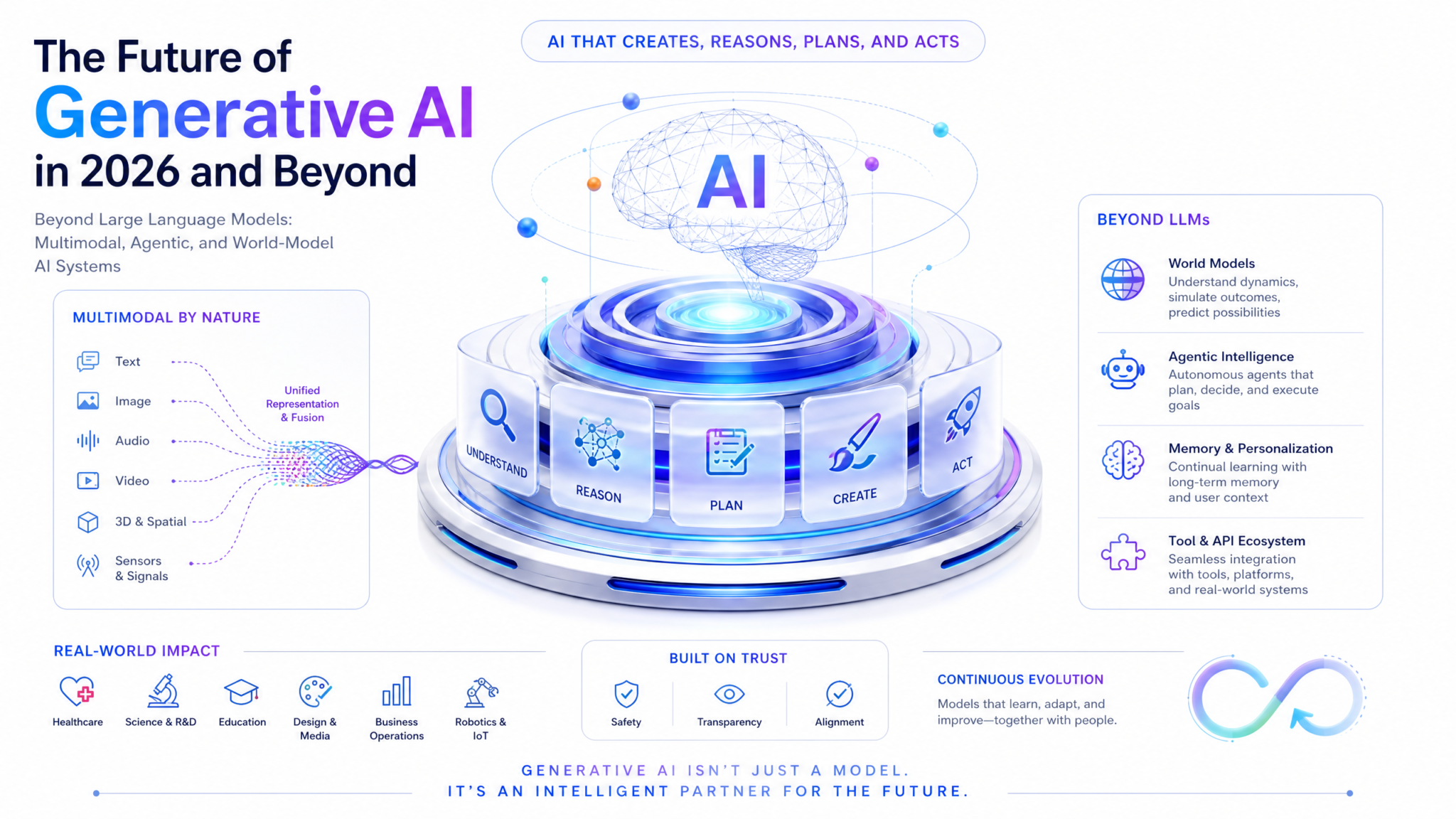
Generative AI has advanced rapidly since the emergence of modern large language models (LLMs). By late 2026, the conversation has shifted: progress is no longer only about making ever-larger text models, but about integrating modalities, bringing generative capabilities onto devices, improving safety and provenance, and embedding generative systems into industry workflows. This long-form article surveys the state of generative AI as it is likely to be in late 2026, analyzes technical and market trends, compares architectures and deployment models, and offers strategic guidance for organizations planning to adopt generative technologies responsibly and effectively.
Executive summary
Generative AI’s trajectory through 2024–2026 moves beyond the narrow framing of “bigger LLMs win.” Key shifts include:
- Multimodal foundation models that natively combine text, images, audio, structured data, and video.
- On-device and edge generative AI that reduce latency and improve privacy, enabled by model compression, distillation, and hardware specialization.
- Hybrid architectures — combining neural generative components with symbolic reasoning, retrieval, and program synthesis — that raise capability, reliability, and interpretability.
- Stronger safety, provenance, and regulatory frameworks, driving features like provenance metadata, watermarking, and standardized evaluation benchmarks.
- Wider vertical specialization: healthcare, design, engineering, finance, and entertainment adopt domain-tuned generative stacks with curated data and guardrails.
Organizations that plan strategically — by investing in data, modular architectures, evaluation, and governance — will capture the economic upside while mitigating risks. Below we unpack each major trend and its implications for business, research, and policy.
How we got here: evolution of generative AI up to 2026
From token prediction to multimodal understanding
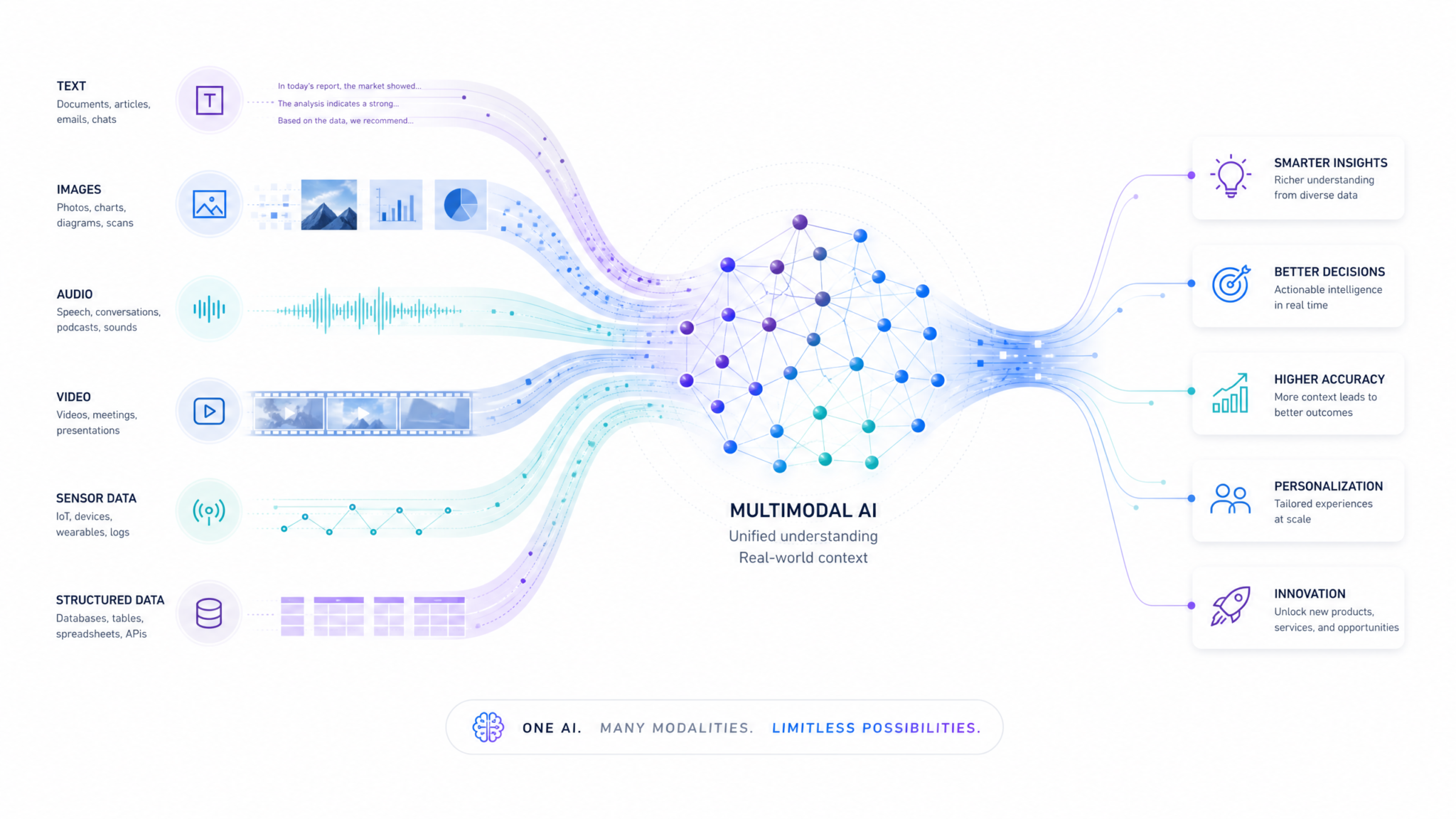
Early modern generative AI centered on autoregressive token prediction using transformer architectures trained on large text corpora. Through 2023–2024, breakthroughs in scale, instruction tuning, and reinforcement learning from human feedback elevated the usefulness of LLMs. After that, research emphasis broadened: multimodal models that can process and generate text, images, audio, and video in a unified manner became prominent. By late 2026, many production systems rely on models that were designed from the start to integrate different modalities, making them better suited to real-world tasks such as multimodal search, content production with visual context, and virtual assistants that perceive and act in physical environments.
From monoliths to modular stacks
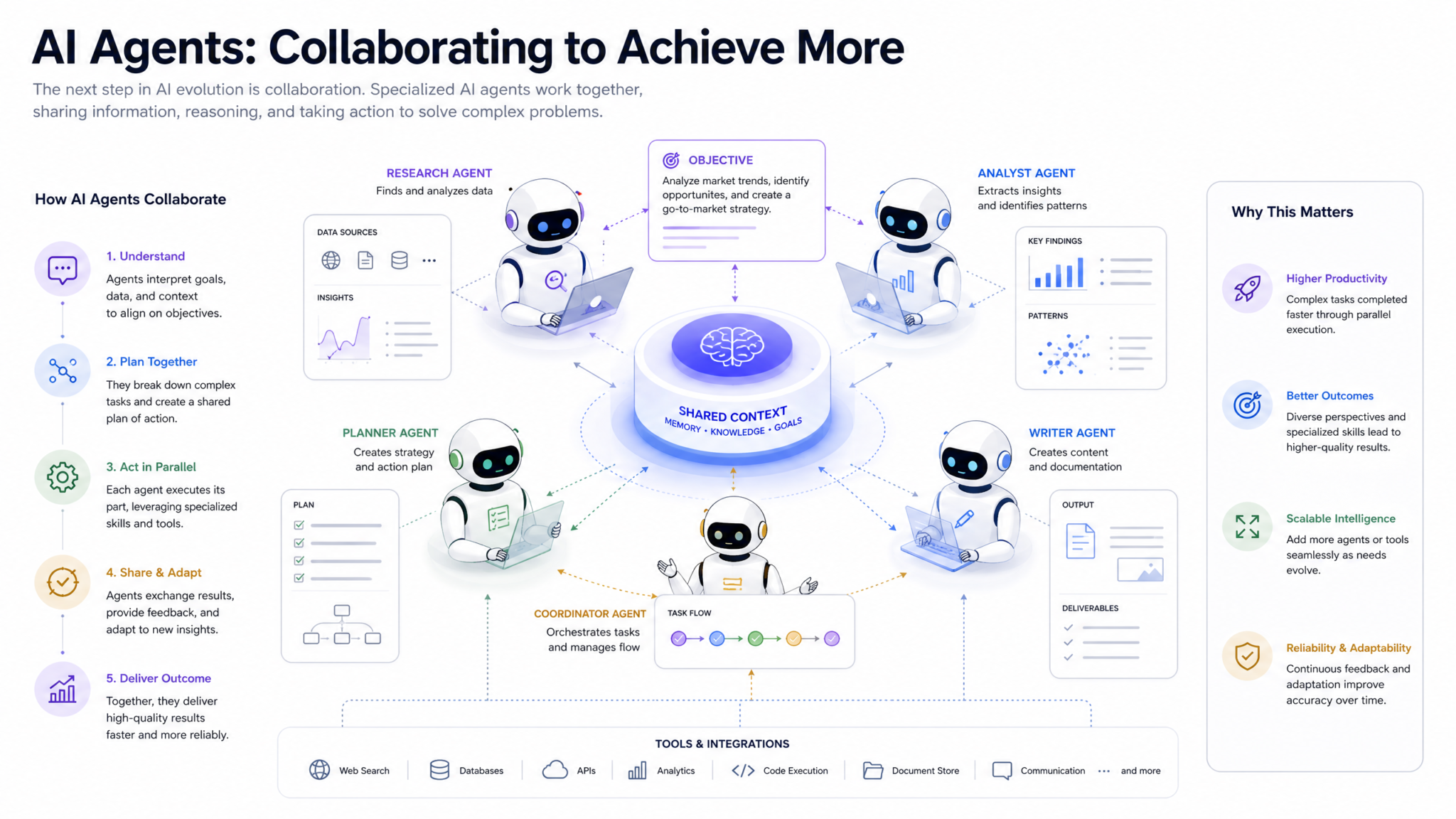
Large monolithic models remain important as “foundation models” but are increasingly treated as one component in modular stacks. Retrieval-augmented generation (RAG), symbolic reasoning components, knowledge graph integration, and specialized small models (experts) combine to provide more reliable, cost-effective, and auditable behavior. This modular approach also enables easier specialization to vertical use cases.
From cloud-only to hybrid and edge deployments
Capacity and cost pressures, along with privacy and latency requirements, have driven deployment diversity. An ecosystem of tools for model distillation, quantization, and compiler optimizations plus specialized AI accelerators make on-device generative AI feasible for many applications. Late 2026 sees a mix of cloud-hosted heavy models and local small or medium models for inference and pre-filtering.
Key technical trends shaping generative AI beyond LLMs
Multimodal foundation models and unified representations
Unified multimodal representations are a core technical trend. Models trained with contrastive, generative, and predictive objectives across modalities learn aligned embeddings and can perform tasks such as cross-modal retrieval, captioning, question answering with images/video, and conditioned generation. The architectural innovations include:
- Cross-attention layers that condition text generation on visual or audio encodings.
- Shared latent spaces enabling interpolation and transfer across modalities.
- Pretraining objectives mixing masked modeling, contrastive losses, and autoregressive decoding.
Hybrid symbolic-neural systems
Purely neural systems excel at pattern completion but struggle with consistent rule-based reasoning, long-horizon plans, and precise arithmetic. Hybrid systems marry symbolic reasoning (logic, constraint solvers, program interpreters) with neural generation. These systems are increasingly used in domains requiring reliability — e.g., finance computations, compliance checking, legal drafting with constraints — where outputs must be verifiable and traceable.
Efficient training and inference: distillation, quantization, and sparsity
Advances in model compression, quantization-aware training, structured sparsity, and adapter-style tuning make it practical to deploy robust generative capabilities at lower cost. Techniques include:
- Parameter-efficient fine-tuning (PEFT) such as adapters and LoRA to adapt large foundation models using small updates.
- Quantization to 8-bit, 4-bit, or mixed-precision to reduce memory and compute requirements.
- Sparse expert layers (Mixture-of-Experts) to scale capacity while reducing FLOPs per token at inference.
- Knowledge distillation to produce smaller models that approximate larger ones for latency-sensitive use cases.
Better alignment, evaluation, and provenance
By late 2026, there is a stronger emphasis on alignment with human values and domain constraints. Key developments include:
- Evaluation suites that measure not only capability but safety, factuality, bias, and hallucination rates.
- Provenance tagging and cryptographic techniques (e.g., signed attestations) to trace content source and generation context.
- Watermarking and detectable signatures for model outputs to assist moderation and provenance verification.
Comparing model families and architectures
The following table compares major generative architecture families relevant in late 2026, highlighting typical strengths, weaknesses, and likely use cases.
| Model Family | Strengths | Limitations | Common Use Cases |
|---|---|---|---|
| Large Language Models (LLMs) | Strong text generation, instruction-following, broad knowledge | Hallucination risk, limited multimodal native capability, compute expensive | Chat assistants, summarization, copywriting, knowledge work |
| Multimodal Foundation Models | Cross-modal reasoning, unified embedding spaces, versatile outputs | Large pretraining cost, complexity of fine-tuning for single modality | Visual question answering, multimedia content creation, AR/VR |
| Diffusion and Generative Image/Video Models | High-quality image/video generation, creative control via conditioning | Sampling cost/latency, artifacts in fine details, temporal coherence challenges | Design, film production, advertising, game asset generation |
| Neurosymbolic / Hybrid Systems | Reliable reasoning, verifiability, constraint satisfaction | Integration complexity, may require domain knowledge engineering | Compliance checks, engineering design verification, legal automation |
| Sparse / Mixture-of-Experts (MoE) | High capacity with lower average inference cost | Routing complexity, potential fairness/consistency issues | Large-scale conversational systems, specialized expert routing |
Deployment and cost trade-offs
When choosing an architecture for a production application, teams must balance capability, cost, latency, privacy, and maintainability. The next table summarizes typical deployment choices and trade-offs commonly considered by organizations in 2026.
| Deployment Model | Performance | Cost | Privacy & Compliance | Best for |
|---|---|---|---|---|
| Cloud-hosted large models | Highest capability, scalable | High for frequent inference | Depends on provider; easier to centralize controls | High-end assistants, heavy-duty content generation |
| Hybrid (cloud + local caching) | Good — latency optimized for hot paths | Moderate (cloud + infra for edge) | Better control over sensitive data via local pre-processing | Latency-sensitive applications with privacy constraints |
| On-device / Edge | Lower raw capability, ultra-low latency | Lower per-inference cost; upfront engineering effort | Best for privacy (data stays local) | Mobile assistants, IoT, secure deployments |
| Federated / Split inference | Balanced; can utilize central and local compute | Complex to manage; moderate | Strong privacy guarantees if designed well | Regulated industries, multi-party data scenarios |
Industry verticals: how generative AI transforms sectors by late 2026
Healthcare and life sciences
Generative AI in healthcare has matured from research assistance to production-grade workflows by late 2026. Key impacts include:
- Clinical documentation automation with strong privacy and provenance controls, reducing clinician administrative burden.
- Medical image generation and augmentation for training data, synthetic cohorts for rare conditions, and multimodal assistants combining imaging and electronic health record (EHR) data for decision support.
- Drug discovery acceleration through generative models for molecular design, although wet-lab validation and regulatory pathways remain rate-limiting.
Regulatory compliance, explainability, and rigorous validation are essential. Hybrid systems that incorporate mechanistic models and formal verification become default in critical workflows.
Finance and regulated services
In finance, generative AI offers automated reporting, personalized insights, and synthetic data for modeling. Adoption patterns emphasize:
- Conservative deployment with strict audit trails and certified model behavior.
- Use of explainable modules for decisions affecting credit, trading, or risk where regulatory scrutiny mandates transparency.
- Provenance tracking to detect synthetic content and prevent fraud.
Creative industries: media, design, and entertainment
Creatives exploit advanced generative tools for concepting, storyboarding, asset production, and interactive experiences. By late 2026, workflows frequently involve:
- Multimodal ideation pipelines where a prompt produces moodboards, scripts, and animated sequences that are iterated by humans.
- Rights and licensing frameworks integrated into tools to respect creators and manage derivative works.
- Real-time content generation for games and immersive experiences, with latency-optimized generation on edge servers or specialized hardware.
Manufacturing, engineering, and architecture
Generative AI augments engineering design through rapid exploration of design spaces, generative CAD, and simulation-informed synthesis. Neurosymbolic systems combining physics engines and generative propose-and-evaluate loops reduce prototyping cycles. Industry adoption prioritizes traceable outputs and reproducible simulations to ensure safety and compliance.
Ethics, governance, and regulation by late 2026
Regulatory landscape and compliance expectations
Between 2024 and 2026, governments and standards bodies accelerated efforts to regulate AI. Key trends likely by late 2026:
- Operational requirements: organizations are expected to maintain documentation (model cards, data lineage, risk assessments) for high-risk generative systems.
- Provenance standards: regulations encourage or require provenance metadata and detectable watermarks for generated content in certain contexts (e.g., political ads, synthetic media).
- Certification and audits: third-party audits or certification regimes become common for mission-critical deployments, particularly in finance, healthcare, and public sector.
Companies must design for compliance from the outset: privacy-preserving data handling, explainability mechanisms, and monitoring plans are no longer optional for many enterprise use cases.
Safety, alignment, and malicious use mitigation
As capabilities grow, so do concerns about misuse. By late 2026, practical mitigations include:
- Operational guardrails implemented in model architectures (e.g., safety layers, refusal modules) and deployment pipelines (content filters, human-in-the-loop).
- Collaboration between industry and defenders to share indicators of malicious content and coordinate responses to deepfake and disinformation campaigns.
- Better red-teaming standards and public benchmarks for adversarial behavior.
Privacy, data rights, and synthetic data ethics
Synthetic data generation techniques reduce the need to share real user data across organizational boundaries, but ethical questions remain about whether synthetic datasets may replicate sensitive attributes or biases. Responsible use requires rigorous testing for leakage and fairness, and adherence to data subject rights where applicable.
Technical and operational challenges to address
Hallucination, factuality, and trust
While performance on benchmarks improves, hallucination — confident but incorrect outputs — remains a central challenge. Solutions and best practices that have gained traction by late 2026 include:
- Retrieval-augmented pipelines that ground generation in authoritative external sources with citations and checkable references.
- Post-generation verification modules (e.g., fact-checkers, constraint solvers) that flag or correct likely errors.
- Standardized factuality metrics used in CI/CD for model releases.
Data quality and the “garbage in, garbage out” risk
Generative systems are highly sensitive to training and fine-tuning data. Effective data governance practices include data provenance, labeling quality controls, diverse and representative datasets, and synthetic augmentation when real data is scarce. Organizations deploy data valuation frameworks to prioritize investments where quality improvements yield the greatest downstream impact.
Interoperability and standards
With a proliferation of model providers and tooling, interoperability and model portability are crucial. Open formats for model weights, tokenizer mappings, multimodal embeddings, and metadata for provenance and policy help organizations avoid vendor lock-in and enable auditability. Late 2026 sees industry consolidation around several interoperability standards and an ecosystem of exporters, converters, and runtime runtimes that support hybrid stacks.
Workforce and economic impacts
Augmentation, reskilling, and new roles
Generative AI augments cognitive labor across many professions. Job displacement concerns are balanced by creation of new roles: prompt engineers, model reliability engineers, AI ethicists, synthetic data curators, and multimodal designers. Organizations that invest in reskilling programs focused on AI literacy, prompt design best practices, and domain-AI collaboration see higher productivity and lower churn.
Economic value and cost structure changes
Generative AI alters cost structures: some tasks become much cheaper (e.g., first-draft content creation, image prototyping) while new costs emerge (model audit, compliance, and monitoring). Firms must account for both infrastructure and non-infrastructure costs — data labeling, human oversight, and lifecycle governance. ROI analysis for AI initiatives increasingly factors in risk-adjusted cost-of-error in addition to productivity gains.
Best practices for organizations deploying generative AI in late 2026
Adopt a modular, testable architecture
Design systems as layered stacks: foundation models for broad capabilities, mediator layers for retrieval and knowledge integration, specialized small models for domain tasks, and verification layers for validation and safety checks. This modularity enables targeted upgrades, clearer responsibilities, easier monitoring, and simplified compliance.
Invest in evaluation and continuous monitoring
Put in place continuous evaluation pipelines that track task-specific metrics (accuracy, latency, cost) and non-functional metrics (fairness, safety, hallucination rates). Use shadow deployments and canary releases for safer rollouts. Instrument models and pipelines with telemetry that supports real-time alerts and offline audits.
Design for provenance and traceability
Every generated artifact used in production should carry metadata describing the model, prompt/context, confidence scores, and data sources consulted. Standardize metadata formats internally to simplify audits and regulatory reporting. Where required, integrate cryptographic signing to authenticate generation sources.
Choose the right deployment mix
Match deployment patterns to application needs. Use cloud-hosted models for heavy generative workloads where centralization and scaling matter; place distilled or quantized models on-device for latency-sensitive or privacy-focused experiences; and adopt hybrid architectures for regulated contexts needing both capability and data residency.
Build ethical and governance guardrails into workflows
Create a cross-functional governance body that includes legal, security, product, data science, and domain experts. Define acceptance criteria for models, human-in-the-loop thresholds, escalation processes, and incident response plans for misuse or unintended behavior.
Evaluating vendors and open-source options
Criteria for vendor selection
When choosing between cloud providers, specialist vendors, and open-source models, evaluate on:
- Transparency: documentation, model cards, training data provenance.
- Governance support: audit logs, metadata, compliance tooling.
- Integration: APIs, SDKs, adapters for common pipelines.
- Cost profile: pricing model for inference, fine-tuning, and data transfer.
- Roadmap and community: vendor commitment to safety and continued improvement.
Open-source vs proprietary trade-offs
Open-source generative models offer inspection, customization, and avoidance of vendor lock-in. Proprietary models can provide superior performance and value-added services (e.g., managed safety features, fine-tuning marketplaces). Many organizations adopt a hybrid approach: open-source for baseline capabilities and vendor services for mission-critical features or specialized vertical models.
Research frontiers to watch into 2027 and beyond
Better architectures for generalization and reasoning
Research continues toward architectures that generalize better with less data and that incorporate explicit reasoning primitives. Areas to monitor include continuous-time models for video, graph-based generative mechanisms for structured data, and neural architectures with built-in compositionality. Success here will reduce reliance on task-specific fine-tuning.
Robust, low-latency generation for interactive experiences
Real-world interactive systems — AR glasses, mixed-reality collaboration, real-time game worlds — require fast, consistent generation. Expect progress in model compilers, hardware specialization, and incremental generation techniques that reduce latency while preserving quality.
Standards for provenance, watermarking, and accountability
Interoperable, robust watermarking schemes and provenance standards are active research areas. Progress will enable better detection of synthetic media, better attributions for generated works, and stronger legal frameworks for liability and rights management.
Scenario outlook: plausible states of the world in late 2026
Scenario A — Broad maturity with managed risk
Multimodal, hybrid generative stacks become mainstream across industries. Standards for evaluation and provenance reduce many misuse risks. Growth is steady and productivity gains are realized widely. Governance frameworks balance innovation and safety, and new market segments (AI-managed content marketplaces, synthetic data services) flourish.
Scenario B — Fragmented advancement with regulatory patchworks
Adoption accelerates unevenly; some regions impose strict controls and certification requirements while others remain permissive. Cross-border coordination lags, causing compliance complexity for multinational firms. Innovation continues rapidly in permissive markets, but public trust issues slow adoption in sensitive domains.
Scenario C — Rapid misuse and reaction
High-profile manipulative uses of generative AI (deepfakes, automated disinformation at scale) trigger stringent emergency regulations and slowed deployment. Short-term productivity gains are offset by heavy compliance costs and a retrenchment of open ecosystems.
Which scenario unfolds depends on policy, industry cooperation, and technological progress in safety and detection. Organizations should plan for scenario variability, investing in capabilities that are robust across futures (e.g., modular stacks, strong provenance, adaptable governance).
Actionable checklist for leaders
- Create an AI roadmap aligned with strategic priorities and risk tolerance; map business use cases to specific architectures and deployment models.
- Invest in data governance, labeling tooling, and privacy-preserving data pipelines.
- Adopt modular stack designs incorporating retrieval, verification, and governance layers.
- Establish continuous evaluation, monitoring, and incident management processes for generative systems.
- Form cross-functional governance with clear accountability and transparent documentation practices.
- Plan for workforce transitions: reskilling programs, hybrid role definitions, and hiring for AI reliability roles.
- Engage with industry consortia to stay aligned with standards for provenance, watermarking, and audits.
Conclusion: beyond the hype toward sustained value
By late 2026, generative AI is less a novelty and more an integral part of digital transformation. The focus has moved from simply increasing model scale to improving integration, trustworthiness, and applicability across modalities and devices. Organizations that treat generative AI as a systems challenge — balancing capabilities, governance, and human collaboration — will capture the greatest value.
Expect continuous iterative improvement rather than a single disruptive moment. The next phase is about building predictable, auditable, and responsibly governed generative systems that augment human creativity and decision-making while minimizing harm. That is the practical and strategic frontier for leaders today.
Useful Links
- OpenAI Research
- DeepMind Research
- Google AI Research
- arXiv.org — Preprint server for AI research
- NIST AI Program
- European Commission — AI Act and policy
- IEEE — AI Standards and Ethics
- Nature — Artificial Intelligence collection
- GitHub — Open-source AI projects
