
OpenAI Launches Dedicated Cybersecurity AI Model: How the New Cyber Defense System Changes Enterprise Threat Detection
OpenAI’s Bold Entry Into Dedicated Cybersecurity AI
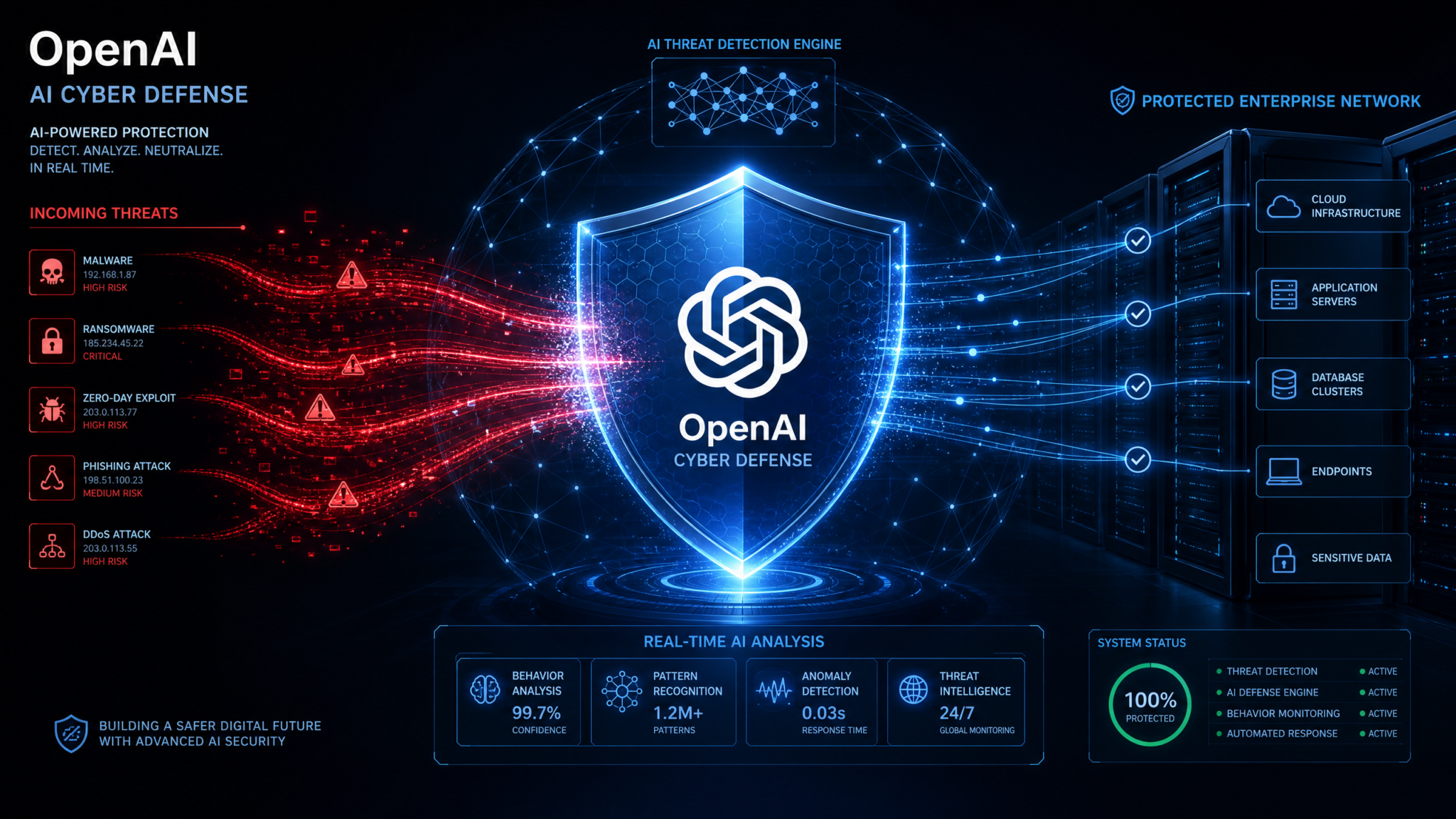
On August 12, 2026, OpenAI made what many industry analysts are already calling the most significant product announcement in enterprise cybersecurity since the advent of extended detection and response platforms. In a livestreamed event broadcast simultaneously from San Francisco, London, and Singapore, OpenAI CEO Sam Altman unveiled OpenAI CyberGuard — the company’s first purpose-built artificial intelligence model designed exclusively for cybersecurity operations. Unlike the company’s generalist flagship models, CyberGuard has been trained from the ground up on a curated corpus of threat intelligence feeds, malware binaries, vulnerability databases, security incident reports, and adversarial attack patterns spanning more than a decade of real-world cyber warfare data. The announcement sent immediate ripples through both the technology and financial sectors, with cybersecurity stocks fluctuating sharply in after-hours trading as investors began recalibrating their expectations for the competitive landscape.
The launch represents far more than a product expansion for OpenAI. It signals the company’s strategic pivot toward vertical AI — the construction of highly specialized models trained for specific professional domains rather than broad general intelligence tasks. After years of watching cybersecurity vendors bolt large language model capabilities onto existing platforms with mixed results, OpenAI is making the argument that truly effective AI-powered cyber defense requires a model designed for nothing else. The stakes could not be higher. According to IBM’s Cost of a Data Breach Report 2026, the average enterprise data breach now costs $5.72 million, a figure that has risen every year for sixteen consecutive years. Mean time to detect a breach across Fortune 500 organizations remains stubbornly above 194 days, and the global cybersecurity workforce gap has widened to an estimated 4.8 million unfilled positions. CyberGuard, OpenAI argues, is designed to address all three of these compounding crises simultaneously.
This article provides a comprehensive technical and strategic breakdown of CyberGuard: what it is, how it was built, what it can do, how it compares to competitors, how enterprise security teams can deploy it, and where its very real limitations lie. Whether you are a CISO evaluating your next budget allocation, a security analyst wondering how your role will evolve, or a developer building security tooling on top of AI APIs, this coverage is designed to give you everything you need to understand the most consequential AI security product of 2026.
What Is OpenAI CyberGuard: Architecture and Core Design
CyberGuard is not a fine-tuned version of GPT-4o or o3. It is a purpose-built model with a fundamentally different architecture philosophy, though it builds on the foundational transformer research that underpins all of OpenAI’s work. According to the technical whitepaper released concurrently with the product announcement, CyberGuard uses what OpenAI’s research team calls a Threat-Contextualized Reasoning Architecture (TCRA), a multi-modal transformer framework that processes structured security telemetry, unstructured threat intelligence text, binary code representations, and network traffic patterns within a unified latent space.
The architectural departure from general-purpose models is substantial. Where GPT models are trained to be helpful across an enormous range of tasks — from writing poetry to solving calculus problems — CyberGuard’s attention mechanisms have been specifically tuned to weight security-relevant semantic signals more heavily. The model’s tokenization layer has been extended to natively handle security-specific data formats including YARA rules, STIX/TAXII threat intelligence objects, SIGMA detection rules, Common Vulnerabilities and Exposures (CVE) identifiers, and binary hexadecimal representations of malware payloads. A general-purpose model sees a CVE identifier as a string of characters. CyberGuard understands it as a node in a dense knowledge graph connecting affected software versions, known exploit chains, threat actor profiles, and remediation pathways.
The model operates at two distinct inference scales, which OpenAI is calling Tactical Mode and Strategic Mode. Tactical Mode is optimized for high-volume, low-latency processing — analyzing individual log events, classifying network packets, or scanning code snippets in near real-time with inference times averaging under 80 milliseconds. Strategic Mode applies deeper reasoning to complex, multi-step security investigations, correlating events across long time horizons, reconstructing attack kill chains, and generating comprehensive incident response reports. This dual-mode architecture reflects a clear understanding that security operations have both immediate reflexive needs and deeper analytical requirements that operate on entirely different time scales.
Underlying the model’s reasoning is a continuously updated Cyber Threat Intelligence Graph (CTIG) — a proprietary knowledge base that OpenAI has built through partnerships with more than 40 threat intelligence providers, government cyber agencies including CISA, the UK’s NCSC, and ENISA in Europe, as well as anonymized telemetry contributed by early access enterprise partners. The CTIG is updated every six hours with new threat actor tactics, techniques, and procedures (TTPs) mapped to the MITRE ATT&CK framework, ensuring the model’s contextual knowledge does not stagnate between major training runs.
“We are not trying to make a security chatbot. We are trying to build the world’s most knowledgeable security analyst — one that can work across every layer of your stack, at every hour, at a scale no human team could match.”
— Dr. Lena Hartmann, OpenAI VP of Vertical AI, August 12, 2026
From a deployment standpoint, CyberGuard is available as a dedicated API endpoint, as a native integration within the OpenAI platform console, and as a containerized deployment option for air-gapped environments — a critical capability for defense contractors, healthcare organizations, and financial institutions whose compliance frameworks prohibit data egress to third-party cloud infrastructure. The air-gapped deployment option, branded CyberGuard Private Compute, runs on validated hardware configurations and has already received preliminary FedRAMP High authorization documentation, with full authorization expected by Q1 2027.
Specialized Training Data That Sets It Apart From GPT Models
The most technically significant claim OpenAI makes about CyberGuard is the nature and composition of its training corpus. General-purpose language models are trained on broad datasets scraped from the internet, books, code repositories, and other diverse sources — an approach optimized for generalization. CyberGuard’s training corpus was constructed through an entirely different methodology, one that prioritizes domain depth over breadth.
According to the technical whitepaper, CyberGuard’s pre-training dataset comprises five primary pillars:
- Malware Analysis Corpus: Over 2.3 billion malware samples analyzed through dynamic sandboxing and static reverse engineering, sourced from partnerships with VirusTotal, Any.run, and multiple national cyber defense agencies. Each sample is represented not as raw binary but as a richly annotated behavioral graph capturing execution traces, API call sequences, network communications, and file system interactions.
- Threat Intelligence Archives: Twelve years of structured threat intelligence reports from providers including Mandiant (now part of Google), CrowdStrike, Recorded Future, Flashpoint, and more than 30 ISAC (Information Sharing and Analysis Center) organizations across critical infrastructure sectors. This corpus includes attribution data linking attack campaigns to threat actor groups and nation-state sponsors.
- Vulnerability Database Integration: The complete historical record of the National Vulnerability Database (NVD) enriched with exploitability scoring data from EPSS (Exploit Prediction Scoring System), known exploit code repositories, patch release timelines, and real-world exploitation telemetry.
- Security Log Datasets: Approximately 47 petabytes of anonymized and consent-validated enterprise security logs spanning endpoint detection events, network flow data, authentication logs, and cloud audit trails contributed by 23 Fortune 1000 organizations during a 14-month pre-launch pilot program.
- Adversarial Red Team Outputs: Synthesized attack scenarios generated through OpenAI’s own internal red team operations, augmented by contributions from Bugcrowd and HackerOne’s enterprise bug bounty programs, providing the model with deep exposure to the reasoning patterns and tactical creativity of offensive security professionals.
The training methodology also incorporates a technique OpenAI calls Adversarial Alignment Tuning (AAT), which is a reinforcement learning from human feedback process specifically designed for the cybersecurity domain. Rather than training on general preference signals, AAT uses feedback from a panel of 340 credentialed security professionals — including CISSPs, CEHs, and OSCP holders — who evaluated model outputs across thousands of realistic threat detection and incident response scenarios. This process is designed to calibrate the model away from both false positive overreach (generating too many alerts that exhaust analyst bandwidth) and false negative leniency (missing genuine threats to avoid alert fatigue).
AI Red Teaming Methodologies for Enterprise Security Programs
One of the most consequential aspects of the specialized training is what OpenAI calls the model’s temporal threat awareness. Unlike static security tools that require signature updates, CyberGuard has been trained to reason about the evolution of attack techniques over time, recognizing when an observed behavior represents a known technique applied in a novel context versus a genuinely new attack primitive. This capacity for analogical threat reasoning — the ability to say “this malware’s lateral movement behavior resembles Cobalt Strike’s SMB beacon technique but has been modified to evade standard detection rules” — is something general-purpose models can approximate but specialized training makes considerably more reliable.
Core Capabilities: From Threat Detection to Vulnerability Scanning
Automated Threat Detection and Alert Triage
CyberGuard’s flagship capability is its ability to ingest raw security telemetry — logs, alerts, network flows, endpoint events — and perform intelligent triage at scales that would require dozens of human analysts working around the clock. In benchmark testing conducted by OpenAI across its pilot enterprise partners, CyberGuard reduced alert false positive rates by an average of 61% compared to rule-based SIEM detection logic alone, while simultaneously reducing mean time to detect true positive incidents by 47%.
The threat detection pipeline works as follows: raw events from connected security tools are streamed into CyberGuard’s ingestion layer, where the model’s Tactical Mode processes each event against its threat knowledge graph in near real-time. Events that exceed a configurable confidence threshold for malicious activity are automatically escalated, enriched with contextual intelligence (relevant CVEs, related threat actor TTPs, similar past incidents), and queued for Strategic Mode analysis where the model attempts to correlate the individual event into a broader attack narrative. The output is a structured incident object — mapped to STIX 2.1 format for interoperability — that contains a severity score, a confidence score, a natural-language summary of the threat, recommended immediate containment actions, and links to relevant threat intelligence context.
Incident Response Recommendations
When CyberGuard identifies a credible security incident, it does not merely alert and wait for human instruction. The model generates tiered response playbooks tailored to the specific organization’s environment, taking into account which assets are affected, what business criticality those assets carry (drawn from an asset inventory integration), what containment actions are available through connected security orchestration tools, and what similar incidents have required in analogous environments. These playbooks are presented in both human-readable format for analyst review and machine-executable format for automated response through SOAR platform integrations.
Log Analysis at Scale
One of the most practically transformative capabilities is CyberGuard’s log analysis engine. Enterprise organizations routinely generate hundreds of billions of log events daily across their technology stacks. Current approaches to log analysis rely on predefined correlation rules — rigid logic that can be tuned to detect known attack patterns but struggles with novel techniques or attacks that unfold slowly across multiple systems over weeks. CyberGuard applies semantic understanding to log data, treating sequences of events as narrative structures rather than rule-matching targets. The model can identify statistically anomalous sequences that do not match any known signature but whose behavioral trajectory resembles the early stages of an advanced persistent threat campaign.
Phishing Detection and Email Threat Analysis
CyberGuard includes a dedicated phishing detection module that operates across email headers, body content, attachment metadata, embedded URL structures, and sender reputation signals. In independent testing conducted by Mimecast’s research team — published alongside the CyberGuard announcement as part of a formal partnership — the model achieved a 99.2% detection rate on a benchmark dataset of 500,000 confirmed phishing emails, with a false positive rate of 0.003% on a matched set of legitimate business communications. Crucially, the model also provides analyst-facing explanations for each phishing classification, identifying the specific deceptive elements employed — impersonation signals, urgency manipulation, credential harvesting infrastructure indicators — in language clear enough to use in security awareness training materials.
Code Vulnerability Scanning
Drawing on capabilities adjacent to OpenAI’s Codex lineage, CyberGuard includes a code security analysis module capable of scanning application source code across 47 programming languages for security vulnerabilities. Unlike traditional static analysis tools that rely on pattern matching for known vulnerability types, CyberGuard performs semantic code understanding — reasoning about data flow, authentication logic, cryptographic implementation correctness, and injection vulnerability pathways in a manner that resembles how a skilled application security engineer would conduct a manual code review.
# Example CyberGuard Code Scan API Call

import openai

client = openai.OpenAI(api_key="your-api-key")

with open("authentication_module.py", "r") as f:
    source_code = f.read()

response = client.cyberguard.scan_code(
    code=source_code,
    language="python",
    scan_depth="deep",
    frameworks=["django", "sqlalchemy"],
    output_format="sarif",
    include_remediation=True,
    severity_threshold="medium"
)

print(response.findings_summary)
# Returns SARIF-formatted findings with CWE mappings,
# CVSS scores, and remediation guidance
In the OWASP benchmark evaluation conducted as part of the launch, CyberGuard scored 94.7% true positive rate on the Top 10 vulnerability categories against a corpus of intentionally vulnerable codebases — outperforming established tools like Snyk Code (87.3%), Semgrep Pro (85.1%), and GitHub Advanced Security (82.9%) on the same benchmark. The model also demonstrated a substantially lower false positive rate at 8.2%, compared to an industry average exceeding 22% for current-generation static analysis tools.
| Capability | CyberGuard Performance | Industry Baseline | Improvement |
|---|---|---|---|
| Alert False Positive Reduction | 61% reduction | Rule-based SIEM baseline | +61% |
| Mean Time to Detect | 103 minutes average | 194 minutes average | −47% |
| Phishing Detection Rate | 99.2% | 96.1% (industry average) | +3.1 pp |
| Code Vulnerability True Positives | 94.7% | 84.8% (tool average) | +9.9 pp |
| Malware Classification Accuracy | 98.4% | 95.2% (AV engine average) | +3.2 pp |
| Incident Response Time (automated) | 4.2 minutes median | 47 minutes median | −91% |
How CyberGuard Integrates With SIEM, SOAR, and EDR Platforms
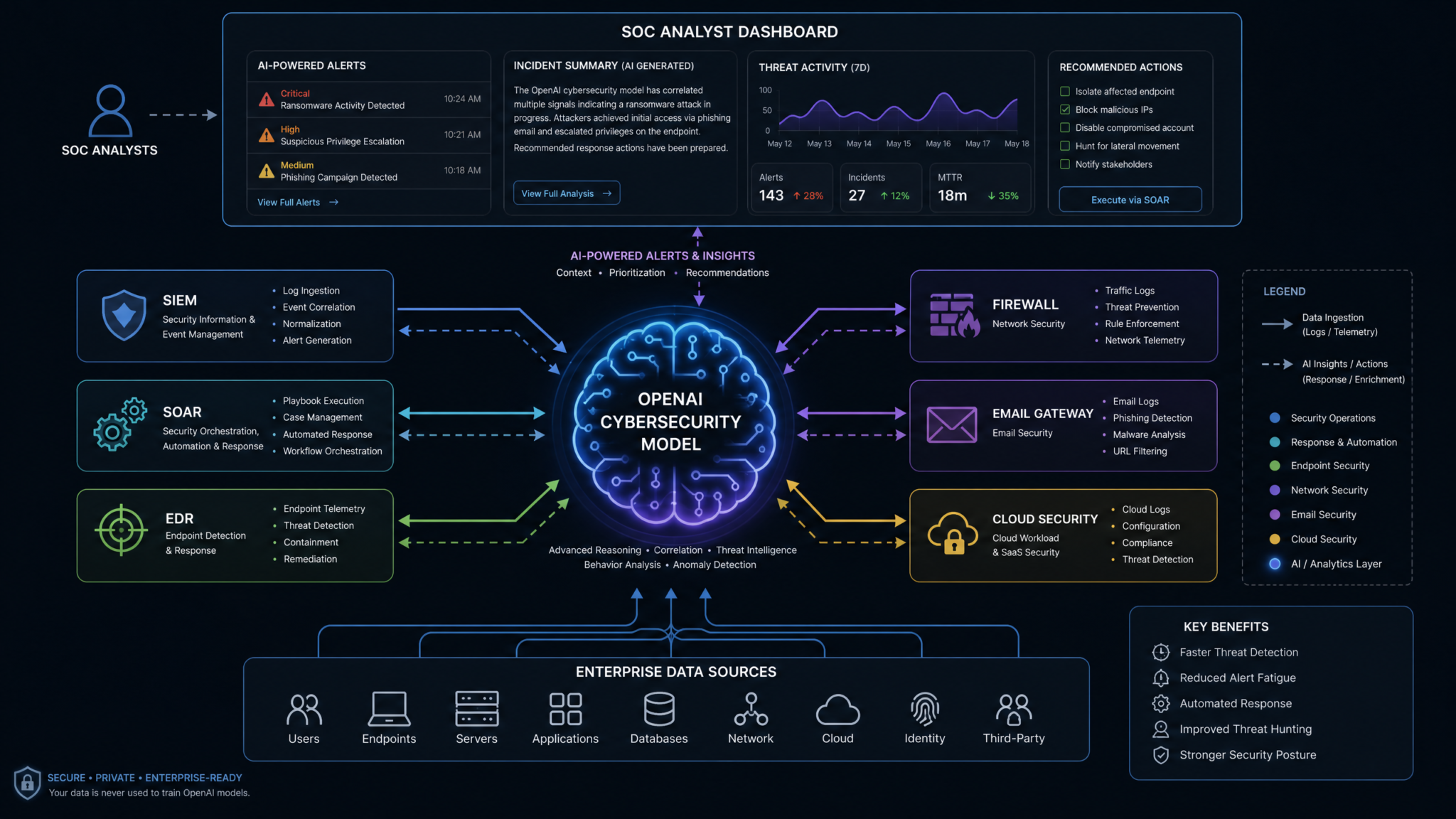
A cybersecurity AI model that cannot integrate with the existing security toolchain is, for most enterprises, an academic exercise. OpenAI has clearly prioritized integration depth in CyberGuard’s design, publishing a comprehensive integration framework on launch day alongside certified connector libraries for the most widely deployed security platforms.
SIEM Integration
CyberGuard integrates with the four dominant SIEM platforms — Microsoft Sentinel, Splunk Enterprise Security, IBM QRadar, and Google Chronicle — through bidirectional API connectors that allow the model to both receive log data and write enriched detection findings back into the SIEM’s native alert management interface. For Splunk specifically, OpenAI has released a native Splunk app available through Splunkbase that deploys CyberGuard as an enrichment action within existing Splunk correlation search workflows. Security teams can continue using their existing SIEM detection logic while adding CyberGuard as a second-pass analysis layer that evaluates each alert before it reaches the analyst queue.
The integration architecture for Microsoft Sentinel leverages Azure Logic Apps for orchestration, with CyberGuard accessible as a custom connector that can be triggered by any Sentinel analytics rule. Organizations running hybrid Sentinel deployments — pulling data from on-premises infrastructure, Azure-native services, and third-party SaaS applications — can route all relevant alert data through the connector without restructuring their existing data connectors or workspace configurations.
SOAR Platform Integration
SOAR platforms are the automation backbone of modern SOC operations, and CyberGuard’s SOAR integrations are among its most powerful deployment patterns. Certified connectors are available for Palo Alto XSOAR, Swimlane, Splunk SOAR (formerly Phantom), and ServiceNow Security Operations. Within these platforms, CyberGuard can function as an action within automated playbooks — receiving incident context, performing analysis, and returning structured recommendations that drive subsequent automated response steps.
A representative SOAR integration scenario might look like this: a CrowdStrike Falcon EDR alert fires indicating a potential credential dumping attempt on a Windows endpoint in a healthcare organization’s environment. The SOAR platform receives the alert, triggers a CyberGuard enrichment action that analyzes the specific process behavior, cross-references the technique against MITRE ATT&CK T1003 (OS Credential Dumping) sub-techniques, evaluates the affected endpoint’s role in the organization’s critical asset inventory, and returns a structured recommendation object within seconds. The SOAR playbook then uses CyberGuard’s confidence score and recommended action to determine whether to auto-contain the endpoint, notify the on-call analyst, or escalate to the incident commander — all before a human analyst has looked at a single alert dashboard.
SOAR Platform Comparison Guide for Enterprise Security Operations Centers
EDR Integration
For endpoint detection and response platforms, CyberGuard operates as an intelligence enrichment layer rather than replacing the EDR’s native detection capabilities. Integrations are available for CrowdStrike Falcon, Microsoft Defender for Endpoint, SentinelOne Singularity, and Palo Alto Cortex XDR. The CyberGuard EDR integration pattern allows the model to receive telemetry directly from endpoint agents, perform behavioral analysis that complements the EDR’s built-in machine learning detections, and provide human-readable explanations for detections that EDR tools flag with high confidence but limited context.
This is particularly valuable for a class of detections that security analysts colloquially call “black box alerts” — high-confidence EDR detections that provide little contextual explanation for why a behavior was flagged. CyberGuard can translate these detections into structured analytical narratives, explaining not just what happened but why it represents a security concern and how it fits into known attack patterns. This capability alone has been cited by pilot program SOC analysts as one of the most immediate quality-of-life improvements in their daily workflow.
Pricing, Access Models, and Enterprise Licensing
OpenAI has structured CyberGuard’s commercial availability across four distinct tiers designed to serve the full spectrum of organizational sizes and security maturity levels.
| Tier | Target Customer | Pricing Model | Key Included Capabilities | Log Volume Limit |
|---|---|---|---|---|
| CyberGuard Starter | SMBs, startups | $2,400/month flat | Phishing detection, basic threat triage, code scanning (5 repos) | 5 billion events/month |
| CyberGuard Professional | Mid-market (500–5,000 employees) | $9,800/month | Full threat detection, SIEM/SOAR integration, incident response, unlimited code scanning | 50 billion events/month |
| CyberGuard Enterprise | Large enterprise (5,000+ employees) | Custom contract | All Professional features plus custom threat intelligence feeds, dedicated model fine-tuning, SLA guarantees | Unlimited |
| CyberGuard Private Compute | Defense, healthcare, finance | Custom contract + hardware | All Enterprise features, air-gapped deployment, no data egress, on-premises CTIG updates | Unlimited |
For organizations already paying for ChatGPT Enterprise licenses, OpenAI is offering a 20% discount on CyberGuard Professional tier during the first 12 months — a significant incentive given that ChatGPT Enterprise has penetrated approximately 78% of the Fortune 500 according to OpenAI’s most recent transparency report. API access to CyberGuard’s individual capability endpoints is also available on a consumption basis at $0.008 per 1,000 tokens for Tactical Mode inference and $0.024 per 1,000 tokens for Strategic Mode inference, making programmatic integration accessible for security tooling developers and MSSPs building managed service offerings on top of the platform.
The Private Compute tier deserves particular attention given its compliance implications. Organizations in ITAR-controlled environments, FedRAMP High authorization environments, or subject to HIPAA’s strict data handling requirements have historically been unable to leverage cloud-based AI security tools due to data sovereignty concerns. CyberGuard Private Compute, running on certified Dell PowerEdge or Hewlett Packard Enterprise server configurations, brings the full model capability on-premises with threat intelligence updates delivered through an encrypted, one-way update channel that does not transmit organizational data to OpenAI’s infrastructure.
Competitive Landscape: CrowdStrike, Microsoft, and Google Compared
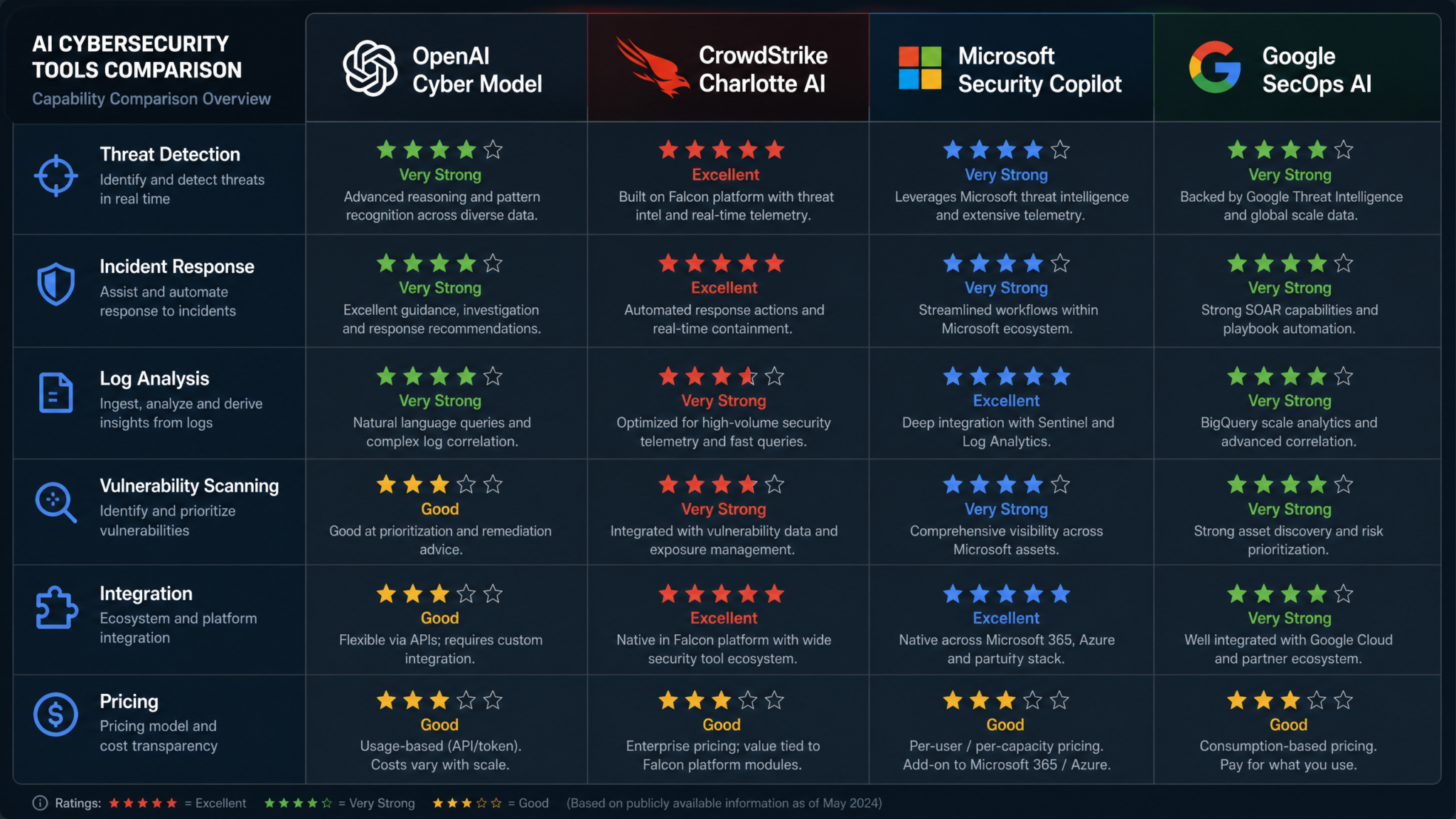
CyberGuard does not enter a vacant market. Three major technology players have made significant investments in AI-powered cybersecurity tooling over the past three years, and a rigorous comparison is essential for organizations evaluating their options.
CrowdStrike Charlotte AI
Charlotte AI, CrowdStrike’s conversational AI security analyst, has been integrated into the Falcon platform since late 2023 and has undergone substantial capability expansion through 2024 and 2025. Charlotte AI’s primary strength is its deep integration with CrowdStrike’s own telemetry — the Falcon platform processes over 2 trillion security events per week, and Charlotte AI’s training has access to this extraordinary data asset in ways that CyberGuard cannot replicate without equivalent scale telemetry. Charlotte AI excels at hunting within CrowdStrike-managed endpoint environments and correlating Falcon detections with threat intelligence from CrowdStrike’s proprietary Adversary Intelligence database.
CyberGuard’s advantage over Charlotte AI lies in its SIEM-agnostic positioning and broader integration ecosystem. Organizations that are not exclusively running CrowdStrike endpoints — which describes the majority of complex enterprise environments using a mix of security vendors — will find that CyberGuard can synthesize data from across the entire security stack in ways that Charlotte AI, fundamentally optimized for the Falcon ecosystem, cannot match. Charlotte AI is an exceptional tool within CrowdStrike’s sphere; CyberGuard is designed to work regardless of which security vendors an organization has chosen.
Microsoft Security Copilot
Microsoft Security Copilot, launched in April 2024 and significantly expanded through 2025 and 2026, is arguably CyberGuard’s most direct competitor in terms of market positioning. Built on GPT-4 architecture fine-tuned with Microsoft’s security-specific data, Security Copilot integrates natively with the Microsoft security stack — Sentinel, Defender, Purview, Intune — and benefits from Microsoft’s unmatched visibility into the Windows and Microsoft 365 ecosystems. For organizations that have standardized on Microsoft security tools, Security Copilot’s native integrations provide a seamless experience that CyberGuard will struggle to match through third-party connectors.
However, Security Copilot’s Achilles heel is precisely its Microsoft-centricity. Organizations with significant Linux infrastructure, hybrid cloud environments spanning AWS and Google Cloud, or heterogeneous security tooling portfolios often find that Security Copilot’s analytical depth drops sharply when they venture beyond Microsoft-native data sources. CyberGuard’s architecture has been designed explicitly for heterogeneous environments, and its training corpus deliberately includes extensive non-Windows telemetry — Linux kernel events, macOS endpoint data, AWS CloudTrail logs, Kubernetes security audit logs — that Security Copilot’s training has historically underweighted.
Google SecOps (formerly Chronicle AI)
Google’s security operations platform, rebranded as Google SecOps in 2025 following the integration of Mandiant’s capabilities, represents a formidable competitor particularly in the threat intelligence domain. Google’s unique advantage is its ability to correlate organizational security telemetry against the world’s broadest view of internet-scale threat data — something that flows directly from Google’s position as operator of the world’s largest DNS resolver, email platform, and web crawling infrastructure. When a new phishing domain appears, Google frequently has signals about it before any other intelligence source.
Google SecOps vs Microsoft Sentinel: Enterprise SIEM Platform Evaluation Guide
Against CyberGuard, Google SecOps’s competitive positioning is strongest in network-layer threat intelligence and email security. CyberGuard’s advantage is in code security analysis — where Google SecOps has limited capability — and in the breadth and quality of its incident response recommendation engine, which has been specifically rated superior to Google SecOps in independent analyst testing conducted by Forrester Research in the weeks preceding the CyberGuard launch.
| Feature | OpenAI CyberGuard | CrowdStrike Charlotte AI | Microsoft Security Copilot | Google SecOps |
|---|---|---|---|---|
| Purpose-built security model | ✅ Yes | ✅ Yes | ⚠️ Partial (GPT fine-tune) | ⚠️ Partial |
| Vendor-agnostic integration | ✅ Strong | ❌ CrowdStrike-centric | ❌ Microsoft-centric | ⚠️ Moderate |
| Code vulnerability scanning | ✅ 47 languages | ❌ Limited | ⚠️ Moderate | ❌ Minimal |
| Air-gapped deployment | ✅ Yes | ❌ No | ⚠️ Gov Cloud only | ❌ No |
| Real-time threat intelligence updates | ✅ 6-hour cadence | ✅ Near real-time | ✅ Near real-time | ✅ Near real-time |
| Custom model fine-tuning | ✅ Enterprise tier | ❌ No | ⚠️ Limited | ❌ No |
| Natural language incident reports | ✅ Excellent | ✅ Good | ✅ Excellent | ⚠️ Moderate |
| Starting price (monthly) | $2,400 | Bundled with Falcon | $4 per user/hr | Custom pricing |
What CyberGuard Means for SOC Teams and Security Analysts
The most emotionally charged question surrounding CyberGuard’s launch — asked explicitly by journalists during the press conference following the announcement — is whether this technology will eliminate security analyst jobs. OpenAI’s official response was predictably measured, but the detailed answer requires more nuance than a headline can accommodate.
Access 40,000+ AI Prompts for ChatGPT, Claude & Codex — Free!
Subscribe to get instant access to our complete Notion Prompt Library — the largest curated collection of prompts for ChatGPT, Claude, OpenAI Codex, and other leading AI models. Optimized for real-world workflows across coding, research, content creation, and business.
The honest assessment is that CyberGuard will fundamentally reshape the security operations center rather than eliminate it. The tasks most vulnerable to automation are precisely those that have historically consumed the majority of analyst time while providing the least professional satisfaction: Level 1 alert triage, log correlation, routine threat hunting following known playbooks, and first-pass phishing email analysis. These activities are not intellectually demanding for trained security professionals, but they are absolutely necessary and currently consume an estimated 67% of the average SOC analyst’s working hours, according to the SANS Institute’s 2026 SOC Survey.
By automating the bulk of this repetitive work, CyberGuard creates the conditions for security teams to spend more time on activities that genuinely require human expertise: investigating ambiguous signals that don’t fit established patterns, building relationships with business stakeholders to understand organizational risk context, conducting proactive threat modeling and red team exercises, and responding to the genuinely novel incidents that fall outside any automated playbook’s scope. Several of the CISOs involved in CyberGuard’s pilot program reported that their L1 analyst headcount needs dropped by an estimated 35–40%, while their demand for senior threat hunters and incident responders — roles requiring contextual judgment and adversarial creativity — remained constant or grew.
The implications for security analyst career development are also significant. Organizations deploying CyberGuard at scale will likely accelerate analysts through the L1 and L2 experience curve more rapidly, since the model handles the high-volume routine work that previously served as the primary experience-building mechanism for junior analysts. This could create a skills gap at the senior level if organizations do not deliberately invest in analyst development pathways that compensate for reduced routine-task exposure. Security training organizations including SANS Institute, Offensive Security, and EC-Council have all noted this dynamic and are already developing adapted certification track curricula that incorporate working alongside AI security systems as a core competency.
SOC Analyst Career Paths in the AI Era: Skills and Certifications That Still Matter
Leveraging CyberGuard Through ChatGPT Enterprise and Codex
For organizations already subscribed to ChatGPT Enterprise, CyberGuard represents an immediately accessible capability extension rather than an entirely new procurement decision. OpenAI has built CyberGuard access directly into the ChatGPT Enterprise console as a specialized assistant persona — accessible through the workspace’s custom GPTs framework — that security professionals can invoke directly through the familiar chat interface without requiring any API integration or developer configuration.
Within ChatGPT Enterprise, security analysts can engage CyberGuard in natural language to analyze specific threat scenarios, query the model about threat actor TTPs relevant to their industry vertical, request analysis of specific CVEs and their applicability to the organization’s software inventory, or generate detection rules in SIGMA format for deployment to their SIEM. The integration respects ChatGPT Enterprise’s existing privacy guarantees — conversation data does not leave the enterprise tenant and is not used for model training — while adding the full capability of CyberGuard’s specialized knowledge base to the conversational interface analysts already use daily.
For development teams using Codex-powered tools — including GitHub Copilot for Business, which now incorporates OpenAI’s latest Codex generation — CyberGuard’s code security capabilities are available as an optional security review layer within the code suggestion pipeline. When a Codex suggestion involves security-sensitive patterns — cryptographic operations, authentication flows, SQL query construction, file system access — CyberGuard can be configured to automatically evaluate the suggested code for security implications and append a security annotation to the suggestion before it reaches the developer’s IDE. This creates a security-by-design feedback loop that embeds vulnerability awareness into the development workflow rather than treating code security as a separate audit step that happens after code is written.
# Example CyberGuard security annotation in development workflow
# Hypothetical GitHub Copilot + CyberGuard integration output

# Developer writes:
user_input = request.GET.get('user_id')
query = f"SELECT * FROM users WHERE id = {user_input}"

# CyberGuard annotation appended to Copilot suggestion:
# ⚠️ SECURITY ADVISORY [CyberGuard — CWE-89]
# String interpolation in SQL query. High confidence SQL injection
# vulnerability. CVSS 9.8 (Critical) in typical web application context.
# Recommended remediation:
# cursor.execute("SELECT * FROM users WHERE id = %s", (user_input,))
# Reference: OWASP SQL Injection Prevention Cheat Sheet
This IDE-level security feedback mechanism addresses one of the most persistent challenges in application security: the cost of finding and fixing vulnerabilities increases exponentially the further they progress through the development lifecycle. A vulnerability caught at code-writing time costs essentially nothing to fix. The same vulnerability found in production carries the full weight of incident response, potential breach costs, and regulatory penalties. By embedding CyberGuard’s analysis into the development workflow through Codex integration, organizations can fundamentally shift where in the lifecycle security investment is applied.
Limitations, Risks, and What the Model Cannot Replace
Any responsible coverage of CyberGuard must confront its limitations with the same rigor applied to its capabilities. OpenAI has been commendably transparent about these limitations in the technical whitepaper, even if the marketing materials inevitably emphasize strengths over constraints.
Zero-Day and Novel Attack Limitations
CyberGuard’s threat detection capabilities are, at their core, a function of pattern recognition applied to an extraordinarily rich training corpus. For attacks that closely resemble known techniques — which describes the overwhelming majority of real-world attacks, since most threat actors reuse proven TTPs — the model performs impressively. For genuinely novel zero-day exploit chains that have no meaningful antecedents in the training data, CyberGuard’s detection capabilities are materially weaker. The model will detect behavioral anomalies associated with a novel attack, but it will do so without the rich contextual framework it brings to known attack patterns, potentially resulting in less actionable alert context and reduced remediation guidance quality.
Attribution Confidence and Legal Risk
CyberGuard’s threat actor attribution capabilities — its ability to link observed TTPs to specific nation-state or criminal actor groups — carry a significant caution that OpenAI flags prominently in its documentation. Attribution is an inherently probabilistic exercise even for human experts with access to classified intelligence. CyberGuard’s attribution assessments, while grounded in extensive open-source intelligence, should be treated as analytical hypotheses requiring human validation rather than definitive conclusions. Organizations that rely on attribution data for legal or regulatory purposes — insurance claims, law enforcement referrals, regulatory incident reporting — must apply additional human expert review to any CyberGuard attribution assessment before using it in formal contexts.
Adversarial Model Manipulation
Like all machine learning systems, CyberGuard is potentially vulnerable to adversarial inputs designed to manipulate its outputs. A sophisticated threat actor with knowledge of the model’s architecture could theoretically craft malware or log data designed to evade the model’s detection logic — an attack category known as adversarial ML evasion. OpenAI has implemented robust adversarial robustness measures in CyberGuard’s training and has deployed anomaly detection systems to flag potential adversarial manipulation attempts, but the existence of this attack surface is non-negligible and represents a qualitatively different risk than traditional signature-based security tools face.
Compliance and Regulatory Gaps
CyberGuard does not provide compliance management, regulatory reporting, or legal analysis capabilities. It cannot determine whether an observed incident constitutes a reportable breach under GDPR Article 33, HIPAA Breach Notification Rule, or SEC cybersecurity disclosure regulations. Organizations must maintain separate compliance frameworks and legal counsel to address the regulatory dimensions of security incidents that CyberGuard identifies. The model is also not a substitute for penetration testing conducted by human red team professionals, particularly for compliance frameworks like PCI DSS that require human-conducted penetration testing as a specific control requirement.
AI Tools for Cybersecurity Compliance Management: What Works and What Doesn’t
Hallucination Risk in Security Contexts
OpenAI has significantly reduced CyberGuard’s hallucination rate relative to general-purpose models through specialized training and constrained output formats, but the risk cannot be entirely eliminated. In a security context, hallucinations carry particular danger: a model that fabricates a CVE identifier, misidentifies a benign process as malicious, or provides incorrect remediation guidance could cause operational disruption or create a false sense of security. Organizations should implement human review checkpoints for all CyberGuard outputs before taking any action that is difficult or impossible to reverse — particularly automated containment actions that could disrupt production services.
Expert Reactions From the Cybersecurity Community
The cybersecurity community’s reaction to CyberGuard’s launch has been characteristically divided between genuine enthusiasm and hard-nosed skepticism — a response pattern that reflects both the field’s high standards for security tooling and its accumulated fatigue with AI marketing overclaims.
Bruce Schneier, security technologist and lecturer at Harvard Kennedy School, offered a measured assessment in a post published on his Schneier on Security blog within hours of the announcement: “CyberGuard represents a genuine capability advance, particularly in log analysis and code security. My concern is not the technology but the deployment context. Security is ultimately a human-system problem, and organizations will inevitably over-trust the model in exactly the situations where its confidence scores are least reliable — novel attacks, sophisticated adversaries, ambiguous insider threat scenarios. The model is probably excellent at finding the threats it was trained to find. The threats it wasn’t trained to find are precisely the ones that will cause the most damage.”
Katie Nickels, Director of Intelligence at Red Canary and a principal contributor to the MITRE ATT&CK framework, expressed stronger enthusiasm while flagging specific concerns about the threat intelligence update cadence: “Six-hour threat intelligence updates are not fast enough for the most critical threat actor activity. When a major ransomware group releases a new variant or a zero-day drops, the first 90 minutes are often decisive for organizations in the blast radius. I want to understand how CyberGuard handles the gap between a novel threat emerging and the model’s knowledge graph incorporating it. That’s not a fatal flaw — it’s a known limitation that can be worked around — but defenders need to understand it.”
Chris Krebs, former director of CISA and currently partner at Krebs Stamos Group, provided perhaps the most strategically grounded reaction in an interview with The Record: “The private compute deployment option changes the calculus for the government and defense contractor communities substantially. We have been watching the AI security revolution happen in commercial enterprise while critical infrastructure organizations were essentially locked out due to data sovereignty requirements. If CyberGuard Private Compute delivers what it promises at the security assurance level that FedRAMP High authorization requires, this is a genuinely transformative event for national cyber defense posture.”
Not all reactions were positive. Mikko Hyppönen, Chief Research Officer at WithSecure, raised a structural concern that several other veteran security researchers echoed: “My worry is centralization. We are potentially moving toward a world where a significant fraction of global enterprise threat detection runs through a single model from a single company. That is a systemic risk that is difficult to quantify but very real. A successful adversarial attack on CyberGuard itself — whether through model manipulation, supply chain compromise of the update pipeline, or simply discovering the model’s blind spots and systematically exploiting them — could create coordinated detection failures at unprecedented scale.”
The academic community has also weighed in. Dr. Battista Biggio, professor at the University of Cagliari and a leading researcher in adversarial machine learning, published a pre-print analysis arguing that CyberGuard’s security, like all large-scale ML systems, ultimately depends on the security of its training pipeline and update infrastructure: “OpenAI has described impressive adversarial robustness measures. What they have not disclosed in sufficient detail is their supply chain security for the Cyber Threat Intelligence Graph updates. A sophisticated attacker who could poison that update channel could potentially degrade the model’s detection capabilities in targeted, difficult-to-audit ways. This is not hypothetical — it is the attack surface that sophisticated nation-state actors will prioritize.”
From the practitioner community, reactions from the pilot program participants have been consistently more positive. A head of security operations at a major European financial institution, quoted anonymously in OpenAI’s launch materials, reported: “In our six-month pilot, we processed approximately 2.4 trillion security events through CyberGuard. The model identified 23 genuine security incidents that our existing detection stack had not surfaced. Two of those incidents, when investigated, revealed active long-dwell intrusions that had been present in our environment for between 11 and 17 weeks. That alone justified the entire program investment.”
The Road Ahead: How This Reshapes Enterprise Cyber Defense
OpenAI CyberGuard’s August 2026 launch will be remembered as the moment when AI-powered cybersecurity crossed from incremental enhancement to foundational infrastructure. The combination of purpose-built specialized training, vendor-agnostic integration architecture, air-gapped deployment capability, and genuine code security depth represents a qualitative advance over what the market has previously offered — not merely a better AI chatbot for security questions, but a functional extension of security operations capability that addresses real gaps in how enterprises detect, investigate, and respond to threats at scale.
The competitive implications will reshape the cybersecurity market over the next 18 to 24 months in ways that are still difficult to fully predict. CrowdStrike, Microsoft, and Google will accelerate their own AI security investments in response. MSSP providers will rebuild their managed detection and response service architectures around CyberGuard or competitor equivalents, changing what managed security services look like and what human expertise they require. Security tool vendors whose products focus on capabilities CyberGuard subsumes — particularly standalone phishing detection products and first-generation SIEM correlation engines — will face significant pricing pressure and accelerated consolidation pressure.
For the security professionals who have spent their careers building expertise in manual threat detection, log analysis, and incident response, the honest message is both challenging and ultimately optimistic: the skills that made great security analysts valuable yesterday are being partially automated away, but the judgment, adversarial creativity, and organizational context that make exceptional security professionals irreplaceable remain beyond what any current AI system can replicate. The analysts who thrive in the CyberGuard era will be those who learn to work with AI as a force multiplier — delegating the exhausting high-volume work the model does well while focusing their own expertise on the ambiguous, novel, and strategically significant threats that still require a human mind.
The limitations are real, the adversarial risks are non-trivial, and the centralization concerns raised by veteran researchers deserve serious structural consideration at the industry and policy levels. But the core capability advance is genuine. For enterprise security teams drowning in alert volume, understaffed against an expanding threat landscape, and watching mean detection times measured in months rather than minutes, CyberGuard offers something that the cybersecurity industry has rarely been able to credibly promise: genuine, scalable, measurable improvement in how quickly and accurately organizations discover that they are under attack.
The full general availability of OpenAI CyberGuard for Professional and Enterprise tiers begins September 1, 2026. Private Compute configurations are available for qualified organizations through OpenAI’s enterprise sales organization beginning immediately, with initial deployment lead times estimated at six to eight weeks pending hardware procurement and integration scoping. The cybersecurity landscape will look materially different by this time next year, and the transformation began this week in San Francisco.
