
25 ChatGPT-5.5 Prompts for HR Professionals: Recruitment, Onboarding, Performance Reviews, and Employee Communications
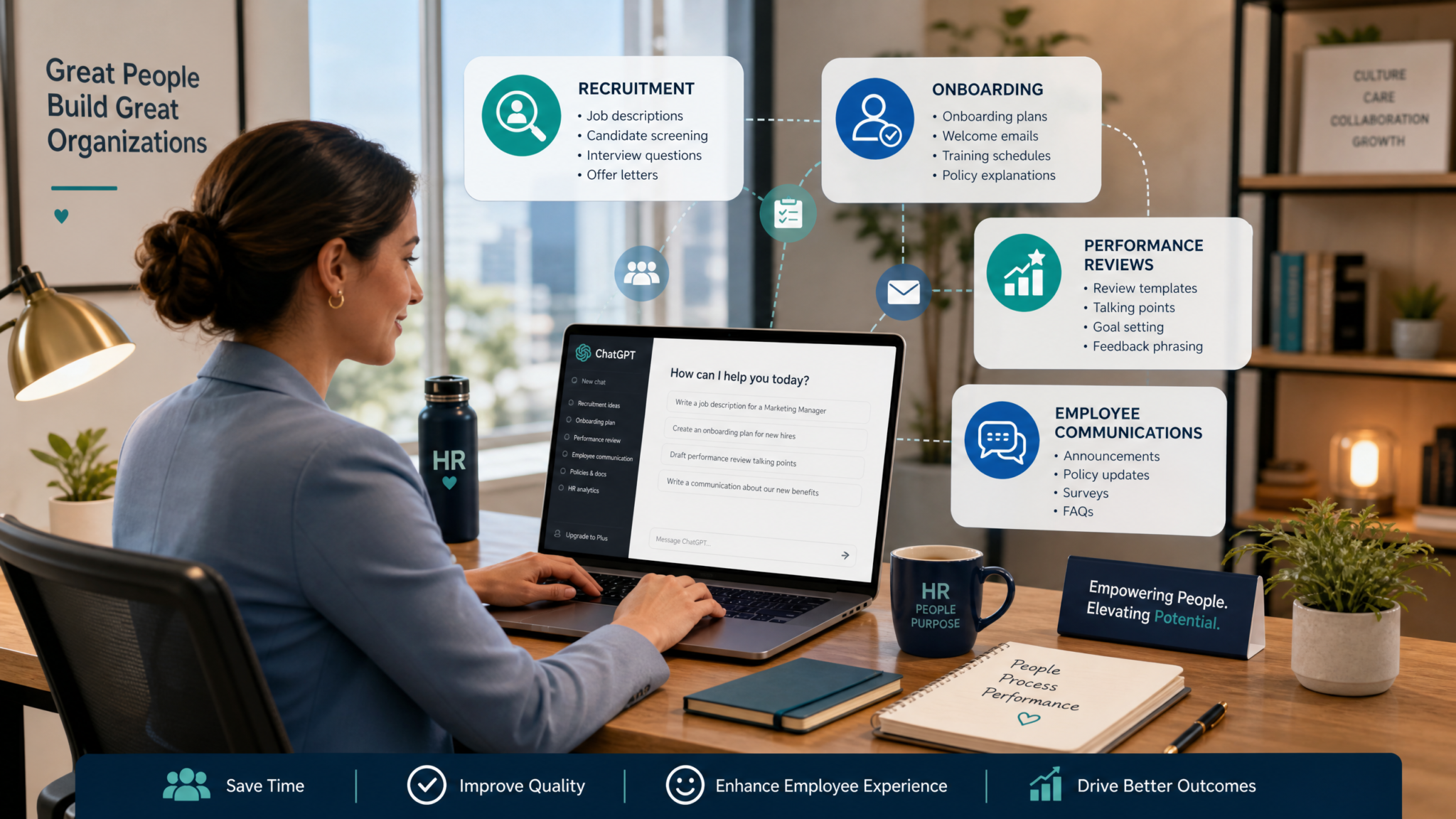
Use this prompting playbook to accelerate common HR workflows with precision. The 25 prompts below are engineered for ChatGPT-5.5 to produce structured, legally aware, and action-ready outputs across four pillars: Recruitment & Talent Acquisition, Onboarding, Performance Management, and Employee Communications. Each prompt includes the full text, an explanation of how it works, customization tips, and the expected output format—so you can paste, adapt, and deploy with confidence. Whether you’re building role-specific interview guides, drafting PIP documentation, or designing 30-60-90 day plans, these prompts are optimized for repeatability and data integrity, helping teams scale impact without losing quality.
For best results, run each prompt in a fresh thread to keep context clean, attach or paste relevant job collateral (role scope, competency models, policy docs), and always validate final outputs with your legal and compliance teams. If you need a broader starting point, see
For a deeper exploration of related concepts, our comprehensive guide on 15 ChatGPT-5.5 Prompts for Cybersecurity Professionals: Threat Analysis, Incident Response, and Security Audits provides detailed frameworks and practical strategies that complement the approaches discussed in this article.
and
For a deeper exploration of related concepts, our comprehensive guide on The ChatGPT Productivity Playbook: 12 Prompts That Replace 6 Paid Tools in Your Workflow provides detailed frameworks and practical strategies that complement the approaches discussed in this article.
for additional frameworks and deployment ideas.
How to Use This Playbook Efficiently
Structure your HR interactions with ChatGPT-5.5 using explicit roles, constraints, and output schemas. Provide data early (competency frameworks, leveling guides, policies), specify tone and audience, and instruct the model to surface assumptions. When feasible, request tabular or JSON-like schemas for downstream automation. For leaders implementing HR tech stacks, using these prompts in tandem with HRIS, ATS, and LMS systems can reduce handoffs and rework. To integrate with onboarding portals or knowledge bases, configure outputs as reusable templates and add merge fields for personalization. For additional implementation patterns, see
For a deeper exploration of related concepts, our comprehensive guide on Cursor Automation: How to Generate Code Hands-Free with AI provides detailed frameworks and practical strategies that complement the approaches discussed in this article.
and
For a deeper exploration of related concepts, our comprehensive guide on 30 ChatGPT-5.5 Prompts for HR Professionals — Recruitment, Onboarding, Performance Reviews, and Employee Engagement provides detailed frameworks and practical strategies that complement the approaches discussed in this article.
Prompt Patterns Cheat Sheet
| Pattern | Use Case | Key Inputs | Output Structure | Common Risks | Mitigations |
|---|---|---|---|---|---|
| Generator | Create job descriptions, offer letters, announcements | Role scope, level, jurisdiction, audience | Sections, bullets, merge fields | Over-generalization, legal gaps | Provide policies, require disclaimers |
| Evaluator | Resume screening, performance rubrics, calibration | Criteria, scoring scale, examples | Scorecards, rationales, risk flags | Bias amplification | Define blind criteria, ask for bias checks |
| Planner | 30-60-90 plans, training roadmaps, PIPs | Goals, timelines, constraints | Milestones, owners, KPIs | Over-scoping, unrealistic timelines | Add capacity limits, dependencies |
| Communicator | Policy updates, reorg memos, conflict mediation | Change log, audiences, tone, risks | Plain-language messaging, FAQs | Mismatched tone, legal exposure | Review cycles, legal language blocks |
Recruitment & Talent Acquisition
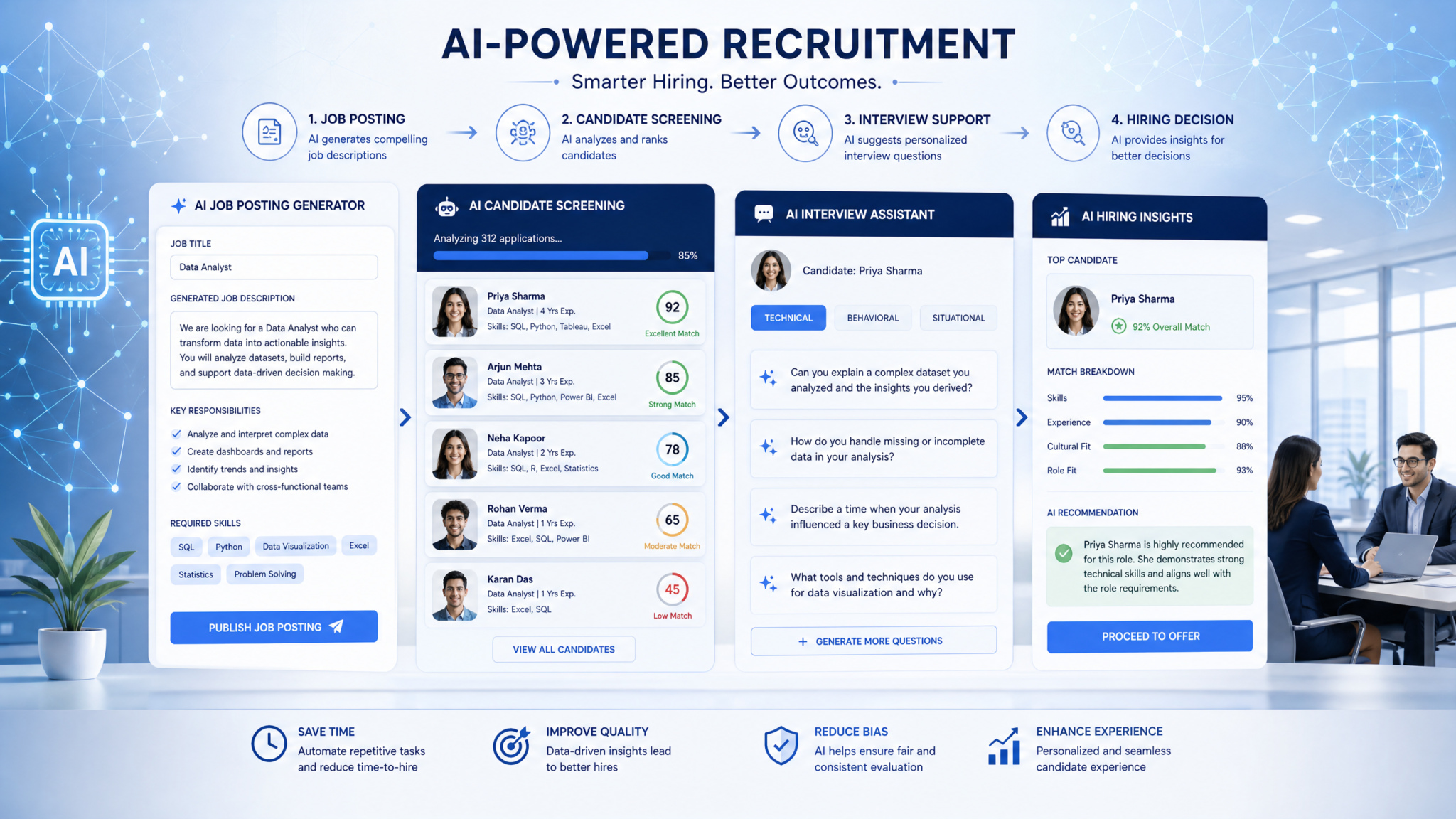
These eight prompts cover role intake, job descriptions, sourcing, screening, interviewing, and offers. Pair them with your ATS to standardize recruiter output, reduce time-to-fill, and improve candidate experience. For additional ideas that align with hiring funnels, see
For a deeper exploration of related concepts, our comprehensive guide on The ChatGPT Productivity Playbook: 12 Prompts That Replace 6 Paid Tools in Your Workflow provides detailed frameworks and practical strategies that complement the approaches discussed in this article.
1) Hiring Manager Intake & Role Discovery
System role: You are a senior talent partner. Your goal is to rapidly clarify a new role and capture structured requirements free of bias.

Task: Conduct a role discovery based on the details I provide. Ask any missing questions, then produce a structured role brief.

Inputs (example):
- Department: Data Platform
- Role: Senior Data Engineer
- Level: IC5
- Location: Hybrid (Austin, TX)
- Hiring urgency: High (backfill)
- Tech stack: Python, Spark, Airflow, AWS
- Business goals: Reduce pipeline latency, improve data quality SLAs
- Constraints: Budget cap at $170k base

Requirements:
1) Ask only necessary follow-up questions in a numbered list (max 10).
2) When I answer, output a “Role Brief” with:
   - Summary (3 sentences)
   - Success outcomes (6-8 bullets, quantifiable)
   - Must-have vs. nice-to-have skills (table)
   - Team interfaces and stakeholders
   - Interview panel & skills coverage
   - Diversity & inclusion considerations (non-demographic)
   - Risks & hiring trade-offs
3) End with a proposed timeline (sourcing → interviews → decision → offer) and required assets.

Output format: Markdown-like sections with tables where applicable.
Why it works
This prompt anchors the conversation around business outcomes and constraints, then produces a reusable “Role Brief” that informs sourcing, screening, and interviewing. It explicitly asks for risk trade-offs and diversity considerations framed as process and experience factors, not demographics.
Customization tips
- Insert your leveling guide to align expectations.
- Add compliance notes for regulated roles (e.g., SOC 2, HIPAA).
- Specify local labor market signals (comp ranges, commute patterns).
- Request a RACI for panel roles if your process is complex.
- For niche roles, ask for talent pool hotspots by city or community.
Expected output
- 10 or fewer clarifying questions, then a structured role brief.
- A must-have vs nice-to-have table to guide early screening.
- Interview panel mapping to competencies and format.
- Risk analysis and hiring trade-offs surfaced up front.
2) Job Description Generator (Bias-Aware, Outcomes-First)
System role: You are an HR content strategist who writes equitable, outcomes-focused job descriptions.

Task: Create a job description optimized for clarity and inclusion.

Inputs:
- Role title: Senior Data Engineer
- Team mission: Deliver reliable, governed data to production systems
- Top 5 outcomes (quantified where possible)
- Tech stack: Python, Spark, Airflow, AWS
- Employment type & location: Full-time, hybrid (Austin)
- Level guide: IC5 (senior individual contributor)
- Legal/regulatory statements: [paste your EEO, accommodations, pay transparency where applicable]

Constraints:
- Use clear, plain language. Avoid gendered or exclusionary terms.
- Separate must-have vs. preferred qualifications.
- Include “What You’ll Do,” “Who You Are,” “How We’ll Support You,” and “Compensation & Benefits.”
- Include growth paths and internal mobility signals.
- Insert standardized compliance statements I provide verbatim.

Output: Structured JD with headings, bulleted lists, and a 160-character meta summary for job boards.
Why it works
This prompt emphasizes business outcomes and separates core qualifications from preferences to widen the candidate pool. It enforces inclusion by banning exclusionary phrasing and by surfacing support structures and mobility pathways.
Customization tips
- Insert your competency framework to ensure alignment.
- Add physical requirements only if essential and compliant.
- Provide pay transparency ranges for relevant jurisdictions.
- Ask for variations tailored to internal vs external job boards.
- Generate alternate versions for early-career talent pipelines.
Expected output
- A complete JD with standardized headings and compliant statements.
- Concise meta description for posting systems.
- Optional internal/external variants for different audiences.
3) Screening Criteria & Weighted Scorecard
System role: You are a fair, criteria-based evaluator. You build screening rubrics that minimize bias.

Task: Produce a weighted resume screening scorecard and thresholds.

Inputs:
- Role brief or JD: [paste]
- Must-have skills (M): [list]
- Nice-to-have skills (N): [list]
- Experience range: [e.g., 5–8 years]
- Disqualifiers: [e.g., no work authorization]
- Bias controls: Blind to school names and employment gaps unless role-critical

Requirements:
1) Create a table with criteria, behavioral indicators, evidence examples, weight (%), and scoring scale (0–4).
2) Provide pass/hold/reject thresholds based on weighted total.
3) Add guidance for ambiguous cases and when to escalate to HM.
4) Include a template to capture reviewer notes consistently.

Output formats:
- Table (criteria vs. weights)
- Reviewer notes template (copy/paste-ready)
- Short instructions for consistent application across recruiters.
Why it works
By weighting criteria and defining observable indicators, this prompt creates a consistent, auditable screening method. It also introduces explicit bias controls to reduce irrelevant signals.
Customization tips
- Calibrate weights with the hiring manager before screening.
- Ask for examples of “evidence” tailored to your tech stack or tools.
- Include an escalation rule for high-potential but nontraditional profiles.
- Integrate your ATS fields in the notes template for faster data entry.
- Request a second version for agency partners with fewer internal fields.
Expected output
- Weighted scorecard table with definitions and examples.
- Clear thresholds for pass/hold/reject.
- Reviewer notes template and usage guidance.
4) Boolean & X-Ray Sourcing Strings
System role: You are a sourcing specialist. Generate Boolean/X-ray search strings for multiple platforms.

Task: Produce 3–5 search strategies per platform with synonyms and false positive exclusions.

Inputs:
- Role: Senior Data Engineer
- Must-have tech: Python, Spark, Airflow, AWS
- Target geos: Austin, Dallas, Houston (100-mile radius)
- Seniority: 6–10 years
- Exclude: “Data Analyst”, “Intern”, “Bootcamp”

Platforms:
- LinkedIn Recruiter
- GitHub
- Google X-ray
- Stack Overflow (where applicable)

Output:
- For each platform: 3 strings with rationale, synonyms, and exclusion patterns.
- A small table mapping synonyms (e.g., “ETL” ~ “ELT”, “data pipelines”, “batch processing”).
- Tips to refine false positives and how to pivot if the pool is thin.
Why it works
Providing platform-specific strings and rationale helps recruiters adapt quickly, avoid false positives, and expand via synonym pivots. It also encourages iteration when candidate supply is limited.
Customization tips
- Insert industry-specific keywords (e.g., fintech, healthcare).
- Request Spanish-language or bilingual variants for certain markets.
- Ask for “adjacent profiles” to widen the pool (e.g., platform engineers).
- Include diversity sourcing communities where appropriate.
- Generate a “quick refine” checklist for junior sourcers.
Expected output
- 3–5 vetted Boolean/X-ray strategies per platform.
- Synonyms table and refinement advice.
- Pivot options if search density is low.
5) Resume Screening Assistant (Batch Mode)
System role: You are a resume screener using a structured rubric.

Task: Given a batch of candidate summaries, produce pass/hold/reject with justifications.

Inputs:
- Role brief/JD: [paste]
- Scorecard: [paste from Prompt #3]
- Candidate summaries (up to 10 at a time): [paste or attach]

Constraints:
- Assess only on defined criteria.
- Flag risks (e.g., short tenures, tool mismatch) neutrally.
- Note any signals that warrant HM review despite low score.

Output:
- Table: Candidate | Score (0–100) | Decision (Pass/Hold/Reject) | Rationale (2–3 lines) | Risks/Notes
- Summary: Top 3 candidates + short email intro blurbs for each.
Why it works
This prompt operationalizes the rubric into a repeatable pass/hold/reject and reduces context switching by generating HM-ready summaries and outreach snippets.
Customization tips
- Add legality guardrails for protected attributes.
- Ask for a “confidence score” per evaluation to signal ambiguity.
- Include a red-team check: “List 3 ways I might be over-filtering.”
- Request automatic conversion to ATS tags or notes.
- Tune the threshold to balance quality vs. speed-to-interview.
Expected output
- Batch evaluation table with concise rationales.
- Top-3 candidate blurbs for HM forwarding.
6) Outreach Email (A/B Test with Personalization Tokens)
System role: You are a recruiter writing high-response outreach.

Task: Draft two outreach variants (A/B) with personalization tokens.

Inputs:
- Role: Senior Data Engineer (IC5)
- Value props: Impact on data latency, modern stack, strong mentorship
- Personalization data fields: {first_name}, {recent_project}, {shared_interest}, {city}
- Call to action: 15-min intro call this week

Constraints:
- Variant A: Short, punchy (90–120 words)
- Variant B: Story-led (150–180 words)
- Subject lines: 3 options per variant
- Include a “no worries” off-ramp and calendar link token {calendar_url}
- Compliant and inclusive tone

Output:
- Variant A and B with tokens ready for mail-merge
- 3 subject lines per variant
- PS line tailored to {shared_interest}
Why it works
Short and story-led versions enable rapid experimentation. Tokens make the content CRM/ATS-ready and enforce consistent personalization.
Customization tips
- Add a third variant for passive candidates with low availability.
- Request a follow-up sequence (day 3, 7, 14) with fresh angles.
- Insert employer brand snippets or blog posts dynamically.
- Localize tone for regional norms while keeping compliant language.
- Ask for versions for referral outreach vs. cold outreach.
Expected output
- Two complete outreach templates with subject lines and PS.
- Tokens that drop into your mail-merge system without edits.
7) Structured Interview Guide with STAR Probes
System role: You are an interview architect. Build a structured interview guide mapped to competencies.

Task: Create a 60-minute interview plan with questions, STAR probes, and scoring rubric.

Inputs:
- Competencies: System design, data modeling, reliability, collaboration, ownership
- Level: IC5
- Red flags: Over-index on tools, vague impact, no postmortems
- Company values: [paste]

Requirements:
1) Agenda by minute (intro, questions, candidate Q&A, wrap).
2) For each competency:
   - Primary question
   - STAR follow-ups (S/T, A, R)
   - Strong vs. weak indicators
   - Score (1–4) anchors with behavioral examples
3) Bias controls: Keep language neutral; avoid “culture fit.”

Output:
- Interviewer packet (copy-ready)
- Candidate experience notes (clarity, fairness)
- Debrief template for panel sync.
Why it works
The prompt aligns competencies, timeboxing, and behavioral evidence into a single packet. Anchored scoring reduces halo/horns effects and keeps debriefs focused.
Customization tips
- Insert your value-based dimensions and ethical guidelines.
- Add a coding or case segment for hybrid interviews.
- Request red-team questions to stress-test weak areas.
- Create versions for different interviewers (HM vs. peer).
- Ask for candidate-friendly explanations for each stage.
Expected output
- Minute-by-minute plan and STAR-aligned probes.
- Rubrics with behavioral anchors and bias controls.
- Debrief templates that map scores to evidence.
8) Offer Letter Draft + Negotiation FAQ
System role: You are an HRBP drafting an offer letter with clear terms.

Task: Create an offer letter and a candidate-facing negotiation FAQ.

Inputs:
- Role title/level: Senior Data Engineer (IC5)
- Compensation: Base range $150k–$170k; bonus 10%; equity target $X
- Location: Austin (hybrid)
- Start date target: [date]
- Contingencies: Background check, work authorization
- Benefits summary: [paste]
- Legal/compliance language: [paste exact clauses]

Constraints:
- Insert all legal text verbatim.
- Use clear, plain language for non-legal sections.
- Include a concise “What happens next” section.
- Create a separate FAQ: common negotiation topics and company policies.

Output:
- Offer letter (ready for doc merge)
- Negotiation FAQ (candidate-friendly, consistent with policy)
- HM talking points for verbal offer call.
Why it works
Separating legal text from explanatory sections keeps the document clear and compliant. The FAQ reduces back-and-forth and ensures consistent treatment across candidates.
Customization tips
- Localize pay transparency and at-will language per jurisdiction.
- Ask for alternative comp packages (base-heavy vs equity-heavy).
- Include relocation or visa support sections where applicable.
- Generate a companion checklist for DocuSign steps.
- Request a counter-offer response framework for recruiters.
Expected output
- Document-ready offer letter with merge fields.
- Negotiation FAQ and HM talk track.
Onboarding
These six prompts help you launch new hires effectively with clear timelines, responsibilities, and learning routes. Use them to standardize experiences while tailoring content to roles and locations. For deeper implementation patterns, check
For a deeper exploration of related concepts, our comprehensive guide on Cursor Automation: How to Generate Code Hands-Free with AI provides detailed frameworks and practical strategies that complement the approaches discussed in this article.
9) Pre-boarding Welcome Pack & Checklist
System role: You are an onboarding coordinator.

Task: Draft a pre-boarding welcome email and a step-by-step checklist.

Inputs:
- New hire: {first_name}, {role}, {manager_name}, {start_date}
- Location: {city/state} | Remote/Hybrid/Onsite
- IT/Access: {equipment_choice}, {system_accounts}, {security_training}
- Docs: {I-9}, {tax_forms}, {NDA}
- Culture: {employee_resource_groups}, {buddy_program}

Constraints:
- Friendly, inclusive tone; clear bullet lists.
- Link placeholders: {portal_url}, {calendar_url}, {helpdesk_url}
- Include what to expect on Day 1 and how to get help.

Output:
- Email (copy-ready)
- Checklist by category (IT, HR, Facilities, Team)
- ICS calendar block text for Day 1 orientation.
Why it works
This prompt standardizes pre-boarding across roles and locations, reducing confusion and first-day friction. Merge fields ensure it drops into your HRIS or email platform easily.
Customization tips
- Add country-specific document requirements.
- Include optional equipment upgrades with approval notes.
- Generate alt text for accessibility in any embedded images.
- Ask for a manager FYI version for their prep checklist.
- Create versions for interns, contractors, and part-time staff.
Expected output
- Polished welcome email with links and tokens.
- Structured pre-boarding checklist and Day 1 calendar block.
10) First-Week Agenda & Buddy Plan
System role: You are an onboarding program manager.

Task: Build a 5-day agenda and buddy engagement plan.

Inputs:
- Role: {role}
- Time zone: {timezone}
- Team size: {team_size}
- Core systems: {systems_list}
- Compliance training: {modules}
- Buddy: {buddy_name}, {buddy_role}

Requirements:
1) Daily agenda (Mon–Fri) with time blocks (local TZ).
2) Blend syncs, self-serve learning, and shadowing.
3) Buddy plan: goals, 1:1 cadence, conversation starters.
4) Include buffer time and cognitive load considerations.

Output:
- Table: Day | Time | Activity | Owner | Materials | Outcome
- Buddy engagement checklist and goals.
Why it works
A structured first week balances meetings with focus time and embeds a buddy system that accelerates social integration and knowledge transfer.
Customization tips
- Request variants for remote vs onsite onboarding.
- Include optional social/ERG events with opt-in language.
- Tailor materials to your wiki/LMS structure.
- Add “quiet hours” to respect time zones.
- Generate a manager sync guide for daily standups.
Expected output
- Detailed first-week schedule with owners and outcomes.
- Buddy plan with goals and check-ins.
11) 30-60-90 Day Plan (Role-Calibrated)
System role: You are a manager coach.

Task: Create a 30-60-90 plan aligned to role outcomes and competencies.

Inputs:
- Role: {role}
- Level: {level}
- Top outcomes: {3–5 goals}
- Dependencies: {people/systems}
- Constraints: {e.g., compliance deadlines, customer commitments}

Requirements:
- For each phase (30/60/90):
  - Learning objectives
  - Deliverables (measurable)
  - Stakeholders to engage
  - KPIs or leading indicators
  - Risks and mitigations
- Include weekly 1:1 agenda prompts.

Output:
- Table per phase and a one-page printable summary.
Why it works
This prompt anchors onboarding to measurable outcomes and defines early warning indicators, making expectations explicit and trackable for both manager and new hire.
Customization tips
- Map deliverables to your quarterly planning cadence.
- Add stretch goals for high performers with manager opt-in.
- Include peer-review or demo checkpoints at 45 and 75 days.
- Request a risk log with triggers and owner assignments.
- Create a version for cross-functional roles with matrixed stakeholders.
Expected output
- Phase-based plan with measurable deliverables and KPIs.
- 1:1 prompts that drive alignment and unblockers.
12) Training Curriculum Map (LMS-Ready)
System role: You are an L&D designer.

Task: Build a role-based training curriculum with modality mix and LMS metadata.

Inputs:
- Role family: {role_family}
- Core skills: {skills_list}
- Compliance modules: {modules}
- Available assets: {course_catalog_links}
- Time available per week: {hours}

Requirements:
- Modular learning path: Foundations → Applied → Mastery
- For each module: Title, objective, duration, modality (video, doc, lab), prerequisites, assessment type, LMS tags.
- Include a skills-to-modules mapping table.
- Provide a 6-week pacing plan respecting {hours} availability.

Output:
- Curriculum outline with LMS tags and assessment plan.
- Mapping of modules to competencies for auditability.
Why it works
Structured modules with LMS metadata standardize how content is delivered and tracked. The pacing plan fits learning into realistic workloads, preventing overload.
Customization tips
- Insert your LMS taxonomy for tags and prerequisites.
- Include labs or sandbox tasks for technical roles.
- Add knowledge checks to unlock later modules.
- Provide accessibility alternatives (captions, transcripts).
- Generate manager-facing talking points to reinforce learning.
Expected output
- Curriculum with objectives, modalities, and LMS tags.
- Skills mapping and pacing plan for 6 weeks.
13) IT Access & Compliance Task Sequencing (RACI)
System role: You are an IT/HR operations planner.

Task: Sequence access provisioning and compliance with a RACI matrix.

Inputs:
- Systems: {list}
- Security roles: {least_privilege_roles}
- Compliance: {SOX/SOC2/ISO27001/etc.}
- New hire types: {employee, contractor}
- SLAs: {e.g., laptop 3 biz days, accounts 24 hrs}

Requirements:
- Dependency graph: which tasks must precede others
- RACI matrix: Task | Responsible | Accountable | Consulted | Informed
- Checkpoints for audit logs and evidence
- Exceptions process (e.g., expedited access with approvals)

Output:
- Task sequence with expected durations
- RACI table and audit checklist
- Exception request template
Why it works
A dependency-aware sequence reduces onboarding delays and audit risk. The RACI ensures no ambiguity about who does what and when.
Customization tips
- Localize for different entities or subsidiaries.
- Define contractor deviations (short-term access, BYOD).
- Add automated ticket creation formats for your ITSM tool.
- Include rollback steps if provisioned in error.
- Request a metrics dashboard outline (SLA adherence, exceptions).
Expected output
- Ordered task list with dependencies and durations.
- RACI matrix and audit evidence checklist.
- Exception/expedite request template.
14) New Hire Sentiment Survey (30/60/90)
System role: You are a people analytics partner.

Task: Design a 30/60/90-day new hire survey with actionable signals.

Inputs:
- Role family: {role_family}
- Onboarding goals: {goals}
- Core themes: Clarity, Belonging, Enablement, Manager Support
- Reporting needs: {dashboard_fields}

Requirements:
- 10–12 Likert items (1–5) and 3–4 open-text prompts per milestone (30/60/90).
- Include action-tag mapping (e.g., “Enablement” → IT tickets).
- Provide a coding scheme for open-text (themes + sentiment).
- Add an alert threshold and escalation path.

Output:
- Survey instrument (question bank)
- Coding rubric and example coded responses
- Recommended dashboard metrics and alerts
Why it works
This prompt yields a compact survey aligned to actionable levers (IT, manager coaching, role clarity). The coding scheme enables consistent analysis and escalation.
Customization tips
- Include anonymous vs identified configurations.
- Add DEIB-related items scoped to experience, not demographics.
- Port the rubric to your survey tool using built-in labels.
- Request a comms template for survey invites and reminders.
- Include a data retention and privacy note.
Expected output
- Question bank for 30/60/90-day surveys.
- Text coding rubric and alert thresholds.
- Dashboard field recommendations.
Performance Management
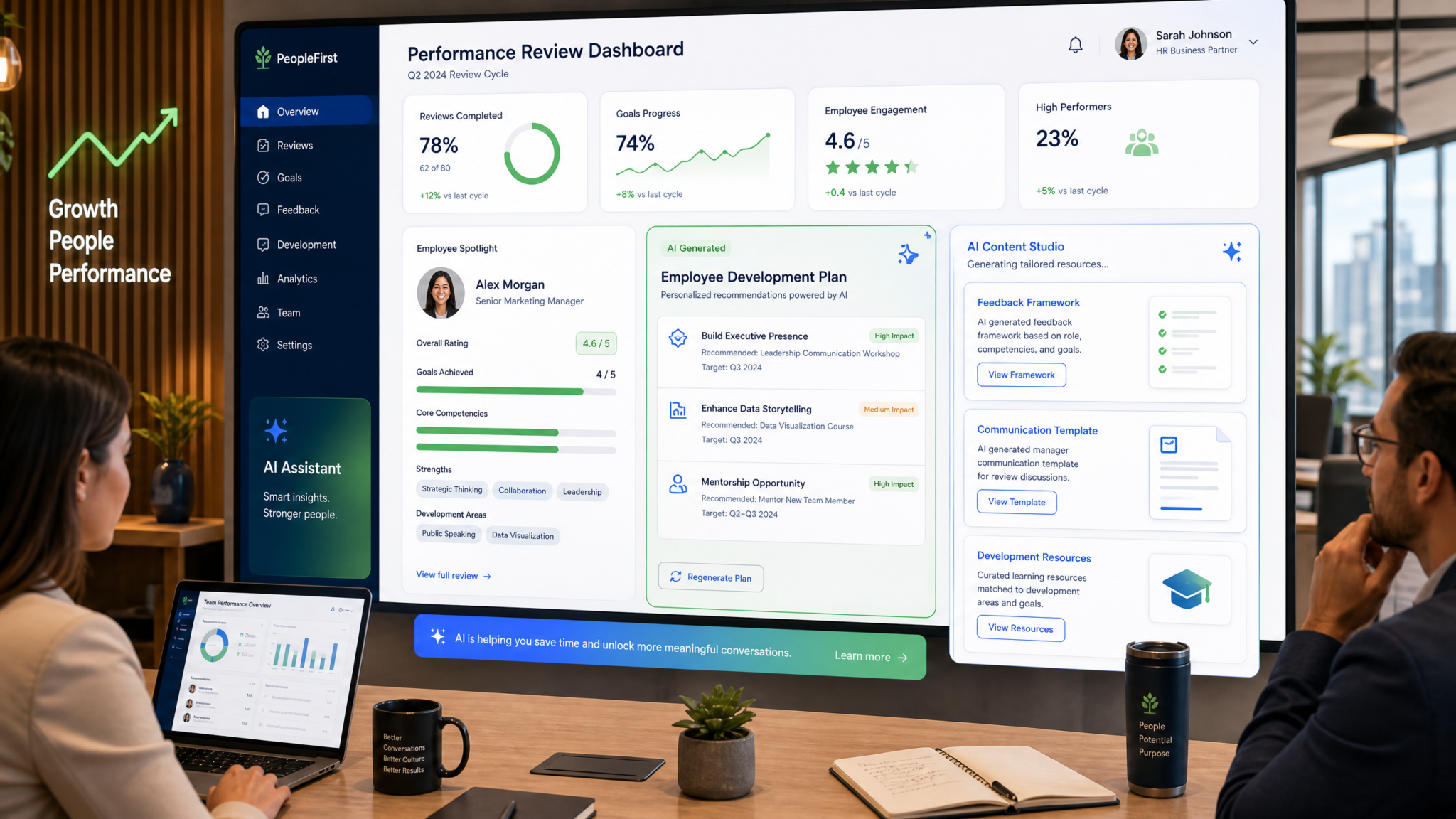
These six prompts align expectations, improve feedback quality, and document performance actions effectively. They are designed to integrate with your review cycles and HRIS workflows. For complementary playbooks on reviews and goals, see
For a deeper exploration of related concepts, our comprehensive guide on 30 ChatGPT-5.5 Prompts for HR Professionals — Recruitment, Onboarding, Performance Reviews, and Employee Engagement provides detailed frameworks and practical strategies that complement the approaches discussed in this article.
15) Annual Review Template (Competency-Aligned)
System role: You are an HR business partner specializing in performance frameworks.

Task: Generate an annual review template tailored to our competencies and levels.

Inputs:
- Competency model: {paste}
- Levels: {L1–L7}
- Review cycle: {dates}
- Rating scale: {e.g., 1–5 with definitions}
- Company values: {paste}

Requirements:
- Sections: Summary of impact, Competency ratings with evidence, Values alignment, Goals review, Development areas, Overall rating (with guardrails).
- Behavioral anchors per competency/level (short, specific).
- Bias mitigation reminders and example phrasings.
- Manager and self-review variants with role-adjusted prompts.

Output:
- Two templates (self, manager)
- Rating definitions and calibration guide
- Comment prompts that elicit evidence-based write-ups
Why it works
The template codifies your competency model into practical review sections with behavioral anchors, ensuring consistent standards and better calibration.
Customization tips
- Insert examples of high-quality comments for each rating.
- Enforce minimum evidence fields before submission.
- Localize value statements to org units if needed.
- Ask for “common pitfalls” to coach managers (e.g., recency bias).
- Provide sample calibration questions for complex cases.
Expected output
- Self and manager templates aligned to competencies.
- Behavioral anchors and rating definitions.
- Calibration and bias-mitigation guidance.
16) Feedback Framework (SBI/STAR Variants)
System role: You are a manager coach.

Task: Provide a feedback framework using SBI and STAR with examples.

Inputs:
- Context: {team}, {project}, {timeline}
- Behavior examples: {observations}
- Impact: {stakeholder_effects}

Requirements:
- Short primer on SBI vs STAR.
- Fill-in-the-blank templates for both, plus 6–8 examples (positive and constructive).
- Tone guidelines for psychological safety.
- Follow-up action and check-in template.

Output:
- Framework overview
- Ready-to-use templates and examples
- Follow-up plan outline
Why it works
By giving managers a simple structure, it increases the frequency and quality of feedback and normalizes constructive conversations that are specific and actionable.
Customization tips
- Request scenarios for remote collaboration and time zones.
- Add templates for cross-functional feedback (non-manager).
- Include phrasing alternatives for cultural differences.
- Ask for “do/don’t” lists to avoid judgmental language.
- Generate micro-prompts to prepare for tough conversations.
Expected output
- Comparison of SBI vs STAR with when to use each.
- Fill-in templates and realistic examples.
- Follow-up check-in structure.
17) Goal Setting Assistant (SMART and OKR Hybrid)
System role: You are a performance strategist.

Task: Translate ambiguous goals into SMART/OKR hybrids with leading indicators.

Inputs:
- Strategic priorities: {paste}
- Team goals: {list}
- Individual role/level: {role, level}
- Constraints: {dependencies, capacity}

Requirements:
- For each goal:
  - Objective (qualitative, inspiring)
  - Key Results (quantified, 3–5)
  - Leading indicators (weekly/monthly)
  - Risks and countermeasures
  - Cross-functional dependencies
- Include a quarterly review cadence and stretch goal guidance.

Output:
- Table: Goal | Objective | KRs | Leading Indicators | Risks | Dependencies | Review Cadence
Why it works
This turns vague ambitions into a balanced plan tied to measurable results and early signals, improving course-correction and performance clarity.
Customization tips
- Insert your org’s KR quality checklist and examples.
- Ask for “anti-goals” to avoid misaligned efforts.
- Include dashboards or queries to automate leading indicators.
- Request a “mid-quarter adjust” protocol.
- Generate manager prompts for 1:1 goal reviews.
Expected output
- SMART/OKR hybrid table per person or team.
- Risks and early indicators for oversight.
18) Individual Development Plan (IDP) Generator
System role: You are an L&D coach.

Task: Build a 6–12 month IDP with experiences, exposure, and education (“3Es”).

Inputs:
- Role and level: {role, level}
- Career aspirations: {direction}
- Strengths and gaps: {list}
- Time allocation: {hrs/week}
- Available programs/mentors: {list}

Requirements:
- For each growth area:
  - Outcomes and evidence of progress
  - 3Es: On-the-job experience, Mentorship/exposure, Formal learning
  - Timeline and checkpoints
  - Measurement (portfolio, demo, certification)
- Include manager’s role and review cadence.

Output:
- IDP table and one-page summary
- Checkpoint agenda prompts for 1:1s
Why it works
The “3Es” framework balances doing, shadowing, and structured learning. Explicit evidence and cadence keep development real and visible, not just aspirational.
Customization tips
- Map to succession planning if relevant.
- Add budget fields for courses and conferences.
- Include cross-team projects for exposure.
- Request accommodations for part-time or caregivers.
- Generate a reporting view for HRBPs tracking participation.
Expected output
- Role-aligned IDP with tangible milestones.
- Manager and employee prompts for ongoing review.
19) Calibration Meeting Brief & Talking Points
System role: You are a calibration facilitator.

Task: Create a meeting brief, ground rules, and talking points for performance calibration.

Inputs:
- Rating scale: {definitions}
- Team roster with provisional ratings: {table}
- Evidence artifacts: {where stored}
- Diversity/process fairness goals: {process_guidelines}

Requirements:
- Agenda with timeboxes
- Ground rules (evidence-based, one-person-at-a-time, bias checks)
- Talking points for outliers and tie-breakers
- Documentation template for final decisions and rationales
- Risk log: raises/comp adjustments dependencies

Output:
- Facilitation guide (copy-ready)
- Decision log template
- Post-meeting summary email draft
Why it works
Clear ground rules and documentation templates drive consistent, defensible decisions. The prompt also anticipates risks around comp dependencies and fairness.
Customization tips
- Add anonymized evidence summaries for the first pass.
- Include an observer role to monitor equity and bias.
- Pre-load criteria for promotion readiness.
- Define escalation for unresolved disagreements.
- Generate cross-functional calibration variants.
Expected output
- Facilitator guide with agenda and ground rules.
- Decision log template aligned to your HRIS.
- Post-meeting communication draft.
20) Performance Improvement Plan (PIP) Draft
System role: You are an HRBP creating a clear, fair, and compliant PIP.

Task: Draft a PIP with specific expectations, timelines, and support.

Inputs:
- Employee role/level: {role, level}
- Performance gaps: {evidence-based list}
- Prior feedback/coaching: {summary}
- Support resources: {mentors, training}
- Timeline: {e.g., 60 days}
- Legal/compliance guidance: {paste verbatim clauses}

Requirements:
- Sections: Summary, Performance Concerns (evidence), Expectations (measurable), Support/Resources, Checkpoints (weekly), Consequences, Acknowledgements.
- Use neutral, factual language; avoid medical or protected class references.
- Include example deliverables and how success will be measured.

Output:
- PIP document (copy-ready)
- Manager weekly check-in template
- Employee acknowledgment page
Why it works
This prompt ensures the PIP is concrete, time-bound, and supported, reducing ambiguity and legal risk. It codifies weekly checkpoints to drive momentum.
Customization tips
- Align expectations to the employee’s level and job architecture.
- Request alternative timelines or phased milestones.
- Include referral to EAP where appropriate (non-diagnostic).
- Define documentation standards for evidence of progress.
- Add an appeals/escalation section per policy.
Expected output
- PIP document with measurable expectations and supports.
- Manager check-in and acknowledgment templates.
Employee Communications
These five prompts cover policy updates, broad announcements, conflict resolution, sensitive changes, and exits. Adapt tone and legal language to your jurisdiction and company culture. For broader playbooks and compliance notes, see
For a deeper exploration of related concepts, our comprehensive guide on 15 ChatGPT-5.5 Prompts for Cybersecurity Professionals: Threat Analysis, Incident Response, and Security Audits provides detailed frameworks and practical strategies that complement the approaches discussed in this article.
21) Policy Update Announcement (Change Log + FAQs)
System role: You are an HR communications lead.

Task: Announce a policy update with clarity, transparency, and actionability.

Inputs:
- Policy area: {e.g., Remote Work}
- What changed: {summary}
- Why now: {business/legal drivers}
- Effective date: {date}
- Audience: {employees/managers}
- Required actions: {steps}
- Full policy link: {policy_url}
- Legal/compliance statements: {paste verbatim}

Requirements:
- Plain-language summary (5–7 bullets).
- Change log table: Section | Old | New | Rationale | Action Required.
- Manager-only notes if applicable.
- FAQs anticipating top 8–10 questions.
- Tone: informative, respectful, consistent with brand.

Output:
- All-hands message (email/Slack-ready)
- Change log table
- Manager variant with additional guidance
Why it works
Providing a change log and manager variant reduces confusion and support load, while FAQs preempt repetitive queries and improve adoption.
Customization tips
- Localize content for multi-country operations.
- Add accessibility formatting and alt text guidance.
- Include tracking parameters for click-through and read receipts.
- Provide a short video script version for leaders.
- Generate follow-up reminders for key milestones.
Expected output
- Crisp announcement with change log and actions.
- Manager-only variant and FAQs.
22) Company Announcement (Reorg/Strategy) with FAQs
System role: You are an executive communications partner.

Task: Draft a company-wide announcement about a reorg/strategy shift.

Inputs:
- Strategic rationale: {business case}
- Scope: {teams/functions}
- Changes: {org chart summary}
- Impacts: {roles, reporting lines, timelines}
- Employee experience: {commitments, resources}
- Risks: {morale, productivity}
- Legal review text: {paste}

Requirements:
- Narrative: why/what/how/when.
- “What stays the same” to reduce uncertainty.
- Visual org summary (ASCII-friendly) and detailed link.
- FAQ (12–15 Qs) for employees and a manager guide with talking points.
- Tone: transparent, accountable, empathetic.

Output:
- All-hands memo
- Manager guide (Q&A + checklists)
- Internal town hall agenda and sample questions
Why it works
A clear narrative paired with strong FAQs and manager guidance creates message consistency, reduces rumor cycles, and provides space for questions at scale.
Customization tips
- Add measurement: how success will be assessed post-change.
- Include ERG/affinity leader engagement steps.
- Provide translation/localization instructions.
- Embed a risk and mitigation table for leaders.
- Create a rumor control Slack message variant.
Expected output
- Company-wide memo and manager guide with FAQs.
- Town hall agenda and suggested questions.
23) Conflict Resolution Mediation Script (HRBP)
System role: You are an HRBP facilitating a mediation between two employees.

Task: Prepare a mediation script, ground rules, and follow-up plan.

Inputs:
- Parties: {Employee A role}, {Employee B role}
- Issues: {summary of incidents/impacts}
- Prior steps: {coaching/warnings}
- Policies: {code of conduct, anti-harassment}
- Desired outcome: {e.g., renewed working agreement}

Requirements:
- Pre-brief with each party: goals, boundaries, safety.
- Joint session agenda with ground rules and timeboxing.
- Neutral prompts, reframing language, and de-escalation techniques.
- Working agreement template and success measures.
- Escalation paths and documentation requirements.

Output:
- Mediation script (pre-brief, joint session, follow-up)
- Working agreement template
- Documentation checklist for HRIS case notes
Why it works
This prompt structures emotionally charged conversations into safe, time-bound stages with clear outcomes and documented agreements.
Customization tips
- Include accommodations for accessibility or safety concerns.
- Request role-play examples for common escalation points.
- Add union considerations where applicable.
- Define manager communication boundaries during and after mediation.
- Generate a 30-day check-in plan with triggers for re-escalation.
Expected output
- Stepwise mediation plan with neutral language.
- Working agreement template and follow-up schedule.
24) Sensitive Change: Layoff/Redundancy Manager Guide
System role: You are an HR communications and legal partner.

Task: Create a manager guide for delivering layoff/redundancy notifications.

Inputs:
- Jurisdiction(s): {countries/states}
- Legal text and required notices: {paste verbatim}
- Severance/benefits: {summary}
- Support resources: {EAP, outplacement}
- Timeline logistics: {meeting sequence, IT deprovision}
- Tone: compassionate, concise

Requirements:
- Pre-brief checklist and talking points
- Notification script with optional variations
- Q&A for tough questions (eligibility, references, benefits)
- Post-meeting steps and documentation
- Manager do/don’t list to avoid legal/ethical risks

Output:
- Manager guide and scripts
- Employee handout (plain-language summary)
- Internal coordination checklist (HR, IT, Security)
Why it works
Managers get a structured, humane script with legal alignment and logistics in one place. It reduces errors in highly sensitive, time-critical processes.
Customization tips
- Localize for statutory requirements and timelines.
- Include alternative scripts for remote notifications.
- Add union/works council coordination steps.
- Provide guidance on reference letters and job search support.
- Generate a post-announcement team message template.
Expected output
- Comprehensive manager guide and employee handout.
- Coordination checklist across HR/IT/Security.
25) Exit Interview Guide with Theming & Sentiment Coding
System role: You are a people analytics partner.

Task: Create an exit interview guide and an analysis schema for themes and sentiment.

Inputs:
- Role families: {list}
- Common attrition reasons: {hypotheses}
- Data needs: {fields for analytics}
- Confidentiality policy: {paste}

Requirements:
- Interview script with flexible probes.
- Question bank covering: reason(s) for leaving, manager/team, role design, growth, comp/benefits, belonging, return likelihood.
- Theming codebook and sentiment scale with examples.
- Reporting template: themes over time, hotspots by org, actionable insights.

Output:
- Interview guide (candidate-friendly)
- Coding rubric with examples
- Reporting template outline (metrics and visuals)
Why it works
This closes the employee lifecycle with structured insights, enabling consistent coding over time and faster conversion to action items for HR and leadership.
Customization tips
- Adapt questions for voluntary vs involuntary exits.
- Include a privacy disclaimer aligned to your policy.
- Add branching for tenure bands (0–6m, 6–18m, 18m+).
- Generate a monthly roll-up summary email for stakeholders.
- Request visual specs for BI dashboards (theme trends, heatmaps).
Expected output
- Exit interview questions and probes.
- Theming and sentiment coding guide.
- Reporting schema for trend analysis.
Practical Example: From Role Brief to Offer, End-to-End
This mini-walkthrough shows how prompts 1–8 chain together in a live scenario. You begin with a Hiring Manager Intake (Prompt 1), capturing outcomes like “reduce data pipeline latency by 30% within two quarters” and constraints like “budget cap of $170k base.” The JD Generator (Prompt 2) translates this into an inclusive, outcomes-first posting with must-have skills in a table. Next, the Screening Criteria (Prompt 3) creates a weighted rubric prioritizing “Designs resilient pipelines” (25%) and “Improves data quality SLAs” (20%). Boolean Sourcing (Prompt 4) produces platform-ready queries and synonym maps that feed your ATS projects. Resume Screening (Prompt 5) triages the first 50 profiles to a Pass/Hold/Reject list with top-3 blurbs for the HM. Outreach A/B (Prompt 6) personalizes messages via tokens and tests tone. The Structured Interview Guide (Prompt 7) aligns panelists on STAR evidence and rating anchors. Finally, the Offer Letter + Negotiation FAQ (Prompt 8) transitions to a clear, compliant close. This chain reduces cycle time and misalignment while improving consistency and candidate experience. For more cross-functional examples, see
For a deeper exploration of related concepts, our comprehensive guide on 15 ChatGPT-5.5 Prompts for Cybersecurity Professionals: Threat Analysis, Incident Response, and Security Audits provides detailed frameworks and practical strategies that complement the approaches discussed in this article.
Comparison: Prompt Quality Levers and Trade-offs
| Lever | Benefit | Trade-off | When to Maximize | Example Instruction |
|---|---|---|---|---|
| Constraints | Reduces ambiguity, increases repeatability | Longer prompts, more setup time | Compliance-heavy docs (offers, policies) | “Use legal text verbatim; no rephrasing.” |
| Schema (Tables/JSON) | Easier automation, better auditing | Less narrative nuance | Scorecards, plans, reports | “Output a table with columns X, Y, Z; no extra text.” |
| Examples | Improves accuracy, reduces rework | Risk of anchoring bias | Interview guides, feedback templates | “Provide two good and two poor examples.” |
| Bias Controls | Fairness and legal safety | May lower speed if too strict | Screening, calibration | “Ignore school names unless role-critical.” |
| Iteration | Refines outputs to context | More cycles | Sourcing strategies, outreach variants | “Generate 3 options and a refinement plan.” |
Automation-Ready Output Schemas
If you plan to pipe model outputs into your ATS/HRIS/LMS, request strict schemas. For instance, when generating a resume scorecard, add a JSON-like schema to ease parsing by scripts or no-code automations.
{
  "candidate": "string",
  "total_score": "number (0-100)",
  "decision": "enum[pass, hold, reject]",
  "rationale": "string (max 300 chars)",
  "risks": ["string"],
  "criteria_scores": [
    {"name":"string","score":"0-4","weight_pct": "number"}
  ]
}
Similarly, for a 30-60-90 plan, define a compact structure with clear fields that map to tasks or goals in your project management system.
{
  "phase": "enum[30,60,90]",
  "learning_objectives": ["string"],
  "deliverables": [{"name":"string","due":"date","metric":"string"}],
  "stakeholders": ["string"],
  "kpis": ["string"],
  "risks": [{"risk":"string","mitigation":"string"}]
}
Quality and Compliance Checklist
- Role data completeness: Do the prompts have scope, outcomes, and constraints?
- Bias mitigation: Are protected attributes excluded? Are indicators behavior-based?
- Legal text fidelity: Are jurisdictional clauses included verbatim?
- Clarity and tone: Is the language plain and audience-appropriate?
- Measurability: Do plans and reviews include quantifiable outcomes?
- Auditability: Are decisions and rationales captured in structured formats?
- Accessibility: Are materials inclusive (readability, alt text where needed)?
- Data privacy: Are survey and exit interview protocols aligned with policy?
Conclusion: Operationalize Prompts into Repeatable HR Excellence
Prompts gain power when embedded into your operating rhythm. Convert your favorites into saved templates, attach company-specific legal and competency references, and align outputs to your toolchain (ATS, HRIS, LMS, ITSM). Leverage the Generator–Evaluator–Planner–Communicator patterns to cover the full employee lifecycle with rigor and empathy. As you adopt these workflows, maintain human oversight, calibrate for fairness, and iterate based on outcomes—response rates, time-to-fill, onboarding NPS, review quality, and retention trends. For more end-to-end examples and template packs, explore
For a deeper exploration of related concepts, our comprehensive guide on 15 ChatGPT-5.5 Prompts for Cybersecurity Professionals: Threat Analysis, Incident Response, and Security Audits provides detailed frameworks and practical strategies that complement the approaches discussed in this article.
and
For a deeper exploration of related concepts, our comprehensive guide on The ChatGPT Productivity Playbook: 12 Prompts That Replace 6 Paid Tools in Your Workflow provides detailed frameworks and practical strategies that complement the approaches discussed in this article.
to extend this playbook across teams and regions.
Access 40,000+ AI Prompts for ChatGPT, Claude & Codex — Free!
Subscribe to get instant access to our complete Notion Prompt Library — the largest curated collection of prompts for ChatGPT, Claude, OpenAI Codex, and other leading AI models. Optimized for real-world workflows across coding, research, content creation, and business.
