
25 ChatGPT-5.5 Prompts for Privacy-First ChatGPT Ads Campaigns: Research, Creative Briefs, Measurement, and Optimization

How to Use These Prompts Without Overstating What ChatGPT Ads Can Do
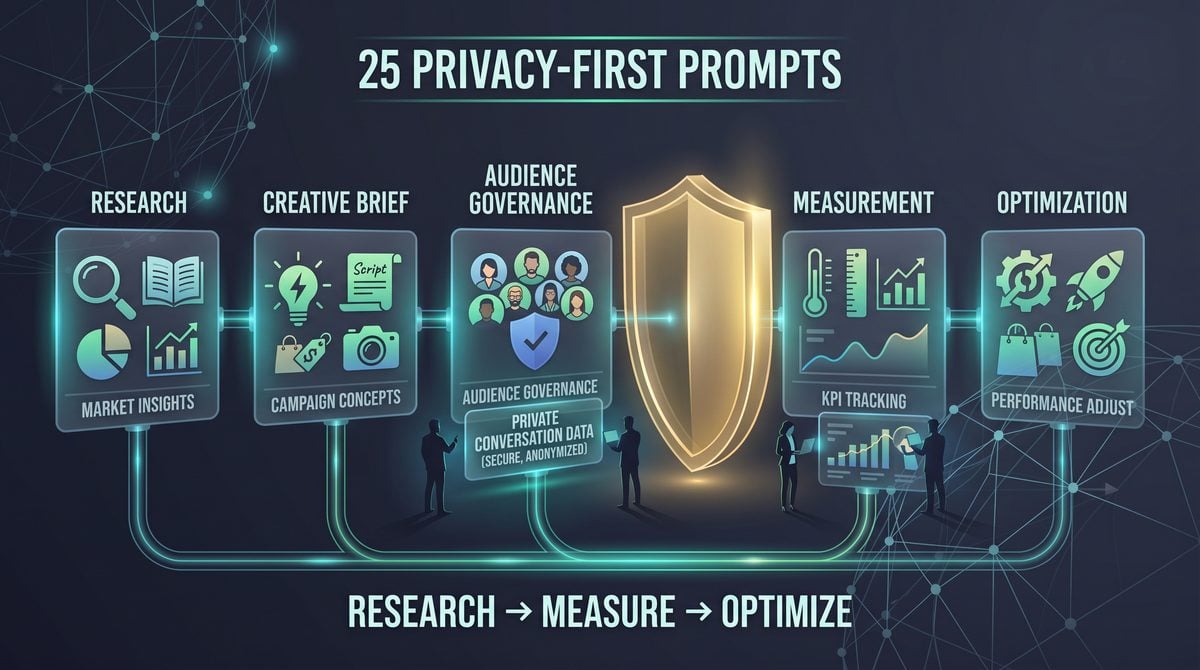
This prompt pack is designed for teams planning privacy-first ChatGPT Ads campaigns: growth marketers building briefs, founders validating positioning, media buyers structuring tests, analysts designing measurement, and enterprise administrators reviewing privacy and governance risk. The prompts can help you turn business inputs into research plans, audience hypotheses, creative briefs, product-feed checklists, measurement schemas, experiment designs, campaign QA workflows, and post-campaign analysis memos. They cannot guarantee revenue, directly publish ads, access your Ads Manager, retrieve private ChatGPT conversations, bypass platform policy, or prove causality where your data only supports directional evidence.
The practical value of these prompts is disciplined structure. Instead of asking ChatGPT to “make a high-performing campaign,” you will ask it to identify assumptions, separate verified facts from hypotheses, define what data is required, propose privacy-preserving segmentation, and produce reviewable artifacts that humans can approve. That distinction matters because OpenAI’s own advertising principles describe ads as labeled and separate from ChatGPT answers, with advertising not influencing the answer itself. A campaign brief should therefore be built around helpful, compliant ad experiences, not around attempts to manipulate or reshape organic answers.
OpenAI has stated that ChatGPT Ads reached a $1 billion annualized revenue run rate less than 200 days after launch and that tens of thousands of advertisers use the product. OpenAI also says self-service Ads Manager access is expanding across India, Europe, the Middle East, and North Africa, while ChatGPT Ads are available in more than 40 countries through its Ads Solutions team and partners. Those claims show that the channel is no longer merely theoretical for advertisers, but they do not remove the need for careful regional review, consent handling, budget controls, brand-safety checks, and measurement design before a campaign goes live.
For Privacy First AI Marketing, ChatGPT Temporary Chat Personalization Explained: Memory, Plugins, Custom Instructions, Saving, and Privacy is the most relevant adjacent resource. The temporary-chat privacy guide explains how memory, personalization, plugins, and saving interact, offering a concrete privacy checklist before marketers turn research or brainstorming prompts into reusable advertising workflows.
What “Privacy-First” Means in a ChatGPT Ads Campaign
For this article, “privacy-first” means the campaign is designed to minimize unnecessary personal data use, avoid sensitive-attribute targeting, preserve answer independence, and make measurement claims only at the level your evidence supports. It does not mean measurement-free marketing, nor does it mean every form of personalization is prohibited. OpenAI says users can control personalization, and that the system may use current-conversation context and, depending on location and settings, broader ChatGPT context. Because those conditions vary, advertisers should write plans that remain valid even when personalization signals are limited or unavailable.
OpenAI says advertisers do not receive users’ private conversations. That statement should shape your prompt usage: do not ask ChatGPT to infer what individual users said in private chats, reconstruct a person’s intent history, or identify hidden traits. Ask instead for campaign hypotheses based on your product, your first-party audience descriptions, your approved customer research, your product-feed attributes, and aggregate performance data that you are allowed to use. If a prompt output implies access to private conversations or individual-level hidden behavior, reject that output and rerun the prompt with stricter privacy instructions.
Operational rule: A useful ChatGPT Ads prompt should produce a document a human team can inspect: a brief, table, checklist, hypothesis list, measurement plan, or decision memo. It should not produce a claim that the platform will target, convert, or attribute users in a way your organization cannot independently verify and approve.
Privacy-first also means avoiding prohibited or high-risk sensitive targeting. Do not build segments or creative variants around health status, race or ethnicity, religion, sexual orientation, political persuasion, precise financial hardship, immigration status, disability, or other sensitive personal attributes. Even when a product serves a community with legitimate needs, the safer workflow is to target contextual relevance, broad geography where permitted, product use cases, declared business categories, or non-sensitive lifecycle signals from your own consented data. The prompts later in this article include review language that forces the model to flag sensitive-attribute assumptions before creative or measurement plans are approved.
Current ChatGPT Ads Context for Prompt Users
OpenAI’s public advertising updates describe a maturing ads ecosystem with more than 50 technology and measurement partners, material participation by small and midsize businesses, and adoption of CPC or outcome-optimized bidding. OpenAI has also cited two advertiser examples: one ecommerce advertiser reported 3× return on ad spend over 28 days, and one technology partner reported that more than 80% of ad-driven ChatGPT traffic came from new customers. These are OpenAI-reported examples, not universal benchmarks. Your prompts should never convert them into forecast assumptions such as “expect 3× ROAS” or “assume most traffic will be new customers.”
The safer way to use those examples is as a reminder to instrument incrementality and customer-status measurement. For example, if your leadership asks whether ChatGPT Ads can acquire new customers, the prompt should produce a plan that defines “new customer,” identifies exclusions for existing users where permitted, proposes holdouts or pre/post comparisons where feasible, and states which result would justify scaling. If your ecommerce team asks about ROAS, the prompt should require margin-aware calculations, attribution-window disclosure, refund handling, consent-loss assumptions, and a separate view of first-order revenue versus lifetime value.
For ChatGPT Marketing Prompts, The Complete Guide to ChatGPT Ads: How Advertisers Can Leverage OpenAI’s New Advertising Platform in 2026 is the most relevant adjacent resource. The complete ChatGPT Ads guide explains advertiser use cases, campaign mechanics, and platform strategy, providing the operating context needed to adapt the copy-ready prompts in this masterclass.
Prompt Outputs You Can Trust, Outputs You Must Review
| Prompt output | Appropriate use | Human review required |
|---|---|---|
| Audience hypothesis | Describe non-sensitive user needs, purchase triggers, and contextual use cases. | Check that no sensitive attributes are inferred or used as targeting criteria. |
| Creative brief | Align message, proof points, offers, landing pages, and brand constraints. | Validate claims, disclosures, regulated-language requirements, and source citations. |
| Measurement schema | Define events, conversion names, consent states, attribution assumptions, and reporting cuts. | Confirm Pixel, Conversions API, analytics, and CRM implementation details in your own systems. |
| Optimization recommendation | Summarize tradeoffs among budget, bids, creative variants, geographies, and funnel stages. | Require statistically and commercially meaningful evidence before scaling spend. |
| Post-campaign readout | Separate observations, likely explanations, unresolved questions, and next tests. | Remove unsupported causal claims and disclose attribution limitations. |
The prompts in this series are intentionally written to make ChatGPT ask for missing inputs rather than fabricate them. If you do not provide conversion volume, attribution window, budget, geography, product margin, or consent constraints, the correct output should say what is unknown and propose a way to proceed. A prompt that fills gaps with invented CPMs, conversion rates, partner integrations, or policy permissions is not useful. Replace it, constrain it, or add a review step that requires every number and platform capability to be labeled as “provided by user,” “from approved source,” or “assumption for scenario planning only.”
How to Replace Bracketed Variables Before Running a Prompt
Each prompt uses bracketed variables such as [PRODUCT], [PRIMARY_MARKET], [CUSTOMER_SEGMENT], [BUDGET_RANGE], [CONVERSION_EVENT], and [APPROVED_DATA_SOURCES]. Replace every bracket with your specific input before running the prompt. If an input is unknown, do not guess; write Unknown — ask clarifying questions before recommending actions. This forces the model to surface dependencies instead of generating a polished but unreliable plan.
Example variable replacement

Before:
Create a privacy-first campaign brief for [PRODUCT] in [PRIMARY_MARKET] using [APPROVED_DATA_SOURCES].

After:
Create a privacy-first campaign brief for a B2B invoice automation platform in Germany using our approved sources: product page copy, anonymized CRM stage data, aggregate web analytics, customer interview notes approved for marketing use, and legal-approved compliance claims.
Use precise, operational variables rather than broad labels. Replace [CUSTOMER_SEGMENT] with “finance managers at companies with 50–500 employees who have opted into product updates,” not “people worried about money.” Replace [CONVERSION_EVENT] with “demo_request_submitted after consented analytics event capture,” not “high-intent lead.” Replace [EXCLUSIONS] with explicit rules such as “exclude existing paying customers from acquisition reporting where permitted by platform tools and applicable law.” Better variables produce outputs that your media, legal, analytics, and security teams can actually review.
Do not paste raw private conversations, unredacted customer support logs, payment data, health information, government identifiers, credentials, or confidential contracts into these prompts. If you need to use qualitative research, summarize it into approved themes, remove personal identifiers, and identify the approval source. If your enterprise uses a governed ChatGPT workspace, follow your administrator’s data-handling rules before entering campaign data. If your organization has not approved a data source for marketing activation, list it under “excluded sources” so the prompt can design around it.
Measurement Uncertainty Is a Feature, Not a Defect
Privacy-first measurement accepts that some uncertainty is unavoidable. Pixel and Conversions API signals can support conversion analysis when implemented lawfully, but consent choices, browser behavior, identity resolution limits, attribution windows, offline sales cycles, refunds, and cross-device journeys can all change what the numbers mean. The prompts in this article therefore ask for confidence levels, missing data, alternative explanations, and next-best tests. That approach is more useful than a single blended ROAS figure presented without caveats.
When you adapt the prompts, require every performance readout to separate four categories: observed platform data, first-party business data, model-assisted interpretation, and recommended action. For example, “ChatGPT Ads generated 420 attributed demo starts” is an observed reporting statement if it comes from your approved reporting source; “these were mostly incremental” is a hypothesis unless you designed an incrementality test; “increase budget by 30%” is a recommendation that should depend on cost per qualified opportunity, sales capacity, payback period, and privacy constraints. This separation protects teams from over-optimizing on convenient but incomplete numbers.
Use the prompts as decision support, not delegation. A strong workflow is to have ChatGPT draft the brief, have marketing refine the offer, have analytics validate the measurement plan, have legal or privacy review data use and claims, have brand review creative, and have an accountable campaign owner approve launch or optimization. That human chain is especially important in a new channel where availability, features, personalization rules, and reporting integrations may vary by country, account, partner, user settings, and implementation status.
Prompts 1–9: Research, Positioning, Feed Readiness, Compliance Questions, and Creative Briefs

The first nine prompts build the campaign foundation before any budget, bid strategy, or asset production decision. They are designed for privacy-first ChatGPT Ads planning in light of OpenAI’s stated advertising principles: ads are labeled and separate from ChatGPT answers, advertising does not influence answers, advertisers do not receive private conversations, and personalization depends on geography and user settings. Use these prompts to produce structured thinking, review artifacts, and campaign inputs; do not treat the outputs as authorization to publish ads, access private conversations, or infer sensitive traits.
For AI Audience Research, 99+ Impactful ChatGPT Prompts for Market Research to Get … is the most relevant adjacent resource. The market-research prompt library covers segmentation, competitor analysis, trend discovery, and evidence synthesis, which can be adapted here as privacy-safe audience hypotheses rather than sensitive-person targeting.
1. Prompt: Market Framing for a Privacy-First ChatGPT Ads Campaign
Use case: Use this prompt when a founder, marketer, or agency strategist needs a campaign frame that explains the market, buying problem, value proposition, likely objections, and measurement assumptions without claiming guaranteed ad performance. It is especially useful before writing creative briefs or choosing between CPC and outcome-oriented campaign goals.
You are a privacy-first advertising strategist preparing a ChatGPT Ads campaign planning memo.

Business:
- Company: [COMPANY_NAME]
- Product or service: [PRODUCT_OR_SERVICE]
- Primary market: [MARKET_OR_CATEGORY]
- Geography: [TARGET_REGIONS]
- Business model: [B2B/B2C/MARKETPLACE/SUBSCRIPTION/ECOMMERCE/OTHER]
- Price range or contract size: [PRICE_CONTEXT]
- Known competitors or alternatives: [COMPETITOR_LIST]
- Primary conversion goal: [CONVERSION_GOAL]
- Evidence available: [CUSTOMER_REVIEWS/SURVEYS/SALES_NOTES/ANALYTICS/WEBSITE_COPY]

Create a market-framing memo for a privacy-first ChatGPT Ads campaign.

Requirements:
1. Define the customer problem in neutral, non-sensitive terms.
2. Describe the decision context and likely alternatives.
3. Identify 3-5 campaign angles that can be tested without using sensitive-attribute targeting.
4. List objections that ads and landing pages should address.
5. Separate evidence-backed statements from assumptions.
6. Avoid performance guarantees, fabricated market statistics, or claims that advertisers receive private ChatGPT conversations.
7. Include measurement questions for CPC and outcome-oriented evaluation.
Expected output: The output should be a concise planning memo with sections for market definition, decision context, campaign angles, objection handling, assumptions, and measurement questions. The best version will separate “known evidence” from “hypotheses,” so a reviewer can see whether a claim came from company data, customer language, or strategist inference.
Verification step: Compare every market claim against source materials such as CRM notes, product analytics, public category pages, customer interviews, and approved brand messaging. Remove any statistic, competitor claim, or customer behavior statement that cannot be traced to a source.
Privacy boundary: Do not ask the model to infer race, religion, health condition, financial distress, political views, union status, sexual orientation, or other sensitive traits. Frame audiences by problem, job-to-be-done, purchase context, product need, or declared business role instead.
Customization fields: Replace [TARGET_REGIONS] with the real jurisdictions under review, replace [CONVERSION_GOAL] with a measurable event such as lead form submission or purchase, and replace [EVIDENCE_AVAILABLE] with only materials your organization is permitted to use.
2. Prompt: Decision-Stage Mapping Without Private Conversation Assumptions
Use case: Use this prompt to map how potential buyers move from awareness to consideration, evaluation, and conversion. The prompt avoids assuming access to private ChatGPT conversations and instead relies on your declared business inputs, public research, and first-party evidence you are allowed to analyze.
You are mapping decision stages for a privacy-first ChatGPT Ads campaign.

Inputs:
- Product: [PRODUCT]
- Buyer or user type stated in non-sensitive terms: [BUYER_TYPE]
- Conversion goal: [CONVERSION_GOAL]
- Sales cycle length: [SALES_CYCLE]
- First-party evidence allowed for planning: [ALLOWED_FIRST_PARTY_EVIDENCE]
- Public evidence allowed for planning: [PUBLIC_EVIDENCE]
- Regions: [REGIONS]

Create a decision-stage map with:
1. Awareness-stage questions the buyer may ask.
2. Consideration-stage comparisons the buyer may make.
3. Evaluation-stage proof requirements.
4. Conversion-stage friction points.
5. Suggested ad-message themes for each stage.
6. Landing-page evidence needed at each stage.
7. Measurement signals that could indicate stage progression.

Constraints:
- Do not claim access to private ChatGPT conversations.
- Do not propose targeting based on sensitive attributes.
- Mark all uncertain assumptions as hypotheses.
- Do not recommend publishing or changing ads directly.
Expected output: The output should be a stage-by-stage table that connects buyer questions, proof needs, ad-message themes, landing-page support, and measurement signals. Strong outputs will distinguish early educational intent from late-stage conversion intent without pretending that the advertiser can see individual user prompts or private conversations.
Verification step: Ask sales, customer success, and support teams to validate whether the listed questions match real objections. For ecommerce, compare the map with search terms, product-page behavior, return reasons, and review text; for B2B, compare it with call notes, lost-deal reasons, and demo questions.
Privacy boundary: Stage mapping can use user intent, product need, and page behavior where your systems lawfully collect it, but it must not translate those signals into sensitive personal inferences. A person researching budgeting software should not be labeled as financially distressed unless they explicitly provided that information for an appropriate purpose.
Customization fields: Use [BUYER_TYPE] for non-sensitive descriptions such as “IT administrator at a mid-sized company” or “homeowner comparing energy products,” not protected-class labels. Use [ALLOWED_FIRST_PARTY_EVIDENCE] to name permitted sources, not unrestricted customer records.
3. Prompt: Audience Hypotheses Based on Jobs, Context, and Intent
Use case: Use this prompt when a media team needs audience hypotheses but wants to avoid sensitive-attribute targeting. It turns product needs, buying jobs, company context, lifecycle status, and declared interests into testable audience ideas that can be reviewed before activation.
You are creating privacy-first audience hypotheses for ChatGPT Ads planning.

Product: [PRODUCT]
Value proposition: [VALUE_PROPOSITION]
Permitted audience inputs: [PERMITTED_INPUTS]
Excluded sensitive attributes: [EXCLUDED_ATTRIBUTES]
Regions: [REGIONS]
Customer lifecycle stages: [LIFECYCLE_STAGES]
Current measurement tools: [PIXEL/CAPI/CRM/ANALYTICS/OTHER]

Generate 6-10 audience hypotheses.

For each hypothesis include:
- Audience name using non-sensitive language.
- Job-to-be-done or decision context.
- Why this audience may need the product.
- Suggested message angle.
- Evidence required before activation.
- Measurement signal to monitor.
- Risk of overreach or sensitive inference.
- Safer alternative phrasing if risk exists.

Do not use protected-class, health, financial hardship, political, religious, biometric, or other sensitive targeting logic.
Expected output: The output should be a list of audience hypotheses such as “operations teams comparing workflow automation tools” or “returning shoppers who viewed product bundles,” each with a rationale and a privacy risk check. The model should provide safer wording when a hypothesis could drift into sensitive inference.
Verification step: Review the hypotheses with legal, privacy, and platform operations before translating them into any platform segment. Confirm that every proposed audience can be created from permitted data, documented consent where required, and platform-supported controls in the relevant geography.
Privacy boundary: Do not create audiences around presumed medical conditions, debt status, immigration status, religious identity, political persuasion, sexuality, race, ethnicity, or children unless a specialized legal basis and platform policy explicitly allow a specific use case. When uncertain, remove the inference and target the product context instead.
Customization fields: Populate [PERMITTED_INPUTS] with examples such as “newsletter subscribers,” “cart abandoners,” “trial users,” or “public company firmographics,” only if your organization has the rights and consent to use them. Populate [EXCLUDED_ATTRIBUTES] with your internal policy list.
4. Prompt: Customer-Language Synthesis for Ad Messaging
Use case: Use this prompt to turn approved customer evidence into message themes, headlines, objections, and proof points. It helps marketers avoid inventing customer motivations while still extracting useful language from reviews, surveys, interview notes, or support tickets that have been cleared for analysis.
You are synthesizing customer language for privacy-first ad planning.

Allowed source excerpts:
[PASTE_APPROVED_CUSTOMER_LANGUAGE]

Product: [PRODUCT]
Audience context in non-sensitive terms: [AUDIENCE_CONTEXT]
Brand voice rules: [BRAND_VOICE_RULES]
Claims that require substantiation: [CLAIMS_REQUIRING_PROOF]
Terms to avoid: [TERMS_TO_AVOID]

Produce:
1. Recurring customer phrases and what they imply.
2. Top problems customers describe in their own words.
3. Desired outcomes customers mention.
4. Objections or anxieties customers raise.
5. Message themes for ads.
6. Landing-page proof points needed.
7. Claims that require legal or evidence review.
8. Phrases that should not be used because they are too sensitive, misleading, or unsupported.

Do not include personally identifiable information. Do not infer sensitive traits from the text.
Expected output: The output should group customer language into themes, quote short approved snippets where appropriate, and explain how each theme could inform ad copy or landing-page structure. It should flag claims that need proof, such as “fastest,” “best,” “guaranteed,” “clinically proven,” or “saves money.”
Verification step: Check that pasted source excerpts were properly anonymized and approved for marketing analysis. Then verify that each proposed phrase reflects a real pattern rather than a single unusual comment unless the output labels it as anecdotal.
Privacy boundary: Remove names, emails, order numbers, account IDs, full transcripts, and unnecessary personal details before prompting. If a customer disclosed a sensitive situation, convert it into a neutral product need or exclude it from ad planning.
Customization fields: Replace [BRAND_VOICE_RULES] with approved tone guidance, required disclaimers, and prohibited claims. Replace [CLAIMS_REQUIRING_PROOF] with your industry-specific review list, especially in regulated categories.
5. Prompt: Competitor Evidence Review Without Unsupported Attack Claims
Use case: Use this prompt when evaluating competitor positioning, category alternatives, and differentiation. It is designed to prevent unsupported superiority claims and to force evidence separation before the team writes comparison ads or landing pages.
You are reviewing competitor evidence for a privacy-first ChatGPT Ads campaign.

Our product: [OUR_PRODUCT]
Competitors or alternatives: [COMPETITOR_LIST]
Approved evidence sources:
- Our product documentation: [OUR_DOCS]
- Public competitor pages or descriptions: [COMPETITOR_PUBLIC_EVIDENCE]
- Customer research allowed for planning: [CUSTOMER_RESEARCH]
- Third-party reviews or analyst material: [THIRD_PARTY_EVIDENCE]

Create a competitor evidence matrix with:
1. Competitor or alternative.
2. Publicly stated positioning.
3. Buyer problem addressed.
4. Our possible differentiation.
5. Evidence supporting the differentiation.
6. Evidence gaps.
7. Claims that are risky, comparative, or require legal review.
8. Safer ad-message alternatives.

Rules:
- Do not fabricate competitor features, prices, availability, or performance.
- Do not recommend disparaging claims.
- Mark unknowns clearly.
- Avoid guarantees and universal performance statements.
Expected output: The output should be a matrix that separates observed competitor messaging from your inferred differentiation. It should provide safer phrasing such as “built for teams that need…” instead of unsupported claims like “better than every competitor.”
Verification step: Re-check competitor pages, screenshots, pricing pages, terms, and public documentation before using any comparison. Competitor claims can change quickly, so timestamp the evidence and route comparative copy through legal review when required.
Privacy boundary: Competitor research should rely on public, licensed, or properly obtained information. Do not ask the model to use scraped private forums, confidential customer data from another company, or personal data about competitor employees.
Customization fields: Use [COMPETITOR_PUBLIC_EVIDENCE] for URLs, excerpts, or approved notes that your team has permission to analyze. Use [THIRD_PARTY_EVIDENCE] only where licensing and usage rights allow campaign planning.
6. Prompt: Offer Positioning and Conversion Friction Review
Use case: Use this prompt to refine the offer before campaign launch. It helps a marketer decide whether the offer is clear enough, whether the landing page supports it, and which friction points could reduce conversion quality even if the ad receives clicks.
You are an offer-positioning reviewer for a ChatGPT Ads campaign.

Offer: [OFFER]
Product: [PRODUCT]
Target decision context: [DECISION_CONTEXT]
Landing page summary: [LANDING_PAGE_SUMMARY]
Conversion event: [CONVERSION_EVENT]
Required disclaimers or eligibility limits: [DISCLAIMERS]
Known objections: [KNOWN_OBJECTIONS]
Regions: [REGIONS]

Evaluate the offer using this structure:
1. One-sentence offer summary.
2. Who the offer is for, using non-sensitive language.
3. Primary value promised.
4. What the user must do next.
5. Potential confusion points.
6. Trust and proof elements needed.
7. Eligibility, price, shipping, trial, or contract details that must be clear.
8. Ad-message angles to test.
9. Landing-page fixes before launch.
10. Claims that require substantiation.

Do not create misleading urgency, hidden conditions, or unsupported savings claims.
Expected output: The output should identify whether the offer is specific, credible, and matched to the conversion event. It should also show where the landing page must clarify eligibility, pricing, cancellation, delivery, proof, or implementation requirements.
Verification step: Compare the output against actual landing-page copy, checkout flow, product terms, sales terms, and support policies. If the offer requires a contract, trial conditions, subscription renewal, regional limitation, or eligibility rule, the ad and page should make that context clear.
Privacy boundary: Offer positioning can address user needs and objections, but it should not exploit personal vulnerability or imply that the advertiser knows a private condition. Avoid phrases such as “we know you are struggling with…” unless the user explicitly declared that context in a permitted interaction.
Customization fields: Replace [DISCLAIMERS] with exact approved language or a summary that legal can review. Replace [CONVERSION_EVENT] with the event your measurement system can observe lawfully, such as “request demo,” “start checkout,” or “complete purchase.”
7. Prompt: Product-Feed Readiness Checklist for ChatGPT Ads Planning
Use case: Use this prompt when an ecommerce, marketplace, travel, education, or catalog-driven advertiser needs to inspect product-feed readiness. OpenAI has identified product feeds as an active ChatGPT Ads capability, but this prompt does not assume your account has every feature, permission, integration, or regional setting available.
You are auditing product-feed readiness for a privacy-first ChatGPT Ads campaign.

Feed context:
- Business type: [BUSINESS_TYPE]
- Feed source: [FEED_SOURCE]
- Number of items: [ITEM_COUNT]
- Required fields available: [FIELDS_AVAILABLE]
- Optional enrichment fields available: [OPTIONAL_FIELDS]
- Regions and currencies: [REGIONS_CURRENCIES]
- Inventory update frequency: [UPDATE_FREQUENCY]
- Landing page pattern: [LANDING_PAGE_PATTERN]
- Measurement setup: [MEASUREMENT_SETUP]

Create a product-feed readiness report with:
1. Required field completeness questions.
2. Data-quality risks.
3. Pricing, availability, inventory, and shipping checks.
4. Regional currency, tax, and language checks.
5. Landing-page consistency checks.
6. Policy or restricted-category review questions.
7. Measurement-event alignment questions.
8. Pre-launch QA checklist.
9. Items that require platform documentation or account-team confirmation.

Do not invent feed specifications, field limits, approval rules, or platform behavior.
Expected output: The output should be a readiness report and QA checklist rather than a fabricated feed spec. It should flag practical problems such as stale availability, inconsistent pricing, missing images, broken landing pages, category mismatches, untranslated descriptions, and unclear measurement alignment.
Verification step: Validate the checklist against the official platform documentation and your account’s actual Ads Manager or partner setup before implementation. Run a sample feed inspection and compare item-level values against live landing pages to catch mismatches.
Privacy boundary: Product feeds should describe products and availability, not expose customer identities, purchase histories, private notes, or inferred sensitive segments. Do not include user-level data in a feed unless an approved integration explicitly requires a specific field and legal has reviewed the use.
Customization fields: Replace [FIELDS_AVAILABLE] with the actual columns or attributes in your feed. Replace [MEASUREMENT_SETUP] with your current lawful tools, such as Pixel, Conversions API, analytics events, or offline conversion imports where applicable.
8. Prompt: Regional Compliance Questions for Campaign Planning
Use case: Use this prompt to prepare a regional compliance question list before campaign setup. OpenAI has stated that self-service Ads Manager access is expanding across India, Europe, the Middle East, and North Africa, and that ChatGPT Ads are available in more than 40 countries through OpenAI’s Ads Solutions team and partners; availability, controls, and personalization may still vary by geography and account context.
You are preparing regional compliance questions for a privacy-first ChatGPT Ads campaign.

Campaign:
- Product or service: [PRODUCT_OR_SERVICE]
- Regions under consideration: [REGIONS]
- Audience inputs: [AUDIENCE_INPUTS]
- Measurement tools: [MEASUREMENT_TOOLS]
- Custom audience plan: [CUSTOM_AUDIENCE_PLAN]
- Product feed plan: [PRODUCT_FEED_PLAN]
- Landing pages: [LANDING_PAGES]
- Data retention and consent notes: [DATA_RETENTION_CONSENT_NOTES]
- Regulated category status: [REGULATED_CATEGORY_STATUS]

Create a compliance-question worksheet.

Include questions for:
1. Regional availability and account eligibility.
2. Consent, notice, and personalization settings.
3. Custom audience use and suppression lists.
4. Pixel, Conversions API, and server-side event sharing.
5. Product-feed data handling.
6. Restricted or regulated-category review.
7. Required disclosures and local-language landing pages.
8. Data retention, deletion, and access controls.
9. Escalation questions for legal, privacy, security, and platform support.

Do not provide legal advice. Do not assume the same ad-personalization rules apply in every region.
Expected output: The output should be a worksheet that legal, privacy, security, and ad operations can use to identify open questions before launch. It should avoid definitive legal conclusions and instead route unresolved topics to the appropriate owner.
Verification step: Send the worksheet to counsel or your privacy lead, then compare answers against current platform documentation, regional law, internal data-processing agreements, consent notices, and vendor-review records. Re-run the worksheet when entering a new region or changing measurement architecture.
Privacy boundary: Regional planning must account for differences in consent, personalization, data sharing, retention, and user rights. Do not use a single global assumption for custom audiences, conversion tracking, or broader-context personalization.
Customization fields: Replace [REGULATED_CATEGORY_STATUS] with a plain-language description such as “financial services,” “employment,” “housing,” “health-related,” “education,” or “not regulated based on current review,” then ask counsel to confirm the classification.
9. Prompt: Creative-Brief Design for Labeled, Answer-Separate Ads
Use case: Use this prompt to create a campaign creative brief that respects OpenAI’s stated separation between labeled ads and ChatGPT answers. The brief should guide copywriters, designers, media buyers, and reviewers without implying that ads influence ChatGPT answers or that advertisers receive private conversations.
You are drafting a privacy-first creative brief for a ChatGPT Ads campaign.

Campaign inputs:
- Brand: [BRAND]
- Product or offer: [PRODUCT_OR_OFFER]
- Audience hypothesis: [AUDIENCE_HYPOTHESIS]
- Decision stage: [DECISION_STAGE]
- Main user problem: [USER_PROBLEM]
- Approved proof points: [APPROVED_PROOF_POINTS]
- Required disclaimers: [DISCLAIMERS]
- Landing page: [LANDING_PAGE]
- Conversion goal: [CONVERSION_GOAL]
- Prohibited claims or sensitive inferences: [PROHIBITED_CLAIMS]
- Measurement plan summary: [MEASUREMENT_PLAN]

Create a creative brief with:
1. Campaign objective.
2. Non-sensitive audience description.
3. Decision-stage insight.
4. Message strategy.
5. Primary and secondary value propositions.
6. Copy territories to test.
7. Proof points and substantiation notes.
8. Landing-page requirements.
9. Privacy and policy boundaries for creative.
10. Review checklist for brand, legal, privacy, and analytics.
11. Questions that must be answered before production.

Do not write final ads unless asked separately. Do not claim that ads change ChatGPT answers or use private conversations.
Expected output: The output should be a structured creative brief suitable for review and production planning. It should identify message territories, proof requirements, privacy boundaries, and unresolved questions instead of jumping directly to final ad copy.
Verification step: Route the brief through brand, legal, privacy, analytics, and media operations before production. Confirm that proof points are documented, disclaimers are present, landing pages match the message, and measurement events are configured before any launch decision.
Privacy boundary: Creative should address contextual needs and declared intent, not private identity or sensitive personal conditions. Avoid language that implies surveillance, such as “ChatGPT told us you need this,” because OpenAI states advertisers do not receive private conversations.
For ChatGPT Creative Briefs, 30 ChatGPT-5.5 Prompts for Content Strategists: Editorial Calendars, SEO Briefs, Audience Research, and Content Repurposing is the most relevant adjacent resource. The content-strategist prompt collection includes editorial planning, SEO briefs, audience research, and repurposing workflows, supplying structured brief patterns that translate well to ad creative development.
Prompts 10–18: Bidding Tests, Privacy-Safe Measurement, Attribution, Incrementality, Landing Pages, Labels, and Audiences

Use prompts 10–18 when the campaign concept has moved from positioning into test design and measurement architecture. OpenAI identifies CPC bidding, outcome-optimized bidding, Pixel, Conversions API, product feeds, geographic and platform targeting, and custom audiences as active ChatGPT Ads capabilities; these prompts turn those capabilities into planning documents, event schemas, and governance checklists rather than assuming that ChatGPT can publish, modify, or optimize campaigns inside your ad account.
OpenAI says ChatGPT Ads are clearly labeled and separate from ChatGPT answers, advertising does not influence answers, advertisers do not receive private conversations, and personalization depends on geography and user settings. The prompts below preserve those boundaries by asking for hypotheses, contracts, QA questions, and review artifacts, not private conversation extraction, sensitive-attribute targeting, or unsupported performance projections.
10. Prompt: CPC Test Design for a Controlled First Campaign
A CPC test should answer whether your offer, audience hypothesis, and landing experience can earn qualified clicks at an acceptable cost before you attempt deeper optimization. This prompt is useful for founders, growth teams, and agencies that need a controlled learning plan with stop rules, diagnostic segments, and privacy-safe reporting fields.
You are a performance marketing test designer. Build a CPC test plan for a privacy-first ChatGPT Ads campaign.

Business context:
- Company: [COMPANY]
- Product or service: [PRODUCT]
- Region or regions: [REGIONS]
- Primary customer job-to-be-done: [JOB_TO_BE_DONE]
- Offer: [OFFER]
- Landing page URL or description: [LANDING_PAGE]
- Known exclusions or compliance constraints: [CONSTRAINTS]
- Budget range for the test: [BUDGET_RANGE]
- Test duration preference: [DURATION]
- Reporting cadence: [CADENCE]

Requirements:
1. Design a CPC test that separates learning goals from performance goals.
2. Propose 2–4 campaign cells based on intent, geography, platform, or product-feed grouping.
3. Define the minimum data needed before making a decision, without inventing benchmark CPCs or conversion rates.
4. Specify stop, continue, and revise rules using relative indicators such as spend pacing, click quality, landing-page engagement, and downstream conversion evidence.
5. List privacy-safe fields for reporting. Do not request private ChatGPT conversations, sensitive personal attributes, or user-level conversation content.
6. Include a QA checklist for ad labeling, answer separation, tracking parameters, landing-page consistency, and consent requirements.
7. End with a decision table for: scale, iterate, pause, or redesign.
Recommended use: Ask the model to produce a test matrix first, then run a second pass asking it to identify “false positive” risks such as low-cost clicks from irrelevant traffic, conversions from existing customers, or landing-page events that fire before meaningful engagement. The goal is a learning system that can reject a weak campaign quickly without mislabeling early noise as market proof.
11. Prompt: Outcome-Optimized Bidding Hypotheses Without Performance Guarantees
OpenAI reports majority adoption of CPC or outcome-optimized bidding, but that does not mean every advertiser has enough clean conversion data to optimize toward outcomes immediately. This prompt helps teams decide which conversion outcomes are plausible bidding candidates and which should remain diagnostic until event volume, data quality, and business value are better understood.
You are a paid media strategist evaluating whether outcome-optimized bidding is appropriate for a ChatGPT Ads campaign.

Inputs:
- Campaign objective: [OBJECTIVE]
- Sales motion: [SELF_SERVE / SALES_ASSISTED / MARKETPLACE / APP / OTHER]
- Conversion events currently trackable: [EVENTS]
- Average time from click to meaningful outcome: [TIME_TO_OUTCOME]
- CRM or ecommerce system of record: [SYSTEM]
- Offline conversion availability: [YES_NO_AND_DETAILS]
- Privacy, consent, and regional constraints: [CONSTRAINTS]
- Current data quality issues: [KNOWN_ISSUES]

Produce:
1. A ranked list of candidate optimization events, from safest to riskiest.
2. A hypothesis for why each event may or may not predict business value.
3. A readiness assessment covering event volume, event deduplication, consent handling, delayed conversions, refunds or cancellations, and new-versus-returning customer status.
4. A recommendation for whether to begin with CPC, outcome optimization, or a staged transition.
5. A test plan that avoids claiming guaranteed ROAS, CPA, revenue lift, or customer acquisition outcomes.
6. A list of questions to ask the ads platform representative, legal reviewer, analytics owner, and finance stakeholder before launch.
Operational warning: Do not optimize toward a shallow event merely because it is easy to fire. A page view, button click, or form-start event can be useful for diagnosis, but if it weakly correlates with revenue or qualified pipeline, outcome bidding may amplify low-quality actions. Ask the model to distinguish “optimization events” from “observation events” in its output.
12. Prompt: Pixel Event Mapping for Privacy-Safe Conversion Measurement
Pixel planning should happen before launch, not after a campaign has already spent budget. OpenAI identifies Pixel as an active ChatGPT Ads capability, so campaign teams should map events, consent states, deduplication keys, and QA procedures in a way that supports measurement without collecting private conversations or unnecessary personal data.
You are an analytics implementation lead. Create a Pixel event map for a ChatGPT Ads campaign.

Campaign and site context:
- Advertiser: [ADVERTISER]
- Website or app flow: [FLOW_DESCRIPTION]
- Conversion objective: [OBJECTIVE]
- Key pages or screens: [PAGES_OR_SCREENS]
- Consent-management approach: [CONSENT_APPROACH]
- Ecommerce, lead-gen, subscription, or app event type: [BUSINESS_MODEL]
- Existing analytics tools: [TOOLS]
- Known regional constraints: [REGIONS_AND_CONSTRAINTS]

Build an event map with:
1. Event name.
2. Trigger condition.
3. Required parameters.
4. Optional parameters.
5. Consent requirement.
6. Deduplication approach if the same action can also arrive through Conversions API.
7. Business purpose for collecting the event.
8. Data minimization note explaining what should not be collected.
9. QA method and expected test result.
10. Owner for implementation and owner for sign-off.

Rules:
- Do not include private ChatGPT conversation text.
- Do not include sensitive personal attributes.
- Do not request more identifiers than needed for measurement and deduplication.
- Flag any event whose business purpose is unclear.
Review procedure: Give the resulting event map to engineering, analytics, legal, and the media buyer in the same review cycle. Engineering can confirm trigger feasibility, analytics can check naming consistency, legal can evaluate consent and data minimization, and the buyer can confirm that the mapped events match the campaign’s optimization and reporting needs.
13. Prompt: Conversions API Data Contract for Server-Side Reliability
Conversions API planning is a contract between marketing, engineering, analytics, and privacy stakeholders. Because server-side events may be closer to systems of record than browser events, the contract should define event timing, allowed fields, hashing or transformation requirements where applicable, consent logic, deduplication, retry behavior, and audit ownership before any production deployment.
You are a solutions architect drafting a Conversions API data contract for ChatGPT Ads measurement.

System context:
- Business model: [BUSINESS_MODEL]
- Server-side source system: [SOURCE_SYSTEM]
- Events to send: [EVENT_LIST]
- Pixel events that may overlap: [PIXEL_EVENTS]
- Consent signal location: [CONSENT_SIGNAL]
- Identity or deduplication fields available: [FIELDS_AVAILABLE]
- Data retention policy summary: [RETENTION_POLICY]
- Regions covered: [REGIONS]
- Engineering constraints: [CONSTRAINTS]

Create a data contract that includes:
1. Purpose and scope.
2. Event definitions and allowed use cases.
3. Required fields, optional fields, and explicitly prohibited fields.
4. Consent and suppression logic.
5. Deduplication logic across Pixel and Conversions API.
6. Event timestamp rules and delayed-conversion handling.
7. Retry, failure, and backfill policy.
8. Monitoring checks for volume drops, duplicate spikes, malformed payloads, and unexpected field values.
9. Access-control and change-management requirements.
10. Acceptance tests before launch.

Do not invent platform-specific endpoint names, authentication methods, required parameters, or rate limits. If a detail depends on official documentation or account configuration, mark it as “verify in implementation documentation.”
Decision rule: If the model proposes sending a field that has no stated measurement purpose, remove it or mark it for privacy review. A good Conversions API contract is not a data lake wish list; it is a minimal, auditable event pipeline for campaign measurement and optimization.
14. Prompt: Attribution Window Planning Across Fast and Delayed Conversions
Attribution windows shape how teams interpret performance, especially when a click can lead to an immediate purchase, a delayed sales conversation, or a trial that converts weeks later. This prompt creates an attribution plan that separates reporting windows from business decision windows and documents the uncertainty that executives need to understand.
You are a measurement strategist. Design attribution-window options for a ChatGPT Ads campaign.

Inputs:
- Offer type: [OFFER_TYPE]
- Typical buying cycle: [BUYING_CYCLE]
- Primary conversion: [PRIMARY_CONVERSION]
- Secondary conversions: [SECONDARY_CONVERSIONS]
- Offline or CRM conversion delay: [DELAY]
- New customer importance: [NEW_CUSTOMER_IMPORTANCE]
- Reporting stakeholders: [STAKEHOLDERS]
- Finance decision cadence: [CADENCE]
- Known limitations in tracking or consent: [LIMITATIONS]

Deliver:
1. A short, medium, and long attribution-window option.
2. The decision each window is best suited for.
3. Risks of over-crediting and under-crediting ChatGPT Ads.
4. How to report conversions that occur after the media test ends.
5. A recommended default reporting view and an executive caveat.
6. A table separating platform-reported outcomes, analytics-reported outcomes, CRM outcomes, and finance-approved outcomes.
7. A list of follow-up analyses for cohorts, new customers, repeat customers, and assisted conversions.
For AI Campaign Analytics, 15 ChatGPT Prompts for E-commerce Marketers Using the New Ads Manager: Boost Your Campaign Performance with AI is the most relevant adjacent resource. The e-commerce Ads Manager prompt guide includes campaign-performance and optimization workflows, complementing this masterclass’s Pixel, Conversions API, attribution, and experiment-review prompts.
15. Prompt: Incrementality Test Design for Lift, Not Just Credit
Attribution asks which touchpoint gets credit; incrementality asks whether the advertising caused additional outcomes that would not otherwise have happened. This prompt is useful when leadership wants to know whether a ChatGPT Ads campaign created net-new demand, shifted existing demand, or mainly captured users who were already likely to convert.
You are an incrementality measurement advisor. Propose an incrementality test for a ChatGPT Ads campaign.

Campaign context:
- Objective: [OBJECTIVE]
- Regions or markets available: [MARKETS]
- Audience or product groups: [AUDIENCE_OR_PRODUCTS]
- Budget and duration constraints: [BUDGET_DURATION]
- Conversion event and expected delay: [CONVERSION_AND_DELAY]
- Existing marketing channels running concurrently: [CHANNELS]
- Ability to create holdouts or geo splits: [HOLDOUT_FEASIBILITY]
- Business risks of withholding ads: [RISKS]

Produce:
1. The best feasible incrementality design: geo holdout, audience holdout, time-based test, product split, or matched-market analysis.
2. Why that design is suitable and what it cannot prove.
3. Required pre-test checks for baseline similarity, seasonality, promotions, inventory, and channel overlap.
4. Primary and secondary success metrics.
5. Guardrails for customer experience, compliance, and revenue risk.
6. A readout template showing observed outcomes, estimated lift, confidence caveats, and recommended next action.
7. A plain-English explanation for executives who may confuse attribution with incrementality.
Operational warning: A weak holdout can create false confidence. If the exposed and control groups differ in region, product availability, promotion timing, or baseline demand, the model should flag the test as directional rather than definitive. Ask for “threats to validity” before presenting lift estimates to finance or the board.
16. Prompt: Landing-Page Alignment Review for Labeled, Answer-Separate Ads
OpenAI states that ads are clearly labeled and separate from ChatGPT answers, so the landing page should continue that clarity after the click. The page should deliver the offer promised by the ad, avoid implying that ChatGPT endorsed the product through its answer, and give users enough context to decide whether to continue.
You are a conversion and compliance reviewer. Audit landing-page alignment for a ChatGPT Ads campaign.

Inputs:
- Ad concept or copy: [AD_COPY]
- Offer: [OFFER]
- Landing page copy or URL summary: [LANDING_PAGE_COPY]
- Product claims: [CLAIMS]
- Pricing or trial terms: [TERMS]
- Form fields or checkout steps: [FORM_OR_CHECKOUT]
- Required disclosures: [DISCLOSURES]
- Regions: [REGIONS]
- Brand voice requirements: [VOICE]

Evaluate:
1. Message match between ad, offer, and landing page.
2. Whether the page could be misunderstood as part of a ChatGPT answer or organic recommendation.
3. Clarity of advertiser identity, terms, pricing, eligibility, renewals, cancellation, and limitations.
4. Friction points that may reduce qualified conversion quality.
5. Claims that require substantiation or legal review.
6. Data collection fields that may be unnecessary for the stated conversion.
7. Accessibility, mobile readability, page speed dependencies, and localization questions.
8. Recommended revisions ranked by risk reduction and expected learning value.

Do not claim that changing the landing page will guarantee lower CPC, higher conversion rate, or better ROAS.
Recommended use: Run this prompt before QA and again after creative revisions. If the ad promises a narrow benefit but the page opens with a broad company overview, the campaign may pay for curiosity rather than intent. If the page asks for excessive information before explaining value, conversion data may understate true demand.
17. Prompt: Ad-Label Comprehension and User-Trust Review
Because OpenAI’s advertising principles emphasize clear labeling and separation from answers, advertisers should evaluate whether users can recognize the paid unit, identify the advertiser, and understand what will happen after a click. This prompt produces a comprehension test plan that can be used by UX researchers, brand teams, or agency strategists without making claims about the ChatGPT interface beyond OpenAI’s stated principles.
You are a user-trust researcher. Design an ad-label comprehension review for a ChatGPT Ads campaign.

Context:
- Advertiser: [ADVERTISER]
- Product category: [CATEGORY]
- Ad copy or concept: [AD_CONCEPT]
- Landing-page destination: [DESTINATION]
- Regions and languages: [REGIONS_LANGUAGES]
- User segments to recruit for research: [SEGMENTS]
- Known trust concerns in category: [TRUST_CONCERNS]

Create:
1. Research objectives focused on label recognition, advertiser recognition, answer-ad separation, and click expectation.
2. A moderated or unmoderated test script.
3. Neutral comprehension questions that do not lead the participant.
4. Pass/fail criteria for whether users understand the unit is an ad.
5. Follow-up questions about trust, relevance, and perceived usefulness.
6. A coding framework for confusing language, unclear advertiser identity, exaggerated claims, or weak destination expectations.
7. Recommended creative changes if comprehension fails.

Rules:
- Do not ask participants to reveal private ChatGPT conversations.
- Do not test sensitive personal attributes as targeting criteria.
- Do not imply that the ad changes ChatGPT’s answer.
Practical example: A neutral question is “Who do you think is responsible for the message you just saw?” A leading question is “Did you notice this was a sponsored ad from the advertiser?” The first question measures comprehension; the second teaches the answer and can make weak labeling appear stronger than it is.
18. Prompt: Custom-Audience Governance for Eligibility, Consent, and Exclusions
OpenAI identifies custom audiences as an active ChatGPT Ads capability, but audience governance is where privacy-first advertising either becomes real or fails. This prompt helps enterprise administrators, lifecycle marketers, and agency operators define who may build audiences, which sources are allowed, which segments are prohibited, and how suppression lists are managed.
You are an audience governance lead. Create a custom-audience governance policy for ChatGPT Ads planning.

Organization context:
- Advertiser: [ADVERTISER]
- Audience sources available: [SOURCES]
- Consent and preference systems: [CONSENT_SYSTEMS]
- Regions: [REGIONS]
- Customer types: [CUSTOMER_TYPES]
- Suppression needs: [SUPPRESSIONS]
- Sensitive categories or prohibited targeting rules: [PROHIBITED_RULES]
- Teams with access: [TEAMS]
- Review cadence: [CADENCE]

Draft a policy that includes:
1. Approved audience sources and disallowed sources.
2. Required consent, preference, and regional eligibility checks.
3. Prohibited uses, including sensitive-attribute targeting or inferred sensitive status.
4. Suppression rules for customers, recent converters, unsubscribed users, minors where applicable, employees, or other excluded groups.
5. Minimum audience documentation: source, purpose, creation date, owner, retention period, and deletion procedure.
6. Access-control rules for creating, uploading, editing, and approving audiences.
7. QA checks before activation and after refresh.
8. Incident response steps if an incorrect audience is uploaded or activated.
9. A review template for legal, privacy, security, and marketing sign-off.

Do not request private ChatGPT conversations or assume advertisers receive them. Do not invent platform-specific upload fields, match rates, audience-size thresholds, or retention limits.
Decision rule: If an audience cannot be explained in one sentence using source, consent basis, purpose, and exclusion logic, it should not be activated. For example, “customers who opted into marketing emails and viewed product category A in the last 30 days, excluding purchasers and unsubscribed users” is governable; “people who seem anxious about money” is a sensitive inference risk and should be rejected.
After running prompts 10–18, consolidate the outputs into one campaign operations packet: CPC or outcome-bidding hypothesis, Pixel map, Conversions API contract, attribution-window decision, incrementality design, landing-page review, ad-label comprehension plan, and custom-audience policy. That packet gives media, analytics, engineering, legal, and executive stakeholders a shared source of truth before spend begins, while preserving OpenAI’s stated boundaries around labeled ads, answer separation, private conversations, and user controls.
Prompts 19–25: QA, Prioritization, Diagnosis, New Customers, Fatigue, Weekly Reviews, and Executive Reporting
The final seven prompts turn campaign planning into an operating system: they check launch readiness, prioritize experiments, diagnose anomalies, separate new-customer learning from blended performance, watch for creative fatigue, structure weekly reviews, and translate results for executives. OpenAI says ChatGPT Ads can use capabilities such as product feeds, geographic and platform targeting, custom audiences, Pixel, and Conversions API; these prompts assume your team has lawful access to the relevant campaign, conversion, and consent data before asking ChatGPT to analyze it.
19. Prompt: Preflight QA for a Privacy-First ChatGPT Ads Launch
Use this prompt before activation or before sending a build to a trafficking, operations, or legal reviewer. The goal is not to let ChatGPT “approve” a campaign, but to produce a structured defect list that humans can clear before spend begins.
You are my privacy-first ChatGPT Ads launch QA assistant.

Campaign context:
- Brand: [BRAND]
- Region(s): [COUNTRIES_OR_REGIONS]
- Product/service: [PRODUCT]
- Objective: [TRAFFIC / LEADS / PURCHASES / OTHER]
- Buying approach under consideration: [CPC / OUTCOME_OPTIMIZED / OTHER]
- Targeting inputs: [GEOGRAPHY, PLATFORM, CUSTOM_AUDIENCE, EXCLUSIONS]
- Measurement inputs: [PIXEL_EVENTS, CONVERSIONS_API_EVENTS, UTM_SCHEMA, ATTRIBUTION_WINDOW]
- Creative assets: [HEADLINES, DESCRIPTIONS, LANDING_PAGES, OFFERS]
- Consent and privacy notes: [CONSENT_STATUS, DATA_RETENTION_RULES, REGIONAL_LIMITS]

Create a preflight QA table with these columns:
1. Area
2. Pass/fail/needs evidence
3. Specific issue or missing proof
4. Privacy or trust risk
5. Measurement risk
6. Launch-blocking severity: high, medium, low
7. Human owner
8. Required fix before launch

Check for:
- Claims that require substantiation
- Sensitive-attribute targeting or exclusions
- Use of private conversation assumptions
- Mismatch between ad promise and landing page
- Missing event definitions
- Duplicate or ambiguous conversion events
- Unclear consent basis for uploaded or server-side data
- Missing geographic restrictions
- Missing fallback plan if outcome data is sparse

Do not claim the campaign is compliant. Produce a reviewer-ready issue log and a short list of questions for legal, analytics, and media operations.
Recommended use: Run this prompt once with the media plan, once with the final creative, and once with the measurement specification. A privacy issue discovered in the media plan often requires a different fix than a privacy issue discovered in the conversion data contract.
20. Prompt: Experiment Prioritization by Impact, Evidence, Risk, and Learning Value
Campaign teams often over-prioritize the most exciting test instead of the most decision-useful test. This prompt ranks experiments by practical value while penalizing privacy risk, implementation burden, and ambiguous measurement.
You are my experiment prioritization partner for ChatGPT Ads.

Inputs:
- Business objective: [OBJECTIVE]
- Budget range: [BUDGET_RANGE]
- Regions: [REGIONS]
- Current campaign status: [NEW / ACTIVE / SCALING / TROUBLESHOOTING]
- Candidate experiments:
[PASTE_EXPERIMENT_LIST]
- Known constraints:
[DATA_LIMITS, CONSENT_LIMITS, CREATIVE_LIMITS, LEGAL_LIMITS, SEASONALITY]

Score each experiment from 1 to 5 on:
- Expected business impact
- Evidence strength behind the hypothesis
- Measurement clarity
- Privacy and consent safety
- Operational effort, where 5 means easy
- Learning value if the result is negative

Then calculate a simple priority score:
impact + evidence + measurement clarity + privacy safety + operational ease + learning value.

Return:
1. Ranked experiment table
2. Top 3 experiments to run first
3. Experiments to defer and why
4. Experiments that require legal, privacy, or analytics review
5. Minimum success metric and guardrail metric for each top experiment
6. What decision we will make after the test
Example decision rule: Prefer a landing-page alignment test with clean conversion measurement over a broad audience expansion test if the audience test depends on uncertain consent status or produces results that cannot be separated from seasonality.
21. Prompt: Performance Anomaly Diagnosis Without Jumping to Attribution Conclusions
Use this prompt when spend, clicks, conversion volume, cost per result, or return metrics move sharply. It forces ChatGPT to separate data quality, auction dynamics, creative behavior, site performance, tracking outages, and external events before recommending budget changes.
You are my performance anomaly diagnosis analyst.

Campaign:
- Brand: [BRAND]
- Campaign/ad set/ad identifiers: [IDS]
- Date range with anomaly: [DATES]
- Comparison period: [DATES]
- Objective and bid approach: [OBJECTIVE_AND_BID]
- Regions/platforms: [REGIONS_PLATFORMS]

Metrics table:
[PASTE_DAILY_OR_HOURLY_METRICS: IMPRESSIONS, CLICKS, CPC, SPEND, CONVERSIONS, CVR, CPA, REVENUE, ROAS_IF_AVAILABLE]

Measurement status:
- Pixel status: [KNOWN_STATUS]
- Conversions API status: [KNOWN_STATUS]
- Site or app incidents: [INCIDENTS]
- Consent banner or checkout changes: [CHANGES]
- Creative or audience changes: [CHANGES]
- Promotions, holidays, PR, inventory, pricing, competitor events: [CONTEXT]

Diagnose the anomaly using a ranked hypothesis table:
1. Hypothesis
2. Evidence supporting it
3. Evidence against it
4. Data needed to confirm
5. Immediate safe action
6. Action to avoid until confirmed
7. Owner

Do not assume attribution is correct. Do not recommend scaling or pausing solely because one blended metric changed. Identify whether the issue is likely tracking, traffic quality, conversion experience, auction cost, creative fatigue, audience shift, or external demand.
Operational warning: If Pixel and Conversions API counts diverge suddenly, treat optimization recommendations as provisional until analytics confirms whether the gap is caused by deduplication, event loss, consent changes, or a real behavior shift.
22. Prompt: New-Customer Analysis for Incremental Growth Signals
OpenAI has cited an example in which a technology partner reported that more than 80% of ad-driven ChatGPT traffic came from new customers, but that example should not be generalized to every advertiser. This prompt helps your team analyze its own new-customer mix without presenting it as proof of incrementality.
You are my new-customer analysis assistant for a ChatGPT Ads campaign.

Business definition:
- New customer definition: [NO_PRIOR_PURCHASE / NO_ACCOUNT / NO_ORDER_IN_X_DAYS / CRM_DEFINED]
- Lookback period: [DAYS_OR_MONTHS]
- Regions included: [REGIONS]
- Data sources: [CRM, ORDER_TABLE, WEB_ANALYTICS, AD_PLATFORM, SERVER_EVENTS]
- Identity rules and limitations: [HASHED_EMAIL, LOGIN_ID, COOKIE_LIMITS, CONSENT_LIMITS]

Performance data:
[PASTE_AGGREGATED_DATA: DATE, CAMPAIGN, SPEND, CLICKS, CONVERSIONS, NEW_CUSTOMERS, RETURNING_CUSTOMERS, REVENUE_IF_AVAILABLE]

Create:
1. New-customer share by campaign and week
2. Cost per new customer, if spend and new-customer counts are available
3. Revenue or order quality comparison, if available
4. Data-quality caveats
5. Reasons this is not the same as incrementality
6. Follow-up tests to estimate lift
7. Executive-safe wording that avoids overclaiming

Do not use private conversation data. Do not infer sensitive traits. Flag any identity resolution method that needs consent, privacy, or legal review.
Recommended interpretation: A high new-customer share can indicate valuable reach, but it does not prove the ads caused those customers to convert. Pair this analysis with holdouts, geo tests, or other incrementality methods when the business decision depends on causal lift.
23. Prompt: Creative Fatigue and Message Rotation Review
Creative fatigue can look like declining click-through rate, rising CPC, weaker conversion rate, or simply a shift in which messages attract the wrong users. This prompt asks for a diagnosis that includes creative, audience, offer, and landing-page explanations rather than assuming every decline requires new ads.
You are my creative fatigue analyst for ChatGPT Ads.

Campaign context:
- Objective: [OBJECTIVE]
- Audience or targeting approach: [APPROACH]
- Active creative variants: [VARIANTS]
- Launch dates by variant: [DATES]
- Offer and landing page: [OFFER_AND_URL_SUMMARY]

Creative performance data:
[PASTE_BY_VARIANT_DATA: IMPRESSIONS, CLICKS, CTR, CPC, CONVERSIONS, CVR, CPA, REVENUE_IF_AVAILABLE, FREQUENCY_IF_AVAILABLE]

Qualitative notes:
- User comments or support feedback: [NOTES]
- Sales team objections: [NOTES]
- Landing-page changes: [NOTES]
- Inventory or pricing changes: [NOTES]

Return:
1. Fatigue risk by creative variant: high, medium, low, unknown
2. Evidence for fatigue versus other explanations
3. Messages to pause, refresh, or keep
4. New creative angles based on customer jobs and decision context
5. Claims that need proof before use
6. Landing-page alignment fixes
7. A rotation plan for the next test cycle

Do not recommend manipulative urgency, unsupported superiority claims, or targeting based on sensitive attributes. Keep ad messaging compatible with labeled ads that are separate from ChatGPT answers.
Practical rotation rule: Refresh the message only after checking whether the landing page, product availability, price, tracking, or audience mix changed during the same period. Otherwise, the team may replace a strong concept while ignoring the real cause of decline.
24. Prompt: Weekly Review for Actions, Not Just Reporting
A useful weekly review converts metrics into decisions: keep, cut, fix, test, investigate, or escalate. This prompt creates a meeting artifact that media, analytics, creative, lifecycle, legal, and leadership teams can use without turning every fluctuation into a strategy change.
You are my weekly ChatGPT Ads review facilitator.

Week reviewed: [DATES]
Business goal: [GOAL]
Campaigns included: [CAMPAIGNS]
Prior week decisions:
[PASTE_LAST_WEEK_ACTIONS]

Weekly metrics:
[PASTE_TABLE: SPEND, IMPRESSIONS, CLICKS, CPC, CONVERSIONS, CPA, REVENUE, ROAS_IF_AVAILABLE, NEW_CUSTOMERS_IF_AVAILABLE]

Experiment status:
[PASTE_TESTS: HYPOTHESIS, START_DATE, SAMPLE_STATUS, PRIMARY_METRIC, GUARDRAIL_METRIC]

Known issues:
[TRACKING, CONSENT, CREATIVE, SITE, INVENTORY, APPROVALS, SEASONALITY]

Create a weekly review with:
1. What changed materially
2. What did not change enough to act on
3. Decisions recommended this week
4. Investigations needed before action
5. Experiment readouts and whether to continue
6. Privacy, consent, or claims-review items
7. Next-week action register with owner and due date
8. Questions for leadership

Distinguish observed correlation from causal evidence. Use cautious language when sample size, attribution, or conversion lag is weak.
For Marketing Performance Optimization, OpenAI Launches Self-Serve ChatGPT Ads Platform for Global Advertisers: What Marketers Need to Know is the most relevant adjacent resource. The global self-serve ChatGPT Ads platform guide outlines advertiser access, campaign planning, and operating considerations, helping teams apply these optimization prompts inside a realistic platform workflow.
25. Prompt: Executive Reporting With Privacy, Measurement, and Decision Caveats
Executive reports should be short enough to read and precise enough to prevent overreaction. This prompt produces a board- or leadership-ready summary that separates OpenAI-attributed platform context from your own campaign data and avoids unsupported claims about causality.
You are my executive reporting assistant for ChatGPT Ads.

Audience:
- Executive readers: [CEO / CFO / CMO / BOARD / REGIONAL_LEADERS]
- Reporting period: [DATES]
- Business objective: [OBJECTIVE]
- Budget and spend: [BUDGET_SPEND]
- Campaign scope: [REGIONS, PRODUCTS, FUNNELS]

Results:
[PASTE_AGGREGATED_RESULTS]

Learning agenda:
[PASTE_TESTS_AND_FINDINGS]

Privacy and measurement notes:
[CONSENT_LIMITS, ATTRIBUTION_LIMITS, PIXEL_OR_CAPI_STATUS, CONVERSION_LAG, DATA_GAPS]

Create:
1. Five-bullet executive summary
2. Performance table with only decision-relevant metrics
3. What we learned
4. What remains uncertain
5. Decisions requested from executives
6. Risks and mitigations
7. Next 30-day plan
8. Approved wording that avoids guarantees, unsupported benchmarks, or private-conversation assumptions

When referencing platform context, attribute it to OpenAI. Do not imply our results are typical, guaranteed, or caused by ads unless supported by incrementality evidence.
Executive-safe wording example: “The campaign generated a higher observed share of first-time buyers than our blended paid benchmark during the period, but attribution and incrementality remain under review.” This sentence reports the signal, protects the caveat, and avoids claiming causal lift before the evidence supports it.
Privacy-First Operating Checklist for Prompts 19–25
- Use aggregated or minimized data whenever possible. Paste campaign-level or cohort-level tables instead of raw user records unless there is a documented business need and approved handling process.
- Do not upload private ChatGPT conversations. OpenAI states that advertisers do not receive private conversations, and campaign analysis should not attempt to reconstruct, infer, or request them.
- Separate targeting from sensitive traits. Ask for jobs, needs, product context, and decision stages; do not ask for targeting based on protected or sensitive attributes.
- Track consent basis for every audience and event source. Custom audiences, Pixel events, and Conversions API events should have documented eligibility, regional treatment, retention rules, and suppression logic.
- Keep ads answer-independent in your review language. OpenAI says ads are clearly labeled and separate from ChatGPT answers, and advertising does not influence the answers; campaign briefs should not imply paid placement changes assistant responses.
- Label AI output as analysis support, not approval. ChatGPT can organize evidence, surface risks, and draft decision memos, but it does not replace legal, privacy, finance, brand, or platform review.
Human Review Requirements Before Acting on Prompt Output
Legal and privacy review is required when a prompt output touches consent basis, sensitive categories, regional restrictions, custom-audience eligibility, data retention, or server-side event transmission. A model-generated checklist can help find missing questions, but it cannot determine whether your implementation satisfies applicable law or contractual commitments.
Analytics review is required before budget moves based on conversion data, especially when Pixel, Conversions API, CRM, and finance systems disagree. Analysts should verify event definitions, deduplication rules, attribution windows, delayed conversions, bot filtering, refunds, cancellations, and currency treatment before executives treat performance as final.
Brand and claims review is required before launching refreshed creative. Prompts may generate useful message angles, but humans must substantiate product claims, comparative language, savings statements, availability references, endorsements, and regulated-category language.
Media operations review is required before changing bids, budgets, audiences, exclusions, regions, or campaign structure. Prompt output should be converted into a change ticket that names the exact campaign object, proposed edit, expected effect, rollback trigger, and monitoring window.
Measurement Caveats to Preserve in Every Review
Attribution is not the same as incrementality. A conversion credited to an ad may have happened without the ad, and a conversion not credited to the ad may still have been influenced by it. Use incrementality designs such as holdouts or geo-based comparisons when the decision requires causal evidence rather than directional optimization.
New-customer reporting depends on identity rules. A “new” customer definition based on cookies, email hashes, account IDs, CRM history, or purchase lookback windows can produce different results, especially when users browse anonymously, clear identifiers, use multiple devices, or withhold consent.
Short windows can mislead outcome-optimized decisions. If your product has delayed consideration, finance approval, offline sales steps, returns, or subscription churn, weekly conversion metrics may overvalue fast converters and undervalue higher-quality delayed customers.
OpenAI-attributed examples should remain examples. OpenAI has reported a 3× return on ad spend example for one ecommerce advertiser and an 80% new-customer traffic example for one technology partner; those figures should not be used as benchmarks, forecasts, or promises for your campaign.
Conclusion: Turn Prompting Into a Controlled Campaign Practice
Prompts 19–25 are most valuable when they become repeatable operating artifacts: QA logs, experiment rankings, anomaly memos, new-customer readouts, fatigue reviews, weekly action registers, and executive summaries. The practical standard is not whether ChatGPT produces a confident answer; it is whether the output makes human review faster, better evidenced, more privacy-aware, and easier to audit.
A privacy-first ChatGPT Ads workflow should preserve OpenAI’s stated boundaries: ads are labeled and separate from answers, advertisers do not receive private conversations, and personalization depends on geography and user settings. Within those boundaries, teams can use ChatGPT to sharpen hypotheses, expose weak measurement, document uncertainty, and make more disciplined decisions without overstating what the platform or the model can prove.
Access 40,000+ AI Prompts for ChatGPT, Claude & Codex — Free!
Subscribe to get instant access to our complete Notion Prompt Library — the largest curated collection of prompts for ChatGPT, Claude, OpenAI Codex, and other leading AI models. Optimized for real-world workflows across coding, research, content creation, and business.
Useful Links
- OpenAI: A milestone in expanding access to AI
- OpenAI: Our approach to advertising and expanding access
