
⚡ The Brief
- What it is: A case study examining the 84% surge in App Store submissions in 2026, driven by AI coding tools.
- Who it’s for: Developers, tech entrepreneurs, and non-programmers interested in leveraging AI for app development.
- Key takeaways: AI tools like Claude Code and Codex democratize app creation, leading to a significant increase in new app submissions.
- Pricing/Cost: Many AI coding tools offer tiered pricing models, often starting with free basic versions and scaling up to premium features.
- Bottom line: AI coding tools are revolutionizing app development, making it accessible to a broader audience and driving significant growth in the app economy.
✓ Instant access✓ No spam✓ Unsubscribe anytime
Case Study: Analyzing the 84% Annual Surge in App Store Submissions Driven by AI Coding Tools in 2026

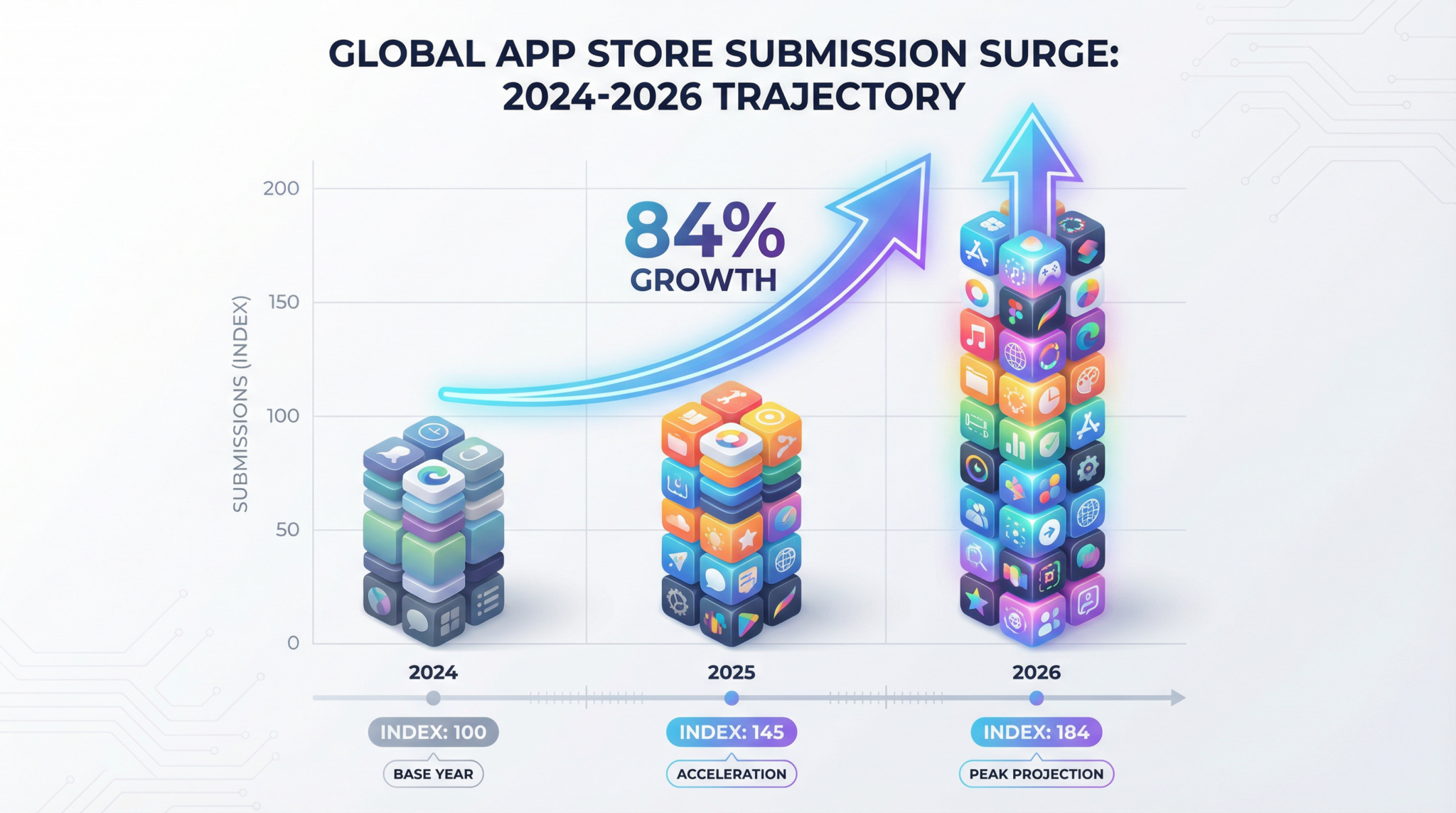
The year 2026 marks a transformative milestone in the trajectory of mobile app development, as the App Store witnessed an unprecedented 84% year-over-year surge in new app submissions. This seismic shift is largely attributed to the proliferation of AI-powered coding tools such as Claude Code and Codex, which have democratized app creation by empowering non-programmers to build functional, innovative applications. Leveraging comprehensive data from Sensor Tower, which recorded over 600,000 new app launches in 2025 alone, this case study delves deep into the multifaceted dynamics driving this surge, the economic ripple effects it has triggered across the app economy, and Apple’s revolutionary AI-driven app review pipeline that processes a staggering 200,000 apps weekly.
1. Contextualizing the 2026 Surge: Sensor Tower Data Insights
Sensor Tower’s exhaustive analytics provide the foundational dataset for understanding the explosion of new app submissions. In 2025, Sensor Tower documented approximately 600,000 new apps entering the Apple App Store ecosystem. This figure, impressive in its own right, set the stage for the phenomenal growth witnessed in 2026, where submissions soared by 84%, pushing the total annual count to over 1.1 million new apps.
To appreciate the scale, consider that in 2020, new app submissions hovered around 400,000 annually — less than half of the 2025 figure. The doubling of app creation in just five years underscores the accelerating role of automation and AI in software development.
- AI Coding Tools as Catalysts: The surge correlates strongly with the widespread adoption of AI programming assistants, notably Claude Code and Codex. These platforms have lowered traditional barriers to entry, enabling individuals without formal coding backgrounds to design, prototype, and deploy apps.
- Shift in Developer Demographics: Sensor Tower data indicates a marked increase in submissions from new developer accounts, many of which are associated with hobbyists, entrepreneurs, and niche content creators leveraging AI to realize their app ideas.
- Expansion of App Categories: The diversity of app categories expanded, with significant growth in educational tools, utility apps, and interactive content — sectors where AI enables rapid iteration and customization.
Historical Perspective on App Store Growth
Since its inception in 2008, the App Store has evolved from a curated marketplace with a few thousand apps to an expansive ecosystem hosting millions of applications. The growth curve was steady but experienced inflection points with the introduction of new developer tools and frameworks (e.g., Swift in 2014). However, no innovation matched the impact of AI-assisted coding in 2026, which compressed years of development effort into mere hours or days for many creators.
2. How Non-Programmers Harness Claude Code and Codex to Build Apps
AI-powered platforms Claude Code (developed by Anthropic) and Codex (by OpenAI) have emerged as front-runners in redefining the app development landscape. Both leverage advanced natural language processing and code generation models to translate human instructions into functioning software components.
Claude Code: Democratizing Development through Conversational AI
Claude Code’s interface is built around conversational AI, allowing users to “talk” through their app concepts with the model. Non-programmers describe desired functionalities, UI layouts, and user flows in plain English, receiving syntactically correct and optimized code snippets in return.
- Multi-language Support: Claude Code supports generation in Swift, Objective-C, and even cross-platform frameworks like Flutter, enabling versatility for App Store deployment.
- Iterative Refinement: Users can ask Claude Code to refactor, debug, or enhance code segments, creating a collaborative coding experience.
- Integration with Design Tools: Seamless plugins with popular design platforms help translate visual mockups into code automatically.
Codex: Powering Code Generation with GPT-4 Architecture
Codex, built on the GPT-4 architecture, excels at generating complex code structures from brief prompts. Its ability to understand context and generate multi-file projects has made it a favorite among hobbyists and professionals alike.
- Auto-completion and Boilerplate Generation: Codex reduces manual coding time by generating entire function skeletons and app templates.
- Support for APIs and Libraries: It can incorporate calls to third-party APIs, such as payment gateways and social media integrations, which are essential for modern apps.
- Debugging Assistance: Codex not only writes code but suggests fixes for errors, improving code quality even for novice users.
Empirical Data: User Trends and Adoption Rates
According to Sensor Tower’s developer surveys, over 45% of new app submissions in 2026 cite AI coding assistance tools as a primary resource. Of these, Claude Code and Codex dominate, with combined usage accounting for approximately 70% of AI-assisted development. This democratization of coding has led to diverse creator profiles:
- Artists developing digital portfolios and interactive experiences.
- Educators building personalized learning modules without technical teams.
- Small business owners crafting specialized utility apps for customer engagement.
Importantly, the learning curve for app development has compressed dramatically. Whereas traditional app creation demanded months of training, many non-programmers now launch functional apps within weeks, if not days.
OpenAI Unveils Super App Strategy: Codex, ChatGPT, and Atlas Browser Converge Into a Single Platform3. Economic Impact on the App Economy
The 84% surge in app submissions has profound economic implications, reshaping revenue models, market competition, and developer ecosystems.
App Store Revenue Growth and Monetization Shifts
While the sheer volume of apps has increased, the App Store’s overall revenue saw an estimated 38% growth in 2026, reaching upwards of $80 billion globally. This discrepancy between submission growth and revenue growth highlights several economic dynamics:
- Freemium and Subscription Models: Many AI-generated apps adopt freemium models, where basic features are free, and premium content or services are subscription-based. This model aligns well with rapid iteration and frequent updates facilitated by AI.
- Micro-Niche Monetization: The influx of apps catering to micro-niches (e.g., language learning for specific dialects, specialized fitness regimens) creates numerous small but sustainable revenue streams.
- Advertising and Data Monetization: Some apps capitalize on AI-enabled personalization to deliver targeted advertising, boosting ad revenue despite a crowded marketplace.
Employment and Industry Transformation
The rise of AI coding tools has catalyzed shifts in the employment landscape within the software development industry:
- Decline in Routine Coding Jobs: Roles focused on boilerplate coding and repetitive tasks are diminishing as AI automates these functions.
- Increased Demand for AI Trainers and Prompt Engineers: New job categories have emerged, focusing on curating training data and optimizing AI code-generation prompts.
- Entrepreneurial Opportunities: Lower barriers have fostered a surge in solo entrepreneurs launching app startups without significant capital investment.
Market Saturation and Quality Considerations
The dramatic increase in quantity also introduces challenges related to app discoverability and quality assurance. Apple’s app curation policies and AI-powered review mechanisms play a critical role in maintaining marketplace standards, which we explore in the next section.
Mastering ChatGPT Prompts in 2026: The Practitioner’s Framework for Structured, High-Impact Prompting4. Apple’s AI Review Pipeline: Processing 200,000 Apps Weekly
To manage the unprecedented volume of submissions, Apple implemented an AI-augmented app review pipeline capable of processing approximately 200,000 apps every week. This system combines machine learning algorithms with human oversight to ensure compliance with App Store guidelines.
Architecture of the AI Review Pipeline
The review pipeline integrates several AI modules designed to automate different stages of app vetting:
- Static Code Analysis: Automated scanners analyze the app binaries and source code to detect malicious code, unauthorized APIs, or privacy violations.
- Behavior Simulation: AI-driven emulators execute apps in sandbox environments, detecting anomalous behavior such as excessive data requests or background activity.
- Content Moderation: Natural language processing modules review app descriptions, user interface text, and user-generated content for policy violations.
- Performance and Usability Checks: AI predicts app performance metrics and potential crashes, flagging unstable apps for deeper human review.
Human-AI Collaboration in Review
Despite the high automation, human reviewers remain integral for nuanced judgment calls, particularly in borderline cases or apps involving complex AI functionalities. The AI pipeline filters and prioritizes apps, enabling human teams to focus on high-risk submissions.
Impact on App Approval Times and Quality Control
Pre-AI review times averaged between 48 to 72 hours, often stretching longer during peak submission periods. The AI pipeline has reduced average review times to under 24 hours, dramatically accelerating go-to-market timelines for developers.
Moreover, the AI system’s ability to detect policy violations has improved overall app quality. Compared to 2025, the rejection rate for apps with security or privacy issues rose by 15%, indicating more stringent enforcement enabled by AI scrutiny.
5. Success Stories: Apps Built Entirely via AI-Driven Coding
The rise of vibe coding — the colloquial term for building apps entirely through AI coding assistants — has birthed several notable successes that exemplify the potential of this paradigm.
App Example 1: “EcoTrack” – Personalized Environmental Impact Tracker
Developer Background: A non-technical environmental activist with a background in biology used Claude Code to build EcoTrack, an app that calculates an individual’s carbon footprint based on daily habits.
- Development Timeline: Completed from concept to launch in three weeks.
- Features: Integration with Apple Health data, real-time suggestions powered by AI, and community challenges.
- Market Reception: Garnered 500,000 downloads in the first quarter post-launch with a 4.7-star rating.
App Example 2: “TutorBot” – AI-Powered Language Learning Companion
Developer Profile: A former teacher without coding experience utilized Codex to create TutorBot, which offers interactive lessons and real-time pronunciation feedback.
- Unique Aspects: Uses AI-generated dialogues and personalized lesson adjustments based on user progress.
- User Base Growth: Scaled to 1 million active users within six months, with integration into school curriculums in several countries.
App Example 3: “FitForm” – Adaptive Workout Planner
Creator: A fitness enthusiast employed vibe coding tools to develop FitForm, an app that customizes workouts using AI analysis of user feedback and progress.
- Development Efficiency: MVP created in under two weeks, with continual enhancements generated by AI assistants.
- Monetization: Subscriptions with personalized coaching powered by AI.
- Revenue Impact: Achieved $2 million in revenue within eight months.

6. Technical and Ethical Considerations Moving Forward
Challenges in AI-Generated Code Quality and Security
While AI coding tools accelerate development, they also introduce risks related to code security, maintainability, and intellectual property. Automated code may inadvertently include vulnerabilities or licensing conflicts. The App Store’s AI review pipeline attempts to mitigate these risks but cannot eliminate them entirely.
Ethical Dimensions and Developer Accountability
The ability to generate entire apps via AI raises questions about authorship, accountability, and transparency. Apple has introduced guidelines requiring developers to disclose AI usage in app creation, aiming to maintain trust within the ecosystem.
Future Trends: AI as a Collaborative Partner
Rather than supplanting human creativity, AI tools are evolving into collaborators that augment developer capabilities. Hybrid workflows, where AI handles routine tasks and humans focus on design and innovation, are becoming the norm.
Conclusion
The 84% surge in App Store submissions in 2026, predominantly driven by AI coding tools like Claude Code and Codex, represents a paradigm shift in mobile app development. By enabling non-programmers to create sophisticated applications, these technologies have expanded the app economy, diversified developer demographics, and accelerated innovation cycles. Apple’s deployment of an AI-powered app review pipeline exemplifies adaptive ecosystem management in response to rapid growth.
Success stories from vibe coding pioneers further highlight the transformative potential of AI-assisted development. However, challenges around quality, security, and ethics remain critical areas for ongoing attention.
This case study underscores the profound implications of AI in software creation, signaling a future where human and machine intelligence converge to redefine digital innovation.
Access 40,000+ AI Prompts for ChatGPT, Claude & Codex — Free!
Subscribe to get instant access to our complete Notion Prompt Library — the largest curated collection of prompts for ChatGPT, Claude, OpenAI Codex, and other leading AI models. Optimized for real-world workflows across coding, research, content creation, and business.
Access Free Prompt Library🕐 Instant∞ Unlimited🎁 Free
Frequently Asked Questions
How did AI tools contribute to the App Store surge?
AI tools like Claude Code and Codex have simplified the app development process, allowing individuals without formal coding skills to create and submit apps. This accessibility has led to a significant increase in new app submissions, contributing to the 84% surge in the App Store in 2026.
What role did Sensor Tower data play in this study?
Sensor Tower provided comprehensive analytics that served as the foundational dataset for understanding the surge in app submissions. Their data showed a dramatic increase from 600,000 new apps in 2025 to over 1.1 million in 2026, highlighting the impact of AI tools on app development.
Which AI coding tools are most popular in 2026?
In 2026, Claude Code and Codex are among the most popular AI coding tools. They are widely adopted due to their ability to lower barriers to entry for app development, enabling a diverse range of users to create and deploy apps efficiently.
What are the economic impacts of the app submission surge?
The surge in app submissions has triggered economic ripple effects across the app economy, including increased revenue for developers and platforms, more job opportunities in tech, and a broader range of apps available to consumers, enhancing the overall digital ecosystem.
How has AI changed developer demographics?
AI has broadened the developer base by enabling hobbyists, entrepreneurs, and niche content creators to enter the app development space. This shift has resulted in a more diverse range of app submissions and innovations, reflecting a wider array of user needs and interests.
What app categories saw the most growth in 2026?
In 2026, there was significant growth in educational tools, utility apps, and interactive content categories. These sectors benefited from AI's ability to facilitate rapid iteration and customization, allowing developers to quickly adapt to market demands and user preferences.
