
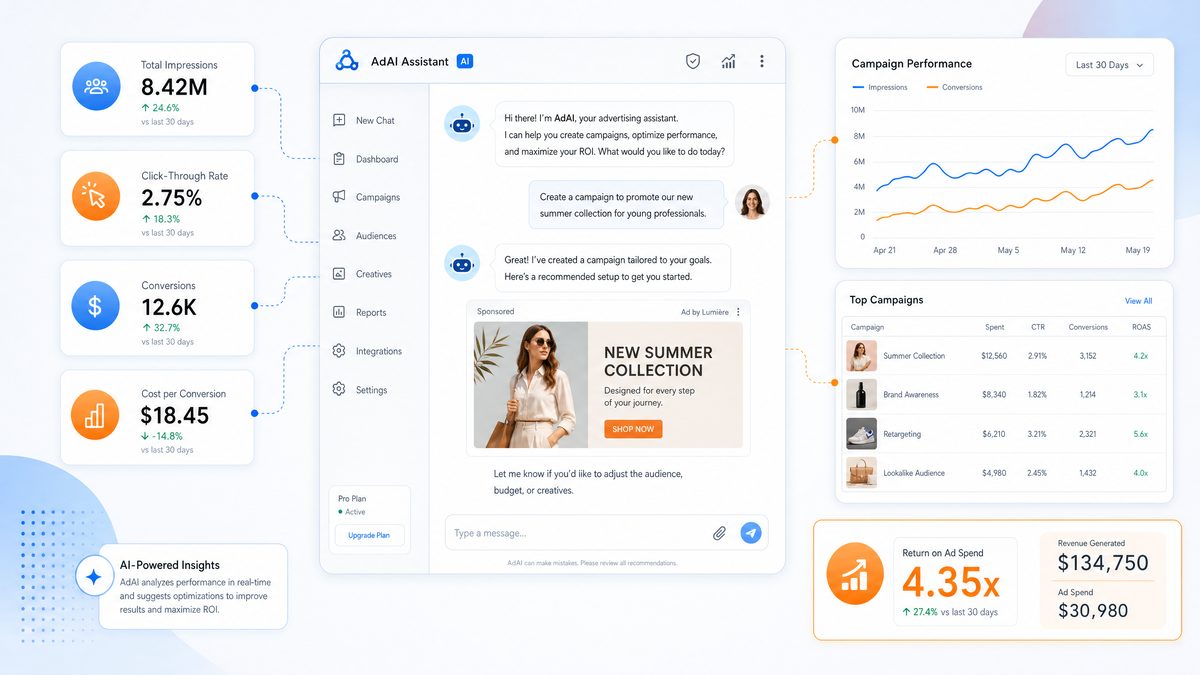
On May 5, 2026, OpenAI significantly expanded its presence in the digital advertising space by launching a self-serve advertising platform integrated directly within ChatGPT. This marks the most substantial evolution since advertising was first introduced to the conversational AI environment in February 2026. Initially, ad placements were limited to a select group of large test partners operating on a cost-per-thousand-impressions (CPM) basis. The new platform democratizes access, allowing a broader range of U.S.-based advertisers to engage ChatGPT users with sophisticated targeting, bidding, and measurement tools designed specifically for the conversational AI context.
This comprehensive article explores OpenAI’s advertising platform rollout, its innovative features, ethical principles, and how it positions ChatGPT to compete with established digital advertising giants like Google and Meta. Marketers, advertisers, and AI enthusiasts will gain valuable insights into leveraging conversational AI for effective advertising campaigns.
1. The Launch: ChatGPT Ads Manager Opens to U.S. Businesses
OpenAI’s announcement on May 5, 2026, unveiled the ChatGPT Ads Manager — a self-serve platform designed to democratize advertising within the AI-powered conversational interface. Moving beyond invitation-only CPM partnerships, this launch opens the door for any verified U.S. business to create, manage, and optimize campaigns via a user-friendly dashboard.
Key Features of the ChatGPT Ads Manager Include:
- Open Access: Previously exclusive to large brands and agencies, the platform now welcomes advertisers of all sizes, from local boutiques to startups, enabling broad experimentation with conversational AI marketing.
- Conversational Ad Formats: Ads are seamlessly integrated into ChatGPT conversations, appearing naturally without disrupting the user experience. For instance, a user planning travel might receive a subtle airline promotion embedded within AI-generated itinerary suggestions.
- Advanced Targeting: Leveraging OpenAI’s proprietary AI models, advertisers can target users based on real-time conversation topics, intents, and preferences, offering hyper-contextual ad delivery unmatched by traditional platforms.
- Strict Compliance & Moderation: Ad content undergoes rigorous vetting through AI filters and human moderators to prevent misinformation, harmful content, or deceptive practices, ensuring user trust is maintained.
OpenAI’s CEO emphasized that this launch reflects a commitment to responsible monetization while preserving the integrity of the ChatGPT user experience. To support advertisers, the platform includes comprehensive onboarding resources such as tutorial videos, FAQs, and dedicated support. Early adopter case studies show promising engagement rates, especially in industries like travel, finance, and e-commerce. For example, a travel company reported a 25% increase in conversion rates by targeting users during travel planning conversations.
OpenAI is also working with marketing agencies to develop best practices for conversational advertising, fostering a collaborative ecosystem to drive innovation and education.
2. How ChatGPT Advertising Works: Format, Placement, and Bidding
ChatGPT advertising redefines ad integration by embedding ads directly within natural language conversations. Unlike traditional banner or video ads, these ads maintain conversational flow and relevance, enhancing user engagement rather than interrupting it.
Ad Format and Placement
Ads appear contextually during conversations, inserted at natural breakpoints or triggered by specific user queries aligned with advertiser offerings. Examples include:
- Sponsored Suggestions: Contextual recommendations carrying sponsor branding. For instance, a user asking about healthy recipes might see a sponsored suggestion promoting a meal delivery service specializing in organic ingredients.
- Branded Content Snippets: Informational blocks with embedded calls to action (CTAs), such as summaries of products or services related to the conversation, paired with “Learn More” or “Book Now” buttons.
- Interactive Elements: Actionable buttons like “Get a Quote” or “Schedule a Consultation” that facilitate seamless user conversion without leaving the chat environment.
Ad placement is carefully optimized to avoid disrupting the conversational flow. OpenAI’s AI heuristics analyze conversation length, engagement, and content sensitivity to determine optimal insertion points. For example, ads are suppressed during highly technical or sensitive discussions to maintain user comfort.
Bidding and Targeting Models
The platform supports multiple bidding options tailored to diverse advertiser goals:
- CPM (Cost Per Mille): Suitable for brand awareness campaigns, advertisers pay for every 1,000 impressions their ads receive.
- CPA (Cost Per Action): A performance-based model where advertisers pay only when a defined user action occurs, such as clicking a link or completing a purchase. This model appeals to advertisers focused on ROI and measurable outcomes.
Targeting options leverage multiple data signals, including:
- Conversational Context: Ads are triggered by keywords, topics, sentiment, and inferred user intent in real-time, exceeding traditional keyword targeting.
- Demographics: Anonymized data such as age and location enable geographically and generationally relevant ad delivery.
- Behavioral Signals: Past engagement patterns with ChatGPT and other OpenAI services help refine targeting for repeat interactions.
The platform offers budget controls, scheduling options, and detailed analytics dashboards. AI-driven recommendations dynamically adjust bids and targeting to optimize campaign performance, with support for A/B testing across ad creative and formats.
Use cases illustrate the platform’s versatility — a financial services firm might run CPA campaigns targeting queries about retirement planning, while a travel agency could use CPM bidding for seasonal brand awareness.
3. From CPM to CPA: New Measurement and Bidding Options
The introduction of CPA bidding marks a pivotal enhancement in ChatGPT’s advertising capabilities, aligning advertiser costs directly with business outcomes and promoting efficient spend.
Measurement Tools and Analytics
OpenAI integrates advanced measurement tools tailored for conversational ads, providing real-time insights into campaign effectiveness. Key metrics include:
- Click-Through Rate (CTR): Measures user engagement with embedded ads within chat flows.
- Conversion Rates: Tracks successful completions of desired actions post-ad interaction.
- Engagement Depth: Evaluates influence of ads on conversation length and quality, critical for understanding impact on user experience.
- Return on Ad Spend (ROAS): Calculates advertising profitability for precise budget optimization.
The platform supports integration with third-party analytics providers like Google Analytics and Adobe Analytics, enabling advertisers to validate data and maintain consistent reporting across channels.
Bidding Strategies
Advertisers can choose:
- Automated Bidding: Uses machine learning to optimize bids dynamically, balancing cost and conversion volume by analyzing historical and contextual data. For example, bids may increase during high-demand holiday seasons to capture premium traffic.
- Manual Bidding: Allows experienced advertisers to set precise bid amounts and targeting parameters, ideal for niche campaigns or testing new creative approaches.
These capabilities underscore OpenAI’s commitment to a competitive, transparent advertising environment that aligns with evolving marketer expectations and the unique dynamics of conversational AI.
4. OpenAI’s Advertising Principles and User Privacy
OpenAI’s advertising expansion is anchored by a robust framework of principles designed to protect users, safeguard privacy, and maintain the quality of the ChatGPT experience. These principles include:
- Non-Intrusiveness: Ads are designed to avoid disrupting conversation flow or overwhelming users, with frequency caps and placement aligned with natural conversation breaks.
- Transparency: Sponsored content is clearly labeled, using visual cues to distinguish ads from organic AI responses, preserving user trust.
- Privacy Protection: User data is handled in compliance with privacy laws (e.g., GDPR, CCPA). OpenAI does not sell personal data and only shares anonymized, aggregated signals with advertisers. The platform avoids persistent tracking technologies, relying on ephemeral data from immediate conversational context.
- Content Integrity: All ads undergo automated and human review to prevent misinformation, offensive content, or deceptive claims, maintaining a safe and trustworthy advertising environment.
- Opt-Out Options: Users can manage ad personalization preferences or opt out of targeted ads entirely within ChatGPT’s privacy settings.
Privacy experts commend ChatGPT’s model for its privacy-forward approach compared to traditional ad platforms reliant on cookies and extensive user profiling. OpenAI also commits to publishing periodic transparency reports detailing ad performance, policy enforcement, and user feedback to promote accountability.
This privacy-centric approach aims to balance monetization with ethical responsibility, setting new industry benchmarks for AI advertising.
5. How ChatGPT Ads Compare to Google and Meta Platforms
ChatGPT’s advertising platform enters a crowded market dominated by Google and Meta, both with mature, global ad ecosystems. Here is a comparison of key features:
| Feature | ChatGPT Ads | Google Ads | Meta Ads (Facebook/Instagram) |
|---|---|---|---|
| Ad Format | Conversational, context-driven integrated ads | Search, display, video, app ads | Social feed, stories, video, messenger ads |
| Targeting Basis | Conversational context, intent, topic inference | Keyword intent, demographics, behavior | Demographics, interests, behaviors, social connections |
| Measurement Models | CPM, CPA with third-party measurement support | CPM, CPC, CPA, advanced attribution | CPM, CPC, CPA, multi-touch attribution |
| User Privacy | Anonymized data, no personal data sales, opt-out options | Uses cookies, tracking pixels, broad data collection | Extensive data collection, pixel tracking, targeting |
| Ad Experience | Seamless, conversational, non-intrusive | Traditional display/search ads, sometimes intrusive | Highly personalized social ads, varying intrusion levels |
| Self-Serve Access | New, U.S.-focused, conversational AI-centric | Global, mature, multi-channel | Global, mature, social media-focused |
While Google and Meta offer extensive reach and powerful targeting, ChatGPT’s conversational ads provide a unique, less intrusive engagement model. Ads feel like personalized recommendations woven into the user’s ongoing dialogue, potentially increasing attention and conversion rates.
OpenAI’s emphasis on privacy and ethical ad delivery may appeal to advertisers and users increasingly concerned about data misuse on traditional platforms. Regulatory pressures have forced Google and Meta to restrict some targeting capabilities, whereas ChatGPT’s anonymized, context-driven approach sidesteps many privacy challenges.
Marketers familiar with Google and Meta will find ChatGPT’s conversational targeting innovative but requiring new creative strategies and measurement approaches. The platform’s success stories, such as Nexen Tire’s manufacturing AI transformation, illustrate how industries are adopting AI to optimize operations and marketing.
6. What This Means for Marketers and Small Businesses
The launch of ChatGPT Ads Manager offers fresh opportunities for marketers and small businesses to reach audiences within an AI-powered conversational environment. The platform’s self-serve nature and low entry barriers democratize access to cutting-edge advertising technology.
Advantages for Marketers
- Highly Relevant Targeting: Real-time conversational context enables precision targeting beyond traditional keyword or demographic filters, often resulting in higher engagement rates. For example, a local fitness studio can target users discussing exercise routines or wellness goals.
- Outcome-Based Bidding: CPA bidding lets marketers pay only for actual conversions, maximizing budget efficiency—a boon for startups and small businesses with limited marketing spend.
- Rich Analytics: Integrated measurement tools provide granular performance data, empowering rapid iteration and optimization to maximize ROI.
- Brand Safety: OpenAI’s content moderation reduces risks of ads appearing alongside inappropriate or harmful content, protecting brand reputation in sensitive industries.
- Innovative Formats: Conversational ads foster deeper engagement through interactive, contextually relevant CTAs, enabling storytelling and seamless customer journeys.
Challenges and Considerations
- Learning Curve: Crafting effective conversational ad creatives requires new skills and understanding user expectations in the chat environment. Marketers should allocate time for training and experimentation.
- Limited Geographic Availability: Currently restricted to U.S.-based advertisers, limiting global campaign reach, though expansion is anticipated.
- Measurement Nuances: Attribution models differ from traditional web or app tracking, requiring adaptation and new KPIs to evaluate success effectively.
Small businesses benefit from easy campaign setup and performance-based bidding, leveling the playing field against bigger competitors. For example, a local home renovation company can target users discussing remodeling plans, increasing conversion rates through timely recommendations.
Integrating ChatGPT ads with other digital channels and learning from AI-first organizations like Walleye Capital, which achieved 100% AI adoption with Claude Code, can further enhance marketing effectiveness.
7. The Broader Implications for AI Monetization
OpenAI’s move to monetize ChatGPT via advertising signals a broader industry shift toward sustainable AI revenue models. Historically funded by grants, subscriptions, or enterprise licensing, AI platforms are increasingly exploring advertising as a scalable income source.
- Democratization of AI Advertising: Opening conversational ad access to smaller advertisers fosters inclusivity and innovation, accelerating AI adoption across industries.
- New Data Paradigms: Real-time conversational context offers richer, dynamic targeting data that could redefine personalization standards in digital advertising.
- Privacy-First Monetization: OpenAI’s privacy-centric approach may set industry benchmarks, balancing revenue generation with user trust and regulatory compliance.
- Competitive Differentiation: AI companies will compete not only on model accuracy but also on monetization efficacy and ethical advertising frameworks, with OpenAI positioned as a pioneer.
The success of ChatGPT Ads Manager will influence how other AI providers approach monetization, potentially catalyzing innovation in AI-driven marketing technologies. It also raises important ethical questions about persuasive AI and consumer attention management.
Industry forecasts predict conversational AI advertising could evolve into a multi-billion-dollar market within five years, integrating with existing digital media ecosystems. Developers and marketers should closely monitor this space to harness emerging opportunities effectively.
For an in-depth example of AI-driven transformation, see the Claude Code case study on Walleye Capital, showcasing the impact of an AI-first mindset in hedge fund operations.
8. Useful Links
- OpenAI Official Blog: Announcements and Updates on ChatGPT Advertising
- ChatGPT Ads Manager User Guide: Step-by-Step Setup and Campaign Management
- Privacy and Data Use Policies for ChatGPT Ads
- Third-Party Measurement Providers Supported by OpenAI
- Industry Reports on Conversational AI Advertising Trends
- Best Practices for Conversational Ad Creative
Conclusion
OpenAI’s launch of the ChatGPT Ads Manager represents a landmark moment at the intersection of AI and digital advertising. By introducing a self-serve platform featuring sophisticated targeting, measurement, and bidding capabilities underpinned by ethical principles, OpenAI gives businesses a direct way to create, launch, manage, and measure campaigns in the beta Ads Manager. OpenAI’s announcement lists CPM and cost-per-click (CPC) buying; the CPA bidding described earlier is not confirmed in that announcement. Advertisers receive aggregated performance insights without access to individual conversations or personal details. Marketers should test carefully, validate conversion measurement, and compare results with established channels before shifting substantial budget.
