
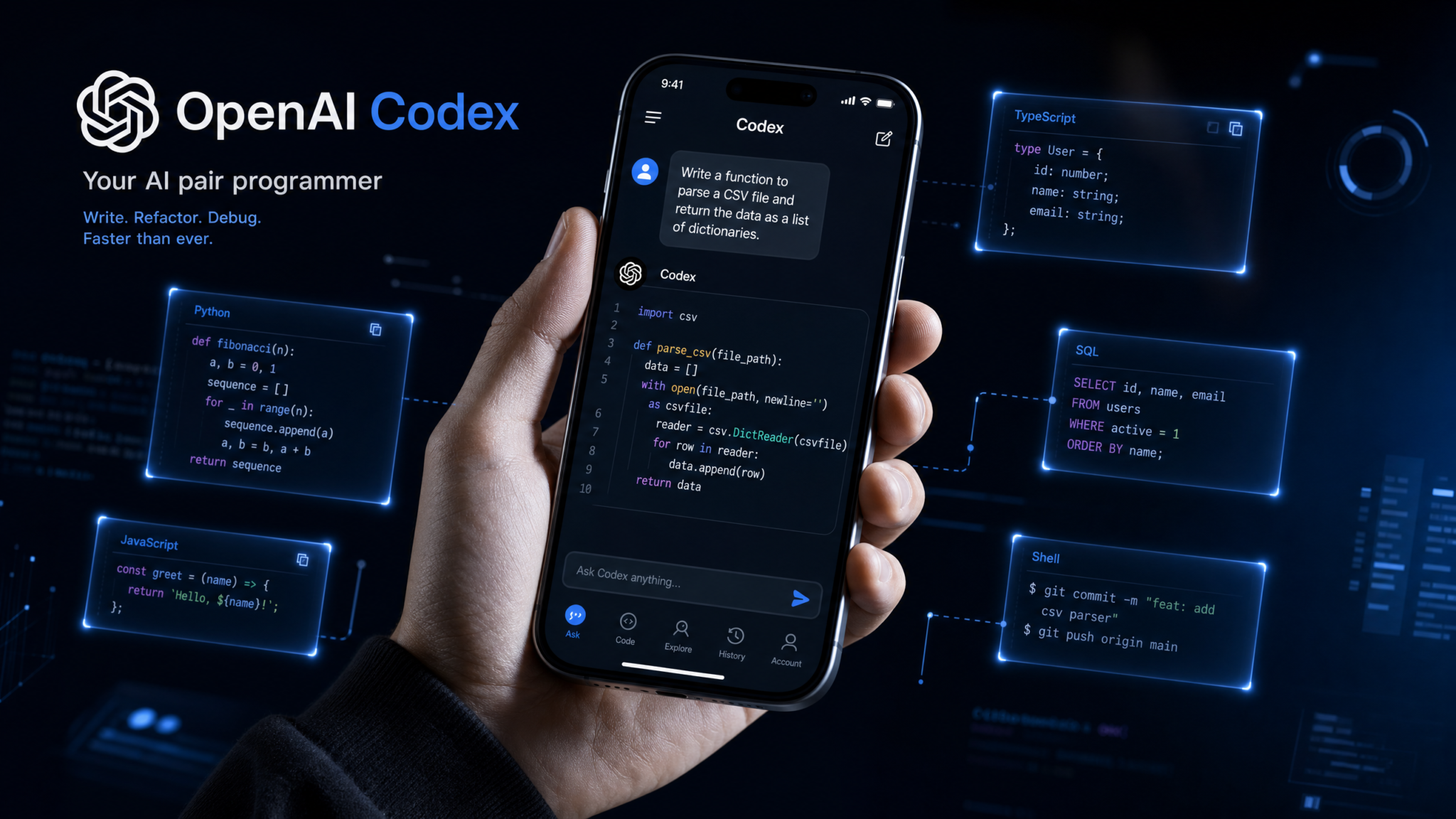
How to Use OpenAI Codex on Mobile: Complete Setup and Workflow Guide
[IMAGE_PLACEHOLDER_HEADER]
Artificial Intelligence continues to reshape the way developers create and innovate. With OpenAI’s groundbreaking Codex now integrated into the ChatGPT mobile application as of May 14, 2026, coding on the go has become a reality. This powerful AI assistant transforms your smartphone or tablet into a versatile development environment, allowing you to write, debug, and understand code anytime, anywhere.
Whether you’re a professional developer needing to tweak code during travel or a learner exploring programming from the palm of your hand, this guide offers you a complete walkthrough for setting up Codex on your mobile device, mastering practical workflows, and maximizing productivity.
Setting Up OpenAI Codex on Your Mobile Device
Utilizing Codex on mobile requires the latest ChatGPT app version. Here’s how to get started quickly:
Step 1: Install or Update the ChatGPT Mobile App
- iOS Users: Open the App Store, tap your profile icon, scroll to pending updates, and update ChatGPT to version 2.15.0 or later. If you haven’t installed the app yet, search for “ChatGPT” and download it.
- Android Users: Go to the Google Play Store, tap your profile icon, select “Manage apps & device,” and update ChatGPT to v2.15.0 or newer. If it’s not installed, search “ChatGPT” and install it.
Important: Codex features are enabled server-side. After updating, the functionalities might appear after a few hours. Ensure you’re logged into your OpenAI account within the app.
Step 2: Confirm Codex Activation
Launch the updated ChatGPT app and look for any of the following indicators that Codex is active:
- Model Selection Dropdown: Tap on the model selector at the top of the chat and check if “Codex” or “GPT-4 Code Interpreter” appears as an option.
- Dedicated “Code” or “Developer” Mode Tab: Some users may notice a new tab offering direct access to coding features alongside the chat interface.
- Implicit Activation: For ChatGPT Plus or Enterprise users, Codex may activate automatically when you input code-related queries, though manual selection of the Codex model is recommended for consistent results.
If you cannot see Codex immediately, try force-closing the app, restarting your device, or waiting a few hours for the rollout to complete.
[IMAGE_PLACEHOLDER_SECTION_1]
Step 3: Customize Your Mobile Coding Environment (Optional but Recommended)
To optimize your coding experience on mobile, consider these adjustments:
- Enable Dark Mode: Reduce eye strain during coding by enabling dark mode via your phone’s system settings or the ChatGPT app’s interface settings.
- Optimize Keyboard for Coding:
- Use Code-Friendly Keyboards: Install third-party keyboards supporting easy input of programming symbols such as
<,>,{},;, and arrow keys. “Hacker’s Keyboard” on Android is a great choice. - Text Expansion Shortcuts: Leverage your keyboard or device’s text expansion features to create shortcuts for frequently used code snippets or templates.
- Use Code-Friendly Keyboards: Install third-party keyboards supporting easy input of programming symbols such as
- Master Copy/Paste: Familiarize yourself with clipboard history and multi-clipboard managers on your device to efficiently handle code snippets and refactorings.
Practical Mobile Coding Workflows with OpenAI Codex
With Codex ready on your device, here are some effective workflows to boost your mobile development:
Workflow 1: Rapid Prototyping and Code Generation
Capture your ideas anytime. Suppose you want a quick utility script while commuting:
Example Prompt: "Write a Python function that takes a list of numbers and returns a new list containing only the prime numbers, with docstrings and type hints."
Codex instantly generates clean, annotated code, which you can test in mobile code editors like Termux (Android) or text editors on iOS, or save for integration later.
Interested in how enterprises leverage Codex for rapid development? Check out our case study on Simplex, which reduced software development time by 60% using AI workflows.
Workflow 2: Debugging and Error Resolution En Route
Fix bugs immediately without waiting for your desktop:
Example Prompt: "I'm getting a 'TypeError: 'str' object is not callable' in my JavaScript function: [paste function code]. What causes this, and how can I fix it?"
Codex diagnoses the error — often a variable name shadowing a function — and suggests code fixes, helping you resolve blockers quickly.
Workflow 3: Learning and Exploring New Languages
Use mobile Codex as your AI tutor anytime, anywhere.
Example Prompts:
"Explain closures in JavaScript with a simple example.""Show me how to perform an INNER JOIN between 'Orders' and 'Customers' tables in SQL."
Codex generates easy-to-understand explanations and runnable snippets, perfect for learners and professionals expanding their skillset.
If you’re new to programming, start with our beginner-friendly guide, OpenAI Codex for Non-Developers, which showcases AI tools making coding accessible for everyone.
Workflow 4: Refactoring and Optimizing Existing Code
Enhance readability and performance of your code with AI assistance.
Example Prompt: "Refactor this C++ function to improve readability and efficiency without changing its behavior: [paste code]."
Codex suggests idiomatic improvements such as cleaner iterations, simplified conditionals, and best practices to maintainable code.
Workflow 5: Generating Boilerplate and Configuration Files
Don’t waste time remembering syntax. Generate common files effortlessly:
Example Prompts:
"Generate a Dockerfile for a Python Flask app using Gunicorn.""Create a basic HTML page template with a navbar and main content area."
This accelerates project scaffolding and reduces context switching.
[IMAGE_PLACEHOLDER_SECTION_2]
Tips for Maximizing Productivity with OpenAI Codex on Mobile
-
Craft Precise and Detailed Prompts
Clarity is key; specify the language, task goals, inputs, constraints, and code context. Instead of “write code,” try “write a Ruby script to parse a JSON file and extract all ‘product_name’ values.”
-
Use Proper Code Formatting
When sharing code, use Markdown-style code blocks or maintain consistent indentation and spacing so Codex correctly interprets the structure. Output code is typically clean and easy to copy.
-
Divide Complex Problems
Break large tasks into smaller, manageable parts. For example, first ask for a function to fetch data, then a separate function to process it. This iterative approach yields better results.
Access 40,000+ AI Prompts for ChatGPT, Claude & Codex — Free!
Subscribe to get instant access to our complete Notion Prompt Library — the largest curated collection of prompts optimized for real-world workflows in coding, content creation, research, and business.
Useful Links
- Case Study: How Simplex Reduced Software Development Time by 60% Using OpenAI Codex Agentic Workflows
- OpenAI Codex for Non-Developers: 7 Features Making AI Coding Accessible to Everyone
- ChatGPT AIHub Free Prompt Library Subscription
