
How to Set Up and Run Your First ChatGPT Ads Campaign: The Ultimate Advertiser’s Guide for 2026
Author: Markos Symeonides
Introduction to ChatGPT Ads Manager: Revolutionizing Conversational Advertising
In the rapidly evolving landscape of digital marketing, conversational AI has emerged as a powerful channel for engaging users in meaningful and personalized ways. In May 2026, OpenAI launched the groundbreaking ChatGPT Ads Manager, a self-serve advertising platform that integrates seamlessly within the ChatGPT ecosystem, enabling businesses and developers to create, manage, and optimize ad campaigns tailored for conversational environments.
Unlike traditional advertising platforms that rely on static placements, ChatGPT Ads Manager leverages OpenAI’s advanced AI capabilities to deliver contextually relevant, dynamic ads that align with the ongoing conversations users have with ChatGPT. This results in highly personalized ad experiences that feel natural and non-intrusive, increasing user engagement and conversion potential.
As of Q1 2026, ChatGPT has amassed over 500 million monthly active users globally, spanning diverse demographics, industries, and interests. This vast and engaged audience presents advertisers with unparalleled opportunities to reach potential customers in a conversational setting that encourages interaction, discovery, and trust.
The platform combines precision targeting, AI-driven automation, and native integrations with leading ad technology partners to empower advertisers with tools that optimize every stage of the campaign lifecycle—from creative development to real-time bidding and performance analytics.
Whether your goal is to build brand awareness, generate qualified leads, drive website traffic, or increase conversions, ChatGPT Ads Manager offers versatile features and best-in-class technology to maximize your advertising impact in 2026 and beyond.
In this comprehensive guide, we will explore everything you need to know to set up and run your first ChatGPT Ads campaign effectively. We will cover prerequisites, detailed campaign creation steps, advanced optimization techniques, integrations, and expert tips to help you succeed in this new frontier of AI-powered advertising.
[IMAGE__SECTION_1]Getting Started with ChatGPT Ads: Prerequisites and Account Setup
Essential Requirements Before Launching Your First Campaign
Starting your journey with ChatGPT Ads requires careful preparation to ensure a smooth onboarding experience and campaign success. Meeting the following prerequisites will set a solid foundation:
- OpenAI Business Account: Access to the Ads Manager is exclusive to verified business accounts. This means your account must have validated company information, billing details, and legal credentials. This verification ensures compliance with OpenAI’s policies and protects the platform’s integrity.
- Subscription Tiers and Access Levels: While basic Ads Manager access is granted automatically to business accounts, unlocking advanced features such as premium audience targeting, granular analytics, and priority support requires subscribing to the Go-tier plan. This tiered system provides flexibility based on your advertising needs and budget constraints.
- Digital Properties with Tracking Capabilities: To measure your campaign’s impact accurately, your website or mobile application must integrate with OpenAI’s Conversions API or support tracking pixel implementation. Proper tracking is essential for optimizing campaigns and attributing conversions.
- Compliance with OpenAI Advertising Policies: Familiarize yourself with OpenAI’s strict advertising guidelines that prohibit certain content types, protect user privacy, and enforce ethical advertising standards. Ensuring your ads comply prevents disruptions, disapprovals, or account suspensions.
Once these requirements are met, you can confidently proceed to the Ads Manager dashboard by logging into your OpenAI console and navigating to the Ads Manager tab.
Setting Up Your Business Profile and Payment Information
A complete and accurate business profile is vital for account legitimacy and billing purposes. Key components include:
- Company Name and Contact Details: Ensure your business name matches legal records, and provide accessible contact information for verification and support communication.
- Tax Identification and Legal Status: Input your tax ID and confirm your company’s legal status to comply with regional regulations and tax reporting requirements.
- Billing Address and Payment Method: Add valid payment methods such as credit or debit cards, or other supported options that facilitate seamless ad spend processing.
The Billing & Payments section within the OpenAI console allows you to manage invoices, update payment details, and monitor your advertising budget in real time.
Ensuring correct payment information prevents campaign interruptions and streamlines financial management.
Account Security and User Role Management
For agencies or larger organizations, managing access control is crucial to protect sensitive data and streamline collaboration. ChatGPT Ads Manager provides a granular user role system:
- Admin: Full permissions including billing, user management, and campaign control. Ideal for business owners or senior marketing managers.
- Campaign Manager: Can create, edit, and launch campaigns but cannot alter billing or user roles. Best suited for marketing team members focused on execution.
- Analyst: Read-only access to campaign data and performance reports, enabling data-driven decision-making without administrative privileges.
Assign roles thoughtfully based on team responsibilities to foster security and operational efficiency.
For a deeper dive into account setup best practices and advanced role configurations, check out our detailed walkthrough here: AI News
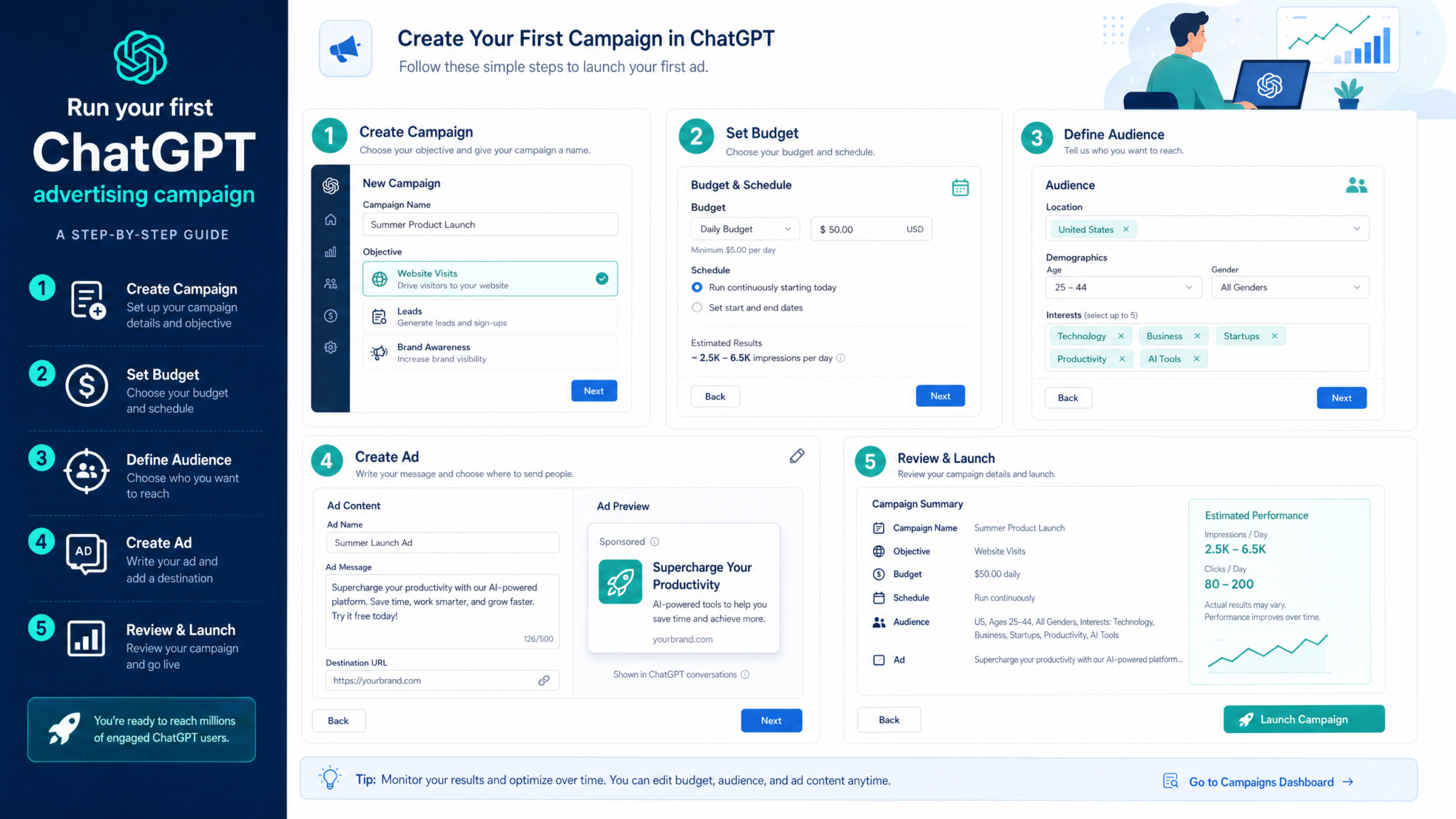
Creating Your First ChatGPT Ads Campaign: Step-by-Step Guide
Step 1: Initiating Your Campaign
Once logged into the Ads Manager dashboard, begin by clicking the “Create Campaign” button. This launches an intuitive campaign creation wizard that simplifies the setup by guiding you through each critical step with contextual tips and validations.
The wizard’s user-friendly interface reduces errors and streamlines the process, making it accessible even for marketers new to AI-powered advertising platforms.
Step 2: Selecting Your Campaign Objective
Your campaign objective determines how the Ads Manager optimizes your ads and evaluates performance metrics. Choosing the right objective aligns your campaign strategy with your desired business outcomes. ChatGPT Ads supports several objectives:
- Brand Awareness: Focus on maximizing impressions and reach to increase your brand’s visibility among ChatGPT users. Ideal for new product introductions, market expansion, or boosting brand recall.
- Website Traffic: Drive users to specific web pages to increase engagement, such as blog posts, product pages, or content hubs. Great for content marketing and e-commerce promotion.
- Lead Generation: Collect contact information through integrated lead forms within ChatGPT conversations, facilitating direct communication channels for sales or newsletters.
- Conversions: Optimize for concrete actions like purchases, sign-ups, or app downloads. This objective benefits from detailed conversion tracking for precise ROI measurement.
Selecting the correct objective tailors the Ads Manager’s AI algorithms to optimize bidding, creative delivery, and audience engagement accordingly.
Step 3: Naming and Scheduling Your Campaign
Provide a clear, descriptive campaign name that reflects its core purpose and timing, for example, “Spring Sale 2026 – Brand Awareness.” Thoughtful naming conventions facilitate easy identification and reporting, especially when managing multiple campaigns simultaneously.
Schedule your campaign by setting start and end dates with flexible options:
- Continuous Run: Campaign runs indefinitely until manually paused or stopped.
- Fixed Duration: Set specific start and end dates to align with promotions, seasonal events, or product launches.
Strategic scheduling allows you to optimize budget allocation and synchronize advertising efforts with broader marketing calendars.
Step 4: Choosing Your Bidding Strategy
Understanding bidding models is crucial for controlling ad spend and achieving your campaign goals efficiently. ChatGPT Ads Manager offers several bidding options:
| Bidding Model | Description | Recommended Use Case | Suggested Bid Range |
|---|---|---|---|
| Cost-Per-Click (CPC) | Pay only when a user clicks on your ad, focusing your spend on engagement. | Ideal for campaigns aimed at driving traffic or direct response actions. | $3 – $5 per click |
| Cost-Per-Mille (CPM) | Pay per 1,000 impressions to maximize ad visibility. | Best for brand awareness and broad audience reach campaigns. | Varies based on targeting and market demand. |
| Cost-Per-Acquisition (CPA) | Pay based on the number of conversions achieved. | Suitable for performance-driven campaigns focused on measurable ROI. | Depends on conversion value and industry benchmarks. |
Pro Tip: New advertisers often start with CPC bidding to establish baseline performance metrics. As you accumulate conversion data, consider testing CPA bidding to optimize for cost-efficient results.
Step 5: Designing Your Ads to Engage ChatGPT Users
ChatGPT Ads are designed to blend naturally into the conversational interface, utilizing visually rich and concise formats that capture attention without disrupting the user experience. Best practices for crafting compelling ads include:
- High-Quality Images: Use images optimized for ChatGPT’s display dimensions, ideally 1200×628 pixels, to ensure clarity and responsiveness.
- Concise Headlines: Craft headlines with up to 40 characters that grab attention and clearly communicate your value proposition.
- Clear Descriptions: Limit descriptions to 90 characters, focusing on benefits and enticing users to engage.
- Powerful Call-to-Actions (CTAs): Use action-oriented CTAs like Learn More, Sign Up, or Buy Now to direct user behavior effectively.
Additionally, leverage ChatGPT’s AI-powered dynamic creative optimization feature. This tool automatically tests multiple ad variants and iteratively prioritizes the best performing creatives, boosting engagement and conversion rates over time.
Keep messaging aligned with your target audience’s preferences and the conversational tone of ChatGPT to maximize resonance.
Step 6: Defining Your Target Audience with Laser Precision
ChatGPT Ads Manager’s advanced targeting capabilities allow you to reach the most relevant users by combining multiple audience dimensions:
- Demographics: Filter by age groups, gender, countries, regions, cities, and preferred languages to match your buyer personas.
- Interests & Behaviors: Target users based on their conversation topics, hobbies, professional fields, and engagement patterns. For example, reaching technology enthusiasts, fitness buffs, or finance professionals.
- User Tier: Differentiate between Free-tier users and Go-tier subscribers. Go-tier users typically demonstrate higher engagement and conversion rates, allowing for more focused budget allocation.
- Contextual Targeting: Ads are dynamically inserted based on the content of users’ ongoing ChatGPT interactions, ensuring maximum relevance.
- Lookalike Audiences: Utilize AI-generated audiences that mirror the characteristics of your best customers, expanding reach while maintaining targeting precision.
Fine-tuning audience parameters enhances ad relevance, reduces wasted spend, and improves overall campaign ROI.
Step 7: Configuring Conversion Tracking for Accurate Measurement
Tracking conversions accurately is fundamental to evaluating your campaign’s success and informing optimization decisions. ChatGPT Ads Manager supports two primary tracking methods:
- Conversions API: A server-to-server integration that transmits real-time event data from your backend directly to OpenAI’s platform. This method is highly reliable, bypassing client-side limitations like ad blockers and browser privacy restrictions.
- Tracking Pixel: A lightweight JavaScript snippet embedded on your website or app that tracks user interactions such as page views, form submissions, and purchases.
Choosing the right method depends on your technical resources and tracking needs. Many advertisers benefit from implementing both for comprehensive data capture.
For a detailed technical guide on setting up tracking, refer to the Tracking, Targeting, and Budget Optimization section below.
Step 8: Reviewing and Launching Your Campaign
Before launching, meticulously review every campaign element to ensure accuracy and compliance:
- Confirm campaign objectives and budget allocations align with your marketing goals.
- Verify ad creatives for clarity, adherence to OpenAI’s policies, and visual appeal.
- Double-check targeting parameters to ensure you are reaching the intended audience segments.
- Test your conversion tracking setup thoroughly to guarantee data accuracy.
After submission, your campaign enters OpenAI’s review process, which typically completes within 24 hours unless flagged for policy review. Once approved, your ads go live and start reaching ChatGPT’s audience.
[IMAGE__SECTION_2]Tracking, Targeting, and Budget Optimization: Maximizing Campaign Performance
Implementing Conversion Tracking: Conversions API vs. Tracking Pixel
Effective conversion tracking forms the backbone of data-driven advertising. Let’s explore the two primary methods supported by ChatGPT Ads Manager:
Conversions API: Server-to-Server Precision
The Conversions API offers a robust, privacy-conscious way to send conversion events directly from your server to OpenAI’s ad platform.
- Generate API Key: Access the Tracking section in Ads Manager to create your unique API key for authentication.
- Implement API Calls: Use OpenAI’s SDK or REST API to send event data structured in JSON format, including parameters like event name, timestamp, user identifiers (hashed for privacy), and conversion value.
- Validate Setup: Utilize the dashboard’s test tools to simulate conversion events and confirm successful data transmission.
This method is especially beneficial in overcoming browser privacy restrictions and ad blockers, ensuring high-fidelity tracking for precise campaign optimization.
Tracking Pixel: Simple Client-Side Implementation
The tracking pixel is a JavaScript snippet added to your website or app’s HTML that records user interactions.
- Copy Pixel Code: Obtain the tracking pixel snippet from the Ads Manager interface.
- Embed Pixel: Insert the script into your website’s header, footer, or on specific conversion pages such as checkout confirmation or thank-you pages.
- Test Pixel Firing: Use browser developer tools or OpenAI’s pixel debugger to ensure the pixel activates correctly upon user actions.
While easier to implement, the pixel is more susceptible to being blocked by privacy tools and may yield incomplete data compared to the Conversions API.
Optimizing Audience Targeting for Maximum Engagement and ROI
Smart targeting is essential to reach users who are most likely to engage and convert. Consider these advanced targeting strategies:
- Micro-targeting Demographics: Drill down into specific age ranges, genders, and locations to align precisely with your buyer personas.
- Interest Clusters: Exploit AI-driven insights from ChatGPT’s conversational data to target niche groups based on their expressed interests and behaviors.
- User Tier Segmentation: Allocate higher budget shares to Go-tier users, who statistically convert 30% more often, while maintaining Free-tier reach for brand discovery and awareness.
- Dynamic Contextual Ads: Enable ChatGPT’s AI to automatically match your ads with relevant conversation topics in real time, increasing user receptiveness.
Employing these targeting layers in combination improves ad relevance, engagement rates, and overall campaign efficiency.
Budget Planning and Smart Optimization Techniques
Efficient budget management can significantly influence campaign outcomes. Here are key strategies to optimize your ad spend on ChatGPT Ads:
| Strategy | Description | Benefits |
|---|---|---|
| Minimum Viable Budget | Start with at least $50/day to provide sufficient data for AI-driven optimization. | Ensures the Ads Manager’s algorithms have enough information to improve bidding and targeting accuracy. |
| Bid Caps and Pacing Controls | Set maximum bid limits and control daily spending pace to prevent early budget exhaustion. | Maintains campaign longevity and cost control. |
| A/B Testing | Run simultaneous experiments with different creatives, audiences, or bidding strategies. | Identifies top-performing elements to maximize ROAS and refine campaign tactics. |
| Frequency Capping | Limit the number of ad impressions per user (e.g., max 3 per week) to avoid ad fatigue. | Improves user experience and maintains engagement levels. |
| Data-Driven Budget Reallocation | Continuously analyze performance data to shift budget toward profitable audiences and creatives. | Maximizes ROI by focusing resources on high-impact areas. |
For a thorough exploration of budget and bidding optimization tactics, consult our expert resource here: AI News
[IMAGE__SECTION_3]Partner Integrations, Performance Measurement & Advanced Tips for ChatGPT Ads
Seamless Ad Tech Integrations for Enhanced Campaign Control
ChatGPT Ads Manager integrates with top-tier advertising technology platforms, enabling centralized campaign management and enriched data insights. Notable integrations include:
- Adobe Experience Platform: Import custom audience data and export performance metrics, facilitating unified marketing analytics and activation.
- Criteo: Implement dynamic retargeting using synchronized product catalogs and user behavior data, delivering personalized ads that drive conversions.
- Pacvue: Utilize AI-powered bid automation and keyword optimization to streamline campaign management.
- Kargo: Access premium native and mobile advertising inventory designed for ChatGPT’s mobile-first, conversational user base.
- StackAdapt: Engage in programmatic ad buying with detailed audience segmentation, scaling campaigns efficiently.
Integrations enhance your ability to orchestrate complex marketing ecosystems and leverage cross-platform data for superior results.
Monitoring and Measuring Campaign Success
The Ads Manager dashboard offers a robust analytics suite that provides real-time insights into your campaign’s performance:
- Impressions, Clicks, and Click-Through Rate (CTR): Gauge ad visibility and user engagement levels.
- Conversions and Conversion Rate: Track the proportion of users completing desired actions to assess effectiveness.
- Cost Metrics (CPC, CPM, CPA): Monitor spending efficiency and control budgets.
- Audience Insights: Analyze demographic and behavioral data to refine targeting continually.
- Return on Ad Spend (ROAS): Calculate profitability by comparing revenue generated to ad spend.
Visual charts, exportable reports, and API access enable in-depth data analysis and facilitate strategic planning with stakeholders. Integration with enterprise business intelligence (BI) tools further empowers data-driven decision-making.
Expert Tips and Best Practices for New ChatGPT Advertisers
- Leverage AI-Powered Creative Tools: Use ChatGPT’s AI to rapidly generate and optimize multiple ad copy variants, increasing relevance and user engagement.
- Prioritize Early Conversion Tracking: Implement tracking solutions at campaign launch to accumulate actionable data from day one, enabling continuous optimization.
- Start Narrow, Then Scale: Focus initially on well-defined audience segments to maximize budget efficiency before expanding reach.
- Apply Smart Retargeting Strategies: Re-engage users who interacted with your ads but did not convert, significantly improving overall conversion rates.
- Maintain Daily Campaign Oversight: Regularly monitor metrics to detect issues early and capitalize on opportunities.
Common Pitfalls and How to Avoid Them
- Skipping Proper Tracking Setup: Without conversion tracking, campaigns lack optimization signals, leading to wasted budget and poor results.
- Starting with High Bids Without Data: Avoid aggressive bidding before gathering sufficient performance data; begin conservatively and adjust based on insights.
- Neglecting User Tier Differences: Tailor creatives and budgets to the distinct behaviors of Free-tier and Go-tier users for maximum effectiveness.
- Overloading Ads with Information: Keep messaging clear, concise, and focused to avoid overwhelming users and diluting your call to action.
- Ignoring Compliance Guidelines: Always review ads against OpenAI’s policies to prevent disapprovals, account suspensions, and reputational damage.
Frequently Asked Questions (FAQ)
What is the minimum budget required to run a ChatGPT Ads campaign?
The recommended minimum daily budget is $50. This threshold provides sufficient data for the Ads Manager’s AI algorithms to learn, optimize bidding, and target audiences effectively, enhancing campaign performance over time.
How long does ad approval take?
Most ads undergo review and receive approval within 24 hours. However, ads flagged for policy concerns or requiring manual inspection may experience longer review times.
Can I target both Free-tier and Go-tier users simultaneously?
Yes, campaigns can include both Free-tier and Go-tier users. However, segmenting campaigns by user tier often results in better performance, as Go-tier subscribers generally show higher engagement and conversion rates.
Is it possible to optimize campaigns for different regions?
Absolutely. ChatGPT Ads Manager supports detailed geographic targeting at multiple levels—country, region, and city—allowing you to tailor your marketing efforts to specific markets or demographics.
What tracking method is better: Conversions API or Tracking Pixel?
The Conversions API is typically more reliable because it bypasses client-side limitations like ad blockers and browser privacy restrictions, ensuring more accurate and complete conversion data. The tracking pixel is simpler to implement but may suffer from data gaps due to these limitations.
Can I integrate ChatGPT Ads data with my existing marketing platforms?
Yes, ChatGPT Ads Manager supports native integrations with platforms such as Adobe Experience Platform, Criteo, and StackAdapt. Additionally, you can export campaign reports to use with other business intelligence tools, enabling unified marketing analytics and comprehensive performance tracking.
Useful Links
- Official ChatGPT Ads Manager Overview
- OpenAI Advertising Policies
- Conversions API Implementation Guide
- Tracking Pixel Setup Instructions
- Using AI to Enhance Ad Creatives
- Best Practices for ChatGPT Advertising
- ChatGPT Marketing Strategies and Case Studies
By thoroughly following this extensive guide, you are well-equipped to launch effective, data-driven ChatGPT ad campaigns that captivate users and deliver measurable business outcomes. The synergy of AI-powered targeting, creative optimization, and robust conversion tracking positions ChatGPT Ads Manager as a game-changing tool in the digital marketing arsenal.
Embark on your ChatGPT Ads journey today and harness the future of conversational advertising to elevate your brand and grow your business.
Continue exploring to master ChatGPT Ads and stay ahead in the dynamic AI-driven marketing landscape: AI News
“`