
Advanced Prompt Engineering for AI Coding Agents
The rapid evolution of AI coding agents like OpenAI’s Codex, GPT-based models, and Claude has transformed how developers approach software development. These agents assist not only in writing code but in debugging, optimization, documentation, and even architectural design. However, to truly harness their power, advanced prompt engineering techniques are essential. Understanding how to craft detailed, context-rich prompts will enable you to engage AI coding agents at a deeper technical level, facilitating efficient, accurate, and scalable code generation.
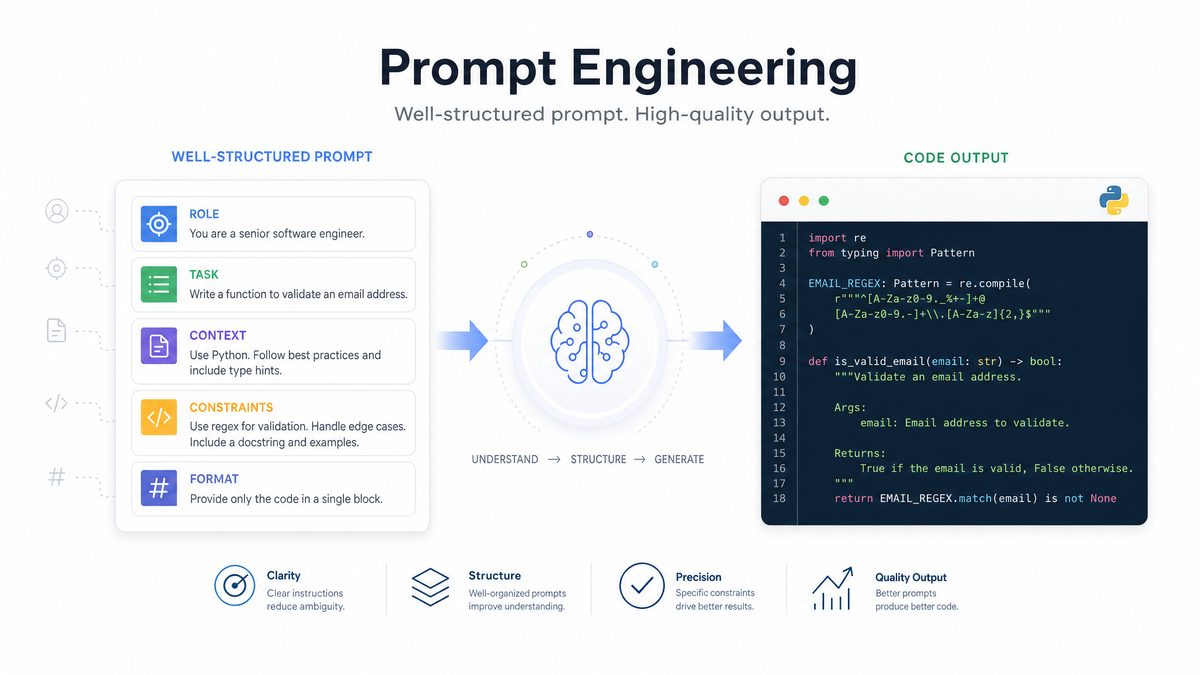
This comprehensive guide explores the cutting-edge strategies of prompt engineering tailored specifically for AI coding agents. We delve into principles, techniques, usage scenarios, optimization, and pitfalls to avoid. Whether you’re a software engineer, AI researcher, or technical lead, mastering these methods will elevate your workflows to the next stage of human-computer collaboration.
Fundamental Principles of Prompt Engineering for AI Coding Agents
Prompt engineering is the practice of carefully designing and formatting the input text given to an AI model to guide its output effectively. When working with AI coding agents, the prompt’s structure impacts the program generation quality, correctness, and contextual relevance.
Advanced prompt engineering incorporates best practices that extend beyond simple instructions to embrace explicit context, detailed input constraints, formatting cues, and layered directives. Below we examine the foundational principles crucial for harnessing AI coding agents at scale.
1. Contextual Clarity and Environment Specification
Coding is intrinsically contextual. AI models benefit immensely from precise environment and system specifications such as programming language, framework, version, dependencies, and coding conventions.
- Explicit Language and Versioning: Clearly specify the programming language and version to avoid ambiguity. For example, “Write a function in Python 3.9” rather than just “Write a function.”
- Frameworks and Libraries: When expecting usage of frameworks like React, Django, or TensorFlow, mention them upfront to influence the API calls and code structure the AI generates.
- Code Environment: Define runtime or deployment environment if relevant, such as “Node.js 16 runtime” or “AWS Lambda environment”. This guides optimizations and module imports.
2. Problem Statement Precision and Scope Restriction
Providing a clear, precise problem description avoids vague or overly generic responses. Restricting the scope helps the model produce focused outputs suitable for complex tasks involving multiple components.
- Detailed Requirements: Include input/output specifications, edge cases, error handling rules, and performance constraints.
- Stepwise Tasks: Break down large problems into sequential subtasks or steps in the prompt to guide incremental solution development.
- Example-driven Instructions: When possible, provide sample inputs and expected outputs or code snippets to demonstrate the desired style or algorithm.
3. Instructional Format and Syntax Highlighting
Formatting your prompts with proper code blocks, comments, and explicit questions clarifies AI intentions. When your prompt itself mimics code commenting or technical documentation style, it enables more consistent and interpretable outputs.
- Code Block Usage: Use triple backticks or platform-supported code delimiters to enclose code portions in prompts.
- Step Comments: Annotate instructions with comments that simulate real-world developer notes, aiding the agent in understanding task rationale.
- Directives and Constraints: Use comments or specific lines such as “// Do not use recursion” or “/* Optimize for O(n) complexity */” as part of the prompt.
4. Leveraging Chain-of-Thought Prompting
Advanced AI prompting involves encouraging the model to reason through coding challenges step by step, similar to a developer brainstorming before implementation. This can be induced via direct instructions or exemplars in the prompt guiding the agent through intermediate reasoning steps.
- Explicit Reasoning Instructions: “First outline the approach, then implement the function.”
- Incremental Code Generation: Ask for pseudo-code generation followed by detailed implementation.
- Debugging & Testing Plans: Supplement with requests for test case design or code review comments.
Mastering these foundational principles creates a solid basis for more sophisticated prompt engineering strategies tailored to diverse coding tasks.Prompt Engineering for AI Coding Agents: 30 Battle-Tested Prompts for Codex, Claude Code, and Cursor
Techniques for Advanced Prompt Design in AI Coding Tasks
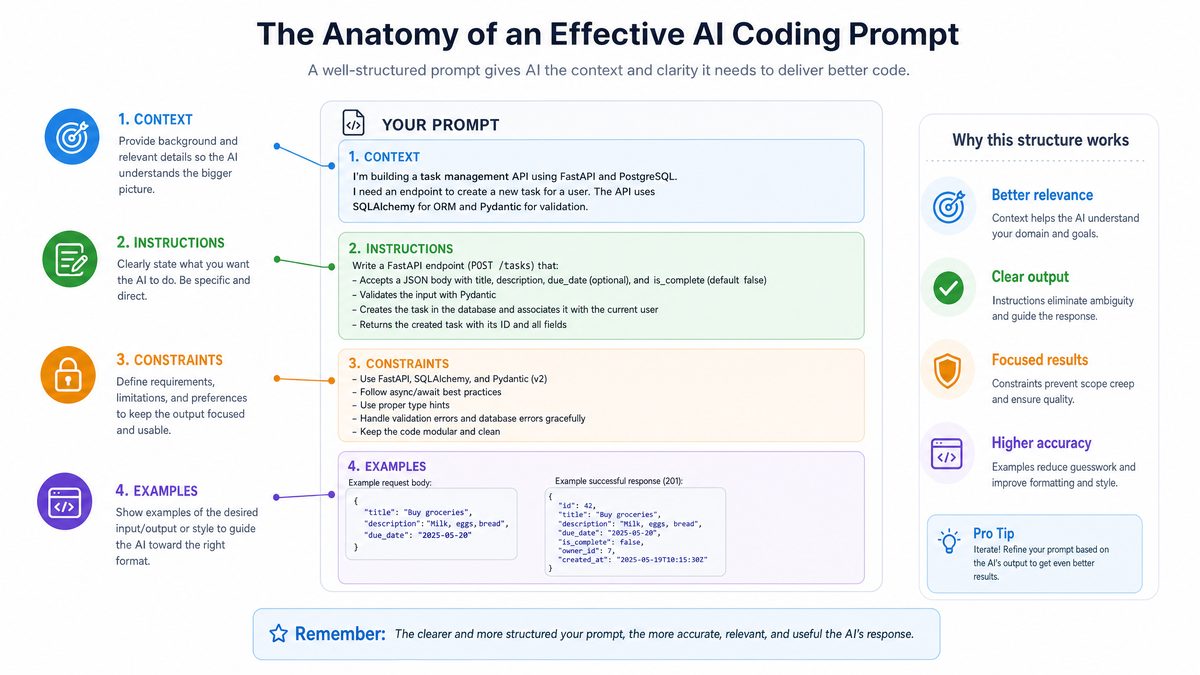
Building upon foundational rules, there exist numerous advanced prompt engineering techniques tailored specifically for AI coding agents. These methods increase precision, reduce hallucination, and improve code quality, maintainability, and alignment with engineering best practices.
1. Few-Shot Learning and Code Examples Integration
Few-shot prompting refers to embedding several examples of input and output pairs, or problem-solution pairs, in the prompt to guide the AI model’s behavior explicitly.
- Example Consistency: Use examples with similar structure and complexity to the target task.
- Contextual Examples: Include code snippets demonstrating style, naming conventions, or particular API usage patterns you want the model to emulate.
- Balanced Example Quantity: Too few examples will underguide, while too many increase token usage and computational cost, possibly diluting focus.
2. Prompt Scaffolding for Complex Code Generation
Instead of asking for a monolithic answer, break the prompt into scaffolded queries that progressively develop components, classes, or modules. You can chain such prompts to integrate feedback and iterative improvements.
- Modular Queries: Ask first for data structure definitions, then helper functions, and finally the main algorithm.
- Validation Checks: Request self-review or test case generation after code is output.
- Iterative Improvement: Submit revisions based on initial answers by referencing previous outputs and asking for refinements.
3. Explicit Role Playing and Persona Simulation
Defining the AI agent’s role can cause significant variance in output style, depth, and professional tone. For coding tasks, prompts that position the AI as an expert software engineer or domain specialist help produce higher quality code and technical commentary.
- Role Statements: “You are a senior Python backend developer with expertise in REST API design.”
- Domain-Specific Expertise: “You are a machine learning engineer familiar with TensorFlow 2.x.”
- Style Guides: Ask to follow specific coding standards or company style guides.
4. Constraint-Based Prompting for Safety and Optimization
AI coding agents may generate undesirable or risky code if not properly constrained. Incorporate constraints to ensure outputs adhere to safety, security, performance, or licensing requirements.
- Security Constraints: “Do not use shell execution commands that could create vulnerabilities.”
- Performance Constraints: “Optimize this function for memory usage.” or “Use vectorized operations instead of loops.”
- License Compliance: “Only use libraries with permissive open-source licenses.”
5. Metadata Injection and Prompt Variables
In advanced workflows, dynamically generate or inject metadata into prompts, such as function signatures, variable names, or user comments, to customize and contextualize AI responses precisely. This technique is often programmatically automated in IDE integrations or APIs.
- Embedding Code Documentation: Include docstrings or comments as a template to instruct the AI about code functionality.
- Custom Variables: Use tokens like
{class_name}or{input_format}that your toolchain fills before sending the prompt. - Version & Dependency Awareness: Pass environment details to enable AI to generate compatible code.
Using these advanced prompting methods systematically enables sophisticated code generation tailored to domain requirements, enhancing trustworthiness and usability.ChatGPT Coding Masterclass Part 2: Prompt Engineering for Developers in the Era of GPT-5.3-Codex
Optimizing Prompts for Specific AI Coding Agent Capabilities
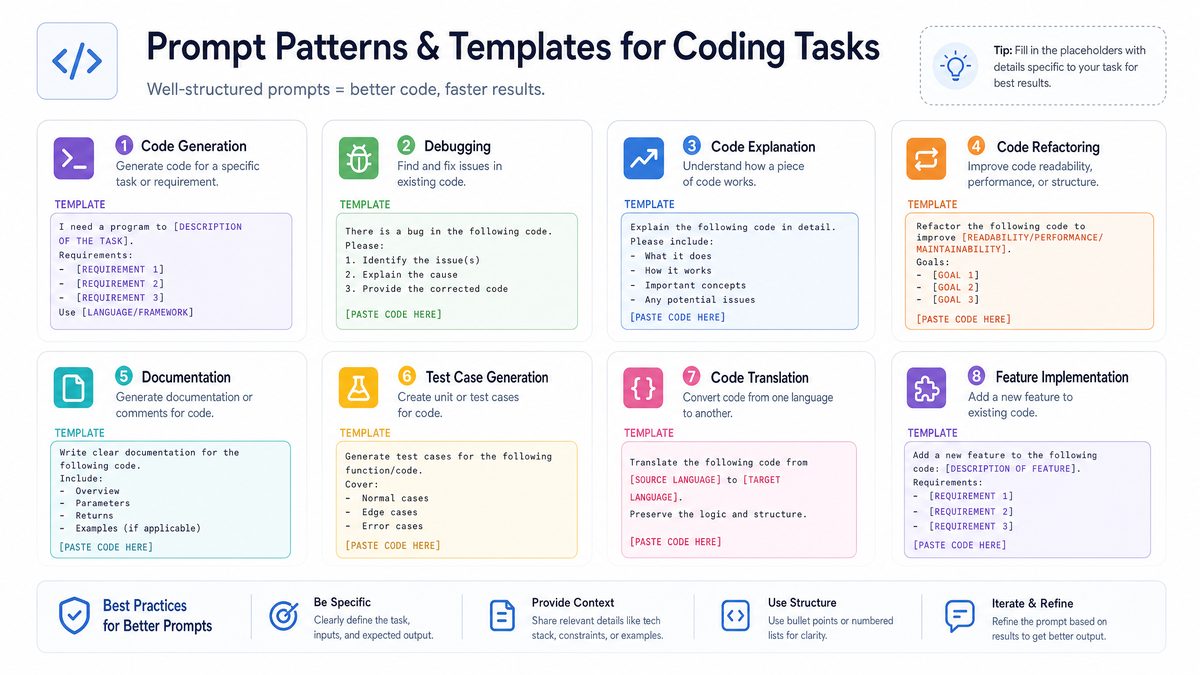
Different AI coding agents have unique architectures, training datasets, and operational capabilities. Tailoring your prompts to exploit these differences can dramatically improve outputs. Below we explore techniques for popular AI coding agents like Codex, GPT variants, and Claude.
1. OpenAI Codex
Codex is optimized for code generation with extensive training on public code repositories. It can understand API calls, complete half-written code blocks, and generate complex functions.
- Use Explicit Language Tags: Prefix prompts with language specification such as
# Python 3or// JavaScriptto improve syntax correctness. - Code Continuation: Provide partially written code blocks and ask Codex to complete them, maintaining style and variable usage.
- Multi-Step Reasoning: Couple with chain-of-thought prompting for complex tasks, ensuring Codex reasons about logic before coding.
2. GPT-4 and Variants
While GPT models are generalist, their language understanding capabilities can be leveraged to write explanatory comments, generate documentation, and design test cases alongside code generation.
- Instruction Clarity: GPT-4 excels with direct instructions and multi-turn conversations; use system messages or chat context to specify goals.
- Role Prompting: Frame GPT-4 as a senior developer, software architect, or code reviewer for enhanced contextual outputs.
- Hybrid Outputs: Request explanations simultaneously with code, “Explain the logic followed by the implementation.”
3. Claude AI by Anthropic
Claude emphasizes safety and compliance, making it excellent for security-critical code generation and reviewing AI-generated code for ethical implications.
- Safety-Conscious Instructions: Reinforce code safety and avoid insecure constructs explicitly in the prompt.
- Ethics & Privacy: Ask Claude to verify data privacy compliance within generated code snippets.
- Incremental Verification: Use Claude to generate and then audit code in two separate prompt stages.
4. Comparative Prompting Strategies Summary
| Agent | Strengths | Recommended Prompt Practices | Limitations |
|---|---|---|---|
| OpenAI Codex | Code generation & completion, widely trained on code, multi-language support | Explicit language tags, code snippet continuation, focused problem statements | May hallucinate APIs, requires careful constraints for complex logic |
| GPT-4 | Powerful language understanding, explanations, hybrid outputs | Role-playing, multi-turn conversation, combined explanation + code | Less specialized in coding; prompts must be highly explicit |
| Claude AI | Safety and compliance, code review, privacy awareness | Safety constraints, stepwise verification, ethical code checks | Less code specialization, slower multi-stage prompting needed |
Understanding these platform-specific nuances enables prompt engineers to craft better prompts and select agents most suited to particular coding objectives.15 ChatGPT Prompts for E-commerce Marketers Using the New Ads Manager: Boost Your Campaign Performance with AI
Common Challenges and Best Practices in Prompt Engineering for AI Coding Agents
Despite advances, prompt engineering for AI coding agents is challenging. Models may hallucinate code, misunderstand nuanced requirements, or generate insecure or inefficient solutions. Addressing these issues proactively is crucial.
1. Minimizing Hallucination and False Code Generation
Hallucination refers to AI generating plausible but incorrect or non-compilable code.
- Use Verified Examples: Anchor prompts with tested sample codes rather than hypothetical descriptions.
- Request Code Explanation: Have the model explain the generated code logic within the same response to cross-check plausibility.
- Iterative Refinement: Use multi-step verification and ask the agent for corrections or self-audits.
2. Handling Ambiguity and Implicit Knowledge Gaps
Vague instructions lead to unpredictable outputs. Make implicit assumptions explicit:
- Specify Expected Input Types: Define data formats, structures, and constraints.
- Outline Edge Cases: Include boundary condition examples or failure mode expectations.
- Clarify Output Formatting: State if output should be code only, comments, or formatted test cases.
3. Managing Token Limitations and Context Window
Given the token limits in AI models, prompts must balance completeness with brevity.
- Modular Prompts: Split tasks into smaller, sequenced prompts rather than single monolithic requests.
- External Context References: Provide summaries or use referencing rather than dumping large codebases in prompts.
4. Best Practices for Effective Prompt Engineering
- Iterate and Test: Continuously refine prompts based on output quality and failures.
- Maintain a Prompt Repository: Catalogue working prompt templates and techniques for reuse and knowledge sharing.
- Automate Prompt Generation: Where possible, inject dynamic variables and metadata programmatically to maintain consistency and scalability.
- Human-in-the-Loop: Always review generated code and incorporate feedback loops involving human experts.
These best practices help mitigate risks and maximize the practical utility of AI coding agents in professional environments.
Integrating AI Coding Agents into Development Workflows
Advanced prompt engineering is a powerful skill, but its true value emerges when effectively integrated into real-world software development workflows. Understanding how to embed AI coding agents within established processes such as code reviews, continuous integration/deployment (CI/CD), and pair programming results in tangible productivity and quality gains.
1. AI-Assisted Code Reviews and Static Analysis
AI coding agents can act as augmented code reviewers, providing automated critique, stylistic suggestions, and potential bug detection. Effective prompt design can harness this potential systematically.
- Example Prompt for Review:
// You are a senior code reviewer. Analyze the following code for potential bugs, inefficient constructs, and style guide violations. Provide detailed comments. - Automated Linting Assistance: Embed style rules and patterns as constraints to guide the AI in raising relevant coding standard flags.
- Issue Prioritization: Prompt agents to categorize detected issues by severity, enabling triage workflows in code management tools.
2. Seamless Integration with CI/CD Pipelines
Integrating AI coding agents into CI/CD environments optimizes automated code generation, testing, and deployment cycles.
- On-Demand Code Generation: Trigger AI-powered generation or upgrades of boilerplate code and configurations during pipeline executions.
- Automated Test Case Generation: Use prompts instructing the AI to produce unit or integration tests corresponding to code changes, increasing coverage.
- Prompt Templates for CI: Maintain prompt templates embedded into CI scripts, dynamically injected with commit metadata and code snippets to contextualize AI requests.
- Example Workflow: A GitHub Action triggers a prompt to generate tests for newly added functions, automatically adding the output to the test suite.
3. Collaborative Pair Programming with AI Agents
Embedding AI agents into IDEs as pair programmers is an emerging practice to improve developer productivity and creativity.
- Incremental Prompting: Developers iteratively craft prompts to elicit suggestions, refactorings, or alternative approaches.
- Context Sharing: Pass current editor buffer content, cursor position, and selected code blocks for focused assistance.
- Example Interaction: A prompt that says “Suggest an optimized sorting algorithm for this dataset” combined with the current code context.
- Output Verification: Prompt the AI to generate inline comments explaining its suggestions, aiding human comprehension and acceptance.
Practical Tips for Workflow Integration
- Build Feedback Loops: Incorporate human validation at critical junctions, leveraging AI-generated suggestions with human expertise.
- Track Prompt Metrics: Log prompt effectiveness, time saved, error rates, and developer satisfaction for continuous process improvement.
- Ensure Security Compliance: Sanitize any sensitive code or metadata before sending it to external AI services to avoid leaks.
Advanced Techniques for Controlling AI Behavior in Generated Code
Achieving precise and reliable AI-generated code often requires nuanced control mechanisms. Beyond fundamental prompt structuring, advanced control techniques can steer AI behavior towards desired patterns, enforce coding policies, and dynamically adapt outputs.
1. Prompt Chaining and Conditional Prompting
Large tasks or complex logic can be decomposed into multiple interlinked prompts, where the output of one prompt informs the next. This approach facilitates progressive refinement and staged reasoning.
- Chaining Example: First prompt for a high-level algorithm description, second for data structure definitions, third for function implementations, and so forth.
- Conditional Logic: Use prompt variables to conditionally trigger certain code paths, e.g., “If {use_async} is true, generate async functions.”
- Benefits: This reduces token overload per prompt and makes debugging easier by isolating AI-generated components.
2. Negative Prompting to Avoid Undesired Outputs
Explicitly instruct AI models on what not to do is a subtle but effective strategy, often known as “negative prompting.”
- Examples: “Do not use global variables,” “Avoid deprecated APIs,” or “Exclude library XYZ from the solution.”
- Practical Use: Negative prompts prevent model hallucinations or unsafe coding patterns that may otherwise be inadvertently generated.
- Integration: Combine with positive constraints to reinforce comprehensive output requirements.
3. Style and Formatting Enforcement via Customized Prompts
Consistency in style enhances code maintainability. Prompts can be engineered to enforce style guides at generation time.
- Specify Code Style: “Use Google Python Style Guide conventions” or “Follow Airbnb JavaScript style guide.”
- Example Reinforcement: Include inline examples demonstrating desired docstring format or error handling idioms.
- Automated Fixup Requests: Post-generation, prompt the AI to reformat code, correct stylistic errors, or insert missing documentation.
4. Dynamic Prompt Adjustments Using Feedback-Driven Heuristics
Incorporate runtime feedback to adapt prompt parameters and content dynamically, improving output quality with continuous learning.
- Heuristic Rules: Track common failure modes such as partial code generation or misunderstood constraints, then adjust prompt phrasing accordingly.
- Interactive Prompt Debugging: Use human oversight combined with AI suggestions to iteratively improve prompt design.
- Automated Analytics: Analyze outputs for token usage, coherence, and accuracy to modify prompts programmatically over time.
Sample Prompt Control Comparison
| Control Technique | Purpose | Example Instruction | Benefits | Limitations |
|---|---|---|---|---|
| Prompt Chaining | Decompose complex tasks |
|
Improves focus, reduces context length; eases debugging | Requires orchestration infrastructure; increased latency |
| Negative Prompting | Exclude undesired patterns |
|
Reduces unsafe or incorrect code generation | May limit model creativity; complexity in exhaustive negations |
| Style Enforcement | Maintain code quality and consistency |
|
Improves maintainability and review ease | Depends on model’s understanding of styles; potential token overhead |
| Feedback-Driven Heuristics | Adapt prompt based on prior outputs |
|
Progressively improves output quality | Needs monitoring infrastructure and evaluation metrics |
Explainability and Interpretability in AI-Generated Code
As AI coding agents assume increasingly autonomous roles, ensuring that generated code is understandable and its reasoning traceable is critical for developer trust and debugging efficiency. Prompt engineering can facilitate explainability and interpretability in multiple ways.
1. Prompting for Code Comments and Documentation
Encouraging AI to embed rich comments and generate associated documentation improves user comprehension.
- Inline Comments: “Add clear inline comments explaining each step of the algorithm.”
- Docstring Generation: “Generate a detailed docstring with parameters, return types, and example usage.”
- API Documentation: Post-generation prompts can request detailed README or API docs aligned with the produced code.
2. Reasoning Trace Outputs and Stepwise Explanation
Incorporating chain-of-thought techniques for code generation with embedded reasoning outputs clarifies the AI’s decision-making process.
- Stepwise Logic Breakdown: “Explain the choice of each data structure before implementing.”
- Debugging Insight: “Provide likely failure points and diagnostic suggestions.”
- Testing Rationale: “Outline test cases that cover edge conditions and error handling.”
3. Visualizing Code Generation Decisions
Though limited in pure prompt design, coupling prompt engineering with external visualization tools can provide flowcharts or dependency graphs generated alongside the code.
- Prompt Suggestions for Diagrams: Request textual descriptions of data flow or module interactions that other tools can translate into graphs.
- Documentation Integration: Embed links or markers for diagrams in prompt outputs for comprehensive understanding.
4. Practical Examples for Transparent AI Coding
// You are a software engineer tasked with writing a function to compute factorials.
// First, explain the factorial concept and implementation approach.
// Then, provide the Python code with detailed comments explaining each line.
// Finally, outline test cases including normal, edge, and invalid inputs.
Using such comprehensive prompts promotes generation of self-explanatory, maintainable code that aids human developers in auditing and extending AI outputs.
Explainability Techniques Comparison
| Technique | Description | Use Cases | Advantages | Considerations |
|---|---|---|---|---|
| Inline Comments | Embed explanations within code lines | Code clarity, maintenance | Immediate context, easy review | May increase code length |
| Docstrings and API Docs | Structured function or module descriptions | Documentation generation, API usage | Standardized format, aids tools | Requires careful prompt wording |
| Chain-of-Thought Reasoning | Stepwise explanation of logic | Understanding complex algorithms | Improves developer insight and trust | Potentially longer responses |
| Test Case Rationale | Explain testing approach in outputs | QA integration, robustness checks | Encourages better test coverage | Relies on prompt specificity |
Future Directions in Prompt Engineering for AI Coding Agents
Prompt engineering continues to evolve in line with AI model advancements, development methodologies, and user demands. Anticipating future trends helps developers and organizations stay ahead in leveraging AI coding tools.
1. Adaptive and Context-Aware Prompting
Next-generation systems will dynamically tailor prompts based on ongoing user interaction, context history, and personalized coding styles, minimizing manual prompt engineering.
- Context Retention: Models maintaining session memory to understand codebase evolution and user preferences.
- Personalized Prompt Templates: Automatic adjustment of prompt phrasing and content based on individual or team coding norms.
- Multi-Modal Inputs: Integrating code, natural language, and graphical models in prompts for richer context comprehension.
2. Integration with Automated Program Synthesis and Verification
AI coding agents are poised to bridge prompt engineering with formal methods, enabling verified code synthesis and automatic correctness proofs.
- Specification-Driven Prompting: Enabling specification languages or formal contracts within prompts for guaranteed behaviors.
- Automated Theorem Proving: AI assistance in verifying logical correctness and compliance with requirements.
- End-to-End Synthesis: Combining natural language prompts, test cases, and logic constraints for provably correct code.
3. Collaborative Multi-Agent Prompt Engineering
Emerging paradigms involve multiple AI agents specializing in subtasks, collaboratively engineering prompts and code snippets through orchestration layers.
- Division of Labor: Separate agents for design, coding, testing, and security review interacting via prompts and outputs.
- Prompt Mediation: Meta-prompts managing communication, conflict resolution, and integration across agents.
- Benefits: Increased scalability, specialization, and robustness of AI-generated software.
4. Ethical and Responsible AI Prompting
Prompt engineering will increasingly embed ethical considerations, bias mitigation, and compliance as fundamental aspects rather than afterthoughts.
- Bias Detection Prompts: Elicit explicit audit trails of code fairness and inclusivity considerations.
- Transparency Prompts: Request explanations of ethical implications and user privacy concerns alongside code.
- Governance Integration: Align prompt designs with organizational AI ethics frameworks and regulatory standards.
Summary of Emerging Trends
| Trend | Key Features | Impact on Prompt Engineering | Challenges |
|---|---|---|---|
| Adaptive Prompting | Dynamic context-awareness, personalization | Reduced manual effort, more natural interactions | Requires sophisticated context management and privacy safeguards |
| Program Synthesis & Verification | Formal specification integration, correctness proofs | Higher reliability and safety of generated code | Complexity in formal methods and model alignment |
| Multi-Agent Collaboration | Specialized AI agents, orchestrated prompting | Modular and scalable AI development ecosystems | Coordination overhead, integration complexity |
| Ethical Prompting | Bias mitigation, transparency, compliance | Promotes responsible AI development and trust | Balancing ethical rigor with functional goals |
Useful Links
- OpenAI Codex Official Blog
- OpenAI API Guides for Code Generation
- OpenAI Prompt Examples Library
- Anthropic Claude API Documentation
- OpenAI Cookbook GitHub Repository
- Research Paper: Chain-of-Thought Prompting Elicits Reasoning in Large Language Models
- Google AI Blog: Scaling Language Models
- Prompt Engineering Methodologies – Papers with Code Collection
Access 40,000+ AI Prompts for ChatGPT, Claude & Codex — Free!
Subscribe to get instant access to our complete Notion Prompt Library — the largest curated collection of prompts for ChatGPT, Claude, OpenAI Codex, and other leading AI models. Optimized for real-world workflows across coding, research, content creation, and business.
