
Introduction to OpenAI Codex on Amazon Bedrock
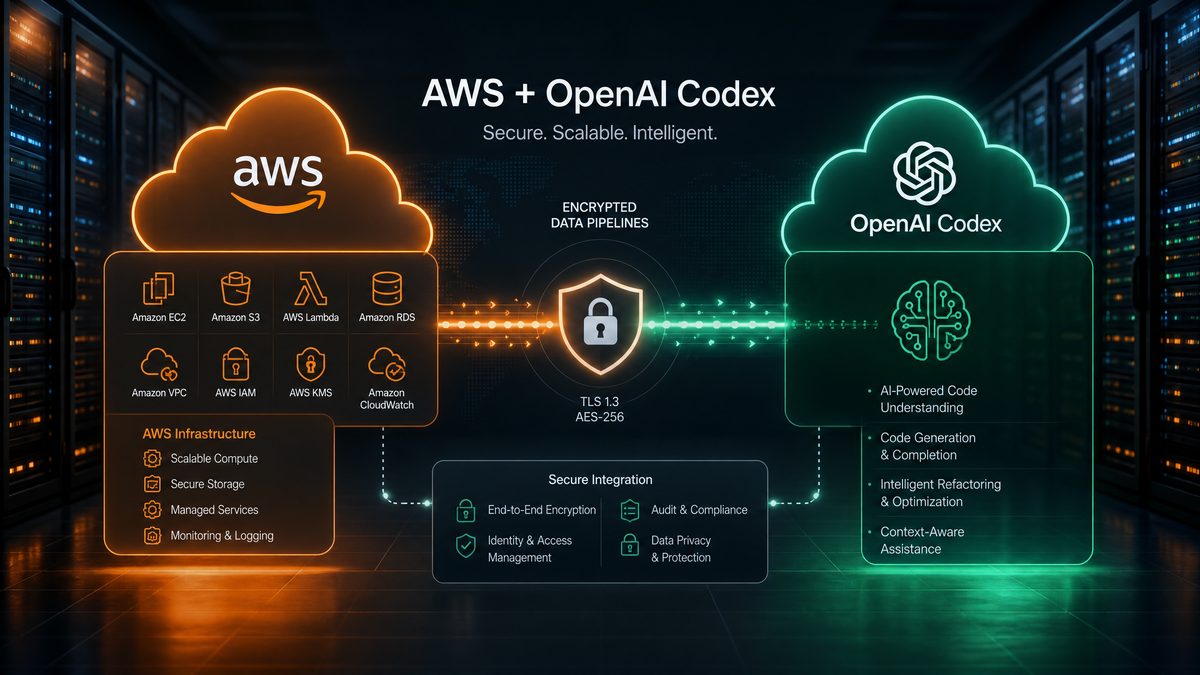
On June 1, 2026, OpenAI’s frontier models, including the groundbreaking Codex, became generally available on AWS through Amazon Bedrock. This milestone opens new horizons for enterprise teams seeking to leverage advanced AI capabilities for software development, code review, debugging, and modernization — all within the secure and compliant AWS ecosystem. This tutorial offers a complete, step-by-step guide to accessing and using OpenAI Codex on Amazon Bedrock tailored for enterprise environments.
Amazon Bedrock provides two primary access paths for OpenAI models: OpenAI models on Amazon Bedrock and Codex on Amazon Bedrock. Both are available in Commercial and GovCloud regions, enabling enterprises with stringent regulatory requirements to utilize these AI tools without compromising compliance.
Why Use OpenAI Codex on Amazon Bedrock for Enterprises?
Amazon Bedrock integrates OpenAI Codex into the AWS cloud infrastructure, allowing enterprises to:
- Leverage existing AWS security, compliance, and governance frameworks: Codex models run within your AWS environment, respecting IAM roles, VPC configurations, and data protection policies.
- Streamline procurement and billing: Access Codex APIs billed through your AWS account, simplifying vendor management and cost tracking.
- Enable collaborative coding workflows: Codex helps teams write, review, debug, and modernize code faster, improving developer productivity and code quality.
Leading enterprises like Amgen in pharmaceutical research and Autodesk in design and manufacturing have already integrated Codex on Bedrock into their development pipelines to accelerate innovation and maintain rigorous compliance.
Understanding Amazon Bedrock and OpenAI Codex Integration
Amazon Bedrock is a fully managed service that provides API access to foundation models from multiple AI model providers, including OpenAI. It abstracts the complexities of managing infrastructure and model lifecycle, enabling developers to build generative AI applications quickly and securely.
OpenAI Codex is a specialized AI model fine-tuned for programming tasks. When accessed through Bedrock, Codex can:
- Generate code snippets based on natural language prompts
- Review and suggest improvements to existing code
- Debug code by identifying potential errors
- Automate code modernization and refactoring
Using Codex through Bedrock ensures your code-related data remains within your AWS account boundaries, benefiting from AWS’s robust security and governance controls.
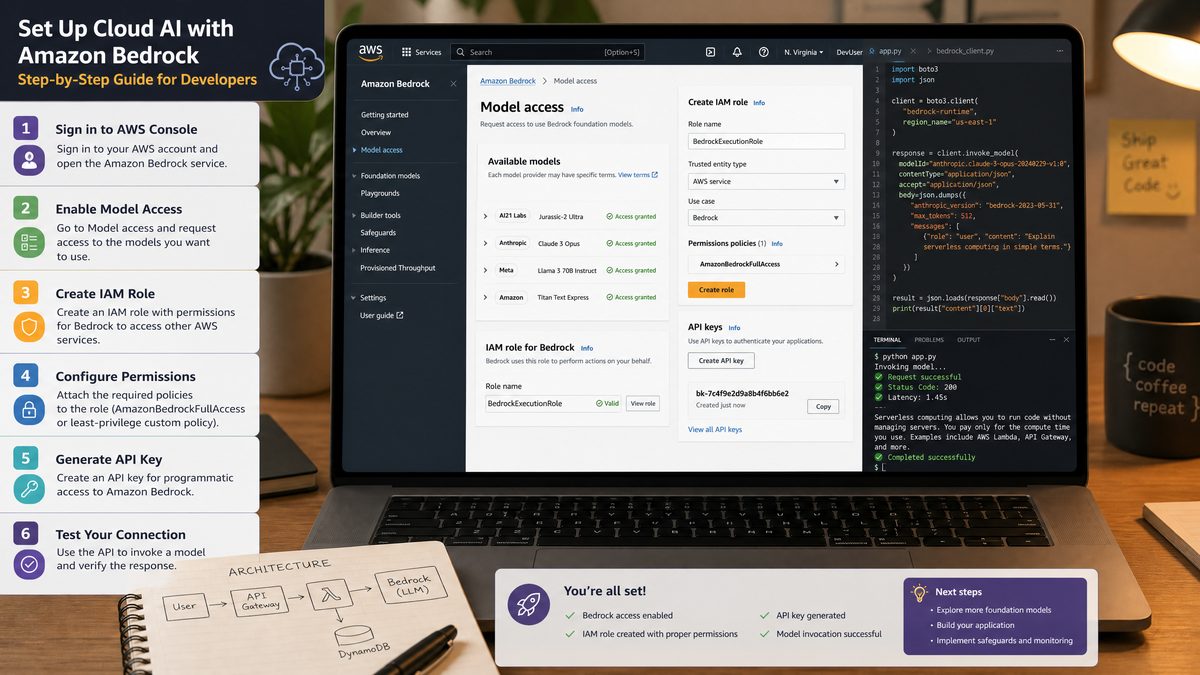
Step-by-Step Enterprise Setup Guide for Accessing OpenAI Codex on Amazon Bedrock
Step 1: Prerequisites and AWS Account Setup
- Ensure you have an AWS account with appropriate permissions to create IAM roles and access Amazon Bedrock.
- Confirm your AWS account is enabled in a region where Amazon Bedrock with OpenAI Codex is available (Commercial or GovCloud).
- Install and configure AWS CLI v2 with credentials linked to your AWS account.
Step 2: Create an IAM Role for Bedrock Access
To securely call Amazon Bedrock APIs, you must create an IAM role with permissions to invoke Bedrock models.
| Permission | Description |
|---|---|
| bedrock:InvokeModel | Allows calling Bedrock models including Codex |
| logs:CreateLogGroup, logs:CreateLogStream, logs:PutLogEvents | Enables logging for auditing and troubleshooting |
Example IAM policy snippet:
{
  "Version": "2012-10-17",
  "Statement": [
    {
      "Effect": "Allow",
      "Action": [
        "bedrock:InvokeModel",
        "logs:CreateLogGroup",
        "logs:CreateLogStream",
        "logs:PutLogEvents"
      ],
      "Resource": "*"
    }
  ]
}
Step 3: Confirm Amazon Bedrock Model Availability
Use AWS CLI or AWS Console to list available Bedrock models:
aws bedrock list-foundation-modelsLook for models with names indicating OpenAI Codex, e.g., openai-codex-001. Confirm that the model is accessible in your region.
Step 4: Configuring Network and Security Settings
- Ensure your AWS VPC and network ACLs allow outbound HTTPS (port 443) traffic to access Bedrock endpoints.
- For sensitive government or regulated workloads, use GovCloud regions and verify compliance with applicable frameworks (FedRAMP, HIPAA, etc.).
- Consider integrating AWS CloudTrail and AWS Config for continuous monitoring of Bedrock API usage.
Step 5: Writing Code to Call Codex on Bedrock
Amazon Bedrock exposes a RESTful API for interacting with foundation models. Below is an example Python script using boto3 to invoke the OpenAI Codex model for code generation:
import boto3

# Initialize Bedrock client
bedrock = boto3.client('bedrock')

def generate_code(prompt):
    response = bedrock.invoke_model(
        modelId='openai-codex-001',
        contentType='application/json',
        accept='application/json',
        body=json.dumps({
            "prompt": prompt,
            "max_tokens": 150,
            "temperature": 0.2,
            "stop": ["\n\n"]
        })
    )
    response_body = response['body'].read()
    result = json.loads(response_body)
    return result['choices'][0]['text']

prompt = "Write a Python function to compute the Fibonacci sequence up to n."
code_snippet = generate_code(prompt)
print("Generated Code:\n", code_snippet)
This example demonstrates how to:
- Initialize the Bedrock client with AWS SDK
- Invoke the Codex model with a natural language prompt
- Parse and print the generated code snippet
Step 6: Integrating Codex Output into Enterprise Workflows
Enterprises can build applications on top of Codex responses to:
- Automate code review by analyzing Codex recommendations
- Integrate with CI/CD pipelines to auto-generate unit tests or refactor code
- Enhance developer IDEs with AI-assisted code completion and debugging
Consider building microservices that wrap Codex API calls and implement logging, error handling, and access control consistent with your organizational policies.
For a deeper exploration of related AI capabilities and implementation strategies, our comprehensive resource on **Topic:**
“Mastering Custom GPTs: How Developers Can Build and Deploy Tailored AI Assistants Using OpenAI’s Latest API Features”
**Why it’s trending/high-value:**
With OpenAI’s recent rollout of customizable GPT models, developers now have unprecedented control to create AI assistants fine-tuned for specific industries, workflows, or user needs. This tutorial/news article would dive deep into the step-by-step process of leveraging these new API capabilities, showcasing practical use cases, optimization techniques, and deployment best practices. It addresses the growing developer demand to move beyond generic AI and build specialized, high-performance conversational agents—making it a must-read for the chatgptaihub.com audience eager to stay ahead in the AI app development space. provides additional context, practical examples, and expert analysis that extends the concepts covered in this article.
Cost Considerations and Billing Management
One of the significant advantages of accessing OpenAI Codex via Amazon Bedrock is that all usage is billed through your AWS account. This consolidates costs and simplifies procurement.
Key cost factors include:
- Model invocation volume: Number of API calls and tokens processed
- Model complexity: Larger, more advanced models like Codex typically cost more per token
- Region: Different AWS regions may have varying prices
Use AWS Cost Explorer and Budgets to monitor your Bedrock usage and set alerts for unexpected spikes.
Security and Governance Best Practices for OpenAI Codex on Bedrock
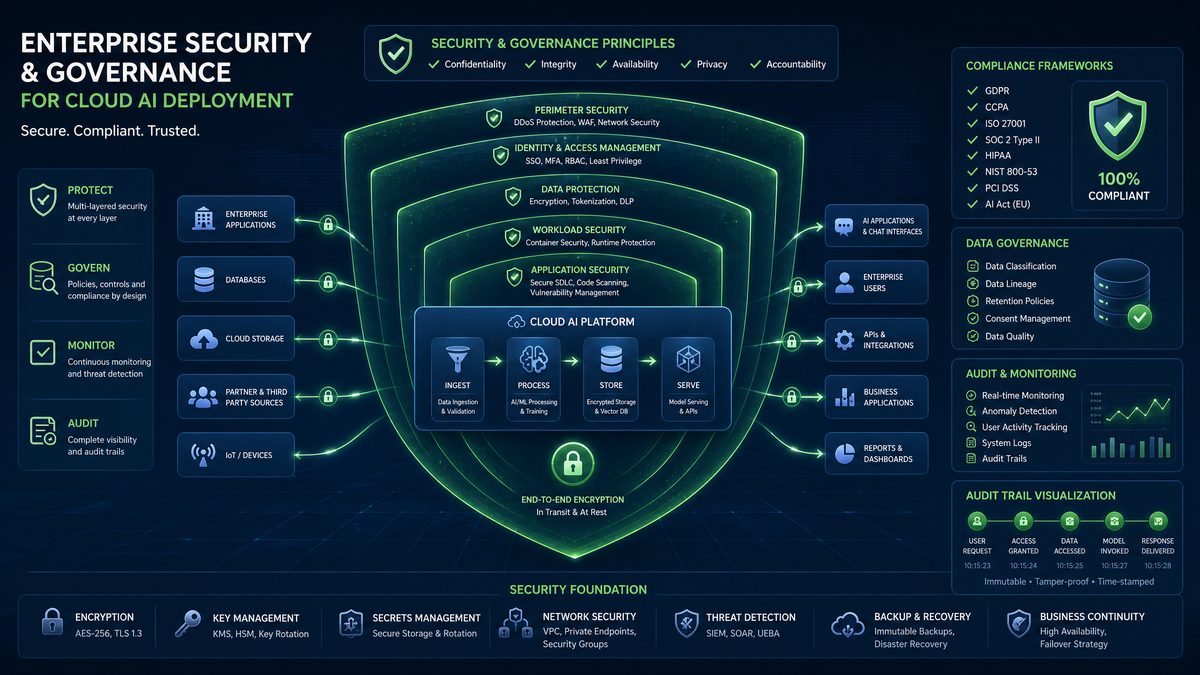
Enterprises must maintain strict control over AI model usage to protect code confidentiality and ensure compliance. Recommended practices include:
- Use fine-grained IAM policies: Restrict Bedrock API access to only authorized users and services.
- Encrypt data in transit and at rest: AWS automatically encrypts Bedrock communications; ensure your applications also enforce TLS.
- Implement logging and audit trails: Enable AWS CloudTrail to capture Bedrock API calls and integrate with SIEM tools for monitoring.
- Review generated code outputs: Establish policies for human review of AI-generated code to prevent security vulnerabilities.
- Leverage AWS Config and GuardDuty: Continuously assess your AWS environment for compliance and anomalies.
For a deeper exploration of related AI capabilities and implementation strategies, our comprehensive resource on The Future of AI: Key Trends and Innovations for June 2026 provides additional context, practical examples, and expert analysis that extends the concepts covered in this article.
Case Studies: Enterprise Success with Codex on Bedrock
Amgen: Accelerating Pharmaceutical Research
Amgen integrated Codex on Bedrock into their internal research tools to automate code validation and scripting for data analysis pipelines. This reduced development time by 30% and enhanced code reliability, all while complying with HIPAA and FDA regulations.
Autodesk: Enhancing Design Software Development
Autodesk uses Codex on Bedrock to assist developers in writing complex CAD automation scripts and modernizing legacy codebases. The integration helped improve developer productivity and maintain strict internal governance over proprietary code.
Advanced Use Cases and Industry Applications of OpenAI Codex on Amazon Bedrock
Enterprise Software Development Automation
OpenAI Codex on Amazon Bedrock streamlines software development workflows by automating repetitive and complex coding tasks. Enterprises can integrate Codex into continuous integration/continuous deployment (CI/CD) pipelines to generate boilerplate code, automate unit test creation, and assist in refactoring legacy systems. This accelerates development cycles and reduces human error.
Example: A financial services firm uses Codex to automatically generate API wrappers for internal services. By providing API specifications, Codex produces standardized code snippets in multiple languages, enabling quicker integration and reducing manual coding effort by up to 40%.
Code Review and Security Vulnerability Detection
Codex’s understanding of code semantics enables it to assist in code reviews by highlighting potential bugs, security vulnerabilities, or performance bottlenecks. When integrated into code repository platforms like AWS CodeCommit, Codex can provide inline suggestions and automated pull request comments.
Practical use case: An e-commerce company employs Codex to scan code merges for common security issues such as SQL injection patterns or improper authentication flows. This proactive approach enhances security posture and reduces the likelihood of costly breaches.
Multi-Cloud and Hybrid Environments
Amazon Bedrock’s ability to abstract access to OpenAI Codex allows enterprises operating in multi-cloud or hybrid cloud environments to maintain consistent AI-powered development practices. Teams can leverage Codex capabilities regardless of underlying cloud infrastructure while benefiting from AWS’s compliance and governance controls.
Step-by-Step Guide: Integrating OpenAI Codex with AWS Developer Tools
Step 1: Set Up Amazon Bedrock and Obtain API Credentials
- Sign into the AWS Management Console and navigate to Amazon Bedrock.
- Create a Bedrock endpoint for OpenAI Codex by selecting the desired model version.
- Configure IAM roles and permissions with least privilege access for your development environment.
- Obtain API keys or temporary credentials for programmatic access.
Step 2: Configure AWS CodePipeline to Invoke Codex
# Example AWS CodePipeline snippet invoking Codex Lambda function
Stages:
  - Name: Source
    Actions:
      - Name: SourceAction
        ActionTypeId:
          Category: Source
          Owner: AWS
          Provider: CodeCommit
          Version: 1
        OutputArtifacts:
          - Name: SourceOutput
  - Name: Build
    Actions:
      - Name: InvokeCodex
        ActionTypeId:
          Category: Invoke
          Owner: AWS
          Provider: Lambda
          Version: 1
        InputArtifacts:
          - Name: SourceOutput
        Configuration:
          FunctionName: codex-integration-lambda
Step 3: Implement Lambda Function to Call Codex API
import boto3
import json
import os

bedrock = boto3.client('bedrock-runtime')

def lambda_handler(event, context):
    code_snippet = event['code']
    response = bedrock.invoke_model(
        modelId='openai-codex',
        contentType='application/json',
        accept='application/json',
        body=json.dumps({
            "prompt": f"Review this code for errors and security issues:\n{code_snippet}",
            "max_tokens": 500,
        }),
    )
    result = json.loads(response['body'].read())
    return {
        "statusCode": 200,
        "body": result['choices'][0]['text']
    }
Step 4: Automate Feedback Loop in Code Reviews
Configure AWS CodeCommit triggers to invoke the Lambda function upon pull request creation or updates. Use the Codex-generated feedback as comments on the pull request, enabling developers to address issues before merging.
Comparative Analysis: OpenAI Codex on Amazon Bedrock vs. Other AI Coding Assistants
| Feature | OpenAI Codex on Amazon Bedrock | GitHub Copilot | TabNine | Google Cloud Codey |
|---|---|---|---|---|
| Model Architecture | OpenAI Codex (GPT-based) | OpenAI Codex (integrated) | Transformer-based ensemble | T5-based large language model |
| Deployment Model | API via Amazon Bedrock (cloud) | IDE plugin (cloud-assisted) | Local & cloud hybrid | Cloud API |
| Enterprise Security & Compliance | Built-in AWS compliance frameworks (HIPAA, FedRAMP, SOC 2) | Limited enterprise controls | Enterprise plans with data privacy | Supports Google Cloud compliance standards |
| Customizability | Fine-tune via prompt engineering and AWS tooling | Limited customization | Configurable models and training | Prompt-based customization |
| Integration with Cloud Services | Deep AWS ecosystem integration (Lambda, CodeCommit, CloudWatch) | GitHub ecosystem integration | Supports multiple IDEs and CI tools | Google Cloud services and APIs |
| Use Cases | Code generation, review, refactoring, debugging | Code completion and suggestions | Code completion and snippet generation | Code generation and data science assistance |
Future Outlook: The Evolution of AI-Assisted Development with Amazon Bedrock
Emerging Trends and Innovations
The integration of OpenAI Codex into Amazon Bedrock signals a broader trend toward AI-first software engineering. Future developments are expected to include:
- Adaptive AI Models: Models that learn from an organization’s codebase and development patterns to provide highly contextualized suggestions.
- Explainable AI for Code: Tools that not only suggest code but also explain reasoning in human-readable terms to increase developer trust.
- Cross-Domain AI Collaboration: Integration with AI models specialized in project management, testing, and deployment to create an end-to-end AI-assisted development lifecycle.
- Improved Regulatory Compliance: Enhanced privacy-preserving techniques such as federated learning and differential privacy to protect sensitive enterprise data.
Impact on Developer Roles and Skills
As AI-driven coding becomes more widespread, developers will pivot from writing boilerplate code toward higher-order problem solving, architecture design, and AI model supervision. Skills in prompt engineering, AI ethics, and cloud-native architectures will become increasingly vital.
How Enterprises Can Prepare
- Invest in Training: Upskill development teams on AI integration and prompt engineering best practices.
- Establish Governance: Define policies for AI tool usage, data security, and compliance adherence.
- Pilot Projects: Start with low-risk applications to evaluate Codex capabilities within your environment.
- Monitor and Iterate: Continuously measure AI impact on productivity and code quality to refine workflows.
By embracing these strategies, enterprises can harness OpenAI Codex on Amazon Bedrock to transform software development into a more efficient, secure, and innovative process.
“`html
Optimizing OpenAI Codex Performance on Amazon Bedrock: Best Practices
1. Fine-Tuning Prompt Engineering for Enterprise Workloads
Effective use of OpenAI Codex on Amazon Bedrock starts with crafting precise and context-aware prompts. Enterprises can significantly improve code generation quality by tailoring prompts to their specific domain and coding standards. Here are actionable tips:
- Use Clear Context: Include relevant code snippets, comments, or architectural details in the prompt to guide Codex’s understanding.
- Define Output Format: Specify the expected output style, such as language version (e.g., Python 3.8), coding conventions, or modular structure.
- Iterative Refinement: Use multiple prompt variations and evaluate outputs to identify the most effective phrasing and structure.
- Leverage Few-shot Learning: Provide examples of input-output pairs to teach Codex your enterprise-specific coding patterns.
For example, a financial services firm generating compliance scripts can prepend prompts with regulatory context and sample scripts, reducing errors and ensuring adherence to compliance norms.
2. Managing Latency and Throughput for Large-Scale Development Pipelines
Latency and throughput are critical metrics when integrating Codex into CI/CD pipelines or real-time developer tools. To optimize performance:
- Batch Requests: Group multiple code generation requests to reduce overhead and improve throughput.
- Cache Frequent Queries: Store popular prompt-response pairs to avoid repeated calls for identical or similar prompts.
- Asynchronous Processing: Implement asynchronous API calls within development workflows to avoid blocking developer tasks during code generation.
- Region Selection: Deploy Amazon Bedrock in AWS regions closest to your developer teams to minimize network latency.
For example, a multinational company with developer teams in Europe and Asia can configure Bedrock endpoints in eu-west-1 and ap-southeast-1, respectively, optimizing responsiveness.
3. Monitoring and Continuous Improvement with Metrics and Feedback Loops
Enterprises should establish monitoring systems to track the quality and efficiency of Codex-generated code. Key strategies include:
- Automated Quality Checks: Integrate static analysis tools and unit test coverage reports to evaluate generated code automatically.
- User Feedback Integration: Enable developers to rate or flag generated snippets, feeding insights back into prompt tuning and usage policies.
- Logging and Analytics: Use AWS CloudWatch or third-party tools to collect usage metrics such as API call frequency, response times, and error rates.
- Periodic Retraining of Internal Models: For enterprises using custom models alongside Codex, incorporate feedback data to refine models and improve relevance.
By establishing these feedback loops, organizations can iteratively enhance developer productivity and code quality over time.
Integrating OpenAI Codex with Enterprise DevOps Workflows on Amazon Bedrock
1. Automating Code Reviews and Pull Request Generation
OpenAI Codex can streamline DevOps by automating parts of the code review and pull request (PR) creation process. Steps to implement this integration include:
- Trigger Codex API on PR Creation: Configure CI tools like Jenkins or AWS CodePipeline to invoke Codex when a new PR is submitted.
- Generate Review Comments: Use Codex to analyze diffs and provide inline suggestions or detect potential bugs.
- Auto-generate Unit Tests: Codex can create initial test cases for new or modified code, reducing manual effort.
- Integrate with GitHub Actions or AWS CodeBuild: Automate merging or flagging PRs based on Codex-generated insights and test results.
This approach accelerates code quality assurance and maintains high standards with minimal manual input.
2. Continuous Integration and Deployment (CI/CD) Pipeline Enhancements
Incorporating Codex into CI/CD pipelines enables smarter automation:
- Dynamic Script Generation: Use Codex to generate deployment scripts based on infrastructure changes, reducing manual scripting errors.
- Infrastructure as Code (IaC) Assistance: Automate the creation and validation of AWS CloudFormation or Terraform templates through Codex-powered suggestions.
- Rollback Strategies: Codex can propose rollback commands or contingency plans when pipeline failures occur.
For instance, a retail company might leverage Codex to automatically generate Lambda function handlers during feature rollouts, ensuring deployment consistency and speed.
3. Security and Compliance Automation in DevOps
Security is paramount in DevOps. Codex can assist by:
Access 40,000+ AI Prompts for ChatGPT, Claude & Codex — Free!
Subscribe to get instant access to our complete Notion Prompt Library — the largest curated collection of prompts for ChatGPT, Claude, OpenAI Codex, and other leading AI models. Optimized for real-world workflows across coding, research, content creation, and business.
- Generating Secure Code Snippets: Provide prompts that emphasize security best practices, such as input validation and encryption.
- Automated Vulnerability Scanning Suggestions: Codex can recommend tools or scripts to scan dependencies or container images for vulnerabilities.
- Compliance Reporting Automation: Generate audit-ready reports on code changes and pipeline activities through Codex-generated templates.
Embedding Codex in DevSecOps workflows helps maintain compliance with standards like SOC 2, HIPAA, or PCI DSS with reduced manual overhead.
Measuring ROI and Business Impact of OpenAI Codex Deployment on Amazon Bedrock
1. Key Performance Indicators (KPIs) for Codex Adoption
To quantify the value delivered by OpenAI Codex on Amazon Bedrock, enterprises should track:
| KPI | Description | Measurement Approach |
|---|---|---|
| Developer Productivity | Increase in code output or reduction in task completion time | Time tracking and lines of code generated per developer per sprint |
| Code Quality Improvement | Reduction in bugs or defects in generated code | Bug tracking systems and static code analysis reports |
| Cost Savings | Reduction in developer hours and third-party tool expenses | Financial analysis comparing pre- and post-Codex implementation costs |
| Time to Market | Acceleration of release cycles and feature rollouts | Project management tools and release timeline comparisons |
2. Case Example: ROI Calculation for a SaaS Company
A SaaS provider integrated OpenAI Codex through Amazon Bedrock to automate code generation for API clients and internal tooling. Over six months, they observed:
- 25% reduction in average development time per feature.
- 15% decrease in reported bugs related to generated code.
- Cost savings of $120,000 due to reduced contractor hours and faster releases.
Using these metrics, the company calculated a payback period of under four months for their Codex integration investment, highlighting significant business impact.
3. Recommendations for Tracking and Communicating Impact
- Set Baseline Metrics: Measure current developer productivity and code quality before deploying Codex.
- Regular Reporting: Share progress reports with stakeholders highlighting improvements and areas for adjustment.
- Solicit Developer Feedback: Gauge user satisfaction and gather suggestions to fine-tune Codex usage.
- Align with Business Goals: Tie Codex benefits to strategic objectives such as faster innovation or improved security posture.
These steps ensure that enterprise leaders understand Codex’s value and can justify ongoing investments.
“`
Looking Ahead: Future Innovations with Daybreak and Codex Security
Amazon and OpenAI plan to introduce Daybreak, a next-generation suite combining cyber security models with Codex Security capabilities, soon available on AWS. This will enable enterprises to automatically detect security vulnerabilities in code, perform threat modeling, and remediate risks proactively within their development workflows.
Integrating Daybreak with existing Codex deployments on Bedrock will empower enterprises to build secure software faster and with greater confidence.
Summary and Conclusion
Accessing OpenAI Codex on Amazon Bedrock provides enterprises with a powerful, secure, and compliant way to harness AI-driven coding assistance. By leveraging the familiar AWS environment, teams can accelerate software development, enhance code quality, and maintain governance without disrupting existing workflows.
This tutorial has outlined the end-to-end process for enterprise teams to:
- Set up necessary IAM roles and permissions
- Configure network and security settings
- Invoke Codex models using the Bedrock API
- Integrate Codex outputs into development pipelines
- Manage costs and maintain security best practices
Enterprises ready to innovate at the cutting edge of AI-assisted software development should adopt OpenAI Codex on Amazon Bedrock today, positioning themselves for ongoing advancements like the upcoming Daybreak platform.
For detailed AWS IAM guidance to secure your AI workloads, see our in-depth coverage here:
For a deeper exploration of related AI capabilities and implementation strategies, our comprehensive resource on **Topic:**
“Mastering Custom GPTs: How Developers Can Build and Deploy Tailored AI Assistants Using OpenAI’s Latest API Features”
**Why it’s trending/high-value:**
With OpenAI’s recent rollout of customizable GPT models, developers now have unprecedented control to create AI assistants fine-tuned for specific industries, workflows, or user needs. This tutorial/news article would dive deep into the step-by-step process of leveraging these new API capabilities, showcasing practical use cases, optimization techniques, and deployment best practices. It addresses the growing developer demand to move beyond generic AI and build specialized, high-performance conversational agents—making it a must-read for the chatgptaihub.com audience eager to stay ahead in the AI app development space. provides additional context, practical examples, and expert analysis that extends the concepts covered in this article.
To understand how to maintain compliance and security for AI on AWS, explore:
For a deeper exploration of related AI capabilities and implementation strategies, our comprehensive resource on The Future of AI: Key Trends and Innovations for June 2026 provides additional context, practical examples, and expert analysis that extends the concepts covered in this article.
Finally, for advanced integration techniques and API usage, refer to:
For a deeper exploration of related AI capabilities and implementation strategies, our comprehensive resource on How to Set Up OpenAI Codex on Amazon Bedrock: Complete Enterprise Deployment Guide provides additional context, practical examples, and expert analysis that extends the concepts covered in this article.
